
The CAAT Support Staff Job Evaluation System A

The CAAT Support Staff Job Evaluation System A Joint Classification Committee Presentation May 29, 2019
• • • Introductions Role of the Joint Classification Committee (JCC) System Design Criteria Who Should Write the Position Description Form (PDF)? When Should a PDF Be Reviewed? What a PDF Describes & Does Not Describe “Regular & Recurring” and “Occasional” Activities Review of Factors in PDF Resources/Assistance Grievance & Arbitration Process • Role of the Arbitrator • Notes to Raters and Definitions • Questions Joint Classification Committee Agenda 2
• The Terms of Reference are contained under Appendix F of the Collective Agreement • Responsible for: • maintaining the evaluation system and supporting documents • developing guidelines and procedures for training and orientation of Arbitrators • discussing and resolving system-wide matters pertaining to the evaluation system Joint Classification Committee Role of the Joint Classification Committee (JCC) 3
The evaluation system is based on the following design criteria: • ease of use (both in completing the Position Description Form (PDF) and evaluating positions) • reduce subjectivity • recognize the skills needed to do the work vs. nature/level of work • future growth – can accommodate changing roles and expectations Joint Classification Committee System Design Criteria 4
• Jointly negotiated by Council and OPSEU • Joint Classification Committee, Appendix F • Factors used in the job evaluation system meet five criteria: Joint Classification Committee System Design Criteria 1. Present in all positions to some degree 2. Significant differences in the levels of each Factor can be defined and distinguished in positions 3. Useful in differentiating between positions 4. Important in determining relative worth of positions for compensation purposes (internal equity in the College Sector) 5. Comply with the Pay Equity Act 5
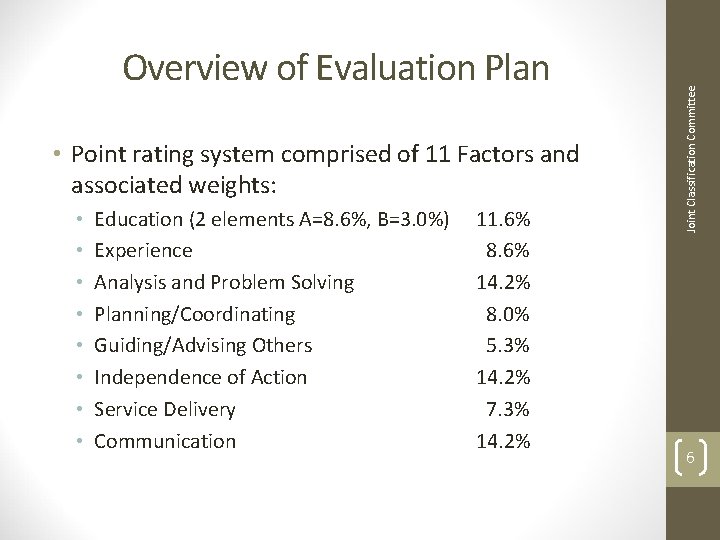
• Point rating system comprised of 11 Factors and associated weights: • • Education (2 elements A=8. 6%, B=3. 0%) Experience Analysis and Problem Solving Planning/Coordinating Guiding/Advising Others Independence of Action Service Delivery Communication 11. 6% 8. 6% 14. 2% 8. 0% 5. 3% 14. 2% 7. 3% 14. 2% Joint Classification Committee Overview of Evaluation Plan 6
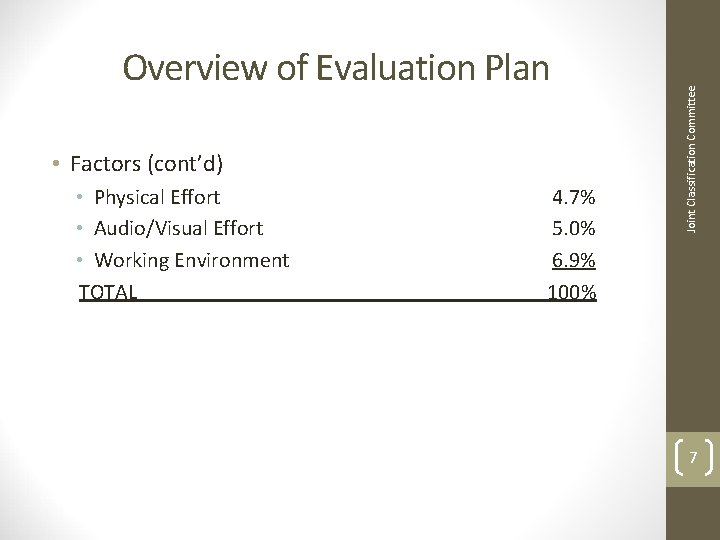
• Factors (cont’d) • Physical Effort • Audio/Visual Effort • Working Environment TOTAL 4. 7% 5. 0% 6. 9% 100% Joint Classification Committee Overview of Evaluation Plan 7
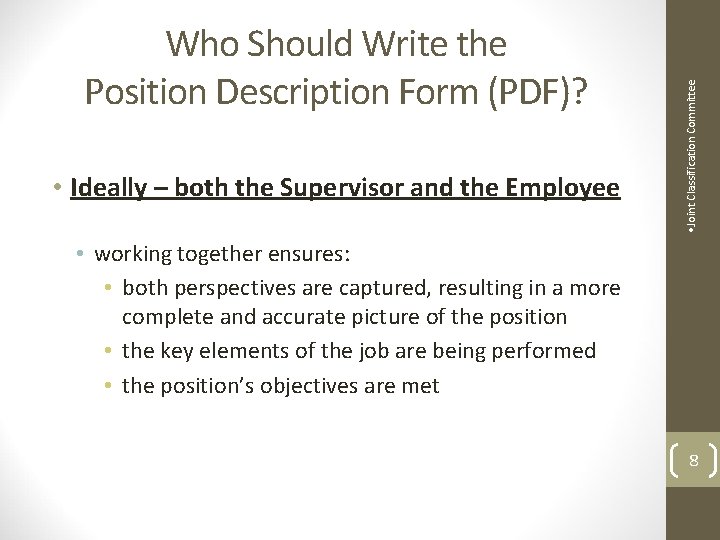
• Ideally – both the Supervisor and the Employee • Joint Classification Committee Who Should Write the Position Description Form (PDF)? • working together ensures: • both perspectives are captured, resulting in a more complete and accurate picture of the position • the key elements of the job are being performed • the position’s objectives are met 8
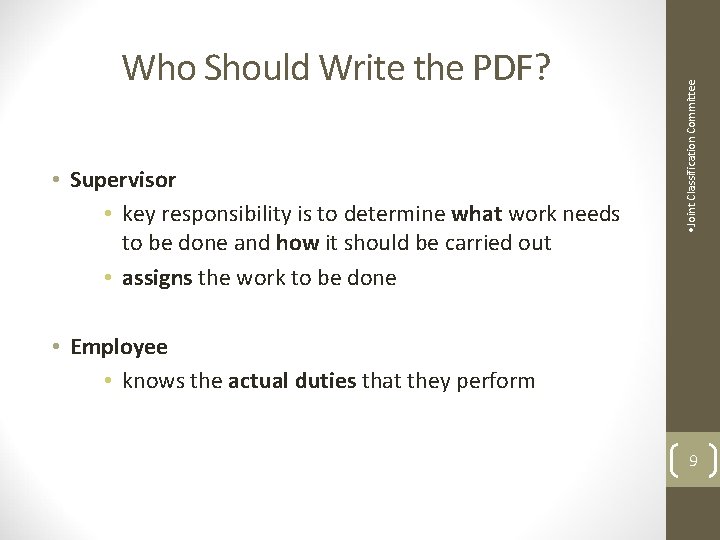
• Supervisor • key responsibility is to determine what work needs to be done and how it should be carried out • assigns the work to be done • Joint Classification Committee Who Should Write the PDF? • Employee • knows the actual duties that they perform 9
• PDFs should be reviewed on a regular basis (i. e. , annually) as part of the performance appraisal process • refer to Articles 7. 2 & 16. 1 in the Collective Agreement • Joint Classification Committee When Should a PDF Be Reviewed? • Whenever permanent changes to the work occur • introduction of new procedures • assignment of new or different responsibilities • change to the job structure or functions 10
• the PDF describes: • the position as it exists today; a “snap-shot” in time • what the incumbent does, how a task is carried out and why it is done • (Skill) education; experience; analysis and problem solving; planning/coordinating; communication • (Effort) physical effort; audio/visual effort • (Responsibility) guiding/advising others; independence of action; service delivery • (Working Conditions) work environment • Joint Classification Committee What the PDF Describes 11
• the PDF does not describe: • the person in the position • Joint Classification Committee What the PDF Does Not Describe • a position as it might appear in the future • a detailed working procedure • duties that are infrequently assigned and not essential to the position 12
• gender neutral • third person singular • present tense • Joint Classification Committee Suggested Writing Style • examples: • The incumbent assists students by…. • They design …. . • avoid jargon unless absolutely necessary • use proper names of operations, departments or equipment 13
• reduce subjectivity by: • using clear and concise language • selecting words that accurately describe the work being performed • Joint Classification Committee Suggested Writing Style • words that can have different meanings may result in different interpretations depending on the reader • Refer to the Glossary of Action Words in the “Guide on How to Write Support Staff PDFs” • write with the reader in mind 14
• there are 8 factors that ask for examples for “regular & recurring” and “occasional” • regular & recurring – provide up to 3 examples • occasional – provide up to 2 examples, if applicable • Joint Classification Committee Regular & Recurring and Occasional • if the “occasional” component is not applicable, then delete that section from the PDF • use examples that have actually occurred and reflect the nature of the position 15
• regardless of whether an activity is “regular & recurring” or “occasional”, it must be significant or a core duty • Joint Classification Committee Regular & Recurring and Occasional Activities • when considering whether an activity or element of a job should be reflected in the PDF, it must be important enough that without it the position duties could not be performed 16
• usually reflects activities that are performed daily, weekly or monthly (e. g. month-end) • can be yearly, if a significant portion of the incumbent’s time is required during the period the activity is being done • Joint Classification Committee Regular & Recurring • the responsibility or duty must be an integral part of the position’s work and consistently relied on 17
• must be a significant activity or an important distinguishing element of the position that occurs: • for a short period of time • on a few occasions • sporadically throughout the year • Joint Classification Committee Occasional • is performed at a higher level than “regular & recurring” 18
• this is contained on the first or covering page of the PDF • it identifies: • • • Joint Classification Committee Job Identification Data the incumbent the position title the supervisor and their supervisor signatures • incumbent’s signature – means the employee has read and understood the PDF 19
• provides a brief overview of the position • usually 2 – 3 sentences • complete this section last when writing a PDF • Joint Classification Committee Position Summary 20
• Responsibilities • the primary or key functions of the position • most jobs have three to seven major responsibilities • Percentage of time spent must be assigned • Joint Classification Committee Duties and Responsibilities • Duties and tasks • describe a responsibility - what is done and why it is done • are a subset of the responsibility sentence • Suggested format - list the responsibility and then, underneath, list the associated duties or tasks • Factor examples should capture the essence of the “Duties and Responsibilities” 21
• Two elements: • Part A – Primary Education Level • Joint Classification Committee Education • level of formal education required • Part B – Additional Education • required education that is not obtained as part of the educational level or qualification listed in Part A (primary education) 22
• Primary Education Level • Joint Classification Committee Education 1 A • check the box that best represents the minimum level of education (e. g. hiring standard) • reflects the education level of the position; not the incumbent • based on today’s educational levels and standards 23
• Additional Education • check the box that best describes and explains the additional education required • Joint Classification Committee Education 1 B • include only requirements that would be listed in the job posting • do not include courses or certifications that are part of formal education (listed in 1 A) • do not include courses taken to maintain a professional designation 24
• this section describes the work experience required in prior positions to learn the techniques, methods and practices necessary to perform the job • Joint Classification Committee Experience • check the box that best describes the minimum experience level for the position; not the incumbent’s • do not include field time required for membership in a professional organization or designation 25
• this section looks at the steps and complexity involved in analyzing situations, information or problems • also looks at the judgement used to develop solutions or corrective actions and what resources are available to assist • the example(s) used should also be reflected in the statements provided in the “Duties and Responsibilities” section • Joint Classification Committee Analysis and Problem Solving • this factor has an occasional component 26
• this section identifies the organizational and/or project management skills needed to organize and complete tasks or projects • consideration is given to whether the incumbent plans tasks of others and to what degree it affects those individuals’ work schedules • Joint Classification Committee Planning / Coordinating • for each project or task, answer the questions in the table provided • this factor has an occasional component 27
• this section in the PDF records the assigned responsibility to guide others in the area of the position’s expertise • others refers to other employees, students or clients • Joint Classification Committee Guiding / Advising Others • check the box of the description that best fits and provide example(s) of this level of responsibility • this responsibility is more than just being helpful and providing ad hoc advice or assistance to others • this factor has an occasional component 28
• this section looks at the level or autonomy in the position and the assigned responsibility to work independently. • it also looks at the types of decisions the position is required to make: • on its own • with assistance or input from others • Joint Classification Committee Independence of Action • as well as rules, procedures, past practices, and guidelines that are available to provide guidance & direction • the physical work location of the supervisor is not necessarily relevant; what is relevant is the ability to contact them and consult 29
• consideration is also given to how the incumbent’s work is reviewed (e. g. daily, in progress, by exceptions only, upon completion, etc) • work may be reviewed by people and processes other than the supervisor consider: • built-in “checks” and “balances” • clients’ and staffs’ verification that the task was completed correctly • Joint Classification Committee Independence of Action 30
• this section examines the required manner in which a position delivers service to its customers • takes into account other items besides the normal anticipation of knowing what a customer wants or needs and then supplying it efficiently • Joint Classification Committee Service Delivery • “service delivery” does not refer to an incumbent’s interpersonal relationship with customers • customer refers to individual(s) internal or external to the College • this factor has an occasional component 31
• this section records the communication skills used • Joint Classification Committee Communication • a table is provided listing various skill levels • check the appropriate box(es) and provide examples, the audience and frequency • For more information - refer to the Guide; explanations have been provided about some of the levels • this factor has an occasional component 32
• this section captures information about the physical activity, its frequency, degree and duration • Joint Classification Committee Physical Effort • it also looks at whethere is the ability to reduce strain by changing positions • a table has been provided to record this information • this factor has an occasional component 33
• there are 2 elements to be considered: • the degree of attention or focus required • activities that the position has little or no control of, that make focus or concentration difficult • Joint Classification Committee Audio Visual Effort • examples should illustrate activities that require a high level of focus or concentration • Note: Customer requests are not disruptions or interruptions unless the position has other primary tasks assigned (with a high level of concentration) that must be completed while also tending to these requests 34
• this section describes the work environment of the position and the extent to which there exists undesirable or hazardous elements • Joint Classification Committee Working Environment • it reflects conditions that are real and not conditions that might occur • check all the applicable boxes and provide an example and frequency 35
• “A Guide on How to Write a Support Staff PDF” • “Job Evaluation Manual” (May 2009) • Contact Human Resources or the Local Union • Joint Classification Committee Where To Go For Assistance 36
�Grievance Process �Article 18. 5 Joint Classification Committee Grievance Process Summary �Arbitration �Expedited Arbitration �Full Board Arbitration 37
• Expedited • most common process for classification arbitrations • informal, non-legalistic, Arbitrator driven Joint Classification Committee Arbitration Process Summary • Full Board • more formal process including witnesses, legal precedents, etc. • either party may request in their brief (18. 5. 4) • Arbitrator may refer (18. 5. 4) 38
• Responsible for: • determining whether the PDF accurately reflects the assigned duties (where disagreement exists) • determining whether the job is properly evaluated • ensuring the expedited process as outlined in the Collective Agreement (Article 18. 5) is honoured by the parties Joint Classification Committee Role of the Arbitrator 39
• “Notes to Raters” and “Definitions” have been developed for every factor • this is important as Arbitrators are directed to follow them Joint Classification Committee Notes to Raters & Definitions Provides direction on: • the intent of the factor • how to interpret the factor levels • how to interpret the information in the PDF 40
• Thank you for your time • We hope this session was useful Joint Classification Committee Questions • Do you have any questions that we have not addressed in this presentation? 41
- Slides: 41