
The Byzantine Empire What Is our Focus Essential
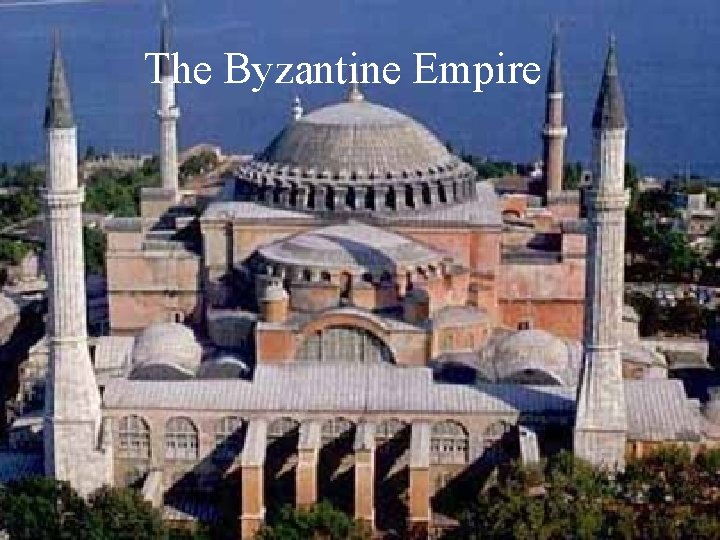
The Byzantine Empire
What Is our Focus? • Essential Questions 1) How can religion impact a culture? 2) What factors lead to the rise and fall of empires? o We’ve already talked about the importance of maintenance and wise decisions. • It Matters Because… In the 4 th century, a separation between the western and eastern parts of the Roman Empire began to develop. While Germanic tribes were taking over western Rome and creating a new European civilization, the Eastern Roman Empire, with Constantinople as its capital, continued to exist and develop into a new empire.
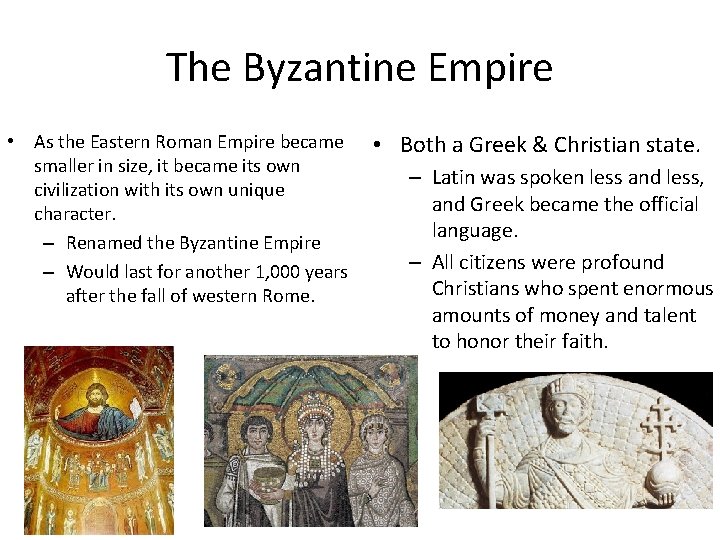
The Byzantine Empire • As the Eastern Roman Empire became smaller in size, it became its own civilization with its own unique character. – Renamed the Byzantine Empire – Would last for another 1, 000 years after the fall of western Rome. • Both a Greek & Christian state. – Latin was spoken less and less, and Greek became the official language. – All citizens were profound Christians who spent enormous amounts of money and talent to honor their faith.
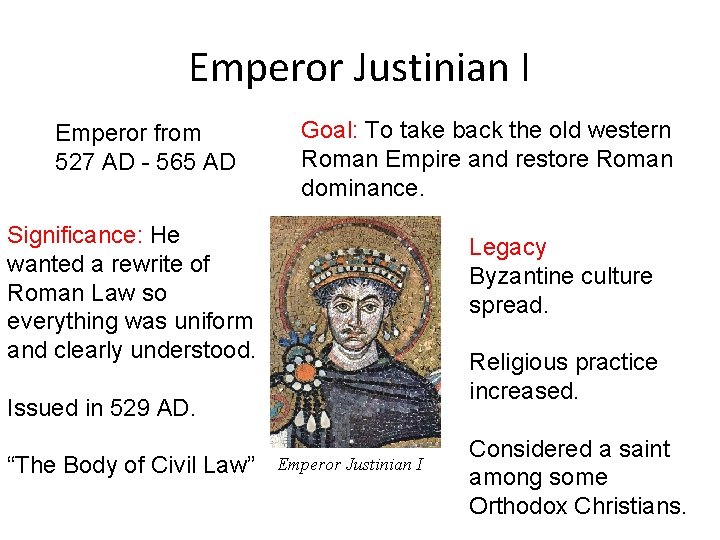
Emperor Justinian I Emperor from 527 AD - 565 AD Goal: To take back the old western Roman Empire and restore Roman dominance. Significance: He wanted a rewrite of Roman Law so everything was uniform and clearly understood. Legacy Byzantine culture spread. Religious practice increased. Issued in 529 AD. “The Body of Civil Law” Emperor Justinian I Considered a saint among some Orthodox Christians.
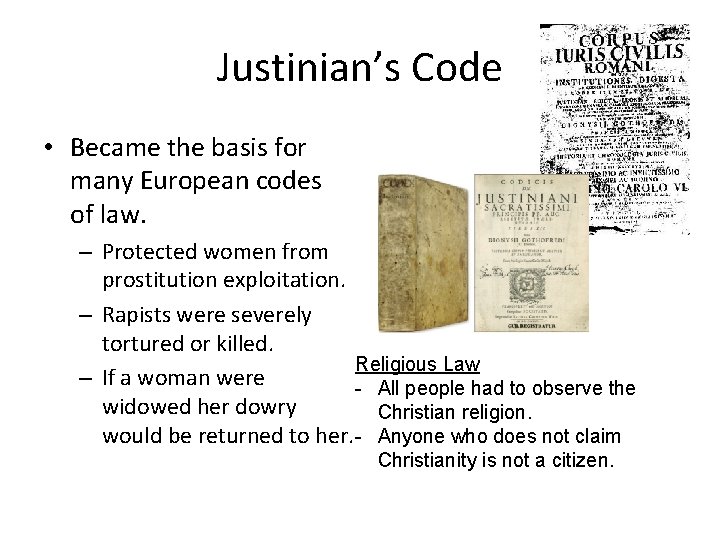
Justinian’s Code • Became the basis for many European codes of law. – Protected women from prostitution exploitation. – Rapists were severely tortured or killed. Religious Law – If a woman were - All people had to observe the widowed her dowry Christian religion. would be returned to her. - Anyone who does not claim Christianity is not a citizen.
Justinian’s Code “The maxims of law are these: to live honestly, to hurt no one, to give every one his due. ” – The Institutes of Justinian, 527 AD -565 AD Analyzing Primary Sources • How do these maxims compare with the rule of law in the modern United States? • Write your thoughts on your paper. Switch with a partner. Now write a response to your partner’s thoughts below their thoughts.
Problems & Struggles Although Justinian’s accomplishments were spectacular, the Eastern Roman Empire still had to face serious problems: • Too much territory to protect • An empty treasury (not enough money) • Decline in population after a plague (that almost killed Emperor Justinian) • Threats to the borders from Persians and Slavs. • 600 s – threats from Arabic tribes under the religion of Islam.
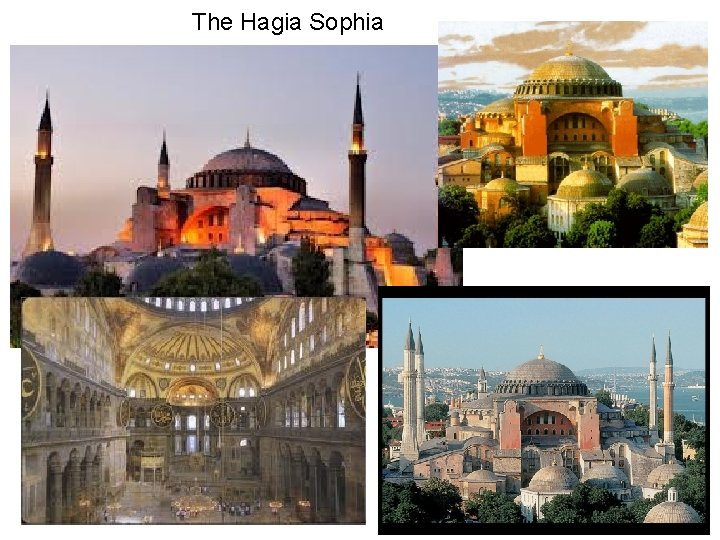
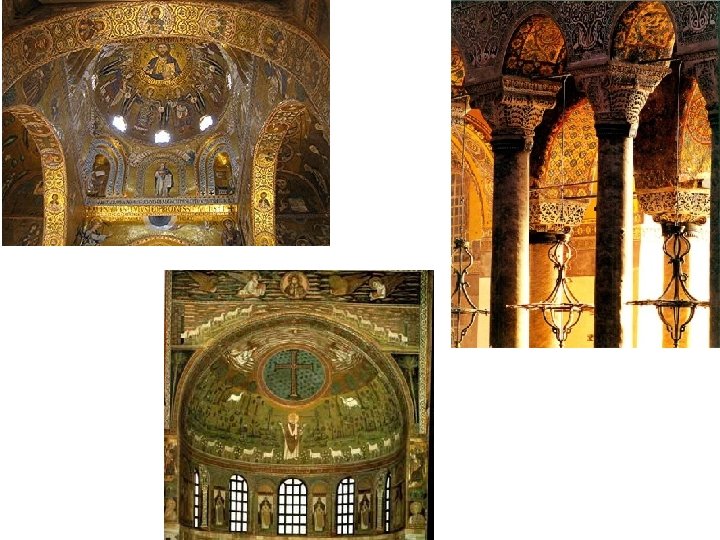
The Hagia Sophia
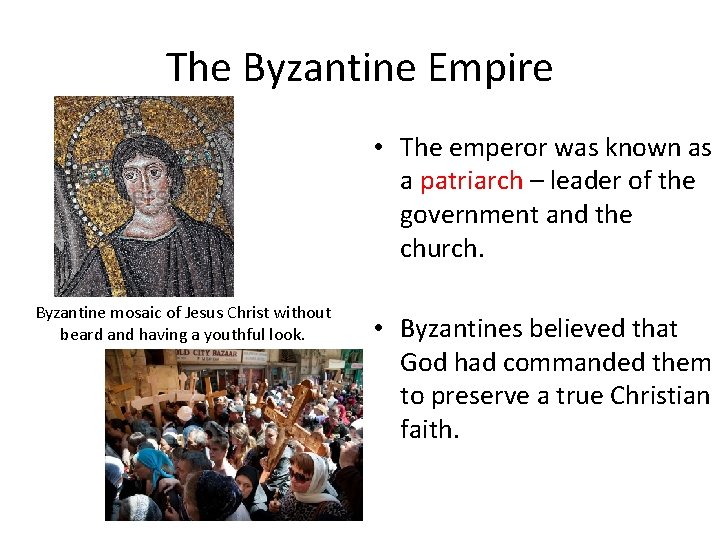
The Byzantine Empire • The emperor was known as a patriarch – leader of the government and the church. Byzantine mosaic of Jesus Christ without beard and having a youthful look. • Byzantines believed that God had commanded them to preserve a true Christian faith.
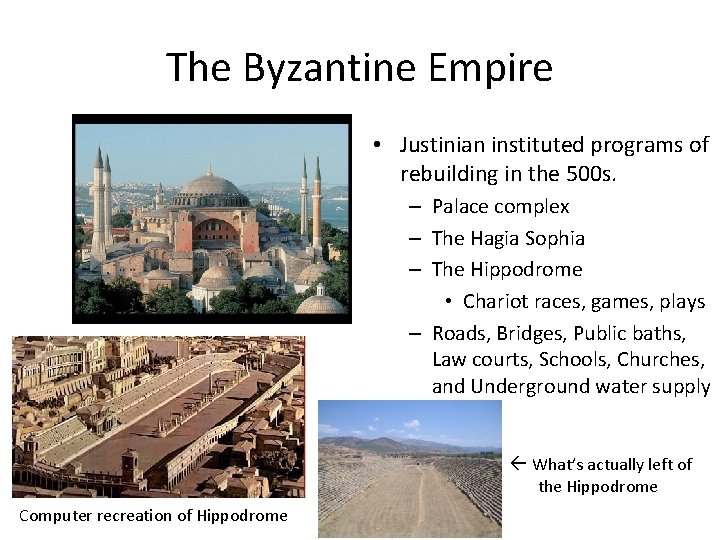
The Byzantine Empire • Justinian instituted programs of rebuilding in the 500 s. – Palace complex – The Hagia Sophia – The Hippodrome • Chariot races, games, plays – Roads, Bridges, Public baths, Law courts, Schools, Churches, and Underground water supply ß What’s actually left of the Hippodrome Computer recreation of Hippodrome
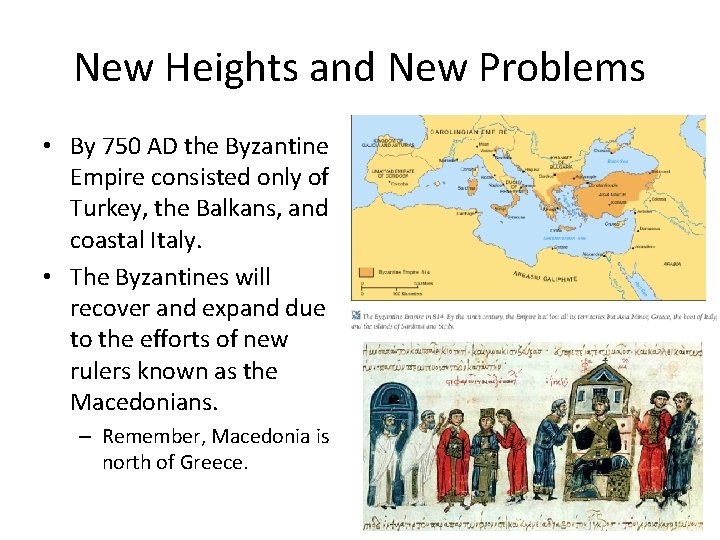
New Heights and New Problems • By 750 AD the Byzantine Empire consisted only of Turkey, the Balkans, and coastal Italy. • The Byzantines will recover and expand due to the efforts of new rulers known as the Macedonians. – Remember, Macedonia is north of Greece.
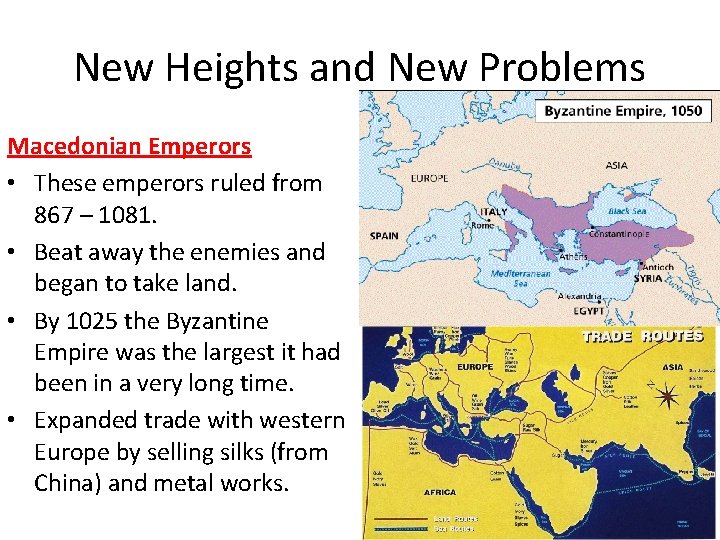
New Heights and New Problems Macedonian Emperors • These emperors ruled from 867 – 1081. • Beat away the enemies and began to take land. • By 1025 the Byzantine Empire was the largest it had been in a very long time. • Expanded trade with western Europe by selling silks (from China) and metal works.
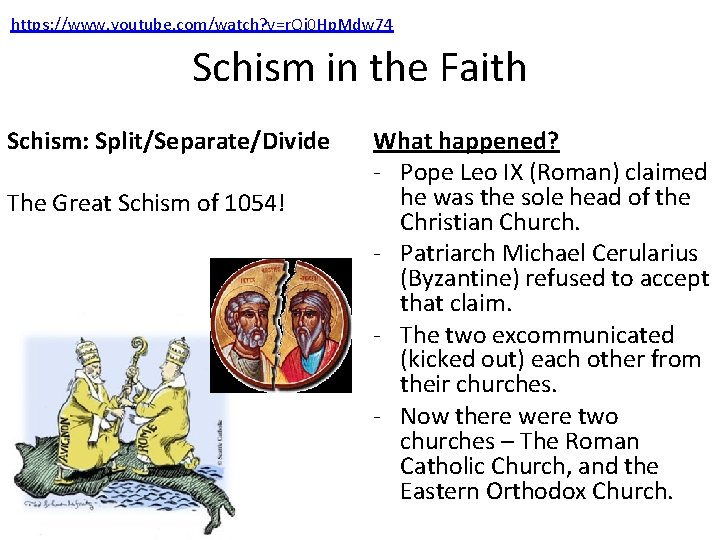
https: //www. youtube. com/watch? v=r. Qj 0 Hp. Mdw 74 Schism in the Faith Schism: Split/Separate/Divide The Great Schism of 1054! What happened? - Pope Leo IX (Roman) claimed he was the sole head of the Christian Church. - Patriarch Michael Cerularius (Byzantine) refused to accept that claim. - The two excommunicated (kicked out) each other from their churches. - Now there were two churches – The Roman Catholic Church, and the Eastern Orthodox Church.
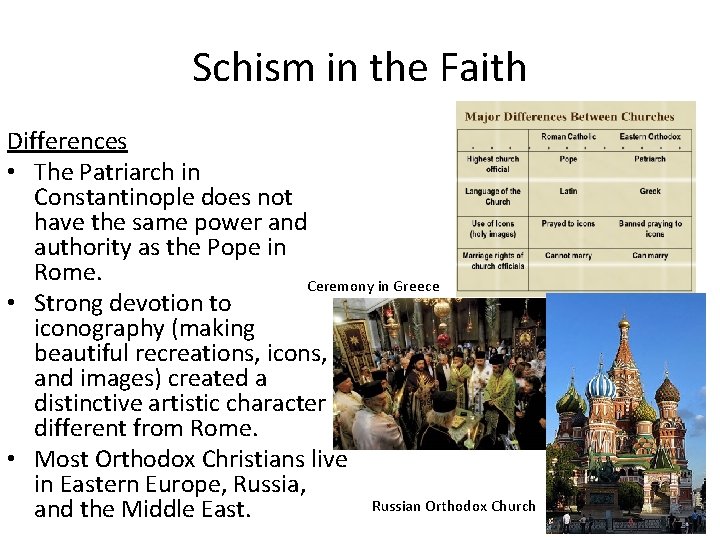
Schism in the Faith Differences • The Patriarch in Constantinople does not have the same power and authority as the Pope in Rome. Ceremony in Greece • Strong devotion to iconography (making beautiful recreations, icons, and images) created a distinctive artistic character different from Rome. • Most Orthodox Christians live in Eastern Europe, Russian Orthodox Church and the Middle East.
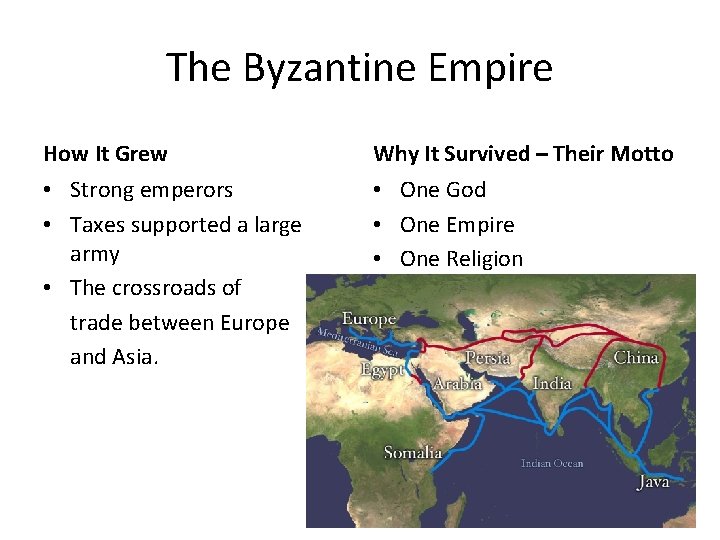
The Byzantine Empire How It Grew Why It Survived – Their Motto • Strong emperors • Taxes supported a large army • The crossroads of trade between Europe and Asia. • One God • One Empire • One Religion
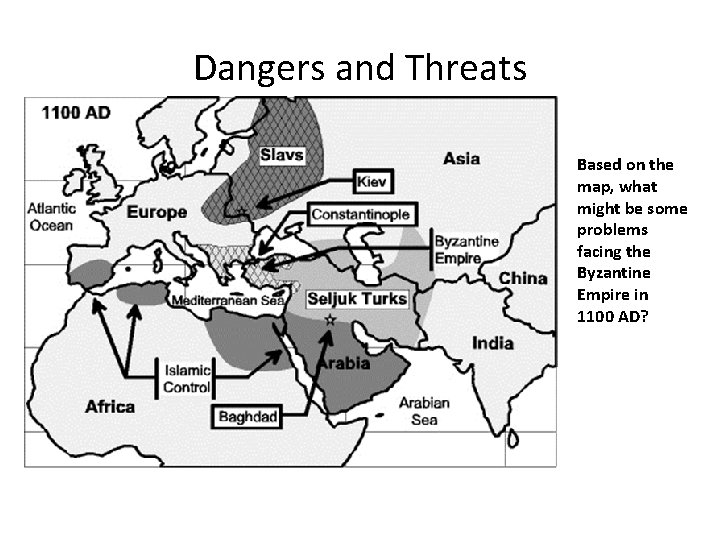
Dangers and Threats Based on the map, what might be some problems facing the Byzantine Empire in 1100 AD?
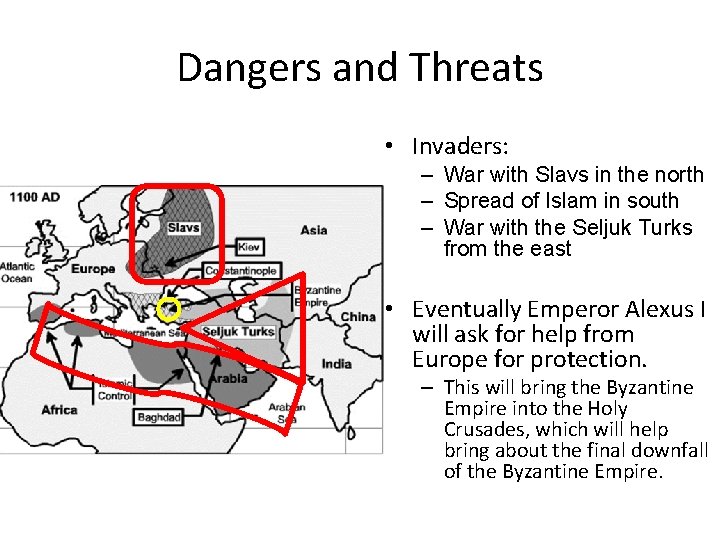
Dangers and Threats • Invaders: – War with Slavs in the north – Spread of Islam in south – War with the Seljuk Turks from the east • Eventually Emperor Alexus I will ask for help from Europe for protection. – This will bring the Byzantine Empire into the Holy Crusades, which will help bring about the final downfall of the Byzantine Empire.
- Slides: 18