
The Byzantine Empire Setting the stage Roman Empire
The Byzantine Empire
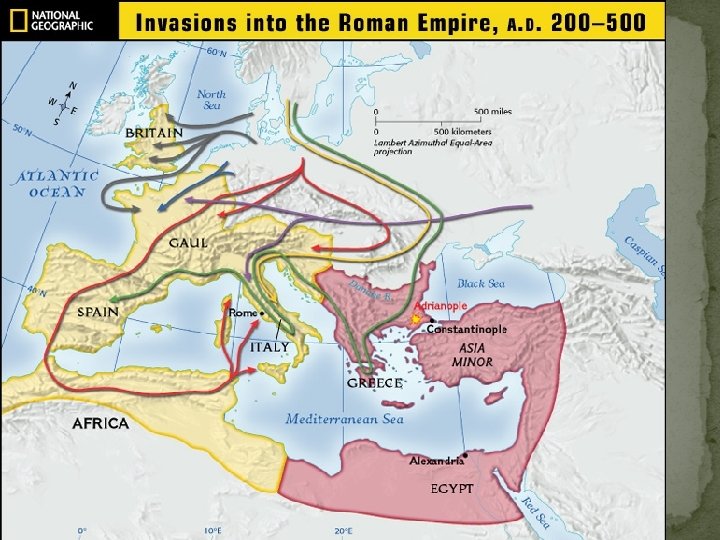
Setting the stage: Roman Empire in Decline � Economy declines � Military Upheaval � Germanic Invasions � Diocletian's reforms
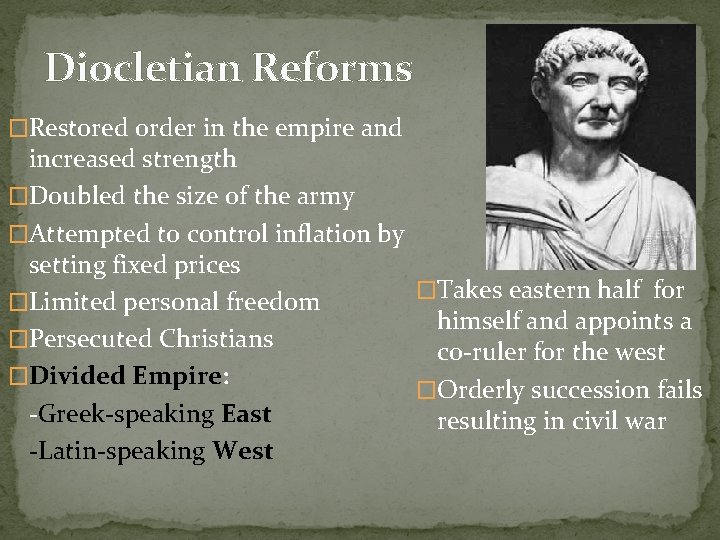
Diocletian Reforms �Restored order in the empire and increased strength �Doubled the size of the army �Attempted to control inflation by setting fixed prices �Takes eastern half for �Limited personal freedom himself and appoints a �Persecuted Christians co-ruler for the west �Divided Empire: �Orderly succession fails -Greek-speaking East resulting in civil war -Latin-speaking West

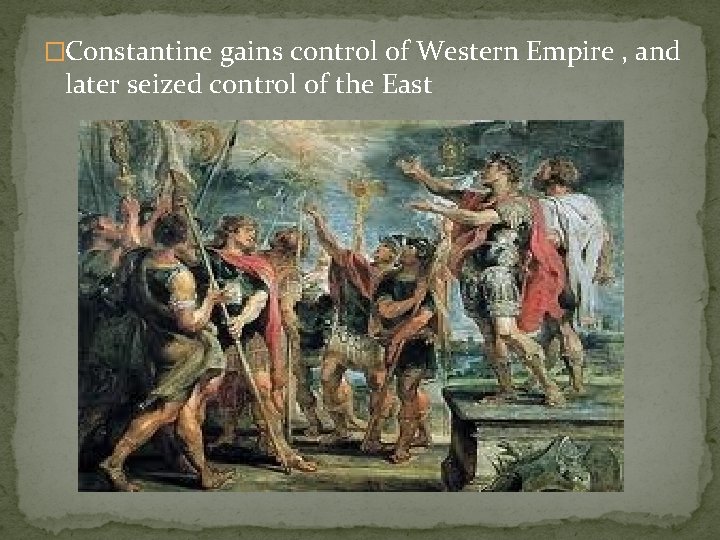
�Constantine gains control of Western Empire , and later seized control of the East
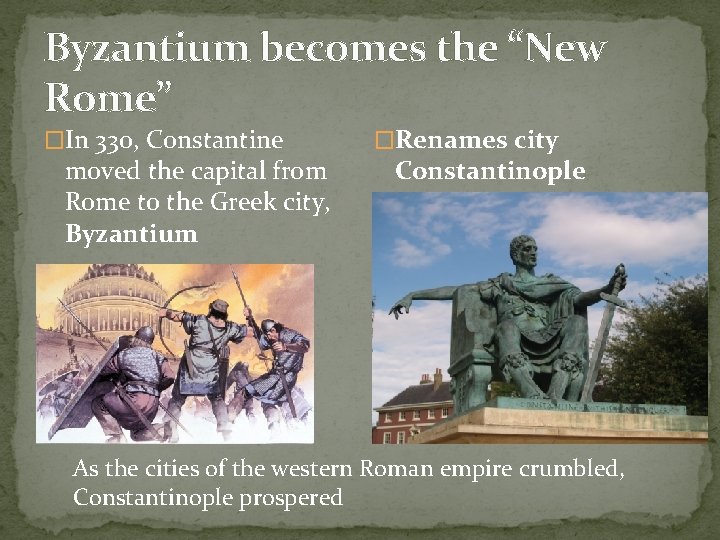
Byzantium becomes the “New Rome” �In 330, Constantine moved the capital from Rome to the Greek city, Byzantium �Renames city Constantinople As the cities of the western Roman empire crumbled, Constantinople prospered
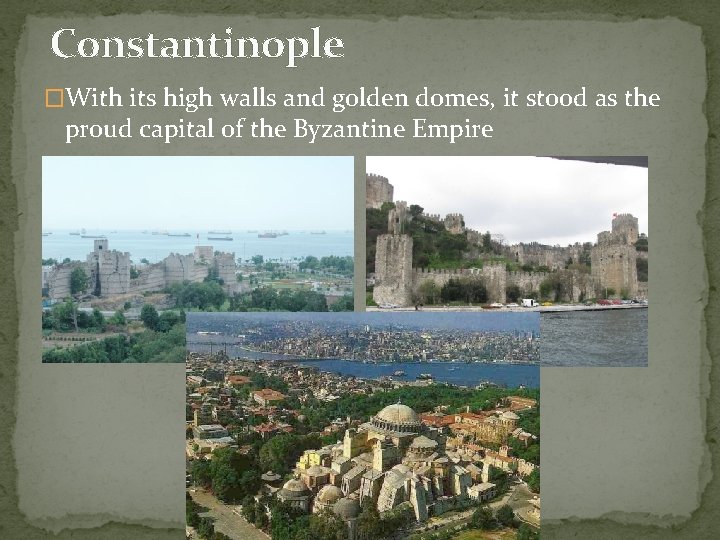
Constantinople �With its high walls and golden domes, it stood as the proud capital of the Byzantine Empire
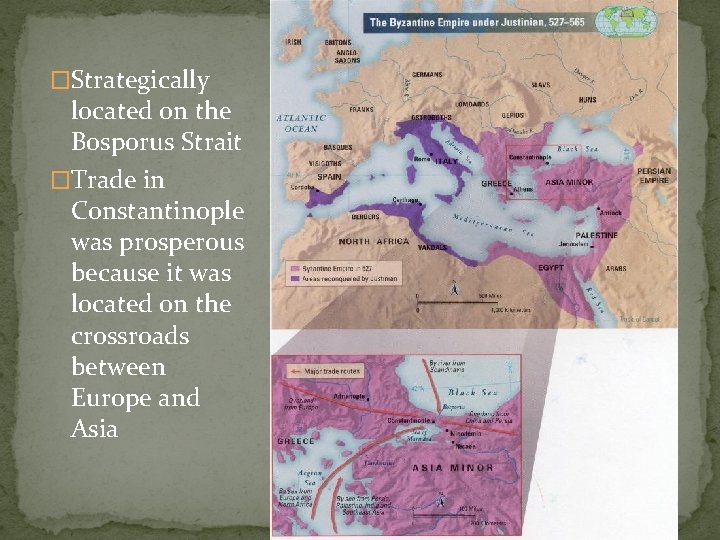
�Strategically located on the Bosporus Strait �Trade in Constantinople was prosperous because it was located on the crossroads between Europe and Asia
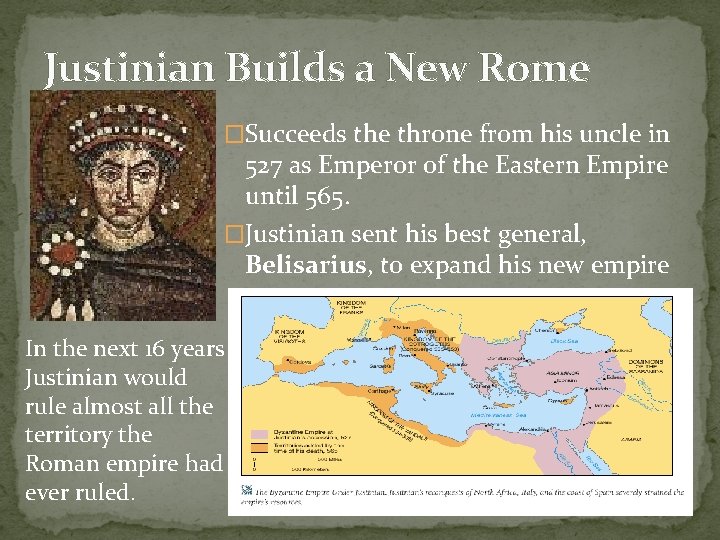
Justinian Builds a New Rome �Succeeds the throne from his uncle in 527 as Emperor of the Eastern Empire until 565. �Justinian sent his best general, Belisarius, to expand his new empire In the next 16 years Justinian would rule almost all the territory the Roman empire had ever ruled.
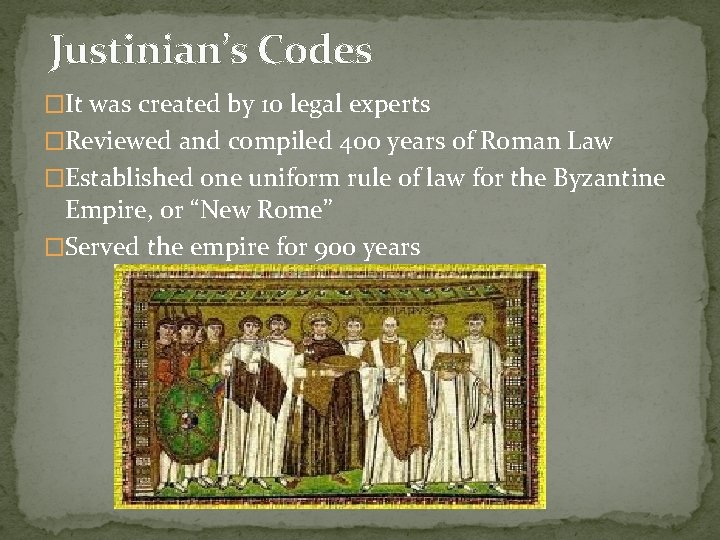
Justinian’s Codes �It was created by 10 legal experts �Reviewed and compiled 400 years of Roman Law �Established one uniform rule of law for the Byzantine Empire, or “New Rome” �Served the empire for 900 years
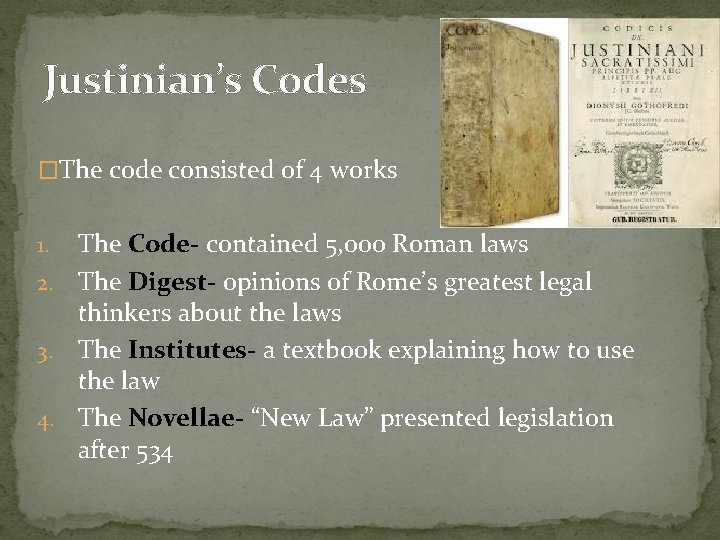
Justinian’s Codes �The code consisted of 4 works The Code- contained 5, 000 Roman laws 2. The Digest- opinions of Rome’s greatest legal thinkers about the laws 3. The Institutes- a textbook explaining how to use the law 4. The Novellae- “New Law” presented legislation after 534 1.
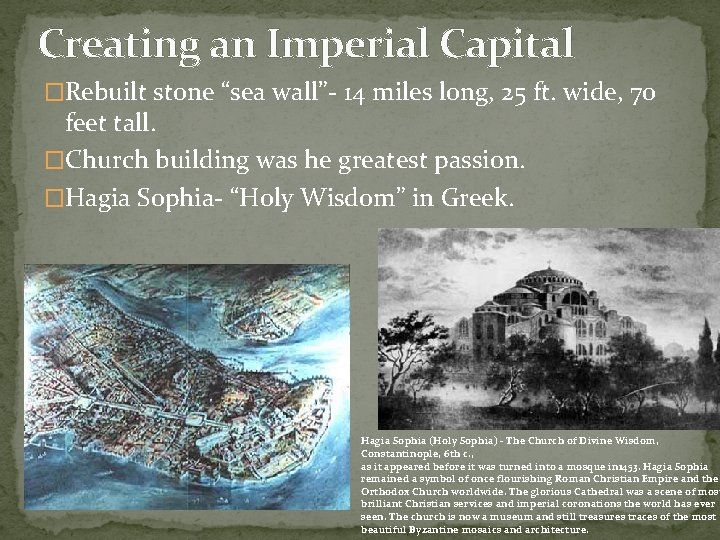
Creating an Imperial Capital �Rebuilt stone “sea wall”- 14 miles long, 25 ft. wide, 70 feet tall. �Church building was he greatest passion. �Hagia Sophia- “Holy Wisdom” in Greek. Hagia Sophia (Holy Sophia) - The Church of Divine Wisdom, Constantinople, 6 th c. , as it appeared before it was turned into a mosque in 1453. Hagia Sophia remained a symbol of once flourishing Roman Christian Empire and the Orthodox Church worldwide. The glorious Cathedral was a scene of most brilliant Christian services and imperial coronations the world has ever seen. The church is now a museum and still treasures traces of the most beautiful Byzantine mosaics and architecture.
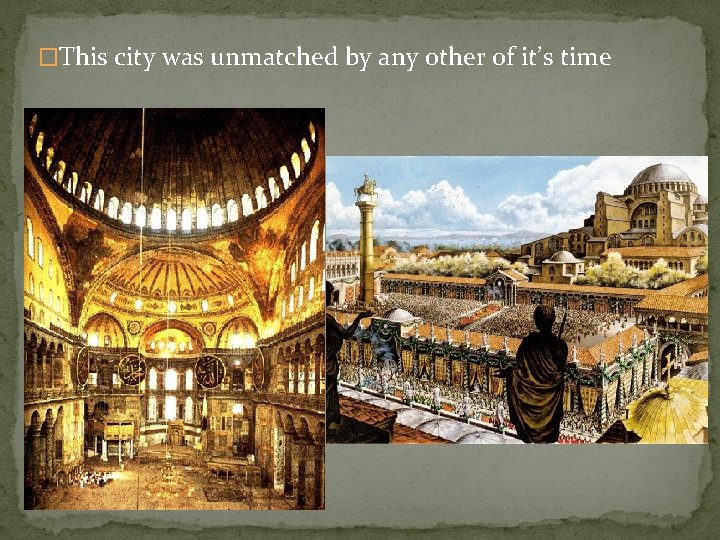
�This city was unmatched by any other of it’s time
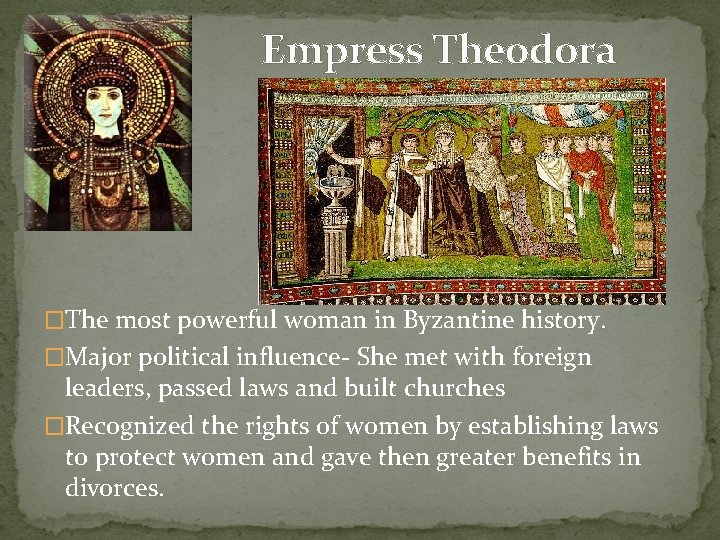
Empress Theodora �The most powerful woman in Byzantine history. �Major political influence- She met with foreign leaders, passed laws and built churches �Recognized the rights of women by establishing laws to protect women and gave then greater benefits in divorces.
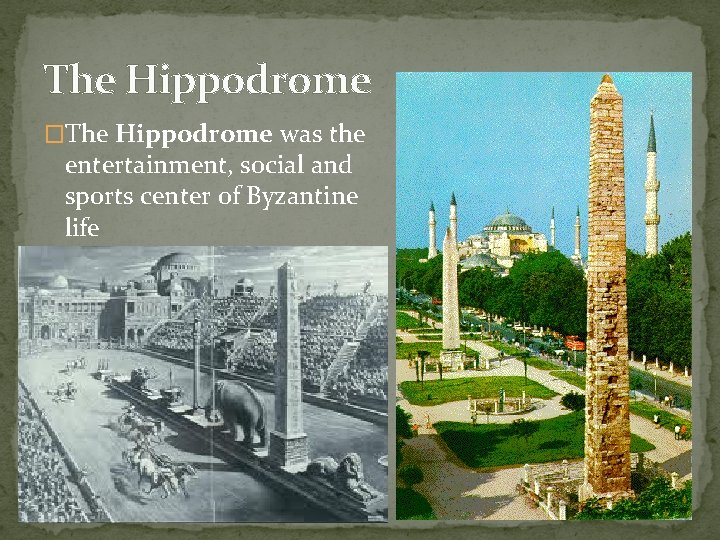
The Hippodrome �The Hippodrome was the entertainment, social and sports center of Byzantine life
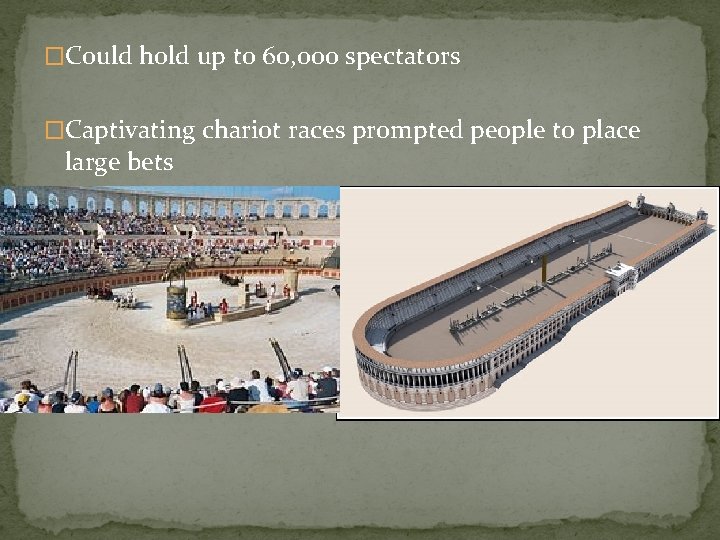
�Could hold up to 60, 000 spectators �Captivating chariot races prompted people to place large bets
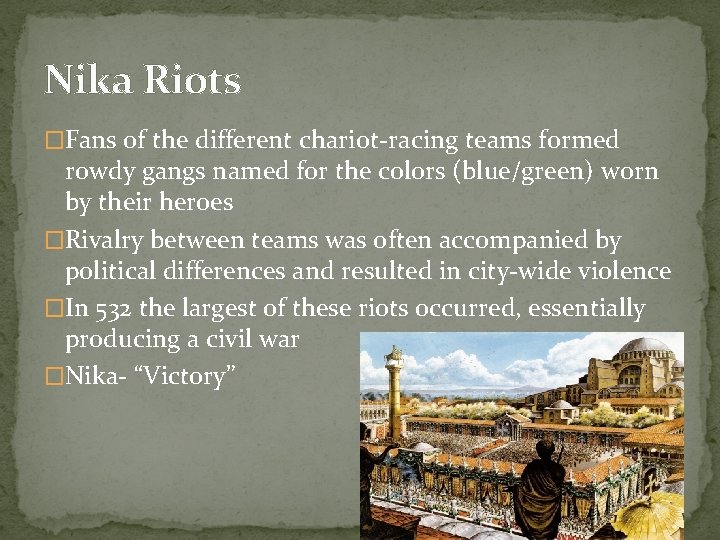
Nika Riots �Fans of the different chariot-racing teams formed rowdy gangs named for the colors (blue/green) worn by their heroes �Rivalry between teams was often accompanied by political differences and resulted in city-wide violence �In 532 the largest of these riots occurred, essentially producing a civil war �Nika- “Victory”
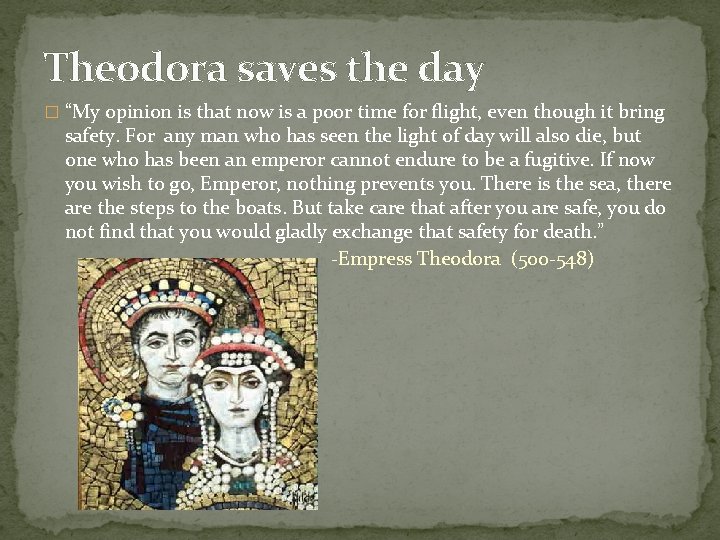
Theodora saves the day � “My opinion is that now is a poor time for flight, even though it bring safety. For any man who has seen the light of day will also die, but one who has been an emperor cannot endure to be a fugitive. If now you wish to go, Emperor, nothing prevents you. There is the sea, there are the steps to the boats. But take care that after you are safe, you do not find that you would gladly exchange that safety for death. ” -Empress Theodora (500 -548)
�After Justinian’s death the empire suffered many setbacks � Plague � Enemy from west, north, and east side � However, attacks on Constantinople by Persians, Slavs, Vikings, Arabs and other groups were largely unsuccessful … CONSTANTINOPLE’S STRONG MILITARY DEFENSE & TECHNOLOGY SAVE THE DAY On two occasions, from 674 to 677, and again in 717 -18, Arab armies besieged Constantinople by land sea. Superior military organization, the city’s high walls and its strategic location, and the timely invention of one of history's most decisive weapons, a medieval form of napalm dubbed "Greek fire“ used by the Byzantine naval fleet enabled the Byzantines to weather the storm. The cost to both sides was high. By 800 A. D. , Byzantium had lost most of her territory south of the Taurus Mountains and much of the remainder of the empire lay devastated. The Arabs lost untold thousands of men through futile attacks against Constantinople's defenses.
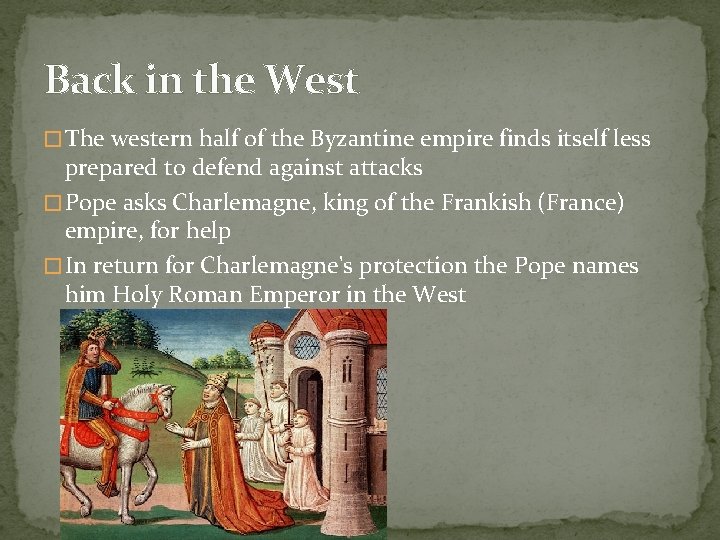
Back in the West � The western half of the Byzantine empire finds itself less prepared to defend against attacks � Pope asks Charlemagne, king of the Frankish (France) empire, for help � In return for Charlemagne's protection the Pope names him Holy Roman Emperor in the West
Differences Emerge Different cultural practices and limited contact between east and west resulted in the development of different religious practices. Rome (West) �Authority: � pope claims authority over all kings and emperors �Language � Latin �Church policies � Priests could not marry � Divorce was never allowed Constantinople (East) � Authority � emperor claims authority over the patriarch and all other bishops � Language � Greek � Church policies � Priests can marry � Divorce allowed under certain conditions
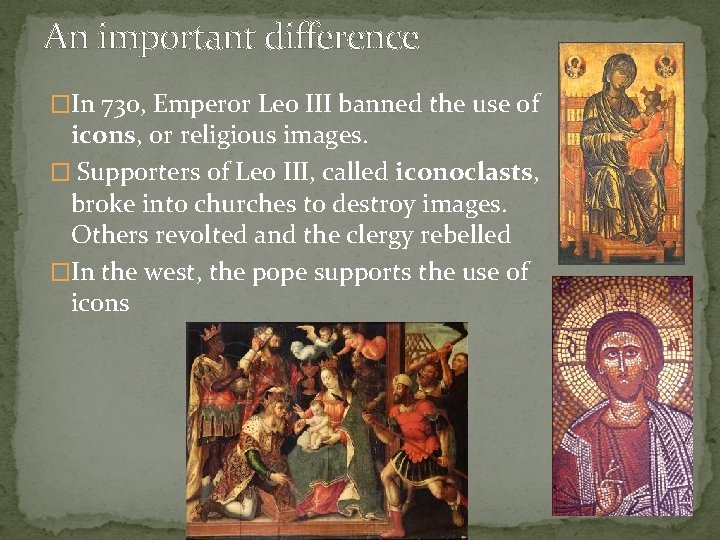
An important difference �In 730, Emperor Leo III banned the use of icons, or religious images. � Supporters of Leo III, called iconoclasts, broke into churches to destroy images. Others revolted and the clergy rebelled �In the west, the pope supports the use of icons
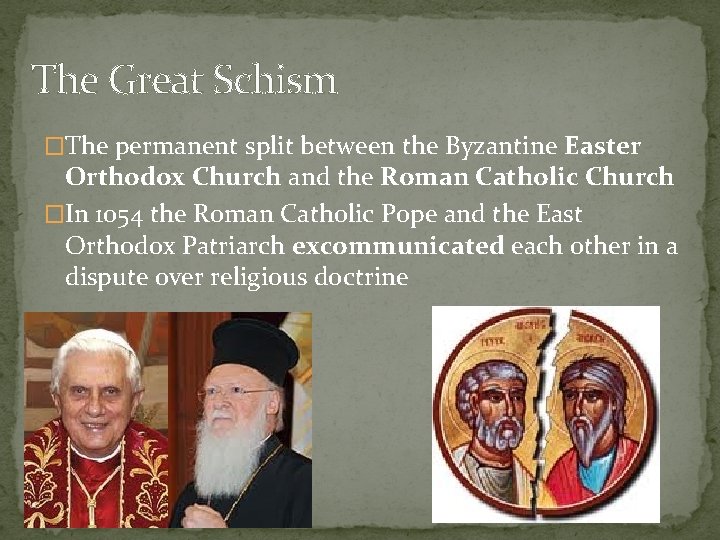
The Great Schism �The permanent split between the Byzantine Easter Orthodox Church and the Roman Catholic Church �In 1054 the Roman Catholic Pope and the East Orthodox Patriarch excommunicated each other in a dispute over religious doctrine
Crisis and Collapse �At the time of the Schism the Byzantine empire was declining �Struggles over succession and constant invasions from the north undermined the empire’s strength �Emperor Heraclius reorganized empire into themes, or military districts. Each district fell into the hands of individual generals. �As the empire faltered, its enemies advanced
The Crusades �The Turks take over the Muslim world and advance across Asia Minor making their way towards Anatolia. �Crusading Christians from western Europe pillage Constantinople �For a 200 year period, Western European Christians fought in 9 Crusades total as they attempted to retake the “Holy Land” (Jerusalem) from the Muslim Empire.
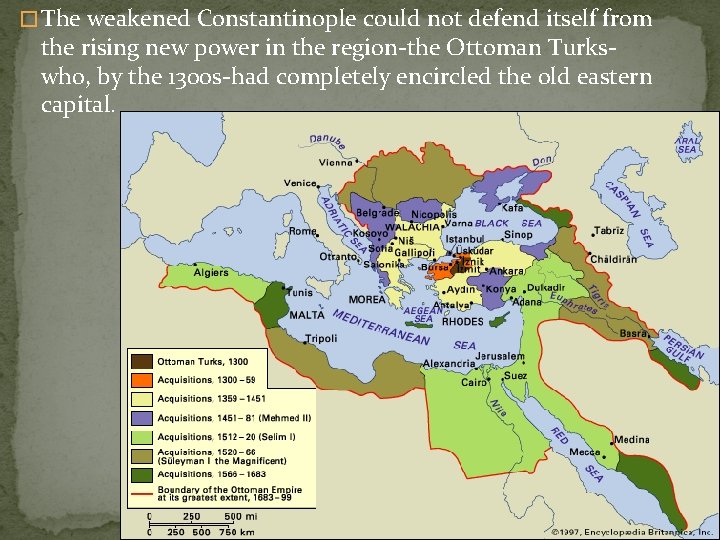
� The weakened Constantinople could not defend itself from the rising new power in the region-the Ottoman Turkswho, by the 1300 s-had completely encircled the old eastern capital.
- Slides: 27