
The Byzantine Empire Mr Schoff Global History I
The Byzantine Empire Mr. Schoff Global History I
OA Scan the boldface subsection headings in Chapter 10 Section 1. Speculate on possible reasons for the rise and fall of the Byzantine empire. Answer the “Global Connections” question on page 234.

Please read Setting the Scene on page 234
Constantine and Constantinople Constantine rebuilt Byzantium, Greek city, gave it the name of Constantinople n n 330, made it “New Rome” Eventually, the eastern Roman empire would be known as the Byzantine Empire Constantinople n n Excellent harbor Guarded by water on 3 sides Land sea walls Trade routes linked Europe and Asia w Made it Europe’s busiest marketplace n Silks From China, wheat from Egypt, gems from India, spices from Southeast Asia, furs from Scandinavian lands in north Emperors and empresses lived in luxury Chariot races at the Hippodrome arena n Shows Roman heritage
Big, Bad, Byzantine Empire Grew quickly, but eventually declined into a small area around Constantinople Yet it was still successful even 1, 000 years after the fall of the western Roman empire Blended Greek, Roman, and Christian influences
Justinian Age…Just in case you didn’t know The BE grew the most under the rule of emperor Justinian, 527 -565 He set out to revive ancient Rome by taking back the provinces that they lost from invasions Belisarius led Byzantine armies and reconquered North Africa, Italy, and southern Spain Victories only lasted a short time because the fighting essentially wiped his treasury clean and he could not afford stronger defenses

Lasting Legacy…and I’m not talking about a Subaru Legacy What he lacked in conquest of lands, he made up for in beauty in his buildings To restore some of the Roman heritage, he set out to beautify Constantinople Church of Holy Wisdom, known as Hagia Sophia was his biggest success n Huge dome, colored marble, embroidered silk curtains Turn to page 235 for pictures and descriptions
Lasting Legacy Continued Best remembered for his reformation of law Set up a commission to collect, revise, and organize all laws of ancient Rome n Corpus Juris Civilis, “Body of Civil Law”, a. k. a. Justinian Code By 1100 s, code reached Western Europe n n Roman Catholic Church and medieval monarchs modeled their laws on its principles Code also guided legal thinkers who began to put together the international law in use today
Ooooo…power He used the law to unite the empire Ruled as an autocrat Power over the Church n Christ’s “co-ruler” on Earth He combined both political and spiritual power His wife served as his adviser and coruler
Changing Times…don’t adjust your watch Empire served as a buffer for Western Europe Arabs gained strength across the Mediterranean Constantinople withstood attack, Byzantines held strong also in the Balkans and Asia Minor n All from strong central gov’t and economy Peasants form backbone of the empire n n n Worked the land Paid taxes Join military
Economy Western Europe reduced to a barter economy BE still a money economy Bezant, gold coin of BE, circulated from England to China
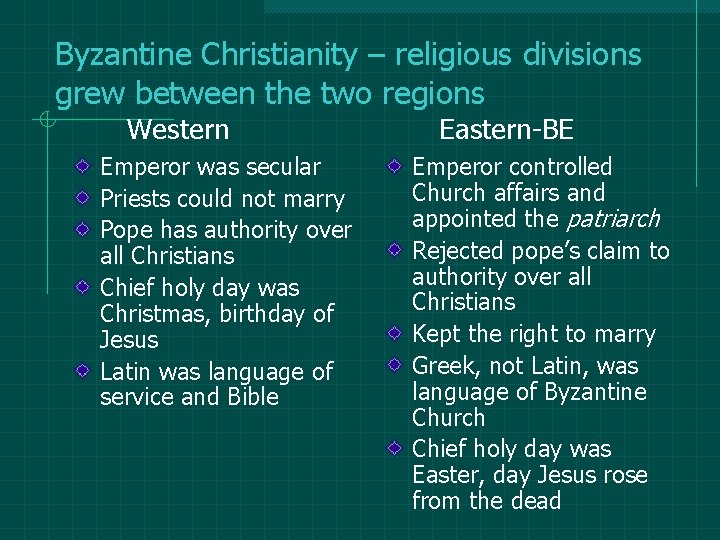
Byzantine Christianity – religious divisions grew between the two regions Western Emperor was secular Priests could not marry Pope has authority over all Christians Chief holy day was Christmas, birthday of Jesus Latin was language of service and Bible Eastern-BE Emperor controlled Church affairs and appointed the patriarch Rejected pope’s claim to authority over all Christians Kept the right to marry Greek, not Latin, was language of Byzantine Church Chief holy day was Easter, day Jesus rose from the dead
Sch…Sch…Schism Two branches of Christianity grew further apart n Icons debate w Byzantine Christians prayed to images of Christ, Virgin Mary, saints n 700 s, outlawed veneration of icons because it violated God’s commandment against worshiping “graven images” a. k. a. idols This ban set off violence within the empire Pope excommunicated the emperor that banned it n Later empress restored the use of icons, but resentment against the pope remained These controversies and others caused a permanent schism n n Byzantine – Eastern Greek Orthodox Roman Catholic Church The churches treated each other as rivals rather than branches of the same belief system
Decline…duhh BE in decline during schism Powerful local lords gained control of large areas Enemies advanced as the empire faltered n n Normans conquered southern Italy Seljuk Turks advanced across Asia Minor w They converted to Islam during their migrations
More Decline…duhh 1090 s, Byzantine emperor needed help from western portion to fight the Seljuks n Seljuks closed off pilgrimage routes to Jerusalem w Resulting in the First Crusade Later crusades were caused by trade rivalry between the BE and Venice Venetian merchants convinced knights on the Fourth Crusade to attack Constantinople in 1204 n 3 days, crusaders burned and plundered the city, sending treasure westward Western Christians ruled Constantinople for 50 years Byzantine emperor reclaimed the capital in the 1260 s but never fully recovered Venetian merchants gained control of Byzantine trade n Drained wealth from the empire Ottoman Turks overran most of Asia Minor and the Balkans
Buh-Bye Constantinople! 1453 – Ottoman armies surrounded the city, stormed broken walls, killed the emperor and renamed it Istanbul n n Became capital of the Ottoman Empire Became great center of Muslim culture Hagia Sophia turned into an Islamic house of worship
End of an Era…so sad For centuries, BE stood for the enduring symbol of Roman civilization Byzantine influences were found all over Europe n Even the Ottomans adopted features of Byzantine gov’t, social life, and architecture They built on the culture of the Hellenistic world, blended Christian religious beliefs with Greek science, philosophy, arts, and literature, and also extended Roman engineering and law
Byzantine Art Made unique advances that influenced religious art and architecture in the western part of Europe from the Middle Ages to present day Icons gave viewers a sense of personal contact with God Mosaics brought scenes from the Bible to life Byzantine palaces and churches blended Greek, Roman, Persian, and other Middle Eastern styles
New Learning…even a caveman could do it Preserved Greek literature Historians n n Herodotus Thucydides Procopius – adviser to the general Belisarius, wrote Secret History, criticizing Justinian and Theodora Anna Comnena – considered western world’s first important female historian, wrote Alexiad, analyzing the reign of her father, Emperor Alexus I Many Greeks left Constantinople to teach at Italian universities n Took valuable Greek manuscripts to the West, along with their knowledge of Greek and Byzantine culture, which contributed to the flourishing cultural time period known as the Renaissance
- Slides: 19