
The BusinessSociety Relationship 1 Chapter One Objectives Characterize
The Business/Society Relationship 1
Chapter One Objectives • Characterize business, society, and their relationship to each other • Describe pluralism and identify its strengths and weaknesses • Clarify how our pluralistic society became a specialinterest society • Identify and discuss factors leading up to the criticism of business • Identify the major criticisms of business and characterize business' response • Identify the major themes of this book: managerial approach, ethics, and stakeholder management 2
Chapter One Outline • Business and Society • Society as the Macroenvironment • Our Pluralistic Society • Our Special-Interest Society • Business Criticism and Corporate Response • Focus of the Book • Structure of the Book • Summary
Introduction to Chapter One The Business and Society Relationship • Specific incidents versus broad societal concerns – Firestone tires versus discrimination • Questions arise as to the behavior of the firm – – Is the firm’s behavior ethical? Is the firm’s behavior socially responsible? What is the firm’s correct response? What is the role of the firm in society?
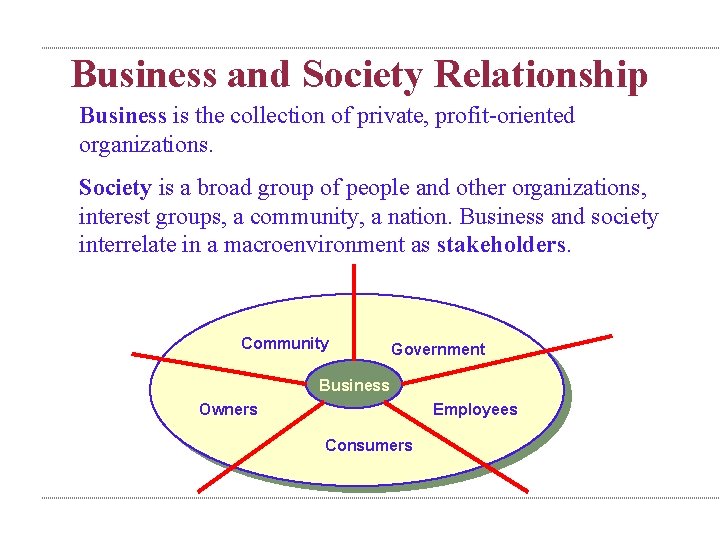
Business and Society Relationship Business is the collection of private, profit-oriented organizations. Society is a broad group of people and other organizations, interest groups, a community, a nation. Business and society interrelate in a macroenvironment as stakeholders. Community Government Business Owners Employees Consumers
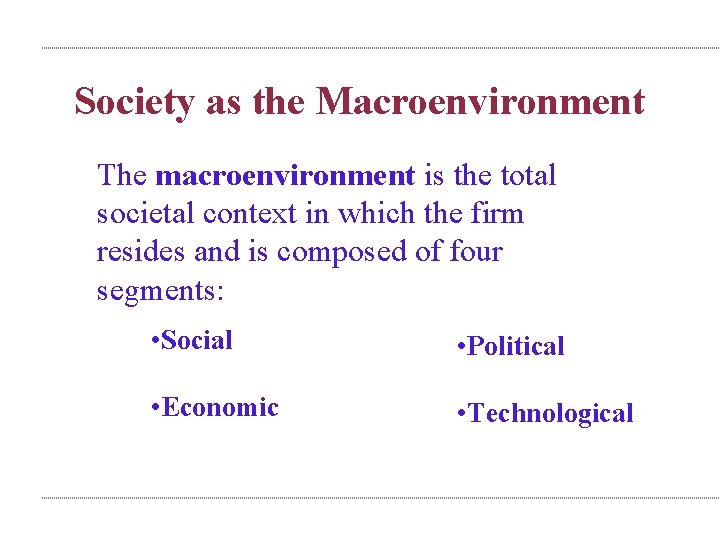
Society as the Macroenvironment The macroenvironment is the total societal context in which the firm resides and is composed of four segments: • Social • Political • Economic • Technological
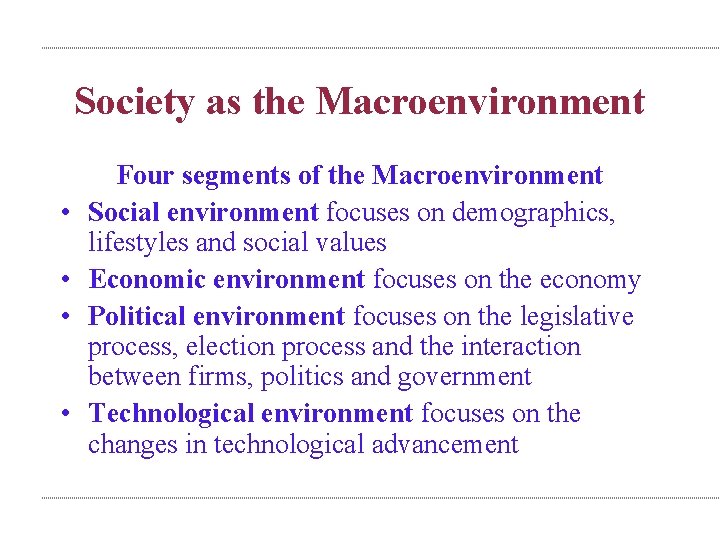
Society as the Macroenvironment • • Four segments of the Macroenvironment Social environment focuses on demographics, lifestyles and social values Economic environment focuses on the economy Political environment focuses on the legislative process, election process and the interaction between firms, politics and government Technological environment focuses on the changes in technological advancement
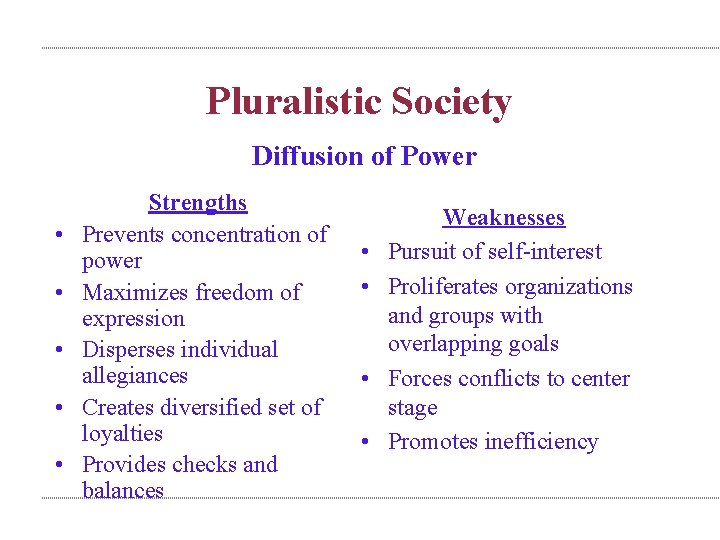
Pluralistic Society Diffusion of Power • • • Strengths Prevents concentration of power Maximizes freedom of expression Disperses individual allegiances Creates diversified set of loyalties Provides checks and balances • • Weaknesses Pursuit of self-interest Proliferates organizations and groups with overlapping goals Forces conflicts to center stage Promotes inefficiency
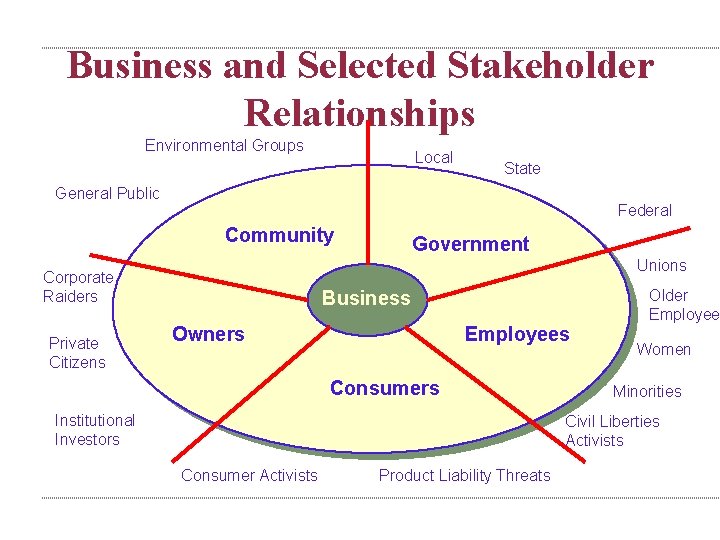
Business and Selected Stakeholder Relationships Environmental Groups Local State General Public Federal Community Unions Corporate Raiders Private Citizens Government Business Owners Employees Consumers Institutional Investors Older Employee Women Minorities Civil Liberties Activists Consumer Activists Product Liability Threats
Special-Interest Society • Special interests make life more complex for business • Special interest groups number in the tens of thousands • Special interest groups each pursue their own limited agenda • Special interest groups are more active, intense, diverse and focused • Special interest groups attract a significant following increasing revenue and power
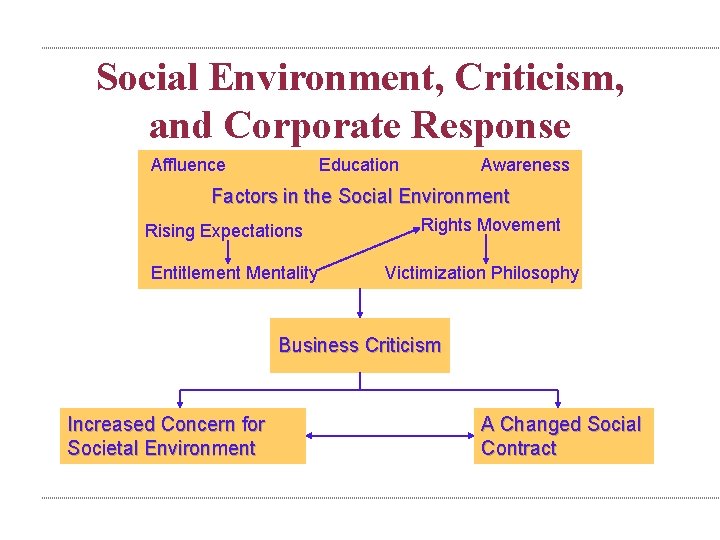
Social Environment, Criticism, and Corporate Response Affluence Education Awareness Factors in the Social Environment Rising Expectations Entitlement Mentality Rights Movement Victimization Philosophy Business Criticism Increased Concern for Societal Environment A Changed Social Contract
Business Criticism Factors in the Social Environment • • • Affluence and education Awareness through television Revolution of rising expectations Entitlementality Rights movement Victimization philosophy
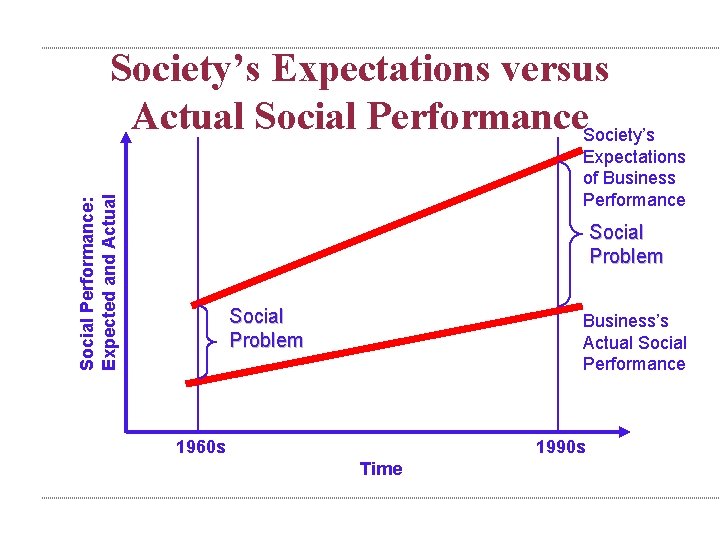
Society’s Expectations versus Actual Social Performance. Society’s Social Performance: Expected and Actual Expectations of Business Performance Social Problem Business’s Actual Social Performance 1960 s 1990 s Time
Business Criticism Power • Use and abuse of power – Business power refers to the ability or capacity to produce an effect or to bring an influence to bear on a situation or people • Iron Law of Social Responsibility – In the long run, those who do not use power in a manner society considers responsible will tend to lose it
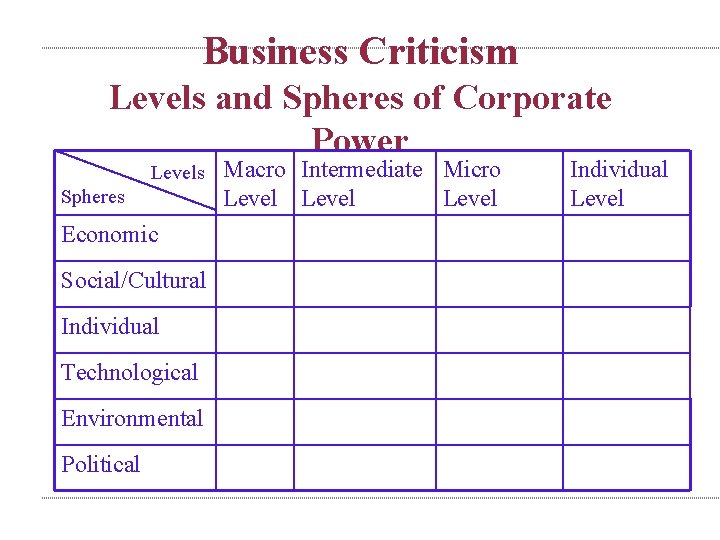
Business Criticism Levels and Spheres of Corporate Power Levels Spheres Economic Social/Cultural Individual Technological Environmental Political Macro Intermediate Micro Level Individual Level
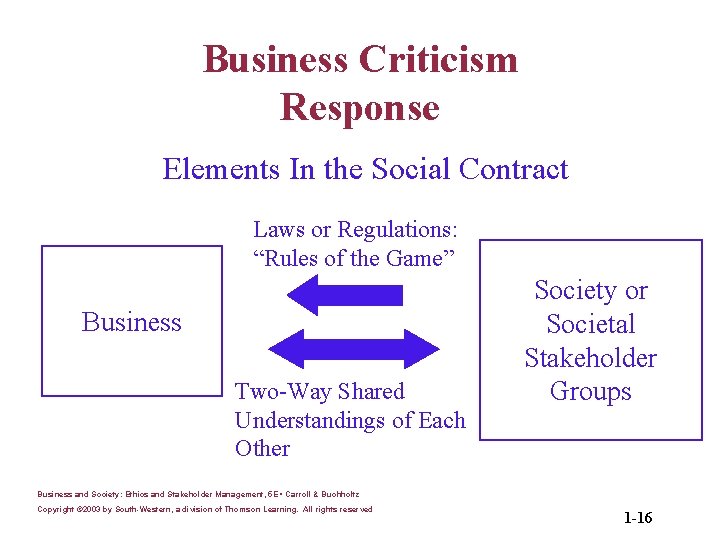
Business Criticism Response Elements In the Social Contract Laws or Regulations: “Rules of the Game” Business Two-Way Shared Understandings of Each Other Society or Societal Stakeholder Groups Business and Society: Ethics and Stakeholder Management, 5 E • Carroll & Buchholtz Copyright © 2003 by South-Western, a division of Thomson Learning. All rights reserved 1 -16
Focus of Book • Managerial approach • Ethics theme • Stakeholder management theme
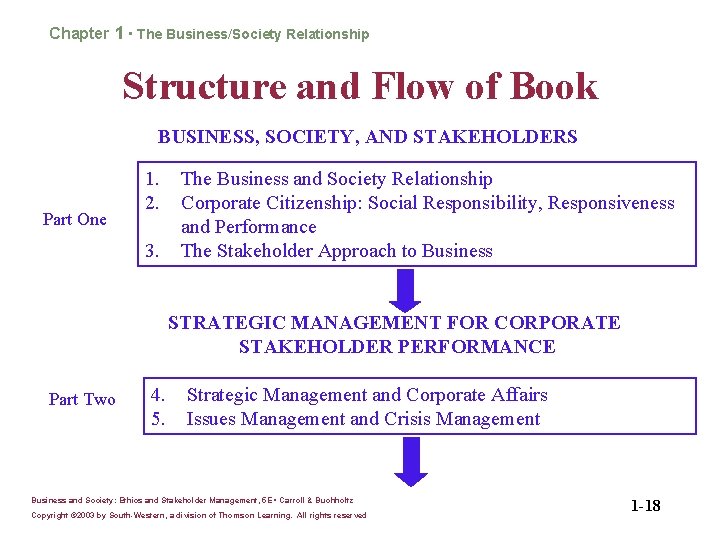
Chapter 1 • The Business/Society Relationship Structure and Flow of Book BUSINESS, SOCIETY, AND STAKEHOLDERS Part One 1. 2. 3. The Business and Society Relationship Corporate Citizenship: Social Responsibility, Responsiveness and Performance The Stakeholder Approach to Business STRATEGIC MANAGEMENT FOR CORPORATE STAKEHOLDER PERFORMANCE Part Two 4. 5. Strategic Management and Corporate Affairs Issues Management and Crisis Management Business and Society: Ethics and Stakeholder Management, 5 E • Carroll & Buchholtz Copyright © 2003 by South-Western, a division of Thomson Learning. All rights reserved 1 -18
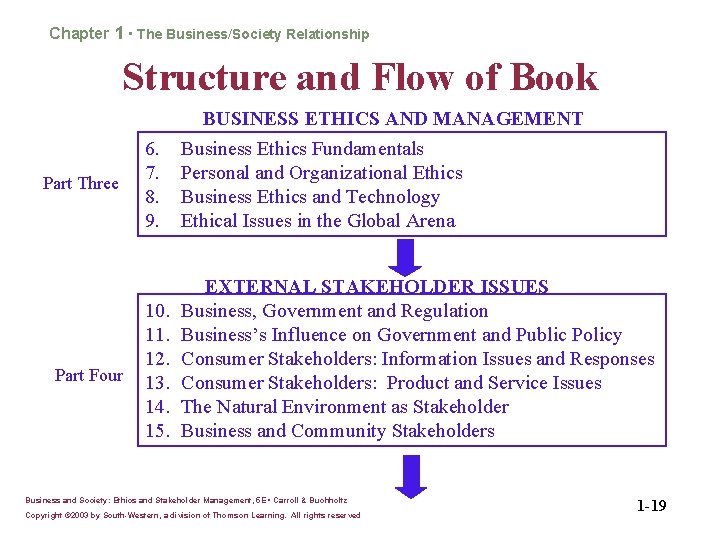
Chapter 1 • The Business/Society Relationship Structure and Flow of Book BUSINESS ETHICS AND MANAGEMENT Part Three Part Four 6. 7. 8. 9. Business Ethics Fundamentals Personal and Organizational Ethics Business Ethics and Technology Ethical Issues in the Global Arena 10. 11. 12. 13. 14. 15. EXTERNAL STAKEHOLDER ISSUES Business, Government and Regulation Business’s Influence on Government and Public Policy Consumer Stakeholders: Information Issues and Responses Consumer Stakeholders: Product and Service Issues The Natural Environment as Stakeholder Business and Community Stakeholders Business and Society: Ethics and Stakeholder Management, 5 E • Carroll & Buchholtz Copyright © 2003 by South-Western, a division of Thomson Learning. All rights reserved 1 -19
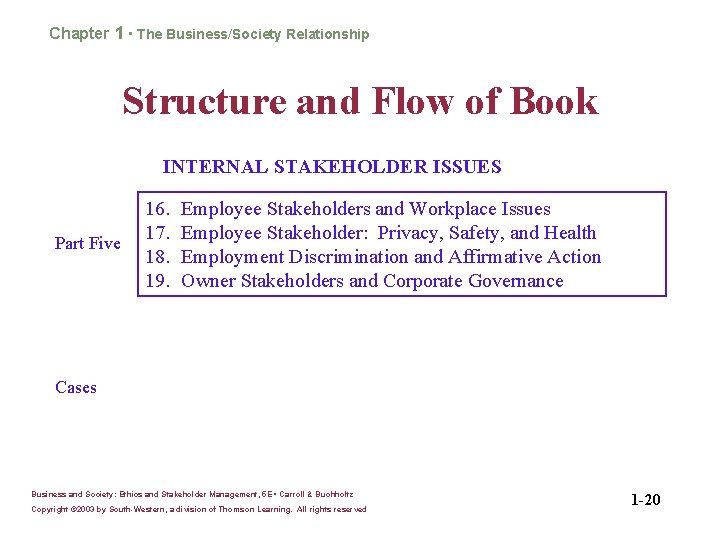
Chapter 1 • The Business/Society Relationship Structure and Flow of Book INTERNAL STAKEHOLDER ISSUES Part Five 16. 17. 18. 19. Employee Stakeholders and Workplace Issues Employee Stakeholder: Privacy, Safety, and Health Employment Discrimination and Affirmative Action Owner Stakeholders and Corporate Governance Cases Business and Society: Ethics and Stakeholder Management, 5 E • Carroll & Buchholtz Copyright © 2003 by South-Western, a division of Thomson Learning. All rights reserved 1 -20
Selected Key Terms • • • Affluence Business ethics Business power Economic environment Education Entitlementality Ethics Iron Law of Responsibility Macroenvironment Pluralism • Political environment • Revolution of rising expectations • Rights movement • Social contract • Social environment • Social problem • Society • Special-interest society • Stakeholders • Technological environment
- Slides: 21