
The Business Value of Environmental Stewardship Examples from
The Business Value of Environmental Stewardship: Examples from the ACSP Place Alternating Slideshow Photo Here
Introduction For years, people have seen environmental protection as a burden or cost to business. In recent years, large and small businesses alike have discovered how voluntary environmental stewardship can lead to reduced costs, improved image & reputation, and even increased revenue for their businesses. Members of Audubon International’s Audubon Cooperative Sanctuary Program (ACSP) for Golf Courses have discovered this as well. The following information, survey results, and member quotes help to support the idea that the environment and business can coexist through the ACSP.
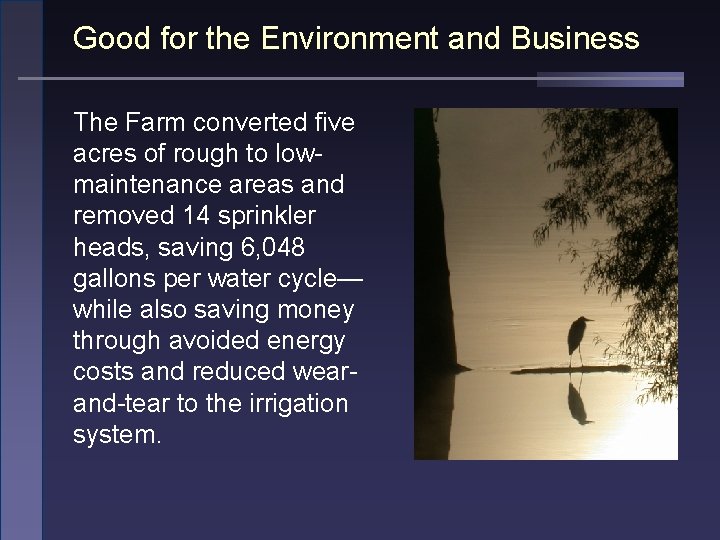
Good for the Environment and Business The Farm converted five acres of rough to lowmaintenance areas and removed 14 sprinkler heads, saving 6, 048 gallons per water cycle— while also saving money through avoided energy costs and reduced wearand-tear to the irrigation system.
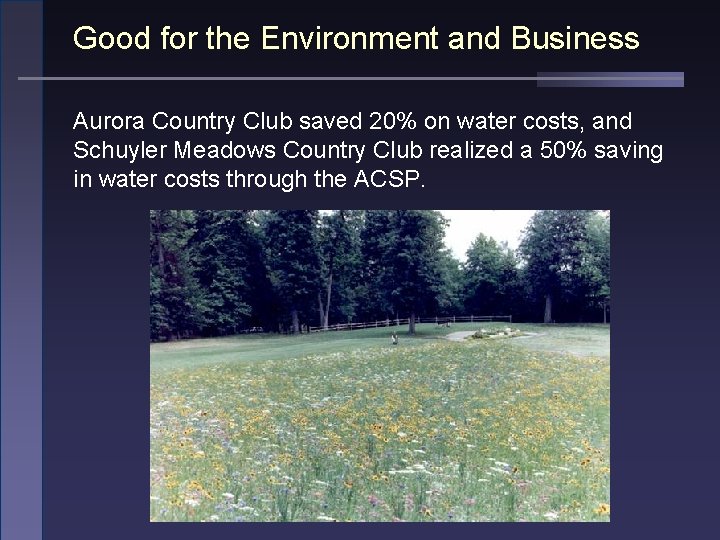
Good for the Environment and Business Aurora Country Club saved 20% on water costs, and Schuyler Meadows Country Club realized a 50% saving in water costs through the ACSP.
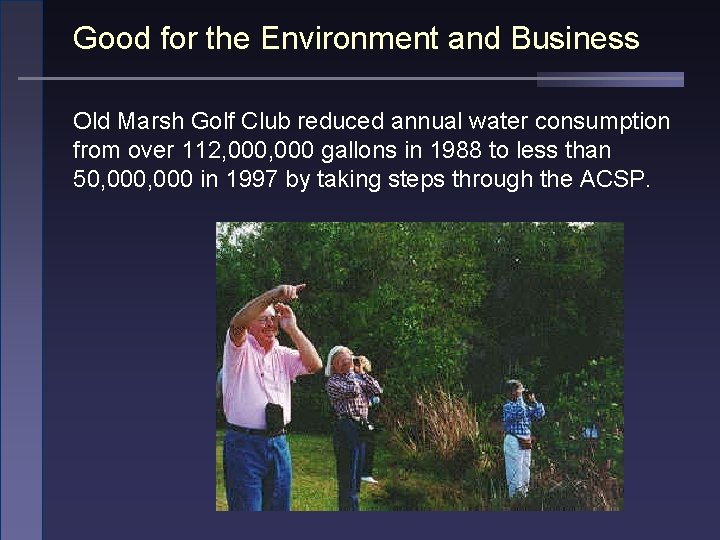
Good for the Environment and Business Old Marsh Golf Club reduced annual water consumption from over 112, 000 gallons in 1988 to less than 50, 000 in 1997 by taking steps through the ACSP.
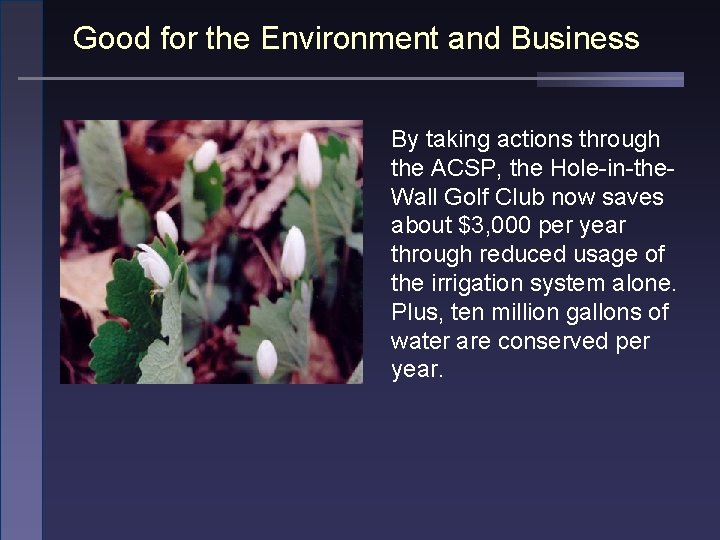
Good for the Environment and Business By taking actions through the ACSP, the Hole-in-the. Wall Golf Club now saves about $3, 000 per year through reduced usage of the irrigation system alone. Plus, ten million gallons of water are conserved per year.
A Green Return on Investment Village Links of Glen Ellyn watched an initial investment of $5, 000 towards ACSP projects yield $30, 000 in savings in just two years.
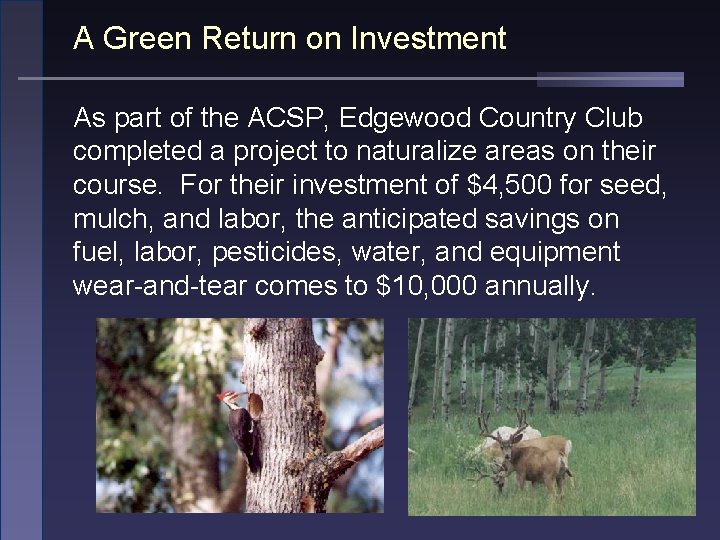
A Green Return on Investment As part of the ACSP, Edgewood Country Club completed a project to naturalize areas on their course. For their investment of $4, 500 for seed, mulch, and labor, the anticipated savings on fuel, labor, pesticides, water, and equipment wear-and-tear comes to $10, 000 annually.
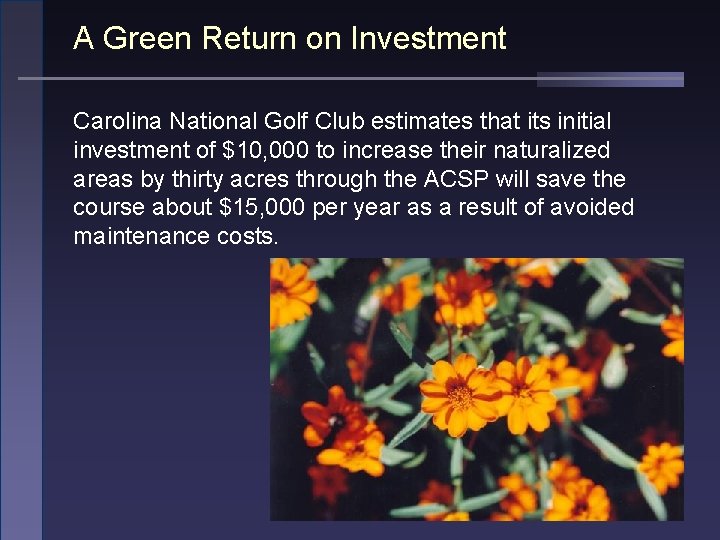
A Green Return on Investment Carolina National Golf Club estimates that its initial investment of $10, 000 to increase their naturalized areas by thirty acres through the ACSP will save the course about $15, 000 per year as a result of avoided maintenance costs.
Environmental Cost Savings Audubon International’s 2000 -2002 survey of ACSP members revealed: • 82% reduced pesticide use and 92% use pesticides with lower toxicity level. • 80% decreased managed turfgrass—with an average increase of 22 acres of habitat/course.
Environmental Cost Savings Audubon International’s 2000 -2002 survey of ACSP members revealed: • 69% decreased water usage and 60% reduced water costs. • Environmental projects were completed in a Place way that maintained or even improved playing Alternating quality at member golf courses. Slideshow Photo Here
Golfer and Staff Satisfaction Audubon International’s 2000 -2002 survey ACSP members revealed that: • 99% reported playing quality has improved (50%) or been maintained (49%) • 99% reported that golfer satisfaction has improved (49. 3%) or been maintained (49. 3%) • 97% of superintendents reported job satisfaction has improved (66%) or has been maintained (34%)
Revenue Generation A 2003 university study revealed the following about golf courses involved with Audubon International programs: • On average, Certified Audubon Cooperative Sanctuaries are able to charge a higher-thanaverage greens fee ($5 -$14) compared to noncertified golf courses. • Both environmental groups and golfers are demanding the attributes exhibited through ACSP-certified golf courses.
Public Recognition & Image Enhancement By documenting their efforts and becoming certified through our programs, golf courses have earned the following types of accolades: • National Pollution Prevention Awards • State-Based Pollution Prevention Awards • GCSAA Environmental Stewardship Awards • Pesticide Environmental Stewardship Awards • Local Environmental Organization Awards
What Members Say “This is not just some philanthropic activity. It's good business. We conserve fuel, we conserve electricity, and we have made this a part of our risk-management system. ” - Ken Giedd, former Director, Kingsmill Resort, VA “The Audubon Cooperative Sanctuary Program was developed for all golf courses, but fit the Village Country Club in Lompoc, CA perfectly. If there were a way to measure golfing value—product for price—the Village Country Club would rate highly and have the ACSP to thank. ” - Robert F. Taeger, CGCS, Village Country Club, Lompoc, CA
What Members Say “Through our involvement with Audubon International, our management practices in areas of the golf course that either cross or are adjacent to the Poplar River are very environmentally sensitive, and the Minnesota Pollution Control Agency has recognized that fact. ” - Mike Davies, Superintendent at Superior National, Lutsen, MN. “Both the Illinois EPA and Lake County Health Department agree that [our local] lake’s improvement is a direct result of our implemented environmental practices motivated by involvement with Audubon International. ” - Brian F. Thompson, Biltmore Country Club, North Barrington, IL
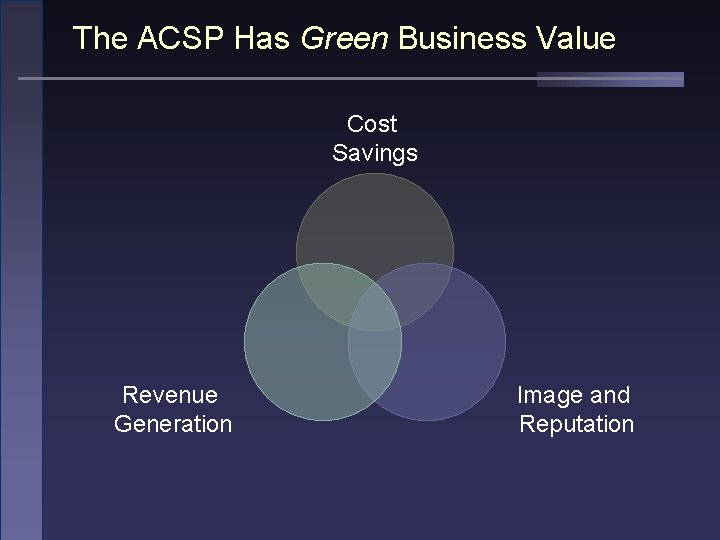
The ACSP Has Green Business Value Cost Savings Revenue Generation Image and Reputation

Enroll and Take Action! Place Alternating Slideshow Photo Here © Audubon International 2004
- Slides: 18