
The Business Plan An alignment of functional activities
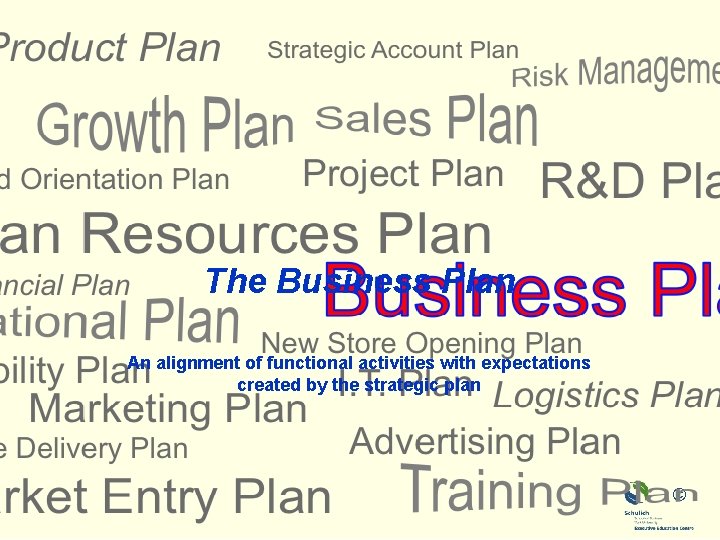
The Business Plan An alignment of functional activities with expectations created by the strategic plan ©
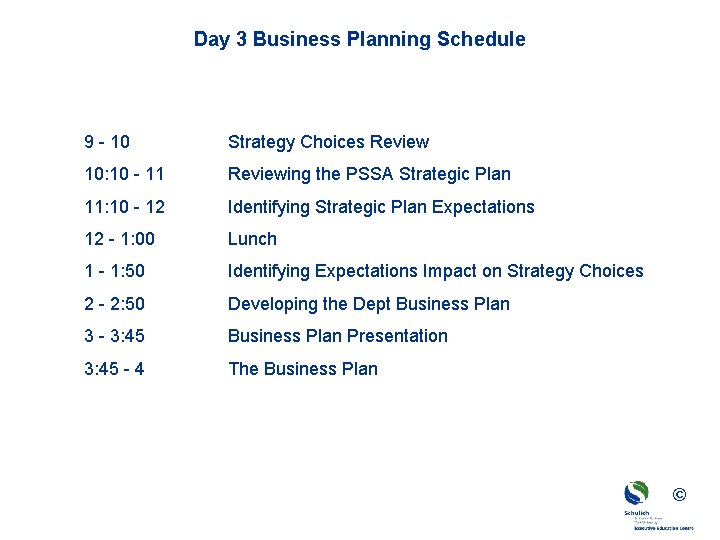
Day 3 Business Planning Schedule 9 - 10 Strategy Choices Review 10: 10 - 11 Reviewing the PSSA Strategic Plan 11: 10 - 12 Identifying Strategic Plan Expectations 12 - 1: 00 Lunch 1 - 1: 50 Identifying Expectations Impact on Strategy Choices 2 - 2: 50 Developing the Dept Business Plan 3 - 3: 45 Business Plan Presentation 3: 45 - 4 The Business Plan ©
© Module 1 Strategy Choices Review ©
What is a business plan? 1. Overview Any strategy planning subsequent to the strategic plan ©
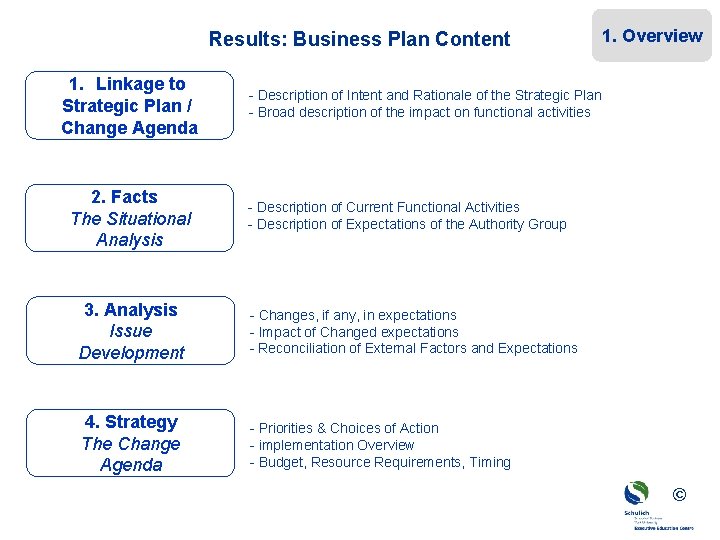
Results: Business Plan Content 1. Linkage to Strategic Plan / Change Agenda 2. Facts The Situational Analysis 1. Overview - Description of Intent and Rationale of the Strategic Plan - Broad description of the impact on functional activities - Description of Current Functional Activities - Description of Expectations of the Authority Group 3. Analysis Issue Development - Changes, if any, in expectations - Impact of Changed expectations - Reconciliation of External Factors and Expectations 4. Strategy The Change Agenda - Priorities & Choices of Action - implementation Overview - Budget, Resource Requirements, Timing ©
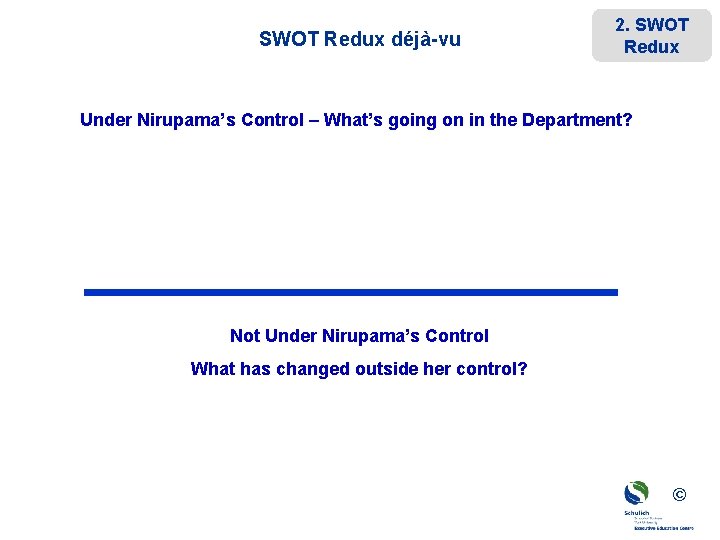
SWOT Redux déjà-vu 2. SWOT Redux Under Nirupama’s Control – What’s going on in the Department? Not Under Nirupama’s Control What has changed outside her control? ©
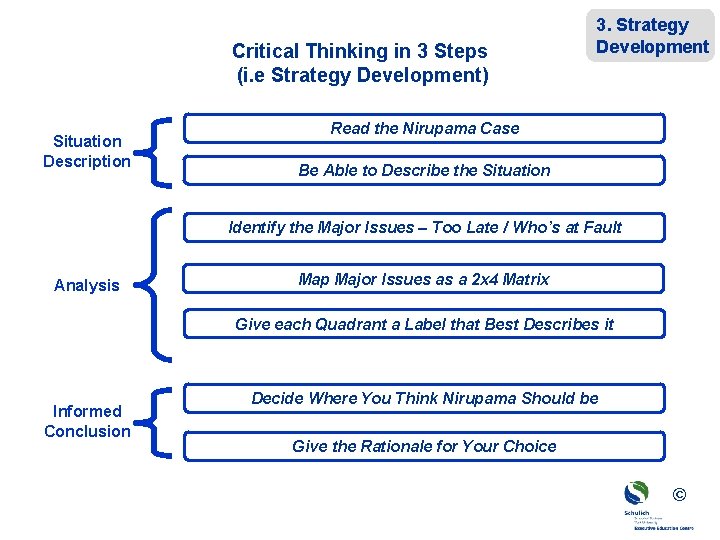
Critical Thinking in 3 Steps (i. e Strategy Development) Situation Description 3. Strategy Development Read the Nirupama Case Be Able to Describe the Situation Identify the Major Issues – Too Late / Who’s at Fault Analysis Map Major Issues as a 2 x 4 Matrix Give each Quadrant a Label that Best Describes it Informed Conclusion Decide Where You Think Nirupama Should be Give the Rationale for Your Choice ©
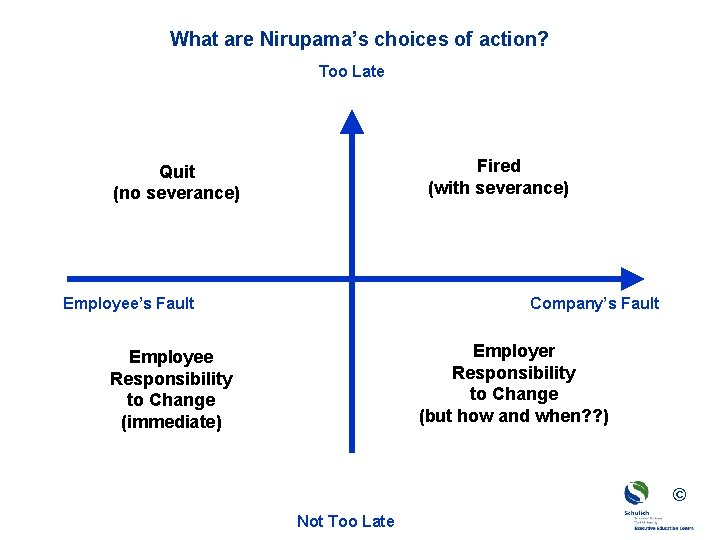
What are Nirupama’s choices of action? Too Late Fired (with severance) Nirupama? Quit (no severance) Employee’s Fault Company’s Fault Employer Responsibility to Change (but how and when? ? ) Employee Responsibility to Change (immediate) © Not Too Late
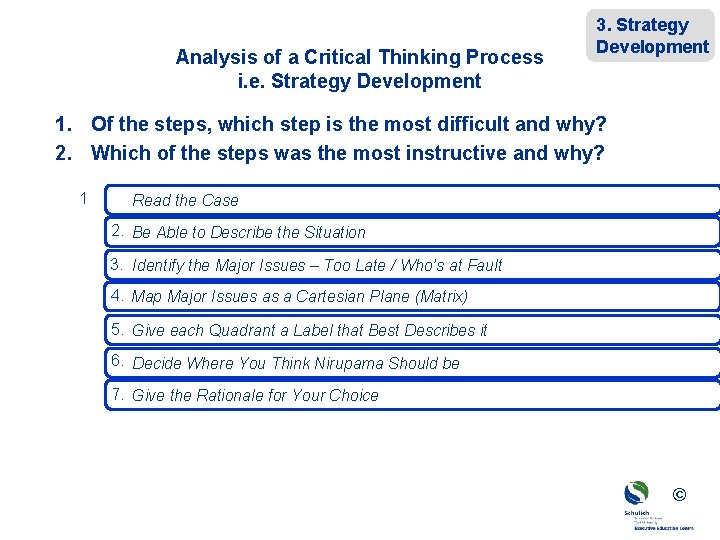
Analysis of a Critical Thinking Process i. e. Strategy Development 3. Strategy Development 1. Of the steps, which step is the most difficult and why? 2. Which of the steps was the most instructive and why? 1 . the Case Read 2. Be Able to Describe the Situation 3. Identify the Major Issues – Too Late / Who’s at Fault 4. Map Major Issues as a Cartesian Plane (Matrix) 5. Give each Quadrant a Label that Best Describes it 6. Decide Where You Think Nirupama Should be 7. Give the Rationale for Your Choice ©
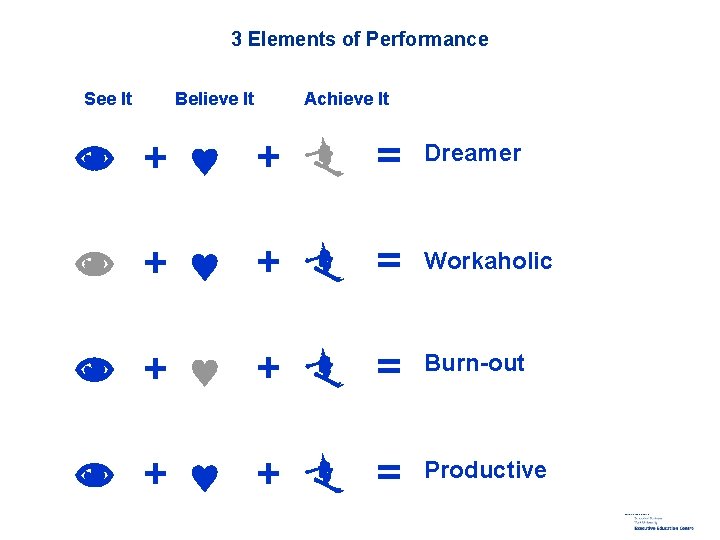
3 Elements of Performance See It Believe It Achieve It + + = Dreamer + + = Workaholic + + = Burn-out + + = Productive ©
Module 2 Reviewing the PSSA Strategic Plan ©
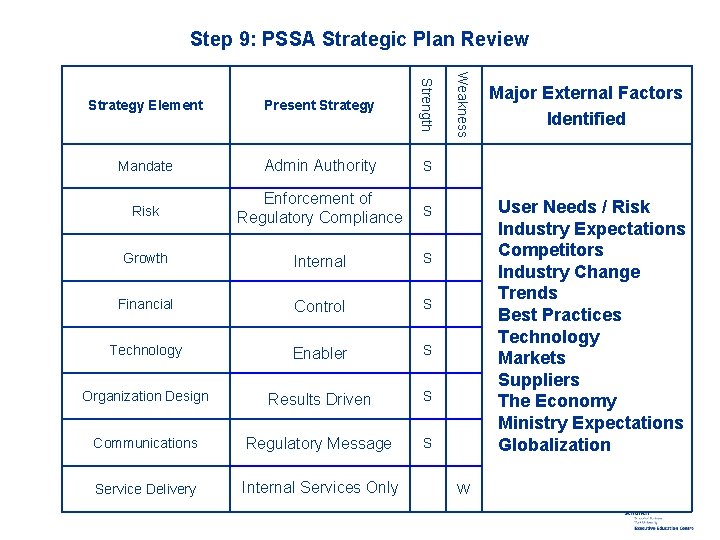
Step 9: PSSA Strategic Plan Review Present Strategy Strength Mandate Admin Authority S Risk Enforcement of Regulatory Compliance S Growth Internal S Financial Control S Technology Enabler S Organization Design Results Driven S Communications Regulatory Message S Service Delivery Internal Services Only Weakness Strategy Element Major External Factors Identified User Needs / Risk Industry Expectations Competitors Industry Change Trends Best Practices Technology Markets Suppliers The Economy Ministry Expectations Globalization W ©
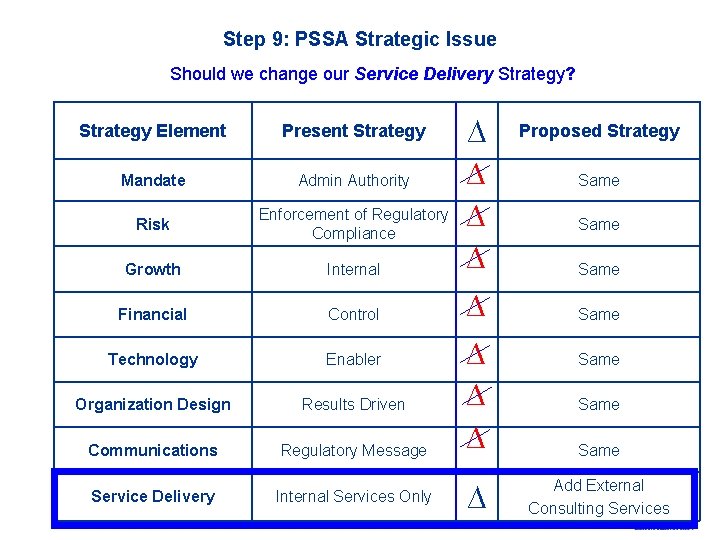
Step 9: PSSA Strategic Issue Should we change our Service Delivery Strategy? Strategy Element Present Strategy Mandate Admin Authority Risk Enforcement of Regulatory Compliance Growth Internal Financial Control Technology Enabler Organization Design Results Driven Communications Regulatory Message Service Delivery Internal Services Only ∆ ∆ ∆ ∆ ∆ Proposed Strategy Same Same Add External © Consulting Services

Step 9: Strategic Plan Implementation Strategy Element ∆ Proposed Strategy Mandate ∆ Admin Authority ∆ ∆ Inspection & Enforcement ∆ ∆ ∆ Compliance Risk Growth Financial Technology Organization Communications Service Delivery Implementation Impact Internal 1. Risk Away Services Development Enabler Results Driven 2. H. R. -Training Regulatory 4. Marketing & Sales External Consulting 3. Service Delivery ©

Background: Rationale for Change Industry Change Risk & Safety Consulting Services Impact on PSSA Need to Offer Consulting Services PSSA Response Launch of Risk-Away Consulting Services Impact on PSSA Depts Need for Inspectors to Market, Sell & Deliver the New Risk-Away Services ©
PSSA Strategy Configuration ©
Nirupama’s Department ©
Module 3 Identifying Strategic Plan Expectations ©
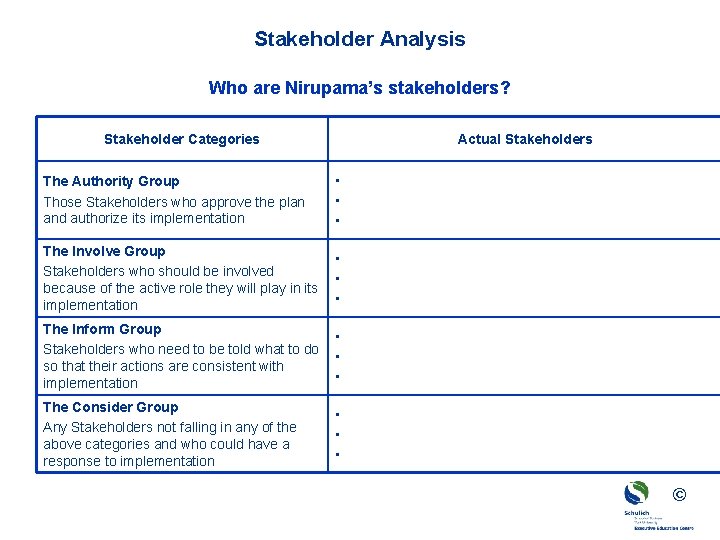
Stakeholder Analysis Who are Nirupama’s stakeholders? Stakeholder Categories Actual Stakeholders The Authority Group Those Stakeholders who approve the plan and authorize its implementation • • • The Involve Group Stakeholders who should be involved because of the active role they will play in its implementation • • • The Inform Group Stakeholders who need to be told what to do so that their actions are consistent with implementation • • • The Consider Group Any Stakeholders not falling in any of the above categories and who could have a response to implementation • • • ©

Expectations q Exceeding Expectations q Meeting Expectations q Not Meeting Expectations © 20

Ontario Premier’s 2017 Letter of Expectations September 25, 2017 The Honourable Charles Sousa Minister of Finance Ministry of Finance 7 Queen’s Park Crescent Seventh Floor, Frost Building South Toronto, Ontario M 7 A 1 Y 7 Dear Minister Sousa: I am honoured to welcome you back to your role as Minister of Finance. We have a strong Cabinet in place, and I am confident that together we will build Ontario up, create new opportunities and champion a secure future for people across our province. The people of Ontario have entrusted their government to be a force for good, and we will reward that trust by working every day in the best interests of every person in this province. Our Speech from the Throne outlined a number of key priorities that will guide your work… ©
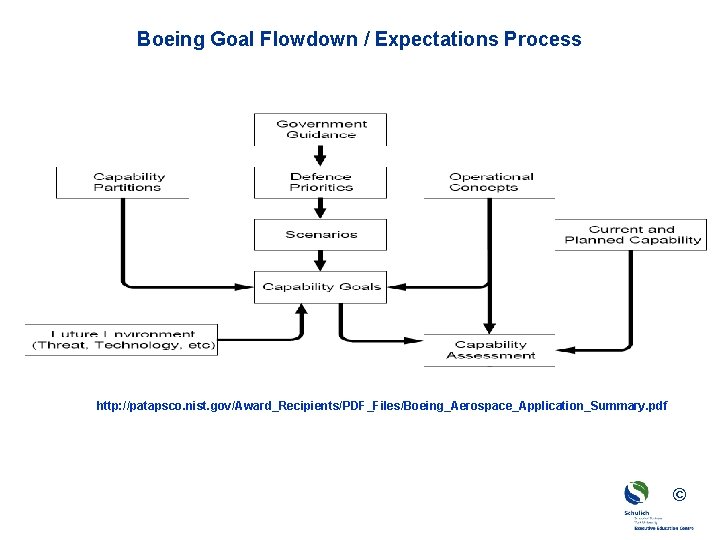
Boeing Goal Flowdown / Expectations Process http: //patapsco. nist. gov/Award_Recipients/PDF_Files/Boeing_Aerospace_Application_Summary. pdf ©
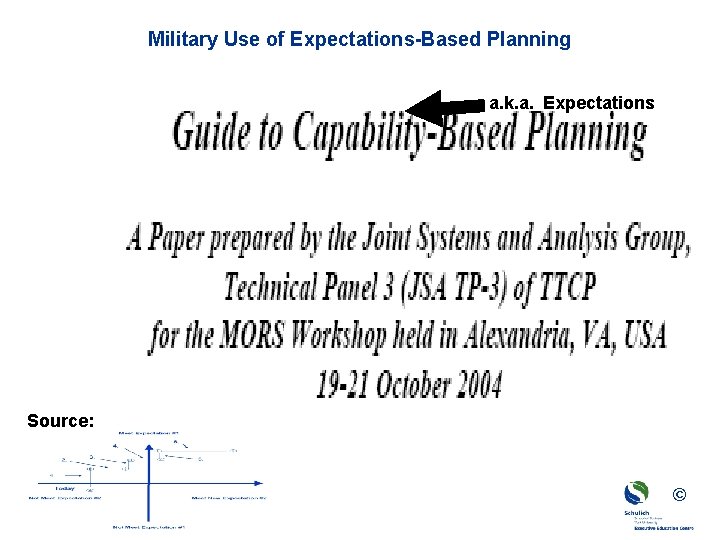
Military Use of Expectations-Based Planning a. k. a. Expectations Source: ©

8 Strategy Expectations Strategy Element Expectations that Must be Met by the Nirupama, as a Manager, Over the Next 1 -3 Years Mandate In business planning, Mandate is the scope of responsibilities of the department Risk Growth Financial Technology R&D Organization Marketing / Sales Service Delivery ©
Module 4 Identifying Expectations Impact on Strategy Choices ©

Expectations Testing 4. Expectations Priority Testing Meet Old Expectation Not Meet New Expectation Not Meet Old Expectation ©

Pros & Cons Analysis 4. Expectations Priority Testing Expectation: Pros Cons ©
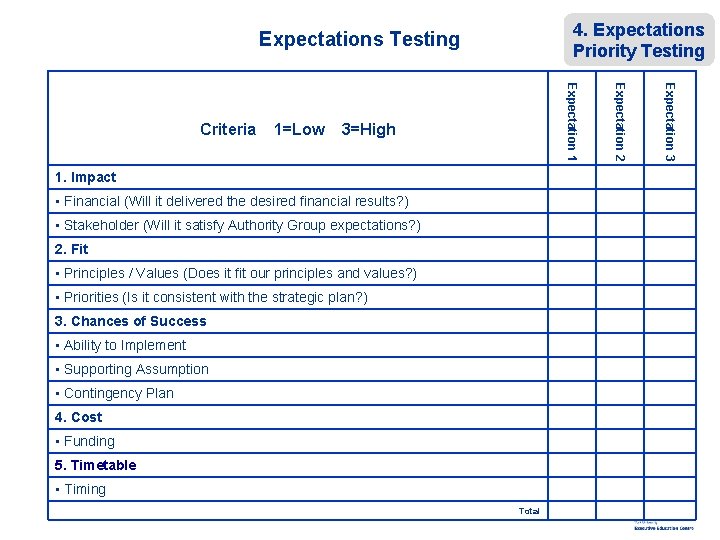
4. Expectations Priority Testing Expectations Testing Expectation 3 3=High Expectation 2 1=Low Expectation 1 Criteria 1. Impact • Financial (Will it delivered the desired financial results? ) • Stakeholder (Will it satisfy Authority Group expectations? ) 2. Fit • Principles / Values (Does it fit our principles and values? ) • Priorities (Is it consistent with the strategic plan? ) 3. Chances of Success • Ability to Implement • Supporting Assumption • Contingency Plan 4. Cost • Funding 5. Timetable • Timing © Total
Module 5 Developing the Dept. Business Plan ©
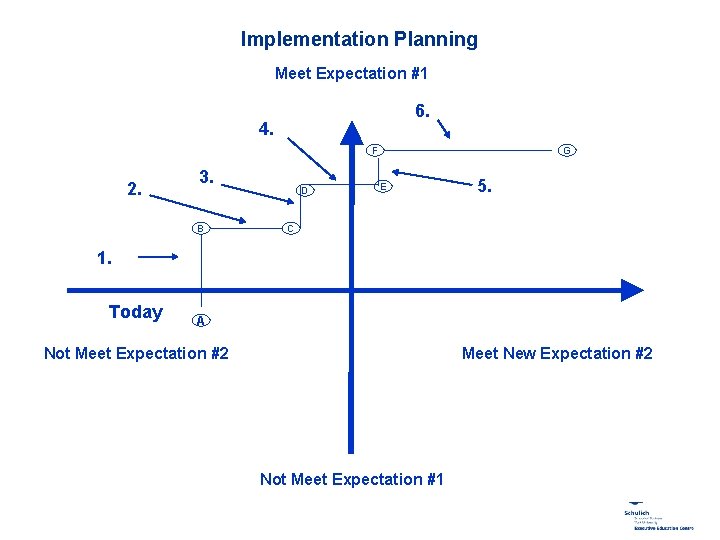
Implementation Planning Meet Expectation #1 6. 4. F 2. 3. B D G E 5. C 1. Today A Not Meet Expectation #2 Meet New Expectation #2 Not Meet Expectation #1 ©
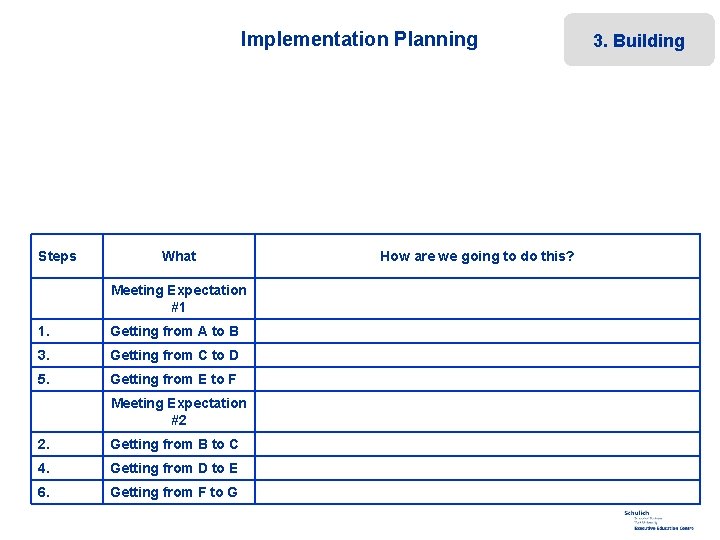
Implementation Planning Steps What 3. Building How are we going to do this? Meeting Expectation #1 1. Getting from A to B 3. Getting from C to D 5. Getting from E to F Meeting Expectation #2 2. Getting from B to C 4. Getting from D to E 6. Getting from F to G ©
Module 6 Business Plan Presentation ©
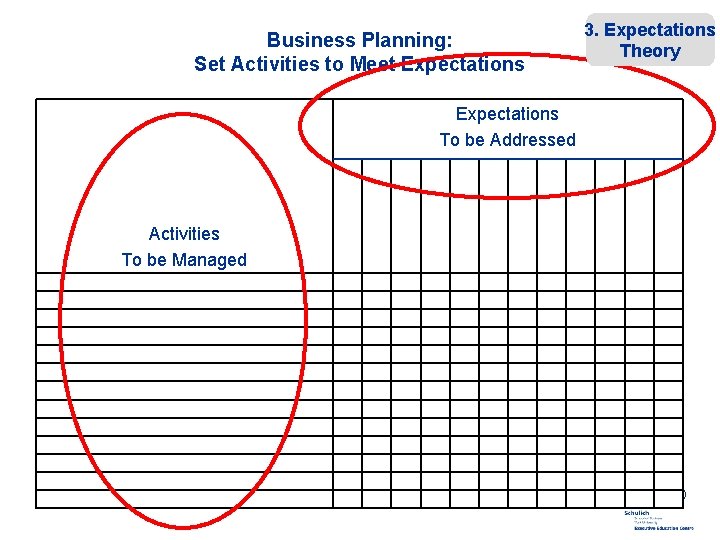
Business Planning: Set Activities to Meet Expectations 3. Expectations Theory Expectations To be Addressed Activities To be Managed ©

3 Categories of Functional Activities Functional Expertise e. g. Compliance / Consulting Services People Management Administrative ©

Functional Responsibilities 2. Branch Responsibilities PSSA Departmental Management Model Compliance and Consulting • • People Development • • Administrative Compliance • • ©
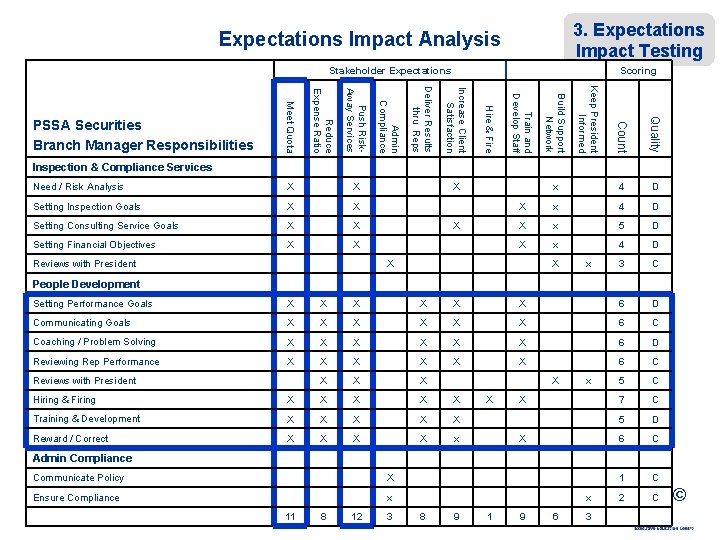
3. Expectations Impact Testing Expectations Impact Analysis Stakeholder Expectations Count Quality Keep President Informed Build Support Network Train and Develop Staff Hire & Fire Increase Client Satisfaction Deliver Results thru Reps Admin Compliance Push Risk. Away Services Reduce Expense Ratio Meet Quota PSSA Securities Branch Manager Responsibilities Scoring x 4 D X x 5 D X x 4 D 3 C Inspection & Compliance Services Need / Risk Analysis X X Setting Inspection Goals X X Setting Consulting Service Goals X X Setting Financial Objectives X X Reviews with President X X x People Development Setting Performance Goals X X X 6 D Communicating Goals X X X 6 C Coaching / Problem Solving X X X 6 D Reviewing Rep Performance X X X 6 C X X X 5 C 7 C 5 D 6 C 1 C 2 C Reviews with President X Hiring & Firing X X X Training & Development X X X Reward / Correct X X x X X Admin Compliance Communicate Policy X Ensure Compliance x 11 8 12 3 x 8 9 1 9 6 3 ©
Schedule “C” The Business Plan ©
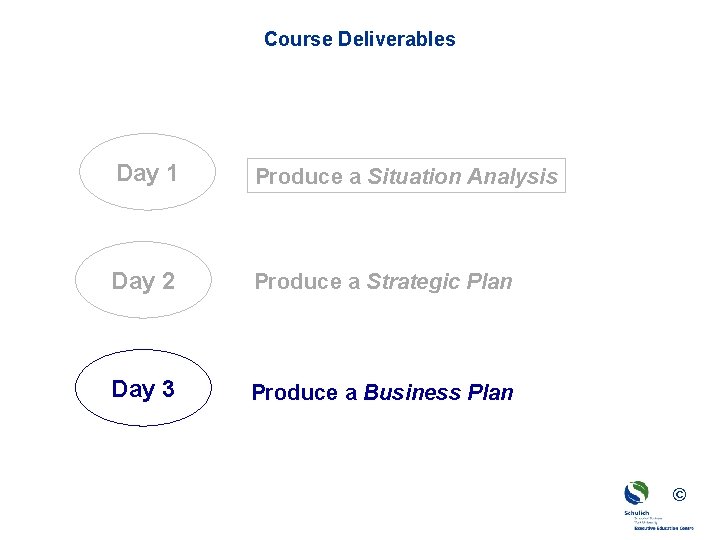
Course Deliverables Day 1 Produce a Situation Analysis Day 2 Produce a Strategic Plan Day 3 Produce a Business Plan ©
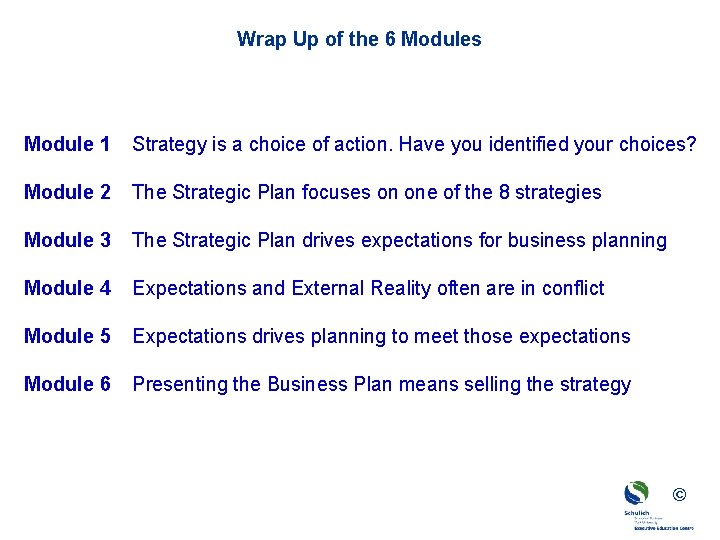
Wrap Up of the 6 Modules Module 1 Strategy is a choice of action. Have you identified your choices? Module 2 The Strategic Plan focuses on one of the 8 strategies Module 3 The Strategic Plan drives expectations for business planning Module 4 Expectations and External Reality often are in conflict Module 5 Expectations drives planning to meet those expectations Module 6 Presenting the Business Plan means selling the strategy ©

Business Plan Review 1. Choice of Planning Process: Should we be doing strategic planning or business planning? Day One: Situation Analysis 2. Scoping Expectations: Have we assessed the expectations for strategic planning? 3. Internal Assessment: Do we truly understand the how’s and why’s of our current state? 4. External Assessment: What factors in the external environment must we truly understand? 5. The Situation Analysis Review: Do we have enough understanding to support informed decis Day Two: Strategic Planning 6. Issue Development: Are we able to connect external factors to the strategy framework? 7. Strategic Issue Identification: Are we able to develop scenarios to identify possible strategic i 8. Strategic Plan Communication: Have we described the likely “what” and “when” impact of cha 9. Strategic Plan Review: Do we understand the strategic plan and how it is likely to impact us? Day Three: Business Planning 10. Expectations Impact: Can we identify the impact of strategic plan expectations on functional 11. Expectations Testing: Are the strategic plan expectations consistent with competitive reality 12. Strategy Implementation: How are new expectations (if any) to be integrated with ongoing re ©
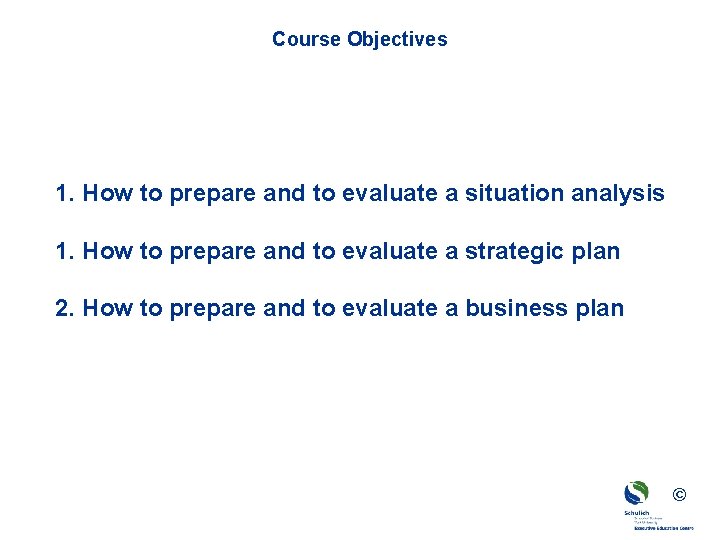
Course Objectives 1. How to prepare and to evaluate a situation analysis 1. How to prepare and to evaluate a strategic plan 2. How to prepare and to evaluate a business plan ©
- Slides: 41