
THE BUSINESS OF MEDICAL DEVICES intro Mike Gara
THE BUSINESS OF MEDICAL DEVICES –intro Mike Gara • Professor of Practice Clemson Bio. E • Director Healthcare Innovation, Clemson • Past Director Coulter Foundation-major funder of Translational Research in BME • Prior experience in VC, Tech Transfer, Business Development, Start-up Biotech, etc. • Baxter, Astra Zeneca, Senmed Ventures, Schwarz Pharma, Genzyme, CURx Pharma, UC
Homework • Read “Americas Bitter Pill”, Money, Politics, Backroom Deals and the Fight to Fix Our Broken Healthcare System • By Steven Brill
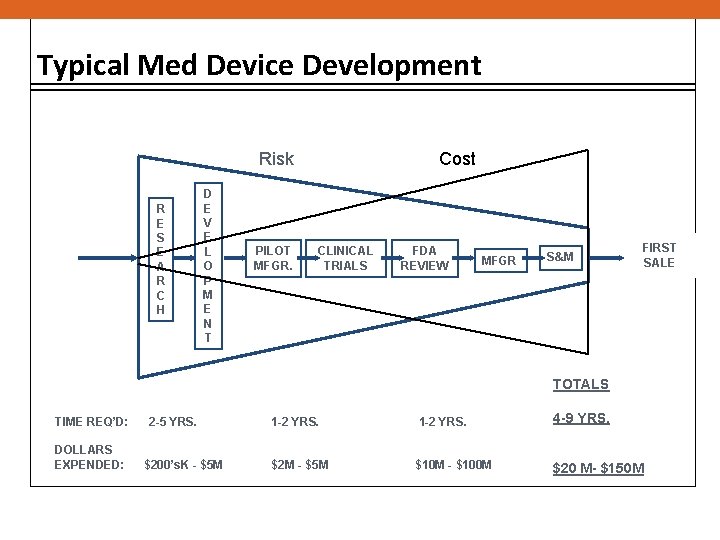
Typical Med Device Development Risk R E S E A R C H D E V E L O P M E N T PILOT MFGR. Cost CLINICAL TRIALS FDA REVIEW MFGR S&M FIRST SALE TOTALS TIME REQ’D: DOLLARS EXPENDED: 2 -5 YRS. $200’s. K - $5 M 1 -2 YRS. 4 -9 YRS. $2 M - $5 M $10 M - $100 M $20 M- $150 M
Technology Transfer • Technology Transfer is the process of moving intellectual capital from the lab or classroom to its practical application • Teaching • Publication • Public Service Activities • Commercialization of Intellectual Property • Universities focuses on transferring technology through • License agreements • New company formation
Intellectual Property • Intellectual property (IP) can be any product of the human mind or intellect, such as an idea, invention, expression, unique name, business method or chemical formula, that can ultimately be reduced to a tangible form. • IP is a right granted by the US constitution – Originate in Art. I, Sec. 8: To promote the progress of science and useful arts by securing for limited times to authors and inventors the exclusive right to their respective writings and discoveries. • 97% of patents don’t make $ to even cover costs of filing • Typical patent filing cost : US-$15 -25 K, WW-$70 -150 K
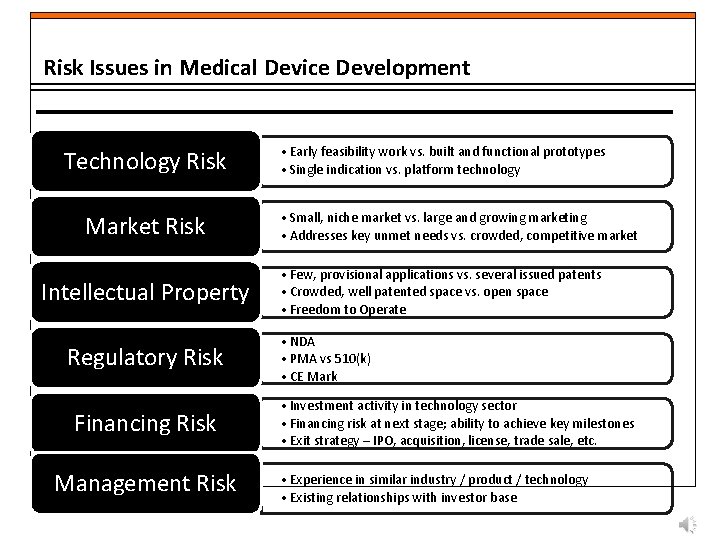
Risk Issues in Medical Device Development Technology Risk Market Risk Intellectual Property Regulatory Risk Financing Risk Management Risk • Early feasibility work vs. built and functional prototypes • Single indication vs. platform technology • Small, niche market vs. large and growing marketing • Addresses key unmet needs vs. crowded, competitive market • Few, provisional applications vs. several issued patents • Crowded, well patented space vs. open space • Freedom to Operate • NDA • PMA vs 510(k) • CE Mark • Investment activity in technology sector • Financing risk at next stage; ability to achieve key milestones • Exit strategy – IPO, acquisition, license, trade sale, etc. • Experience in similar industry / product / technology • Existing relationships with investor base
When Should Companies Innovate? • A great opportunity exists for disruption of equilibrium • To solve a significant problem or need • The product/service can be differentiated resulting in a competitive advantage • The financial model illustrates that potential revenue, margin & profits are substantial • The customer is willing to pay a premium price • Sources of capital are willing to fund
What's a Good Product? • Appropriate level of sophistication to treat the • • problem Reproducible! Manufactured in current plants & processes Approvable (FDA) Reimbursable i. e. 3 -5 yrs. for new codes from CMS Fits current channels of distribution Protectable with strong IP Clinically relevant and cost saving!
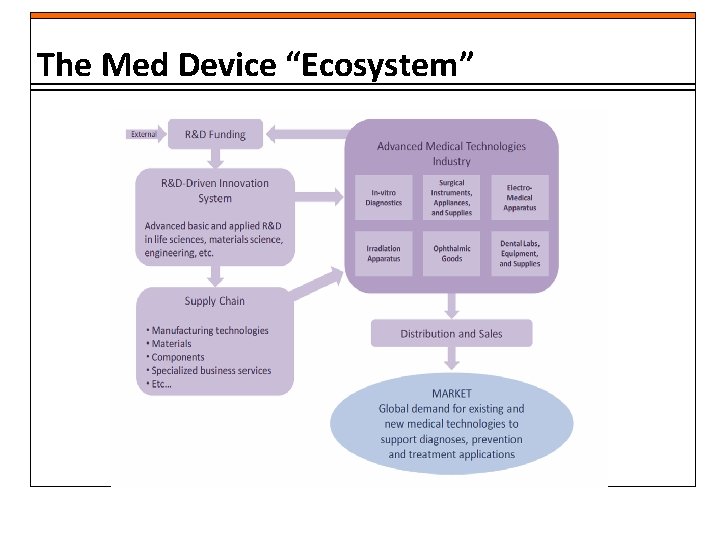
The Med Device “Ecosystem”
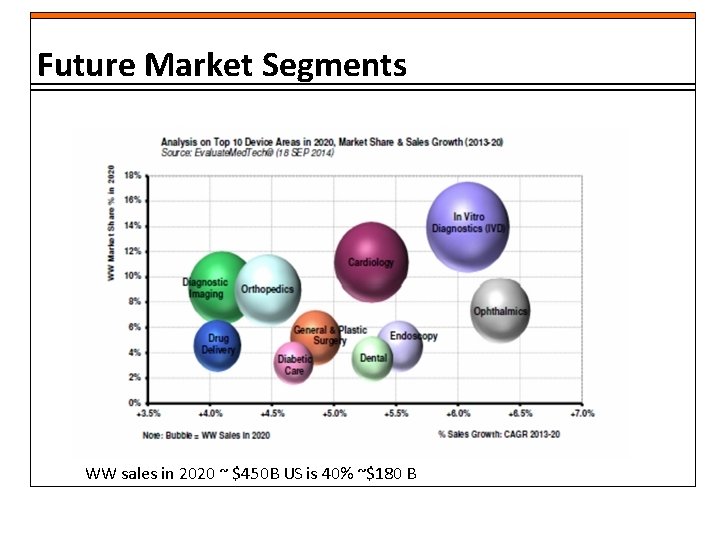
Future Market Segments WW sales in 2020 ~ $450 B US is 40% ~$180 B
Overview Regulatory • Brief overview of FDA governance • What am I developing? – – Drug Biologic Device Combination Product • Regulatory pathways – Devices – Combination Product • Product Testing • Manufacturing, Marketing, Reporting
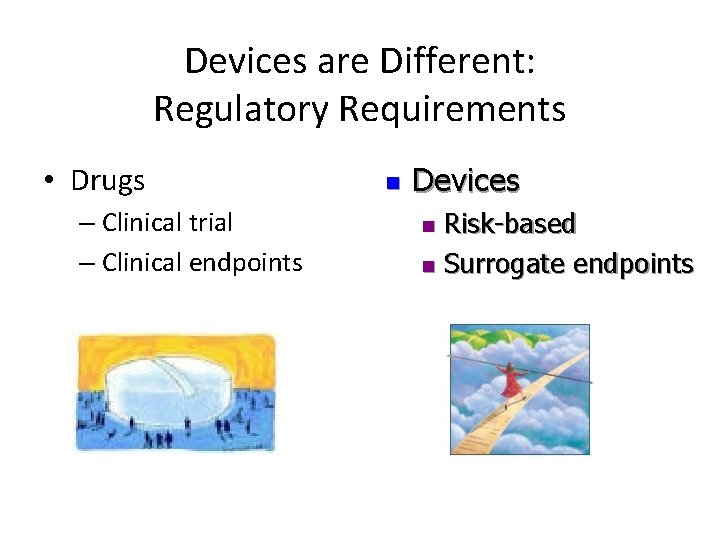
Devices are Different: Regulatory Requirements • Drugs – Clinical trial – Clinical endpoints n Devices Risk-based n Surrogate endpoints n
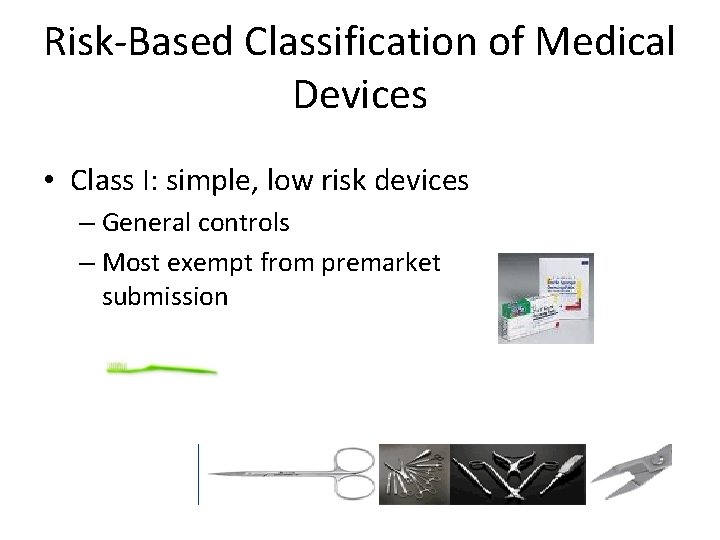
Risk-Based Classification of Medical Devices • Class I: simple, low risk devices – General controls – Most exempt from premarket submission
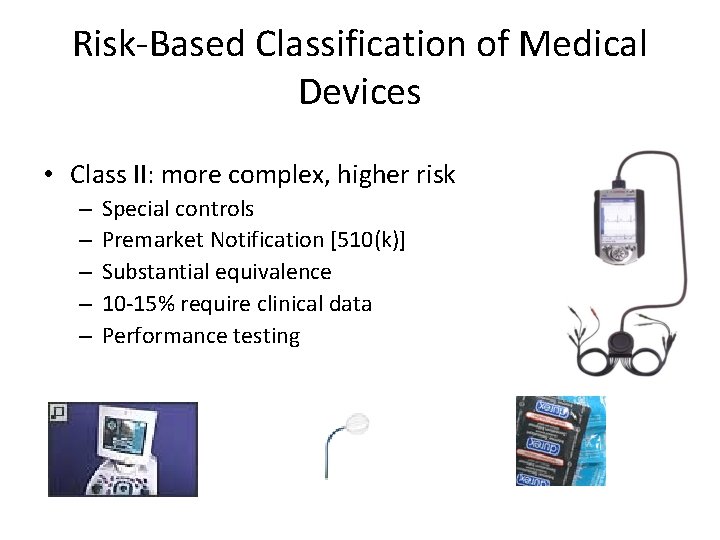
Risk-Based Classification of Medical Devices • Class II: more complex, higher risk – – – Special controls Premarket Notification [510(k)] Substantial equivalence 10 -15% require clinical data Performance testing
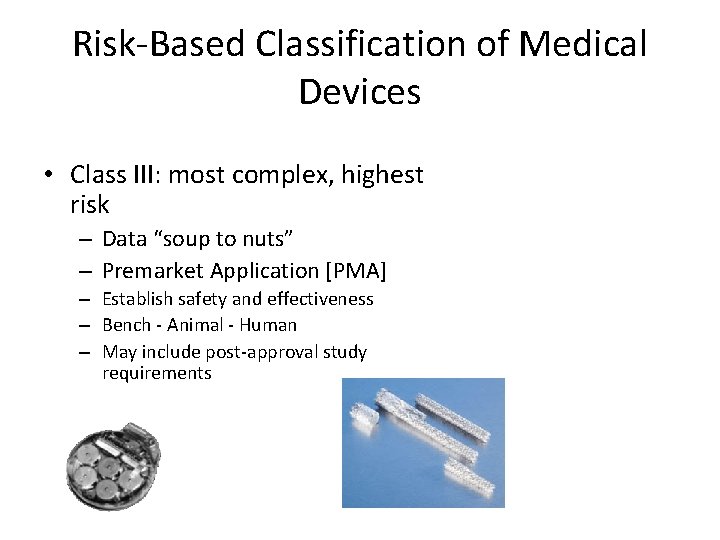
Risk-Based Classification of Medical Devices • Class III: most complex, highest risk – Data “soup to nuts” – Premarket Application [PMA] – Establish safety and effectiveness – Bench - Animal - Human – May include post-approval study requirements
PMA vs. 510(k) PMA • Safety and Effectiveness • Scientific Evidence • Almost Always Accompanied by Clinical Data • Detailed, Lengthy Application • Must be “Approved” Prior to Marketing • Pending PMA is Confidential; Following Approval, Summary Information is Released • Average review time: 364 days • Panel review 510(k) • Substantial Equivalence • Comparison to Existing (Predicate) Device • Possibly Contains Clinical Data (510% of 510(k)s) • Shorter • Must be “Cleared” Prior to Marketing • Pending 510(k) is Confidential; Following SE Determination Entire 510(k), Less Company Proprietary Data, is Released; 510(k) Summary Available 30 Days After Clearance • Average review time: 100 days (longer with clinical data)
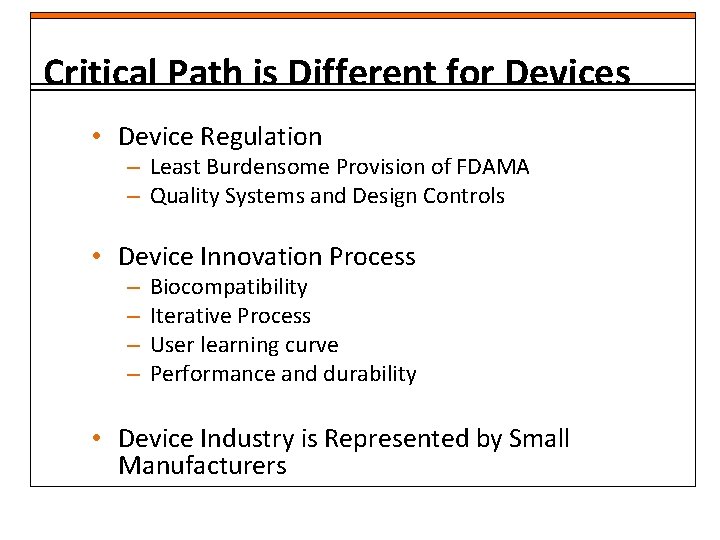
Critical Path is Different for Devices • Device Regulation – Least Burdensome Provision of FDAMA – Quality Systems and Design Controls • Device Innovation Process – – Biocompatibility Iterative Process User learning curve Performance and durability • Device Industry is Represented by Small Manufacturers
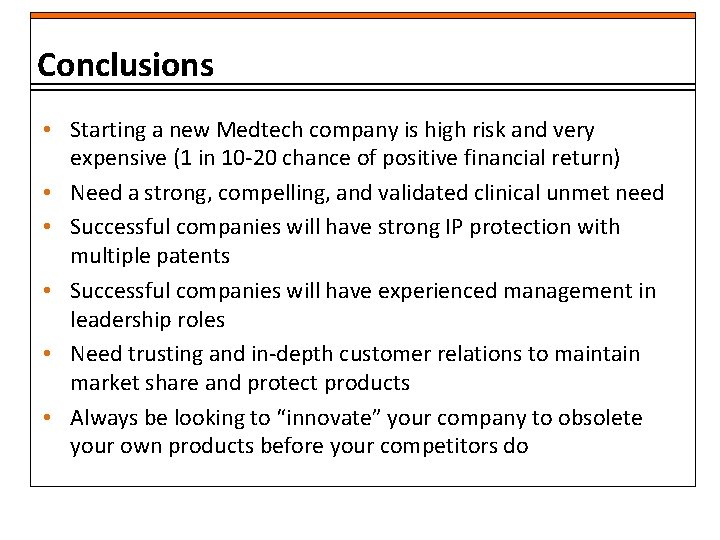
Conclusions • Starting a new Medtech company is high risk and very expensive (1 in 10 -20 chance of positive financial return) • Need a strong, compelling, and validated clinical unmet need • Successful companies will have strong IP protection with multiple patents • Successful companies will have experienced management in leadership roles • Need trusting and in-depth customer relations to maintain market share and protect products • Always be looking to “innovate” your company to obsolete your own products before your competitors do
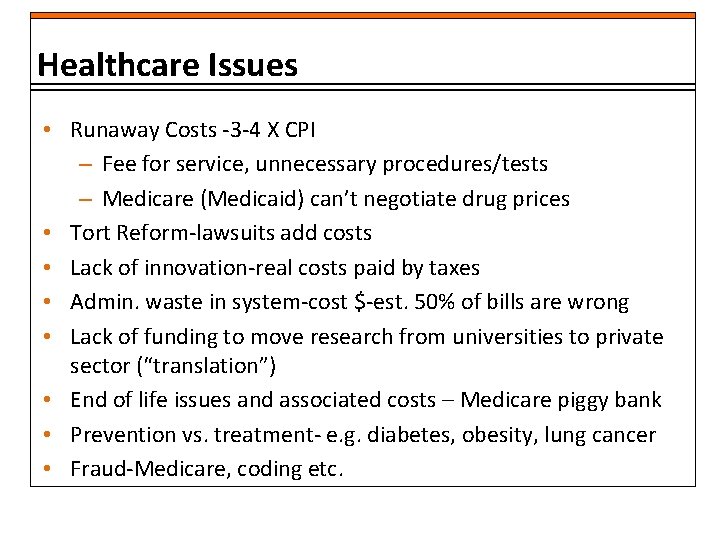
Healthcare Issues • Runaway Costs -3 -4 X CPI – Fee for service, unnecessary procedures/tests – Medicare (Medicaid) can’t negotiate drug prices • Tort Reform-lawsuits add costs • Lack of innovation-real costs paid by taxes • Admin. waste in system-cost $-est. 50% of bills are wrong • Lack of funding to move research from universities to private sector (“translation”) • End of life issues and associated costs – Medicare piggy bank • Prevention vs. treatment- e. g. diabetes, obesity, lung cancer • Fraud-Medicare, coding etc.
- Slides: 19