
The Bureaucracy Where the rubber meets the road
The Bureaucracy Where the rubber meets the road
What is a bureaucracy? • An organization of non-elected officials operating as a part of government which implement the laws, functions and rules of their institution
Bureaucracies • Bureaucratic institutions are created by Congress to achieve specific policy goals • By implementing the laws and policies passed by elected officials they act as agents of the Congress, and the Presidency – Bureaucratic agents have delegated responsibility from these branches and the leeway to carry out their tasks – Despite the best efforts to check bureaucrats, they always have their own goals and thus can exercise influence on policy
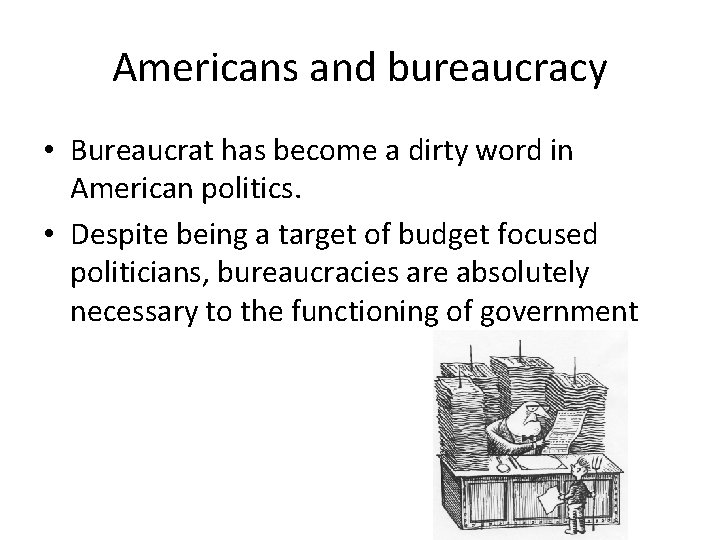
Americans and bureaucracy • Bureaucrat has become a dirty word in American politics. • Despite being a target of budget focused politicians, bureaucracies are absolutely necessary to the functioning of government
What do Bureaucracies do? • Enhance efficiency: – The core of any bureaucracy is a division of labor for carrying out big tasks and mandates – Bureaucracies tend to hire by merit from the public and represent a core of specialized expertise – Because they are on a budget, bureaucracies must operate with the fewest employees per supervisor
Bureaucracies allow governments to operate! • Bureaucracies serve to “routinize” government, creating established channels for the public to get services • Bureaucracy insulates important functions and services from the predatory actions of greedy officials – Mainly because of “Bureaucratic intertia”
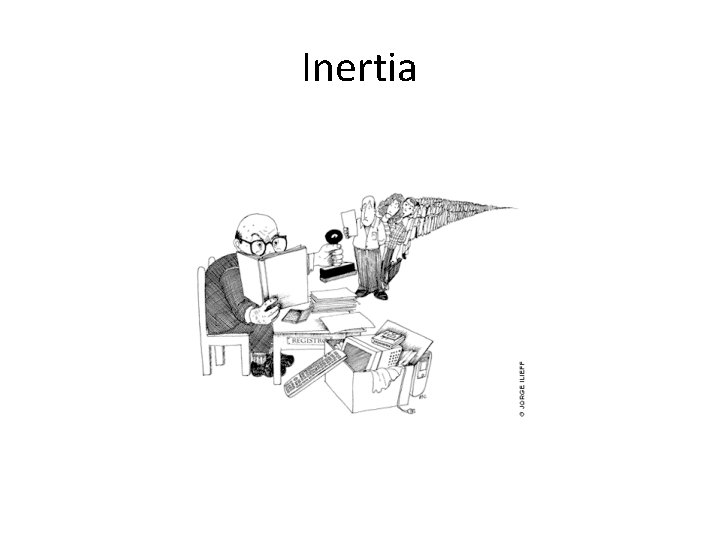
Inertia

The paradox of bureaucracy • Bureaucrats are meant to be the servants of elected officials, but the very nature of bureaucracy, with its layers of specializations makes it difficult if not impossible to significantly change
Bureaucracies both implement and MAKE laws • The most important function of an agency is implementation – Translating laws into specific bureaucratic routines and policies • The more vague the law, the more power the bureaucracy has • Congress can also delegate its law-making ability to bureaucrats, creating: rule making and Administrative Adjudication
Definitions • Rule Making: Giving an agency the power to produce regulations to govern itself or the private sector under its authority • Administrative Adjudication: The application of rules and precedents to settle disputes between parties within a bureaucracy rather than a court system
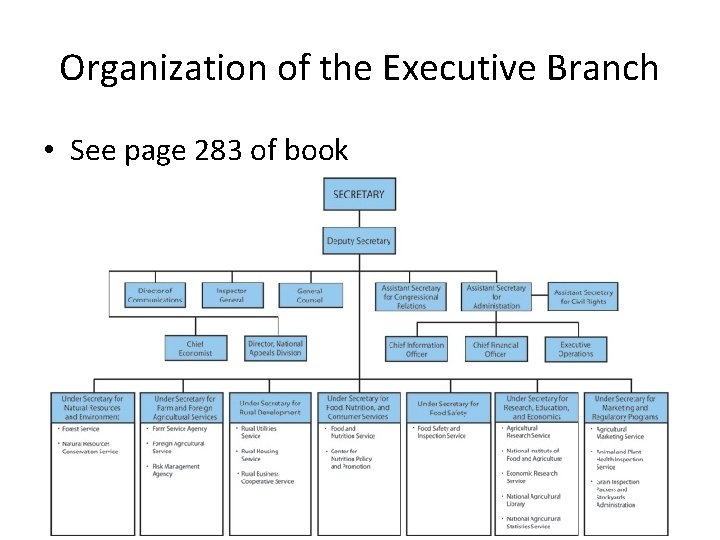
Organization of the Executive Branch • See page 283 of book
Levels of Bureaucracy • Secretary Level: Reports directly to President, represents entire Bureau in the White House • Top Advisors: Includes financial officers, chief inspectors, director of communications and others that help Secretary do his/her job • Under Secretary Level: Controls specific bureaus within the larger Department, typically run by undersecretaries or asst. secretaries
Levels of Bureaucracy • The Bureau Level: Individual Bureaus within the larger department examples: – Forestry Service, Food and Drug Administration
Other types of Bureaucracy • Government Corporation: Government agencies that act as private corporations and offer a market service. Examples include AMTRAK and the USPS • Independent Agencies: Set up by Congress outside the Cabinet structure. Designed to have powers too important or expensive to be left to private initiatives – Examples NASA, CIA
Functions of Bureaucracies • Clientele Agencies: Agencies built to service and regulate a specific group or clientele – Example: Department of Agriculture • Revenue Agencies: Designed to maintain the function of government by collecting revenue in the form of taxes, duties and tariffs – Example: The IRS • Security Agencies: Designed to protect the domestic tranquility and maintain order
Functions of Bureaucracies • External National Security Agencies: located in State and Defense, these are designed to protect the U. S. from espionage, sabotage and maintain our foreign policy • Regulatory Agencies: Bureau whose primary mission is to eliminate or restrict certain behaviors defined as negative by the public – Example: The EPA
Functions of Bureaucracies • Agencies of Redistribution: Implement fiscal, or monetary welfare policies. Help define how money is spent on poverty programs – Example: Social Security Administration • Fiscal and monetary agencies: monitor the flow of money in the country and the health of the banking and finance system. Has regulatory power to investigate and arrest white collar crime – Examples: Federal Reserve System: 12 Federal reserve districts that facilitate the exchange of cash, checks and credit. Regulates banks, and controls inflation/deflation of money
The problem of bureaucratic control • Bureaucracies are controlled by individuals with their own motivations – Bureaucracies are not passive servants, they lobby constantly for money and resources – Bureaucrats typically devote resources to lobbying the very people who pay them, the Committees – Thus Bureaucrats often become politicians in their own right
Problems of Bureaucratic Control • Agents with an agenda often create Bureaucratic Drift: – Bureaucratic implementation produces policy more to the liking to the bureaucrat than faithful to the original legislation • The change is typically noticeable, but not so big that it provokes a reaction from the legislation • Congress will typically build in before-the-fact controls to keep drift to a minimum
Problems of Bureaucratic Control • Bureaucrats sometimes have to deal with legislation written in bad faith – Coalition drift: enacted policy being changed from its original intent by poorly written or provisional policy – This is typically the result of politicians intentionally sabotaging legislation they can’t safely vote against
The President’s Control • The White House has taken an increasingly direct hand in the management of bureaucracies • Budget and Accounting Act: Passed in 1921, this act gives the President direct agenda control of agency budgets • Presidents are now expected to be the CEO of the bureaucracies and will be criticized for bureaucratic failures

Congress • Congress has oversight as well as the purchasing power – Oversight: using hearings, investigations and other techniques to exercise control over executive agencies • Because bureaucracies are in the middle of the Executive and Judicial, they often take advantage of conflicting jurisdictions to evade oversight. They often expand their mandate – Example (do not write) Johnson’s Model Cities program (from 10 to 100 cities)
Reducing Bureaucracy • The only way to effectively end bureaucracy is termination – Ending of an agency, this is a rare occasion – Even Gingrich’s Congress, dedicated to reducing government failed to terminate significant bureaucracies
Reducing Bureaucracy • Deregulation: Reducing or eliminating regulatory constraints laid by bureaucracies on private industry • Devolution: Downsizing the federal government by passing federal bureaucratic control to state and local governments • Privatization: Moving part or all of a program from the public sector to the private sector – Private contractors assume the role of bureaucratic watchdog. – Leads to problems of accountability
Other attempts • Sunshine laws: passed in 1976 the Government in Sunshine Acts requires the heads of Bureaucratic agencies to publish financial reports and hold open meetings regarding their agency • Congress also uses Sunset provisions
Protecting whistleblowers • Whistleblowers are members of an organization that act independently to reveal corruption or mismanagement in that organization • Whistleblower Protection Act of 1989 establishes an Office of Special Counsel to investigate complaints of waste by government employees and protects them from persecution • False Claims Act of 1986 - Allows whistleblowers to receive a monetary award for revealing waste
Staffing a bureaucracy • There are different levels of staffing in a bureaucracy that are typically carried out in specific ways • Political Appointment: Reserved for the top levels of a bureaucracy, the President personally appoints top staff – Cronyism: Problems can arise if a President chooses political donors, or allies (cronies) instead of qualified candidates – Length: Political appointees typically only occupy their offices for AT MOST 8 year terms, fast turnaround means rapid policy change
Cronyism and the Spoils System • 1883 Pendleton Act: requires all civil servants to demonstrate competence in their field • Elrod v Burns 1976: Court forbade politicians from threatening to fire civil servants for not supporting their agenda or politics • Rutan v Republican Party of Illinois, 1990: Forbade bureaucracies from hiring, firing, transferring or promoting based on political party loyalty
Cronyism and the Spoils System • The Hatch Act: Passed as part of the New Deal, this act forbids members of Bureaucracies from taking active part in managing political campaigns – SCOTUS reaffirmed this in 1973, arguing that the neutrality of the Bureaucracy trumps the 1 st amendment right of bureaucrats
Cronyism and the Spoils System • Office of Personnel Management (OPM): monitors the selection process for all bureaucracies and ensures that civil servants are not being given preferential treatment based on politics, race, creed, or gender. Manages security clearances for most non-intelligence agencies • Merit Systems Protection Board (MSPB): Monitors promotions and firings. Allows federal employees who have been fired or suspended to appeal the action if discrimination is suspected.
Staffing a Bureaucracy • Civil Servants: professionals hired by the bureaucracy to act in various functions – Bureaucratic rules make it very difficult to fire civil servants, less than. 1% of federal employees have been fired for incompetence – The Civil Service Reform Act of 1978: allows for a system of promotions and raises within the bureaucracy that has produced the modern ranking system

Bureaucracies of Note • The Federal Reserve: A system of 12 federal banks jointly responsible for handling the nation’s monetary policy. Sets interest rates, thereby tightening or loosening the credit in the country. Facilitates the exchange of checks and credit • Social Security Administration: Independent Agency that oversees the country’s social insurance agency. Provides stipends to retired citizens, or those unable to work. Must adjust social security payments based on Cost of Living Index

Bureaucracies of Note • Federal Trade Commission: Independent agency designed to provide consumer protection and prevent monopolistic policies. Monitors mergers, stock trades, and takeovers to prevent collusion. Has judicial power to investigate and prosecute people who violate trade laws, and to halt mergers or break up monopolies.
Bureaucracies of Note • Federal Deposit Insurance Corporation: Insures deposits in federal banks up to $200, 000, designed to prevent bank runs by allowing citizens to collect their life savings from failed banks.
- Slides: 34