
The Bureaucracy Problems in Implementing Policy Implementation is
The Bureaucracy

Problems in Implementing Policy • Implementation is the process of putting specific policies into implementation. Ultimately, bureaucrats must convert policies from words on paper into action.
Problems in Implementing Policy (Cont’d) • Many factors such as vague directives, the complexity of the endeavor, or lack of discretion can influence the implementation of programs and policies out in the field. • Implementation is an incremental process in which trial and error eventually lead to policies that work.
Reforming the Bureaucracy • Regulation- intervening in the natural working of business markets to promote a social goal. • Deregulation was an approach to reform that was championed by conservatives who prefer less government involvement in the economy. Took place in the 1970’s, 1980’s in airplane, trucking and financial services. Ex. Bell systems was the only carrier for long distance. Now AT&T, Sprint, Verizon. • Presidents and agency administrators always seek to improve the performance of the bureaucracy.
Reforming the bureaucracy • In recent years four basic approaches to reforming the bureaucracy have attracted the most attention. • Deregulation • Competition and outsourcing • Total quality management • Performance standards
Reforming the Bureaucracy (Cont’d) • These initiatives tend to alternate between making government smaller and less intrusive and fighting waste in government. • Private competition and outsourcing promote business-like practices that promote efficiency and innovation.
Reforming the Bureaucracy • The most recent wave of reform focused on government responsiveness and total quality management. 4 components: listening to the customer, relying on teamwork, continual improvement, engaging in participatory management, breaking down barriers. • Performance standards were adopted as a result of the Government Performance and Results Act. Each agency must create a specific plan describing their goals and objectives. In 2000 agencies must publish reports with measurable performance data.
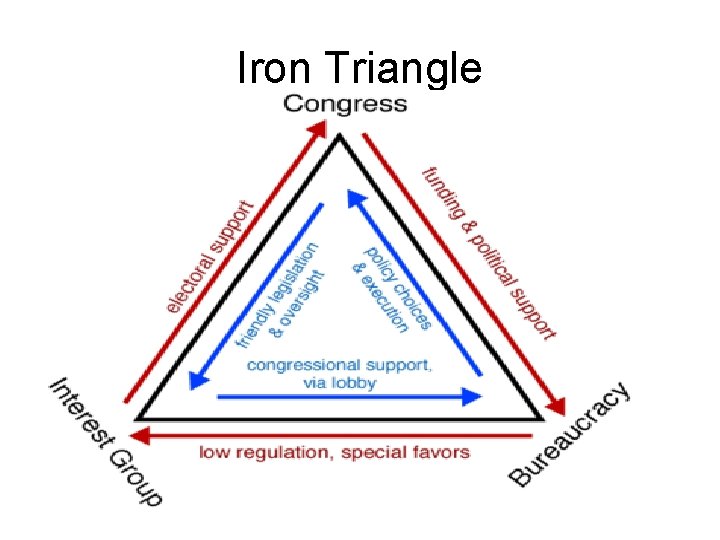
• In United States politics, the iron triangle is a term used by political scientists to describe the policy-making relationship between the legislature, the bureaucracy (sometimes called "Government Agencies"), and interest groups.
Iron Triangle (cont) • In the federal government, the phrase refers to the United States Congress (in particular, the congressional committees responsible for oversight) along with the federal agencies (often independent agencies) responsible for regulation of those industries, and the industries and their trade associations
Iron Triangle
- Slides: 11