
The Buncefield Explosion A benchmark for infrasound analysis
The Buncefield Explosion: A benchmark for infrasound analysis in Europe L. Ceranna, D. Green, A. Le Pichon & P. Mialle BGR / B 3. 11, Hannover, Germany AWE, Blacknest, United Kingdom CEA/DASE, Bruyères le Châtel, France Infrasound Technology Workshop – Tokyo, November 2007 1
Content Ø Infrasound recordings • PMCC analysis in the frequency range between 0. 1 and 4 Hz • Extraction of mean features: signal and wave parameters Ø Propagation modeling • Empirical wind model HWM 93 • Semi empirical wind model NRL G 2 S • 1 D / 3 D ray tracing – propagation tables www. flickr. com Ø Objectives • Comparing atmospheric models and propagation tools • Explain multiple arrivals and lack of detection at some stations • Source location with / without wind corrections • Single station location • Yield estimate • Explaining fast arrivals Ø Conclusions Infrasound Technology Workshop – Tokyo, November 2007 2
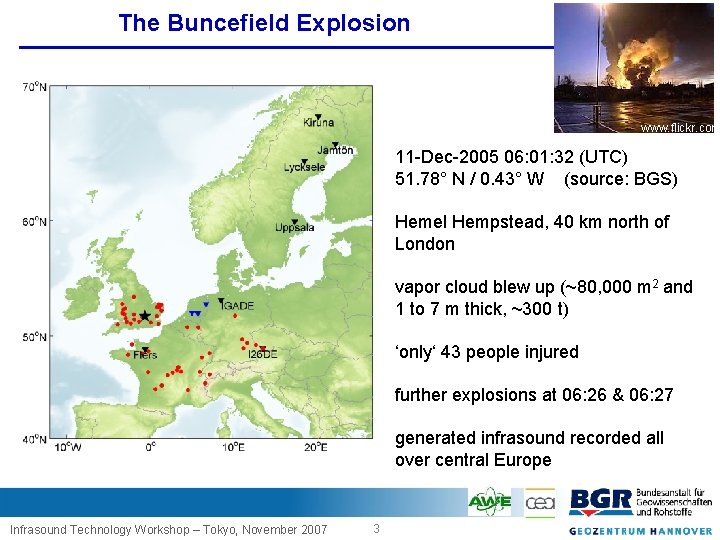
The Buncefield Explosion www. flickr. com 11 Dec 2005 06: 01: 32 (UTC) 51. 78° N / 0. 43° W (source: BGS) Hemel Hempstead, 40 km north of London vapor cloud blew up (~80, 000 m 2 and 1 to 7 m thick, ~300 t) ‘only‘ 43 people injured further explosions at 06: 26 & 06: 27 generated infrasound recorded all over central Europe Infrasound Technology Workshop – Tokyo, November 2007 3
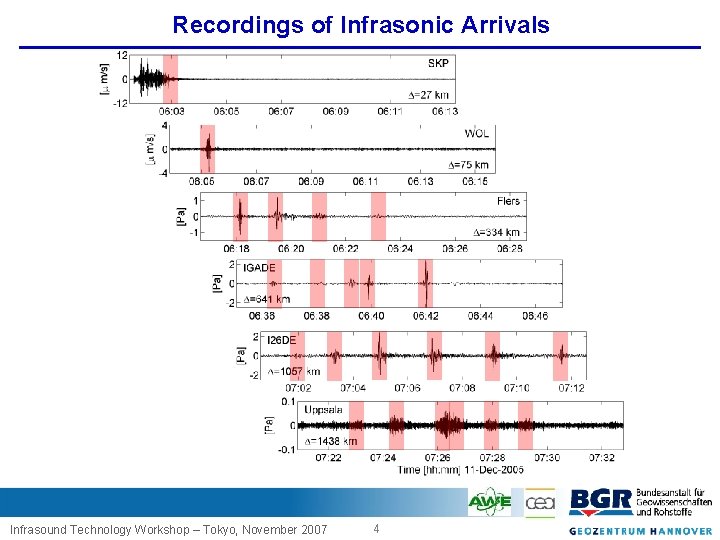
Recordings of Infrasonic Arrivals Infrasound Technology Workshop – Tokyo, November 2007 4
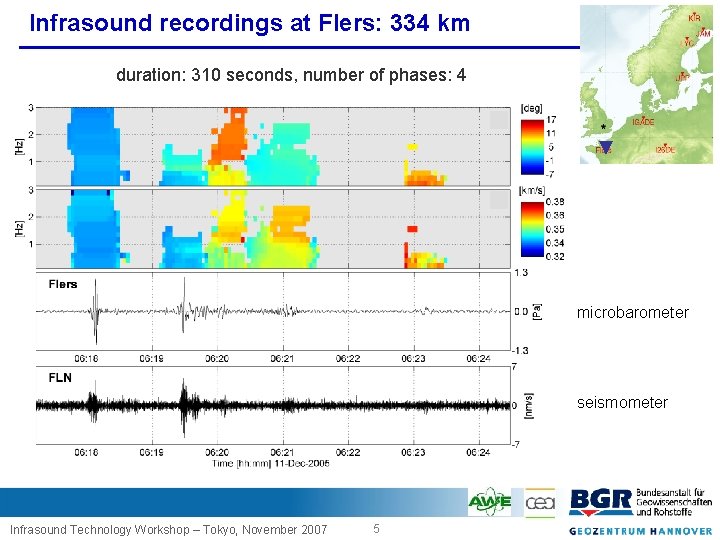
Infrasound recordings at Flers: 334 km duration: 310 seconds, number of phases: 4 ▼ microbarometer seismometer Infrasound Technology Workshop – Tokyo, November 2007 5
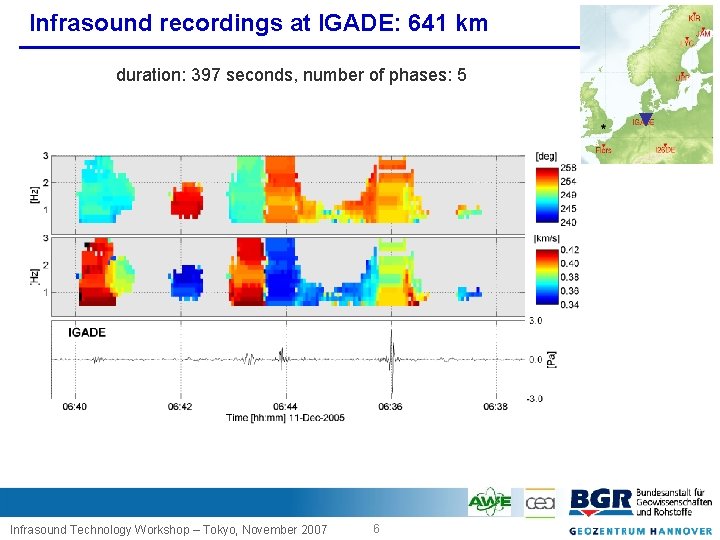
Infrasound recordings at IGADE: 641 km duration: 397 seconds, number of phases: 5 ▼ Infrasound Technology Workshop – Tokyo, November 2007 6
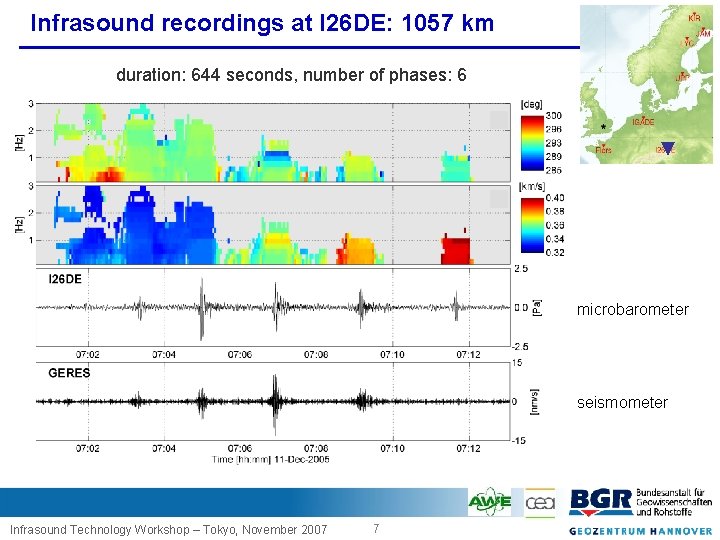
Infrasound recordings at I 26 DE: 1057 km duration: 644 seconds, number of phases: 6 ▼ microbarometer seismometer Infrasound Technology Workshop – Tokyo, November 2007 7
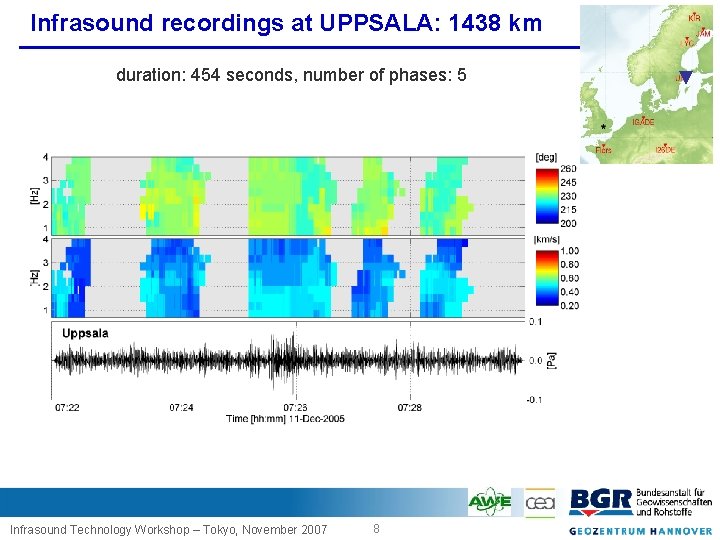
Infrasound recordings at UPPSALA: 1438 km duration: 454 seconds, number of phases: 5 Infrasound Technology Workshop – Tokyo, November 2007 8 ▼

Infrasound recordings at LYCKSELE: 1806 km NO DETECTION Infrasound Technology Workshop – Tokyo, November 2007 9 ▼
Infrasound recordings at JAMTON: 2033 km NO DETECTION Infrasound Technology Workshop – Tokyo, November 2007 10 ▼
Infrasound recordings at KIRUNA: 2114 km NO DETECTION Infrasound Technology Workshop – Tokyo, November 2007 11 ▼
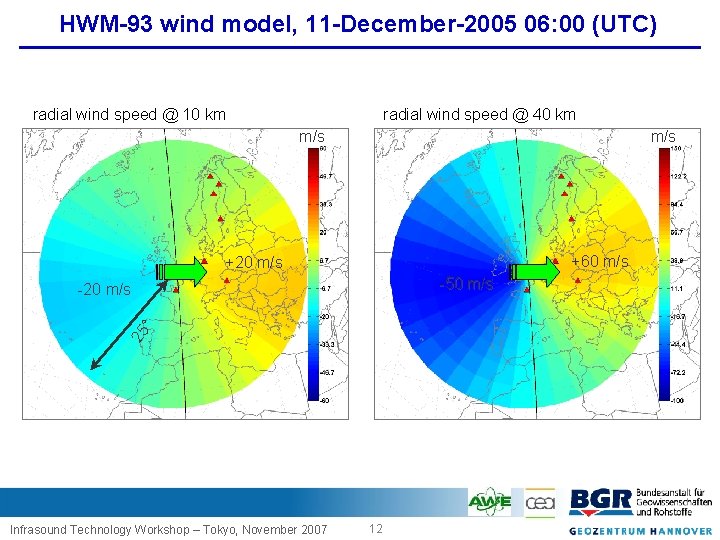
HWM-93 wind model, 11 -December-2005 06: 00 (UTC) radial wind speed @ 10 km radial wind speed @ 40 km m/s +60 m/s +20 m/s 50 m/s 25 ° 20 m/s Infrasound Technology Workshop – Tokyo, November 2007 12
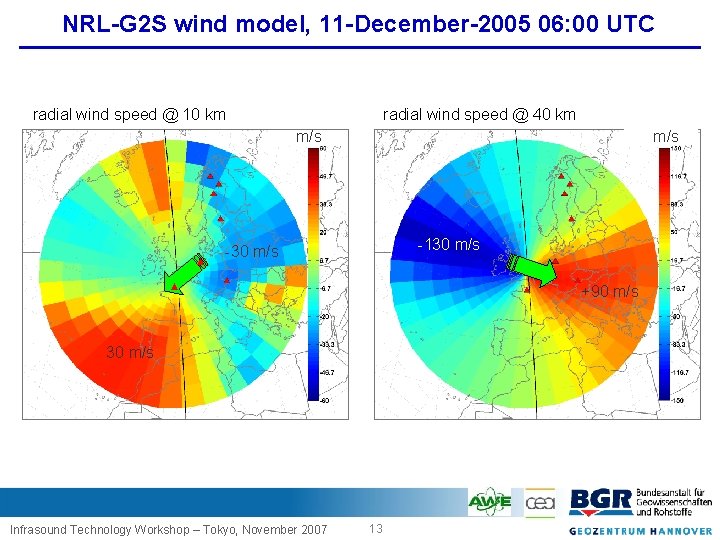
NRL-G 2 S wind model, 11 -December-2005 06: 00 UTC radial wind speed @ 10 km radial wind speed @ 40 km m/s ▲ m/s 130 m/s ▲ +90 m/s 30 m/s Infrasound Technology Workshop – Tokyo, November 2007 13

Differences caused by the extreme wind conditions • large differences in wind speed between HWM 93/NRL G 2 S (20 70 m/s) • tropospheric winds blow in different direction • reception of Iw/Is to the SW/SE of London, predicted for NRL G 2 S • maximum differences in wind speed between individual receivers: ~20 m/s @ 10 for km; 3 -D ~60 m/s @ 40 km Need propagation simulations Infrasound Technology Workshop – Tokyo, November 2007 14
Phase Identification, e. g. , Flers ray tracing (1 D τ p) & WASP 3 D phase identification using travel time curves … and time frequency analysis Infrasound Technology Workshop – Tokyo, November 2007 15
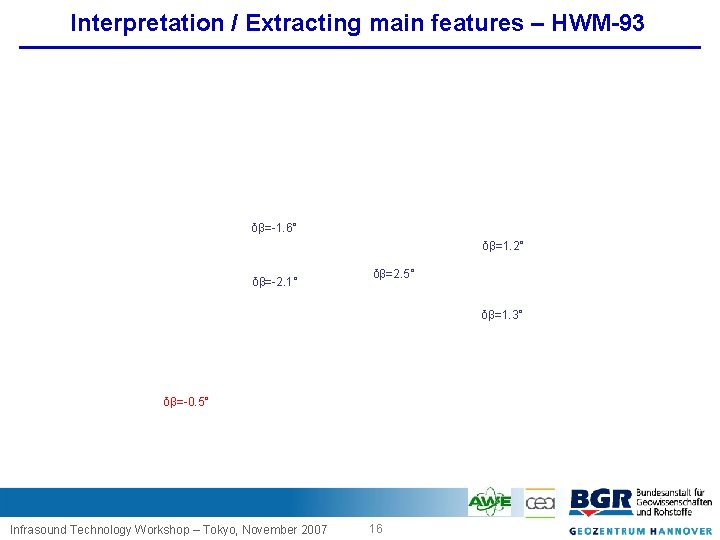
Interpretation / Extracting main features – HWM-93 δβ= 1. 6° δβ=1. 2° δβ= 2. 1° δβ=2. 5° δβ=1. 3° δβ= 0. 5° Infrasound Technology Workshop – Tokyo, November 2007 16
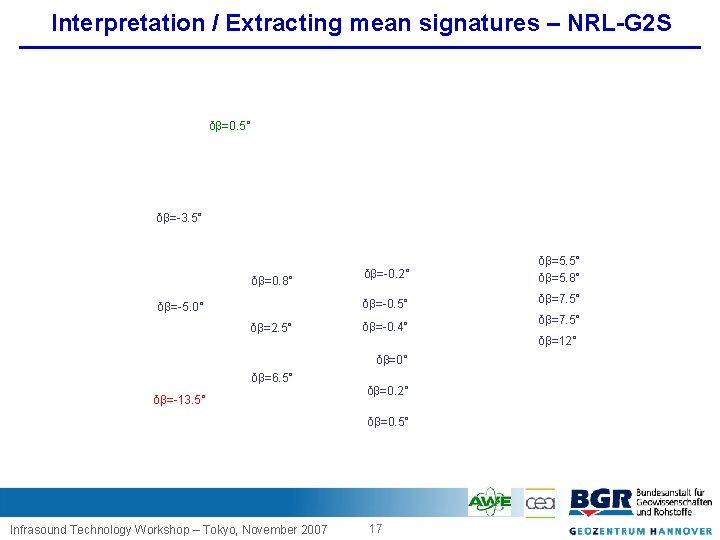
Interpretation / Extracting mean signatures – NRL-G 2 S δβ=0. 5° δβ= 3. 5° δβ=0. 8° δβ= 5. 0° δβ=2. 5° δβ= 0. 2° δβ=5. 5° δβ=5. 8° δβ= 0. 5° δβ=7. 5° δβ= 0. 4° δβ=12° δβ=0° δβ=6. 5° δβ= 13. 5° δβ=0. 2° δβ=0. 5° Infrasound Technology Workshop – Tokyo, November 2007 δβ=7. 5° 17
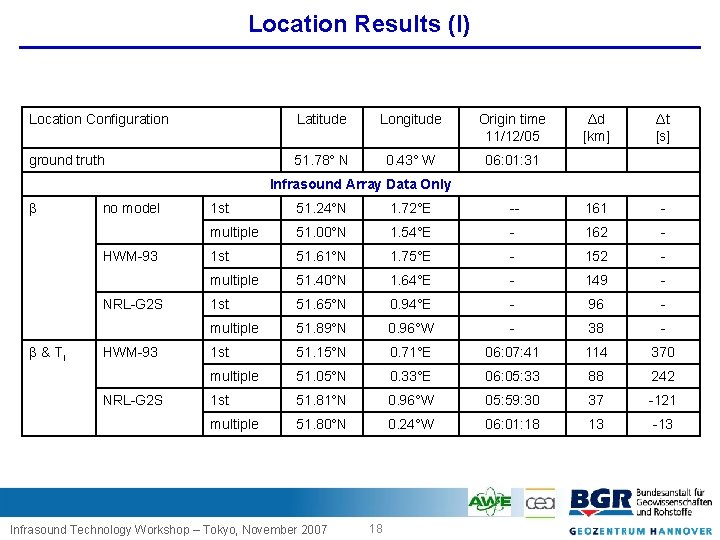
Location Results (I) Location Configuration Latitude Longitude Origin time 11/12/05 ground truth 51. 78° N 0. 43° W 06: 01: 31 Δd [km] Δt [s] Infrasound Array Data Only β no model HWM 93 NRL G 2 S β & TI HWM 93 NRL G 2 S 1 st 51. 24°N 1. 72°E 161 multiple 51. 00°N 1. 54°E 162 1 st 51. 61°N 1. 75°E 152 multiple 51. 40°N 1. 64°E 149 1 st 51. 65°N 0. 94°E 96 multiple 51. 89°N 0. 96°W 38 1 st 51. 15°N 0. 71°E 06: 07: 41 114 370 multiple 51. 05°N 0. 33°E 06: 05: 33 88 242 1 st 51. 81°N 0. 96°W 05: 59: 30 37 121 multiple 51. 80°N 0. 24°W 06: 01: 18 13 Infrasound Technology Workshop – Tokyo, November 2007 18
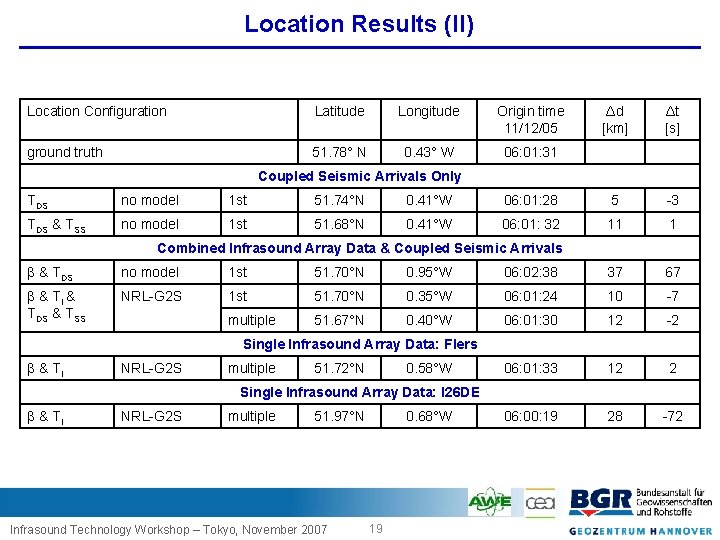
Location Results (II) Location Configuration Latitude Longitude Origin time 11/12/05 ground truth 51. 78° N 0. 43° W 06: 01: 31 Δd [km] Δt [s] Coupled Seismic Arrivals Only TDS no model 1 st 51. 74°N 0. 41°W 06: 01: 28 5 3 TDS & TSS no model 1 st 51. 68°N 0. 41°W 06: 01: 32 11 1 Combined Infrasound Array Data & Coupled Seismic Arrivals β & TDS no model 1 st 51. 70°N 0. 95°W 06: 02: 38 37 67 β & TI & TDS & TSS NRL G 2 S 1 st 51. 70°N 0. 35°W 06: 01: 24 10 7 multiple 51. 67°N 0. 40°W 06: 01: 30 12 2 06: 01: 33 12 2 06: 00: 19 28 72 Single Infrasound Array Data: Flers β & TI NRL G 2 S multiple 51. 72°N 0. 58°W Single Infrasound Array Data: I 26 DE β & TI NRL G 2 S multiple 51. 97°N Infrasound Technology Workshop – Tokyo, November 2007 0. 68°W 19
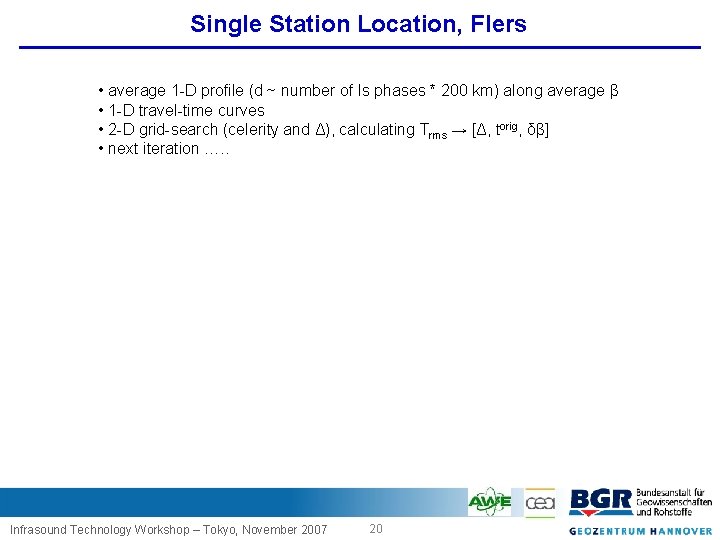
Single Station Location, Flers • average 1 D profile (d ~ number of Is phases * 200 km) along average β • 1 D travel time curves • 2 D grid search (celerity and Δ), calculating Trms → [Δ, torig, δβ] • next iteration …. . Infrasound Technology Workshop – Tokyo, November 2007 20
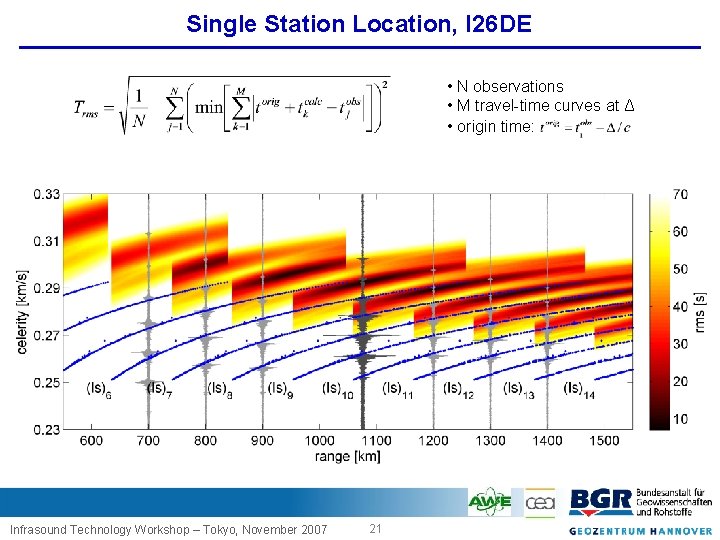
Single Station Location, I 26 DE • N observations • M travel time curves at Δ • origin time: Infrasound Technology Workshop – Tokyo, November 2007 21
![Yield estimate [Whitaker et al. , 2003; Evers et al. 2007] Station Flers IGADE](http://slidetodoc.com/presentation_image_h2/7efe2e17ca4b7e3f0ad795e77bde5d50/image-22.jpg "Yield estimate [Whitaker et al. , 2003; Evers et al. 2007] Station Flers IGADE")
Yield estimate [Whitaker et al. , 2003; Evers et al. 2007] Station Flers IGADE I 26 DE VD [m/s] 15 91 95 A [Pa] max 1. 35 5. 95 4. 88 min 0. 45 3. 87 1. 67 PWCA [Pa] max 0. 73 0. 14 0. 10 min 0. 24 0. 09 0. 03 Y [t] max 153 53 85 yield varies between 19 and 153 t HE min 32 29 19 300 t vapor cloud → ~30 t HE median 33 Infrasound Technology Workshop – Tokyo, November 2007 22
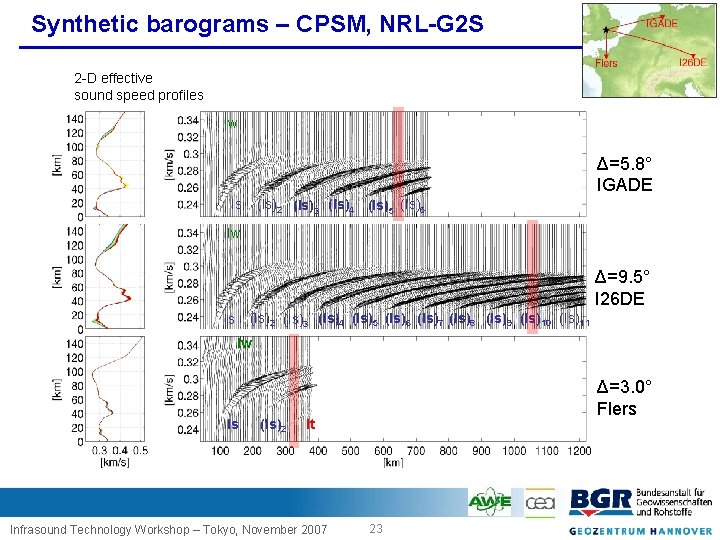
Synthetic barograms – CPSM, NRL-G 2 S 2 D effective sound speed profiles Iw Δ=5. 8° IGADE Is (Is)2 (Is)3 (Is)4 (Is)5 (Is)6 Iw Δ=9. 5° I 26 DE (Is)2 (Is)3 (Is)4 (Is)5 (Is)6 (Is)7 (Is)8 (Is)9 (Is)10 (Is)11 Is Iw Is (Is)2 Δ=3. 0° Flers It Infrasound Technology Workshop – Tokyo, November 2007 23
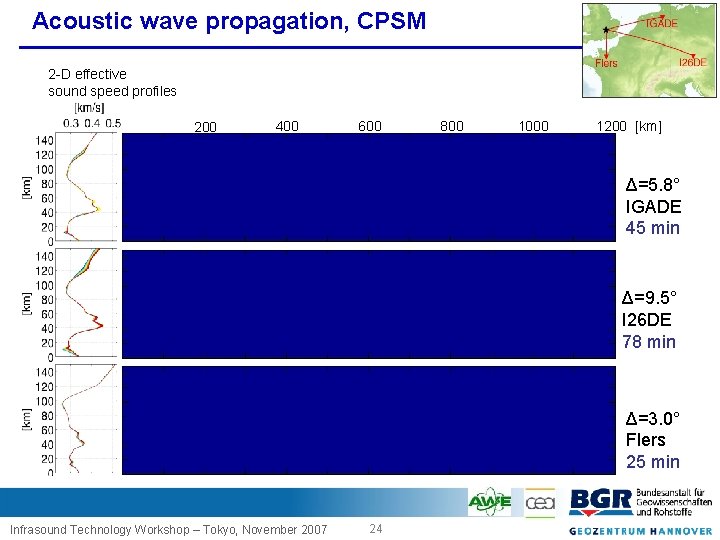
Acoustic wave propagation, CPSM 2 D effective sound speed profiles 200 400 600 800 1000 1200 [km] Δ=5. 8° IGADE 45 min Δ=9. 5° I 26 DE 78 min Δ=3. 0° Flers 25 min Infrasound Technology Workshop – Tokyo, November 2007 24
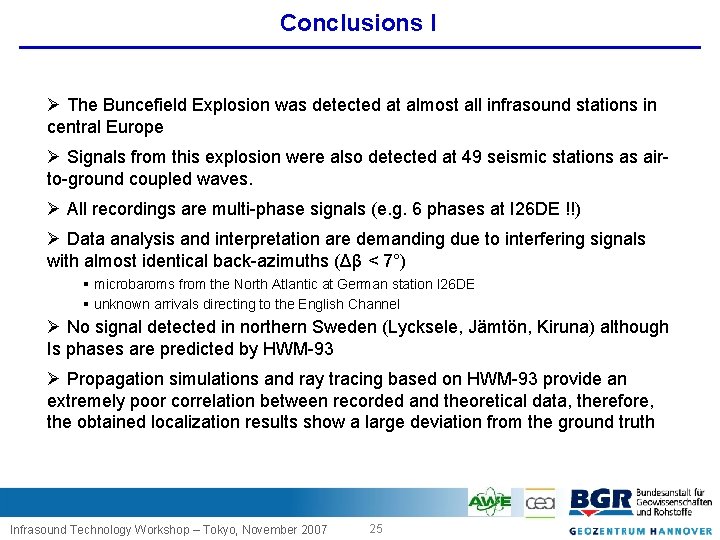
Conclusions I Ø The Buncefield Explosion was detected at almost all infrasound stations in central Europe Ø Signals from this explosion were also detected at 49 seismic stations as air to ground coupled waves. Ø All recordings are multi phase signals (e. g. 6 phases at I 26 DE !!) Ø Data analysis and interpretation are demanding due to interfering signals with almost identical back azimuths (Δβ < 7°) § microbaroms from the North Atlantic at German station I 26 DE § unknown arrivals directing to the English Channel Ø No signal detected in northern Sweden (Lycksele, Jämtön, Kiruna) although Is phases are predicted by HWM 93 Ø Propagation simulations and ray tracing based on HWM 93 provide an extremely poor correlation between recorded and theoretical data, therefore, the obtained localization results show a large deviation from the ground truth Infrasound Technology Workshop – Tokyo, November 2007 25
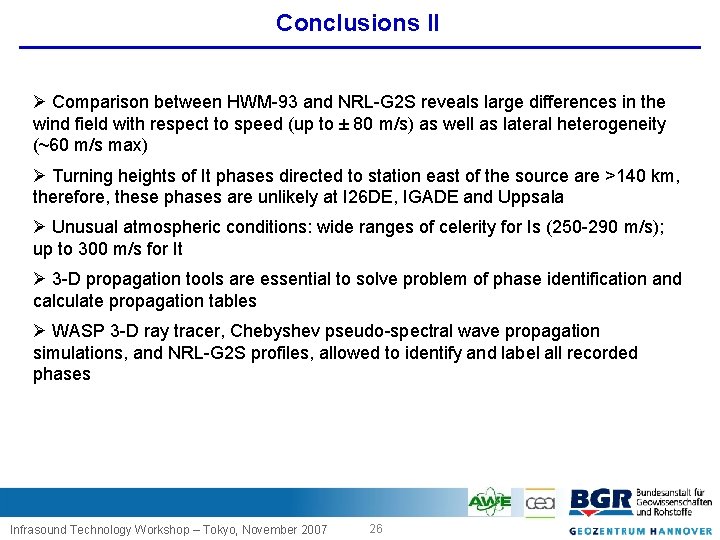
Conclusions II Ø Comparison between HWM 93 and NRL G 2 S reveals large differences in the wind field with respect to speed (up to ± 80 m/s) as well as lateral heterogeneity (~60 m/s max) Ø Turning heights of It phases directed to station east of the source are >140 km, therefore, these phases are unlikely at I 26 DE, IGADE and Uppsala Ø Unusual atmospheric conditions: wide ranges of celerity for Is (250 290 m/s); up to 300 m/s for It Ø 3 D propagation tools are essential to solve problem of phase identification and calculate propagation tables Ø WASP 3 D ray tracer, Chebyshev pseudo spectral wave propagation simulations, and NRL G 2 S profiles, allowed to identify and label all recorded phases Infrasound Technology Workshop – Tokyo, November 2007 26
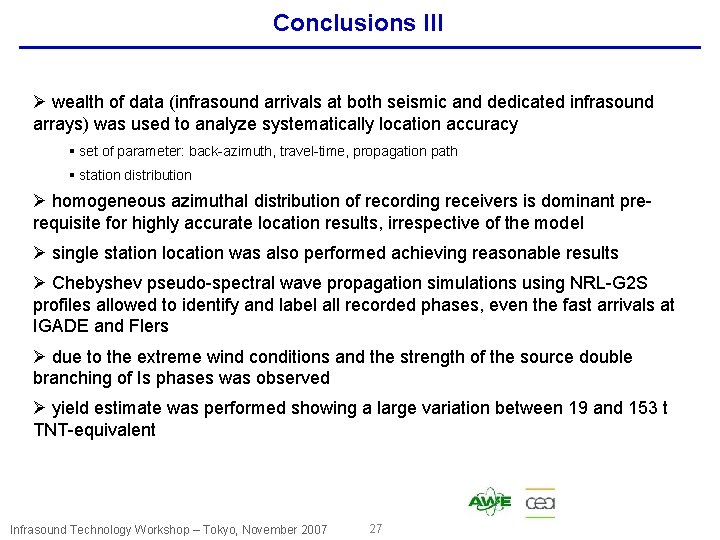
Conclusions III Ø wealth of data (infrasound arrivals at both seismic and dedicated infrasound arrays) was used to analyze systematically location accuracy § set of parameter: back azimuth, travel time, propagation path § station distribution Ø homogeneous azimuthal distribution of recording receivers is dominant pre requisite for highly accurate location results, irrespective of the model Ø single station location was also performed achieving reasonable results Ø Chebyshev pseudo spectral wave propagation simulations using NRL G 2 S profiles allowed to identify and label all recorded phases, even the fast arrivals at IGADE and Flers Ø due to the extreme wind conditions and the strength of the source double branching of Is phases was observed Ø yield estimate was performed showing a large variation between 19 and 153 t TNT equivalent Infrasound Technology Workshop – Tokyo, November 2007 27

Acknowledgement We thank: • IRF, the Swedish Institute Space Physics for providing the infrasound waveform data from the stations in Uppsala, Lycksele, Jämtön, and Kiruna • D. Drob for providing NRL G 2 S profiles • C. Millet (CEA/DASE) for simulations • L. Evers (KNMI) and R. Whitaker (LANL) for discussions Infrasound Technology Workshop – Tokyo, November 2007 28
- Slides: 28