
The Building of Global Empires 19 th Century
The Building of Global Empires 19 th Century Imperialism
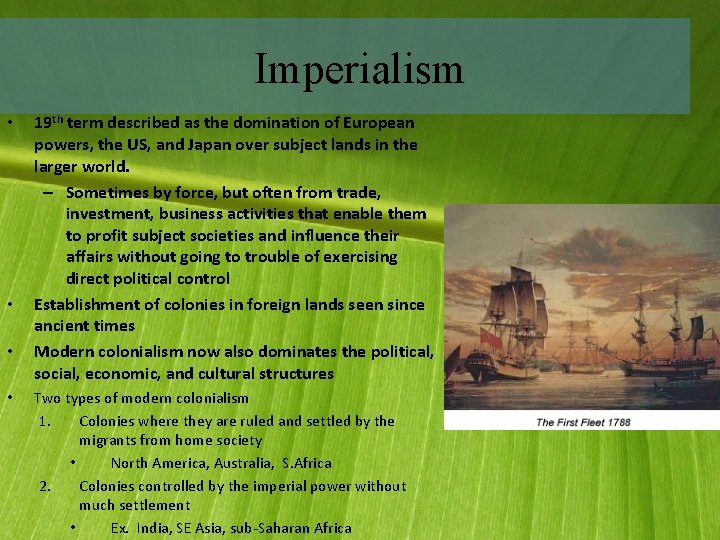
Imperialism • • 19 th term described as the domination of European powers, the US, and Japan over subject lands in the larger world. – Sometimes by force, but often from trade, investment, business activities that enable them to profit subject societies and influence their affairs without going to trouble of exercising direct political control Establishment of colonies in foreign lands seen since ancient times Modern colonialism now also dominates the political, social, economic, and cultural structures Two types of modern colonialism 1. Colonies where they are ruled and settled by the migrants from home society • North America, Australia, S. Africa 2. Colonies controlled by the imperial power without much settlement • Ex. India, SE Asia, sub-Saharan Africa
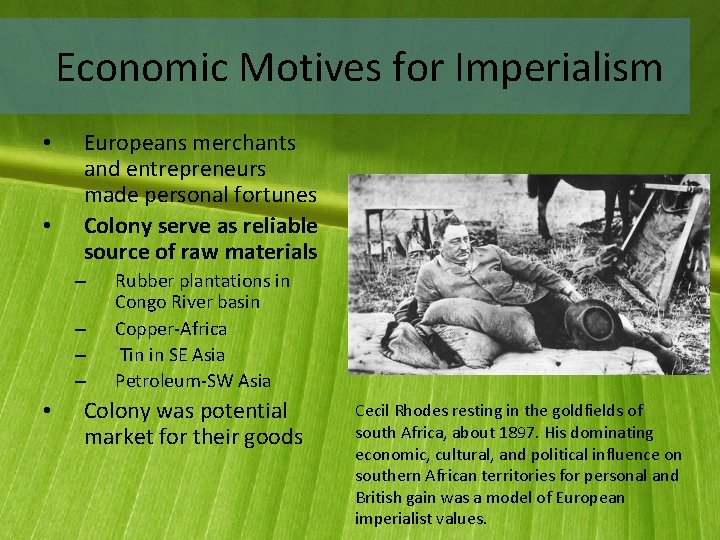
Economic Motives for Imperialism • • Europeans merchants and entrepreneurs made personal fortunes Colony serve as reliable source of raw materials – – • Rubber plantations in Congo River basin Copper-Africa Tin in SE Asia Petroleum-SW Asia Colony was potential market for their goods Cecil Rhodes resting in the goldfields of south Africa, about 1897. His dominating economic, cultural, and political influence on southern African territories for personal and British gain was a model of European imperialist values.
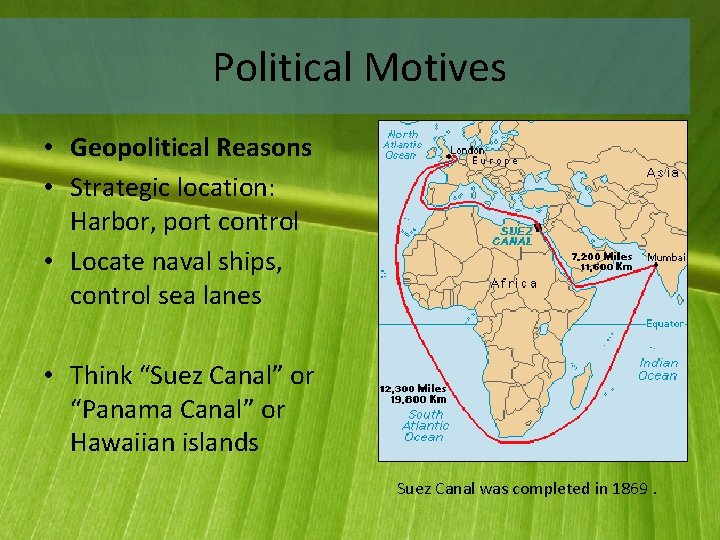
Political Motives • Geopolitical Reasons • Strategic location: Harbor, port control • Locate naval ships, control sea lanes • Think “Suez Canal” or “Panama Canal” or Hawaiian islands Suez Canal was completed in 1869.
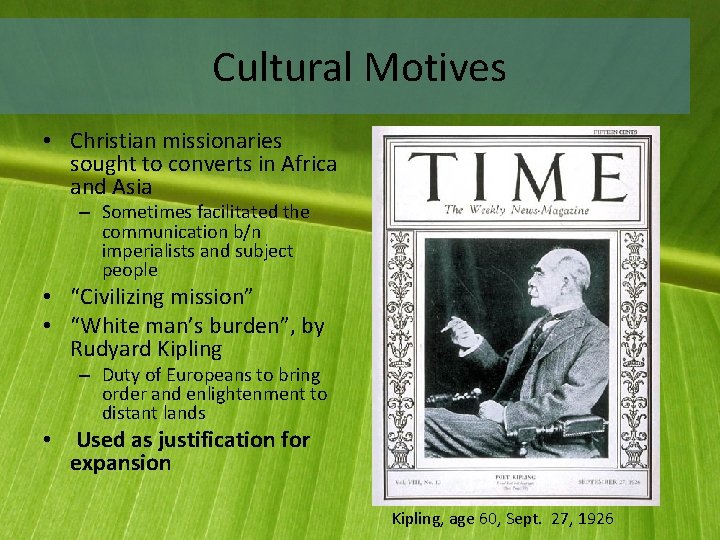
Cultural Motives • Christian missionaries sought to converts in Africa and Asia – Sometimes facilitated the communication b/n imperialists and subject people • “Civilizing mission” • “White man’s burden”, by Rudyard Kipling – Duty of Europeans to bring order and enlightenment to distant lands • Used as justification for expansion Kipling, age 60, Sept. 27, 1926
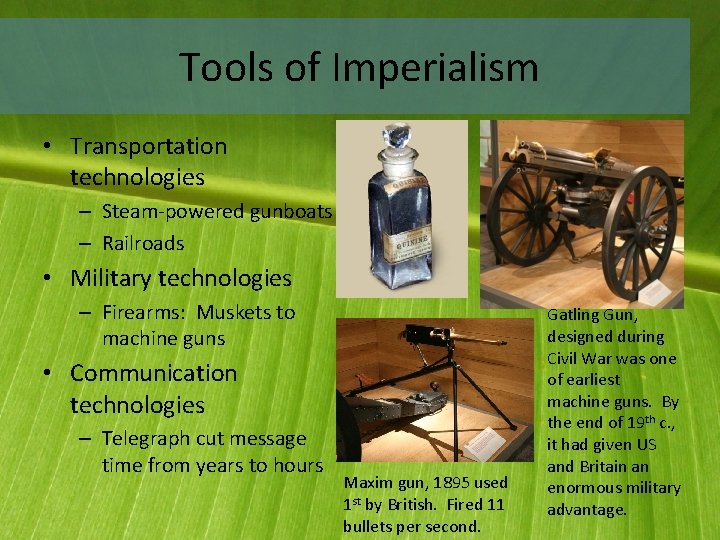
Tools of Imperialism • Transportation technologies – Steam-powered gunboats – Railroads • Military technologies – Firearms: Muskets to machine guns • Communication technologies – Telegraph cut message time from years to hours Maxim gun, 1895 used 1 st by British. Fired 11 bullets per second. Gatling Gun, designed during Civil War was one of earliest machine guns. By the end of 19 th c. , it had given US and Britain an enormous military advantage.

Charles Darwin • Ideas most widely cited and misunderstood • 1859 published book On the Origins of the Species • Living beings over 1, 000 s of years had either evolved or struggle for survival or become extinct
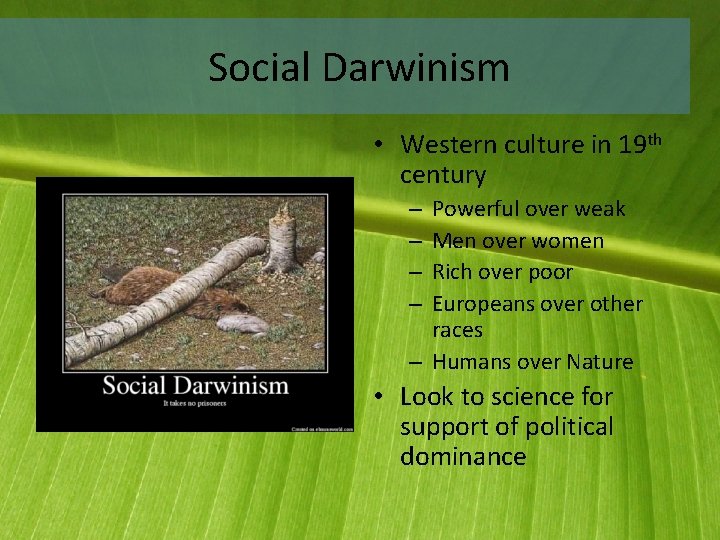
Social Darwinism • Western culture in 19 th century Powerful over weak Men over women Rich over poor Europeans over other races – Humans over Nature – – • Look to science for support of political dominance
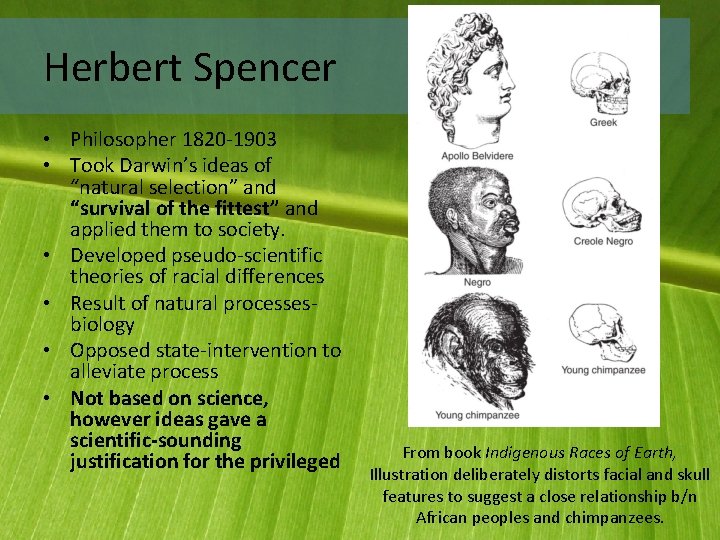
Herbert Spencer • Philosopher 1820 -1903 • Took Darwin’s ideas of “natural selection” and “survival of the fittest” and applied them to society. • Developed pseudo-scientific theories of racial differences • Result of natural processesbiology • Opposed state-intervention to alleviate process • Not based on science, however ideas gave a scientific-sounding justification for the privileged From book Indigenous Races of Earth, Illustration deliberately distorts facial and skull features to suggest a close relationship b/n African peoples and chimpanzees.
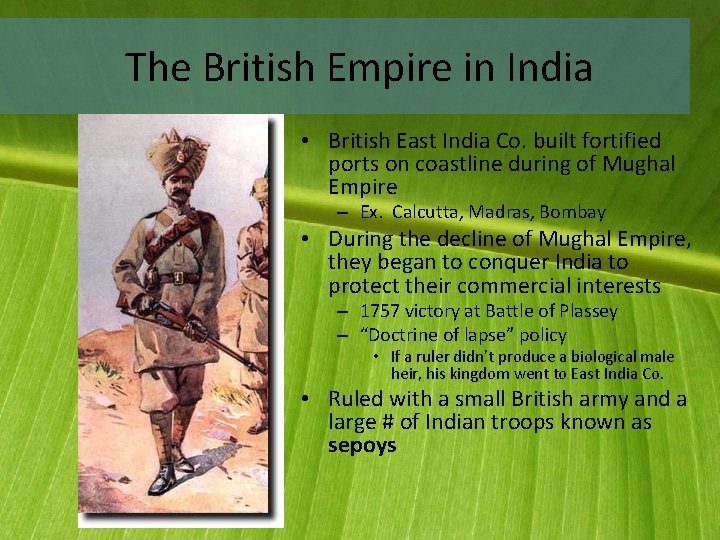
The British Empire in India • British East India Co. built fortified ports on coastline during of Mughal Empire – Ex. Calcutta, Madras, Bombay • During the decline of Mughal Empire, they began to conquer India to protect their commercial interests – 1757 victory at Battle of Plassey – “Doctrine of lapse” policy • If a ruler didn’t produce a biological male heir, his kingdom went to East India Co. • Ruled with a small British army and a large # of Indian troops known as sepoys
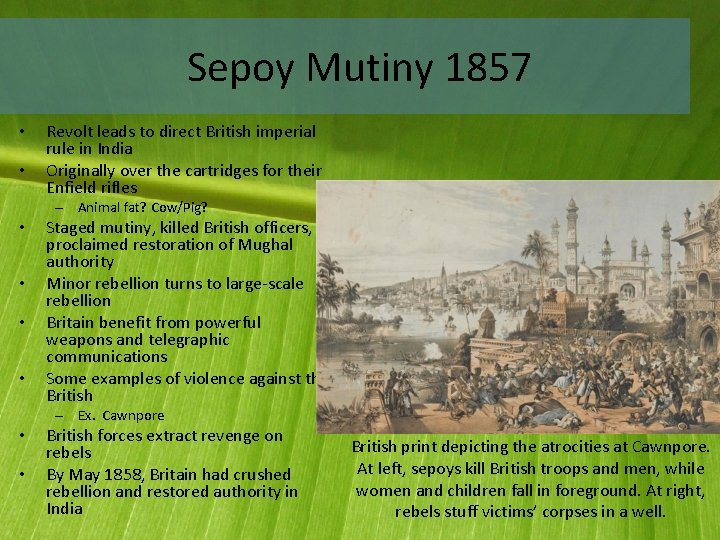
Sepoy Mutiny 1857 • • Revolt leads to direct British imperial rule in India Originally over the cartridges for their Enfield rifles – Animal fat? Cow/Pig? • • Staged mutiny, killed British officers, proclaimed restoration of Mughal authority Minor rebellion turns to large-scale rebellion Britain benefit from powerful weapons and telegraphic communications Some examples of violence against the British – Ex. Cawnpore • • British forces extract revenge on rebels By May 1858, Britain had crushed rebellion and restored authority in India British print depicting the atrocities at Cawnpore. At left, sepoys kill British troops and men, while women and children fall in foreground. At right, rebels stuff victims’ corpses in a well.
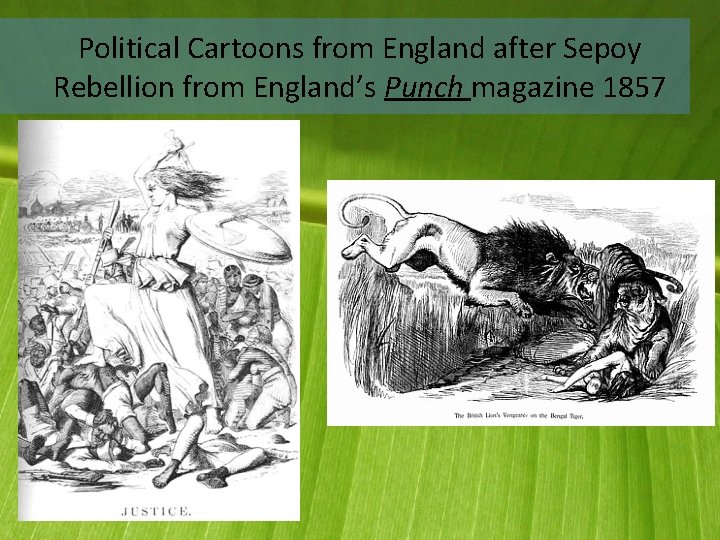
Political Cartoons from England after Sepoy Rebellion from England’s Punch magazine 1857
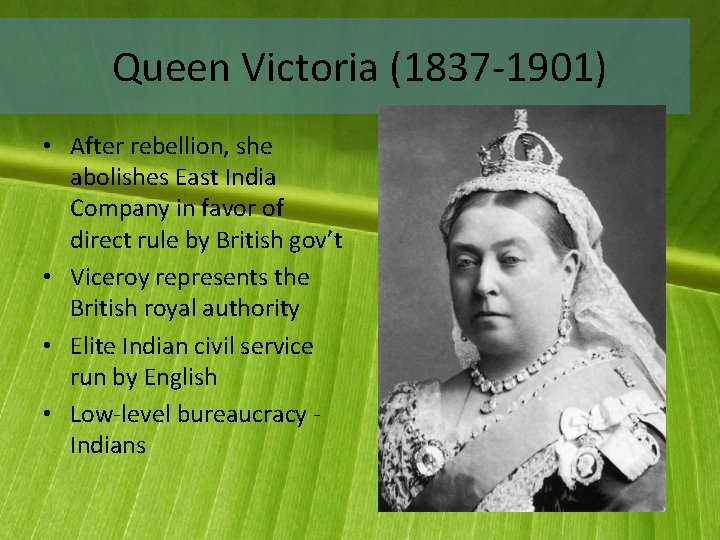
Queen Victoria (1837 -1901) • After rebellion, she abolishes East India Company in favor of direct rule by British gov’t • Viceroy represents the British royal authority • Elite Indian civil service run by English • Low-level bureaucracy Indians
British Imperial Rule of India • After the Sepoy Rebellion: 1858 1. British viceroy represented the royal authority – High-level British civil service aided viceroy – Indians serve as the low-level bureaucratic positions 2. Extend rule to all of India and Ceylon (Sri Lanka) 3. Cleared land for cultivation of coffee, tea, opium 4. Built railroads, telegraph lines for global trade 5. Construct, canals, harbors, irrigation methods to support commerce and agriculture 6. Establish European-style schools for Indian elites 7. Suppress Indian customs Ex. 1829 officially outlaw the practice of sati
Nationalism and Anticolonial Movements • Imperial expansion and colonial domination leads to nationalism and anticolonial movements • Ex. Indian National Congress
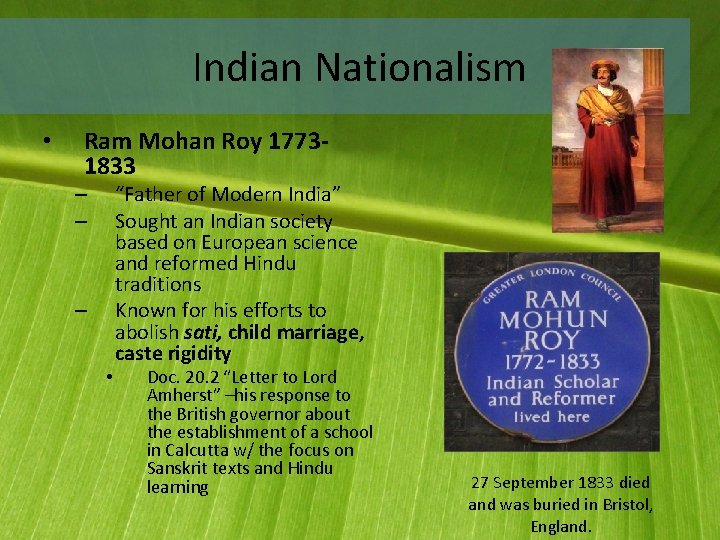
Indian Nationalism • Ram Mohan Roy 17731833 – – – • “Father of Modern India” Sought an Indian society based on European science and reformed Hindu traditions Known for his efforts to abolish sati, child marriage, caste rigidity Doc. 20. 2 “Letter to Lord Amherst” –his response to the British governor about the establishment of a school in Calcutta w/ the focus on Sanskrit texts and Hindu learning 27 September 1833 died and was buried in Bristol, England.
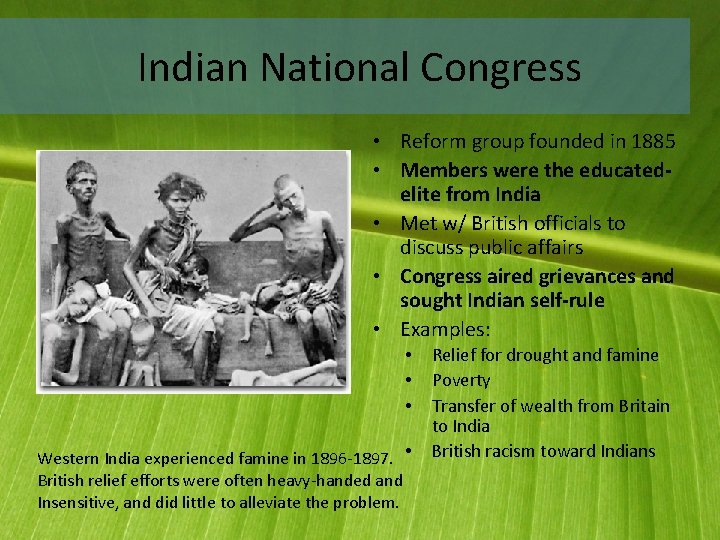
Indian National Congress • Reform group founded in 1885 • Members were the educatedelite from India • Met w/ British officials to discuss public affairs • Congress aired grievances and sought Indian self-rule • Examples: • • • Western India experienced famine in 1896 -1897. • British relief efforts were often heavy-handed and Insensitive, and did little to alleviate the problem. Relief for drought and famine Poverty Transfer of wealth from Britain to India British racism toward Indians
Impact of Indian Nationalism and Independence Movements • Serve as a model for anticolonial campaigns in other lands • All leaders of the movements were European -educated elites who absorbed Enlightenment values and turn them into an attack on European colonial rule – Ex. Jomo Kenyatta-Kenya – Ex. Kwame Nkrumah-Ghana
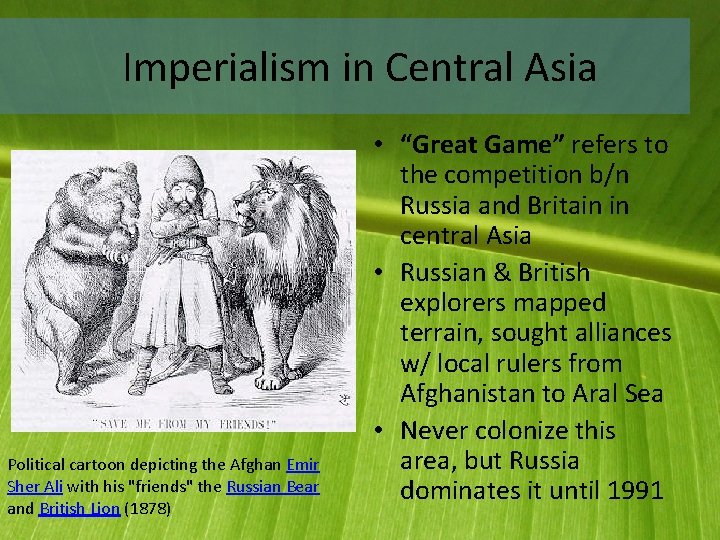
Imperialism in Central Asia Political cartoon depicting the Afghan Emir Sher Ali with his "friends" the Russian Bear and British Lion (1878) • “Great Game” refers to the competition b/n Russia and Britain in central Asia • Russian & British explorers mapped terrain, sought alliances w/ local rulers from Afghanistan to Aral Sea • Never colonize this area, but Russia dominates it until 1991
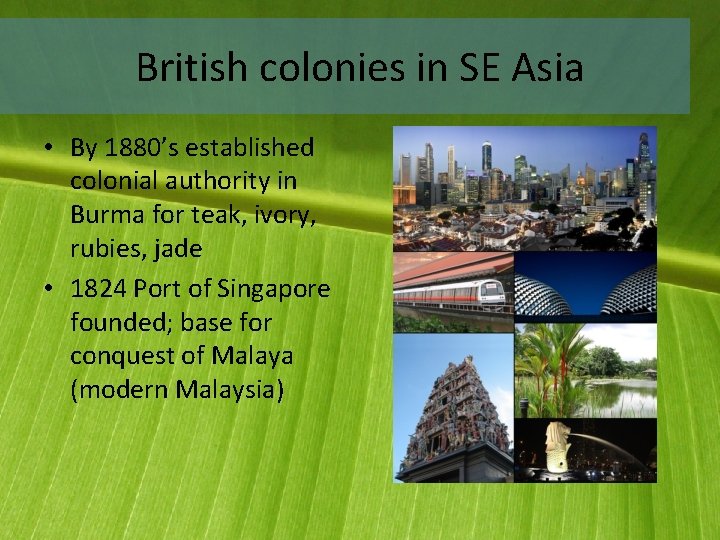
British colonies in SE Asia • By 1880’s established colonial authority in Burma for teak, ivory, rubies, jade • 1824 Port of Singapore founded; base for conquest of Malaya (modern Malaysia)
French Indochina • Built their SE Asian empire in Indochina • Consisted of the modern states of Vietnam, Cambodia, Laos b/n 18591893 • Established European-style schools • Established close connections with native elites • Encouraged conversion to Christianity so Roman Catholic church became prominent
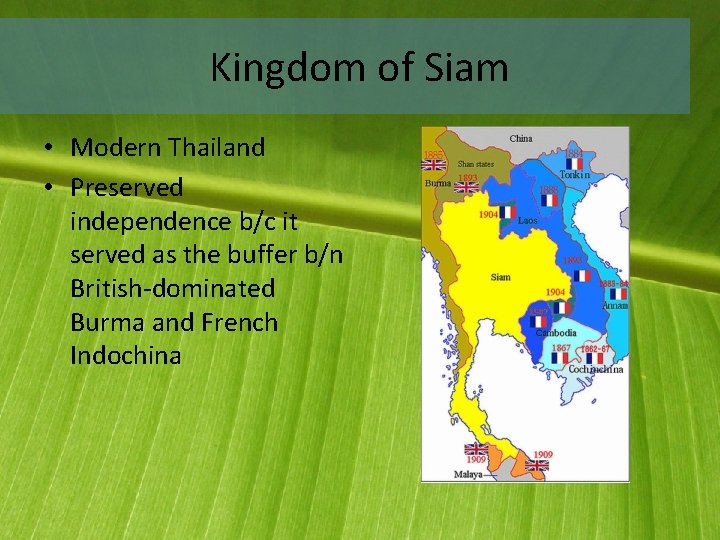
Kingdom of Siam • Modern Thailand • Preserved independence b/c it served as the buffer b/n British-dominated Burma and French Indochina

Imperialism in Asia
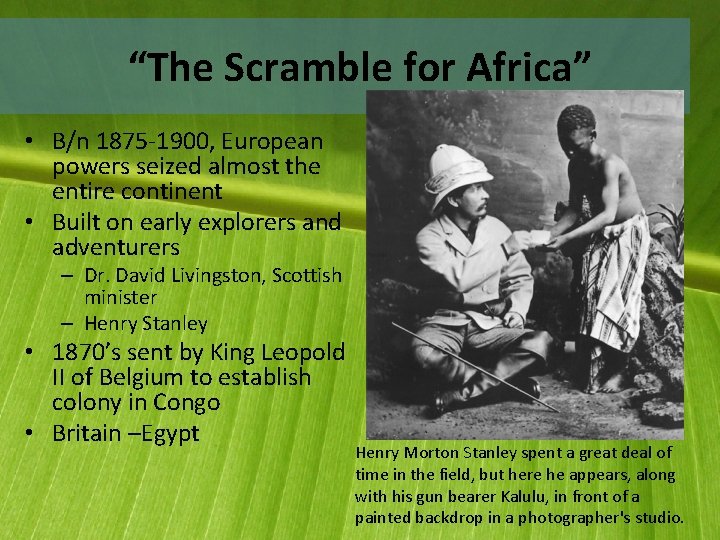
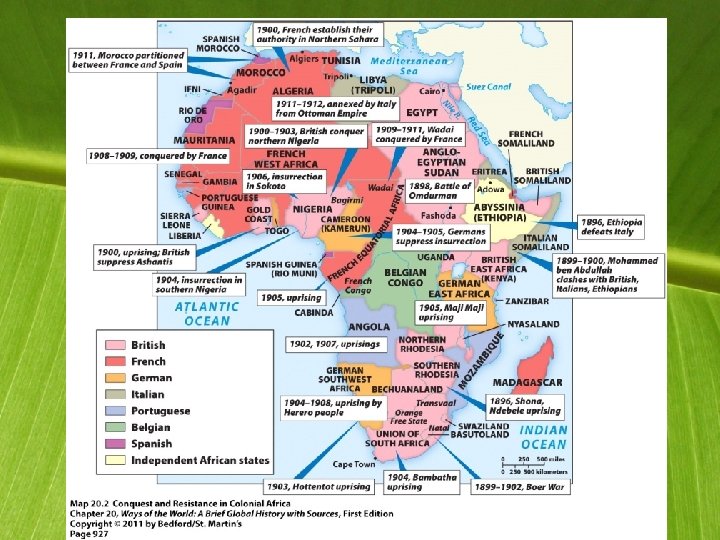
“The Scramble for Africa” • B/n 1875 -1900, European powers seized almost the entire continent • Built on early explorers and adventurers – Dr. David Livingston, Scottish minister – Henry Stanley • 1870’s sent by King Leopold II of Belgium to establish colony in Congo • Britain –Egypt Henry Morton Stanley spent a great deal of time in the field, but here he appears, along with his gun bearer Kalulu, in front of a painted backdrop in a photographer's studio.
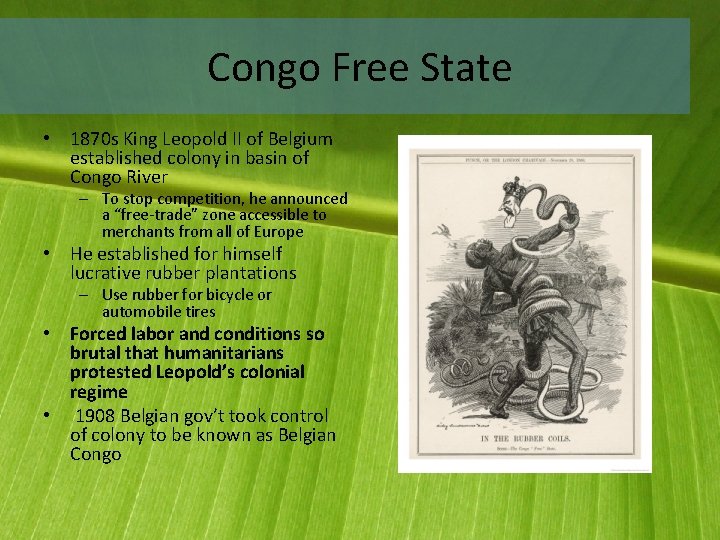
Congo Free State • 1870 s King Leopold II of Belgium established colony in basin of Congo River – To stop competition, he announced a “free-trade” zone accessible to merchants from all of Europe • He established for himself lucrative rubber plantations – Use rubber for bicycle or automobile tires • Forced labor and conditions so brutal that humanitarians protested Leopold’s colonial regime • 1908 Belgian gov’t took control of colony to be known as Belgian Congo
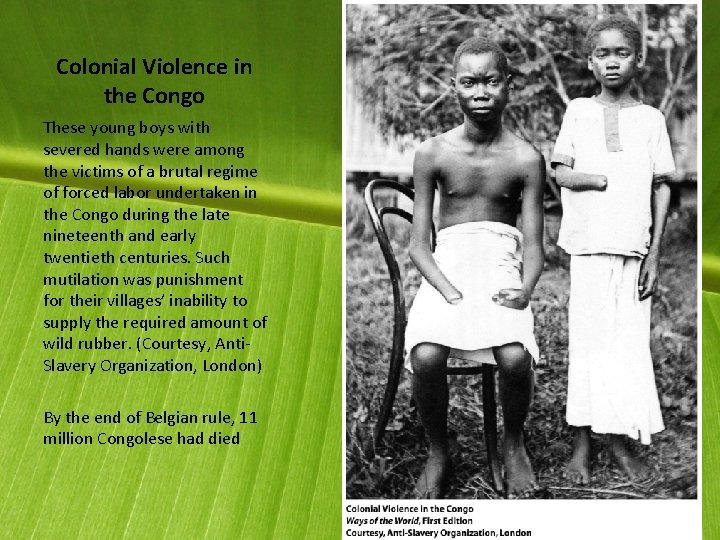
Colonial Violence in the Congo These young boys with severed hands were among the victims of a brutal regime of forced labor undertaken in the Congo during the late nineteenth and early twentieth centuries. Such mutilation was punishment for their villages’ inability to supply the required amount of wild rubber. (Courtesy, Anti. Slavery Organization, London) By the end of Belgian rule, 11 million Congolese had died
South Africa • 1652 Cape Town established by Dutch East India Co. as supply station for ships enroute to Asia • Settlers known as “Boers”(means farmer in Dutch) or “Afrikaaners” • Steady stream of Europeans increase population • British take over in 1806 which disrupts Afrikaan society
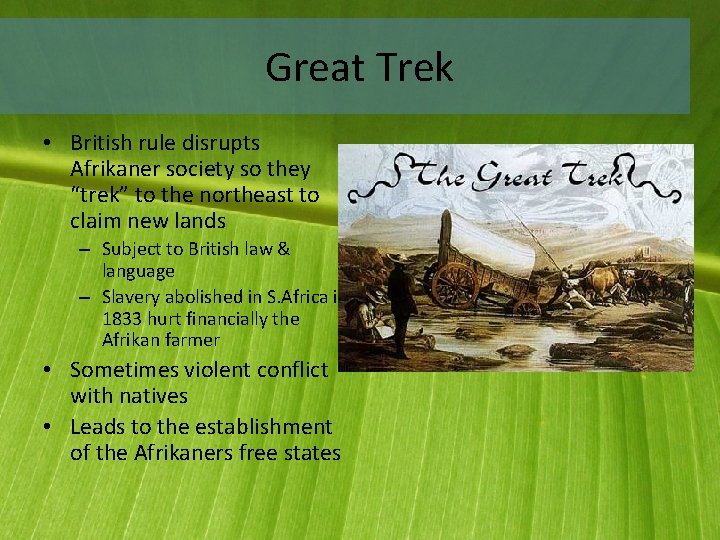
Great Trek • British rule disrupts Afrikaner society so they “trek” to the northeast to claim new lands – Subject to British law & language – Slavery abolished in S. Africa in 1833 hurt financially the Afrikan farmer • Sometimes violent conflict with natives • Leads to the establishment of the Afrikaners free states
Boer War 1899 -1902 • Boers discover diamonds and gold in their new lands • Leads to influx of British settlers • White vs. white fighting over the rights to the resource • Some black Africans also served as soldiers and laborers • Afrikaners defeated and British establish the Union of South Africa in 1910 – Constitution allowed only white men to vote, so natives had few rights – African National Congress founded in 1912 by educated South Africans in an effort to oppose European colonization and policies
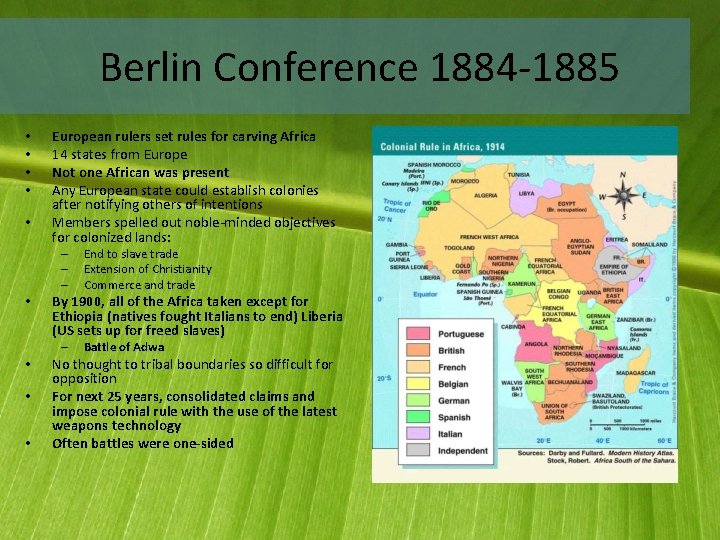
Berlin Conference 1884 -1885 • • • European rulers set rules for carving Africa 14 states from Europe Not one African was present Any European state could establish colonies after notifying others of intentions Members spelled out noble-minded objectives for colonized lands: – – – • By 1900, all of the Africa taken except for Ethiopia (natives fought Italians to end) Liberia (US sets up for freed slaves) – • • • End to slave trade Extension of Christianity Commerce and trade Battle of Adwa No thought to tribal boundaries so difficult for opposition For next 25 years, consolidated claims and impose colonial rule with the use of the latest weapons technology Often battles were one-sided
Systems of Rule in Africa Direct Rule • • French model Intentionally cut ethnic boundaries to weaken power Rulers replaced with Europeans Policy of “Paternalism” – Govern in fatherly way by providing needs but not rights • Policy of “assimilation” – The population would be absorbed into French culture – Tried to pattern all schools, courts, business after French institutions – Did not work so settled on “association” which meant that they recognized African culture. However seen as inferior • • Justified as a “civilizing mission” but hard to find enough European personnel Ex. French West Africa – 3, 600 Europeans rule 9 million Africans Indirect Rule • British model • Use existing tribal authorities – Idea is to train them in British method of government – Ex. British protectorate over the Niger River delta (palmoil) • Worked well in highly organized African societies

Imperialist Control Form Definition Example Colony A Country or territory governed internally by a foreign power Somaliland in East Africa was a French Colony Protectorate A Country or territory with Britain established a its own internal protectorate over the government but under the Niger River Delta control of an outside power Sphere of Influence An area in which an outside power claims exclusive investment of trading privileges Liberia was under the sphere of influence of the United States Economic Imperialism An independent but less developed country controlled by private business interests rather than other governments The Dole Fruit company controlled pineapple trade in Hawaii
Imperial Management Indirect Control • • Local government officials used Limited self-rule Goal: to develop future leaders Government institutions are based on European Styles but may have local rules Examples: • British colonies such as Nigeria, India, Burma • U. S colonies on Pacific Islands Direct Control • • Foreign officials brought in to rule No self-rule Goal: assimilation Government institutions are based only on European styles Examples: • French colonies such as Somaliland, Vietnam • German colonies such as German East Africa • Portuguese colonies such as Angola
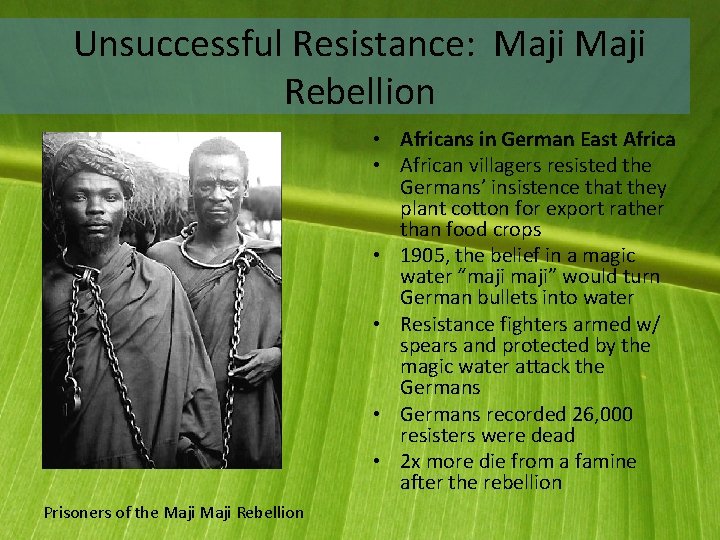
Unsuccessful Resistance: Maji Rebellion • Africans in German East Africa • African villagers resisted the Germans’ insistence that they plant cotton for export rather than food crops • 1905, the belief in a magic water “maji” would turn German bullets into water • Resistance fighters armed w/ spears and protected by the magic water attack the Germans • Germans recorded 26, 000 resisters were dead • 2 x more die from a famine after the rebellion Prisoners of the Maji Rebellion
Ethiopia • Only African nation to successfully resist • Victory due to the emperor, Menelik II • Italians, French, and British all were striving to bring Ethiopia into their sphere of influence • Russia and France sold modern weapons to them • Menelik was about to sign a treaty with Italy to give up a small part of Ethiopia when Italy invades from north • Battle of Adwa – Ethiopian forces defeat the Italians
European Imperialism in Pacific • Australia • • • James Cook explores in 1770 1778 British fleet arrives at Botany Bay with 1, 044 people – 696 convicted criminals – 348 free individuals By 1830’s, voluntary migrants outnumber convicts – Discovery of gold in 1851 also • • Aborigines Population devastated by smallpox and measles British settlers consider Australia to be “land belonging to no one” b/c aborigines were nomadic Pushed them to the desert regions
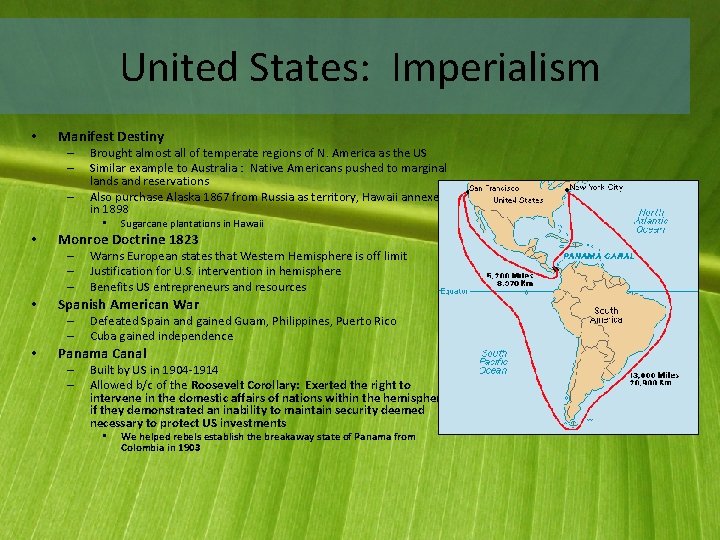
United States: Imperialism • Manifest Destiny – – – Brought almost all of temperate regions of N. America as the US Similar example to Australia : Native Americans pushed to marginal lands and reservations Also purchase Alaska 1867 from Russia as territory, Hawaii annexed in 1898 • • Monroe Doctrine 1823 – – – • Warns European states that Western Hemisphere is off limit Justification for U. S. intervention in hemisphere Benefits US entrepreneurs and resources Spanish American War – – • Sugarcane plantations in Hawaii Defeated Spain and gained Guam, Philippines, Puerto Rico Cuba gained independence Panama Canal – – Built by US in 1904 -1914 Allowed b/c of the Roosevelt Corollary: Exerted the right to intervene in the domestic affairs of nations within the hemisphere if they demonstrated an inability to maintain security deemed necessary to protect US investments • We helped rebels establish the breakaway state of Panama from Colombia in 1903
Legacies of Imperialism 1. 2. 3. 4. 5. 6. Increase in TRADE Increase in MIGRATION Colonial CONFLICT RACISM NATIONALISM ANTICOLONIAL MOVEMENTS
GLOBAL TRADE • • • Global trade surged during the 19 th & 20 th centuries Advantage to the colonial power Timber Rubber Petroleum Gold Silver Diamonds Coffee Tea Forces the people to export what they have instead of keeping it – Ex. Cotton in India
Labor Migrations 1. 2. • European Migration – 50 million migrated b/n 1800 -1914 – ½ of these to US – Most became cultivators, herders, or skilled laborers Indentured Labor – 2. 5 million during 1820 -1914 – Slavery in decline but still need labor – Offer free passage, provide shelter, clothing, food, modest compensation if commit to 5 -7 years of labor – Most from India – China, Japan, Java, Africa also – Tropical and subtropical Empire and Migration – Imperialists recruit people to their lands • 19 th century migrations influenced societies because large communities of people with distinctive ethnic identities are in lands far from their homes
19 th Century Emigration from China and India • Labor shortages in plantation agriculture, the mineral extraction industry, and transportation projects led to large migrations of the Chinese and Indians to migrate
- Slides: 42