
The Building Block Approach A tool for regulatory

The Building Block Approach – A tool for regulatory and supervisory reforms for microfinance European MF week 2012, Luxembourg, 16 th November GIZ Financial Systems Development Rainer Schliwa and Florian Henrich contact@e-mfp. eu www. e-mfp. eu
GIZ’s role in the implementation of regulatory and supervisory reforms n Support partners in developing supervisory capacity n Act as a facilitator and provider of technical assistance n No off-the-shelf solutions n Understand the local context n Build ownership Long-term commitment is key contact@e-mfp. eu www. e-mfp. eu
Countries vary in terms of stages of regulation & supervision n n n n Draft rules may not be enacted; law may not be in place Implementation of international standards (Basel I, II, Basel Core Principles) Limits on permitted products / services Financial institutions may be regulated by different entities Regulator may view microfinance not as primary responsibility Regulator may lack expertise and understanding to effectively identify, assess and manage microfinance specific risks Regulators may still be largely unfamiliar with non-prudential risks (e. g. Consumer Protection) Regulatory actions may not be in line with the market (e. g. interest rate caps) Regulator may be risk averse to financial innovations Need for tailor-made solutions according to country context contact@e-mfp. eu www. e-mfp. eu
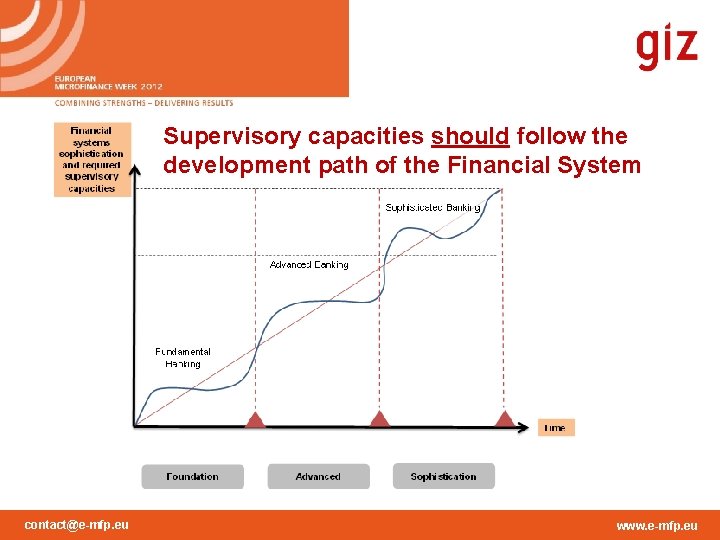
Supervisory capacities should follow the development path of the Financial System contact@e-mfp. eu www. e-mfp. eu
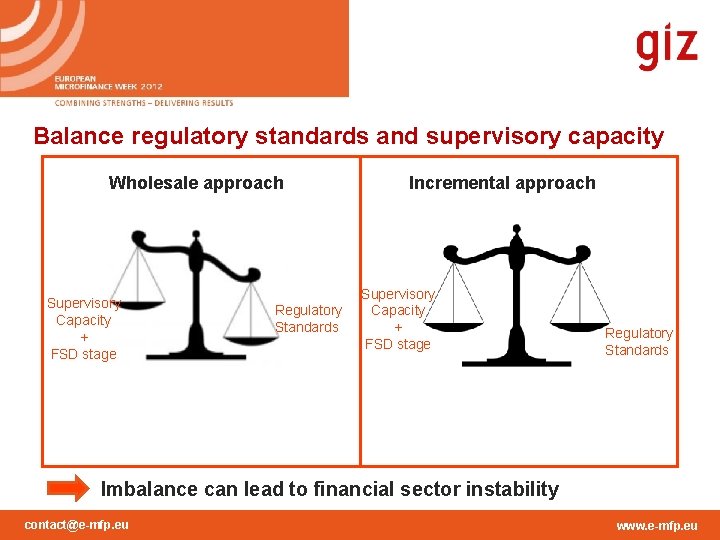
Balance regulatory standards and supervisory capacity Wholesale approach Supervisory Capacity Supervisory + Capacity FSD stage + FSD stage Regulatory Standards Incremental approach Supervisory Capacity + FSD stage Standards Regulatory Standards Imbalance can lead to financial sector instability contact@e-mfp. eu www. e-mfp. eu
“Building Block” Approach – a method to prioritize, sequence and adapt international standards to local context n Background: While international best practice of supervisory standards exists, there is a need to provide guidance on how to adapt those to the local context. 1. Identify thematic blocks of the Basel Core Principles, and/or Basel I – III and cluster them into thematic categories 2. Sequence those thematic blocks in accordance with financial sector development contact@e-mfp. eu www. e-mfp. eu
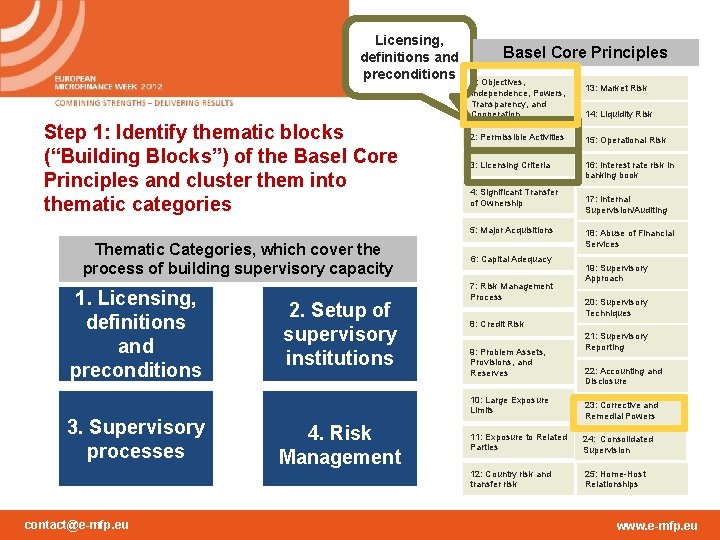
Licensing, definitions and preconditions Step 1: Identify thematic blocks (“Building Blocks”) of the Basel Core Principles and cluster them into thematic categories Basel Core Principles 1: Objectives, Independence, Powers, Transparency, and Cooperation 1. Licensing, definitions and preconditions 2. Setup of supervisory institutions 15: Operational Risk 3: Licensing Criteria 16: Interest rate risk in banking book 4: Significant Transfer of Ownership 6: Capital Adequacy 7: Risk Management Process contact@e-mfp. eu 4. Risk Management 17: Internal Supervision/Auditing 18: Abuse of Financial Services 19: Supervisory Approach 20: Supervisory Techniques 8: Credit Risk 9: Problem Assets, Provisions, and Reserves 10: Large Exposure Limits 3. Supervisory processes 14: Liquidity Risk 2: Permissible Activities 5: Major Acquisitions Thematic Categories, which cover the process of building supervisory capacity 13: Market Risk 21: Supervisory Reporting 22: Accounting and Disclosure 23: Corrective and Remedial Powers 11: Exposure to Related Parties 24: Consolidated Supervision 12: Country risk and transfer risk 25: Home-Host Relationships www. e-mfp. eu
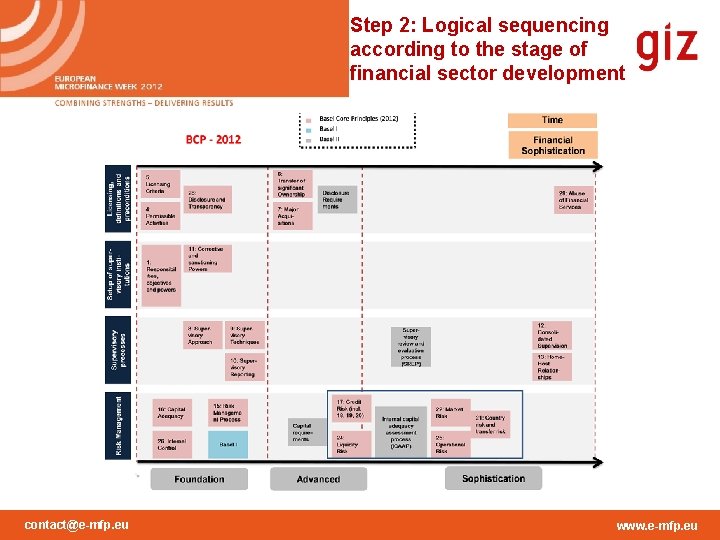
Step 2: Logical sequencing according to the stage of financial sector development contact@e-mfp. eu www. e-mfp. eu
Conclusion I Considerations for prioritization: n Balance financial stability and development concerns (e. g. financial access / financial inclusion) n Consider regulator’s reform capacity (e. g. central bank) n Consider changes in the independence of the regulator Process: n Consultative: stakeholder discussions should involve the regulator, industry associations, government, and donors n Should be in line with the development of the sector (e. g. new risks, new topics – take account of inherent sector dynamics) Success factors and challenges: n Strong commitment of the partner n Local presence of the facilitator n Inconsistency of particular interests contact@e-mfp. eu www. e-mfp. eu
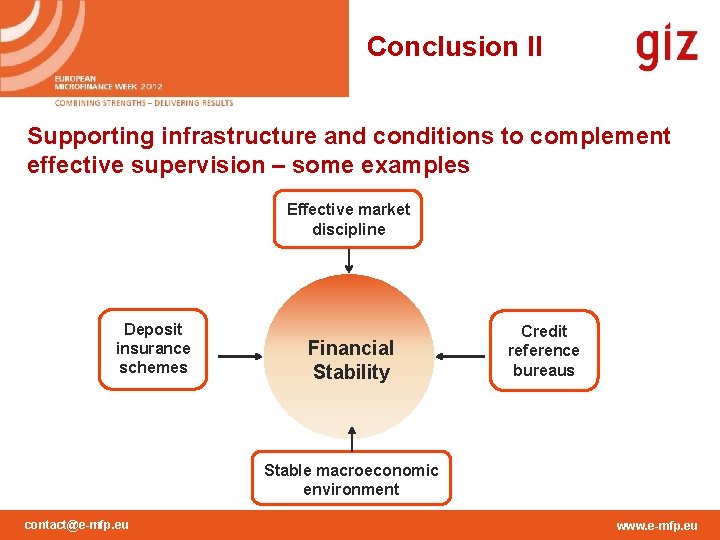
Conclusion II Supporting infrastructure and conditions to complement effective supervision – some examples Effective market discipline Deposit insurance schemes Financial Stability Credit reference bureaus Stable macroeconomic environment contact@e-mfp. eu www. e-mfp. eu

Thank you for your attention contact@e-mfp. eu www. e-mfp. eu
- Slides: 11