
THE BUBONIC PLAGUE Title The Plague Part Dos

THE BUBONIC PLAGUE Title: The Plague – Part Dos Page Number: 123 Date: May 3 rd, 2019 EQ: What caused the Black Death? What impact did it have?

FOR YOU… • Projects? • Benchmarks! • 4) Directions: Tells you where you are • 28) NESW: Acronym for the Cardinal Directions – Never Eat Soggy Waffles! • 31) Geography: The study of people, places, and the Earth’s surface

THE BLACK DEATH • A terrible plague or fast spreading and painful illness, known as the Black Death, swept through Europe in the 1300’s killing millions.
THE BLACK DEATH • Think about… • Have you ever been given a shot to prevent the flu or to protect you from another disease? Lets look at what happened in Europe before modern medicine could control contagious diseases.

THE PLAGUE ARRIVES… • Medieval towns and cities were extremely over-crowded. • The lack of sanitation and procedures for keeping the town clean, was a breeding ground of disease. Arrived in England during the summer of 1348 on trade ships from Asia. Spread quickly throughout Europe and Asia by: 1. Lack of sanitation or cleanliness 2. Mongolian warriors also spread the disease in battle. (Catapulting dead bodies over walled cities- Ghengis Khan) 3. Along trade routes 4. No medicine or medical knowledge 5. Fleas from rats!
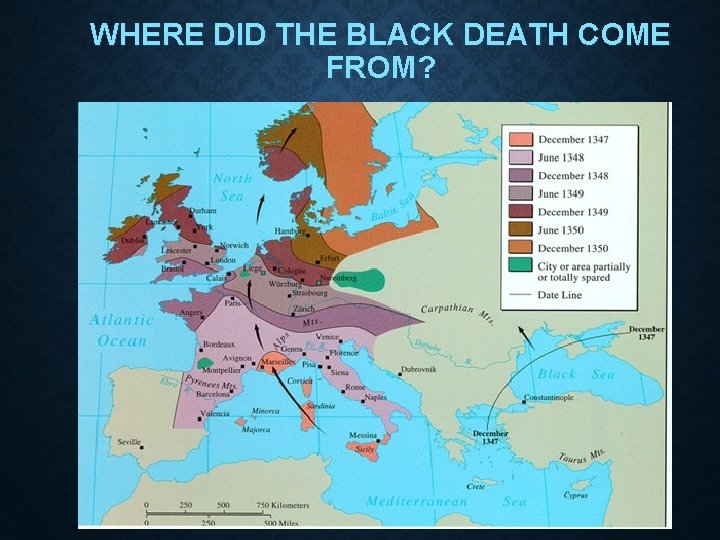
WHERE DID THE BLACK DEATH COME FROM?
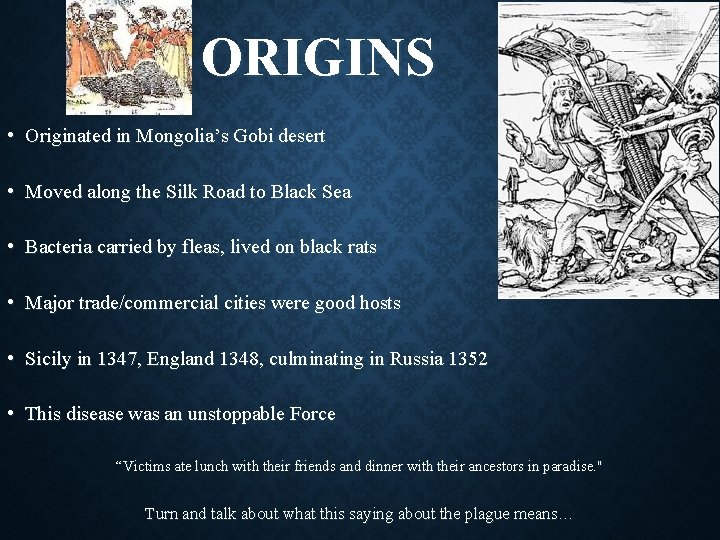
ORIGINS • Originated in Mongolia’s Gobi desert • Moved along the Silk Road to Black Sea • Bacteria carried by fleas, lived on black rats • Major trade/commercial cities were good hosts • Sicily in 1347, England 1348, culminating in Russia 1352 • This disease was an unstoppable Force “Victims ate lunch with their friends and dinner with their ancestors in paradise. " Turn and talk about what this saying about the plague means…
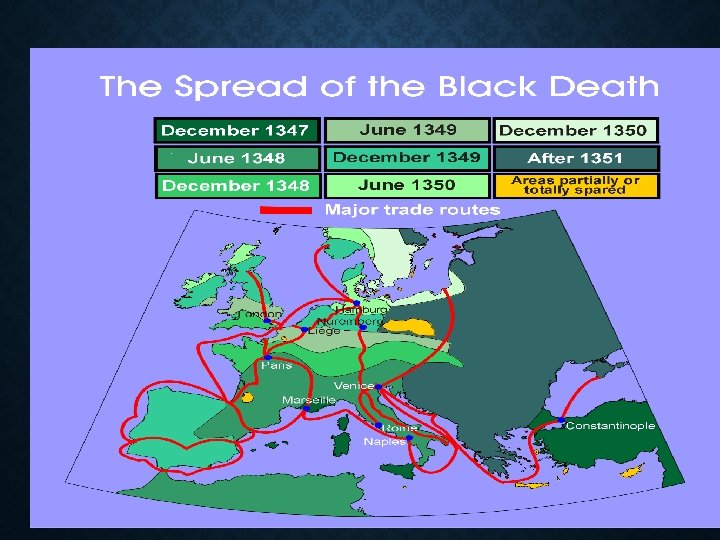

THE BLACK DEATH • The Mongols had continued using an existing, widespread trade network set up between China, India, the Middle East and Europe. • This trade network was so prosperous that they encouraged its use constantly, in order to bring wealth into their vast Empire. • As we know, trade routes are valuable to spread ideas, religions, and goods. However, bad things (like the plague) spread too!

THE BLACK DEATH • Can anyone tell me the name of this massive trade network? ?
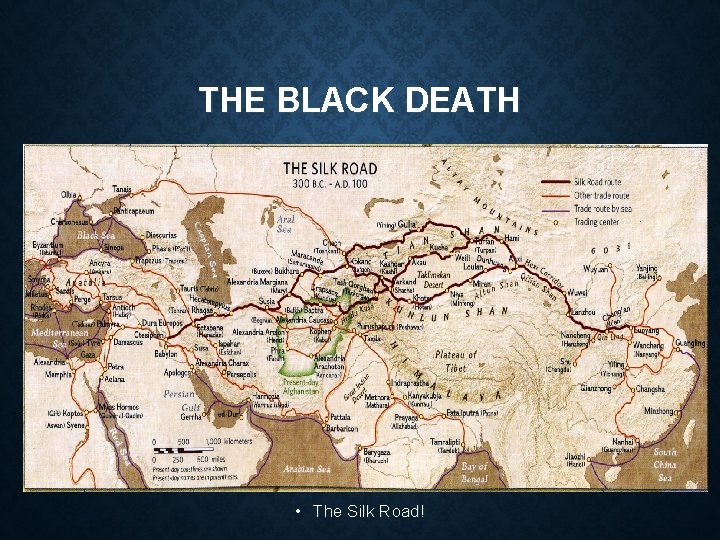
THE BLACK DEATH • The Silk Road!
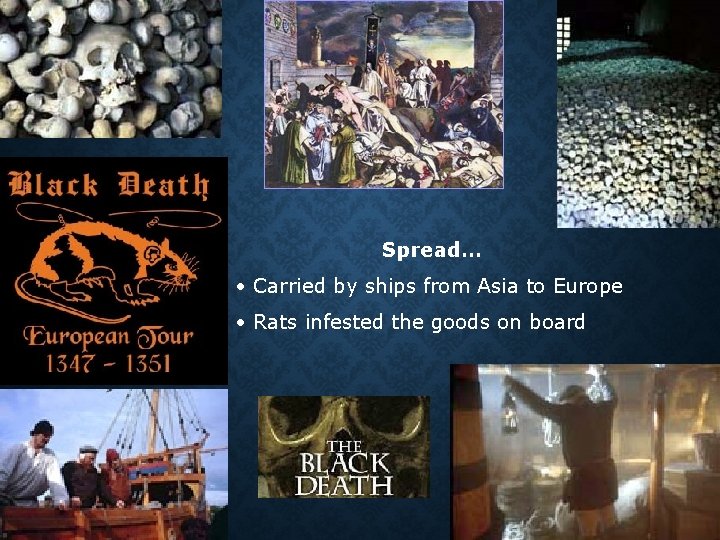
Spread… • Carried by ships from Asia to Europe • Rats infested the goods on board

SYMPTOMS… Fever, chills, aching joints, nausea. . Rashes Boils appear where there are high concentrations of lymph glands: neck, arm pits and groin. Skin turns black from the swelling and internal bleeding. Boils break, oozing pus and blood. Swollen glands drain liquid into the blood spreading the plague's bacteria around the body. If not treated, the bubonic plague can lead to death within 6 -8 days.
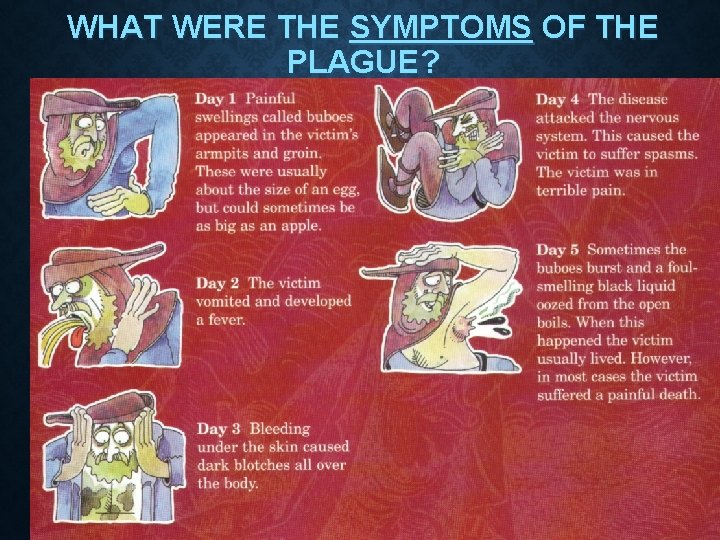
WHAT WERE THE SYMPTOMS OF THE PLAGUE?
WHAT DID THEY THINK CAUSED THE PLAGUE? There were many different beliefs about the plague; without medicine/training…. . It was a punishment from God. Some believed that foreigners or those who followed a different religion had poisoned the wells. Some thought that bad air was responsible. Some thought the position of the planets had caused the plague. Minorities (Jews blamed)
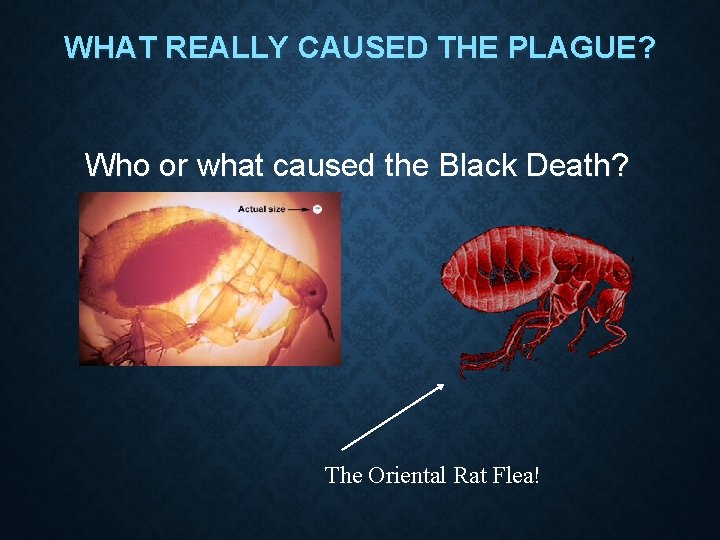
WHAT REALLY CAUSED THE PLAGUE? Who or what caused the Black Death? The Oriental Rat Flea!
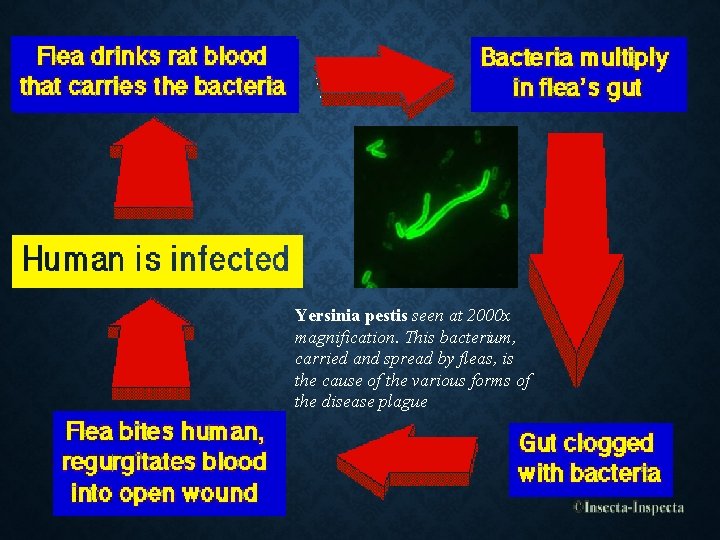
Yersinia pestis seen at 2000 x magnification. This bacterium, carried and spread by fleas, is the cause of the various forms of the disease plague

Mortality Rate (# affected) 35% - 70% of population 25, 000 dead !!!
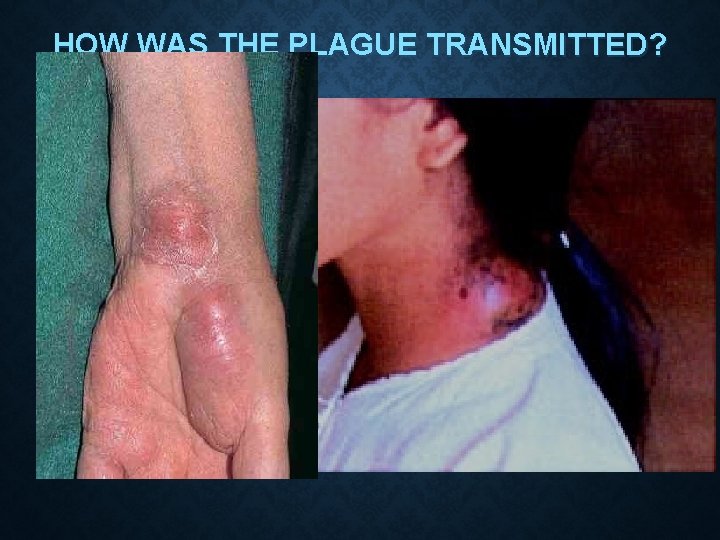
HOW WAS THE PLAGUE TRANSMITTED? We now know that the most common form of the Black Death was the BUBONIC PLAGUE! This disease was spread by fleas which lived on the black rat. The fleas sucked the rat’s blood which contained the plague germs. When the rat died the fleas jumped on to humans and passed on the deadly disease.

TALKING POINT: 2 TYPES OF PLAGUE • The Pneumonic Plague, became a killer when the infection reached the lungs. Because it destroyed the breathing system, this plague could be caught if someone breathed on you. Bubonic Plague did not affect the victim’s lungs, but caused large swellings as the body fought the disease. To catch this type of plague you had to be bitten by a flea that had already bitten a black rat.
CURES? • Medieval people did not know about germs causing disease. They did not understand that plague was spread by rats and fleas. They thought that people’s bodies were poisoned. • If the swellings burst and the poison came out people sometimes survived. It seemed sensible to draw out the poison.
MEDIEVAL CURES The swellings should be softened with figs and cooked onions. The onions were mixed with yeast and butter. Then open the swellings with a knife. (Hot Compress) Take a live frog and put its belly on the plague sore. The frog will swell up and burst. Keep doing this with further frogs until they stop bursting. Some people say that a dried toad will do the job better. (Are there enough Frogs to go around? ? ? )

MORE WEIRD CURES… Carry Flowers & wear a strong perfume Drink hot drinks Carry lucky charms Use leeches to bleed the victim Smoke pipes of tobacco Wear Dead frog around neck Laxatives Coat the victims with mercury and place them in the oven. Hang dead animals above the door entering the home. Prayer, prayer & More Prayer Holding hot metal to the sores Sticking the end of chicken feathers into the sores
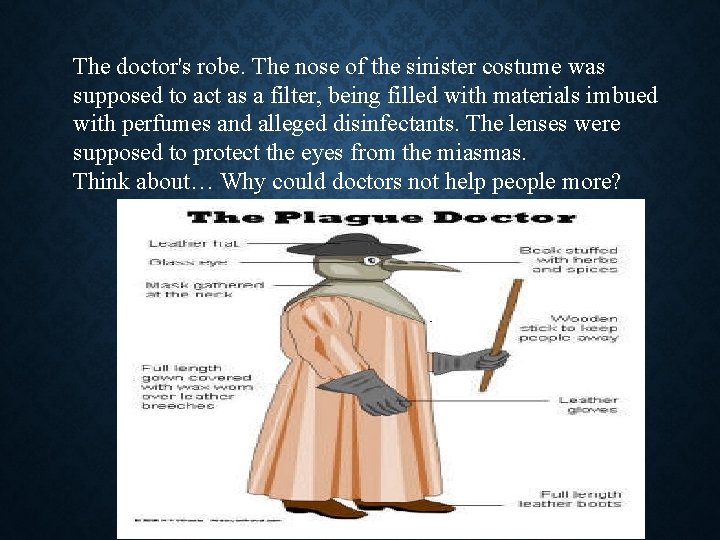
The doctor's robe. The nose of the sinister costume was supposed to act as a filter, being filled with materials imbued with perfumes and alleged disinfectants. The lenses were supposed to protect the eyes from the miasmas. Think about… Why could doctors not help people more?
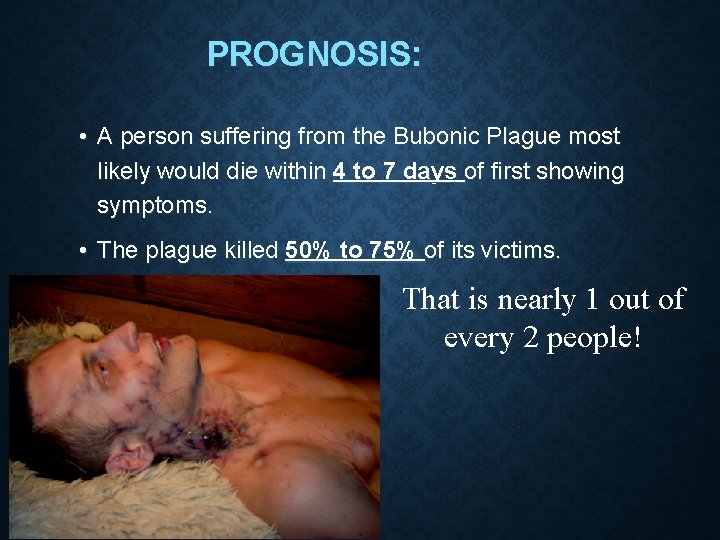
PROGNOSIS: • A person suffering from the Bubonic Plague most likely would die within 4 to 7 days of first showing symptoms. • The plague killed 50% to 75% of its victims. That is nearly 1 out of every 2 people!
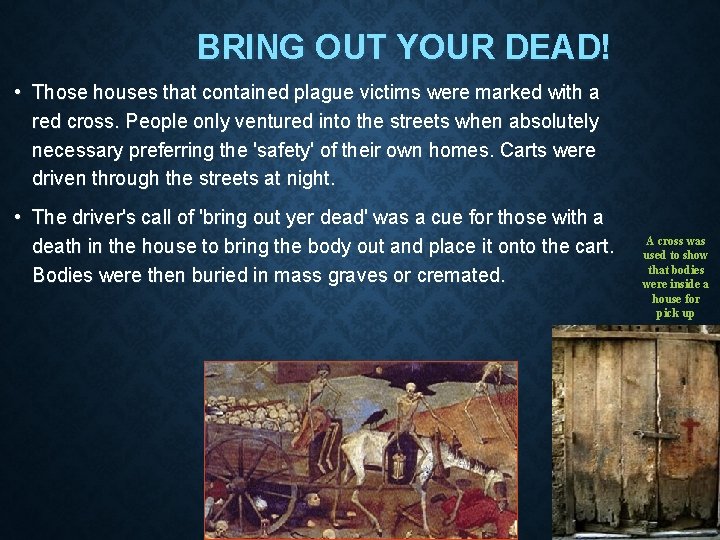
BRING OUT YOUR DEAD! • Those houses that contained plague victims were marked with a red cross. People only ventured into the streets when absolutely necessary preferring the 'safety' of their own homes. Carts were driven through the streets at night. • The driver's call of 'bring out yer dead' was a cue for those with a death in the house to bring the body out and place it onto the cart. Bodies were then buried in mass graves or cremated. A cross was used to show that bodies were inside a house for pick up
BEGINNING TO END: The first case in Europe was in 1347. The last outbreak of the plague in England was in 1665. HOW LONG DID IT LAST? By 1665, more than 25 million people had died from the plague. Stop & Jot- What are some of the effects this type of plague would have? Think economy, trade, jobs, art, morale…
EFFECTS… • Chaos in town- may stop believing b/c saw it as punishment from God, didn’t go to church b/c scared to leave home • The sensible thing to do when the plague struck was to get out of town, the rich could do this but the poor had nowhere to go. Towns were becoming Ghost Towns. • Economy- businesses would die b/c were scared to come out of homes or people keep dying • Population decreased • Trade decreased b/c scared, didn’t want infected products, etc • Job scarcity, things not getting done • Morale= bad, upset, depressed, grief, confused • Peasants/serfs demand more rights • Art- would have a very depressed, gloomy feel • Military- less warriors to fight
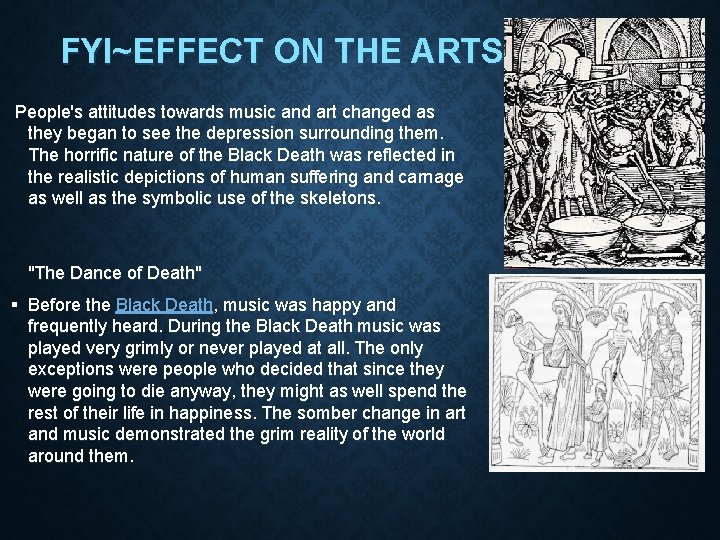
FYI~EFFECT ON THE ARTS: People's attitudes towards music and art changed as they began to see the depression surrounding them. The horrific nature of the Black Death was reflected in the realistic depictions of human suffering and carnage as well as the symbolic use of the skeletons. "The Dance of Death" Before the Black Death, music was happy and frequently heard. During the Black Death music was played very grimly or never played at all. The only exceptions were people who decided that since they were going to die anyway, they might as well spend the rest of their life in happiness. The somber change in art and music demonstrated the grim reality of the world around them.
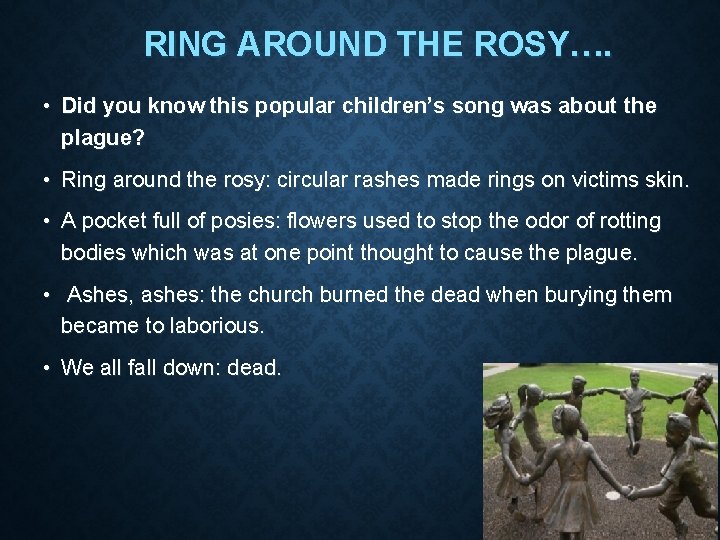
RING AROUND THE ROSY…. • Did you know this popular children’s song was about the plague? • Ring around the rosy: circular rashes made rings on victims skin. • A pocket full of posies: flowers used to stop the odor of rotting bodies which was at one point thought to cause the plague. • Ashes, ashes: the church burned the dead when burying them became to laborious. • We all fall down: dead.
A FEW POSITIVES. . • Peasants revolted as so many needed workers…they demanded more freedom. • Working class moved to cities to earn better wages. • Reduced the power of feudal lords. • Turn and talk… How would something like a bad sickness or plague give the wealthy less power and the poor more power?
- Slides: 32