
THE BROWN POWER MOVEMENT HISPANIC ART AND POETRY
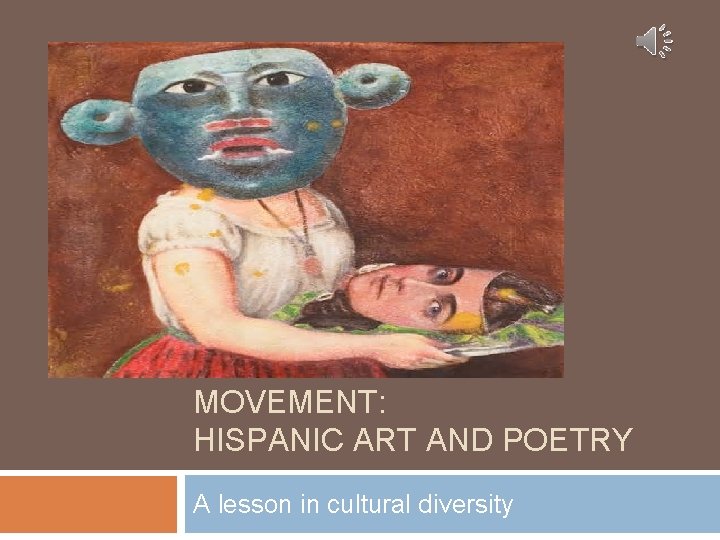
THE BROWN POWER MOVEMENT: HISPANIC ART AND POETRY A lesson in cultural diversity
The following CCSD Standards will be covered in this lesson: Prepare to organize Cornell notes for the day’s lesson: RL. 11 -12. 1 Cite strong and thorough textual evidence to support analysis of what the text says explicitly as well as inferences drawn from the text, including determining where the text leaves matters uncertain. NV 3. 12. 5 Evaluate the use and purpose of imagery, figurative language, and sound devices; analyze the author’s use of language and/or syntax. NV 3. 12. 7 Analyze the influence of historical events and culture on an author’s work.
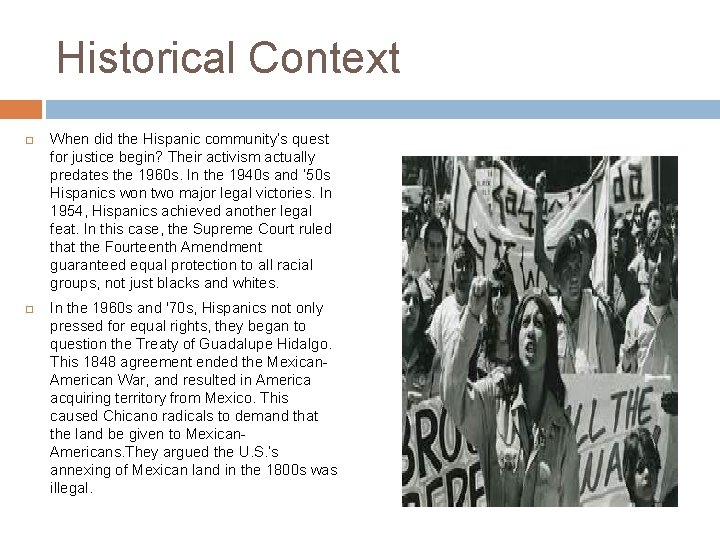
Historical Context When did the Hispanic community’s quest for justice begin? Their activism actually predates the 1960 s. In the 1940 s and ’ 50 s Hispanics won two major legal victories. In 1954, Hispanics achieved another legal feat. In this case, the Supreme Court ruled that the Fourteenth Amendment guaranteed equal protection to all racial groups, not just blacks and whites. In the 1960 s and '70 s, Hispanics not only pressed for equal rights, they began to question the Treaty of Guadalupe Hidalgo. This 1848 agreement ended the Mexican. American War, and resulted in America acquiring territory from Mexico. This caused Chicano radicals to demand that the land be given to Mexican. Americans. They argued the U. S. ’s annexing of Mexican land in the 1800 s was illegal.
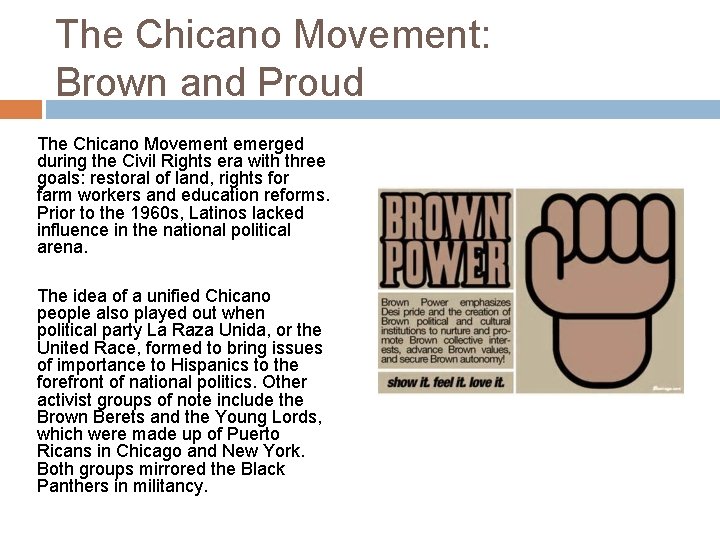
The Chicano Movement: Brown and Proud The Chicano Movement emerged during the Civil Rights era with three goals: restoral of land, rights for farm workers and education reforms. Prior to the 1960 s, Latinos lacked influence in the national political arena. The idea of a unified Chicano people also played out when political party La Raza Unida, or the United Race, formed to bring issues of importance to Hispanics to the forefront of national politics. Other activist groups of note include the Brown Berets and the Young Lords, which were made up of Puerto Ricans in Chicago and New York. Both groups mirrored the Black Panthers in militancy.
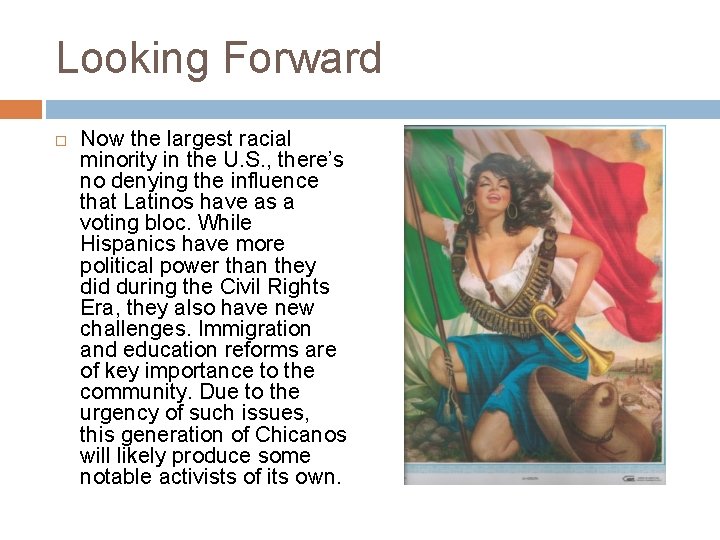
Looking Forward Now the largest racial minority in the U. S. , there’s no denying the influence that Latinos have as a voting bloc. While Hispanics have more political power than they did during the Civil Rights Era, they also have new challenges. Immigration and education reforms are of key importance to the community. Due to the urgency of such issues, this generation of Chicanos will likely produce some notable activists of its own.


Famous Leaders of the Brown Power Movement CESAR CHAVEZ Born near Yuma, Arizona, on March 31, 1927, Cesar Chavez employed nonviolent means to bring attention to the plight of farmworkers, and formed both the National Farm Workers Association, which later became United Farm Workers. As a labor leader, Chavez led marches, called for boycotts and went on several hunger strikes. It is believed that Chavez's hunger strikes contributed to his death on April 23, 1993, in San Luis, Arizona.

CHE GUEVARA Ernesto "Che" Guevara, commonly known as el Che or simply Che, was an Argentine Marxist revolutionary, physician, author, guerrilla leader, diplomat, and military theorist. A major figure of the Cuban Revolution, his stylized visage has become a ubiquitous countercultural symbol of rebellion.
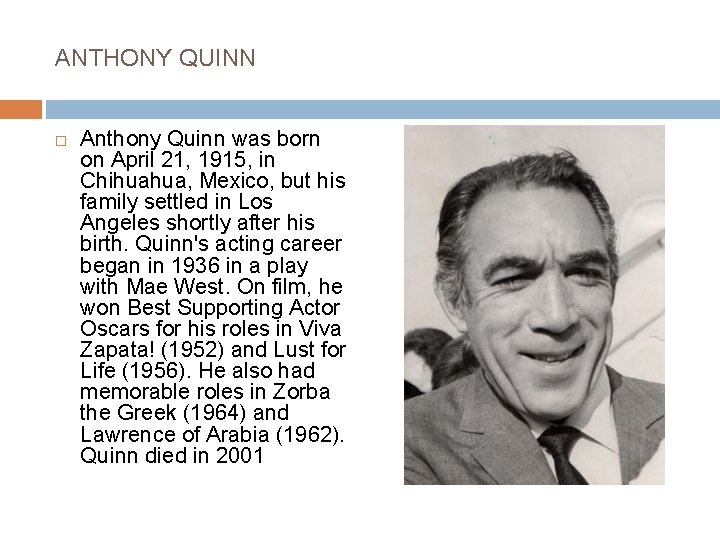
ANTHONY QUINN Anthony Quinn was born on April 21, 1915, in Chihuahua, Mexico, but his family settled in Los Angeles shortly after his birth. Quinn's acting career began in 1936 in a play with Mae West. On film, he won Best Supporting Actor Oscars for his roles in Viva Zapata! (1952) and Lust for Life (1956). He also had memorable roles in Zorba the Greek (1964) and Lawrence of Arabia (1962). Quinn died in 2001
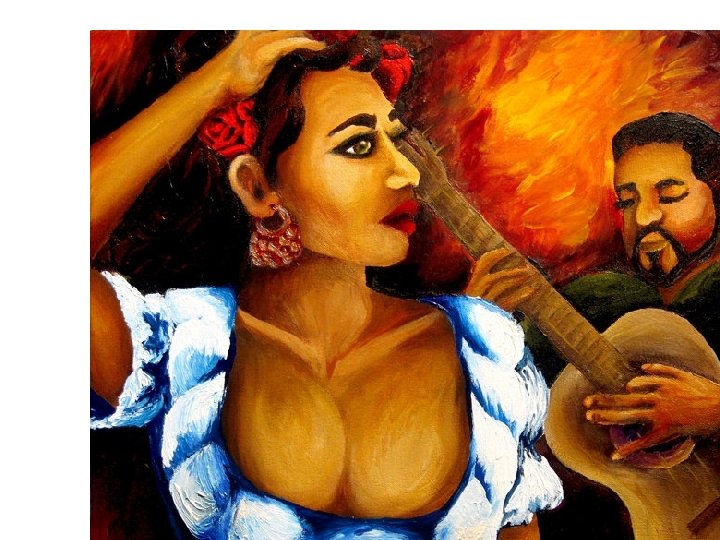
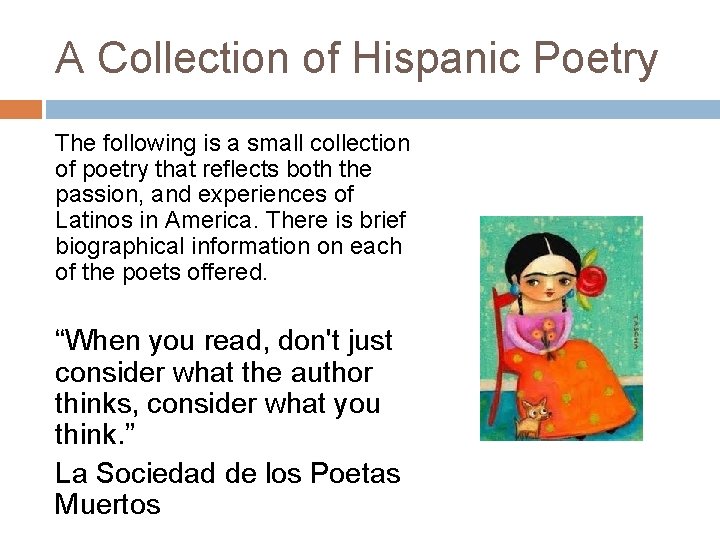
A Collection of Hispanic Poetry The following is a small collection of poetry that reflects both the passion, and experiences of Latinos in America. There is brief biographical information on each of the poets offered. “When you read, don't just consider what the author thinks, consider what you think. ” La Sociedad de los Poetas Muertos
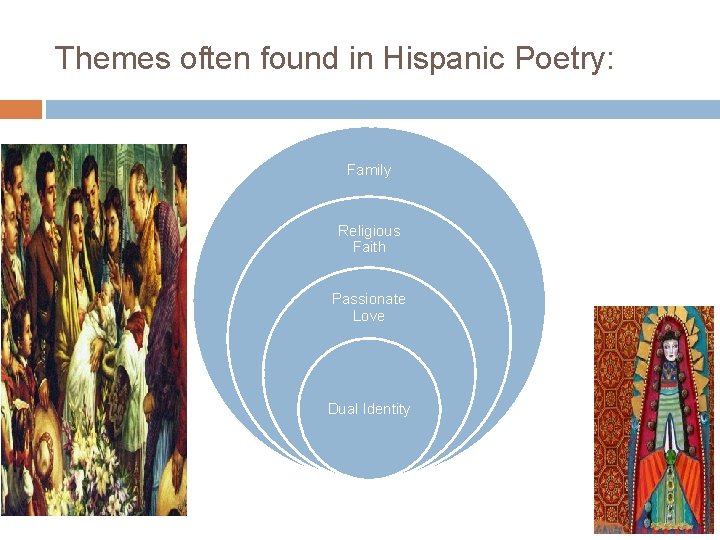
Themes often found in Hispanic Poetry: Family Religious Faith Passionate Love Dual Identity
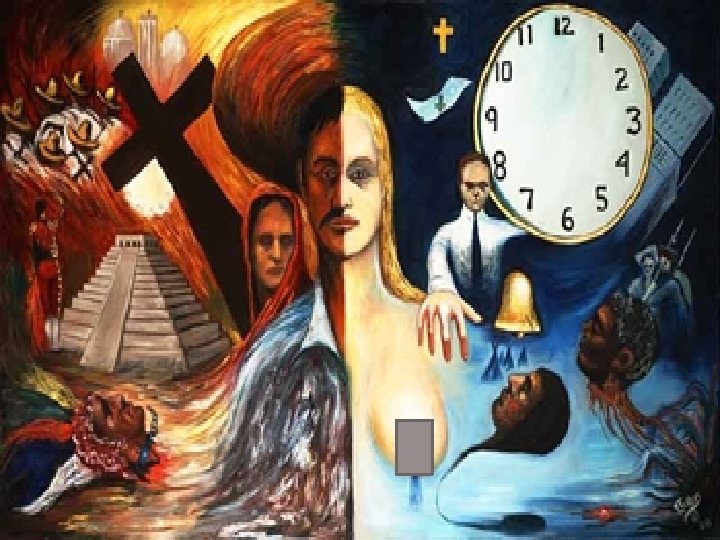
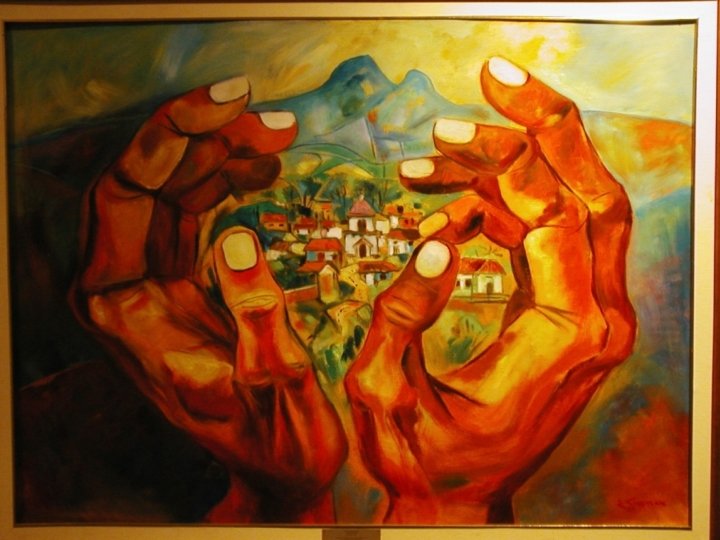
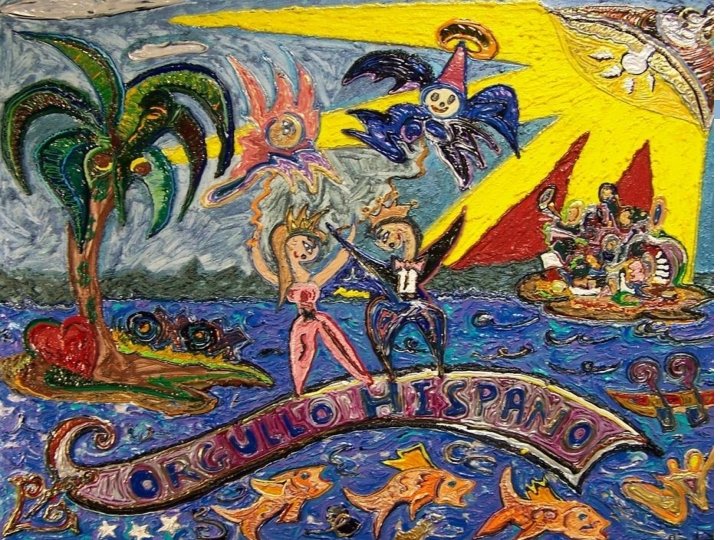
Duality by Herman Sillas’ Art and Activism
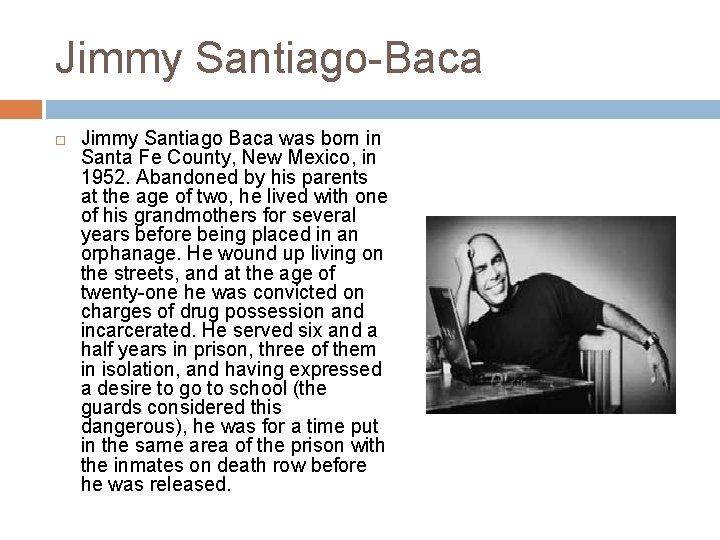
Jimmy Santiago-Baca Jimmy Santiago Baca was born in Santa Fe County, New Mexico, in 1952. Abandoned by his parents at the age of two, he lived with one of his grandmothers for several years before being placed in an orphanage. He wound up living on the streets, and at the age of twenty-one he was convicted on charges of drug possession and incarcerated. He served six and a half years in prison, three of them in isolation, and having expressed a desire to go to school (the guards considered this dangerous), he was for a time put in the same area of the prison with the inmates on death row before he was released.
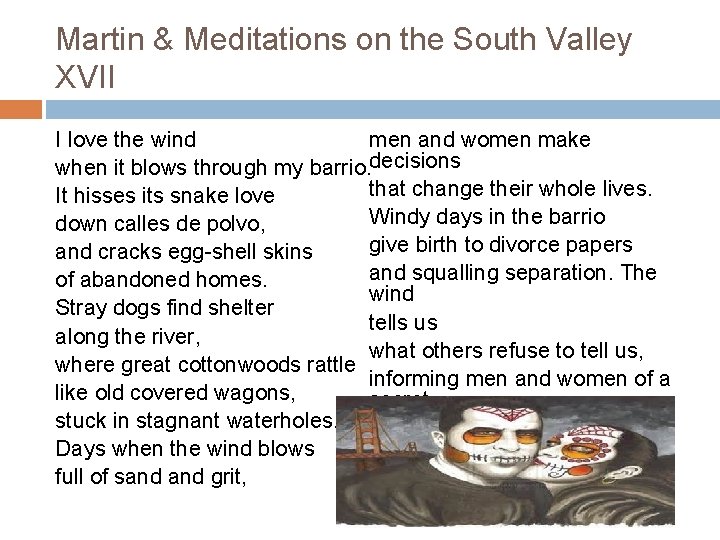
Martin & Meditations on the South Valley XVII men and women make I love the wind when it blows through my barrio. decisions that change their whole lives. It hisses its snake love Windy days in the barrio down calles de polvo, give birth to divorce papers and cracks egg-shell skins and squalling separation. The of abandoned homes. wind Stray dogs find shelter tells us along the river, what others refuse to tell us, where great cottonwoods rattle informing men and women of a like old covered wagons, secret, stuck in stagnant waterholes. that they move away to hide Days when the wind blows from. full of sand grit,
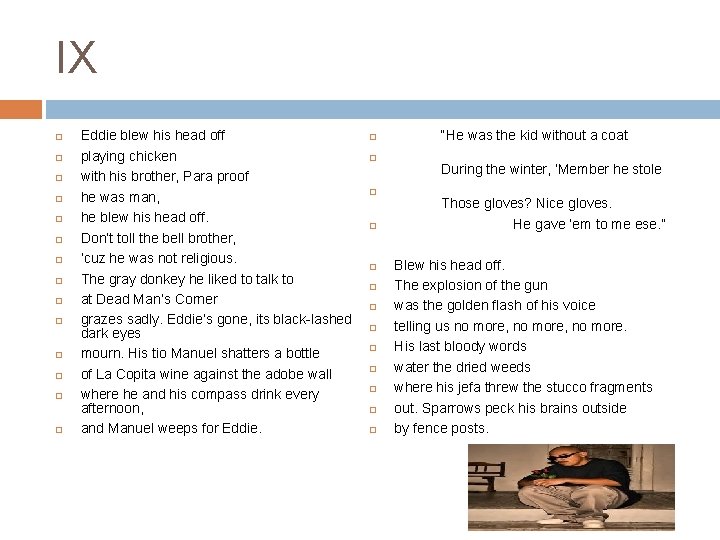
IX Eddie blew his head off playing chicken with his brother, Para proof he was man, he blew his head off. Don’t toll the bell brother, ‘cuz he was not religious. The gray donkey he liked to talk to at Dead Man’s Corner grazes sadly. Eddie’s gone, its black-lashed dark eyes mourn. His tio Manuel shatters a bottle of La Copita wine against the adobe wall where he and his compass drink every afternoon, and Manuel weeps for Eddie. “He was the kid without a coat During the winter, ‘Member he stole Those gloves? Nice gloves. He gave ‘em to me ese. ” Blew his head off. The explosion of the gun was the golden flash of his voice telling us no more, no more. His last bloody words water the dried weeds where his jefa threw the stucco fragments out. Sparrows peck his brains outside by fence posts.
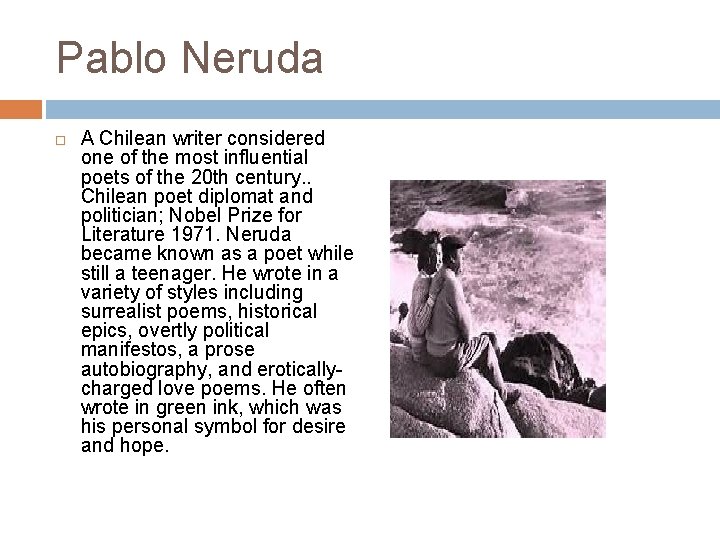
Pablo Neruda A Chilean writer considered one of the most influential poets of the 20 th century. . Chilean poet diplomat and politician; Nobel Prize for Literature 1971. Neruda became known as a poet while still a teenager. He wrote in a variety of styles including surrealist poems, historical epics, overtly political manifestos, a prose autobiography, and eroticallycharged love poems. He often wrote in green ink, which was his personal symbol for desire and hope.
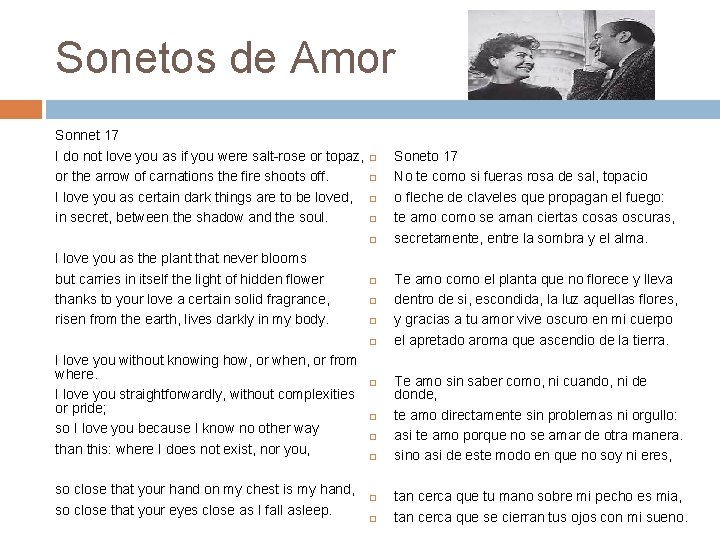
Sonetos de Amor Sonnet 17 I do not love you as if you were salt-rose or topaz, or the arrow of carnations the fire shoots off. I love you as certain dark things are to be loved, in secret, between the shadow and the soul. I love you as the plant that never blooms but carries in itself the light of hidden flower thanks to your love a certain solid fragrance, risen from the earth, lives darkly in my body. I love you without knowing how, or when, or from where. I love you straightforwardly, without complexities or pride; so I love you because I know no other way than this: where I does not exist, nor you, so close that your hand on my chest is my hand, so close that your eyes close as I fall asleep. Soneto 17 No te como si fueras rosa de sal, topacio o fleche de claveles que propagan el fuego: te amo como se aman ciertas cosas oscuras, secretamente, entre la sombra y el alma. Te amo como el planta que no florece y lleva dentro de si, escondida, la luz aquellas flores, y gracias a tu amor vive oscuro en mi cuerpo el apretado aroma que ascendio de la tierra. Te amo sin saber como, ni cuando, ni de donde, te amo directamente sin problemas ni orgullo: asi te amo porque no se amar de otra manera. sino asi de este modo en que no soy ni eres, tan cerca que tu mano sobre mi pecho es mia, tan cerca que se cierran tus ojos con mi sueno.
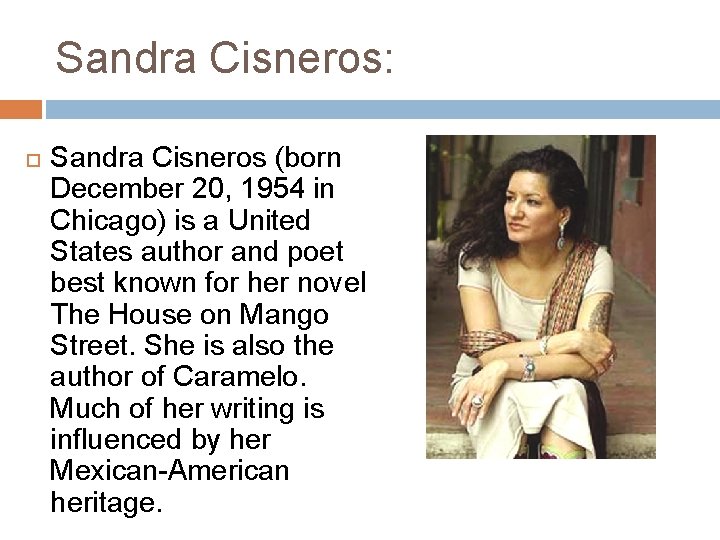
Sandra Cisneros: Sandra Cisneros (born December 20, 1954 in Chicago) is a United States author and poet best known for her novel The House on Mango Street. She is also the author of Caramelo. Much of her writing is influenced by her Mexican-American heritage.
Cloud by: Sandra Cisneros “If you are a poet, you will see clearly that there is a cloud floating in this sheet of paper. ” -Thich Nhat Hanh A lock of straw-colored hair wedged between the mottled pages of a Victor Before you became a cloud, you were an Hugo novel. A crescent of soap. A spider ocean, roiled and murmuring like a mouth. the color of a fingernail. The black nets beneath the sea of olive trees. A skein of You were the shadows of a cloud crossing blue wool. A tea saucer wrapped in over a field of tulips. newspaper. An empty cracker tin. A bowl of You were the tears of a man who cried into blueberries in heavy cream. White wine in a green-stemmed glass a plaid handkerchief. You were the sky without a hat. Your heart puffed and flowered like sheets drying on a And when you opened your wings to wind, line. across the punched-tin sky above a prison And when you were a tree, you listened to courtyard, those condemned to death and the trees and the tree things trees told you. those condemned to life watched how smooth and sweet a white cloud glides. You were the wind in the wheels of a red bicycle. You were the spidery Maria-tattooed on the hairless arm of a boy in downtown Houston. You were the rain rolling off the waxy leaves of a magnolia tree.
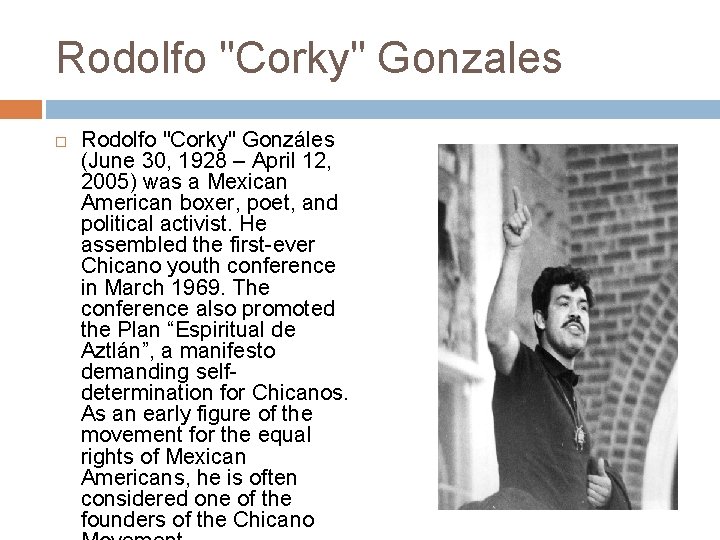
Rodolfo "Corky" Gonzales Rodolfo "Corky" Gonzáles (June 30, 1928 – April 12, 2005) was a Mexican American boxer, poet, and political activist. He assembled the first-ever Chicano youth conference in March 1969. The conference also promoted the Plan “Espiritual de Aztlán”, a manifesto demanding selfdetermination for Chicanos. As an early figure of the movement for the equal rights of Mexican Americans, he is often considered one of the founders of the Chicano
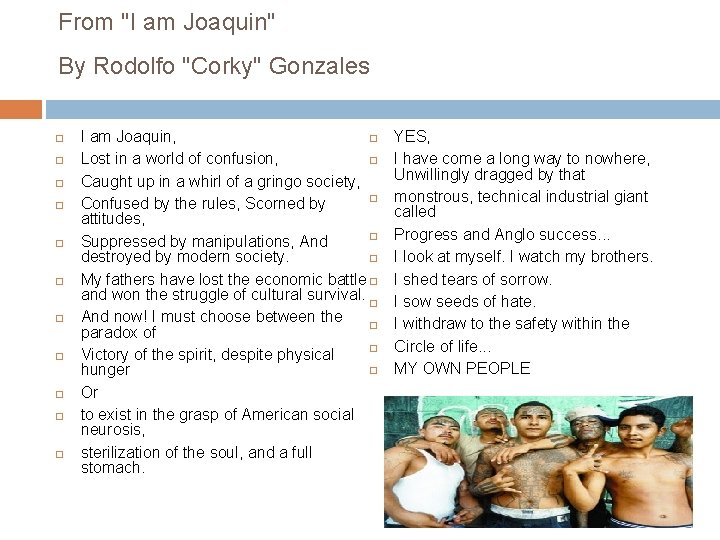
From "I am Joaquin" By Rodolfo "Corky" Gonzales I am Joaquin, Lost in a world of confusion, Caught up in a whirl of a gringo society, Confused by the rules, Scorned by attitudes, Suppressed by manipulations, And destroyed by modern society. My fathers have lost the economic battle and won the struggle of cultural survival. And now! I must choose between the paradox of Victory of the spirit, despite physical hunger Or to exist in the grasp of American social neurosis, sterilization of the soul, and a full stomach. YES, I have come a long way to nowhere, Unwillingly dragged by that monstrous, technical industrial giant called Progress and Anglo success. . . I look at myself. I watch my brothers. I shed tears of sorrow. I sow seeds of hate. I withdraw to the safety within the Circle of life. . . MY OWN PEOPLE
I am Joaquin. I rode with Pancho Villa, crude and warm. A tornado at full strength, nourished and inspired by the passion and the fire of all his earth, people. I am Emillano Zapata. "This Land This Earth Is OURS" The Villages The Mountains The Streams belong to Zapatistas. Our life Or yours is the only trade for soft brown earth and maiz. All of which is our reward, A creed that formed a constitution for all who dare live free! "This land is ours. . . Father, I give it back to you. Mexico must be free. . . " I ride with Revolutionists against myself. I am Rural Course and brutal, I am the mountain Indian, superior over all. The thundering hoof beats are my horses. The chattering of machine guns' are death to all of me: Yaqui Tarahumara Chamula Zapotec Mestizo Espanol
Activities: You will be divided into groups of up to 4, and given the poem selection in hand-out form. Next, your group will choose one of the poems from the selection, and discuss the following questions. Write your responses on a separate sheet of paper with all group member names. Be prepared to read the poem to the class, and support your answers with textual evidence!
Questions: What do you think the poem means… Who or what is the subject of the poem? What are they talking about? Why do you think the author wrote the poem? Where is the poem happening? What is the poet’s attitude? Identify theme (central idea) of the poem.
Assessment: As an individual, your Cornell notes will be graded for completion ? ? /20 pts Your group will be graded on presentation of the poem, as well as the answers to those questions. Always use textual evidence to support your answers, and explain how the textual evidence supports your answers. ? ? /30 pts Total: ? ? /50 pts
- Slides: 30