
The British School Quito is a learning community
The British School Quito is a learning community where students, staff and families work together to provide the foundations for academic excellence and personal growth. Our Values • We live and learn together with respect and care for each other. • We live and learn with a happy and welcoming attitude to everyone. • We live and learn with an active and determined approach to our ambition.
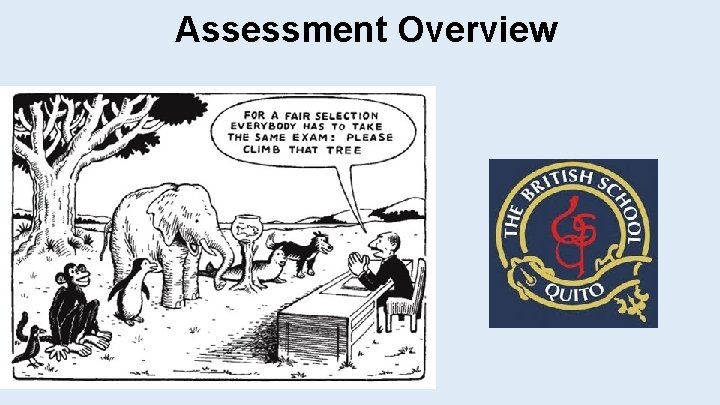
Assessment Overview
Assessment at BSQ provides evidence to guide teaching and learning, as well as providing the opportunity for students to demonstrate and review progress. KEY OBJECTIVES OF ASSESSMENT AT BSQ 1. To use formative assessment to inform teaching and provide for the learning needs of all students 2. To give constructive feedback to students in a range of ways that enables them to have an active role in identifying their own learning needs and how to make progress. 3. To use a systematic approach for informing parents of their child’s progress and giving advice in how to support learning at home. 4. To systematically and effectively monitor and evaluate students’ progress on an individual and school basis and use results to plan for improvement. 5. To align with the Ecuadorian system for assessment.
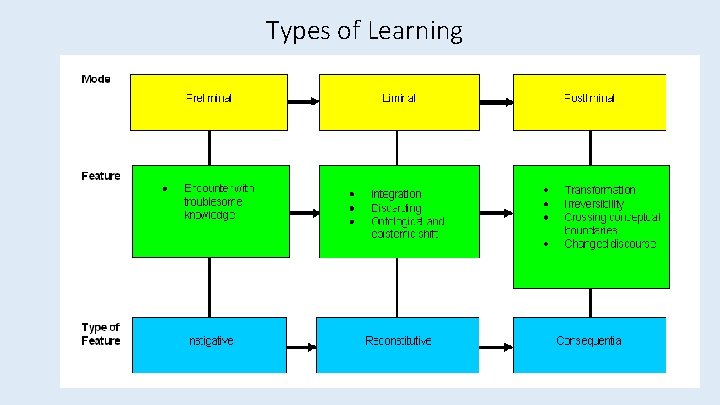
Types of Learning
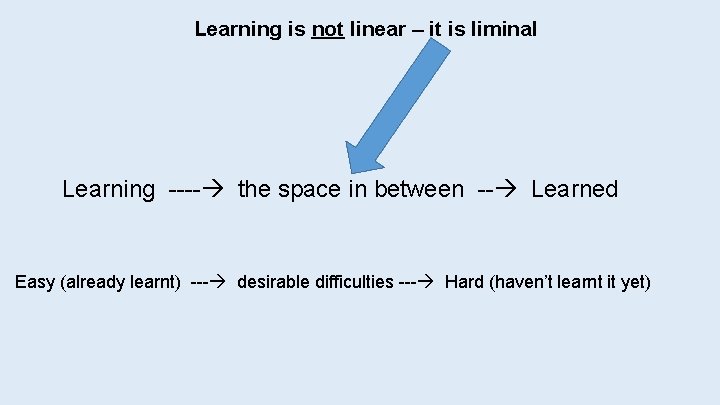
Learning is not linear – it is liminal Learning ---- the space in between -- Learned Easy (already learnt) --- desirable difficulties --- Hard (haven’t learnt it yet)
Types of assessment Formative (Assessment for learning) ● For students: to develop keen, ambitious students with a thirst for learning by identifying for them where they need to target their efforts to improve. ● For teachers: as reflective practitioners, Af. L allows us to identify what a student knows and what they need to learn next. It supports us to provide appropriate support or extension. It supports our evaluation of what is working well in our teaching and what we might need to tweak. ● For parents: it provides us with rich, constructive information to report to parents providing them with a broad picture of their strengths and areas for improvement.
Summative (Assessment of learning) ● For students: an opportunity to understand how well they have understood and retained information on a particular topic. ● For teachers: an opportunity to evaluate student learning and the impact of their teaching of different concepts and skills. All of this information supports the planning of future teaching and learning. ● For parents: to summarise and support the rich information provided by formative assessment and feedback. ● For school leaders: to support and verify judgements made through formative assessment. To assist in monitoring the progress and attainment of individuals, classes, year groups and other identified groups within the school. To use this analysis to redeploy resources as required to close attainment and progress gaps.
Assessment in Early Years (Nursery and Reception) is at the heart of teaching and learning across the Early Years curriculum. Assessment underpins planning, teaching, learning, progress and attainment. Summative judgements are made of students at the end of Nursery and Reception. In Nursery, judgements will be made against the Development Matters Age Bands in all seventeen areas of learning. In Reception, the end of year judgements will be made against the Early Learning Goals in all seventeen areas of learning. Internal Management Information System - Tapestry: The Early Years Online Learning Journal
We report on students’ progress and attainment using four different descriptors: 1. Ecuadorian Grade, from 1 to 10, detailing their attainment within their year group. 2. Their Level Descriptor, which measures their attainment within the year group. This level is reset each academic year. 3. Effort Grade, from A to E, detailing their approach to learning, homework, organisation and participation in class. 4. An overall Conduct Grade, from A to E, detailing their behaviour, linked to the school values.
Ecuadorian Grading System ● Children are graded numerically from 1 -10 in Ecuador. ● It is extremely unusual for children to be graded below a 6. ● The system is more holistic and is based on progress and attitude. ● We do not have level descriptors for each grade but we do have a comparison chart to use.
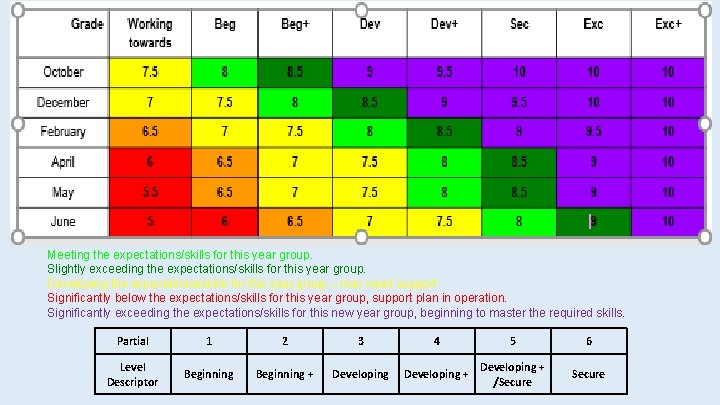
Meeting the expectations/skills for this year group. Slightly exceeding the expectations/skills for this year group. Developing the expectations/skills for this year group – may need support. Significantly below the expectations/skills for this year group, support plan in operation. Significantly exceeding the expectations/skills for this new year group, beginning to master the required skills. Partial 1 2 3 4 5 6 Level Descriptor Beginning + Developing + /Secure
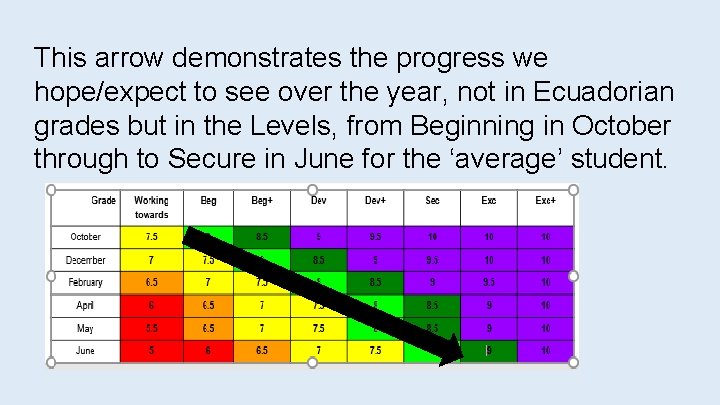
This arrow demonstrates the progress we hope/expect to see over the year, not in Ecuadorian grades but in the Levels, from Beginning in October through to Secure in June for the ‘average’ student.
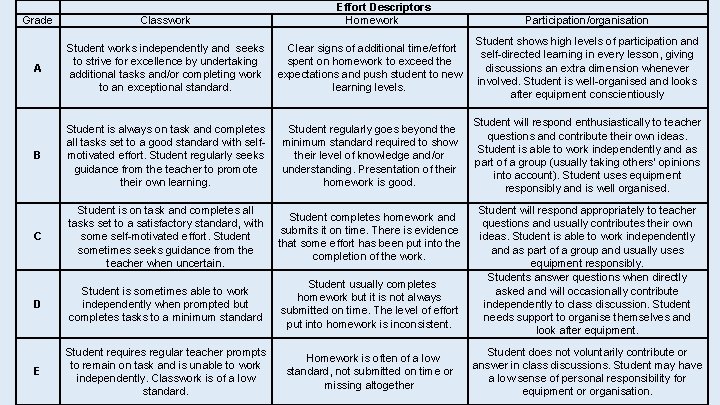
Effort Descriptors Homework Grade Classwork Participation/organisation A Student works independently and seeks to strive for excellence by undertaking additional tasks and/or completing work to an exceptional standard. Clear signs of additional time/effort spent on homework to exceed the expectations and push student to new learning levels. Student shows high levels of participation and self-directed learning in every lesson, giving discussions an extra dimension whenever involved. Student is well-organised and looks after equipment conscientiously B Student is always on task and completes all tasks set to a good standard with selfmotivated effort. Student regularly seeks guidance from the teacher to promote their own learning. Student regularly goes beyond the minimum standard required to show their level of knowledge and/or understanding. Presentation of their homework is good. Student will respond enthusiastically to teacher questions and contribute their own ideas. Student is able to work independently and as part of a group (usually taking others’ opinions into account). Student uses equipment responsibly and is well organised. C Student is on task and completes all tasks set to a satisfactory standard, with some self-motivated effort. Student sometimes seeks guidance from the teacher when uncertain. Student completes homework and submits it on time. There is evidence that some effort has been put into the completion of the work. D Student is sometimes able to work independently when prompted but completes tasks to a minimum standard Student usually completes homework but it is not always submitted on time. The level of effort put into homework is inconsistent. E Student requires regular teacher prompts to remain on task and is unable to work independently. Classwork is of a low standard. Homework is often of a low standard, not submitted on time or missing altogether Student will respond appropriately to teacher questions and usually contributes their own ideas. Student is able to work independently and as part of a group and usually uses equipment responsibly. Students answer questions when directly asked and will occasionally contribute independently to class discussion. Student needs support to organise themselves and look after equipment. Student does not voluntarily contribute or answer in class discussions. Student may have a low sense of personal responsibility for equipment or organisation.
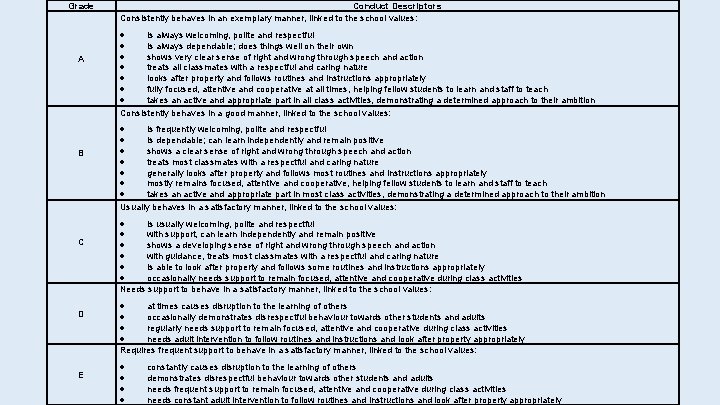
Grade A B C D E Conduct Descriptors Consistently behaves in an exemplary manner, linked to the school values: is always welcoming, polite and respectful is always dependable; does things well on their own shows very clear sense of right and wrong through speech and action treats all classmates with a respectful and caring nature looks after property and follows routines and instructions appropriately fully focused, attentive and cooperative at all times, helping fellow students to learn and staff to teach takes an active and appropriate part in all class activities, demonstrating a determined approach to their ambition Consistently behaves in a good manner, linked to the school values: is frequently welcoming, polite and respectful is dependable; can learn independently and remain positive shows a clear sense of right and wrong through speech and action treats most classmates with a respectful and caring nature generally looks after property and follows most routines and instructions appropriately mostly remains focused, attentive and cooperative, helping fellow students to learn and staff to teach takes an active and appropriate part in most class activities, demonstrating a determined approach to their ambition Usually behaves in a satisfactory manner, linked to the school values: is usually welcoming, polite and respectful with support, can learn independently and remain positive shows a developing sense of right and wrong through speech and action with guidance, treats most classmates with a respectful and caring nature is able to look after property and follows some routines and instructions appropriately occasionally needs support to remain focused, attentive and cooperative during class activities Needs support to behave in a satisfactory manner, linked to the school values: at times causes disruption to the learning of others occasionally demonstrates disrespectful behaviour towards other students and adults regularly needs support to remain focused, attentive and cooperative during class activities needs adult intervention to follow routines and instructions and look after property appropriately Requires frequent support to behave in a satisfactory manner, linked to the school values: constantly causes disruption to the learning of others demonstrates disrespectful behaviour towards other students and adults needs frequent support to remain focused, attentive and cooperative during class activities needs constant adult intervention to follow routines and instructions and look after property appropriately
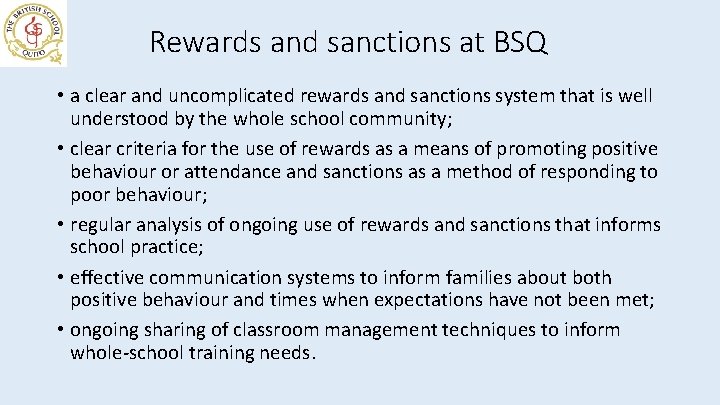
Rewards and sanctions at BSQ • a clear and uncomplicated rewards and sanctions system that is well understood by the whole school community; • clear criteria for the use of rewards as a means of promoting positive behaviour or attendance and sanctions as a method of responding to poor behaviour; • regular analysis of ongoing use of rewards and sanctions that informs school practice; • effective communication systems to inform families about both positive behaviour and times when expectations have not been met; • ongoing sharing of classroom management techniques to inform whole-school training needs.
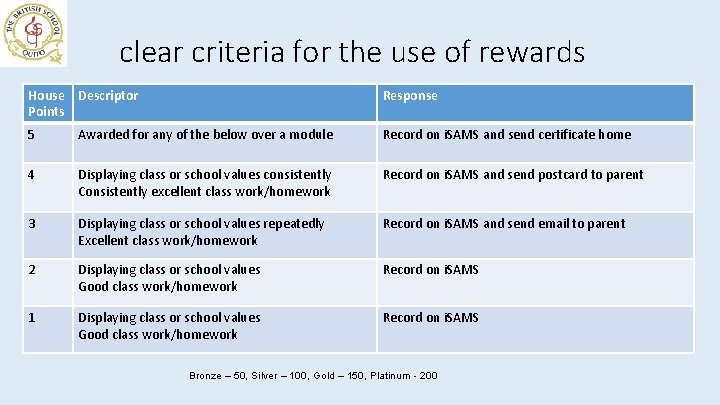
clear criteria for the use of rewards House Descriptor Points Response 5 Awarded for any of the below over a module Record on i. SAMS and send certificate home 4 Displaying class or school values consistently Consistently excellent class work/homework Record on i. SAMS and send postcard to parent 3 Displaying class or school values repeatedly Excellent class work/homework Record on i. SAMS and send email to parent 2 Displaying class or school values Good class work/homework Record on i. SAMS 1 Displaying class or school values Good class work/homework Record on i. SAMS Bronze – 50, Silver – 100, Gold – 150, Platinum - 200
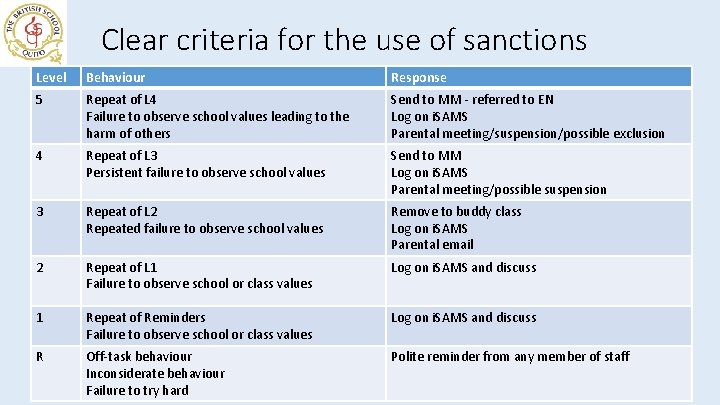
Clear criteria for the use of sanctions Level Behaviour Response 5 Repeat of L 4 Failure to observe school values leading to the harm of others Send to MM - referred to EN Log on i. SAMS Parental meeting/suspension/possible exclusion 4 Repeat of L 3 Persistent failure to observe school values Send to MM Log on i. SAMS Parental meeting/possible suspension 3 Repeat of L 2 Repeated failure to observe school values Remove to buddy class Log on i. SAMS Parental email 2 Repeat of L 1 Failure to observe school or class values Log on i. SAMS and discuss 1 Repeat of Reminders Failure to observe school or class values Log on i. SAMS and discuss R Off-task behaviour Inconsiderate behaviour Failure to try hard Polite reminder from any member of staff
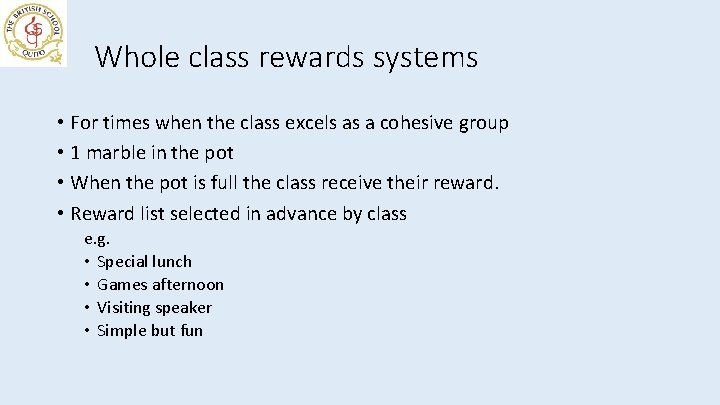
Whole class rewards systems • For times when the class excels as a cohesive group • 1 marble in the pot • When the pot is full the class receive their reward. • Reward list selected in advance by class e. g. • Special lunch • Games afternoon • Visiting speaker • Simple but fun

Any questions?
- Slides: 22