
The British Education System Contents Academic year Key
The British Education System
Contents • • Academic year Key Stage exams Public schools Nurseries Primary education Grammar schools Eton Secondary education • • Sixth form College Tertiary education Non-degree courses Recent issues Information Tips

The British academic year Half-term Start Half-term Christmas Half-term Easter End • Term starts on September 1 st and ends ~July 20 th. • Each term is about 12 weeks, with 1 week off. • Christmas and Easter are 2 weeks off. • Summer holidays is about 4 to 5 weeks.
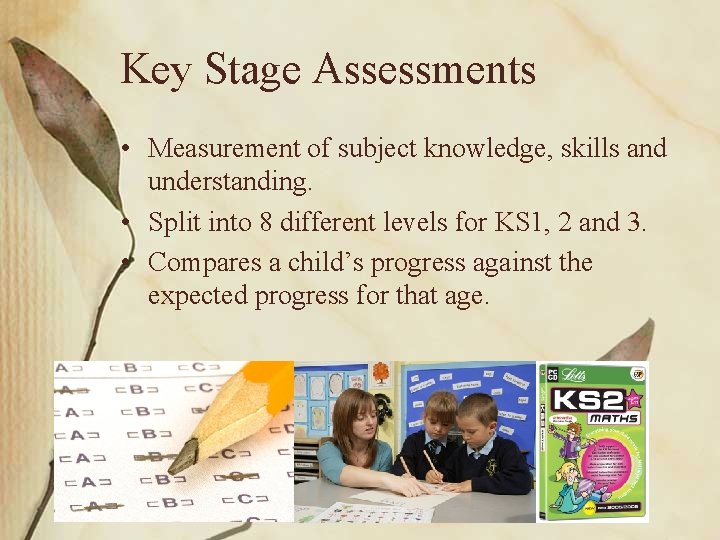
Key Stage Assessments • Measurement of subject knowledge, skills and understanding. • Split into 8 different levels for KS 1, 2 and 3. • Compares a child’s progress against the expected progress for that age.
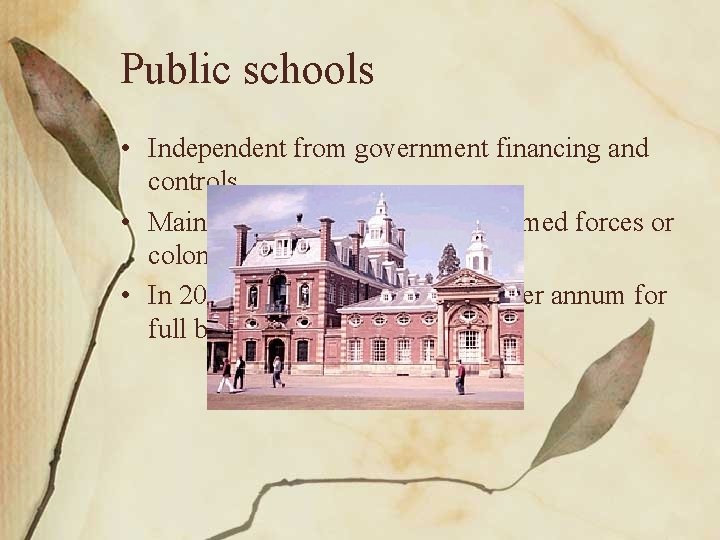
Public schools • Independent from government financing and controls. • Mainly for the elite of politics, armed forces or colonial government. • In 2009, £ 16, 000 to £ 30, 000 per annum for full boarding status.
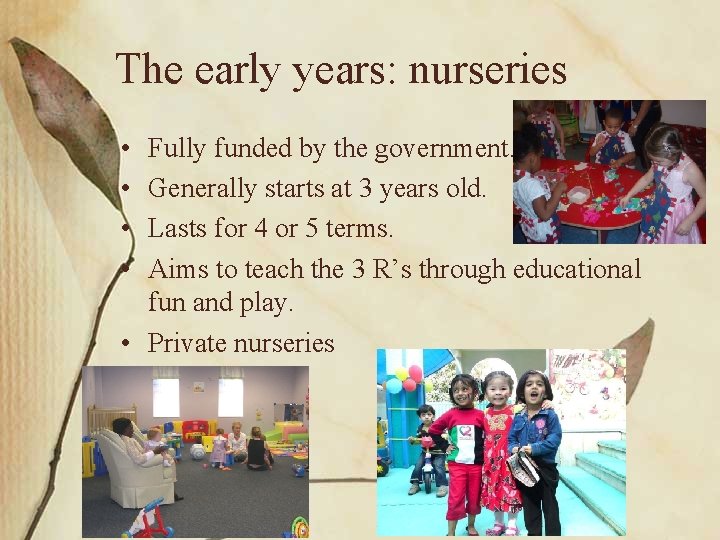
The early years: nurseries • • Fully funded by the government. Generally starts at 3 years old. Lasts for 4 or 5 terms. Aims to teach the 3 R’s through educational fun and play. • Private nurseries
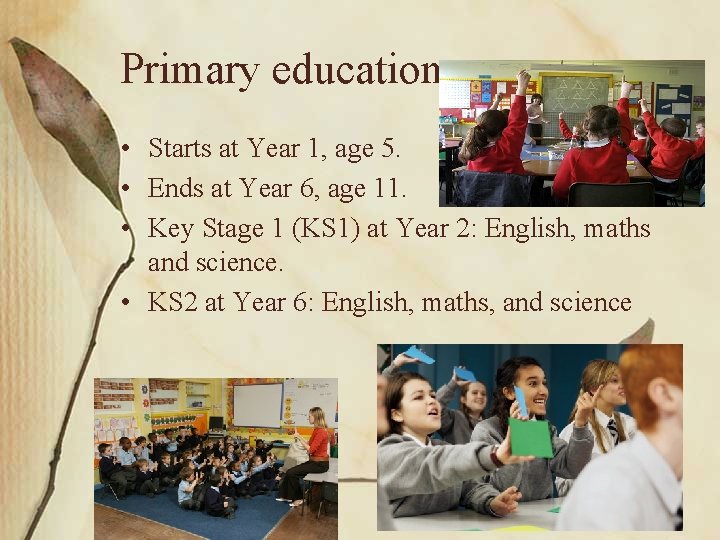
Primary education • Starts at Year 1, age 5. • Ends at Year 6, age 11. • Key Stage 1 (KS 1) at Year 2: English, maths and science. • KS 2 at Year 6: English, maths, and science
Grammar schools and 11+ exams • Entrance exams for grammar schools. • Dominates school leagues for performance. • Most are funded by the government but remaining are fee-paying schools. • Very strict, conservative and traditional. • From early 6 th century, taught Latin mainly and now everything. • Heavily over-subscribed.
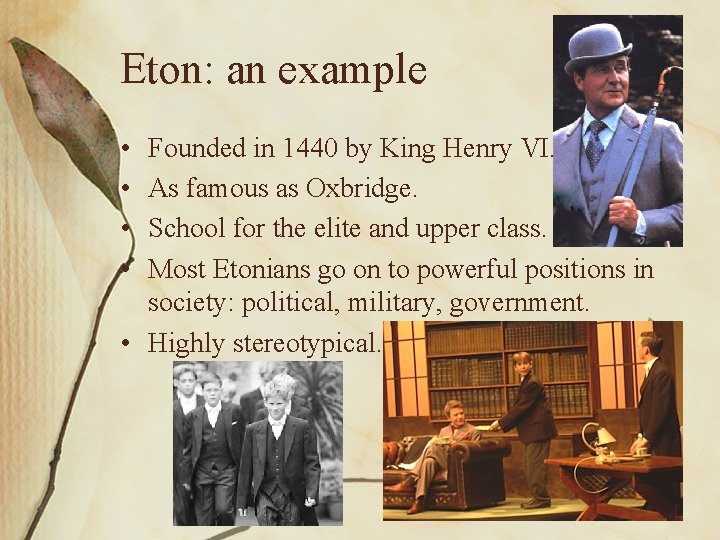
Eton: an example • • Founded in 1440 by King Henry VI. As famous as Oxbridge. School for the elite and upper class. Most Etonians go on to powerful positions in society: political, military, government. • Highly stereotypical.
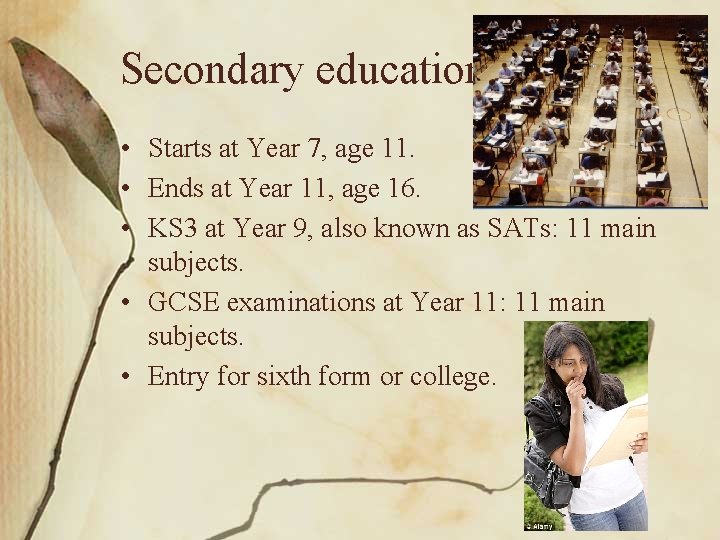
Secondary education • Starts at Year 7, age 11. • Ends at Year 11, age 16. • KS 3 at Year 9, also known as SATs: 11 main subjects. • GCSE examinations at Year 11: 11 main subjects. • Entry for sixth form or college.
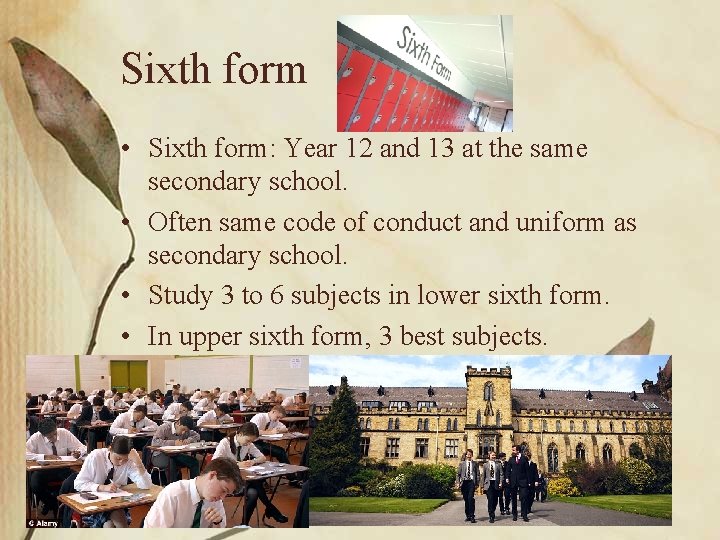
Sixth form • Sixth form: Year 12 and 13 at the same secondary school. • Often same code of conduct and uniform as secondary school. • Study 3 to 6 subjects in lower sixth form. • In upper sixth form, 3 best subjects.
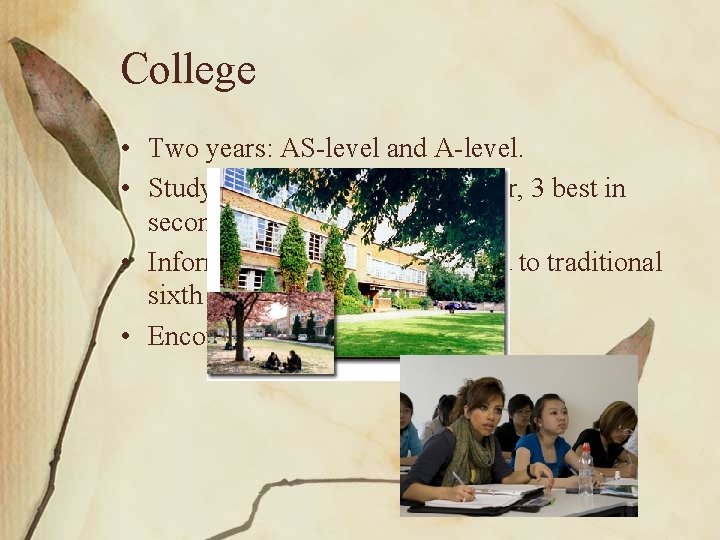
College • Two years: AS-level and A-level. • Study 3 to 6 subjects in first year, 3 best in second. • Informal environment compared to traditional sixth form. • Encourages independent study.
Tertiary education • University entrance is determined by UCAS: 30. • Top programmes require the highest points. • Today, entry often requires more than points. • Students do not apply directly to the university, but through UCAS.
Tertiary education • • Traditional 3 years or sandwich programmes. Vocational courses and diplomas. A professional environment. Tuition: £ 3, 290 a year vs. £ 6 -20, 000 for international students.
Non-degree tertiary education • Higher National Diploma (HND): 2 years, work experience focused, credits transferable. • Vocational courses: 1 -2 years, way of entering degree-level courses slowly. • International students can use these as replacement for A-levels to enter British universities.
Recent university issues • • Tuition fee hike for 2012, £ 7, 000. Prestige universities demands no cap. Higher interest rate on student loans. Allows universities to be more competitive, both domestically and internationally. • Addresses quality of degrees. • 210, 000 students were rejected for 2011.
Information foreign students • IELTS requirement: 6. 0 or higher. • N. H. S. applicable. • Try: British Chevening Scholarships, British Council Fellowship Programme, Commonwealth Scholarship and Fellowship Programme… • 1 -2 year work permit available after completing university studies.
Tips for international students • Be prepared to wait… a lot! • Shops close at 6 p. m. • Bring some instant food and common medicine. • Smile + handshake = friend. • Don’t be afraid to ask for help. • Develop a sense of humour.
Thank you for your attention and patience
- Slides: 19