
The Brain The brain weighs about 3 pounds
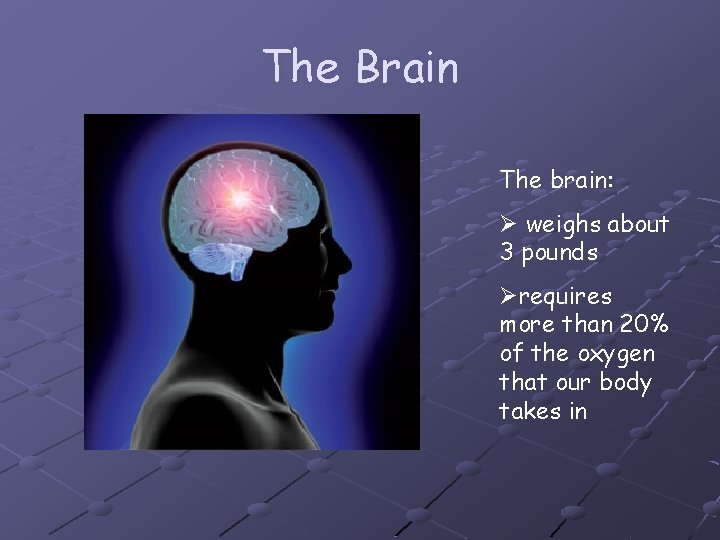
The Brain The brain: Ø weighs about 3 pounds Ørequires more than 20% of the oxygen that our body takes in
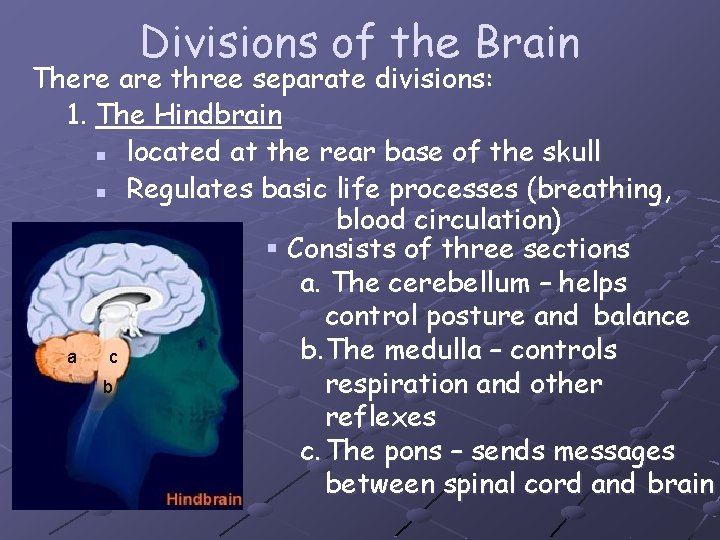
Divisions of the Brain There are three separate divisions: 1. The Hindbrain n located at the rear base of the skull n Regulates basic life processes (breathing, blood circulation) § Consists of three sections a. The cerebellum – helps control posture and balance b. The medulla – controls a c respiration and other b reflexes c. The pons – sends messages between spinal cord and brain
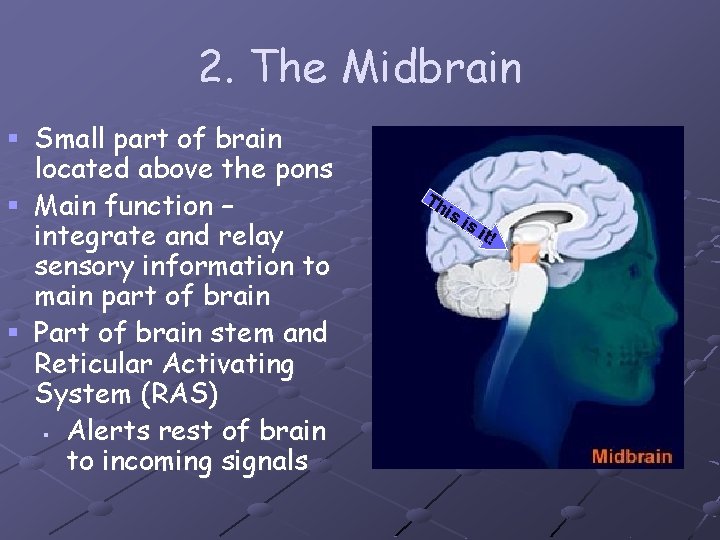
2. The Midbrain § Small part of brain located above the pons § Main function – integrate and relay sensory information to main part of brain § Part of brain stem and Reticular Activating System (RAS) § Alerts rest of brain to incoming signals Th is is it!
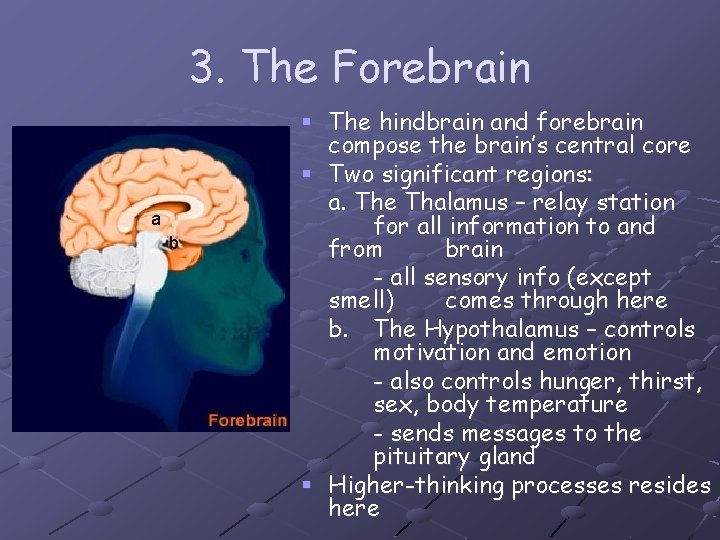
3. The Forebrain a b § The hindbrain and forebrain compose the brain’s central core § Two significant regions: a. The Thalamus – relay station for all information to and from brain - all sensory info (except smell) comes through here b. The Hypothalamus – controls motivation and emotion - also controls hunger, thirst, sex, body temperature - sends messages to the pituitary gland § Higher-thinking processes resides here
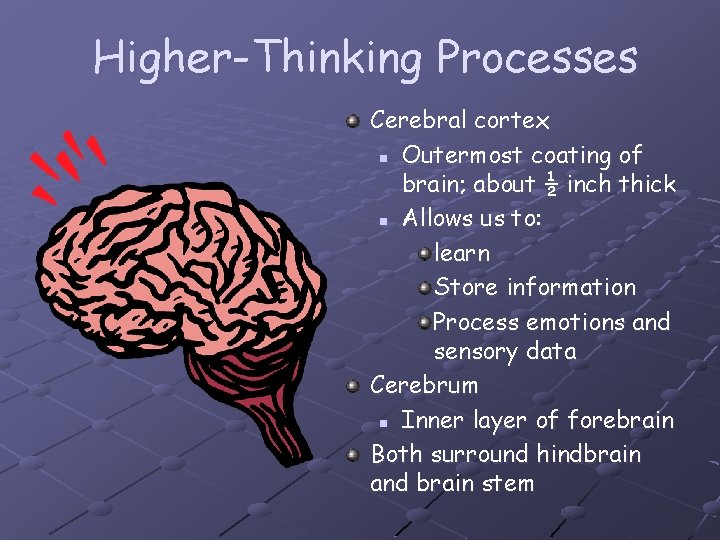
Higher-Thinking Processes Cerebral cortex n Outermost coating of brain; about ½ inch thick n Allows us to: learn Store information Process emotions and sensory data Cerebrum n Inner layer of forebrain Both surround hindbrain and brain stem
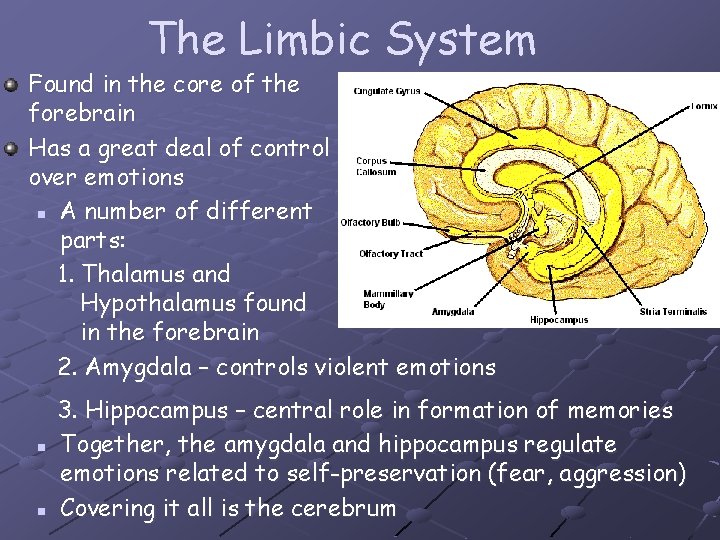
The Limbic System Found in the core of the forebrain Has a great deal of control over emotions n A number of different parts: 1. Thalamus and Hypothalamus found in the forebrain 2. Amygdala – controls violent emotions n n 3. Hippocampus – central role in formation of memories Together, the amygdala and hippocampus regulate emotions related to self-preservation (fear, aggression) Covering it all is the cerebrum
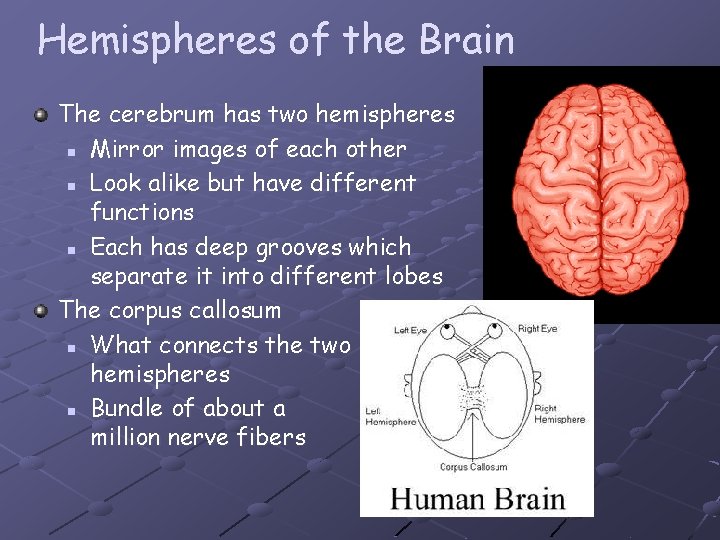
Hemispheres of the Brain The cerebrum has two hemispheres n Mirror images of each other n Look alike but have different functions n Each has deep grooves which separate it into different lobes The corpus callosum n What connects the two hemispheres n Bundle of about a million nerve fibers
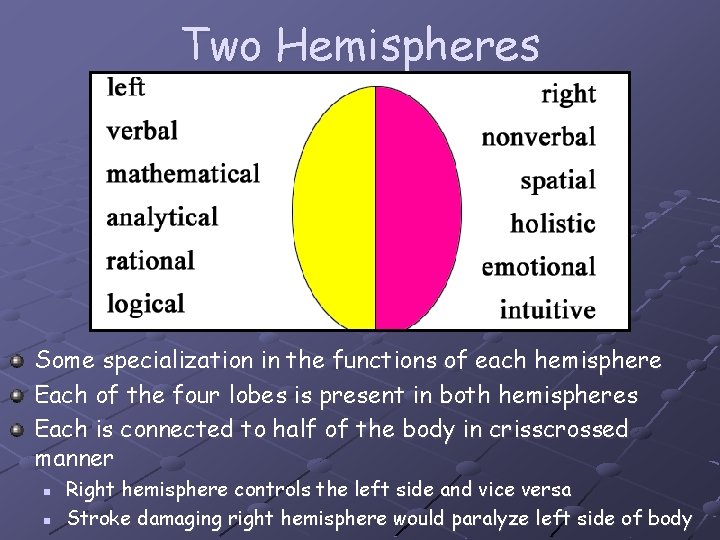
Two Hemispheres Some specialization in the functions of each hemisphere Each of the four lobes is present in both hemispheres Each is connected to half of the body in crisscrossed manner n n Right hemisphere controls the left side and vice versa Stroke damaging right hemisphere would paralyze left side of body
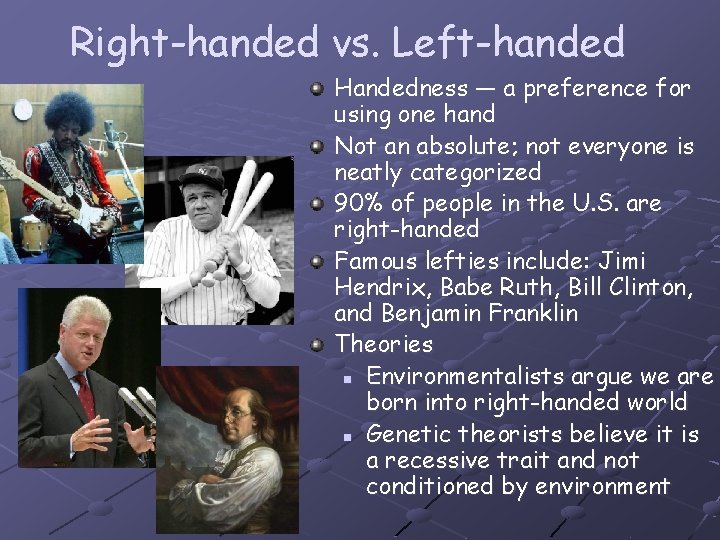
Right-handed vs. Left-handed Handedness — a preference for using one hand Not an absolute; not everyone is neatly categorized 90% of people in the U. S. are right-handed Famous lefties include: Jimi Hendrix, Babe Ruth, Bill Clinton, and Benjamin Franklin Theories n Environmentalists argue we are born into right-handed world n Genetic theorists believe it is a recessive trait and not conditioned by environment
Problems Associated With Being a Lefty Tend to be more prone to suffer from: n Autism and dyslexia n Schizophrenia n Mental retardation n Alcoholism Coren and Halpern – study found correlation linking handedness to life expectancy n Tested more than 5000 subjects n Lefties dwindled from 13% at age 20 to 5% at 50 to less than 1% at 80 n Maybe more accident prone from living in right-handed world
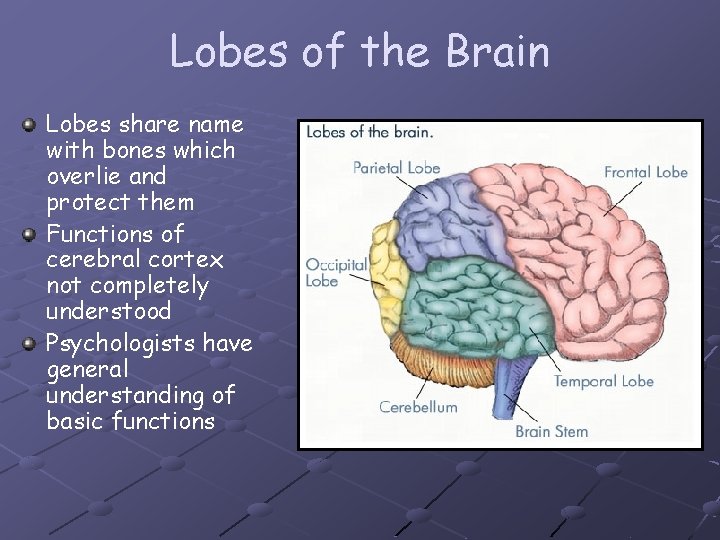
Lobes of the Brain Lobes share name with bones which overlie and protect them Functions of cerebral cortex not completely understood Psychologists have general understanding of basic functions
Lobes and Their Functions Frontal: planning of movements, working memory Temporal: hearing, advanced visual processing, memory Occipital: vision Parietal: body sensations Primary motor cortex: fine motor control
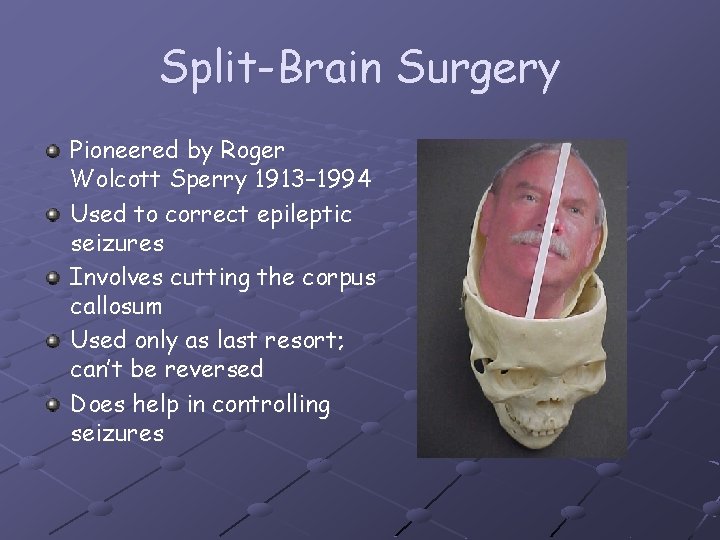
Split-Brain Surgery Pioneered by Roger Wolcott Sperry 1913– 1994 Used to correct epileptic seizures Involves cutting the corpus callosum Used only as last resort; can’t be reversed Does help in controlling seizures
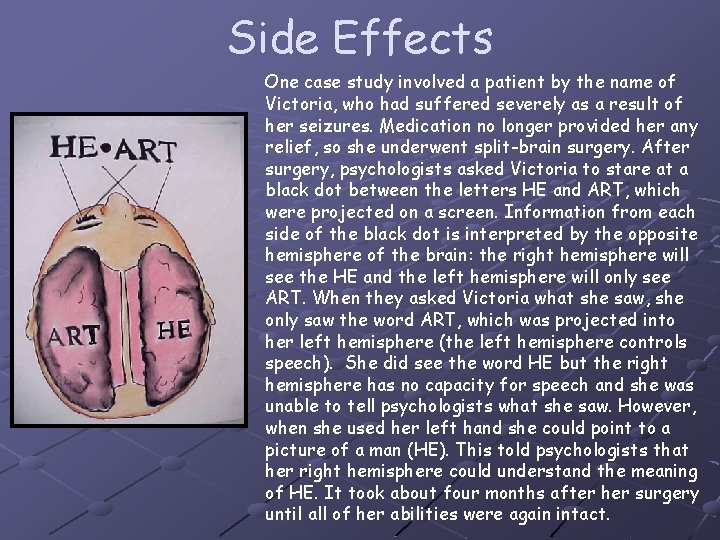
Side Effects One case study involved a patient by the name of Victoria, who had suffered severely as a result of her seizures. Medication no longer provided her any relief, so she underwent split-brain surgery. After surgery, psychologists asked Victoria to stare at a black dot between the letters HE and ART, which were projected on a screen. Information from each side of the black dot is interpreted by the opposite hemisphere of the brain: the right hemisphere will see the HE and the left hemisphere will only see ART. When they asked Victoria what she saw, she only saw the word ART, which was projected into her left hemisphere (the left hemisphere controls speech). She did see the word HE but the right hemisphere has no capacity for speech and she was unable to tell psychologists what she saw. However, when she used her left hand she could point to a picture of a man (HE). This told psychologists that her right hemisphere could understand the meaning of HE. It took about four months after her surgery until all of her abilities were again intact.
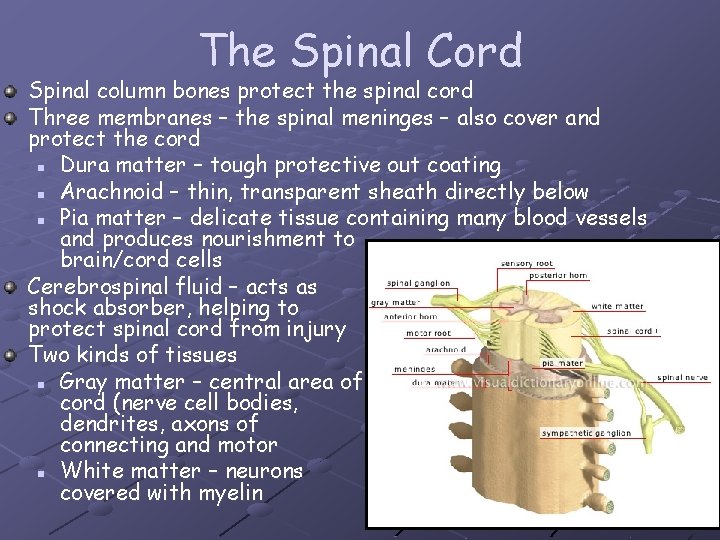
The Spinal Cord Spinal column bones protect the spinal cord Three membranes – the spinal meninges – also cover and protect the cord n Dura matter – tough protective out coating n Arachnoid – thin, transparent sheath directly below n Pia matter – delicate tissue containing many blood vessels and produces nourishment to brain/cord cells Cerebrospinal fluid – acts as shock absorber, helping to protect spinal cord from injury Two kinds of tissues n Gray matter – central area of cord (nerve cell bodies, dendrites, axons of connecting and motor neurons) n White matter – neurons covered with myelin
Looking Inside the Brain Structure mapped out by dissecting brains from bodies donated to science Neuroscientists used specialized techniques to investigate connections between brain and behavior
GIRL SCANNING AREA
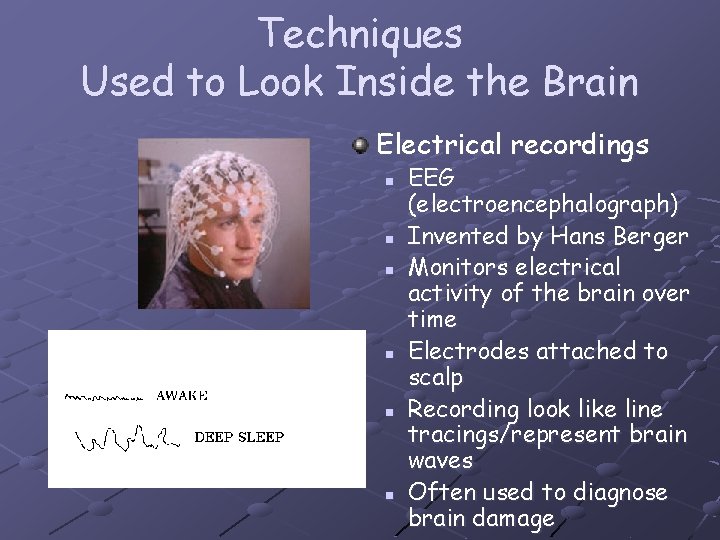
Techniques Used to Look Inside the Brain Electrical recordings n n n EEG (electroencephalograph) Invented by Hans Berger Monitors electrical activity of the brain over time Electrodes attached to scalp Recording look like line tracings/represent brain waves Often used to diagnose brain damage
Lesioning Brain tumors, strokes, head injuries all cause brain damage Leads to behavior changes Gardner (1975) experimented to understand multiple forms of intelligence Lesioning – destroying tissue in specific areas of the brain Limitations n Not many subjects n Can’t control location nor severity of brain damage Tests have been conducted on animals
Electrical Stimulation of the Brain ESB involves sending a weak electrical current into a brain structure in order to stimulate it The current mimics brain wave voltage Most ESB research is done on animals
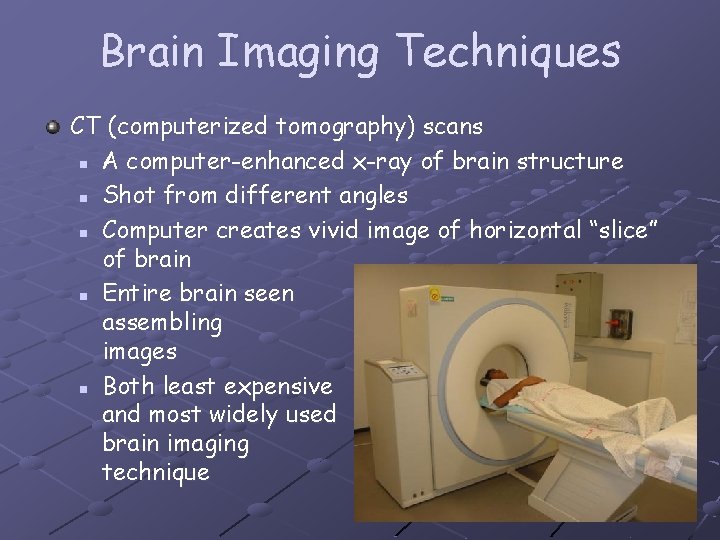
Brain Imaging Techniques CT (computerized tomography) scans n A computer-enhanced x-ray of brain structure n Shot from different angles n Computer creates vivid image of horizontal “slice” of brain n Entire brain seen through assembling of images n Both least expensive and most widely used brain imaging technique
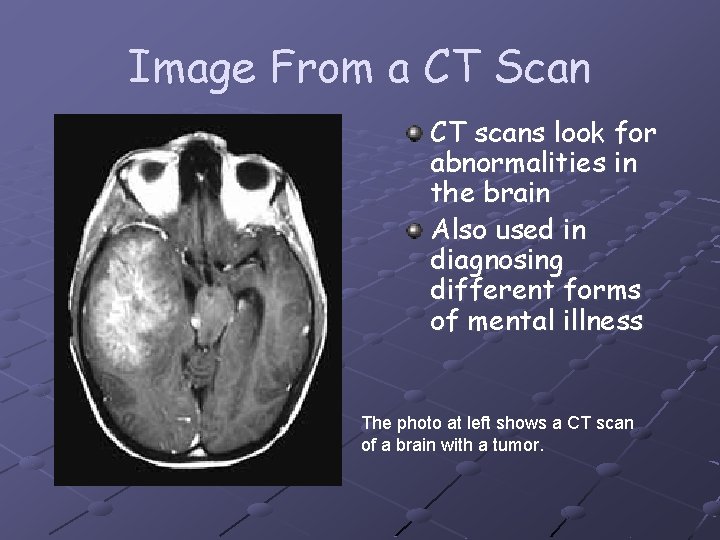
Image From a CT Scan CT scans look for abnormalities in the brain Also used in diagnosing different forms of mental illness The photo at left shows a CT scan of a brain with a tumor.
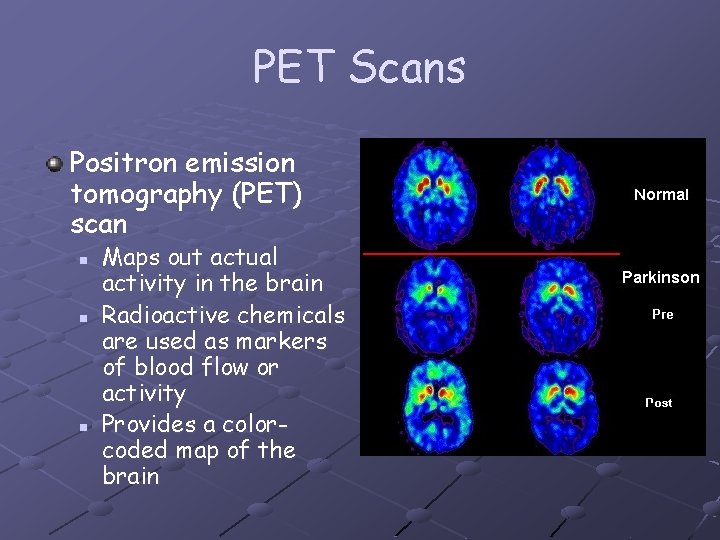
PET Scans Positron emission tomography (PET) scan n Maps out actual activity in the brain Radioactive chemicals are used as markers of blood flow or activity Provides a colorcoded map of the brain
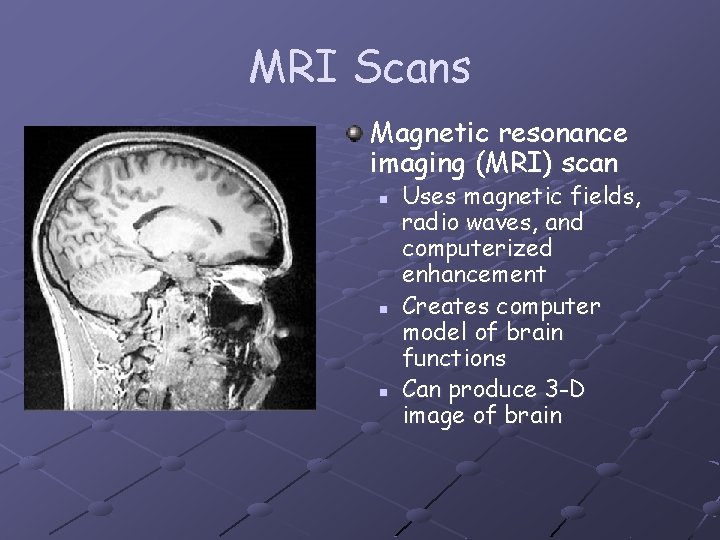
MRI Scans Magnetic resonance imaging (MRI) scan n Uses magnetic fields, radio waves, and computerized enhancement Creates computer model of brain functions Can produce 3 -D image of brain
- Slides: 25