
THE BOTSWANA DEVELOPMENT MODEL SINCE 1966 EVALUATION OF
THE BOTSWANA DEVELOPMENT MODEL SINCE 1966: EVALUATION OF DIVERSIFICATION EFFORTS. WHAT WORKED? WHAT DIDN’T? Keith Jefferis BIDPA/UB/FES Conference 27 th August, 2014
Diversification Policy Diversification a long-standing policy objective Initial dependence on cattle/beef From mid-1970 s – dependence on minerals Concerns about � conventional mineral economy dependence, limited direct job creation etc. � Dutch Disease – squeezed non-mining tradeables sectors � post-mineral sources of growth
Measuring Diversification No single, agreed definition. Focus on sustainability & living standards Structure of GDP & sources of GDP growth – sectoral diversification – but more diversification may just reflect declining minerals Fiscal diversification – sources of revenue Export diversification – balance of payments sustainability Employment, living standards, poverty and income distribution
Policies to promote diversification Macroeconomic policies � Exchange Rate Policy � Monetary Policy � Reserve accumulation � Invest mineral revenues Labour market policies � Minimum wage � Wage compression � Immigration

Policies to promote diversification Early sectoral/subsidy schemes � FAP � ARAP, ALDEP � Industrial Development Policy (1984, 1998) Institutions � BDC, NDB � TIPA Parastatals � WUC, BPC, BTC, BHC, BMC, BAMB
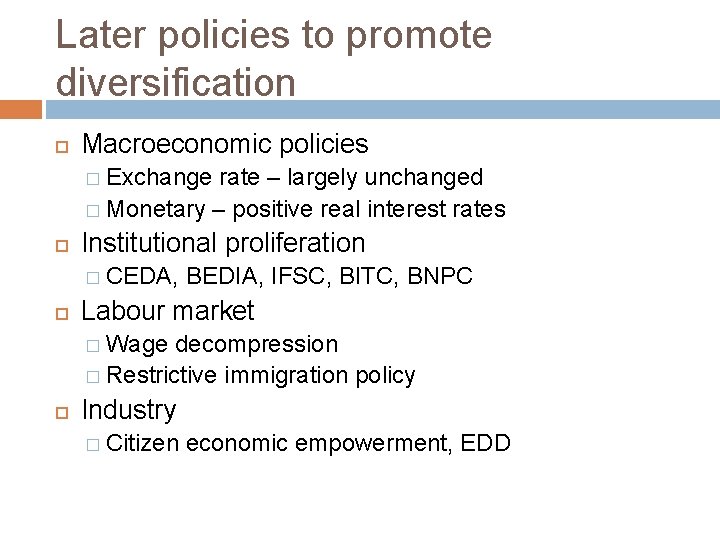
Later policies to promote diversification Macroeconomic policies � Exchange rate – largely unchanged � Monetary – positive real interest rates Institutional proliferation � CEDA, BEDIA, IFSC, BITC, BNPC Labour market � Wage decompression � Restrictive immigration policy Industry � Citizen economic empowerment, EDD
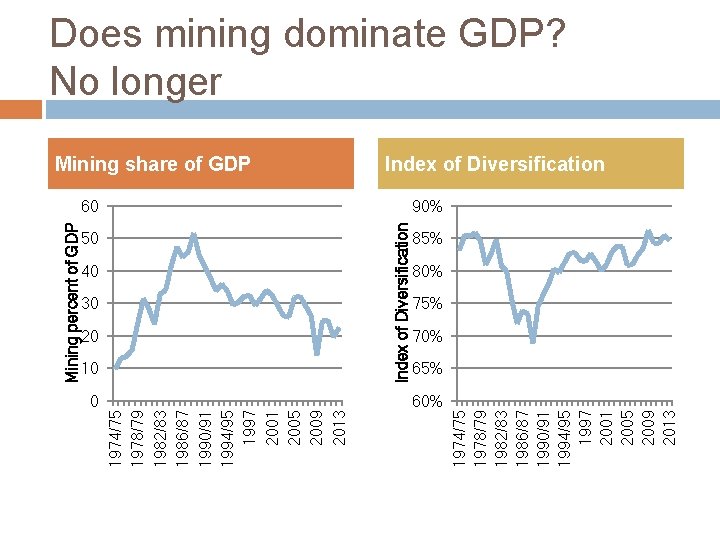
50 40 30 20 10 Index of Diversification Mining share of GDP 60 0 1974/75 1978/79 1982/83 1986/87 1990/91 1994/95 1997 2001 2005 2009 2013 Mining percent of GDP Does mining dominate GDP? No longer Index of Diversification 90% 85% 80% 75% 70% 65% 60%
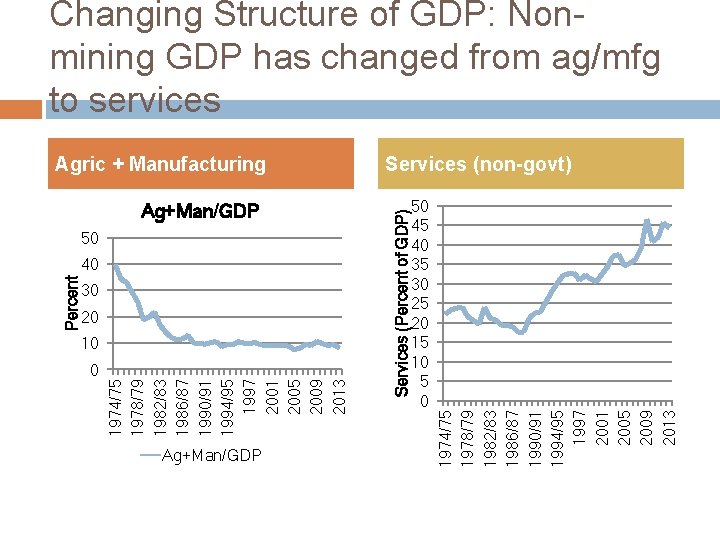
Changing Structure of GDP: Nonmining GDP has changed from ag/mfg to services 50 30 20 10 0 1974/75 1978/79 1982/83 1986/87 1990/91 1994/95 1997 2001 2005 2009 2013 Percent 40 Ag+Man/GDP 50 45 40 35 30 25 20 15 10 5 0 1974/75 1978/79 1982/83 1986/87 1990/91 1994/95 1997 2001 2005 2009 2013 Ag+Man/GDP Services (non-govt) Services (Percent of GDP) Agric + Manufacturing
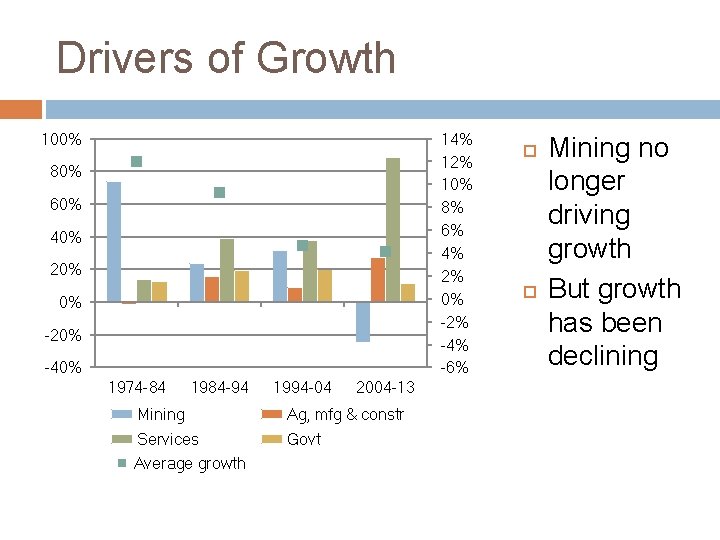
Drivers of Growth 100% 14% 12% 10% 8% 6% 4% 2% 0% -2% -4% -6% 80% 60% 40% 20% 0% -20% -40% 1974 -84 1984 -94 1994 -04 2004 -13 Mining Ag, mfg & constr Services Govt Average growth Mining no longer driving growth But growth has been declining
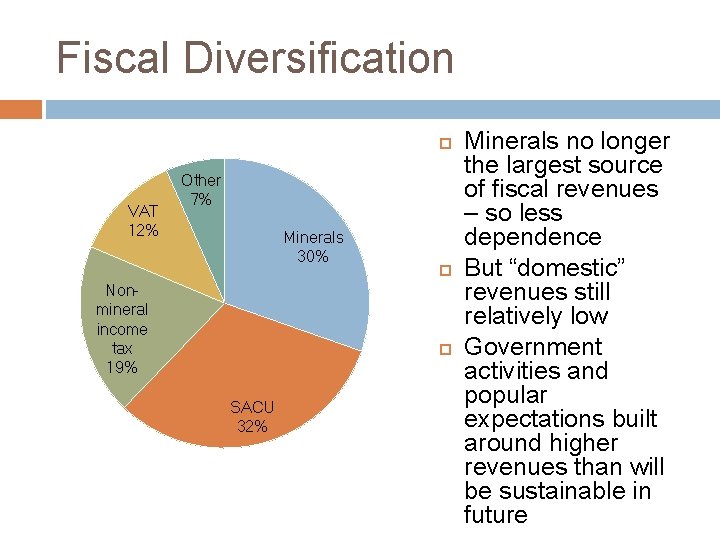
Fiscal Diversification VAT 12% Other 7% Minerals 30% Nonmineral income tax 19% SACU 32% Minerals no longer the largest source of fiscal revenues – so less dependence But “domestic” revenues still relatively low Government activities and popular expectations built around higher revenues than will be sustainable in future
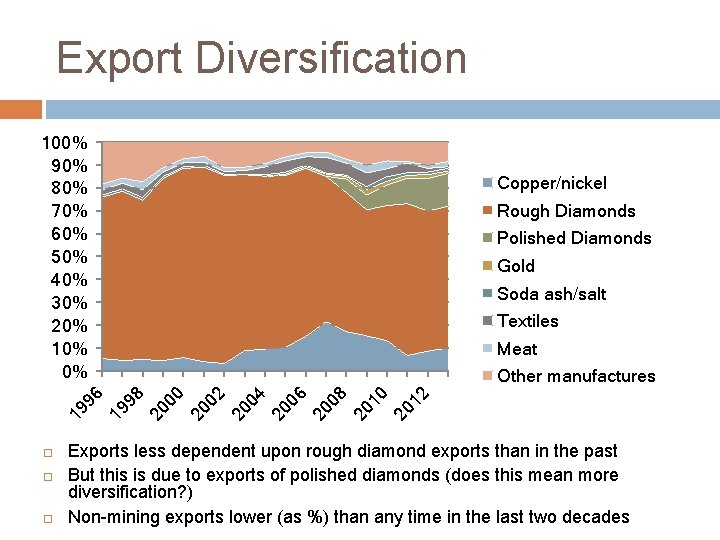
Export Diversification Copper/nickel Rough Diamonds Polished Diamonds Gold Soda ash/salt Textiles Meat Other manufactures 19 96 19 98 20 00 20 02 20 04 20 06 20 08 20 10 20 12 100% 90% 80% 70% 60% 50% 40% 30% 20% 10% 0% Exports less dependent upon rough diamond exports than in the past But this is due to exports of polished diamonds (does this mean more diversification? ) Non-mining exports lower (as %) than any time in the last two decades
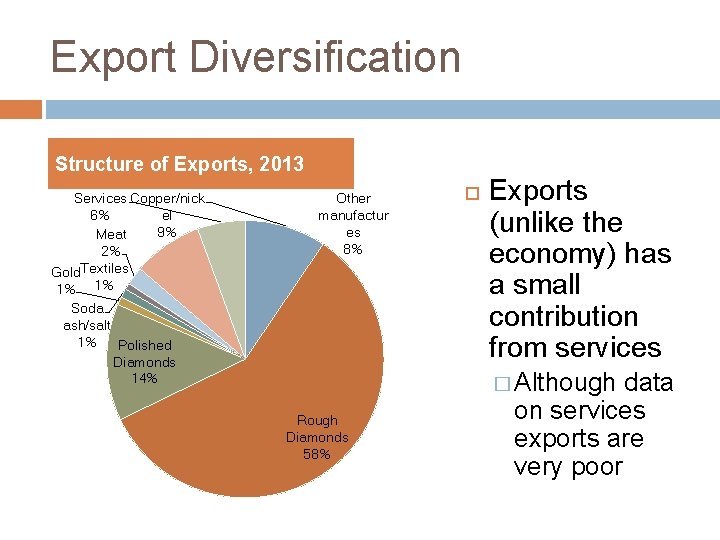
Export Diversification Structure of Exports, 2013 Services Copper/nick 6% el 9% Meat 2% Gold. Textiles 1% 1% Soda ash/salt 1% Polished Diamonds 14% Other manufactur es 8% Exports (unlike the economy) has a small contribution from services � Although Rough Diamonds 58% data on services exports are very poor
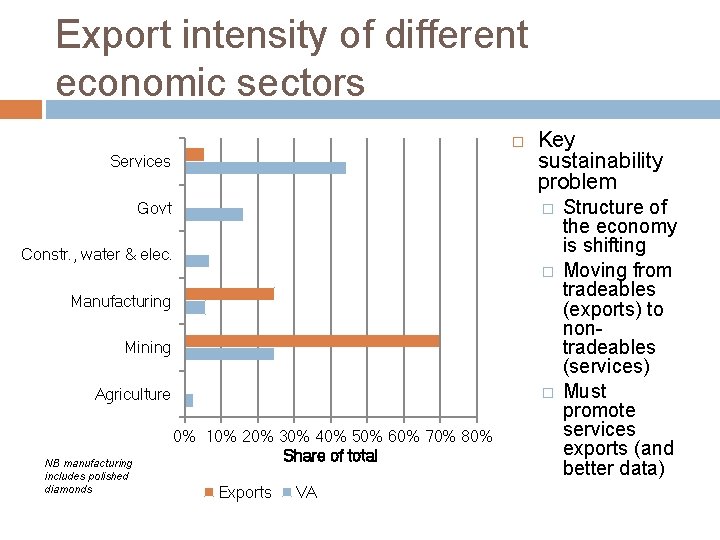
Export intensity of different economic sectors Services Govt Key sustainability problem � Constr. , water & elec. � Manufacturing Mining Agriculture NB manufacturing includes polished diamonds � 0% 10% 20% 30% 40% 50% 60% 70% 80% Share of total Exports VA Structure of the economy is shifting Moving from tradeables (exports) to nontradeables (services) Must promote services exports (and better data)
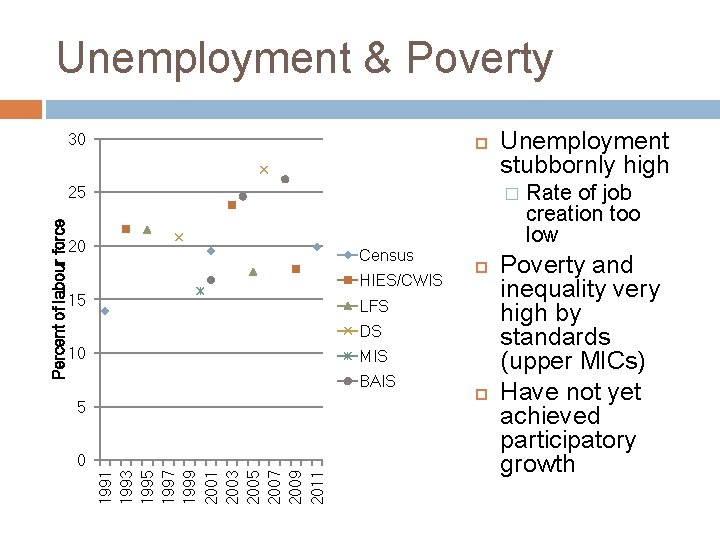
Unemployment & Poverty 30 � 20 Census HIES/CWIS 15 LFS DS 10 MIS BAIS 5 0 1991 1993 1995 1997 1999 2001 2003 2005 2007 2009 2011 Percent of labour force 25 Unemployment stubbornly high Rate of job creation too low Poverty and inequality very high by standards (upper MICs) Have not yet achieved participatory growth
Future Challenges: Export or Die! GDP and government budget much less dependent on minerals than 20 years ago Diversification – yes, but not sustainable diversification In many respects, the challenges remain the same as in the early 1980 s: � � � Employment creation Developing non-mining exports Poverty alleviation and participatory growth But the environment is now more challenging: � � � Closer to the end of diamonds Expectations/dependence on government “Financial cushions’ (fx reserves & govt savings) being depleted Economy much more dependent on services – but we hardly export Many policies have been tried, but most have not succeeded Importance of exports and competitiveness not sufficiently appreciated
The Key Diversification Challenge Moving from an economy based on windfall income – well managed, but unearned – to one where income and wealth are based on competitiveness, efficiency and productivity.
- Slides: 16