
The Book of ISAIAH Introduction ISAIAH NOTES BIBLIOGRAPHY
The Book of ISAIAH Introduction
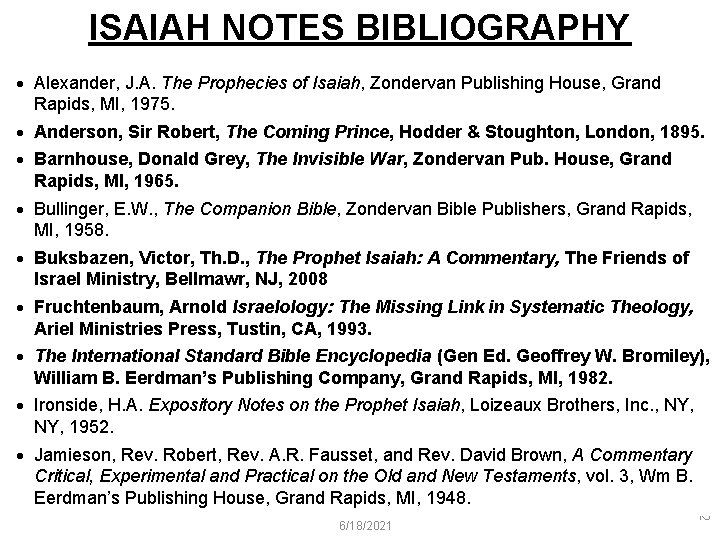
ISAIAH NOTES BIBLIOGRAPHY 6/18/2021 2 The Book of Isaiah Alexander, J. A. The Prophecies of Isaiah, Zondervan Publishing House, Grand Rapids, MI, 1975. Anderson, Sir Robert, The Coming Prince, Hodder & Stoughton, London, 1895. Barnhouse, Donald Grey, The Invisible War, Zondervan Pub. House, Grand Rapids, MI, 1965. Bullinger, E. W. , The Companion Bible, Zondervan Bible Publishers, Grand Rapids, MI, 1958. Buksbazen, Victor, Th. D. , The Prophet Isaiah: A Commentary, The Friends of Israel Ministry, Bellmawr, NJ, 2008 Fruchtenbaum, Arnold Israelology: The Missing Link in Systematic Theology, Ariel Ministries Press, Tustin, CA, 1993. The International Standard Bible Encyclopedia (Gen Ed. Geoffrey W. Bromiley), William B. Eerdman’s Publishing Company, Grand Rapids, MI, 1982. Ironside, H. A. Expository Notes on the Prophet Isaiah, Loizeaux Brothers, Inc. , NY, 1952. Jamieson, Rev. Robert, Rev. A. R. Fausset, and Rev. David Brown, A Commentary Critical, Experimental and Practical on the Old and New Testaments, vol. 3, Wm B. Eerdman’s Publishing House, Grand Rapids, MI, 1948.
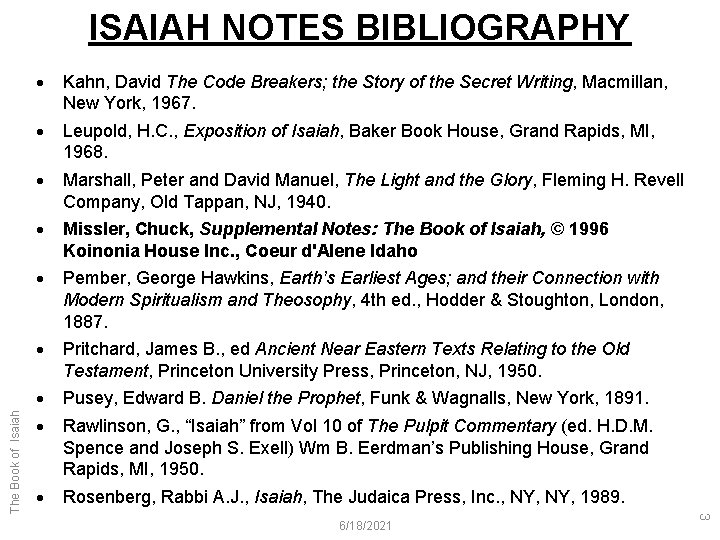
Kahn, David The Code Breakers; the Story of the Secret Writing, Macmillan, New York, 1967. Leupold, H. C. , Exposition of Isaiah, Baker Book House, Grand Rapids, MI, 1968. Marshall, Peter and David Manuel, The Light and the Glory, Fleming H. Revell Company, Old Tappan, NJ, 1940. Missler, Chuck, Supplemental Notes: The Book of Isaiah, © 1996 Koinonia House Inc. , Coeur d'Alene Idaho Pember, George Hawkins, Earth’s Earliest Ages; and their Connection with Modern Spiritualism and Theosophy, 4 th ed. , Hodder & Stoughton, London, 1887. Pritchard, James B. , ed Ancient Near Eastern Texts Relating to the Old Testament, Princeton University Press, Princeton, NJ, 1950. Pusey, Edward B. Daniel the Prophet, Funk & Wagnalls, New York, 1891. Rosenberg, Rabbi A. J. , Isaiah, The Judaica Press, Inc. , NY, 1989. Rawlinson, G. , “Isaiah” from Vol 10 of The Pulpit Commentary (ed. H. D. M. Spence and Joseph S. Exell) Wm B. Eerdman’s Publishing House, Grand Rapids, MI, 1950. 6/18/2021 3 The Book of Isaiah ISAIAH NOTES BIBLIOGRAPHY
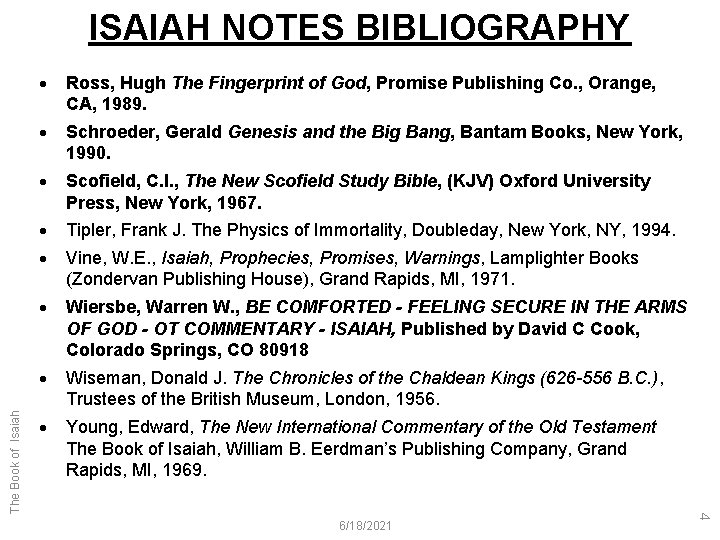
Ross, Hugh The Fingerprint of God, Promise Publishing Co. , Orange, CA, 1989. Schroeder, Gerald Genesis and the Big Bang, Bantam Books, New York, 1990. Scofield, C. I. , The New Scofield Study Bible, (KJV) Oxford University Press, New York, 1967. Tipler, Frank J. The Physics of Immortality, Doubleday, New York, NY, 1994. Wiersbe, Warren W. , BE COMFORTED - FEELING SECURE IN THE ARMS OF GOD - OT COMMENTARY - ISAIAH, Published by David C Cook, Colorado Springs, CO 80918 Wiseman, Donald J. The Chronicles of the Chaldean Kings (626 -556 B. C. ), Trustees of the British Museum, London, 1956. Young, Edward, The New International Commentary of the Old Testament The Book of Isaiah, William B. Eerdman’s Publishing Company, Grand Rapids, MI, 1969. Vine, W. E. , Isaiah, Prophecies, Promises, Warnings, Lamplighter Books (Zondervan Publishing House), Grand Rapids, MI, 1971. 6/18/2021 4 The Book of Isaiah ISAIAH NOTES BIBLIOGRAPHY
Historical circumstances Internally, Israel had broken into two feuding kingdoms, Samaria and Judah. Externally, the two Hebrew kingdoms of Isaiah’s day were caught between the rival empires of Assyria and Egypt. Each empire was bent on liquidating and absorbing the other. Tiny Israel and Judah were in their path, an enclave of monotheism (at least officially) in a pagan world. There was also an unceasing war between the gods of these two empires and the God of Israel. When the Israelites compared their national weakness with the might of their neighbors, they were tempted to follow those gods in the belief that only they were powerful enough to assure their survival, prosperity and victory over their enemies.
Historical circumstances There was Jehovah, "The Holy One of Israel" as Isaiah delighted to call Him. The God of Israel was calling His people to a holy and righteous life. Opposed to Him was the vast pantheon of the cruel, sensual, blood-thirsty and greedy gods of Israel's neighbors. Some of these "gods" were more blood-thirsty and debauched than their human worshippers. The gods of Israel's neighbors, personified the untamed and blind forces of nature, the gods of fertility and conquest. They were constantly tempting and alluring Israel to make a religion out of their sensual appetites and baser instincts.
Historical circumstances This fatal fascination of the alien gods for Israel during the days of Isaiah afflicted Ahaz himself, the king of Judah: And in the time of his distress did he trespass yet more against the Lord: this is that king Ahaz. For he sacrificed unto the gods of Damascus, which smote him: and he said, Because the gods of the kings of Syria help them, therefore will I sacrifice to them, that they may help me. But they were the ruin of him, and of all Israel (2 Chr. 28: 22, 23). Ahaz may strike us as being not only wicked, but foolish. Are we really different from Ahaz and the people of his day? Under a different guise and different names, aren’t we still tempted to serve the old gods of lust and power which our ancestors worshipped?
Historical circumstances Through Isaiah God spoke to both • the prophet's contemporary generation in Judah and Jerusalem and • to all of humanity, of every generation and in all places. Through His servant Isaiah, the Eternal God revealed eternal truth, and heralded the coming of Him who is "the way, the truth, and the life. ”
Isaiah, son of Amoz There were other Jewish men named Isaiah, so the prophet identified himself seven times as “the son of Amoz, ” This should not to be confused with “Amos” (see 1: 1; 2: 1; 13: 1; 20: 2; 37: 2, 21; 38: 1). Isaiah the son of Amoz lived halfway between Moses the Lawgiver and Jesus the Messiah. He was a contemporary of the prophets Amos, Hosea and Micah. The ancient Jewish tradition that Isaiah's father Amoz was a brother of King Amaziah has no historical foundation. Isaiah was apparently a resident of Jerusalem and a member of a prominent family.

Isaiah’s Family; 2 Sons Isaiah's two sons are mentioned by name (7: 3, 8: 1 -3). The name of the first was Shear-Yashub — "A Remnant. Shall-Return"; The second son was called Maher-Shala Hash-Baz — “Hasten-to-Spoil-Hurry-to-Prey. " The two sons of the prophet became the living symbols of the twin themes of Isaiah's message: Divine mercy and wrath.
Isaiah’s Wife We know that the prophet was a married man and referred to his wife as "the prophetess" (Isa. 8: 3). We do not know whether this indicates that Isaiah's wife was a prophetess in her own right, or whether this was merely a title of honor due to Isaiah’s position. The Bible indicates that there women in Israel who prophesied, • Miriam, the sister of Moses, • Deborah, • Huldah • The daughters of Philip • And others.
The Man Called Isaiah It is apparent that Isaiah's family was completely united and dedicated to the service of God and that their lives were subordinated to the prophetic vocation of the head of the household. Together they stood as a living testimony to the truth which God had entrusted to Isaiah and Isaiah was aware of it: Behold, I and the children whom the Lord has given me are signs and portents in Israel from the Lord of hosts who dwells on Mount Zion (Isa. 8: 18).
The Man Called Isaiah, keenly aware of the symbolism of names, may have seen in his own name a divinely appointed significance. For the name "Isaiah" in Hebrew is Yeshayahu, Aabbreviated Yeshaiah, It is a composite which means "Jehovah is salvation. " Old Testament personal names were not given to children as a mere distinguishing label, but as a testimony to the faith and the hope of the parents. Isaiah's name was at the very heart of all his prophecies — "Salvation is in Jehovah. " The name "Jesus" (Hebrew: Yeshua; English: Joshua) is a later variant of the same name which also means "Jehovah is salvation" or "Jehovah saves" (Mt. 1: 21)
The Man Called Isaiah The “salvation of the Lord” (deliverance) is the key theme of his book. Isaiah wrote about 5 acts of deliverance that God would perform: (1) the deliverance of Judah from Assyrian invasion (ch. 3637); (2) the deliverance of the nation from Babylonian captivity (ch. 40); (3) the future deliverance of the Jews from worldwide dispersion among the Gentiles (ch. 11 -12); (4) the deliverance of lost sinners from judgment (ch. 53); and (5) the final deliverance of creation from the bondage of sin when the kingdom is established (chs. 60; 66: 17 ff. ). 6/18/2021 The Book of Isaiah 14
The Man Called Isaiah, like Elijah before him and John the Baptist later, normally wore a garment of hair cloth or sackcloth around his loins, and sandals on his feet. This was the customary garment of a prophet. At the Lord's command in order to drive home the point about the futility of Judah's reliance on Egypt against Assyria, Isaiah walked about naked for a period of three years (except for a loin cloth) (Isa. 20: 2. 6).
The Man Called Isaiah Most prophets and their behavior were considered to be “strange" if not plain crazy by their contemporaries. Isaiah was no exception. Some people contemptuously called the prophet Elijah meshugah, a "mad fellow" (2 Ki. 9: 11). Godly men like Obadiah, treated the same prophet with extreme deference and respect, addressing him as "my lord Elijah" (1 Ki. 18: 7). During his lifetime and for sometime following, Isaiah was not a popular man among the people.
Isaiah’s times The dates of Isaiah's birth and death are a matter of some conjecture with some internal Scriptural evidence. Scriptures usually focused on the message rather than on the messenger, the prophecy rather than on the prophet. Typically the only personal details about the prophet which were mentioned which those considered to be essential for understanding of the message. Biblical personalities are as a rule presented as instruments in God's hand to reveal His purpose or to help in its accomplishment. They appear on the stage of history for a God-appointed purpose and then disappear. The message they brought, whether blessing or wrath, remained after them.
Isaiah’s times The prophet Isaiah's ministry must have covered at least a part of the reign of Uzziah (Isa 1: 1) during the period of his leprosy and separation when his son Jotham was co-regent and later king (2 Ki. 15: 5, 2 Chr. 26: 21), and all of Ahaz's and all of Hezekiah's reigns. Ancient tradition holds that Isaiah lived long enough to witness the early part of Manasseh's reign of terror and was finally murdered by that ungodly king.
Isaiah’s times The following dates which should be considered as approximate, give us a chronological framework for the lifespan of Isaiah. • Uzziah or Azariah co-regent 791 -767 regent 767 -740 B. C. • Jotham co-regent 750 -740 regent 740 -735 B. C. • Ahaz co-regent 744 -735 regent 735 -715 B. C. • Hezekiah co-regent 729. 715 regent 715 -687 B. C. • Manasseh regent 687 -642 B. C.
Isaiah’s death The closing years of Isaiah's life were during the reign of the wicked king Manasseh (687 -642 B. C. ). The Jewish and Christian tradition is that Isaiah was murdered by Manasseh may have some historical substance and was apparently based on 2 Ki. 21: 16 a "Moreover he (Manasseh) shed very much innocent blood till he filled Jerusalem from one end to another. " Some of the early church fathers (e. g. Jerome) saw Heb 11: 87 "they were sawn asunder" as referring to Isaiah's death. Ancient tradition says that Isaiah lived to age 92 years, 7 years of which were under the reign of Manasseh. This gives us a date for his death around the year 680 B. C. So on the basis of internal Scriptural evidence and of ancient tradition, Isaiah lived to an age of 90 or more covering the period between 770 or 765 to 680 B. C.
Isaiah the Author A strong clue relating to the date of Isaiah’s death is provided in 2 Chronicles: Now the rest of the acts of Hezekiah, and his goodness, (or kindly acts) behold, they are written in the vision of Isaiah the prophet, the son of Amoz, and in the book of the kings of Judah and Israel (2 Chr 32: 32). This would indicate that Isaiah outlived Hezekiah (687 B. C. ) and That Isaiah recorded Hezekiah’s life and "his kindly acts" in a book called "The Vision of Isaiah, " This book was later included in the book of "The Kings of Judah and Israel. "
Isaiah the Author The chronological references in Isaiah apparently apply only to the years of the prophet's public ministry life and do not include The years before his call to public ministry or The years of his semi-retirement under Manasseh. Many conservative scholars believe that it was during the period of his semi-retirement that the prophet wrote the second part of his book (ch. 40 -66) in anticipation of the Babylonian exile and Israel's future deliverance.
Isaiah, the Historian Author In addition to his prophetic activities Isaiah was apparently also a prominent historian. "Now the rest of the acts of Uzziah, first and last, did Isaiah the prophet, son of Amoz, write. “ (2 Chr 26: 22) In addition to this monograph about King Uzziah, there was another historical work by Isaiah, dealing with the life of Hezekiah. This apparently contained some prophecies because in 2 Chronicles 32: 32 this book is referred to as "The Vision of Isaiah. " Both these historical works were lost. It is possible that the most important events and prophecies contained in those two works were incorporated in the books of Chronicles and in Isaiah chapters 36 -39.
Isaiah: God’s Man Isaiah was a man in touch with God. He saw God’s Son and God’s glory (chap. 6; John 12: 41), He heard God’s message, and He sought to bring the nation back to God before it was too late. Isaiah was a man who loved his nation. The phrase “my people” is used at least 26 times in his book. He was a patriot with a true love for his country, pleading with Judah to return to God and warning kings when their foreign policy was contrary to God’s will. 6/18/2021 The Book of Isaiah 24
Isaiah: God’s Man Isaiah was a man who hated sin and sham religion. He used his favorite name for God is “the Holy One of Israel, ” 25 times in his book. It is used only 5 times in the rest of the Old Testament. He looked at the crowded courts of the temple and cried out, “They have forsaken the LORD, they have provoked the Holy One of Israel unto anger, they are gone away backward” (1: 4). He examined the political policies of the leaders and said, “Woe to them that go down to Egypt for help. . . but they look not unto the Holy One of Israel, neither seek the LORD!” (31: 1). Jehovah was holy, but the nation was sinful, and Isaiah consistently called the people and the kings to repent. 6/18/2021 The Book of Isaiah 25
Isaiah, God’s Communicator He was a man skilled in communicating God’s truth. Not content with merely declaring facts, Isaiah clothed those facts in striking language that would catch the attention of a people blind and deaf to spiritual truth (6: 9— 10). He compared the nation to: • a diseased body (1: 5— 6), • a harlot (v. 21), • a useless vineyard (ch. 5), • a bulging wall about to fall down (30: 13), and • a woman in travail (66: 8). Like our Lord Jesus Christ, Isaiah knew how to stir the imagination of his listeners so that he might arouse their interest and teach them God’s truth (Matt. 13: 10— 17). 6/18/2021 The Book of Isaiah 26
Isaiah the Courageous Isaiah was a courageous man. He boldly declared the Word of God He was unafraid to denounce kings and priests He was unwavering when public opinion went against him For three years Isaiah wore only a loincloth to dramatize the victory of Assyria over Egypt (chap. 20). He hoped to get the attention of people who were blind to their exposed country’s danger. Assyria, the enemy, would come like: • a swollen stream (8: 7— 8), • a swarm of bees (7: 18), • a lion (5: 29), and • an axe (10: 15). 6/18/2021 The Book of Isaiah 27
The Commitment of Isaiah who saw Jehovah in His holy temple in all His awesome and exalted majesty could no longer be impressed with or be in awe of any mere mortal, whether king or commoner. Isaiah's denunciation of the vices and follies of the inhabitants of Judah had the scorching effect of a branding iron upon the naked flesh. • He exposed the avarice and the injustice of the rich, • He thundered against the smug self-indulgence of Jerusalem's aristocracy. • He confronted the idolatrous King Ahaz with the disastrous consequences of his foreign alliances and practices. • He was nauseated by the spectacle of a religious ritualism, utterly devoid of holiness and justice, • He scorned the dizzy flirtatiousness of the fashionable high society ladies of Jerusalem.
Isaiah’s Faith and Hope Isaiah was not just another voice against the besetting sins and corruption of his nation. Isaiah was the prophet of undaunted faith and undying hope in God's redemptive purpose for Israel and for all mankind. It was his vision of the kingdom of God under the rule of the Messiah, which left an indelible imprint upon his own contemporaries and subsequent generations. Isaiah counseled Israel not to rely on the arm of the flesh, nor to become entangled in foreign alliances with rapacious and ruthless neighbors, but rather to put their trust in Jehovah. "In quietness and in confidence shall be your strength" (Isa. 30: 15 b).
Isaiah, the Orator Isaiah had a superb mastery of language, which was concise, colorful, harmonious and effective. Filled with holy indignation his words lashed and seared as they fell upon the ears of his listeners: "All sinful nation, a people laden with iniquity, a seed of evildoers, children that are corrupters: they have forsaken the Lord, they have provoked the Holy One of Israel unto anger, they are gone away backward" (Isa. 1: 4). Moreover the Lord saith, Because the daughters of Zion are haughty, and walk with stretched forth necks and wanton eyes, walking and mincing as they go, and making a tinkling with their feet: Therefore the Lord will smite with a scab the crown of the head of the daughters of Zion, and the Lord will discover their secret parts (Isa. 3: 16, 17).
Isaiah Sounding the Alarm The prophet tried to warn his people but in their blindness, instead of repenting they were banqueting and fattening themselves up like dumb animals before the slaughter: And in that day did the Lord God of hosts call to weeping and to mourning, and to baldness, and to girding with sackcloth: And behold joy and gladness, slaying oxen, and killing sheep, eating flesh, and drinking wine: let us eat and drink; for tomorrow we shall die (Isa. 22: 12, 13).
Isaiah, the Sorrowful Isaiah took no delight in prophesying doom. His tenderness and love for Israel always came through clearly. He describes his own state of mind as he saw the day of wrath fast approaching: Therefore said I, Look away from me; I will weep bitterly, labor not to comfort me, because of the spoiling of the daughter of my people. For it is a (lay of trouble and of treading down, and of perplexity by the Lord God of hosts in the valley of vision, breaking down the walls, and of crying to the mountains (Isa. 22: 4, 5).
Isaiah, the Emotional He was a man of great sensitivity. His moods and words changed with every changing circumstance. At times he almost sounded like Jeremiah, the weeping prophet of exile. On other occasions he reminds us of Hosea the tragic prophet of the northern kingdom. And now, O inhabitants of Jerusalem, and men of Judah, judge, I pray you, betwixt me and my vineyard. What could have been done in it? Wherefore, when I looked that it should bring forth grapes, brought it forth wild grapes? (Isa. 5: 3, 4).
Isaiah’s Impact No other book of the Old Testament with the possible exception of the Psalms, contains such a wide sweep of far-sighted vision, of penetrating insight into the heart of man or foreknowledge of future events, as the book of Isaiah has seeded the hearts and minds of men with lofty vision of final redemption as no other prophet before him. He left an indelible impact upon his contemporaries and later generations. It is almost certain that Jeremiah and Ezekiel were familiar with the prophecies of Isaiah. It is likely that Micah the contemporary, though younger, prophet of Moresheth, a small town only about 20 miles southwest of Jerusalem, was a personal friend of Isaiah, with whom he cooperated. Mic 4: 1 -3 / Isaiah 2: 2 -4.
Isaiah’s View of God Isaiah's God was no mere tribal deity, but the Creator of heaven and earth, and the God of all nations, a holy and righteous God who abhors evil whether committed by His chosen people Israel or by any other nation: Come near ye nations to hear; and hearken, ye people: Let the earth hear, and all that is therein; The world and all things that come forth of it. For the indignation of the Lord is upon all nations, And his fury upon all their armies (Isa. 34: 1, 2).
Isaiah, Things To Come Isaiah's vision is not confined to the destiny of Israel alone, but embraces all of mankind in the wideness of God's mercy. Even such ancient and traditional foes as Egypt and Syria are included in the blessing of the future kingdom of God: In that day shall Israel be third with Egypt and with Assyria, Even a blessing in the midst of the land; Whom the Lord of hosts shall bless, saying, Blessed be Egypt my people, and Assyria the work of my hands, And Israel mine inheritance (Isa. 19: 24, 25)
Isaiah, Things To Come The message of Isaiah spans all generations and bridges the chasm between time and eternity. Isaiah’s oracles have become a part of man's ultimate hope of redemption for himself and for mankind. More than any other prophet Isaiah brought to mankind the transcendent image of the Messiah in the dual role of • God's Anointed King and • The Suffering Servant who poured out his life for the redemption of many.
Isaiah, Things To Come Beyond the day of divine wrath and judgment Isaiah looked to the day • when nations shall at last attain peace, • when the knowledge of God shall cover the earth "as the waters cover the sea. " (Isa. 11: 1 -9).
Isaiah Today Isaiah is the prophet we need to hear today as he cries out God’s message above the roar of world upheaval, “Comfort, yes, comfort My people!” (40: 1 NKJV). “In quietness and confidence shall be your strength. ” 6/18/2021 39 The Book of Isaiah The English word comfort comes from two Latin words that together mean “with strength. ” When Isaiah says to us, “Be comforted!” it is not a word of pity but of power. God’s comfort does not weaken us; it strengthens us. God is not indulging us but empowering us.
As we study Isaiah’s book, We not only meet the prophet, but also meet some mighty kings and rulers; and we’ll witness the rise and fall of some great kingdoms. We see God’s people chastened and then restored. Above all, We see the Lord Jesus Christ, God’s “Suffering Servant, ” as He does the will of God and suffers and dies for the sins of the world. 6/18/2021 40 The Book of Isaiah’s Message
To succeed in politics one must possess “…the ability to foretell what is going to happen tomorrow, next week, next month, and next year. And to have the ability afterwards to explain why it didn’t happen. ” Sir Winston Churchill God’s prophets were correct all of the time, they didn’t have to explain away their mistakes. “If what a prophet proclaims in the name of the LORD does not take place or come true, that is a message the LORD has not spoken” (Deut. 18: 22 NIV). “To the law and to the testimony, if they speak not according to this word, it is because there is no light in them” (Isaiah 8: 20). Isaiah was a man who had God’s light, and he was not afraid to let it shine. 6/18/2021 41 The Book of Isaiah’s Message
Isaiah’s Message 6/18/2021 42 The Book of Isaiah opened his book with a series of sermons denouncing sin: the personal sins of the people (ch. 1— 6) and the national sins of the leaders (ch. 7— 12). He warned of judgment and pled for repentance. Amos and Hosea were preaching similar messages to the people of the northern kingdom, warning them that time was running out. Israel and Judah had sinned against the law of God and were even more guilty than their neighbors, but the Gentile nations would not escape God’s wrath. In ch. 13— 23, Isaiah denounced those nations for their sins and warned of God’s judgment. The way they had behaved, these nations had sinned against conscience Rom. 2: 1— 16 and against human decency.
Isaiah’s Message Isaiah 24— 27 is devoted to “songs of hope” that describe the glory of the future kingdom. Isaiah saw a day when the two kingdoms of Israel and Judah would return to the land, be reunited and redeemed, and enter into the blessings of the promised kingdom. 6/18/2021 43 The Book of Isaiah interspersed messages of hope with words of judgment. God remembers His mercy even when declaring His wrath (Hab. 3: 2). He assures His people that they have a “hope and a future” (Jer. 29: 11 NIV).
Isaiah’s Message 6/18/2021 44 The Book of Isaiah Chapters 28— 35 focus on the impending Assyrian invasion of Israel and Judah. Israel would be destroyed and the ten tribes assimilated into the Assyrian Empire. This is the origin of the Samaritans, who were part Jewish and part Gentile. Judah would be invaded and devastated, but Jerusalem would be delivered by the Lord.
Then, Isaiah moves from prophecy to history and focused on two key events that occurred during the reign of King Hezekiah: • God’s miraculous deliverance of Jerusalem from the Assyrians (ch. 36— 37), and • Hezekiah’s foolish cooperation with the Babylonians (ch. 38— 39). This section forms a transition from an emphasis on Assyria to an emphasis on Babylon, the last 27 chapters look ahead to the return of the Jewish remnant from Babylonian captivity. 6/18/2021 45 The Book of Isaiah’s Message
Isaiah’s Message The Jewish rabbis call Isaiah 40— 66 “The Book of Consolation”. Addressed originally to the discouraged Jewish exiles returning to an impoverished land a ruined temple, these chapters have brought comfort and hope to God’s people in every age and in every kind of difficult situation. The Hebrew word translated “comfort” also means “to repent. ” God does not bring comfort to a rebellious people but to repentant people. 6/18/2021 46 The Book of Isaiah This section, ch. 40 -66, almost form a second book of Isaiah. If is so unique from ch. 1 -39 in message and style that some ‘scholars’ say one or the other was not really written by Isaiah. Jesus, however, quotes for both halved of the Book of Isaiah and ascribes both quotes to Isaiah. So much for the ‘scholars’.
Isaiah’s Message Chapters 40— 48 exalt the greatness of God the Father; Chapters 49— 57, the grace of God the Son, God’s Suffering Servant; and Chapters 58— 66, the glory of the future kingdom when the Spirit is poured out on God’s people. Note the references to the Spirit in 59: 19, 21; 61: 1; and 63: 10— 11, 14. 6/18/2021 47 The Book of Isaiah The arrangement of chapters 40— 66, “The Book of Consolation” is divided into three sections; Each section focuses on: • a different Person of the Godhead and • a different attribute of God.
Isaiah’s Message 6/18/2021 48 The Book of Isaiah Servant is one of the key words in this section of Isaiah. The word is used 17 times and has three different referents: • The nation of Israel (41: 8— 9; 43: 10); • Cyrus, king of Persia, whom God raised up to help Israel restore their nation and rebuild their temple (44: 28; 45: 1; see Ezra 1: 1); and • Jesus Christ, the Son of God (Isa. 42: 1, 19; 52: 13; 53: 11), the Suffering Servant who died for the sins of the world.
Isaiah’s Message The prophets often used immediate circumstances to illustrate future events. Isaiah sometimes used this invasion to picture “the day of the Lord, ” the future time when the whole world will experience the wrath of God. 6/18/2021 49 The Book of Isaiah Assyria and Egypt vied for the center stage in ch. 1— 39, Babylon and Persia get the attention in ch. 40— 66. Isaiah had an immediate word of warning to both Israel and Judah that Assyria was on the march and would be used by God to punish them for their sins.
Isaiah’s Message Isaiah had a word of promise to Judah that God would deliver Jerusalem from the enemy for the sake of David’s throne. But Isaiah’s greatest message is his word of salvation, announcing the coming of the Messiah, the Servant of the Lord who would die for sinners and would one day return to earth to establish His glorious kingdom. 6/18/2021 50 The Book of Isaiah There was also a word of hope for the future Jewish exiles in Babylon, that God would rescue them and help them restore their nation and their temple.
Isaiah’s Message Isaiah said that a Savior was coming predicted in Isaiah 7: 14; 9: 6— 7; fulfilled in Matthew 1: 18— 25. Isaiah recorded these prophecies 700 years before Jesus Christ , the Messiah, our Savior whom Isaiah said would come, was born. 6/18/2021 51 The Book of Isaiah He said this Savior would come through the line of Jesse, the father of King David predicted in Isaiah 11: 1; fulfilled in Luke 3: 23, 32.
Isaiah, the Foreteller Isaiah said what would happen to the Savior once He came. The Savior would perform miracles predicted in Isaiah 35: 5— 6; fulfilled in Matthew 9: 35. He would be rejected by His own people predicted in Isaiah 53: 3 fulfilled in John 7: 5, 48. He would be wounded and bruised predicted in Isaiah 53: 5; fulfilled in Matthew 27: 26 He would be smitten and spit upon predicted in Isaiah 50: 6; fulfilled in Matthew 26: 67. 6/18/2021 52 The Book of Isaiah He would stand silent before His accusers predicted in Isaiah 53: 7 fulfilled in Matthew 27: 12

Isaiah, the Foreteller He would pray for His persecutors predicted in Isaiah 53: 12 fulfilled in Luke 23: 34. He would be crucified with two thieves predicted in Isaiah 53: 9 fulfilled in Matthew 27: 38. Jesus fulfilled all of these prophecies to pay the price for our sin, so that through faith in Him, we might gain forgiveness and eternal life. Jesus Christ is the Messiah, our Savior who Isaiah said would come to suffer and die in our place. 6/18/2021 53 The Book of Isaiah He would be buried in a rich man’s tomb predicted in Isaiah 53: 9 fulfilled in Matthew 27: 57— 60.
Isaiah, the Foreteller 6/18/2021 54 The Book of Isaiah said the Savior will come back again to set up a literal kingdom on earth and usher in a time of prosperity, peace, and joy (Isa. 2: 2— 5; 32: 1— 8; 35). The Bible describes this as a real, literal time we call the millennial kingdom Jesus will personally reign on the earth for a real, literal thousand years. God’s final outreach and Man’s last opportunity to acknowledge and accept Jesus as Savior and Lord.
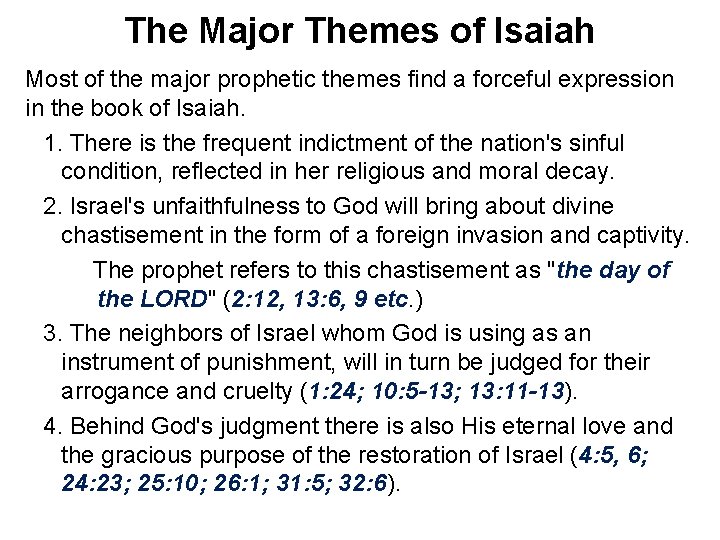
The Major Themes of Isaiah Most of the major prophetic themes find a forceful expression in the book of Isaiah. 1. There is the frequent indictment of the nation's sinful condition, reflected in her religious and moral decay. 2. Israel's unfaithfulness to God will bring about divine chastisement in the form of a foreign invasion and captivity. The prophet refers to this chastisement as "the day of the LORD" (2: 12, 13: 6, 9 etc. ) 3. The neighbors of Israel whom God is using as an instrument of punishment, will in turn be judged for their arrogance and cruelty (1: 24; 10: 5 -13; 13: 11 -13). 4. Behind God's judgment there is also His eternal love and the gracious purpose of the restoration of Israel (4: 5, 6; 24: 23; 25: 10; 26: 1; 31: 5; 32: 6).
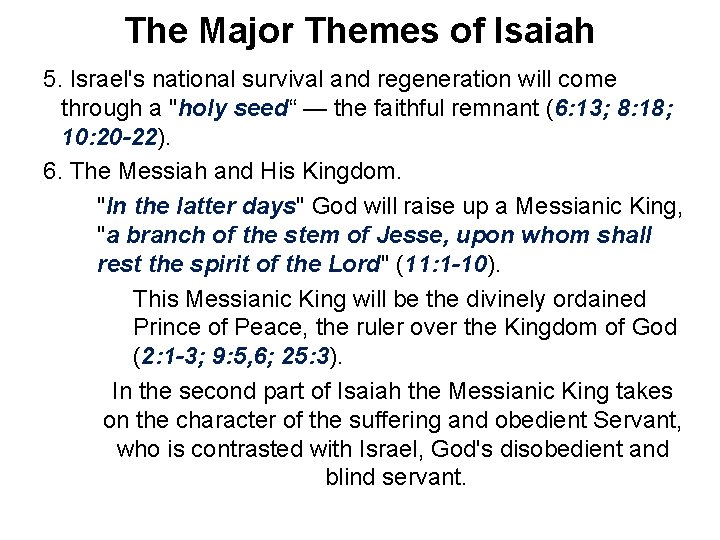
The Major Themes of Isaiah 5. Israel's national survival and regeneration will come through a "holy seed“ — the faithful remnant (6: 13; 8: 18; 10: 20 -22). 6. The Messiah and His Kingdom. "In the latter days" God will raise up a Messianic King, "a branch of the stem of Jesse, upon whom shall rest the spirit of the Lord" (11: 1 -10). This Messianic King will be the divinely ordained Prince of Peace, the ruler over the Kingdom of God (2: 1 -3; 9: 5, 6; 25: 3). In the second part of Isaiah the Messianic King takes on the character of the suffering and obedient Servant, who is contrasted with Israel, God's disobedient and blind servant.
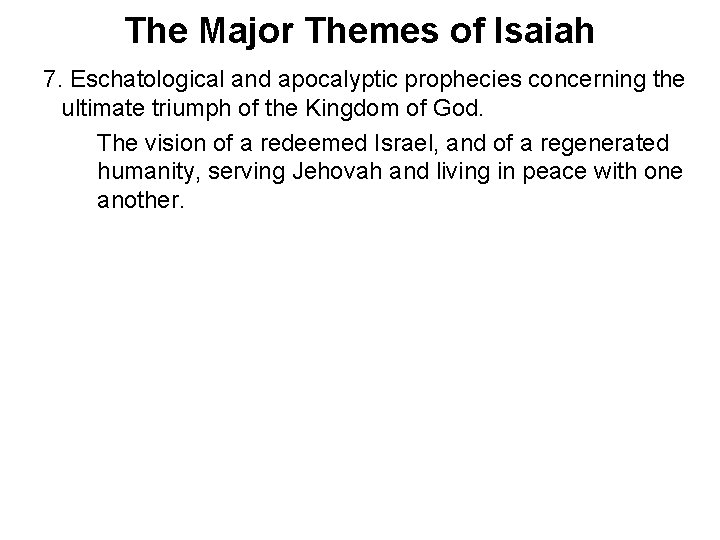
The Major Themes of Isaiah 7. Eschatological and apocalyptic prophecies concerning the ultimate triumph of the Kingdom of God. The vision of a redeemed Israel, and of a regenerated humanity, serving Jehovah and living in peace with one another.
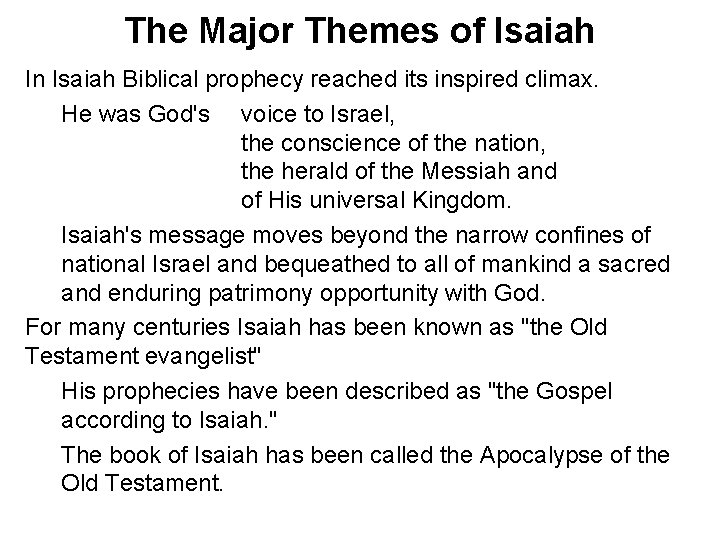
The Major Themes of Isaiah In Isaiah Biblical prophecy reached its inspired climax. He was God's voice to Israel, the conscience of the nation, the herald of the Messiah and of His universal Kingdom. Isaiah's message moves beyond the narrow confines of national Israel and bequeathed to all of mankind a sacred and enduring patrimony opportunity with God. For many centuries Isaiah has been known as "the Old Testament evangelist" His prophecies have been described as "the Gospel according to Isaiah. " The book of Isaiah has been called the Apocalypse of the Old Testament.
THE MESSIAH 6/18/2021 59 The Book of Isaiah Don’t miss Isaiah’s emphasis on the personal message of God’s forgiveness. “Though your sins be as scarlet, they shall be as white as snow; though they be red like crimson, they shall be as wool” (1: 18). “I have blotted out, like a thick cloud, your transgressions, and, like a cloud, your sins” (44: 22 NKJV). “I, even I, am He who blots out your transgressions for My own sake; and I will not remember your sins” (43: 25 NKJV).
Jesus, Isaiah’s Messiah Nothing can change the fact that our God has saved us and that in Him we have a glorious hope and future. “We are in training for reigning. ” Take comfort in that! 6/18/2021 60 The Book of Isaiah Jesus made two incredible promises to His followers. • He promised that after He rose from the dead, He would go and prepare a place for us in His Father’s house. • Jesus promised that He would come back for us, to take us to be with Him forever (John 14: 1— 4). • Then when Jesus comes back to earth to establish the millennial kingdom on the earth, we will return with Him and reign with Him (Zech. 14: 9; 2 Tim. 2: 12).
Jesus, Isaiah’s Messiah The Book of Isaiah 61 Isaiah was both a prophet and an evangelist who presented Jesus Christ and the good news of the gospel. Isaiah’s “Servant Song” about Jesus (Isa. 52: 13— 53: 12) is quoted or alluded to nearly 40 times in the New Testament. The prophet wrote about: • the birth of Christ (Isa. 7: 14; 9: 6; Matt. 1: 18— 25); • the ministry of John the Baptist (Isa. 40: 1— 6; Matt. 3: 1 ff. ); • Christ’s anointing by the Spirit (Isa. 61: 1— 2; Luke 4: 17— 19); • the nation’s rejection of their Messiah (Isa. 6: 9— 11; John 12: 38 ff. ); • Christ, the “stone of stumbling” (Isa. 8: 14; 28: 16; Rom. 9: 32— 33; 10: 11; 1 Peter 2: 6); • Christ’s ministry to the Gentiles (Isa. 49: 6; Luke 2: 32; Acts 13: 47); • the Savior’s suffering and death (Isa. 52: 13— 53: 12; Acts : i 8: 32— 33; 1 Peter 2: 21— 25); • His resurrection (Isa. 55: 3; Acts 13: 34); and • His return to reign as King (Isa. 9: 6— 7; 11: 1 ff; 59: 20— 21; 63: 1— 3; Rom. 11: 26— 27; Rev. 19: 13— 15). There are many other references 6/18/2021 in Isaiah to the Messiah.
Jesus, Isaiah’s Messiah 6/18/2021 62 The Book of Isaiah It is this emphasis on redemption that gives Isaiah a message for the whole world. While his immediate ministry to the little nation of Judah and while he wrote about nations and empires that for the most part are no longer on the world scene, his focus was on God’s plan of salvation for the whole world. Isaiah saw the greatness of God and the vastness of His plan of salvation for Jews and Gentiles alike. Isaiah saw beyond his own nation to the gracious work God would do among the Gentile nations of the world.
Jesus, Isaiah’s Messiah The apostle Paul quoted from Isaiah or alluded to Isaiah about 80 times in his Epistles and in at least three of his messages (Acts 13: 34, 47; 17: 24— 29; 28: 26— 28). Jesus quoted Isaiah 42: 7, 16 when He spoke to Saul (Paul) on the Damascus Road (Acts 26: 16— 18). Paul’s call to evangelize the Gentiles was confirmed by Isaiah 49: 6. Like the prophet Isaiah, Paul saw the vastness of God’s plan for both Jews and Gentiles; and like Isaiah, Paul magnified Jesus Christ, the Savior of the world. Five times in his letters Paul referred to Isaiah 53. 6/18/2021 63 The Book of Isaiah When Jesus encouraged Paul during his ministry to Corinth (Acts. 18: 9— 10), He referred to Isaiah 41: 10 and 43: 5.
How can “the Holy One of Israel, ” a just and righteous God, forgive our sins and remember them no more? The Book of Isaiah 64 “But [Jesus] was wounded for our transgressions, He was bruised for our iniquities; the chastisement for our peace was upon Him, and by His stripes we are healed” (53: 5 NKJV). It was on the basis of this truth that Peter declared, “To [Jesus] all the prophets witness that, through His name, whoever believes in Him will receive remission of sins” (Acts 10: 43 NKJV). Isaiah asks us, “Who hath believed our report? ” (53: 1) Then he warns us, “If you will not believe, surely you shall not be established, ” (7: 9 NKJV). If you have never believed on the Lord Jesus Christ and received Him into your life, then do so now. “Look to Me, and be saved, all you ends of the earth! For I am God, and there is no other” (45: 22 NKJV). “Nor is there salvation in any other, for there is no other name under heaven given among men by which we must be saved” 6/18/2021 (Acts 4: 12 NKJV).
Hebrew Parallelisms Each of the prophecies of Isaiah is a complete oracle in itself, fashioned in the characteristic form of Hebrew poetry - the parallelism, which is a unit of thought. Classic Hebrew poetry does not use rhyme, but employs rhythm and meter. Several verses, usually two or more, form one strophe. This strophic system of Hebrew poetry is sometimes helpful in the understanding of the text where the meaning may not be quite clear.
Hebrew Parallelisms Hebrew parallelisms are either synonymous or antithetic. In the synonymous parallelism, the thought of the first line is amplified in the second line: And I will give children for their princes And babes shall rule over them (Isa. 3: 4). In the antithetic parallelism, the thought of the first line is a pair of contrasting ideas paralleled in the second line by another pair of contrasting ideas. Woe unto them that call good evil, and evil good That put darkness for light and light for darkness (Isa. 5: 20).
The Hebrew Text of Isaiah In spite of minor differences between some of the ancient manuscripts of Isaiah, the Hebrew text has been preserved with remarkable fidelity. The slight variations are chiefly due to copyist errors. Biblical scribes or copyists, "the Sopherim", have always been (and still are) highly trained and dedicated professional men who did their work with great care and painstaking devotion. They considered their occupation as a sacred trust. One error in transcription might render a whole book unfit for public use in temple or synagogue. The Jews have proved themselves as faithful guardians of the Old Testament Scriptures, meriting the gratitude of all who cherish the Word of God as their most precious spiritual heritage.
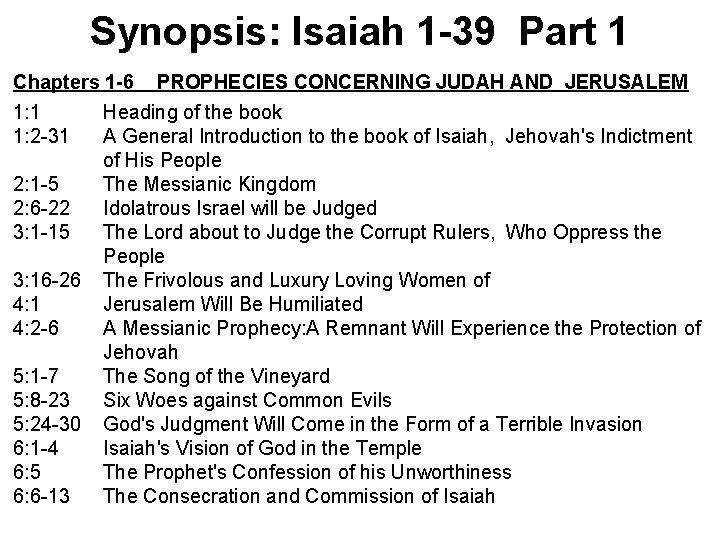
Synopsis: Isaiah 1 -39 Part 1 Chapters 1 -6 PROPHECIES CONCERNING JUDAH AND JERUSALEM 1: 1 Heading of the book 1: 2 -31 A General Introduction to the book of Isaiah, Jehovah's Indictment of His People 2: 1 -5 The Messianic Kingdom 2: 6 -22 Idolatrous Israel will be Judged 3: 1 -15 The Lord about to Judge the Corrupt Rulers, Who Oppress the People 3: 16 -26 The Frivolous and Luxury Loving Women of 4: 1 Jerusalem Will Be Humiliated 4: 2 -6 A Messianic Prophecy: A Remnant Will Experience the Protection of Jehovah 5: 1 -7 The Song of the Vineyard 5: 8 -23 Six Woes against Common Evils 5: 24 -30 God's Judgment Will Come in the Form of a Terrible Invasion 6: 1 -4 Isaiah's Vision of God in the Temple 6: 5 The Prophet's Confession of his Unworthiness 6: 6 -13 The Consecration and Commission of Isaiah
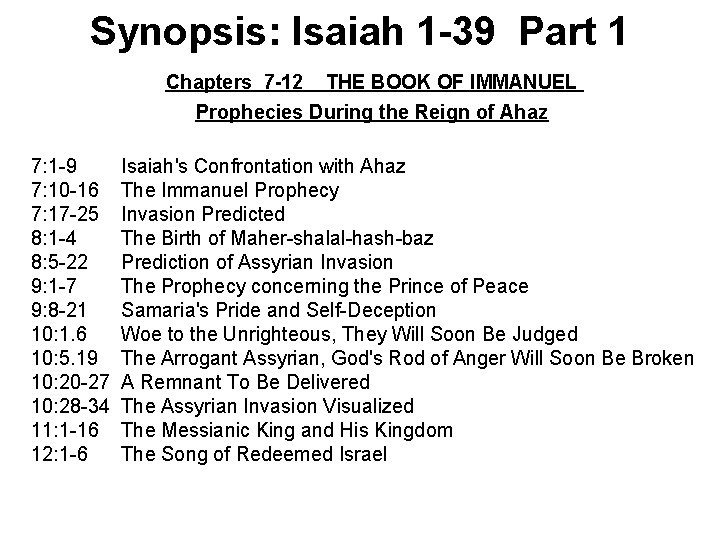
Synopsis: Isaiah 1 -39 Part 1 Chapters 7 -12 THE BOOK OF IMMANUEL Prophecies During the Reign of Ahaz 7: 1 -9 7: 10 -16 7: 17 -25 8: 1 -4 8: 5 -22 9: 1 -7 9: 8 -21 10: 1. 6 10: 5. 19 10: 20 -27 10: 28 -34 11: 1 -16 12: 1 -6 Isaiah's Confrontation with Ahaz The Immanuel Prophecy Invasion Predicted The Birth of Maher-shalal-hash-baz Prediction of Assyrian Invasion The Prophecy concerning the Prince of Peace Samaria's Pride and Self-Deception Woe to the Unrighteous, They Will Soon Be Judged The Arrogant Assyrian, God's Rod of Anger Will Soon Be Broken A Remnant To Be Delivered The Assyrian Invasion Visualized The Messianic King and His Kingdom The Song of Redeemed Israel
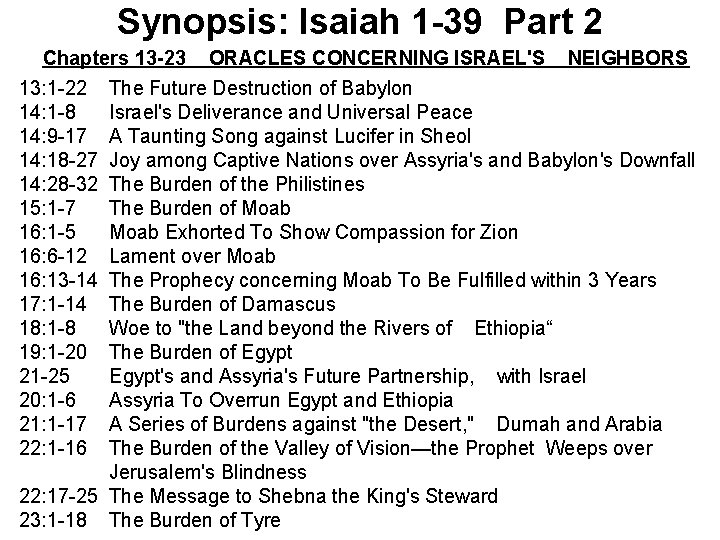
Synopsis: Isaiah 1 -39 Part 2 Chapters 13 -23 ORACLES CONCERNING ISRAEL'S NEIGHBORS 13: 1 -22 The Future Destruction of Babylon 14: 1 -8 Israel's Deliverance and Universal Peace 14: 9 -17 A Taunting Song against Lucifer in Sheol 14: 18 -27 Joy among Captive Nations over Assyria's and Babylon's Downfall 14: 28 -32 The Burden of the Philistines 15: 1 -7 The Burden of Moab 16: 1 -5 Moab Exhorted To Show Compassion for Zion 16: 6 -12 Lament over Moab 16: 13 -14 The Prophecy concerning Moab To Be Fulfilled within 3 Years 17: 1 -14 The Burden of Damascus 18: 1 -8 Woe to "the Land beyond the Rivers of Ethiopia“ 19: 1 -20 The Burden of Egypt 21 -25 Egypt's and Assyria's Future Partnership, with Israel 20: 1 -6 Assyria To Overrun Egypt and Ethiopia 21: 1 -17 A Series of Burdens against "the Desert, " Dumah and Arabia 22: 1 -16 The Burden of the Valley of Vision—the Prophet Weeps over Jerusalem's Blindness 22: 17 -25 The Message to Shebna the King's Steward 23: 1 -18 The Burden of Tyre
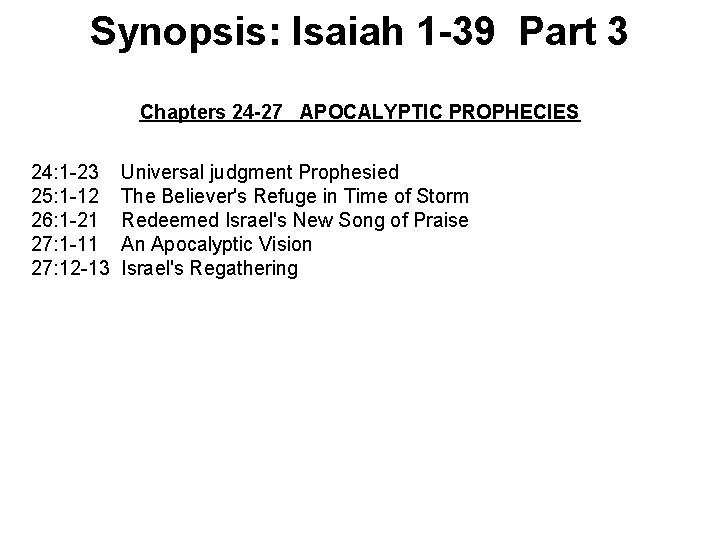
Synopsis: Isaiah 1 -39 Part 3 Chapters 24 -27 APOCALYPTIC PROPHECIES 24: 1 -23 25: 1 -12 26: 1 -21 27: 1 -11 27: 12 -13 Universal judgment Prophesied The Believer's Refuge in Time of Storm Redeemed Israel's New Song of Praise An Apocalyptic Vision Israel's Regathering
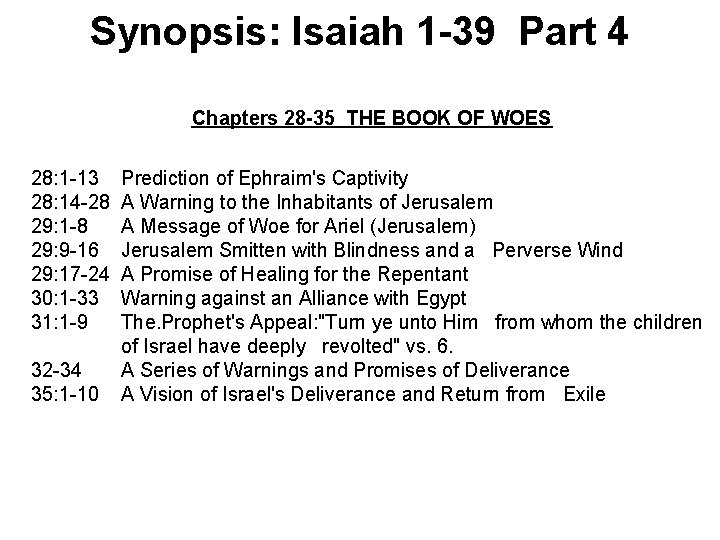
Synopsis: Isaiah 1 -39 Part 4 Chapters 28 -35 THE BOOK OF WOES 28: 1 -13 28: 14 -28 29: 1 -8 29: 9 -16 29: 17 -24 30: 1 -33 31: 1 -9 32 -34 35: 1 -10 Prediction of Ephraim's Captivity A Warning to the Inhabitants of Jerusalem A Message of Woe for Ariel (Jerusalem) Jerusalem Smitten with Blindness and a Perverse Wind A Promise of Healing for the Repentant Warning against an Alliance with Egypt The. Prophet's Appeal: "Turn ye unto Him from whom the children of Israel have deeply revolted" vs. 6. A Series of Warnings and Promises of Deliverance A Vision of Israel's Deliverance and Return from Exile
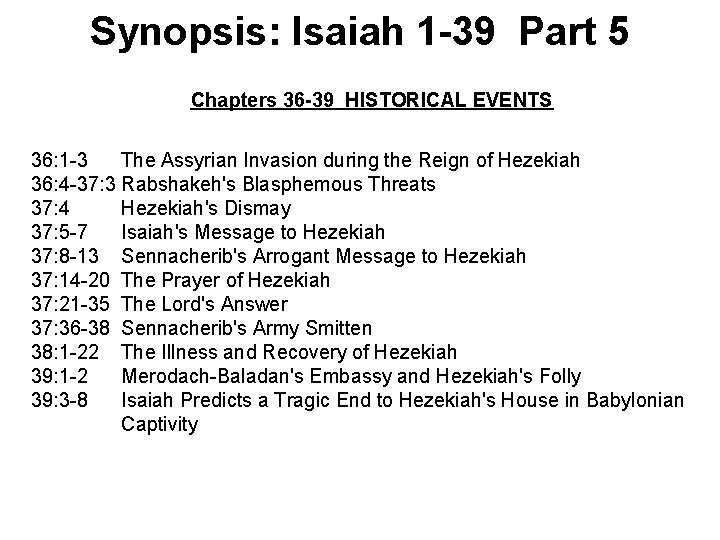
Synopsis: Isaiah 1 -39 Part 5 Chapters 36 -39 HISTORICAL EVENTS 36: 1 -3 The Assyrian Invasion during the Reign of Hezekiah 36: 4 -37: 3 Rabshakeh's Blasphemous Threats 37: 4 Hezekiah's Dismay 37: 5 -7 Isaiah's Message to Hezekiah 37: 8 -13 Sennacherib's Arrogant Message to Hezekiah 37: 14 -20 The Prayer of Hezekiah 37: 21 -35 The Lord's Answer 37: 36 -38 Sennacherib's Army Smitten 38: 1 -22 The Illness and Recovery of Hezekiah 39: 1 -2 Merodach-Baladan's Embassy and Hezekiah's Folly 39: 3 -8 Isaiah Predicts a Tragic End to Hezekiah's House in Babylonian Captivity
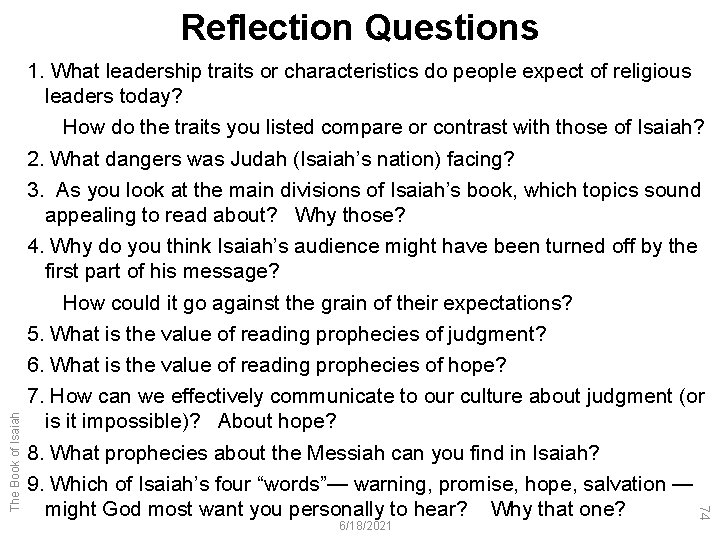
1. What leadership traits or characteristics do people expect of religious leaders today? How do the traits you listed compare or contrast with those of Isaiah? 2. What dangers was Judah (Isaiah’s nation) facing? 3. As you look at the main divisions of Isaiah’s book, which topics sound appealing to read about? Why those? 4. Why do you think Isaiah’s audience might have been turned off by the first part of his message? How could it go against the grain of their expectations? 5. What is the value of reading prophecies of judgment? 6. What is the value of reading prophecies of hope? 7. How can we effectively communicate to our culture about judgment (or is it impossible)? About hope? 8. What prophecies about the Messiah can you find in Isaiah? 9. Which of Isaiah’s four “words”— warning, promise, hope, salvation — might God most want you personally to hear? Why that one? 6/18/2021 74 The Book of Isaiah Reflection Questions
- Slides: 74