
The Bond Rating Process and Credit Trends in
The Bond Rating Process and Credit Trends in the U. S. and Wisconsin Elizabeth Foos, Assistant VP/Analyst Emily Robare, Analyst December 2010
Topics of Discussion 1. Overview of Municipal Bond Rating Process 2. Recalibration to Global Rating Scale 3. Moody’s Outlook for Local Governments 4. Six Key Challenges Facing Local Governments Nationwide and in Wisconsin 5. Potential Mitigants and Management Strategies 6. Questions 2
1. Overview of Municipal Bond Rating Process 3
Steps of the Rating Process » Issuer’s financial advisor requests rating » Issuer provides initial information and documents to ratings analyst – Type of issuance and par amount – Preliminary bond schedule – Preliminary official statement and debt service schedule – 3 years of audited financial statements, current year’s budget – Applicable legal documents » Financial adviser schedules phone call or in-person meeting with analyst » Issuer may receive follow-up questions from analyst » Analyst presents to rating committee and rating is assigned » Issuer reviews credit opinion/rating report prior to release to correct any factual errors » Analyst releases rating report 4
Rating Committee decides the rating » Analyst does not assign rating, but rather presents to a committee composed of senior analysts » Committee composition varies and can include analysts from around the country » A national scale is applied to the rating » Qualitative and quantitative factors are weighted 5
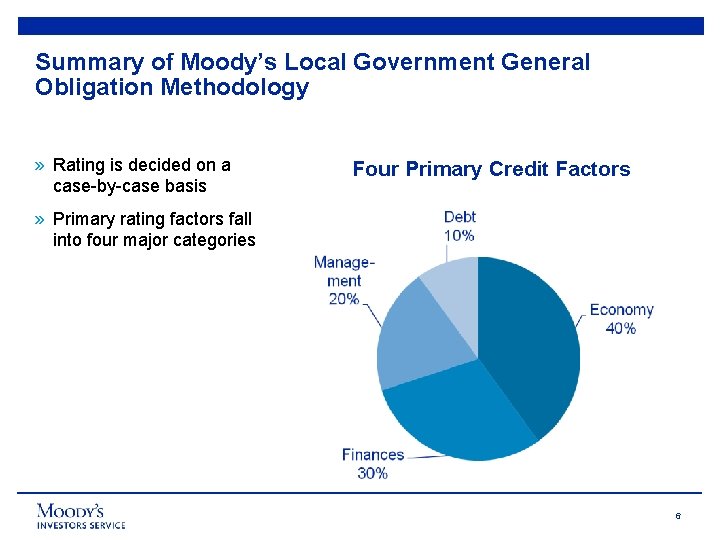
Summary of Moody’s Local Government General Obligation Methodology » Rating is decided on a case-by-case basis Four Primary Credit Factors » Primary rating factors fall into four major categories 6
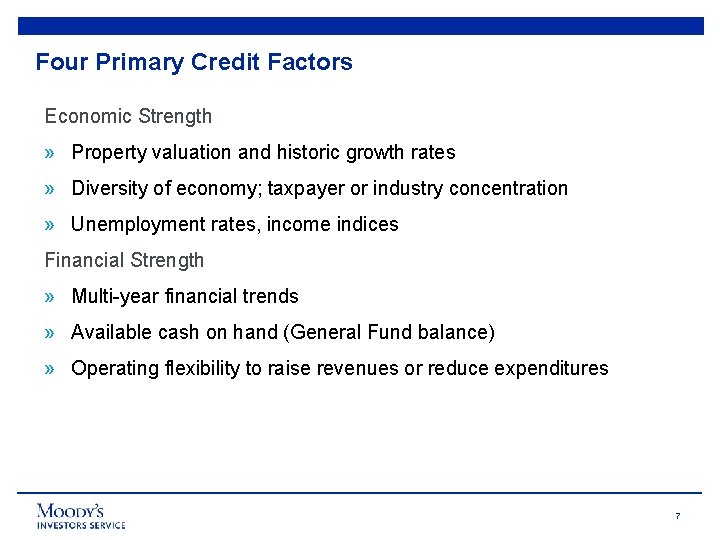
Four Primary Credit Factors Economic Strength » Property valuation and historic growth rates » Diversity of economy; taxpayer or industry concentration » Unemployment rates, income indices Financial Strength » Multi-year financial trends » Available cash on hand (General Fund balance) » Operating flexibility to raise revenues or reduce expenditures 7
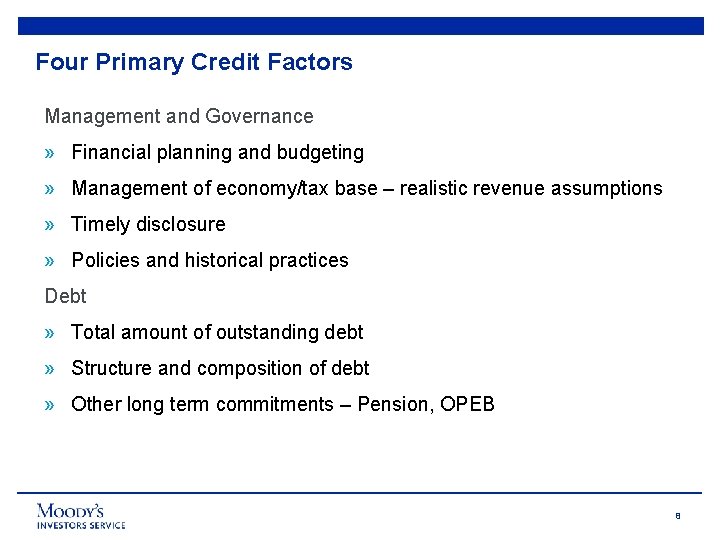
Four Primary Credit Factors Management and Governance » Financial planning and budgeting » Management of economy/tax base – realistic revenue assumptions » Timely disclosure » Policies and historical practices Debt » Total amount of outstanding debt » Structure and composition of debt » Other long term commitments – Pension, OPEB 8
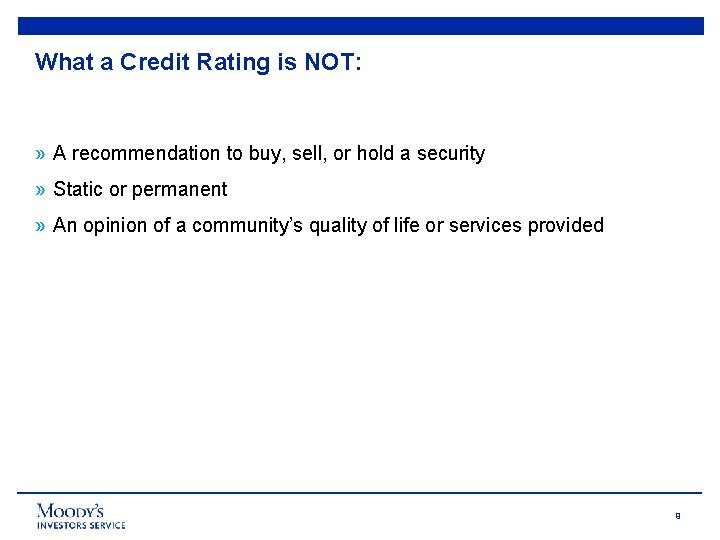
What a Credit Rating is NOT: » A recommendation to buy, sell, or hold a security » Static or permanent » An opinion of a community’s quality of life or services provided 9

Transition to the Global Rating Scale » During the first quarter of 2010, Moody’s recalibrated all of its municipal ratings to its global rating scale, including long-term Wisconsin municipal ratings » In the past, municipal ratings were calibrated on a separate rating scale that emphasized ordinal ranking of credit risk across municipal sectors » Global scale ratings are intended to indicate average levels of default and loss that are roughly consistent across sectors and geographies » Moody’s will maintain a single global rating scale for municipal obligations 10
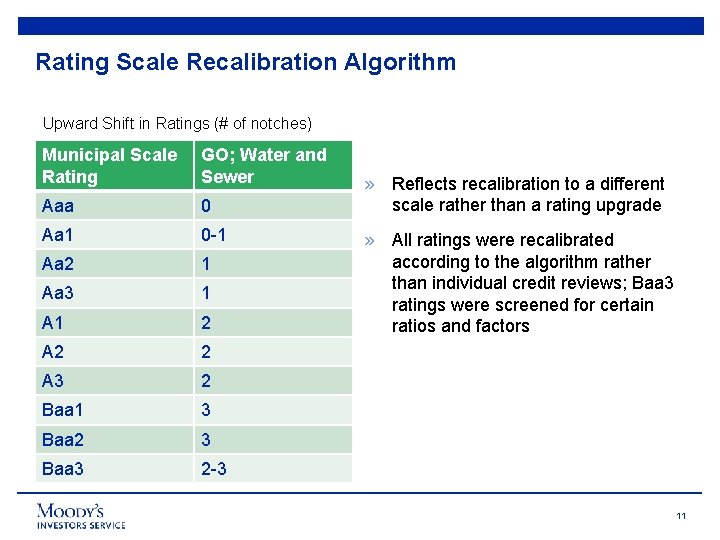
Rating Scale Recalibration Algorithm Upward Shift in Ratings (# of notches) Municipal Scale Rating GO; Water and Sewer Aaa 0 Aa 1 0 -1 Aa 2 1 Aa 3 1 A 1 2 A 2 2 A 3 2 Baa 1 3 Baa 2 3 Baa 3 2 -3 » Reflects recalibration to a different scale rather than a rating upgrade » All ratings were recalibrated according to the algorithm rather than individual credit reviews; Baa 3 ratings were screened for certain ratios and factors 11
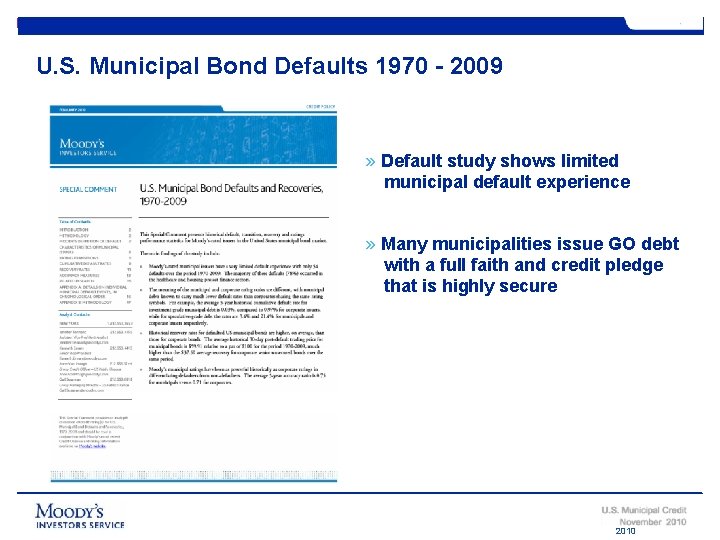
5 U. S. Municipal Bond Defaults 1970 - 2009 » Default study shows limited municipal default experience » Many municipalities issue GO debt with a full faith and credit pledge that is highly secure U. S. Municipal 12 Credit November 2010
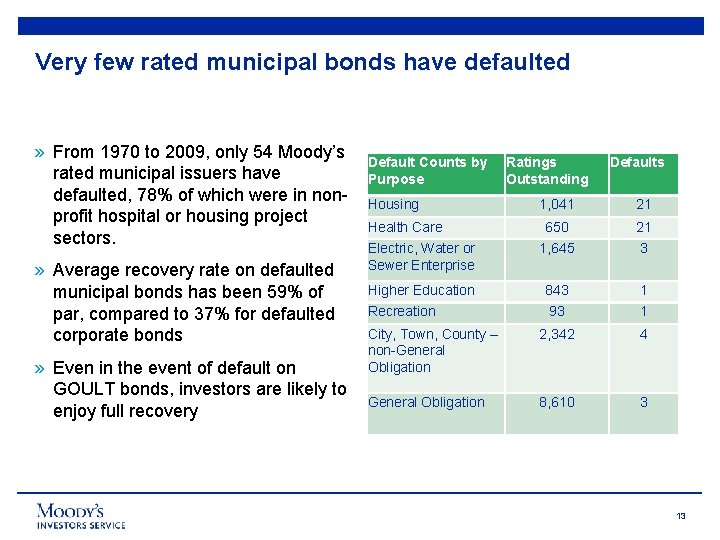
Very few rated municipal bonds have defaulted » From 1970 to 2009, only 54 Moody’s rated municipal issuers have defaulted, 78% of which were in nonprofit hospital or housing project sectors. » Average recovery rate on defaulted municipal bonds has been 59% of par, compared to 37% for defaulted corporate bonds » Even in the event of default on GOULT bonds, investors are likely to enjoy full recovery Default Counts by Purpose Housing Ratings Outstanding Defaults 1, 041 21 650 21 Electric, Water or Sewer Enterprise 1, 645 3 Higher Education 843 1 Recreation 93 1 City, Town, County -non-General Obligation 2, 342 4 General Obligation 8, 610 3 Health Care 13
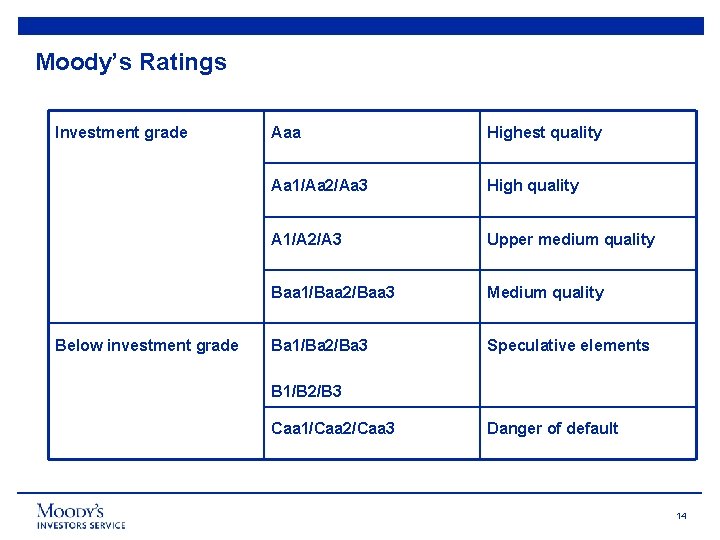
Moody’s Ratings Investment grade Below investment grade Aaa Highest quality Aa 1/Aa 2/Aa 3 High quality A 1/A 2/A 3 Upper medium quality Baa 1/Baa 2/Baa 3 Medium quality Ba 1/Ba 2/Ba 3 Speculative elements B 1/B 2/B 3 Caa 1/Caa 2/Caa 3 Danger of default 14
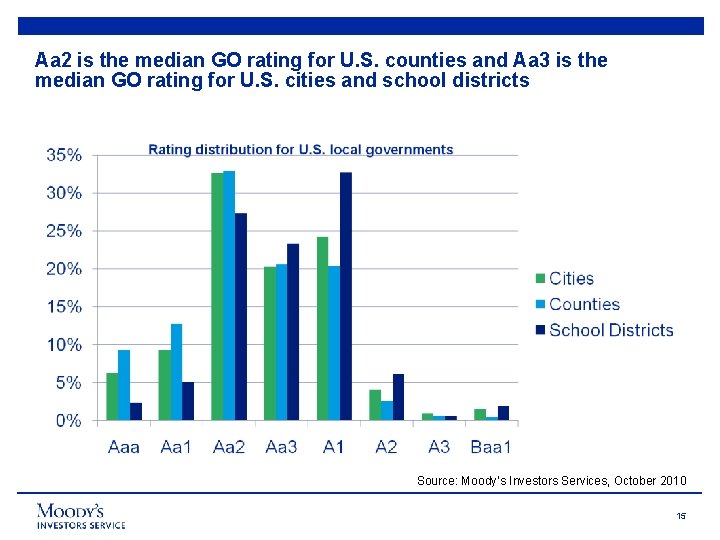
Aa 2 is the median GO rating for U. S. counties and Aa 3 is the median GO rating for U. S. cities and school districts Source: Moody’s Investors Services, October 2010 15
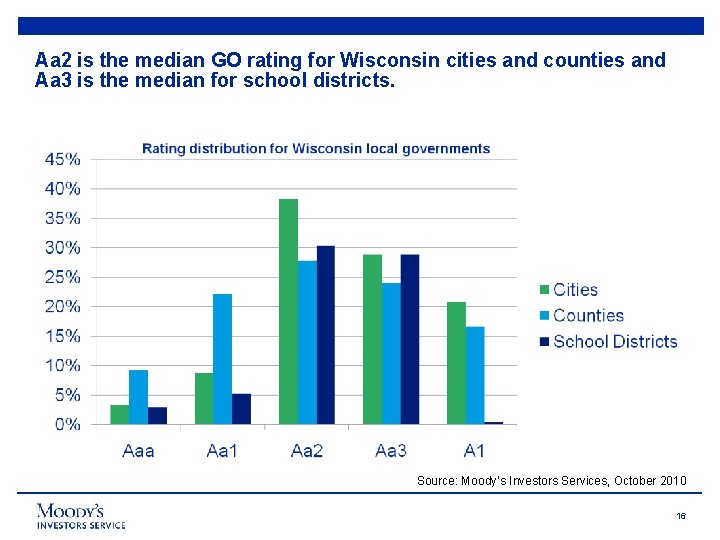
Aa 2 is the median GO rating for Wisconsin cities and counties and Aa 3 is the median for school districts. Source: Moody’s Investors Services, October 2010 16
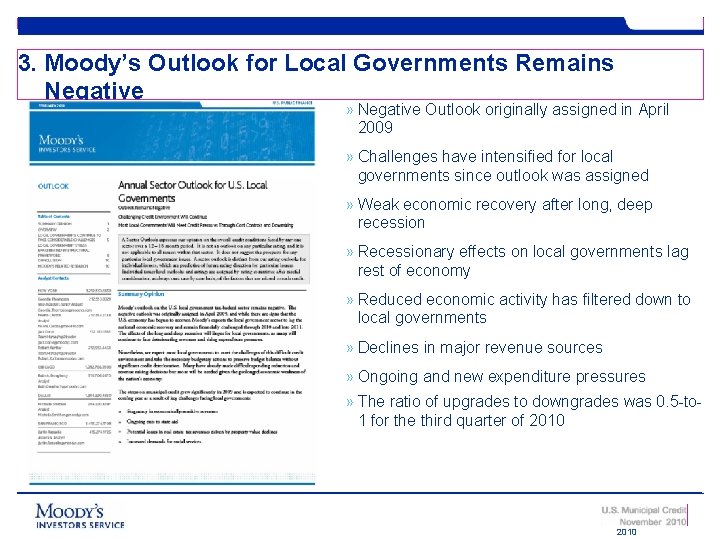
15 3. Moody’s Outlook for Local Governments Remains Negative » Negative Outlook originally assigned in April 2009 » Challenges have intensified for local governments since outlook was assigned » Weak economic recovery after long, deep recession » Recessionary effects on local governments lag rest of economy » Reduced economic activity has filtered down to local governments » Declines in major revenue sources » Ongoing and new expenditure pressures » The ratio of upgrades to downgrades was 0. 5 -to 1 for the third quarter of 2010 U. S. Municipal Credit November 2010
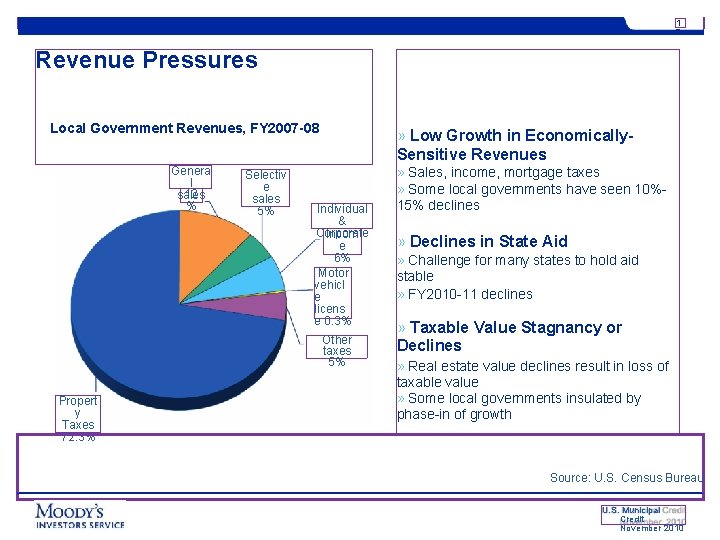
1 7 17 Revenue Pressures Local Government Revenues, FY 2007 -08 Genera l 12 sales % Selectiv e sales 5% » Low Growth in Economically. Sensitive Revenues Individual & Corporate Incom e 6% Motor vehicl e licens e 0. 3% Other taxes 5% Propert y Taxes 72. 3% » Sales, income, mortgage taxes » Some local governments have seen 10%15% declines » Declines in State Aid » Challenge for many states to hold aid stable » FY 2010 -11 declines » Taxable Value Stagnancy or Declines » Real estate value declines result in loss of taxable value » Some local governments insulated by phase-in of growth Source: U. S. Census Bureau U. S. Municipal Credit November 2010
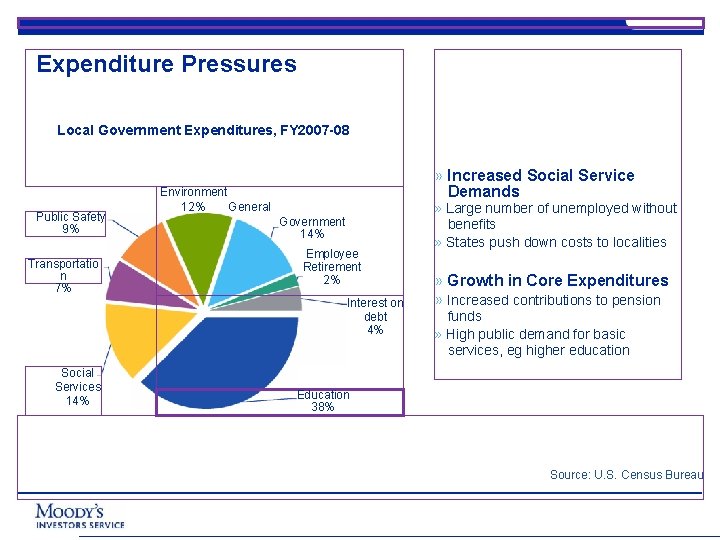
18 Expenditure Pressures Local Government Expenditures, FY 2007 -08 Public Safety 9% Transportatio n 7% » Increased Social Service Demands Environment 12% General Government 14% Employee Retirement 2% Interest on debt 4% Social Services 14% » Large number of unemployed without benefits » States push down costs to localities » Growth in Core Expenditures » Increased contributions to pension funds » High public demand for basic services, eg higher education Education 38% Source: U. S. Census Bureau
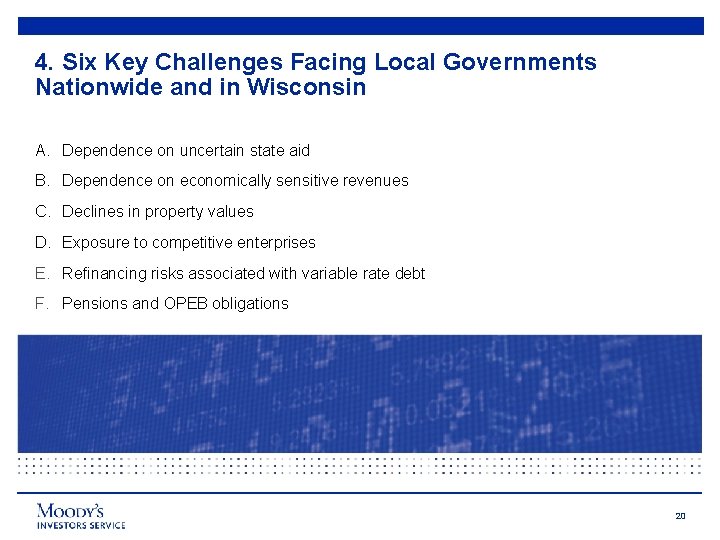
4. Six Key Challenges Facing Local Governments Nationwide and in Wisconsin A. Dependence on uncertain state aid B. Dependence on economically sensitive revenues C. Declines in property values D. Exposure to competitive enterprises E. Refinancing risks associated with variable rate debt F. Pensions and OPEB obligations 20
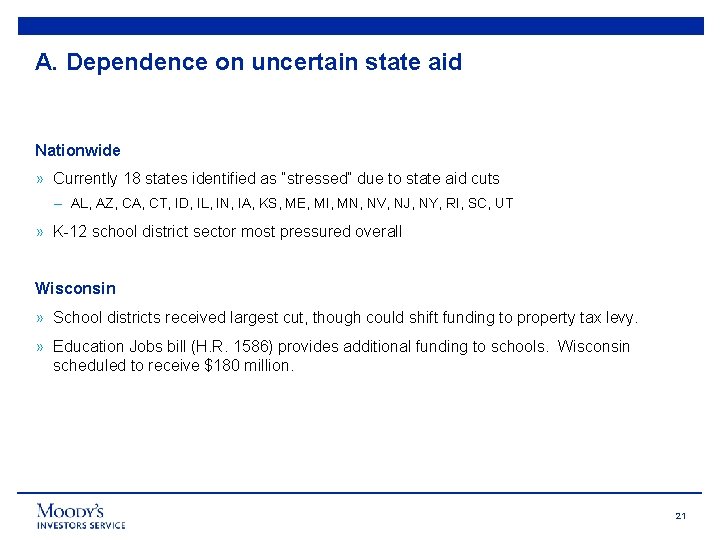
A. Dependence on uncertain state aid Nationwide » Currently 18 states identified as “stressed” due to state aid cuts – AL, AZ, CA, CT, ID, IL, IN, IA, KS, ME, MI, MN, NV, NJ, NY, RI, SC, UT » K-12 school district sector most pressured overall Wisconsin » School districts received largest cut, though could shift funding to property tax levy. » Education Jobs bill (H. R. 1586) provides additional funding to schools. Wisconsin scheduled to receive $180 million. 21
B. Dependence on economically sensitive revenues Nationwide » Economically sensitive revenues - taxes derived from personal and corporate income, sales, mortgage, tourism, hotel stays, and related areas Wisconsin » 61 (out of 72) Wisconsin counties have 0. 5% sales tax » Sales tax receipts experienced a large median decline of 6. 6% from 2008 to 2009, remained essentially flat in 2010. 22
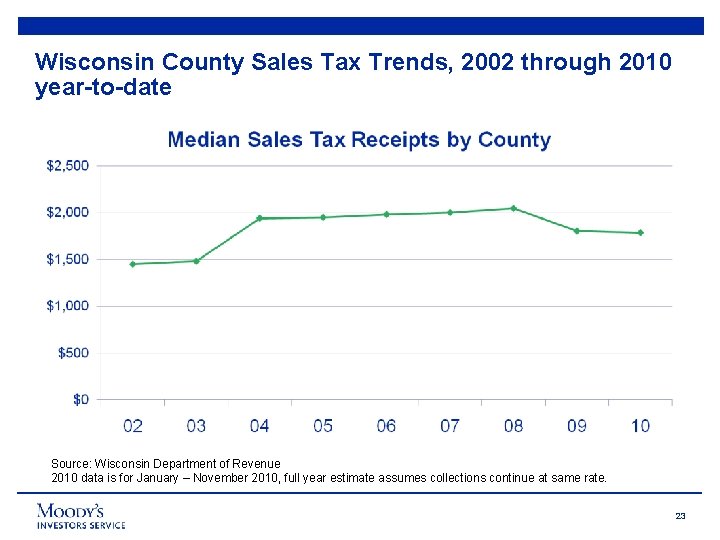
Wisconsin County Sales Tax Trends, 2002 through 2010 year-to-date Source: Wisconsin Department of Revenue 2010 data is for January – November 2010, full year estimate assumes collections continue at same rate. 23
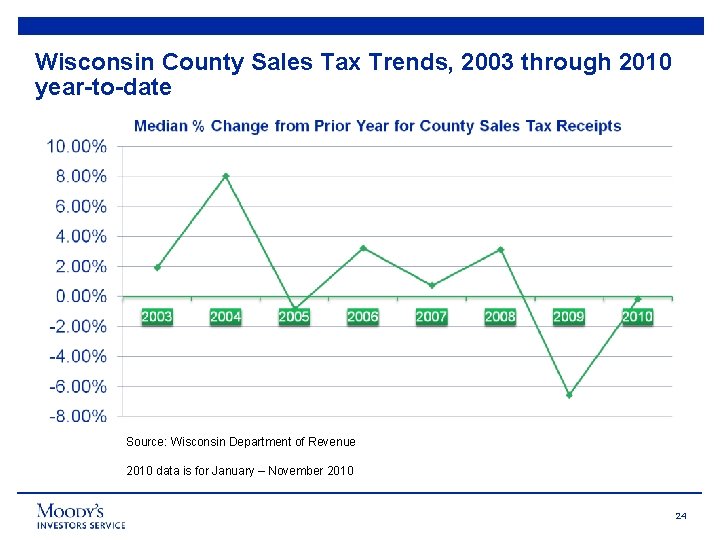
Wisconsin County Sales Tax Trends, 2003 through 2010 year-to-date Source: Wisconsin Department of Revenue 2010 data is for January – November 2010 24
C. Declines in property values Nationwide » Less volatile; lagging indicator » Impact of declining property values reflected in 2010 and 2011 » Greater impact on local governments with limited tax raising flexibility Wisconsin » Wisconsin saw less of a run-up in real estate values compared to other parts of the country » Lower collection rates and higher delinquency rates can also be a concern 25
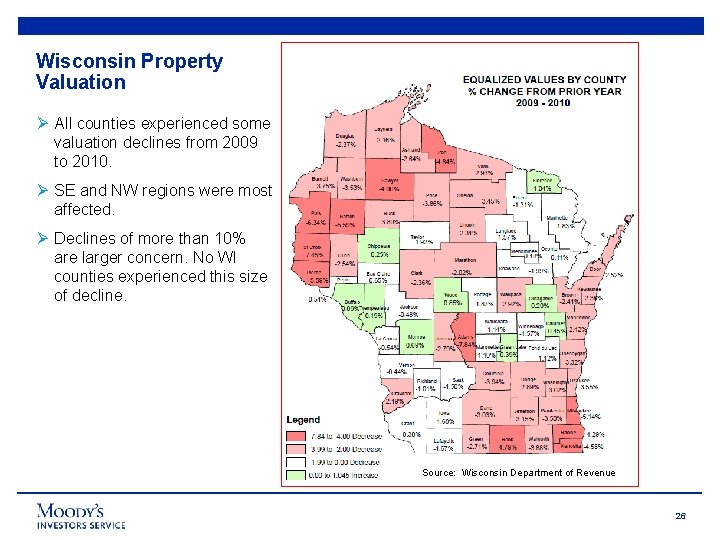
Wisconsin Property Valuation Ø All counties experienced some valuation declines from 2009 to 2010. Ø SE and NW regions were most affected. Ø Declines of more than 10% are larger concern. No WI counties experienced this size of decline. Source: Wisconsin Department of Revenue 26
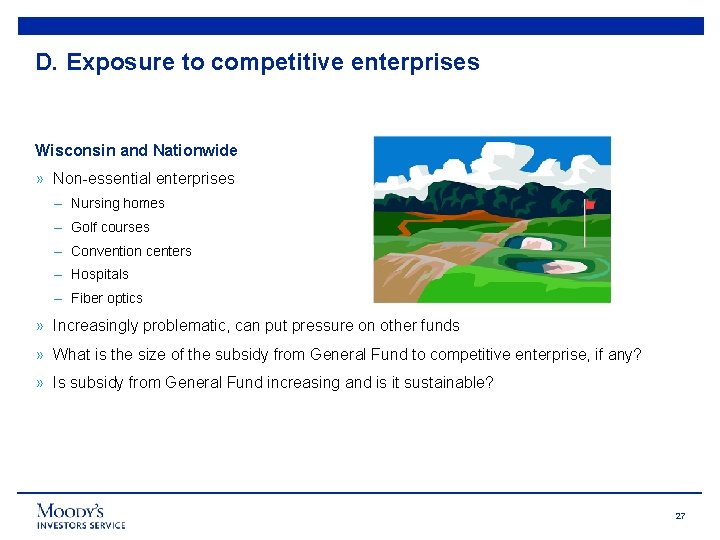
D. Exposure to competitive enterprises Wisconsin and Nationwide » Non-essential enterprises – Nursing homes – Golf courses – Convention centers – Hospitals – Fiber optics » Increasingly problematic, can put pressure on other funds » What is the size of the subsidy from General Fund to competitive enterprise, if any? » Is subsidy from General Fund increasing and is it sustainable? 27
E. Refinancing risks associated with variable rate debt Nationwide » Many liquidity agreements entered into in 2008 and 2009 » Uncertainty related to ability and cost associated with renewing expiring Stand-by Purchase Agreements or Lines of Credit » Swap agreement may require additional termination costs, impacting liquidity/finances Wisconsin » Very few Wisconsin local governments have variable rate debt, not a common concern 28
F. Pension and OPEB obligations Nationwide » Significant investment losses in pension plans throughout 2008 and early 2009 » Exacerbated by decisions by select governments to defer pension contributions during periods of budgetary stress » Government issuers with marginal funding, inflexible regulatory or legal pension funding requirements face greater credit stress » Despite improving performance of the equity markets since spring 2009, previous asset losses continue to weight on plan asset valuations Wisconsin » Pension liabilities handled by state for nearly all local governments. State did not have an unfunded pension liability as of December 2008. » OPEB obligations manageable in most cases. 29
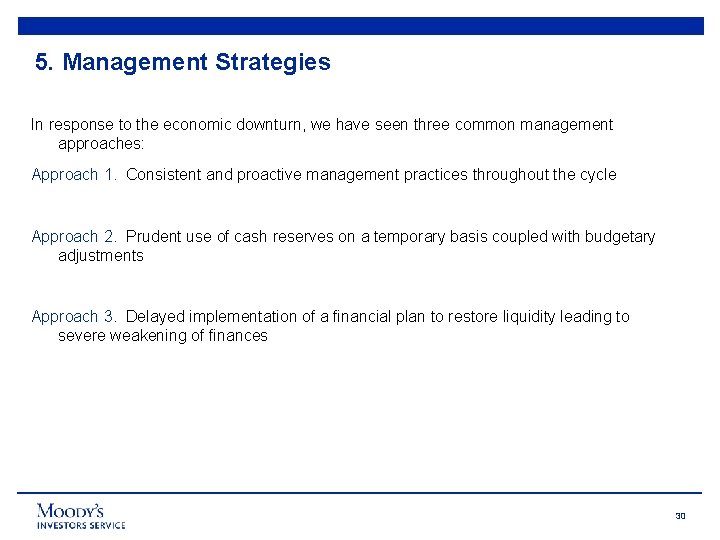
5. Management Strategies In response to the economic downturn, we have seen three common management approaches: Approach 1. Consistent and proactive management practices throughout the cycle Approach 2. Prudent use of cash reserves on a temporary basis coupled with budgetary adjustments Approach 3. Delayed implementation of a financial plan to restore liquidity leading to severe weakening of finances 30
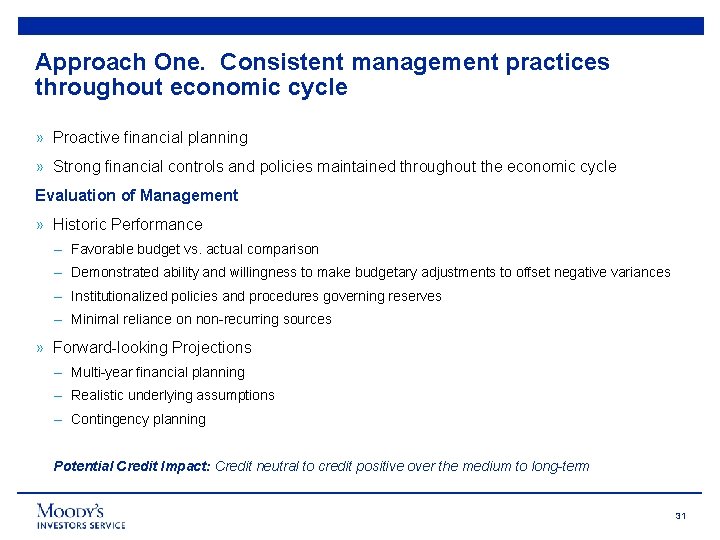
Approach One. Consistent management practices throughout economic cycle » Proactive financial planning » Strong financial controls and policies maintained throughout the economic cycle Evaluation of Management » Historic Performance – Favorable budget vs. actual comparison – Demonstrated ability and willingness to make budgetary adjustments to offset negative variances – Institutionalized policies and procedures governing reserves – Minimal reliance on non-recurring sources » Forward-looking Projections – Multi-year financial planning – Realistic underlying assumptions – Contingency planning Potential Credit Impact: Credit neutral to credit positive over the medium to long-term 31
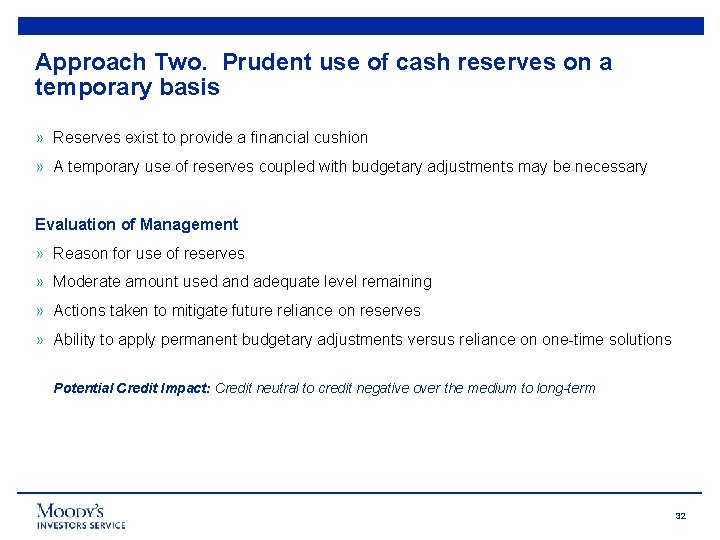
Approach Two. Prudent use of cash reserves on a temporary basis » Reserves exist to provide a financial cushion » A temporary use of reserves coupled with budgetary adjustments may be necessary Evaluation of Management » Reason for use of reserves » Moderate amount used and adequate level remaining » Actions taken to mitigate future reliance on reserves » Ability to apply permanent budgetary adjustments versus reliance on one-time solutions Potential Credit Impact: Credit neutral to credit negative over the medium to long-term 32
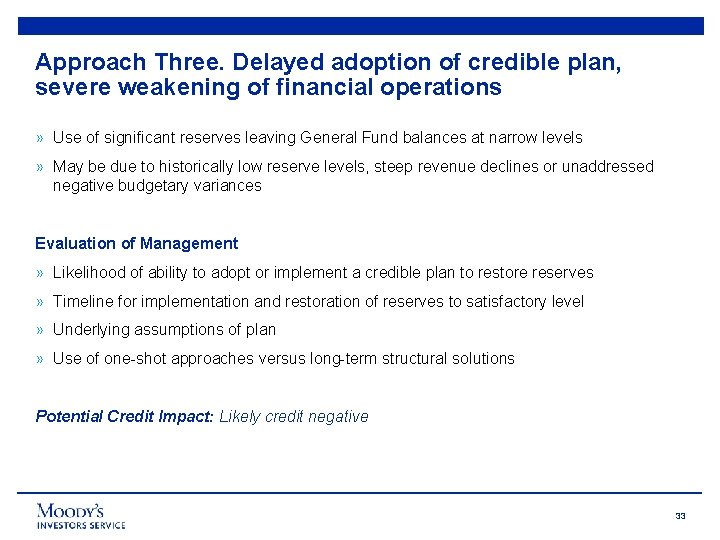
Approach Three. Delayed adoption of credible plan, severe weakening of financial operations » Use of significant reserves leaving General Fund balances at narrow levels » May be due to historically low reserve levels, steep revenue declines or unaddressed negative budgetary variances Evaluation of Management » Likelihood of ability to adopt or implement a credible plan to restore reserves » Timeline for implementation and restoration of reserves to satisfactory level » Underlying assumptions of plan » Use of one-shot approaches versus long-term structural solutions Potential Credit Impact: Likely credit negative 33
6. Summary » Local government sector is large and diverse » Financial and economic challenges expected to persist through 2011 » Management can implement strategies to mitigate concerns » Credits assessed on case by case basis » Increase in negative rating actions, although overall, sector remains largely stable 34

Elizabeth Foos (312) 706 -9954 elizabeth. foos@moodys. com Mark Lazarus (312) 706 -9976 mark. lazarus@moodys. com Emily Robare (312) 706 -9971 emily. robare@moodys. com David Horton (312) 706 -9951 david. horton@moodys. com Soo Chun (312) 706 -9983 soo. chun@moodys. com 35
© 2009 Moody’s Investors Service, Inc. and/or its licensors and affiliates (collectively, “MOODY’S”). All rights reserved. ALL INFORMATION CONTAINED HEREIN IS PROTECTED BY COPYRIGHT LAW AND NONE OF SUCH INFORMATION MAY BE COPIED OR OTHERWISE REPRODUCED, REPACKAGED, FURTHER TRANSMITTED, TRANSFERRED, DISSEMINATED, REDISTRIBUTED OR RESOLD, OR STORED FOR SUBSEQUENT USE FOR ANY SUCH PURPOSE, IN WHOLE OR IN PART, IN ANY FORM OR MANNER OR BY ANY MEANS WHATSOEVER, BY ANY PERSON WITHOUT MOODY’S PRIOR WRITTEN CONSENT. All information contained herein is obtained by MOODY’S from sources believed by it to be accurate and reliable. Because of the possibility of human or mechanical error as well as other factors, however, all information contained herein is provided “AS IS” without warranty of any kind. Under no circumstances shall MOODY’S have any liability to any person or entity for (a) any loss or damage in whole or in part caused by, resulting from, or relating to, any error (negligent or otherwise) or other circumstance or contingency within or outside the control of MOODY’S or any of its directors, officers, employees or agents in connection with the procurement, collection, compilation, analysis, interpretation, communication, publication or delivery of any such information, or (b) any direct, indirect, special, consequential, compensatory or incidental damages whatsoever (including without limitation, lost profits), even if MOODY’S is advised in advance of the possibility of such damages, resulting from the use of or inability to use, any such information. The ratings, financial reporting analysis, projections, and other observations, if any, constituting part of the information contained herein are, and must be construed solely as, statements of opinion and not statements of fact or recommendations to purchase, sell or hold any securities. NO WARRANTY, EXPRESS OR IMPLIED, AS TO THE ACCURACY, TIMELINESS, COMPLETENESS, MERCHANTABILITY OR FITNESS FOR ANY PARTICULAR PURPOSE OF ANY SUCH RATING OR OTHER OPINION OR INFORMATION IS GIVEN OR MADE BY MOODY’S IN ANY FORM OR MANNER WHATSOEVER. Each rating or other opinion must be weighed solely as one factor in any investment decision made by or on behalf of any user of the information contained herein, and each such user must accordingly make its own study and evaluation of each security and of each issuer and guarantor of, and each provider of credit support for, each security that it may consider purchasing, holding or selling. Moody’s Investors Service, Inc. (“MIS”), a wholly-owned credit rating agency subsidiary of Moody’s Corporation (“MCO”), hereby discloses that most issuers of debt securities (including corporate and municipal bonds, debentures, notes and commercial paper) and preferred stock rated by MIS have, prior to assignment of any rating, agreed to pay to MIS for appraisal and rating services rendered by it fees ranging from $1, 500 to approximately $2, 500, 000. MCO and MIS also maintain policies and procedures to address the independence of MIS’s ratings and rating processes. Information regarding certain affiliations that may exist between directors of MCO and rated entities, and between entities who hold ratings from MIS and have also publicly reported to the SEC an ownership interest in MCO of more than 5%, is posted annually at www. moodys. com under the heading “Shareholder Relations — Corporate Governance — Director and Shareholder Affiliation Policy. ” 36
- Slides: 36