
The Body of a News Story Chapter 8
The Body of a News Story Chapter 8 Felder, Bender, Davenport and Drager
Do it for your body • Always, when time permits, read your story before submitting it. If you can’t cut out at least a couple of words, you’re not doing a sufficiently critical job of reading. One of the toughest things in the writing trade, and one of the best for a writer, is to cut your own copy. (Morton Sontheimer, journalist)
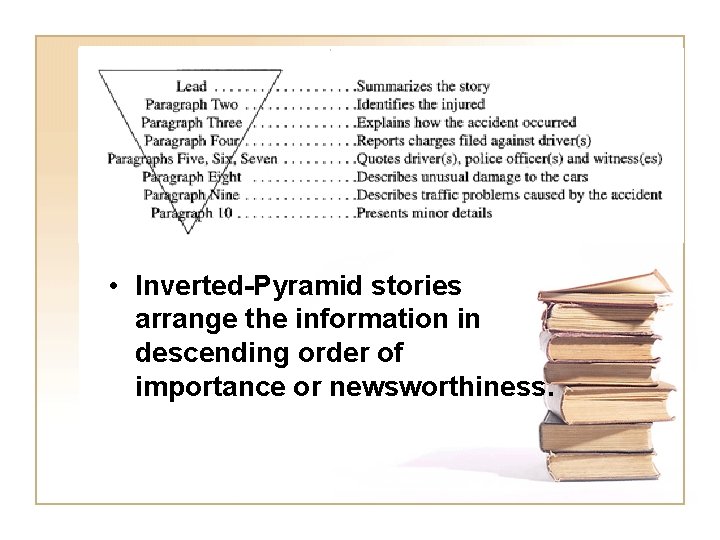
• Inverted-Pyramid stories arrange the information in descending order of importance or newsworthiness.
• The exact organization of the story will depend upon the story’s newsworthy points. • Many writing coaches feel the use of the inverted-pyramid style is overdone. • But, daily deadline pressures encourage its use, because length requirements are still a consideration for print media.
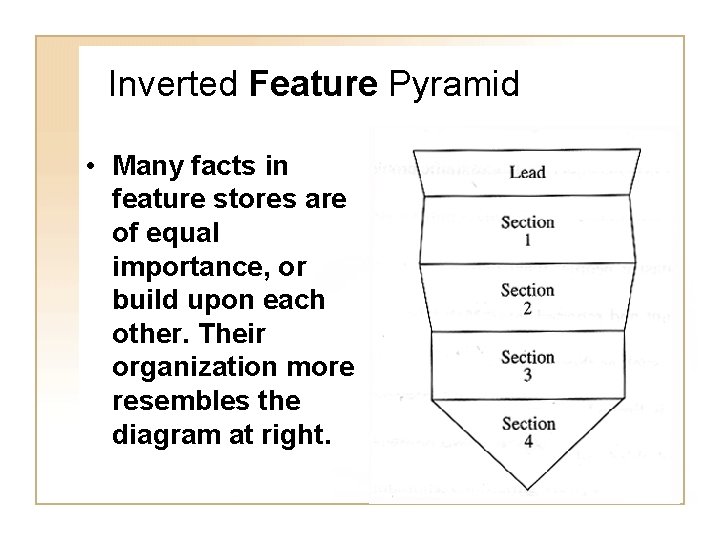
Inverted Feature Pyramid • Many facts in feature stores are of equal importance, or build upon each other. Their organization more resembles the diagram at right.
That “SECOND” Paragraph • The second paragraph is an extension of the lead. • It may fill in facts left out by a short or alternative lead. • You set the tone for your story’s transition with the second paragraph. Is it logical? Does it sustain the metaphor?
• Above all, the second paragraph must emphasize the news. It is not your nut graph, but it supports the newsworthiness of this story. • It can be almost as difficult to write as the lead. • There also some dangers to be considered, especially when you are referring to a person in the lead and start the second paragraph with a name.
No Leapfrogging • Leapfrogging happens when you refer to an individual in the lead and begin the second paragraph with a name, without telling your reader that this is “the same guy. ” • “Felipe M. Santos, 53, ” • “the man suspected of the attack, Felipe M. Santos, 53”
Continue with the NEWS • Continue to expound upon the topic introduced in your lead. • Don’t change topics at this point, you want to set up the flow of your story at this juncture. • Try not to focus too much emphasis on identities. We know these are facts, but usually not most interesting.
Don’t have too much baggage • Background is very useful, but remember this is about news, not that much about history. • Detailed background in the second or third paragraphs is not good. • Complexity of a story can force a writer to summarize other actions, not as important early in the story.
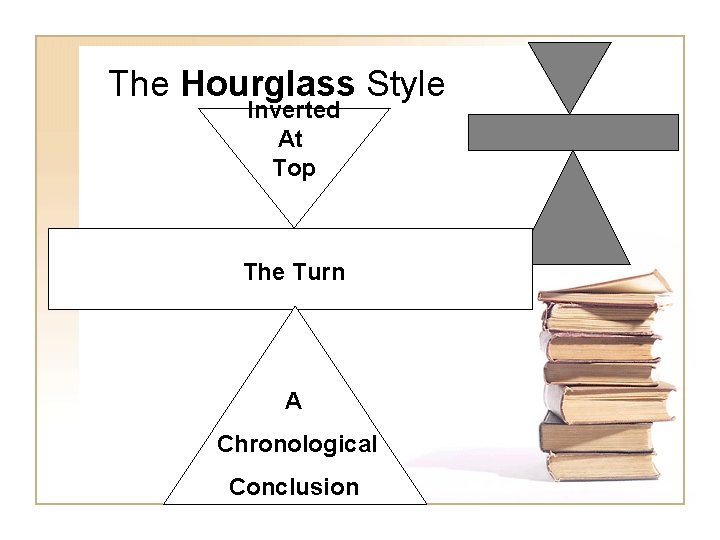
The Hourglass Style Inverted At Top The Turn A Chronological Conclusion
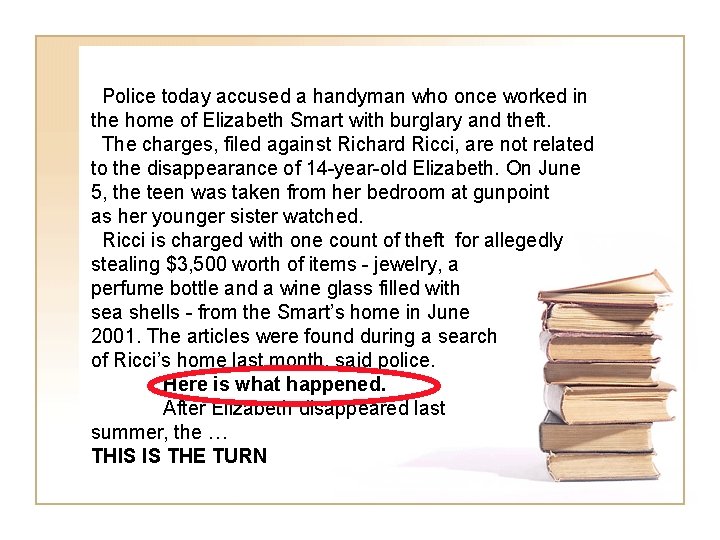
Police today accused a handyman who once worked in the home of Elizabeth Smart with burglary and theft. The charges, filed against Richard Ricci, are not related to the disappearance of 14 -year-old Elizabeth. On June 5, the teen was taken from her bedroom at gunpoint as her younger sister watched. Ricci is charged with one count of theft for allegedly stealing $3, 500 worth of items - jewelry, a perfume bottle and a wine glass filled with sea shells - from the Smart’s home in June 2001. The articles were found during a search of Ricci’s home last month, said police. Here is what happened. After Elizabeth disappeared last summer, the … THIS IS THE TURN
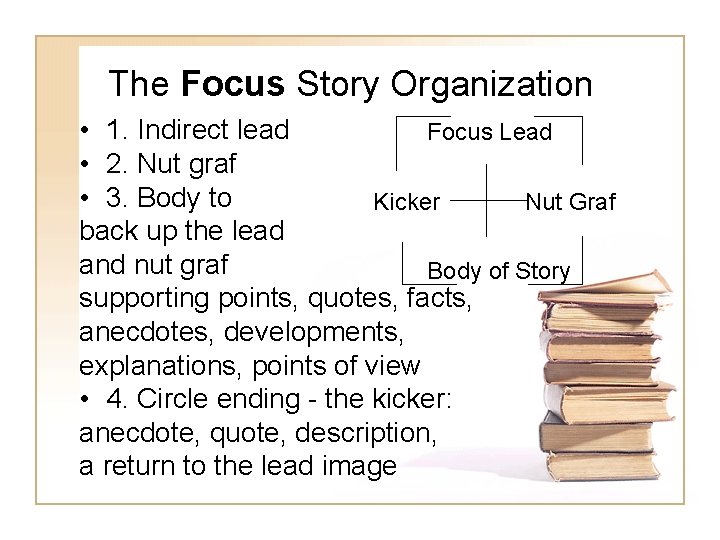
The Focus Story Organization • 1. Indirect lead Focus Lead • 2. Nut graf • 3. Body to Kicker Nut Graf back up the lead and nut graf Body of Story supporting points, quotes, facts, anecdotes, developments, explanations, points of view • 4. Circle ending - the kicker: anecdote, quote, description, a return to the lead image
The Narrative Style • To write in the narrative style, a reporter must find people who are crucial to the story and record their actions. • This is a type of reporting beyond the interview, where the writer must spend time with his characters. ETHNOGRAPHY STYLE
Using Transitions • If your story is a train, then the transitions are the couplings that hold the cars together. • Fortunately, the natural progression of thought, or sequence of facts and action, is adequate. • Often a writer will repeat a noun or pronoun.
Transitional Words • Sometimes a single word can lead readers from one idea to the next – earlier, later, before, after, promptly and tardy. • Time • Addition • Causation • Comparison • Contrast
Transitional Sentences • A good transitional sentence often serves the same purposes as a lead, sometimes summarizing and discussing the topic in more detail. • Transitional QUESTIONS • How does this happen? • How is writing like dancing? • What happened to the rest? • Why question authority?
Explaining • Explain the unfamiliar. • Use examples to make a story easier to understand. • Use DESCRIPTION. Description turns on a reader’s brain. Careful description can turn on memories in a reader’s brain, like certain smells and sights
The Use of Humor • In news stories, humor can be a tricky situation. You do not want to trivialize a serious topic, or downplay the impact of a serious incident. You can, however, use humor to break the routine of a story, like a commission meeting attended by a turkey seeking a governmental pardon at Thanksgiving.
The need to be Fair • Regardless of how a story is organized, it must be balanced, fair and accurate. • Words, like bullets, are selected to be most effective tools. But, once sent on their way, bullets and words take their toll just by doing what they are designed to do.
Edit your story • Edit it ruthlessly. • If you don’t, then someone else will be more than happy to do it for you. • A wise man once said if we don’t set our priorities, then others will set them for us. • Editing your story should be a labor or love – tough love.
A CHECKLIST • Put the most important details in the lead. • Emphasize details throughout the story. • Help readers visualize. • Stick to the topic – a clear purpose. • No leapfrogging. • Concise sentences. • Vary sentence structure. • Don’t overload sentences. • If you have subtopics, mention them in your lead, so your readers won’t be surprised.
• If you use a list, put it in parallel form. • Provide transition. This makes for a smooth ride for your readers. • Make your transitional sentences specific. • Use question transition wisely. • Avoid generalities. • Resist ending your story with a summary, or conclusion. • If you love your story, you will edit it critically, even ruthlessly.

The END
- Slides: 24