
The bloody captains report of Macbeth and Banquos
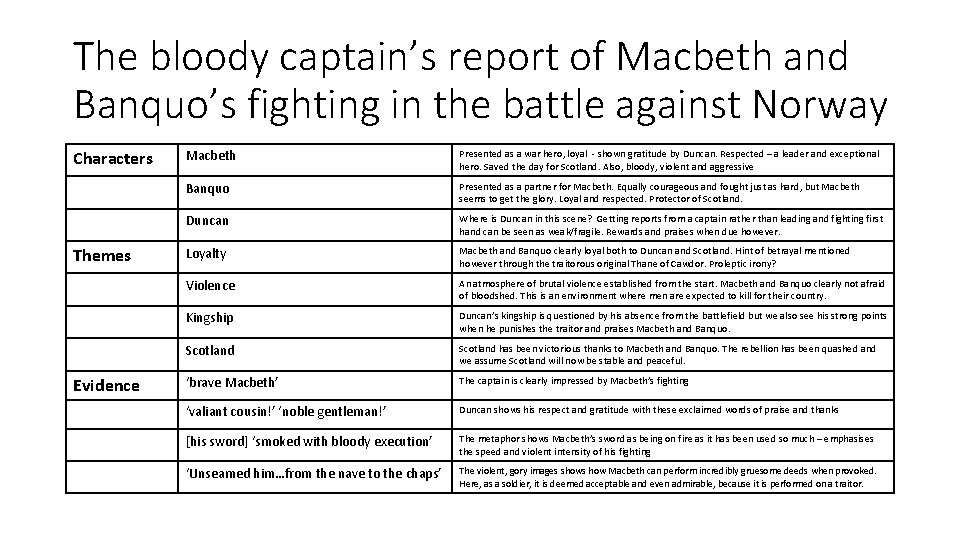
The bloody captain’s report of Macbeth and Banquo’s fighting in the battle against Norway Characters Themes Evidence Macbeth Presented as a war hero, loyal - shown gratitude by Duncan. Respected – a leader and exceptional hero. Saved the day for Scotland. Also, bloody, violent and aggressive Banquo Presented as a partner for Macbeth. Equally courageous and fought just as hard, but Macbeth seems to get the glory. Loyal and respected. Protector of Scotland. Duncan Where is Duncan in this scene? Getting reports from a captain rather than leading and fighting first hand can be seen as weak/fragile. Rewards and praises when due however. Loyalty Macbeth and Banquo clearly loyal both to Duncan and Scotland. Hint of betrayal mentioned however through the traitorous original Thane of Cawdor. Proleptic irony? Violence An atmosphere of brutal violence established from the start. Macbeth and Banquo clearly not afraid of bloodshed. This is an environment where men are expected to kill for their country. Kingship Duncan’s kingship is questioned by his absence from the battlefield but we also see his strong points when he punishes the traitor and praises Macbeth and Banquo. Scotland has been victorious thanks to Macbeth and Banquo. The rebellion has been quashed and we assume Scotland will now be stable and peaceful. ‘brave Macbeth’ The captain is clearly impressed by Macbeth’s fighting ‘valiant cousin!’ ‘noble gentleman!’ Duncan shows his respect and gratitude with these exclaimed words of praise and thanks [his sword] ‘smoked with bloody execution’ The metaphor shows Macbeth’s sword as being on fire as it has been used so much – emphasises the speed and violent intensity of his fighting ‘Unseamed him…from the nave to the chaps’ The violent, gory images shows how Macbeth can perform incredibly gruesome deeds when provoked. Here, as a soldier, it is deemed acceptable and even admirable, because it is performed on a traitor.
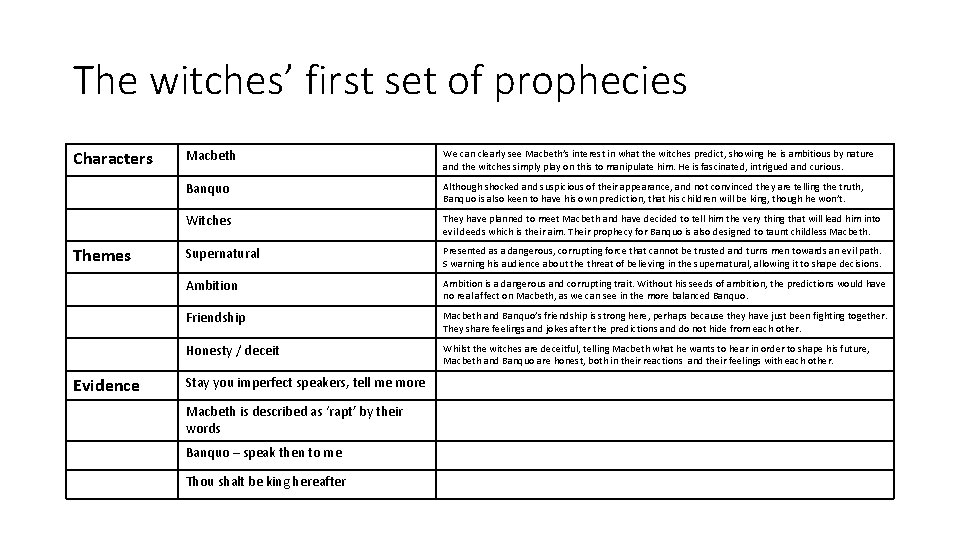
The witches’ first set of prophecies Characters Themes Evidence Macbeth We can clearly see Macbeth’s interest in what the witches predict, showing he is ambitious by nature and the witches simply play on this to manipulate him. He is fascinated, intrigued and curious. Banquo Although shocked and suspicious of their appearance, and not convinced they are telling the truth, Banquo is also keen to have his own prediction, that his children will be king, though he won’t. Witches They have planned to meet Macbeth and have decided to tell him the very thing that will lead him into evil deeds which is their aim. Their prophecy for Banquo is also designed to taunt childless Macbeth. Supernatural Presented as a dangerous, corrupting force that cannot be trusted and turns men towards an evil path. S warning his audience about the threat of believing in the supernatural, allowing it to shape decisions. Ambition is a dangerous and corrupting trait. Without his seeds of ambition, the predictions would have no real affect on Macbeth, as we can see in the more balanced Banquo. Friendship Macbeth and Banquo’s friendship is strong here, perhaps because they have just been fighting together. They share feelings and jokes after the predictions and do not hide from each other. Honesty / deceit Whilst the witches are deceitful, telling Macbeth what he wants to hear in order to shape his future, Macbeth and Banquo are honest, both in their reactions and their feelings with each other. Stay you imperfect speakers, tell me more Macbeth is described as ‘rapt’ by their words Banquo – speak then to me Thou shalt be king hereafter
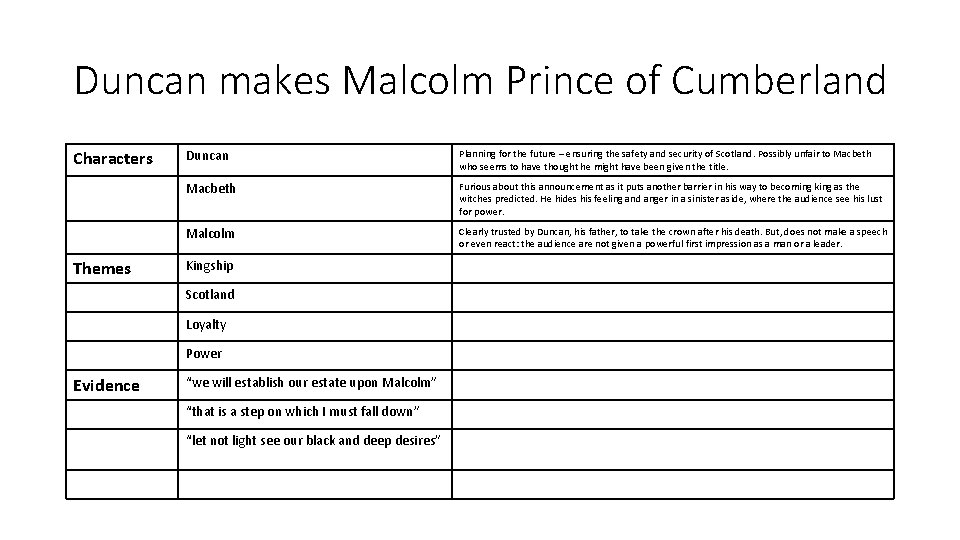
Duncan makes Malcolm Prince of Cumberland Characters Themes Duncan Planning for the future – ensuring the safety and security of Scotland. Possibly unfair to Macbeth who seems to have thought he might have been given the title. Macbeth Furious about this announcement as it puts another barrier in his way to becoming king as the witches predicted. He hides his feeling and anger in a sinister aside, where the audience see his lust for power. Malcolm Clearly trusted by Duncan, his father, to take the crown after his death. But, does not make a speech or even react: the audience are not given a powerful first impression as a man or a leader. Kingship Scotland Loyalty Power Evidence “we will establish our estate upon Malcolm” “that is a step on which I must fall down” “let not light see our black and deep desires”
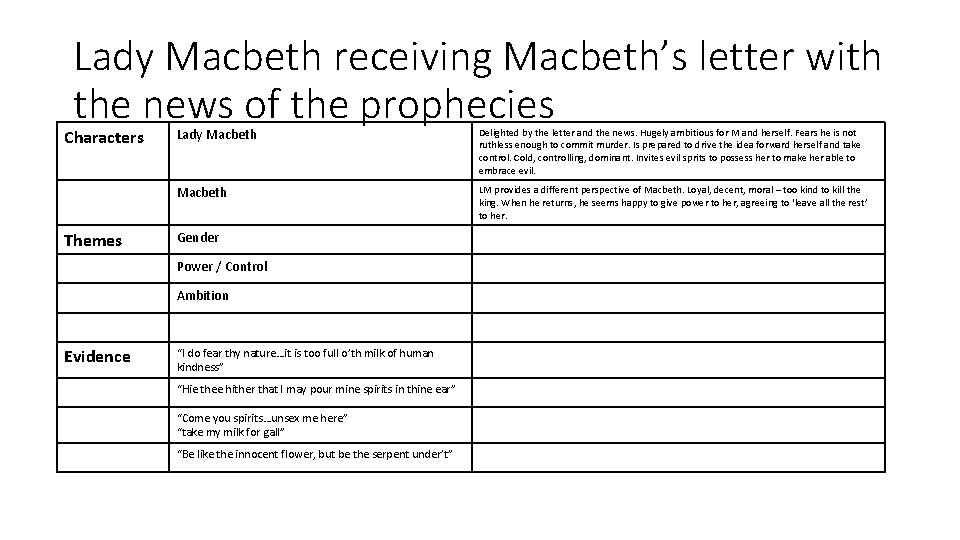
Lady Macbeth receiving Macbeth’s letter with the news of the prophecies Characters Themes Lady Macbeth Delighted by the letter and the news. Hugely ambitious for M and herself. Fears he is not ruthless enough to commit murder. Is prepared to drive the idea forward herself and take control. Cold, controlling, dominant. Invites evil sprits to possess her to make her able to embrace evil. Macbeth LM provides a different perspective of Macbeth. Loyal, decent, moral – too kind to kill the king. When he returns, he seems happy to give power to her, agreeing to ‘leave all the rest’ to her. Gender Power / Control Ambition Evidence “I do fear thy nature…it is too full o’th milk of human kindness” “Hie thee hither that I may pour mine spirits in thine ear” “Come you spirits…unsex me here” “take my milk for gall” “Be like the innocent flower, but be the serpent under’t”
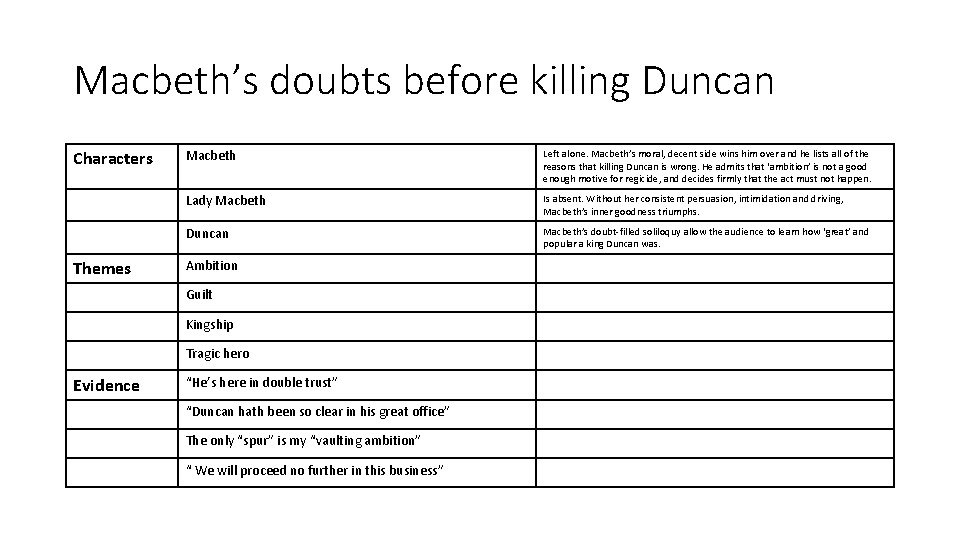
Macbeth’s doubts before killing Duncan Characters Themes Macbeth Left alone. Macbeth’s moral, decent side wins him over and he lists all of the reasons that killing Duncan is wrong. He admits that ‘ambition’ is not a good enough motive for regicide, and decides firmly that the act must not happen. Lady Macbeth Is absent. Without her consistent persuasion, intimidation and driving, Macbeth’s inner goodness triumphs. Duncan Macbeth’s doubt-filled soliloquy allow the audience to learn how ‘great’ and popular a king Duncan was. Ambition Guilt Kingship Tragic hero Evidence “He’s here in double trust” “Duncan hath been so clear in his great office” The only “spur” is my “vaulting ambition” “ We will proceed no further in this business”

Lady Macbeth’s persuasion and intimidation of Macbeth before killing Duncan Characters Themes Lady Macbeth Furious about his decision to not go ahead. Feels betrayed. She intimidates him with a mixture of bullying insults (coward, unmanly), emotional blackmail (saying she would rather have killed her own child than gone back on a promise to him) and encouragement that their plan cannot fail. She is a master of manipulation here. Macbeth Cannot stand up to her persuasive attack. Shows clearly that she is the dominant force in the relationship. He clearly adores her and craves her approval. Relationship Gender Power / Control Masculinity Evidence “Art thou afeard” “When you durst do it, then you were a man” I would rather have “dashed the brains out” of my own child than betray you “Screw your courage to the sticking place and we’ll not fail”

The Macbeths’ contrasting reactions after killing Duncan Characters Themes Lady Macbeth She has masterminded the plot and takes control once more after the murder. Moment of vulnerability when she admits the sleeping Duncan reminds her of her father but this is contrasted with her calm, cold manner, taking the daggers back and washing the blood from her hands. Irony alert! Macbeth Appears dramatically affected by regicide, saying he will never sleep again and he couldn’t say ‘Amen’. He is swamped in guilt and regret, in contrast to his wife. Guilt Gender Control Evidence “Had he not looked like my father as he slept, I had done it” “This is a sorry sight” “Macbeth shall sleep no more” “Inform of purpose. Give me the daggers. ” “A little water clears us of this deed”
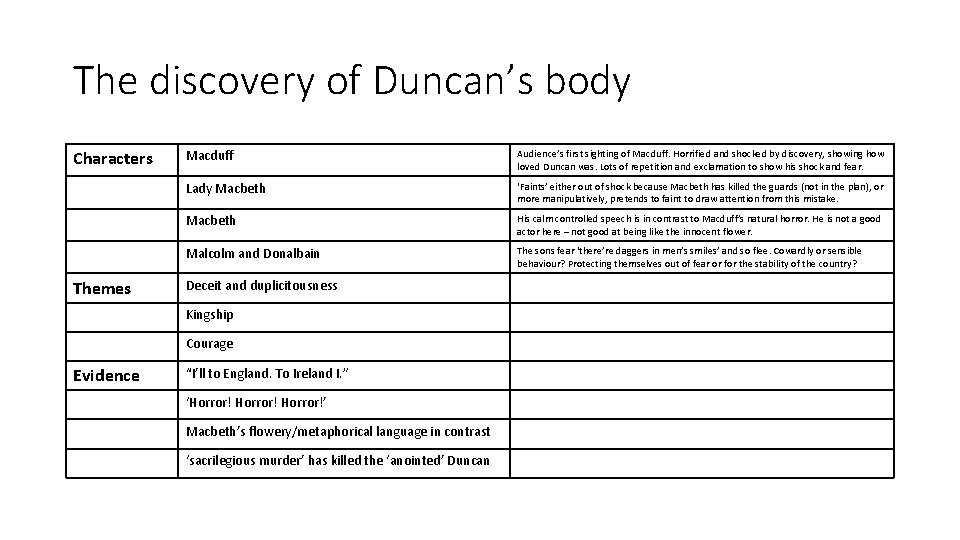
The discovery of Duncan’s body Characters Themes Macduff Audience’s first sighting of Macduff. Horrified and shocked by discovery, showing how loved Duncan was. Lots of repetition and exclamation to show his shock and fear. Lady Macbeth ‘Faints’ either out of shock because Macbeth has killed the guards (not in the plan), or more manipulatively, pretends to faint to draw attention from this mistake. Macbeth His calm controlled speech is in contrast to Macduff’s natural horror. He is not a good actor here – not good at being like the innocent flower. Malcolm and Donalbain The sons fear ‘there’re daggers in men’s smiles’ and so flee. Cowardly or sensible behaviour? Protecting themselves out of fear or for the stability of the country? Deceit and duplicitousness Kingship Courage Evidence “I’ll to England. To Ireland I. ” ‘Horror!’ Macbeth’s flowery/metaphorical language in contrast ‘sacrilegious murder’ has killed the ‘anointed’ Duncan
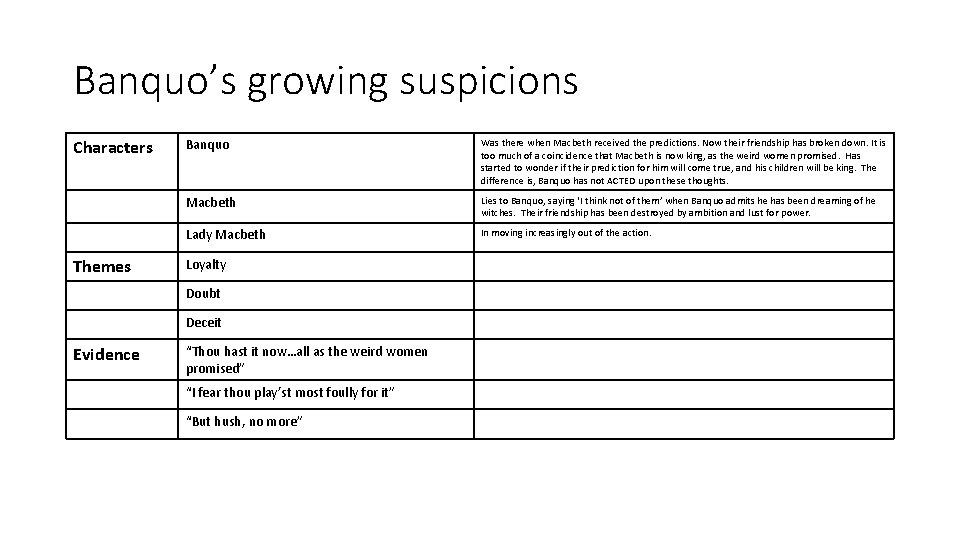
Banquo’s growing suspicions Characters Themes Banquo Was there when Macbeth received the predictions. Now their friendship has broken down. It is too much of a coincidence that Macbeth is now king, as the weird women promised. Has started to wonder if their prediction for him will come true, and his children will be king. The difference is, Banquo has not ACTED upon these thoughts. Macbeth Lies to Banquo, saying ‘I think not of them’ when Banquo admits he has been dreaming of he witches. Their friendship has been destroyed by ambition and lust for power. Lady Macbeth In moving increasingly out of the action. Loyalty Doubt Deceit Evidence “Thou hast it now…all as the weird women promised” “I fear thou play’st most foully for it” “But hush, no more”
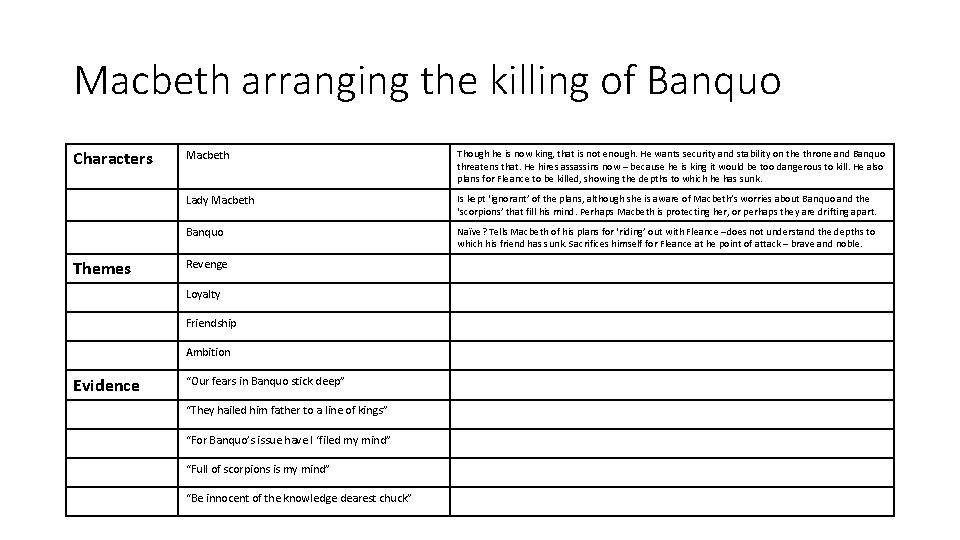
Macbeth arranging the killing of Banquo Characters Themes Macbeth Though he is now king, that is not enough. He wants security and stability on the throne and Banquo threatens that. He hires assassins now – because he is king it would be too dangerous to kill. He also plans for Fleance to be killed, showing the depths to which he has sunk. Lady Macbeth Is kept ‘ignorant’ of the plans, although she is aware of Macbeth’s worries about Banquo and the ‘scorpions’ that fill his mind. Perhaps Macbeth is protecting her, or perhaps they are drifting apart. Banquo Naïve? Tells Macbeth of his plans for ‘riding’ out with Fleance –does not understand the depths to which his friend has sunk. Sacrifices himself for Fleance at he point of attack – brave and noble. Revenge Loyalty Friendship Ambition Evidence “Our fears in Banquo stick deep” “They hailed him father to a line of kings” “For Banquo’s issue have I ‘filed my mind” “Full of scorpions is my mind” “Be innocent of the knowledge dearest chuck”
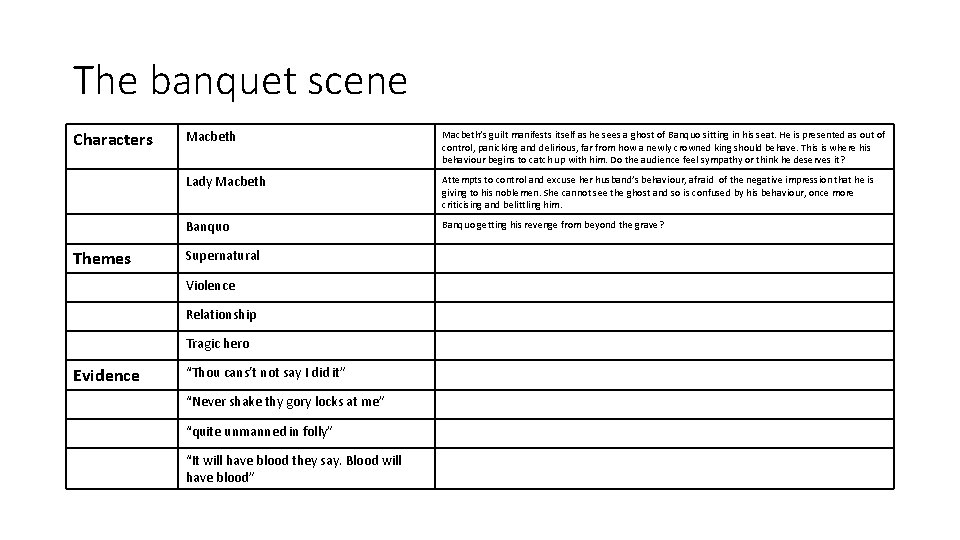
The banquet scene Characters Themes Macbeth’s guilt manifests itself as he sees a ghost of Banquo sitting in his seat. He is presented as out of control, panicking and delirious, far from how a newly crowned king should behave. This is where his behaviour begins to catch up with him. Do the audience feel sympathy or think he deserves it? Lady Macbeth Attempts to control and excuse her husband’s behaviour, afraid of the negative impression that he is giving to his noblemen. She cannot see the ghost and so is confused by his behaviour, once more criticising and belittling him. Banquo getting his revenge from beyond the grave? Supernatural Violence Relationship Tragic hero Evidence “Thou cans’t not say I did it” “Never shake thy gory locks at me” “quite unmanned in folly” “It will have blood they say. Blood will have blood”
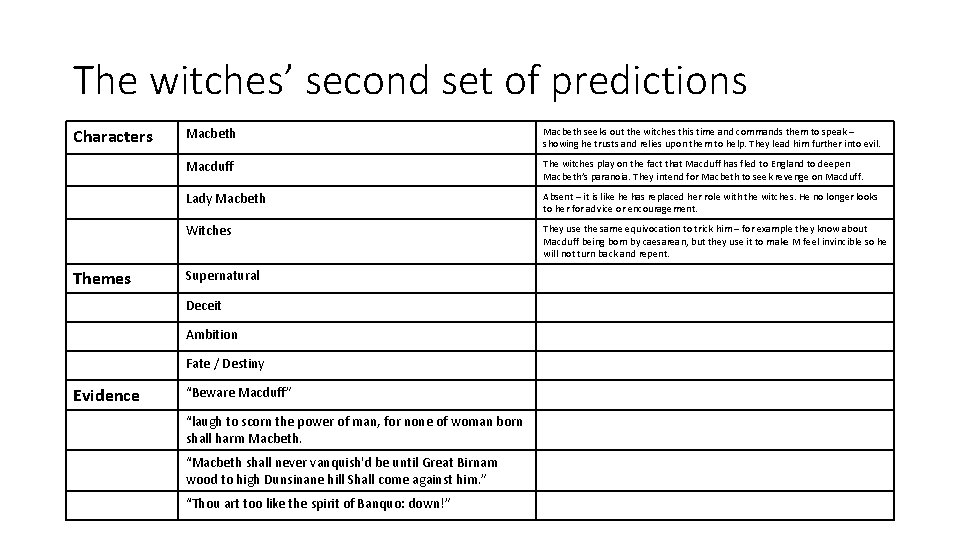
The witches’ second set of predictions Characters Themes Macbeth seeks out the witches this time and commands them to speak – showing he trusts and relies upon them to help. They lead him further into evil. Macduff The witches play on the fact that Macduff has fled to England to deepen Macbeth’s paranoia. They intend for Macbeth to seek revenge on Macduff. Lady Macbeth Absent – it is like he has replaced her role with the witches. He no longer looks to her for advice or encouragement. Witches They use the same equivocation to trick him – for example they know about Macduff being born by caesarean, but they use it to make M feel invincible so he will not turn back and repent. Supernatural Deceit Ambition Fate / Destiny Evidence “Beware Macduff” “laugh to scorn the power of man, for none of woman born shall harm Macbeth. “Macbeth shall never vanquish'd be until Great Birnam wood to high Dunsinane hill Shall come against him. ” “Thou art too like the spirit of Banquo: down!”
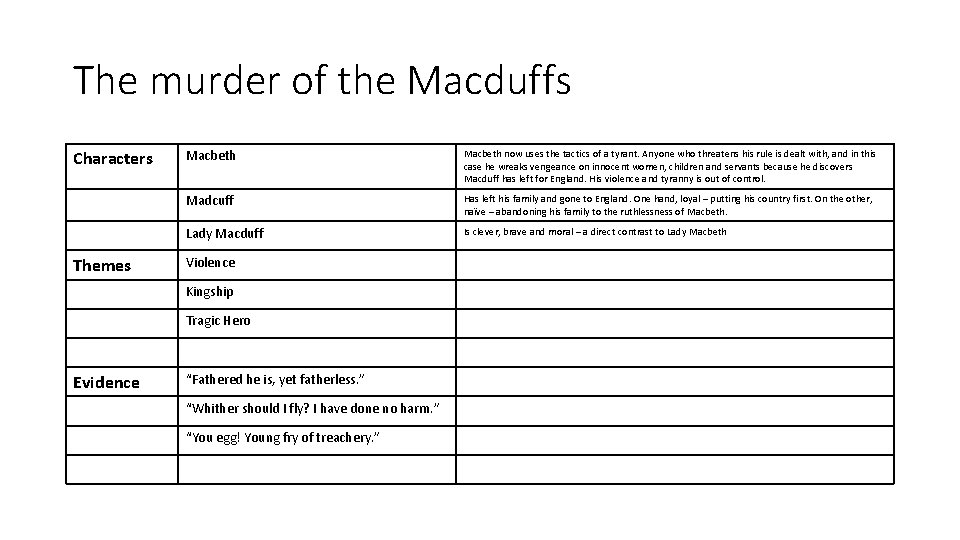
The murder of the Macduffs Characters Themes Macbeth now uses the tactics of a tyrant. Anyone who threatens his rule is dealt with, and in this case he wreaks vengeance on innocent women, children and servants because he discovers Macduff has left for England. His violence and tyranny is out of control. Madcuff Has left his family and gone to England. One hand, loyal – putting his country first. On the other, naïve – abandoning his family to the ruthlessness of Macbeth. Lady Macduff Is clever, brave and moral – a direct contrast to Lady Macbeth Violence Kingship Tragic Hero Evidence “Fathered he is, yet fatherless. ” “Whither should I fly? I have done no harm. ” “You egg! Young fry of treachery. ”
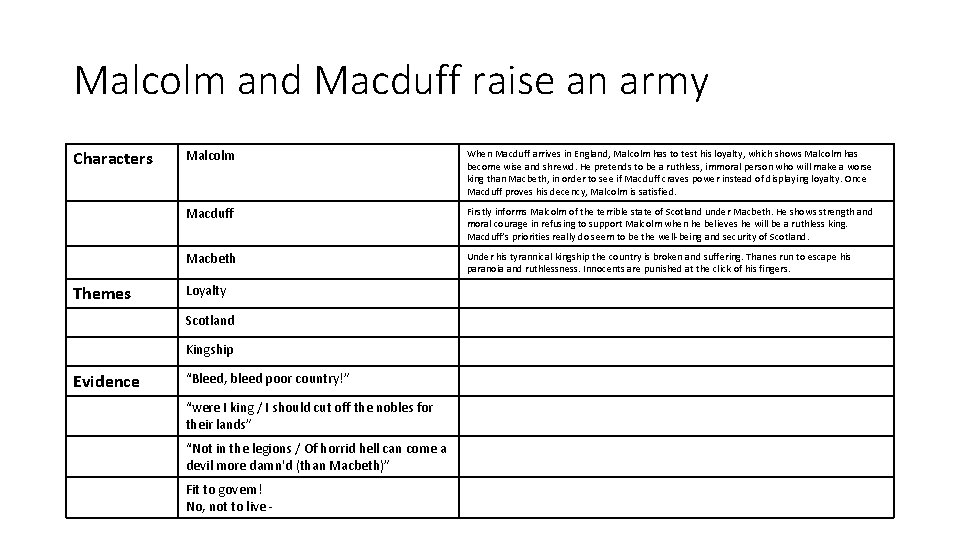
Malcolm and Macduff raise an army Characters Themes Malcolm When Macduff arrives in England, Malcolm has to test his loyalty, which shows Malcolm has become wise and shrewd. He pretends to be a ruthless, immoral person who will make a worse king than Macbeth, in order to see if Macduff craves power instead of displaying loyalty. Once Macduff proves his decency, Malcolm is satisfied. Macduff Firstly informs Malcolm of the terrible state of Scotland under Macbeth. He shows strength and moral courage in refusing to support Malcolm when he believes he will be a ruthless king. Macduff’s priorities really do seem to be the well-being and security of Scotland. Macbeth Under his tyrannical kingship the country is broken and suffering. Thanes run to escape his paranoia and ruthlessness. Innocents are punished at the click of his fingers. Loyalty Scotland Kingship Evidence “Bleed, bleed poor country!” “were I king / I should cut off the nobles for their lands” “Not in the legions / Of horrid hell can come a devil more damn'd (than Macbeth)” Fit to govern! No, not to live -
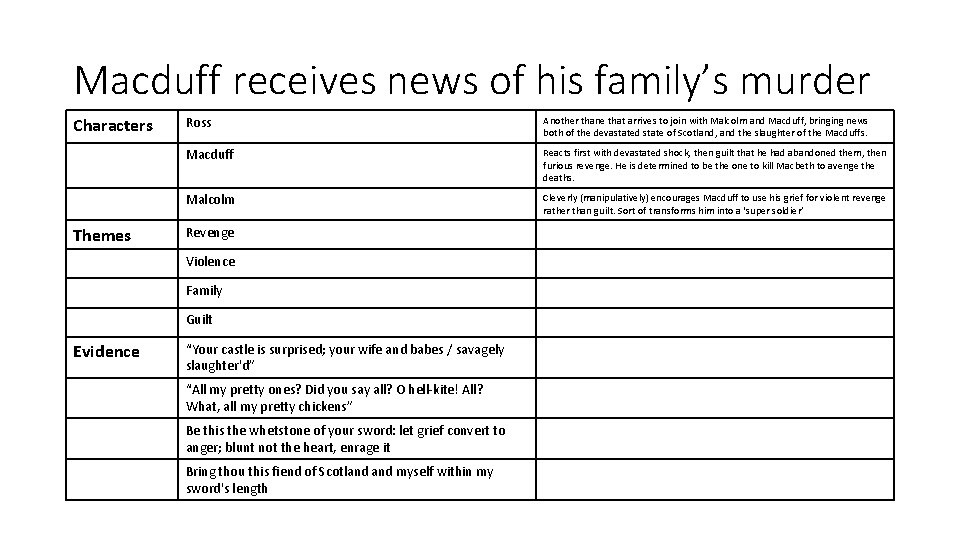
Macduff receives news of his family’s murder Characters Themes Ross Another thane that arrives to join with Malcolm and Macduff, bringing news both of the devastated state of Scotland, and the slaughter of the Macduffs. Macduff Reacts first with devastated shock, then guilt that he had abandoned them, then furious revenge. He is determined to be the one to kill Macbeth to avenge the deaths. Malcolm Cleverly (manipulatively) encourages Macduff to use his grief for violent revenge rather than guilt. Sort of transforms him into a ‘super soldier’ Revenge Violence Family Guilt Evidence “Your castle is surprised; your wife and babes / savagely slaughter'd” “All my pretty ones? Did you say all? O hell-kite! All? What, all my pretty chickens” Be this the whetstone of your sword: let grief convert to anger; blunt not the heart, enrage it Bring thou this fiend of Scotland myself within my sword's length
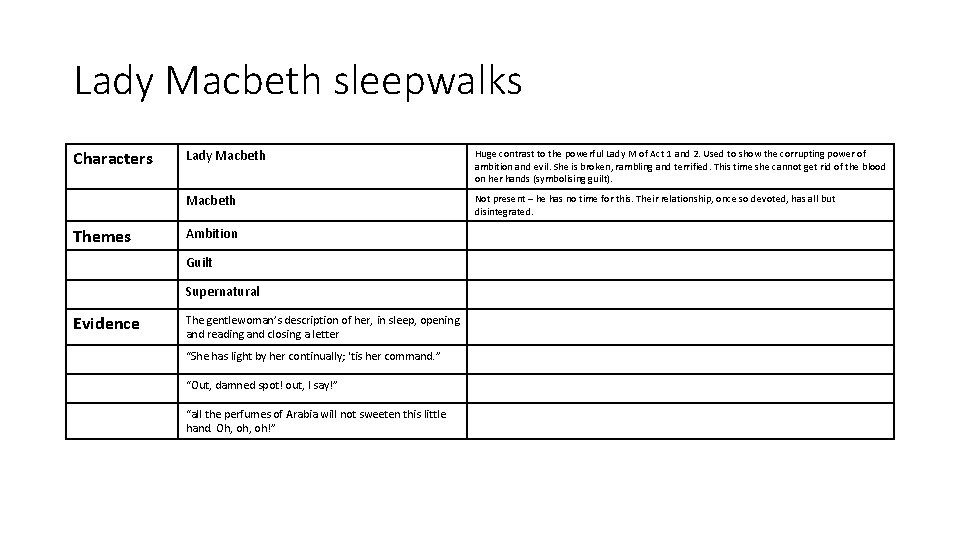
Lady Macbeth sleepwalks Characters Themes Lady Macbeth Huge contrast to the powerful Lady M of Act 1 and 2. Used to show the corrupting power of ambition and evil. She is broken, rambling and terrified. This time she cannot get rid of the blood on her hands (symbolising guilt). Macbeth Not present – he has no time for this. Their relationship, once so devoted, has all but disintegrated. Ambition Guilt Supernatural Evidence The gentlewoman’s description of her, in sleep, opening and reading and closing a letter “She has light by her continually; 'tis her command. ” “Out, damned spot! out, I say!” “all the perfumes of Arabia will not sweeten this little hand. Oh, oh!”
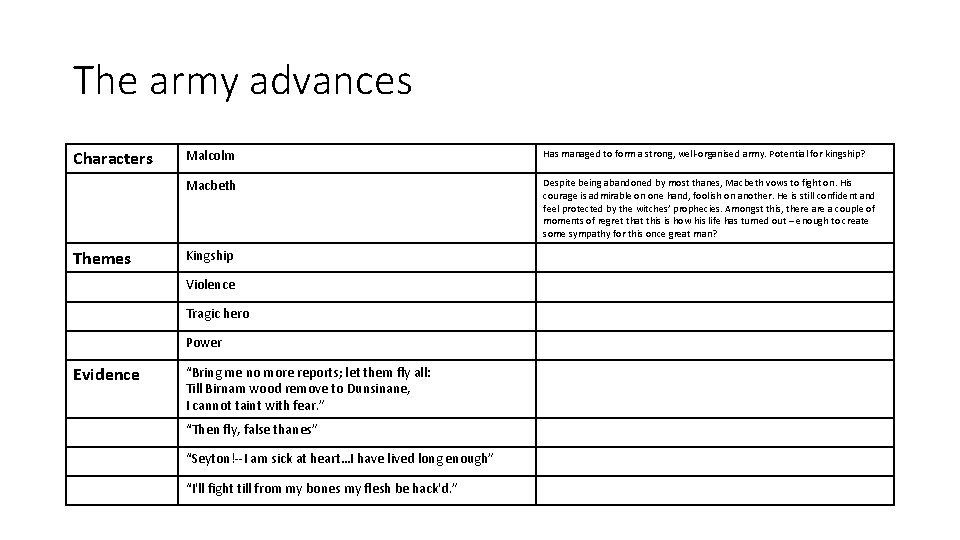
The army advances Characters Themes Malcolm Has managed to form a strong, well-organised army. Potential for kingship? Macbeth Despite being abandoned by most thanes, Macbeth vows to fight on. His courage is admirable on one hand, foolish on another. He is still confident and feel protected by the witches’ prophecies. Amongst this, there a couple of moments of regret that this is how his life has turned out – enough to create some sympathy for this once great man? Kingship Violence Tragic hero Power Evidence “Bring me no more reports; let them fly all: Till Birnam wood remove to Dunsinane, I cannot taint with fear. ” “Then fly, false thanes” “Seyton!--I am sick at heart…I have lived long enough” “I'll fight till from my bones my flesh be hack'd. ”
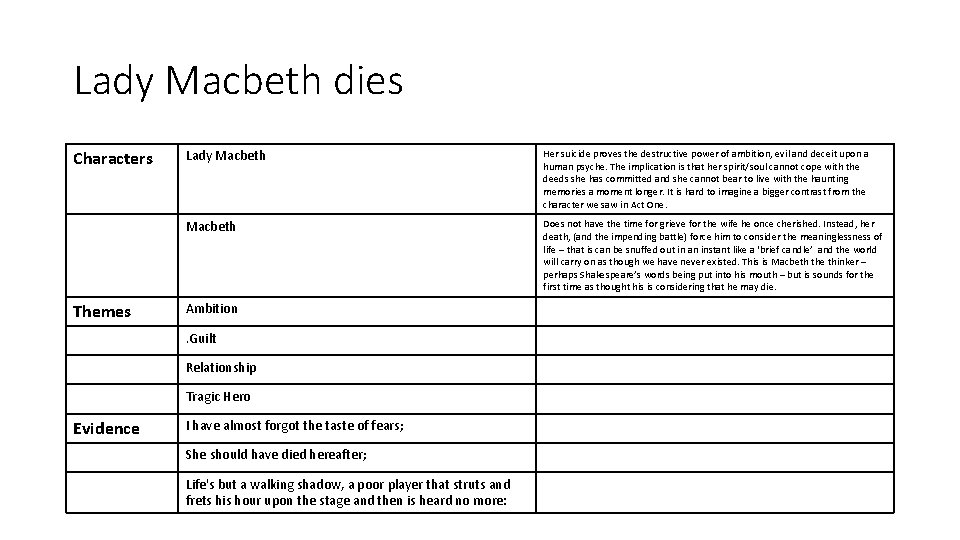
Lady Macbeth dies Characters Themes Lady Macbeth Her suicide proves the destructive power of ambition, evil and deceit upon a human psyche. The implication is that her spirit/soul cannot cope with the deeds she has committed and she cannot bear to live with the haunting memories a moment longer. It is hard to imagine a bigger contrast from the character we saw in Act One. Macbeth Does not have the time for grieve for the wife he once cherished. Instead, her death, (and the impending battle) force him to consider the meaninglessness of life – that is can be snuffed out in an instant like a ‘brief candle’ and the world will carry on as though we have never existed. This is Macbeth the thinker – perhaps Shakespeare’s words being put into his mouth – but is sounds for the first time as thought his is considering that he may die. Ambition. Guilt Relationship Tragic Hero Evidence I have almost forgot the taste of fears; She should have died hereafter; Life's but a walking shadow, a poor player that struts and frets his hour upon the stage and then is heard no more:

Macduff kills Macbeth Characters Themes Macduff Determined to avenge his family, it semes ‘right’ and ‘fitting’ that Macduff gets to kill Macbeth and gain some peace. The big twist (the fact that the witches used to make their predictions sound so optimistic) is that Macduff was born by caesarean. Macduff is brave, noble and aggressive here. Macbeth Refuses to give in and surrender as his castle is infiltrated and he is completely outnumbered. Tries to avoid fighting Macduff – showing perhaps some guilt – which reminds us he is still capable of decency. Even after he finds out about the ‘untimely ripped’ birth, fights on, showing bravery and courage in the face of certain defeat and death. Violence Fate / Destiny Revenge Power Evidence Why should I play the Roman fool, and die On mine own sword? “my soul is too much charged with blood of thine already. ” “Macduff was from his mother's womb untimely ripp'd. ” “Lay on, Macduff, and damn'd be him that first cries, 'Hold, enough!’”
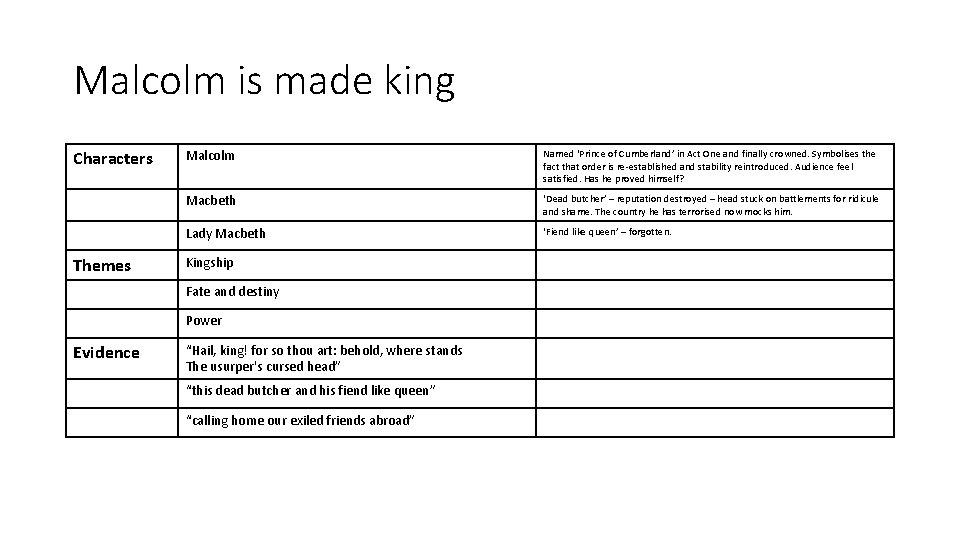
Malcolm is made king Characters Themes Malcolm Named ‘Prince of Cumberland’ in Act One and finally crowned. Symbolises the fact that order is re-established and stability reintroduced. Audience feel satisfied. Has he proved himself? Macbeth ‘Dead butcher’ – reputation destroyed – head stuck on battlements for ridicule and shame. The country he has terrorised now mocks him. Lady Macbeth ‘Fiend like queen’ – forgotten. Kingship Fate and destiny Power Evidence “Hail, king! for so thou art: behold, where stands The usurper's cursed head” “this dead butcher and his fiend like queen” “calling home our exiled friends abroad”
- Slides: 20