
The black box brain Character Coordination Nonconscious control
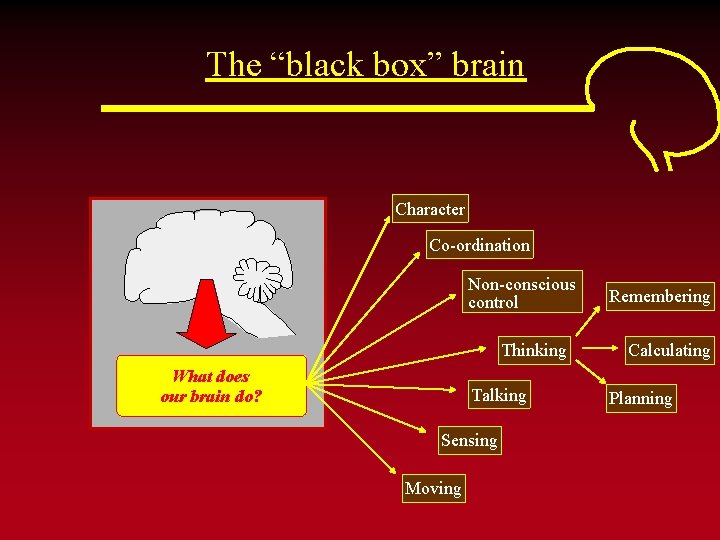
The “black box” brain Character Co-ordination Non-conscious control Thinking What does our brain do? Talking Sensing Moving Remembering Calculating Planning
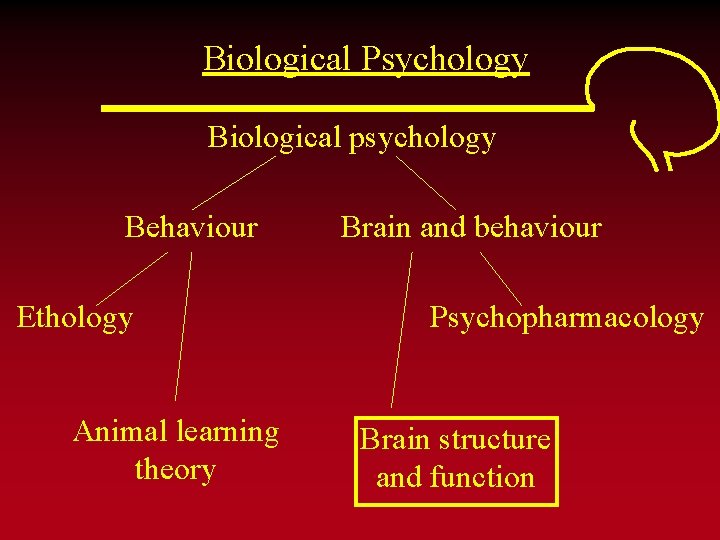
Biological Psychology Biological psychology Behaviour Ethology Animal learning theory Brain and behaviour Psychopharmacology Brain structure and function
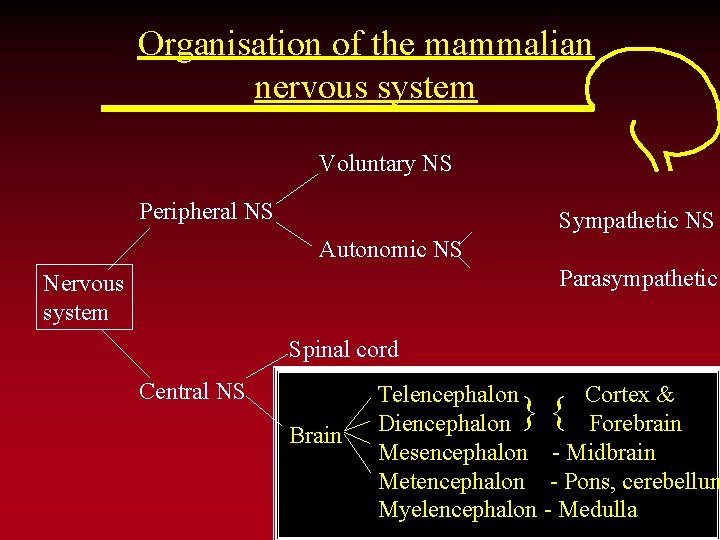
Organisation of the mammalian nervous system Voluntary NS Peripheral NS Nervous system Sympathetic NS Autonomic NS Parasympathetic Spinal cord Central NS Brain Telencephalon Cortex & Telencephalon Cortex & Diencephalon Forebrain Diencephalon Forebrain Mesencephalon - Midbrain Mesencephalon - Midbrain Metencephalon - Pons, cerebellum Rhombencephalon – Hindbrain Myelencephalon - Medulla } {

The divisions of the brain Telencephalon Diencephalon Mesencephalon Metencephalon Myelencephalon Cortex Basal ganglia Hippocampus Amygdala Thalamus Hypothalamus Tectum Tegmentum Pons Cerebellum Medulla
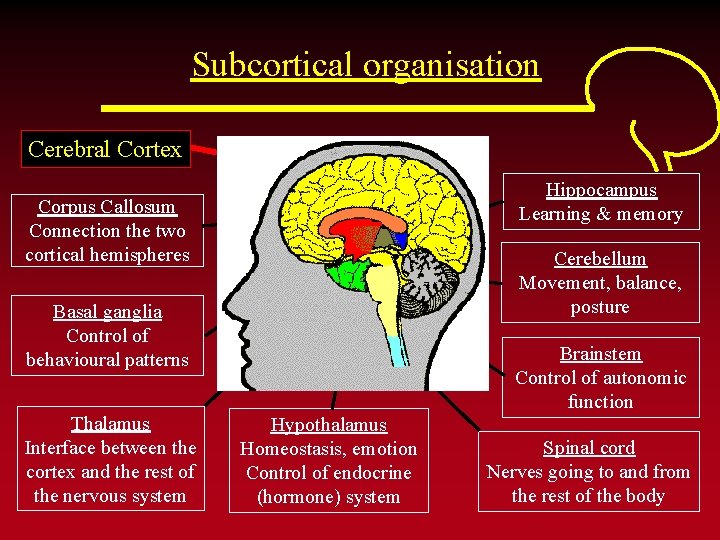
Subcortical organisation Cerebral Cortex Hippocampus Learning & memory Corpus Callosum Connection the two cortical hemispheres Cerebellum Movement, balance, posture Basal ganglia Control of behavioural patterns Thalamus Interface between the cortex and the rest of the nervous system Brainstem Control of autonomic function Hypothalamus Homeostasis, emotion Control of endocrine (hormone) system Spinal cord Nerves going to and from the rest of the body
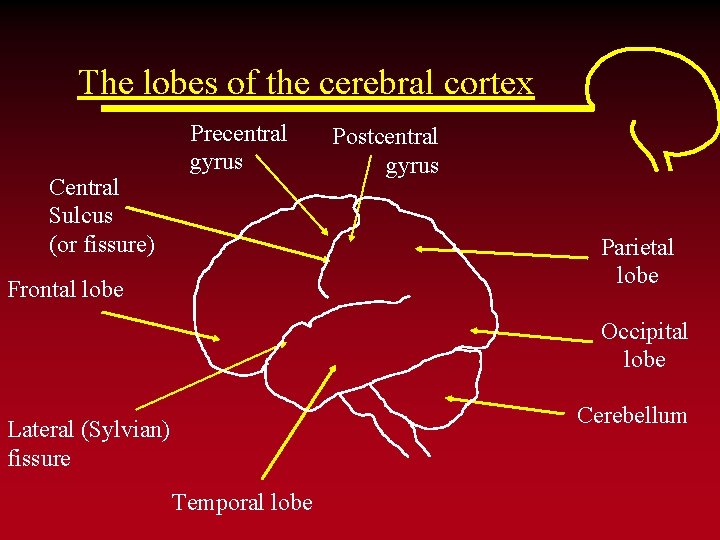
The lobes of the cerebral cortex Central Sulcus (or fissure) Precentral gyrus Postcentral gyrus Parietal lobe Frontal lobe Occipital lobe Cerebellum Lateral (Sylvian) fissure Temporal lobe
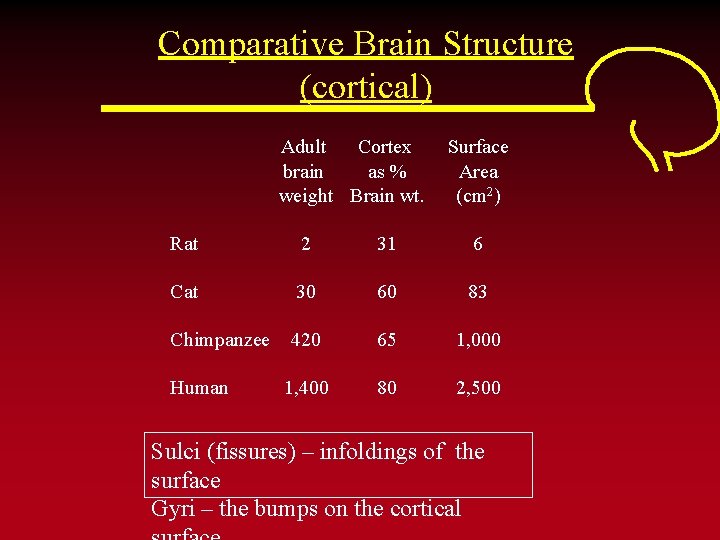
Comparative Brain Structure (cortical) Adult Cortex brain as % weight Brain wt. Surface Area (cm 2) Rat 2 31 6 Cat 30 60 83 Chimpanzee 420 65 1, 000 1, 400 80 2, 500 Human Sulci (fissures) – infoldings of the surface Gyri – the bumps on the cortical
Understanding cortical function • Brain damaged patients • Assess cognitive deficit • Locate area of brain damage (post-mortem, neuroimaging) • Functional neuroimaging • Functional MRI measurements during task performance • Measure areas activated by different aspects of the task
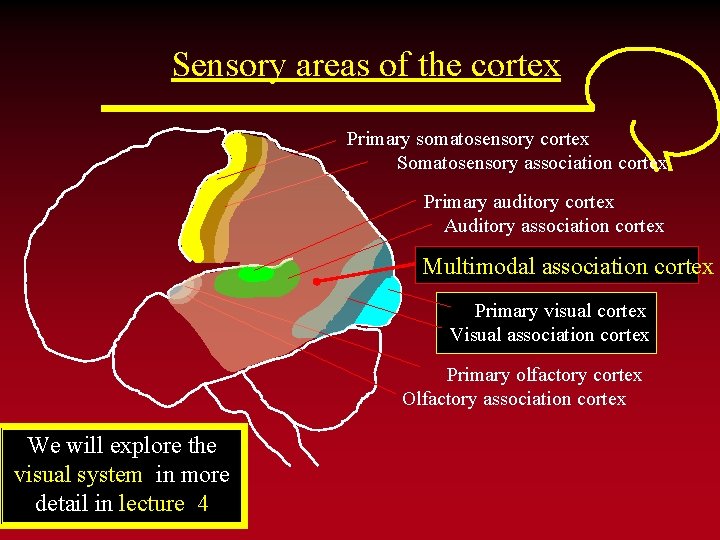
Sensory areas of the cortex Primary somatosensory cortex Somatosensory association cortex Primary auditory cortex Auditory association cortex Multimodal association cortex Primary visual cortex Visual association cortex Primary olfactory cortex Olfactory association cortex We will explore the visual system in more detail in lecture 4
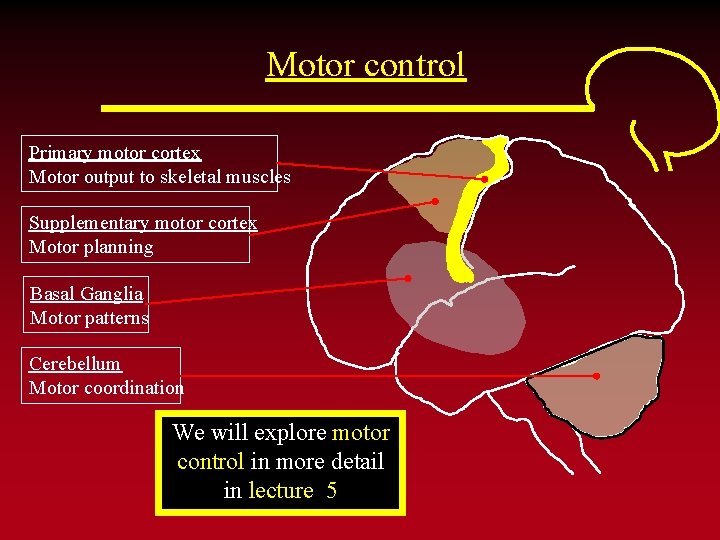
Motor control Primary motor cortex Motor output to skeletal muscles Supplementary motor cortex Motor planning Basal Ganglia Motor patterns Cerebellum Motor coordination We will explore motor control in more detail in lecture 5
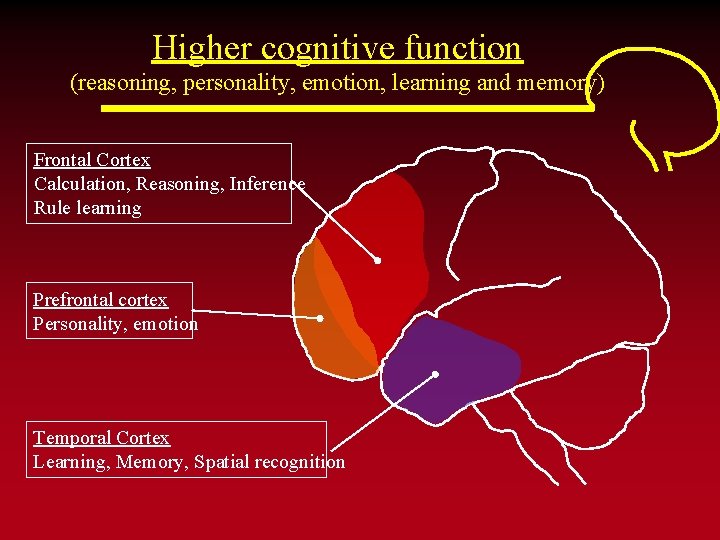
Higher cognitive function (reasoning, personality, emotion, learning and memory) Frontal Cortex Calculation, Reasoning, Inference Rule learning Prefrontal cortex Personality, emotion Temporal Cortex Learning, Memory, Spatial recognition
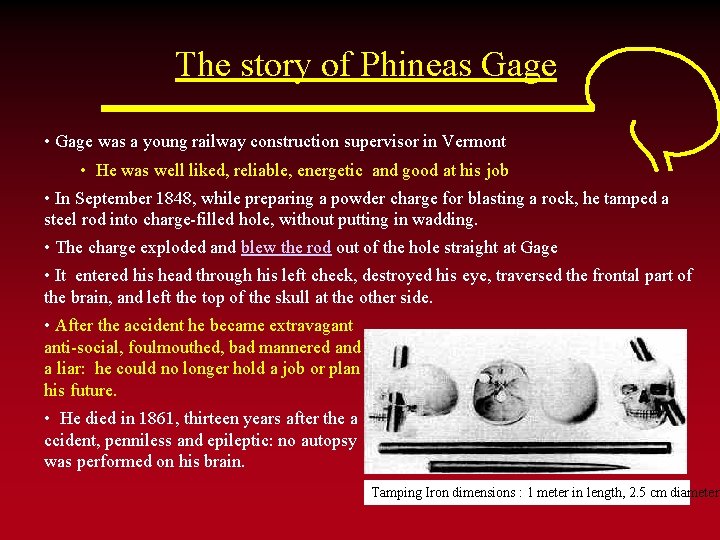
The story of Phineas Gage • Gage was a young railway construction supervisor in Vermont • He was well liked, reliable, energetic and good at his job • In September 1848, while preparing a powder charge for blasting a rock, he tamped a steel rod into charge-filled hole, without putting in wadding. • The charge exploded and blew the rod out of the hole straight at Gage • It entered his head through his left cheek, destroyed his eye, traversed the frontal part of the brain, and left the top of the skull at the other side. • After the accident he became extravagant anti-social, foulmouthed, bad mannered and a liar: he could no longer hold a job or plan his future. • He died in 1861, thirteen years after the a ccident, penniless and epileptic: no autopsy was performed on his brain. Tamping Iron dimensions : 1 meter in length, 2. 5 cm diameter
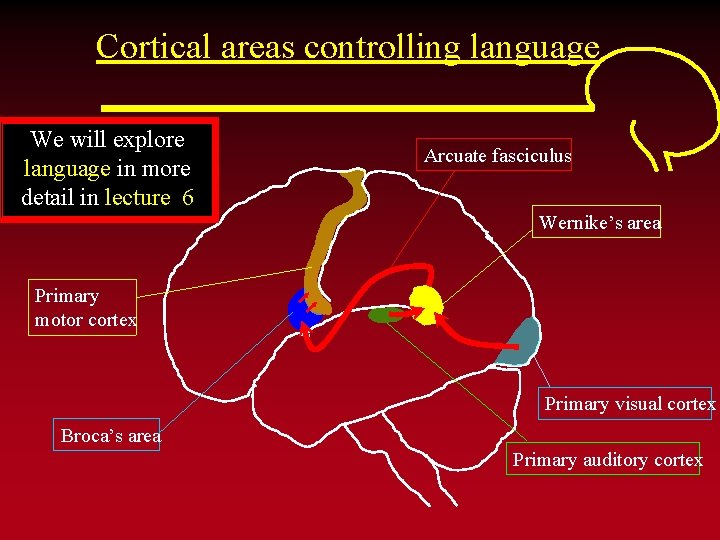
Cortical areas controlling language We will explore language in more detail in lecture 6 Arcuate fasciculus Wernike’s area Primary motor cortex Primary visual cortex Broca’s area Primary auditory cortex
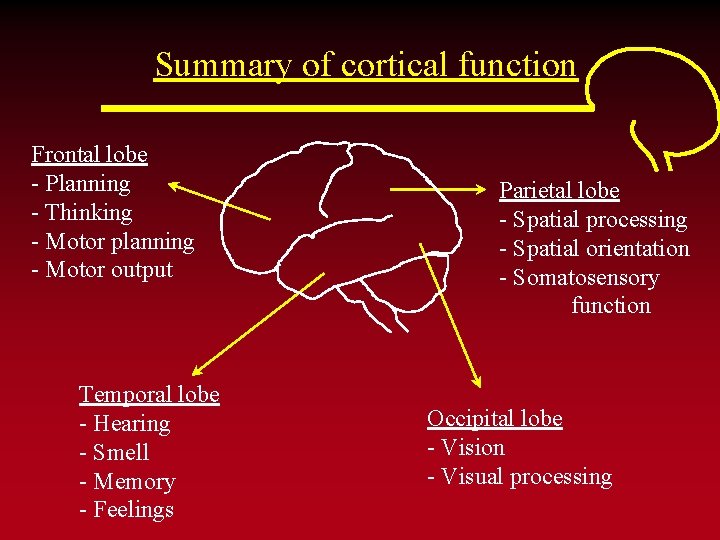
Summary of cortical function Frontal lobe - Planning - Thinking - Motor planning - Motor output Temporal lobe - Hearing - Smell - Memory - Feelings Parietal lobe - Spatial processing - Spatial orientation - Somatosensory function Occipital lobe - Vision - Visual processing
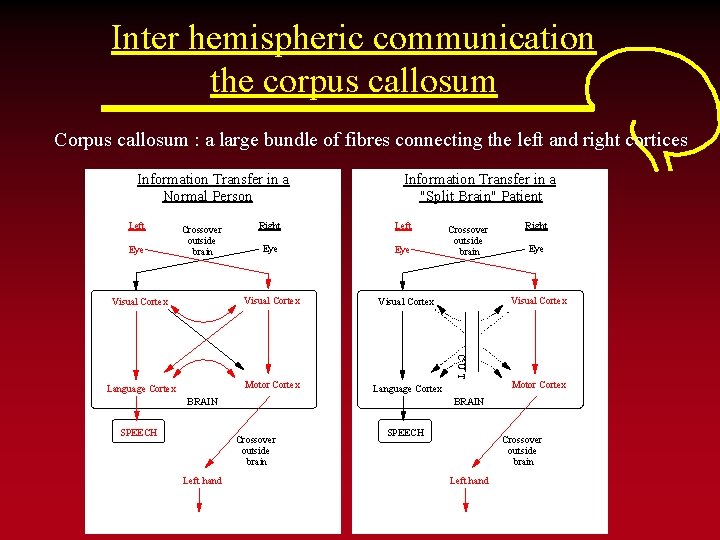
Inter hemispheric communication the corpus callosum Corpus callosum : a large bundle of fibres connecting the left and right cortices Information Transfer in a Normal Person Left Eye Crossover outside brain Information Transfer in a "Split Brain" Patient Right Left Eye Visual Cortex Language Cortex Motor Cortex Language Cortex Right Eye Visual Cortex C U T Visual Cortex Crossover outside brain BRAIN SPEECH BRAIN Crossover outside brain Left hand Motor Cortex SPEECH Crossover outside brain Left hand
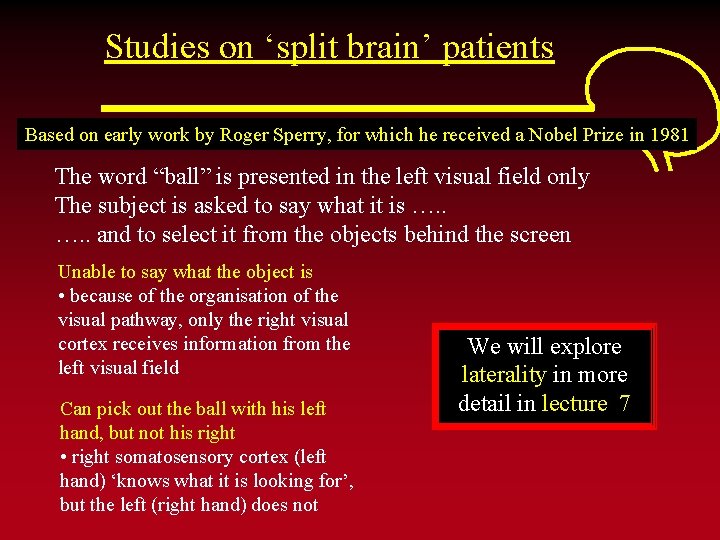
Studies on ‘split brain’ patients Based on early work by Roger Sperry, for which he received a Nobel Prize in 1981 The word “ball” is presented in the left visual field only The subject is asked to say what it is …. . and to select it from the objects behind the screen Unable to say what the object is • because of the organisation of the visual pathway, only the right visual cortex receives information from the left visual field Can pick out the ball with his left hand, but not his right • right somatosensory cortex (left hand) ‘knows what it is looking for’, but the left (right hand) does not We will explore laterality in more detail in lecture 7
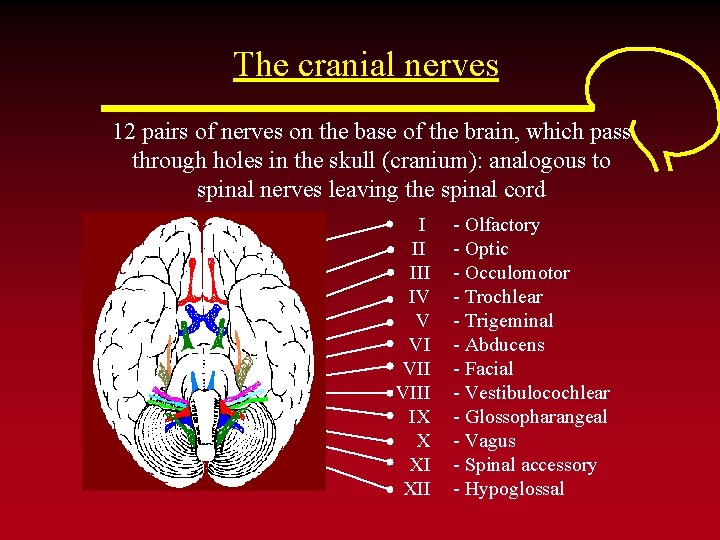
The cranial nerves 12 pairs of nerves on the base of the brain, which pass through holes in the skull (cranium): analogous to spinal nerves leaving the spinal cord I II IV V VI VIII IX X XI XII - Olfactory - Optic - Occulomotor - Trochlear - Trigeminal - Abducens - Facial - Vestibulocochlear - Glossopharangeal - Vagus - Spinal accessory - Hypoglossal
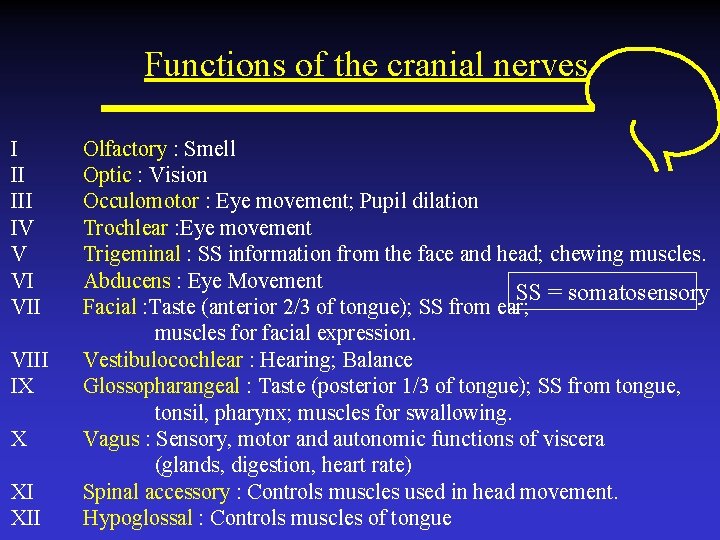
Functions of the cranial nerves I II IV V VI VIII IX X XI XII Olfactory : Smell Optic : Vision Occulomotor : Eye movement; Pupil dilation Trochlear : Eye movement Trigeminal : SS information from the face and head; chewing muscles. Abducens : Eye Movement SS = somatosensory Facial : Taste (anterior 2/3 of tongue); SS from ear; muscles for facial expression. Vestibulocochlear : Hearing; Balance Glossopharangeal : Taste (posterior 1/3 of tongue); SS from tongue, tonsil, pharynx; muscles for swallowing. Vagus : Sensory, motor and autonomic functions of viscera (glands, digestion, heart rate) Spinal accessory : Controls muscles used in head movement. Hypoglossal : Controls muscles of tongue
- Slides: 18