
The Birth of Venus By Sandro Botticelli LAINEY
The Birth of Venus By Sandro Botticelli LAINEY MARTENS

Sandro Botticelli Born March 1, 1445 and Died May 17, 1510 in Florence, Italy. His real name is Alessandro di Mariano Filipepi and got Botticelli from his brother, who people called Botticello (little barrel). Was one of the greatest painters of the Florentine Renaissance. Botticelli’s father was a tanner who apprenticed Sandro to a goldsmith after his schooling was finished. Since Sandro preferred painting, his father then placed him under Filippo Lippi, who was one of the most admired Florentine masters. After Lippi left Florence, Botticelli studied the sculptural style of Antonio Pollaniuolo and Andrea del Verrocchio, the leading Florentine painters of the 1460 s, and under their influence Botticelli produced figures of sculptural roundness and strength. He also replaced Lippi’s delicate approach with a robust and vigorous naturalism, shaped always by conceptions of ideal beauty. By 1470 Botticelli was established in Florence as an independent master with his own workshop. He was so absorbed in his art that he never married and lived with his family.
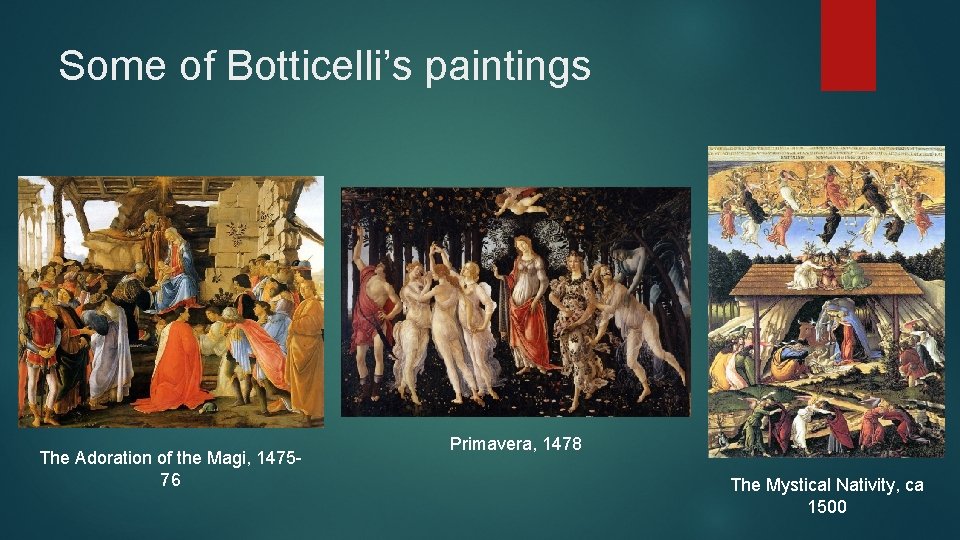
Some of Botticelli’s paintings The Adoration of the Magi, 147576 Primavera, 1478 The Mystical Nativity, ca 1500
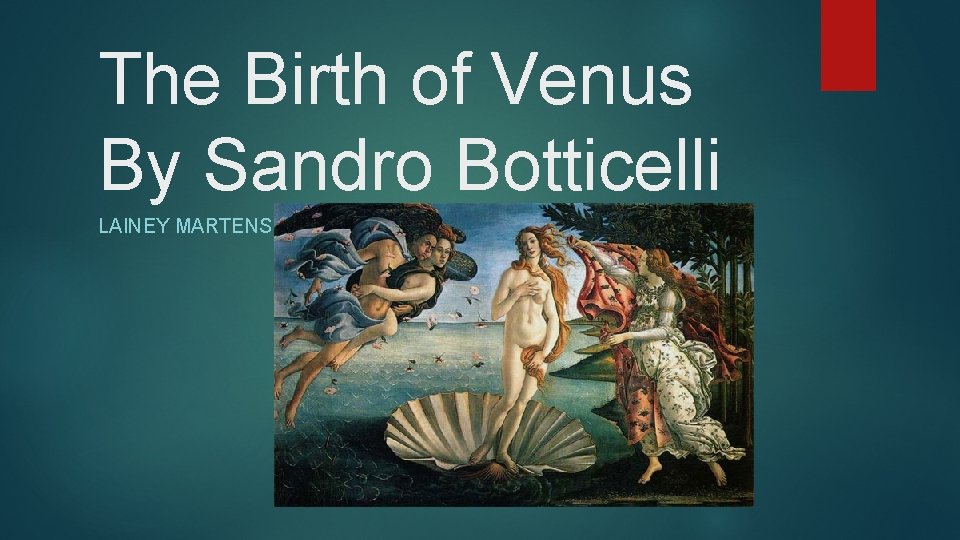
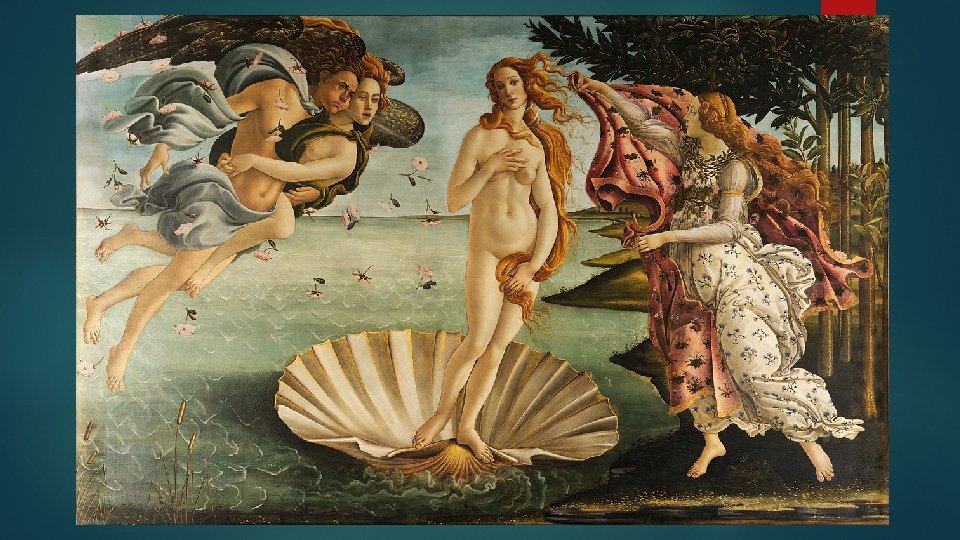
Information and History The theme comes from Ovid’s Metamorphoses The Birth of Venus was the first example of a painting on canvas in Tuscany. As well as the distinctive use of alabaster powder which makes the colors pop that much more. In The Birth of Venus we see the wind Gods, Zephyr and Aura, blowing Venus to shore after she rises from the sea triumphantly. The handmaid, Ora, waits for Venus to come closer to shore so she can dress the goddess to transform her into a mother and saint. There are references to the “Stanzas”, a famous poetic work by Agnolo Poliziano, a contemporary of Botticelli and the greatest Neoplatonic poet of the Medici court.

Symbolism It takes place in the sea to enforce that Venus was born from the sea. The shell she is standing in is used as a symbol for feminism. In this painting we see Venus posing modestly. She is covering her breasts with her one arm and her hair and pother hand is covering her privates. On one side of Venus there are violets, which is a symbol of modesty and they were often used in love potions. The meaning of this piece is the birth of love and beauty, as well as the importance love and beauty are in the Greek and Roman cultures. The Birth of Venus was significant in the fact that during this time, in the Renaissance, many paintings were Christian themed and depicting the Virgin Mary. Not many nudes were shown until this painting.
Views Neoplatonic Interpretation: Neoplatonism was a current of thought that tried to connect the Greek and Roman cultural heritage with Christianity. According to the ancient Greek philosopher Plato, Venus had two aspects: she was an earthly goddess who inspired human to physical love, but on the other hand she was a celestial goddess who inspired humans to intellectual love. Plato also argued that contemplation of physical beauty enabled the human mind to comprehend spiritual beauty. This means that when 15 th-century Neo-Platonic viewers looked at The Birth of Venus they would have felt themselves being inspired to contemplate spiritual love. Christian Interpretation: The nudity of Venus echoes that of Eve in the Garden of Eden. This has led some commentators to speculate that Venus is a personification of the Christian Church. One should note, for instance, that the title of the Virgin Mary is “stella maris”: star of the sea. Perhaps the sea gives birth to Venus just as the Madonna gives birth to Jesus Christ.
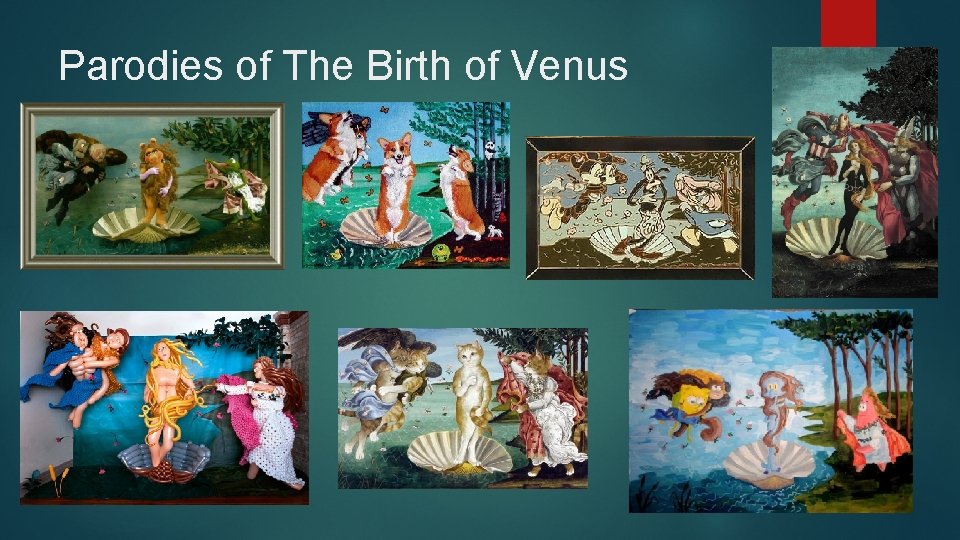
Parodies of The Birth of Venus
- Slides: 8