
THE BIRTH OF THE AUSTRIAN SCHOOL Mises University

THE BIRTH OF THE AUSTRIAN SCHOOL Mises University 2020 Joseph T. Salerno
The Marginalist Revolution • The simultaneous and independent discovery of the principle of “marginal utility” by three different economists (18711874). • Who were the marginalist revolutionaries? Ø Carl Menger (Austria), The Principles of Economics 1871 Ø William Stanley Jevons (Great Britain), Theory of Political Economy 1871 Ø Leon Walras, (Switz. ) Elements of Pure Economics 1874
Marginal Utility • Marginal Utility (Grenznutzen—Friedrich von Wieser, Menger’s student) • Final Utility (Jevons) • Rarété (Walras)

William Stanley Jevons

Leon Walras

Carl Menger
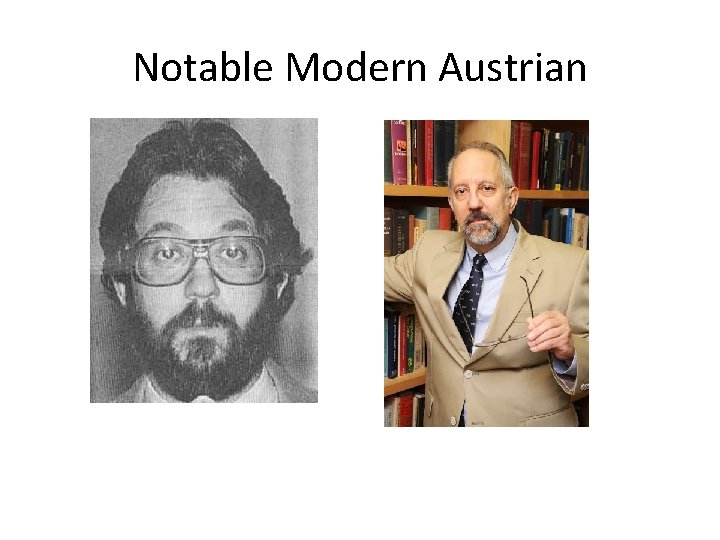
Notable Modern Austrian
Menger versus Jevons and Walras • Jevons and Walras viewed utility as a quantity of satisfaction received from goods, which could be added up and compared between individuals. • Menger viewed utility as the result of an individual actor’s judgment about the importance of concrete goods in satisfying his wants and improving his or her well-being. • For Menger utilities or satisfactions are ranked when choosing: 1 st bottle of water 2 nd can of Coke 3 rd granola bar
Menger’s Achievement • Menger discovered much more than the principle of marginal utility—he created a theory of price and an entire system of economics based on subjective value and individual choice. • Menger was creative genius. He drew on many different influences but his vision of the economy as the systematic outcome of humans striving to satisfy their wants was unique and revolutionary.
Menger: Founder of the Austrian School • Joseph Schumpeter: “Menger is nobody’s pupil and what he created stands. . Menger’s theory of value, price, and distribution is the best we have up to now [1926]. ” • Ludwig von Mises: “What is known as the Austrian School of Economics started in 1871 when Carl Menger published a slender volume under the title [Principles of Economics]. . Until the end of the Seventies there was no ‘Austrian School. ’ There was only Carl Menger. ”
Menger: Founder of the Austrian School • F. A. Hayek said the Austrian school’s “fundamental ideas belong fully and wholly to Carl Menger. . [W]hat is common to the members of the Austrian school, what constitutes their peculiarity and provided the foundations for their later contributions, is their acceptance of the teaching of Carl Menger. ”
Classical Economics 1776 -1871 • David Hume, Essays on Economics (1750 s) • Adam Smith, The Wealth of Nations (1776) • David Ricardo, Principles of Political Economy (1817)
Contributions of Classical School • Prices are not arbitrary or random. They are determined by universal and unchangeable laws (the law of supply and demand). • These prices are used by business owners to calculate profits and losses and to decide what and how much to produce. • Profits encourage businesses to increase supply of a profitable good and lure new businesses to enter the industry; losses drive businesses to reduce supply of an unprofitable good or to cease production altogether and exit the industry. • In the long run, the adjustment of supply causes profits and losses to disappear and prices to equal costs of production.
The Main Flaw in Classical Economics • It attempted to explain values and prices in terms of broad and abstract classes of goods, e. g. , bread, diamonds, coal, iron, water, cotton, beef, etc. • But human beings value and exchange concrete units of goods like one pound of bread, one lb. of beef, 2 carats of diamonds, one doz. eggs, etc. • This led the classical economists to become bogged down in the “paradox of value” or the “diamond-water paradox. ”
The Paradox of Value • Diamonds have a very high “exchange value” but a very low “use value” in everyday life. They have a high price on the market but serve as mere ornamentation or as a conspicuous display of wealth and therefore serve trivial human wants. • Water has a relatively low “exchange value” but a very high “use value. ” It has a low market price but is indispensable in sustaining human life itself and therefore serves extremely important wants.
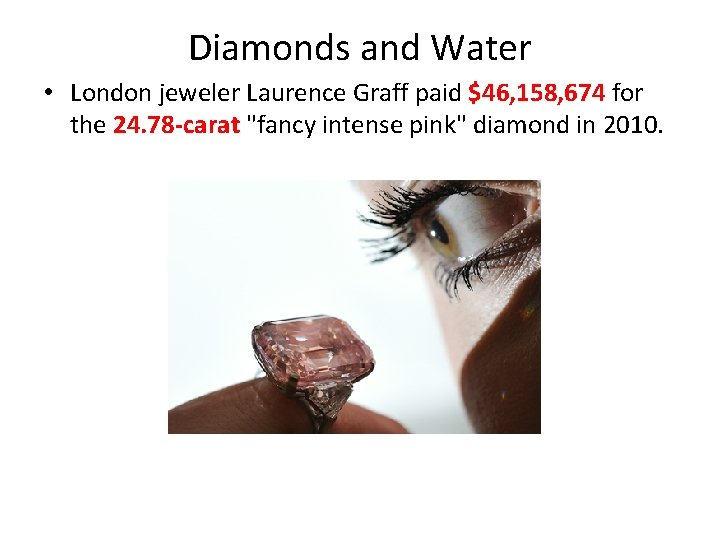
Diamonds and Water • London jeweler Laurence Graff paid $46, 158, 674 for the 24. 78 -carat "fancy intense pink" diamond in 2010.
The Erroneous Solution of the Classical Economists 1. Economics is not concerned with explaining use value; it is only concerned with explaining exchange value or price. 2. Therefore, diamonds are much more expensive than water because it costs more money to produce a carat of diamonds than a gallon of water. 3. The classical economists thus adopted a cost-of-production theory of value and price and focused on the businessman as the central actor in the economy and the consumer dropped out of the picture. 4. Classical economics was about the acquisition and accumulation of wealth by businessmen not about the satisfaction of consumer wants.
Menger’s Aim: A Realistic Price Theory • “I have devoted special attention to the investigation of the causal connections between economic phenomena involving products and the corresponding agents of production, not only for the purpose of establishing a price theory based on reality and placing all price phenomena . . . together under one unified point of view. . ” • (Menger, Principles of Economics, 19
Causal-Realist Economics • Menger began the causal-realist tradition in economics followed by modern Austrians. • Economic theory is the investigation of the causes of real prices, wage rates and rents actually paid on real markets.
So What Is Economics All About? • “Man himself is the beginning and the end of every economy” • “Our science is theory of a human being’s ability to deal with his wants. ” • “All things are subject to the law of cause and effect. ” (The very first sentence of Menger’s Principles)
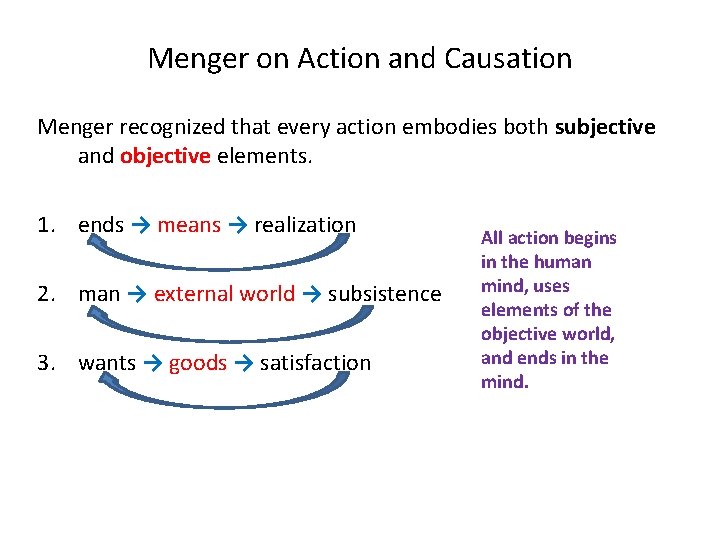
Menger on Action and Causation Menger recognized that every action embodies both subjective and objective elements. 1. ends → means → realization 2. man → external world → subsistence 3. wants → goods → satisfaction All action begins in the human mind, uses elements of the objective world, and ends in the mind.
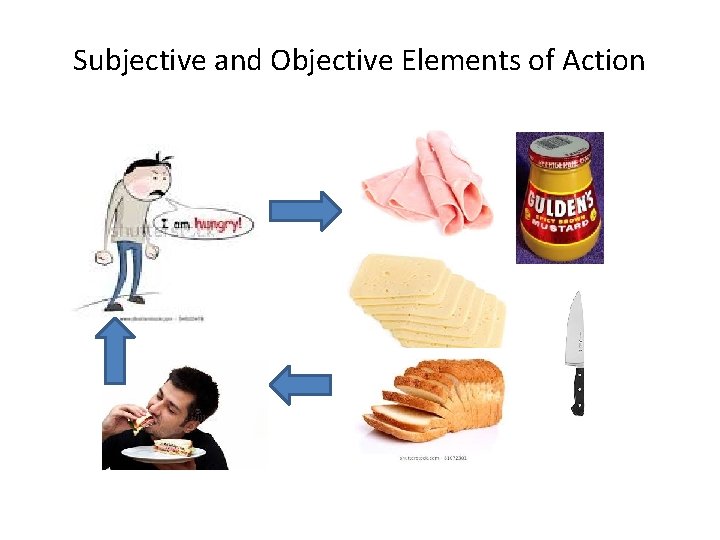
Subjective and Objective Elements of Action
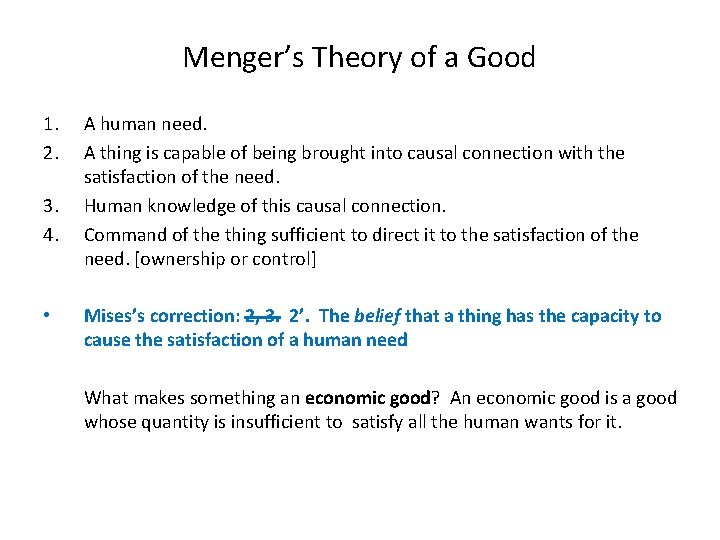
Menger’s Theory of a Good 1. 2. 3. 4. • A human need. A thing is capable of being brought into causal connection with the satisfaction of the need. Human knowledge of this causal connection. Command of the thing sufficient to direct it to the satisfaction of the need. [ownership or control] Mises’s correction: 2, 3. 2’. The belief that a thing has the capacity to cause the satisfaction of a human need What makes something an economic good? An economic good is a good whose quantity is insufficient to satisfy all the human wants for it.
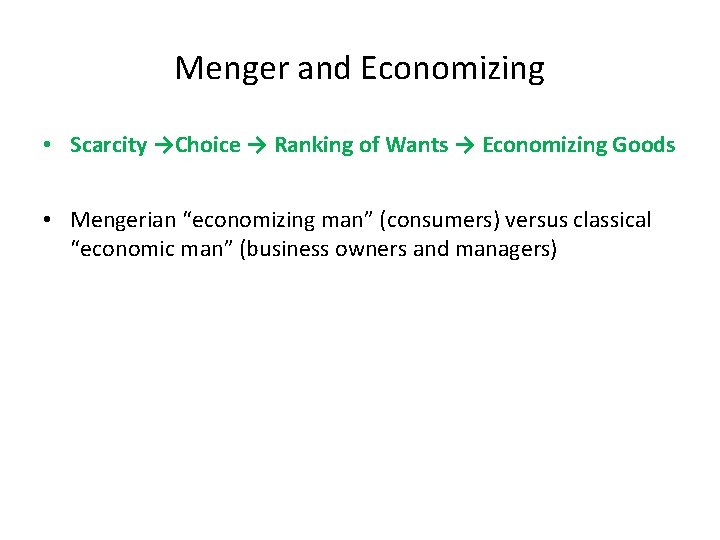
Menger and Economizing • Scarcity →Choice → Ranking of Wants → Economizing Goods • Mengerian “economizing man” (consumers) versus classical “economic man” (business owners and managers)
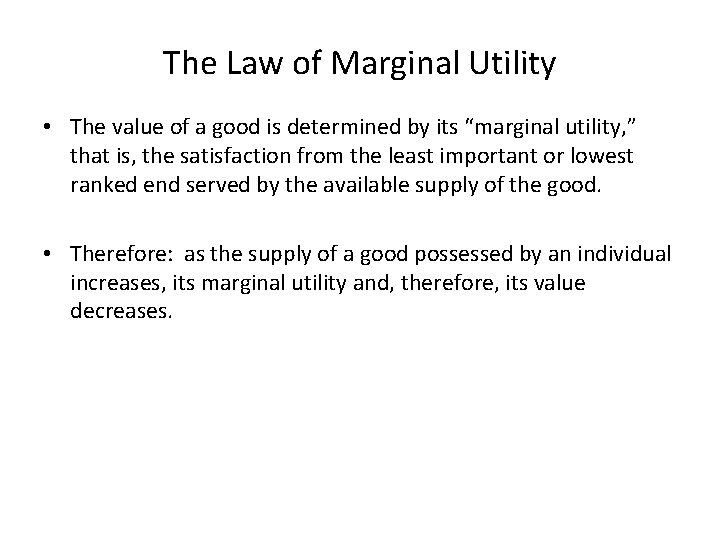
The Law of Marginal Utility • The value of a good is determined by its “marginal utility, ” that is, the satisfaction from the least important or lowest ranked end served by the available supply of the good. • Therefore: as the supply of a good possessed by an individual increases, its marginal utility and, therefore, its value decreases.
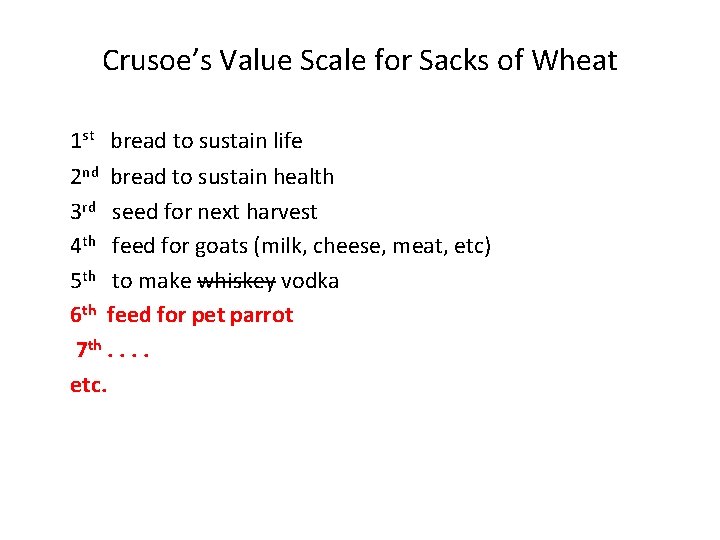
Crusoe’s Value Scale for Sacks of Wheat 1 st bread to sustain life 2 nd bread to sustain health 3 rd seed for next harvest 4 th feed for goats (milk, cheese, meat, etc) 5 th to make whiskey vodka 6 th feed for pet parrot 7 th. . etc.
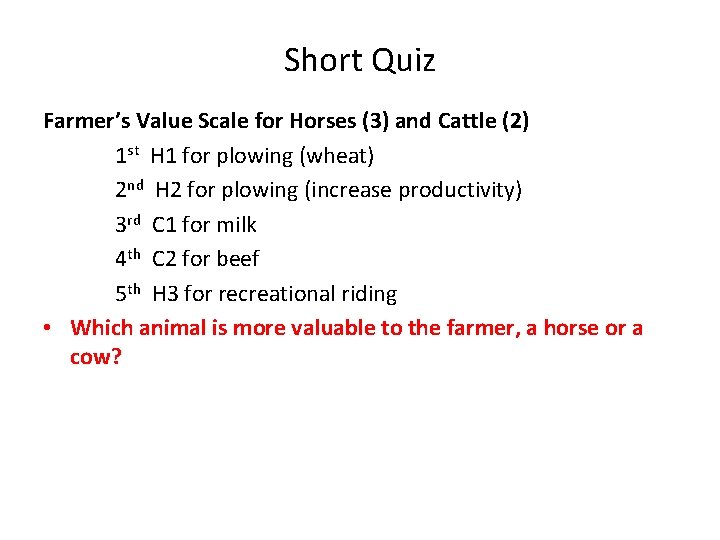
Short Quiz Farmer’s Value Scale for Horses (3) and Cattle (2) 1 st H 1 for plowing (wheat) 2 nd H 2 for plowing (increase productivity) 3 rd C 1 for milk 4 th C 2 for beef 5 th H 3 for recreational riding • Which animal is more valuable to the farmer, a horse or a cow?
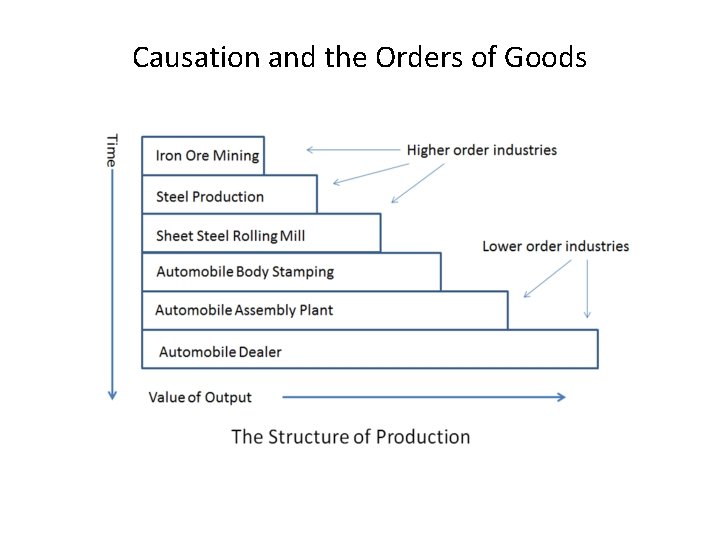
Causation and the Orders of Goods
Menger’s Law of Imputation • The value of the means reflects the value of the ends or wants they serve. • Value is imputed “backwards” from consumer value judgments of the services of the consumer good in satisfying wants to the consumer good itself to higher-order goods (capital goods). • The subjective value of transportation services determines the value of the car and gasoline which determine the value of steel, robot assembly machinery, oil wells, drilling equipment etc.
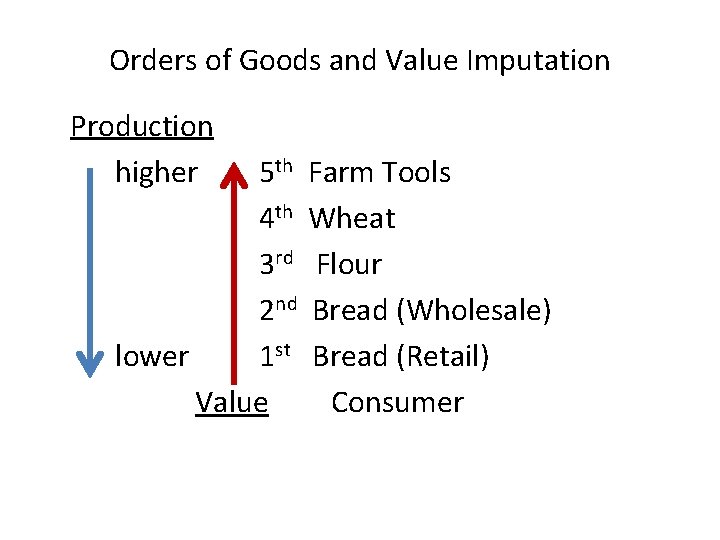
Orders of Goods and Value Imputation Production higher 5 th Farm Tools 4 th Wheat 3 rd Flour 2 nd Bread (Wholesale) lower 1 st Bread (Retail) Value Consumer
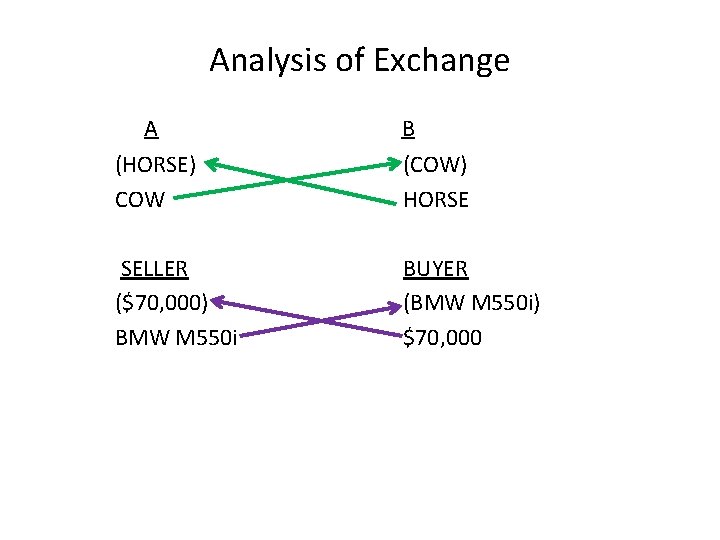
Analysis of Exchange A B (HORSE) COW (COW) HORSE SELLER ($70, 000) BMW M 550 i BUYER (BMW M 550 i) $70, 000
Analysis of Exchange • Goods exchanged are not equal in value. • Double inequality of value—reverse valuations of goods cause exchange. • Exchange increases the utility or welfare of both parties without leaving anyone worse off. Starting point of Austrian welfare economics.
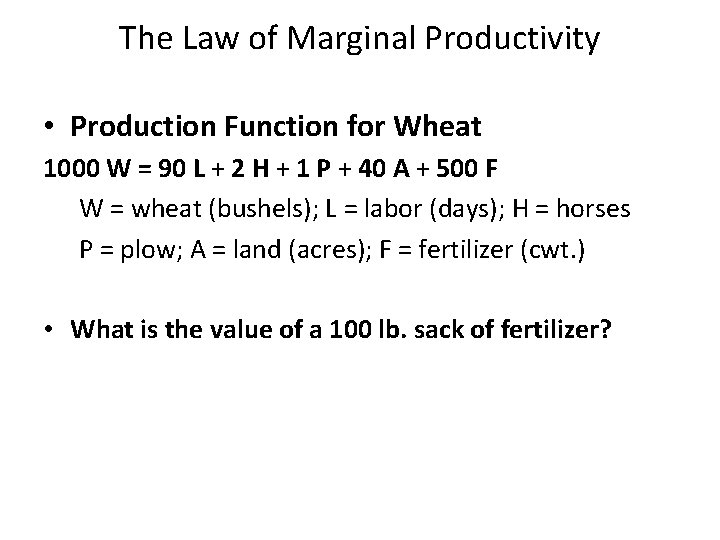
The Law of Marginal Productivity • Production Function for Wheat 1000 W = 90 L + 2 H + 1 P + 40 A + 500 F W = wheat (bushels); L = labor (days); H = horses P = plow; A = land (acres); F = fertilizer (cwt. ) • What is the value of a 100 lb. sack of fertilizer?
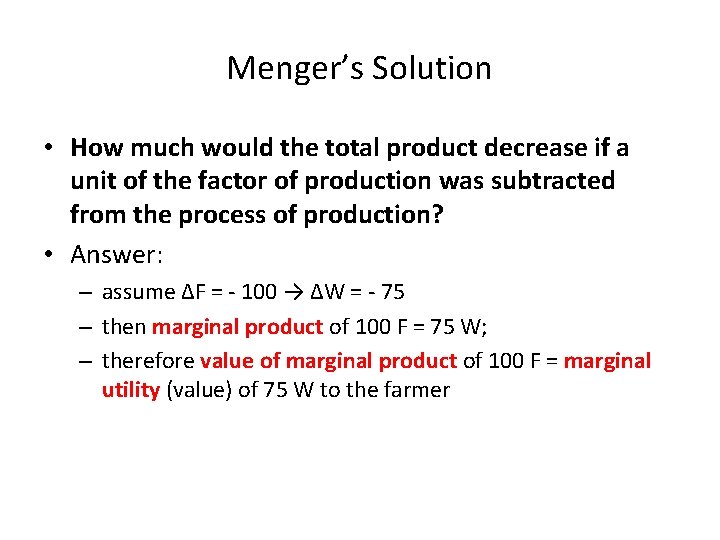
Menger’s Solution • How much would the total product decrease if a unit of the factor of production was subtracted from the process of production? • Answer: – assume ΔF = - 100 → ΔW = - 75 – then marginal product of 100 F = 75 W; – therefore value of marginal product of 100 F = marginal utility (value) of 75 W to the farmer
- Slides: 34