
The Birmingham Approach To Adult Social Care How
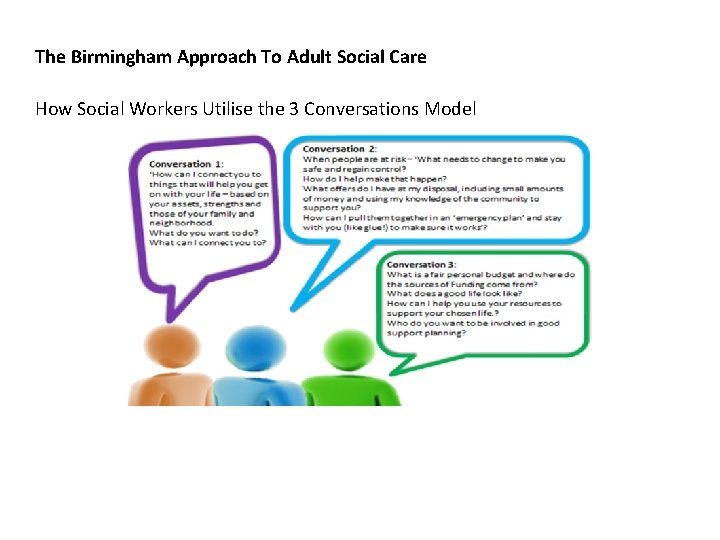
The Birmingham Approach To Adult Social Care How Social Workers Utilise the 3 Conversations Model
Conversation 1 Listen actively, and connect people and families/carers to things that matter Things to consider and discuss: • What matters to the person? • What are their interests? • What are their skills and strengths? • What do they feel would improve their quality of life, their health and their wellbeing? • Are they supported by any carers? • Is there contact with local resources? • What can I connect them to? Conversation starters: • What matters to you? • What would you like to do? • What support do you already have? • What will make your life better? • What will help? Actions to take: • Focus on the person’s strengths. • Consider all the resources and support that you can connect the person to • Is there a potential need for a Family Group Conference? • Make proper connections rather than just giving information and advice. Introduction not signposting • Make sure the person has the support they require so that they can be involved in the process
Conversation 2 Work intensively with people in crisis to enable them to regain stability and control When do I make the shift from a conversation 1 to a conversation 2? • If I am in urgent mode • If I am sticking with someone for a short period of time • If I am making a connection with the person to try and achieve positive change • If I wasn’t around providing significant support the situation would deteriorate. • If I am bringing in any skills that might help alongside my own What counts as a period of instability or crisis? • The person is self-reporting being in a ‘crisis’ • The person’s situation seems to have become ‘stuck’ • There is an immediate risk to the person’s safety, health or wellbeing • The person’s life has become unstable • The situation is dangerous, or could soon become dangerous • The person’s life has changed abruptly, with little or no warning • Immediate action is required to prevent the crisis from getting worse Things to consider and discuss 2: • What is unstable or in crisis? • What has changed? • What are the immediate risks? • How does the person feel the risks can be managed? • What does the person feel needs to change urgently? • Is there contact with local resources? • What can I connect them to?
Conversation 3 Support people who need long-term care and support to build a good life Things to consider and discuss: • Does the person need assistance, advocacy and help with planning and organising the support? • What does a good life look like? • Is there contact with local resources? What can I connect them to? • Have earlier conversations provided sufficient information to determine eligibility for funded services? If not, this should be discussed and considered. • Financial assessment should be discussed and completed to determine funding status. • Consider a direct payment. Conversation starters: • What is working well so far? • Where do you want to get to? • What are the next things we need to plan together? • What does a good plan look like? • How can we support positive risk taking. • How can any risks be managed? Determining eligibility: A person has eligible needs for care and support if • Their needs arise from or are related to a physical or mental impairment or illness, and; • As a result, they are unable to achieve 2 or more outcomes, as defined in the Care Act, and; • As a consequence, there is or likely to be, a significant impact on their wellbeing. • The focus at this stage should be on working with the person to make sure they have the support in place to build the best life possible for them. All discussions should be recorded. You must provide the person with a copy of their record, which clearly states the eligibility determination. This is a legal requirement.
- Slides: 4