
The Biology of the Mind Chapter 2 Neural
The Biology of the Mind Chapter 2
Neural and Hormonal Systems Everything psychological—every idea, every mood, every urge—is biological. Psychologists working from a biological perspective study the links between biology and behavior. They work on a biopsychosocial systems in which factors interact to influence behavior Biological Psychological social-cultural factors
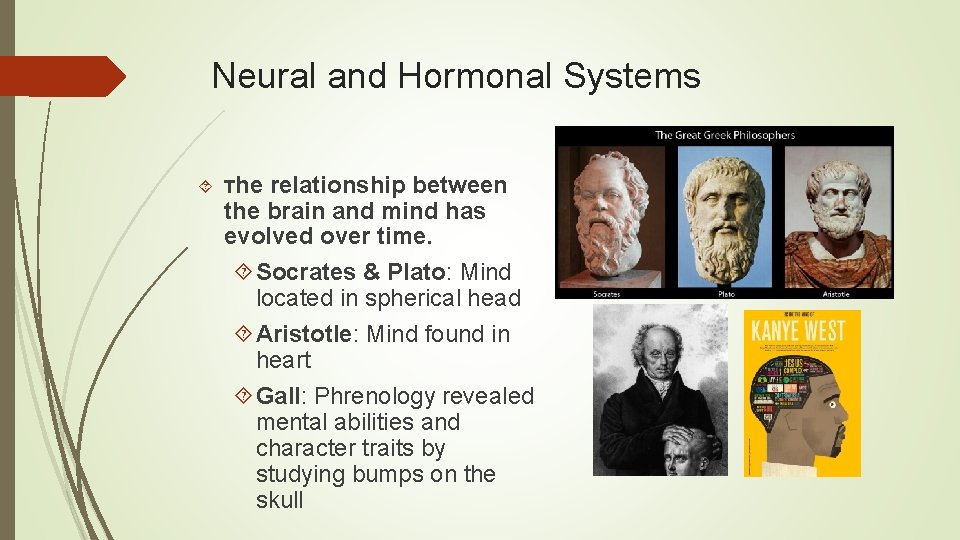
Neural and Hormonal Systems The relationship between the brain and mind has evolved over time. Socrates & Plato: Mind located in spherical head Aristotle: Mind found in heart Gall: Phrenology revealed mental abilities and character traits by studying bumps on the skull
Neural and Hormonal Systems During the past century, researchers discovered Nerve cells conduct electricity and communicate through chemical messages across tiny separating gaps Specific brain systems serve specific functions and information is integrated to construct a wide range of experiences The adaptive brain is wired by experience
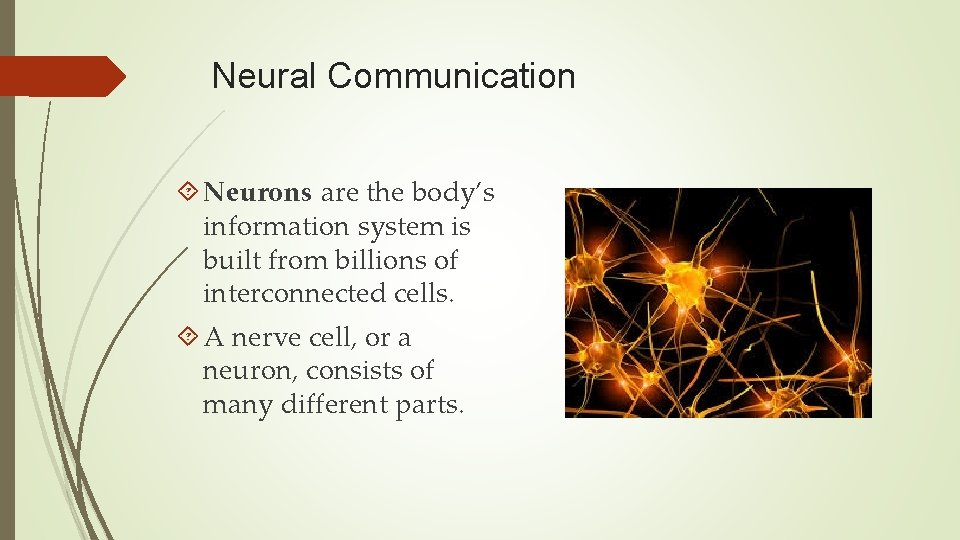
Neural Communication Neurons are the body’s information system is built from billions of interconnected cells. A nerve cell, or a neuron, consists of many different parts.
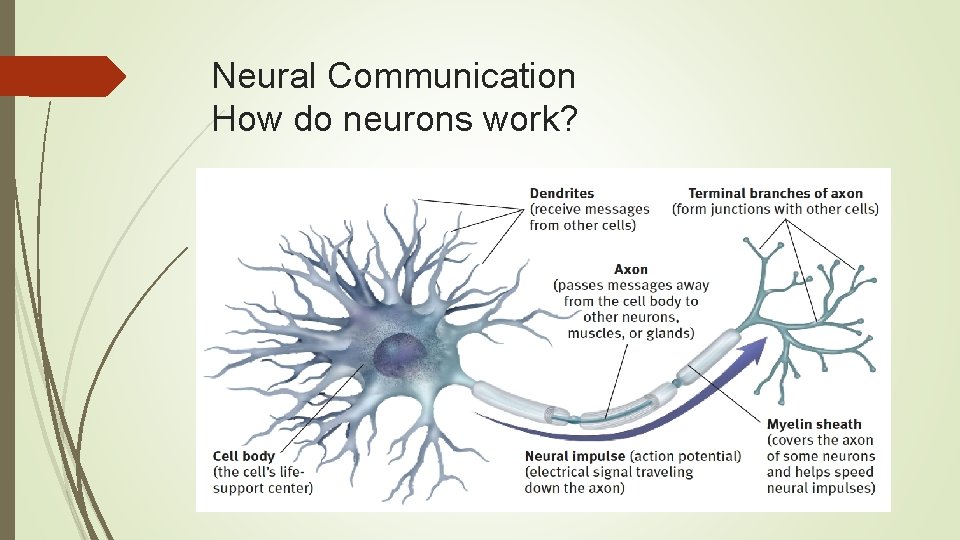
Neural Communication How do neurons work? Neurons are the elementary components of the nervous system. the body’s speedy electrochemical system. Neuron receives signals through branching dendrites then sends signals through its axons. Some axons are encased in a myelin sheath, which enables faster transmission. Glial cells provide myelin and support, nourish, and protect neurons. These also play a role in thinking and learning. If a combined signal received by a neuron exceeds a minimum threshold, the neuron fires, transmitting an action potential or electrical impulse down its axon through a chemical-to-electricity process. The neuron’s reaction is an all-or-none process.
Neural Communication How do neurons work? Glial cells provide myelin and support, nourish, and protect neurons. These also play a role in thinking and learning. If a combined signal received by a neuron exceeds a minimum threshold, the neuron fires, transmitting an action potential or electrical impulse down its axon through a chemical-to-electricity process. The neuron’s reaction is an all-or-none process. Either it fires or it does not
Neural Communication How do neurons work?
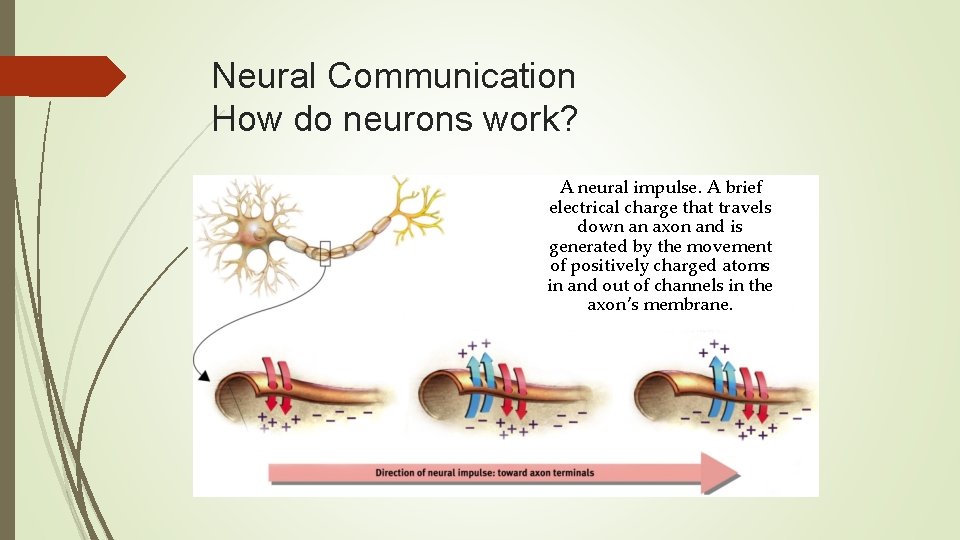
Neural Communication How do neurons work? A neural impulse. A brief electrical charge that travels down an axon and is generated by the movement of positively charged atoms in and out of channels in the axon’s membrane.
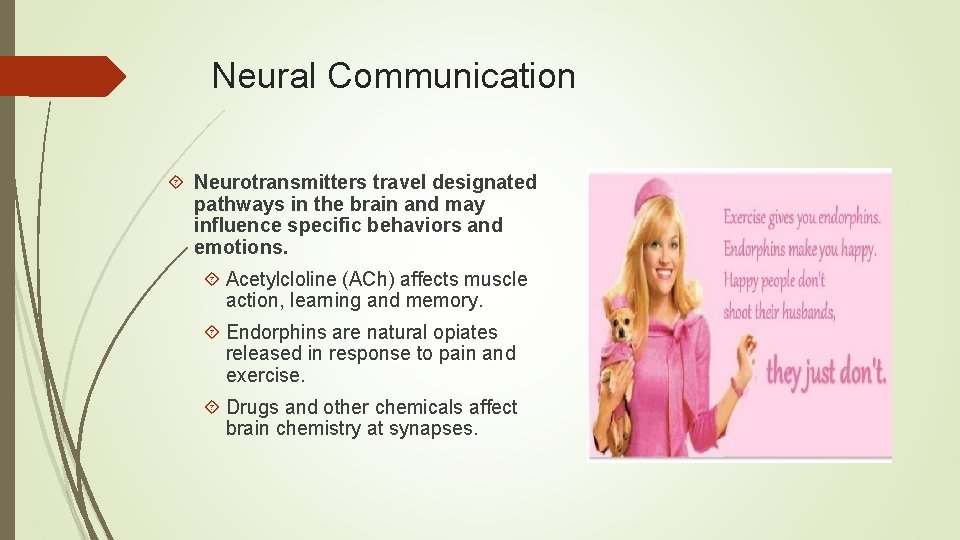
Neural Communication Neurotransmitters travel designated pathways in the brain and may influence specific behaviors and emotions. Acetylcloline (ACh) affects muscle action, learning and memory. Endorphins are natural opiates released in response to pain and exercise. Drugs and other chemicals affect brain chemistry at synapses.
![Neural Communication Synapse [SIN-aps] a junction between the axon tip of the sending neuron](http://slidetodoc.com/presentation_image/0808ed87f3099124a41d1619ebc2c884/image-11.jpg "Neural Communication Synapse [SIN-aps] a junction between the axon tip of the sending neuron")
Neural Communication Synapse [SIN-aps] a junction between the axon tip of the sending neuron and the dendrite or cell body of the receiving neuron. This tiny gap is called the synaptic gap or cleft.
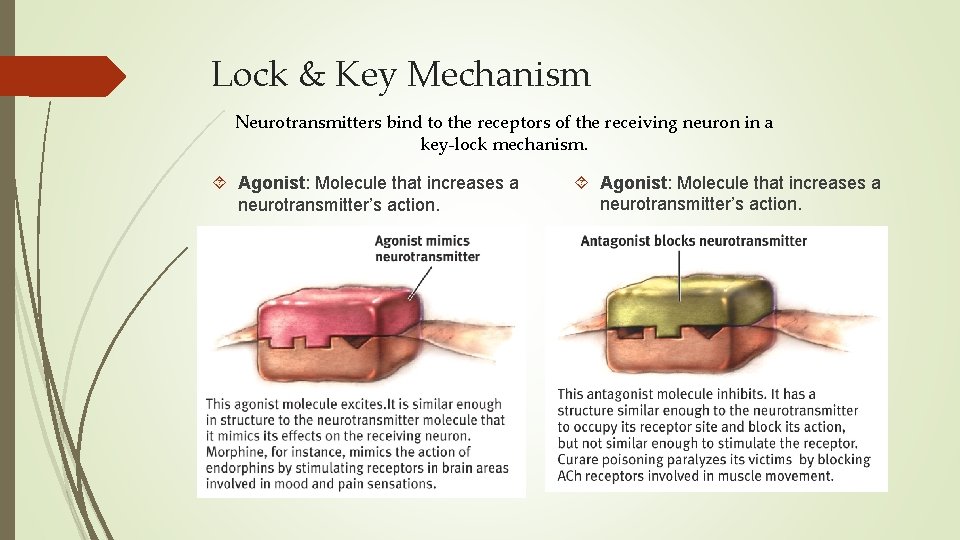
Lock & Key Mechanism Neurotransmitters bind to the receptors of the receiving neuron in a key-lock mechanism. Agonist: Molecule that increases a neurotransmitter’s action.

Neural Communication Neurotransmitters in the synapse are reabsorbed into the sending neurons through the process of reuptake. This process applies the brakes on neurotransmitter action. Medications like SSRIs (Selective Serotoin Reuptake Inhibitors) like Prozac
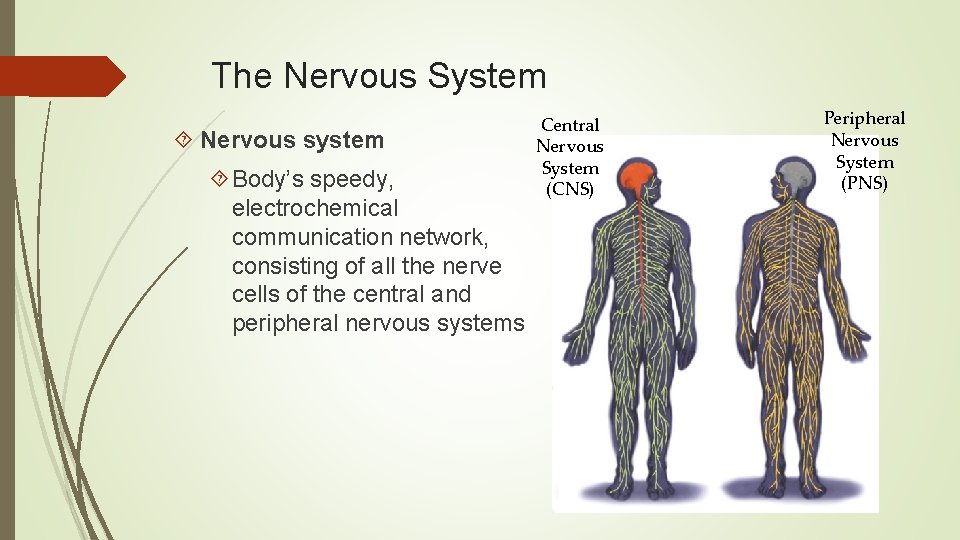
The Nervous System Nervous system Body’s speedy, electrochemical communication network, consisting of all the nerve cells of the central and peripheral nervous systems Central Nervous System (CNS) Peripheral Nervous System (PNS)
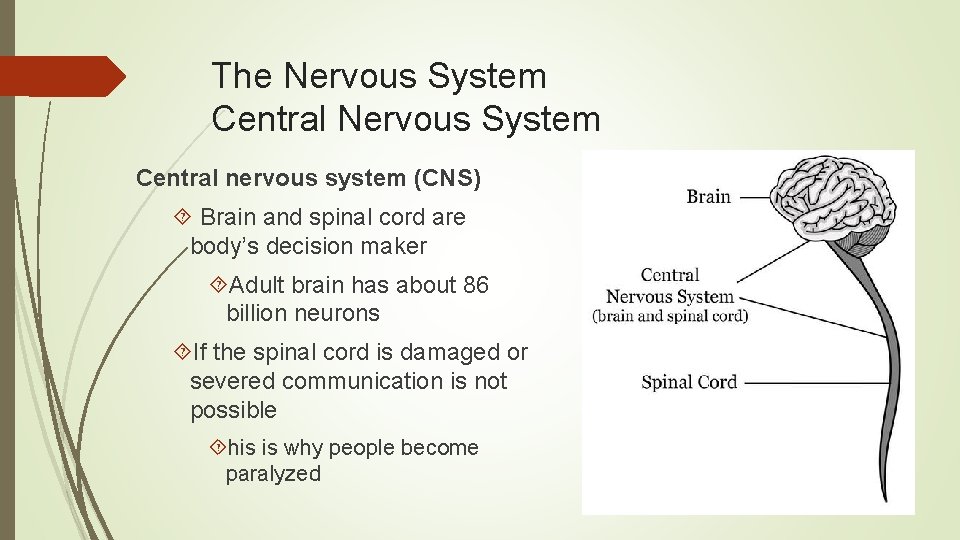
The Nervous System Central nervous system (CNS) Brain and spinal cord are body’s decision maker Adult brain has about 86 billion neurons If the spinal cord is damaged or severed communication is not possible his is why people become paralyzed
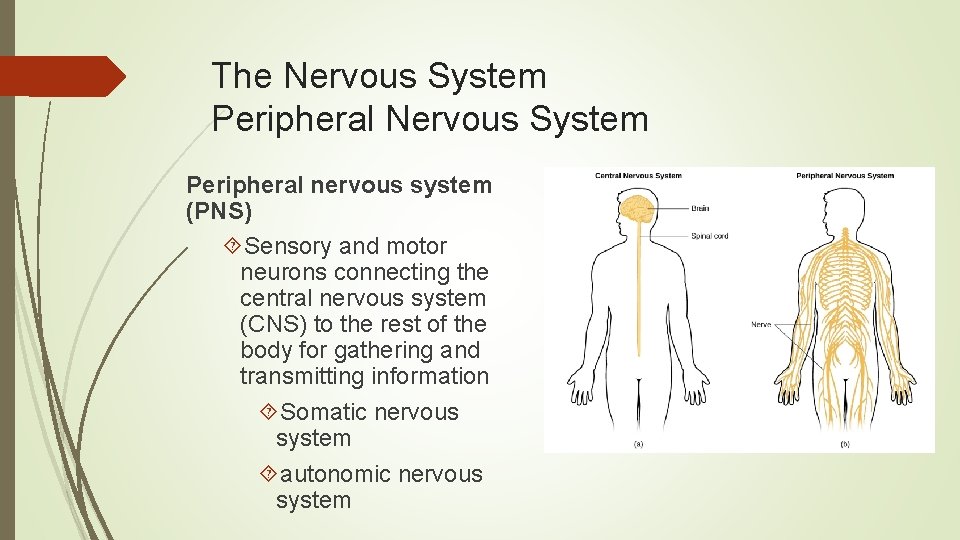
The Nervous System Peripheral nervous system (PNS) Sensory and motor neurons connecting the central nervous system (CNS) to the rest of the body for gathering and transmitting information Somatic nervous system autonomic nervous system
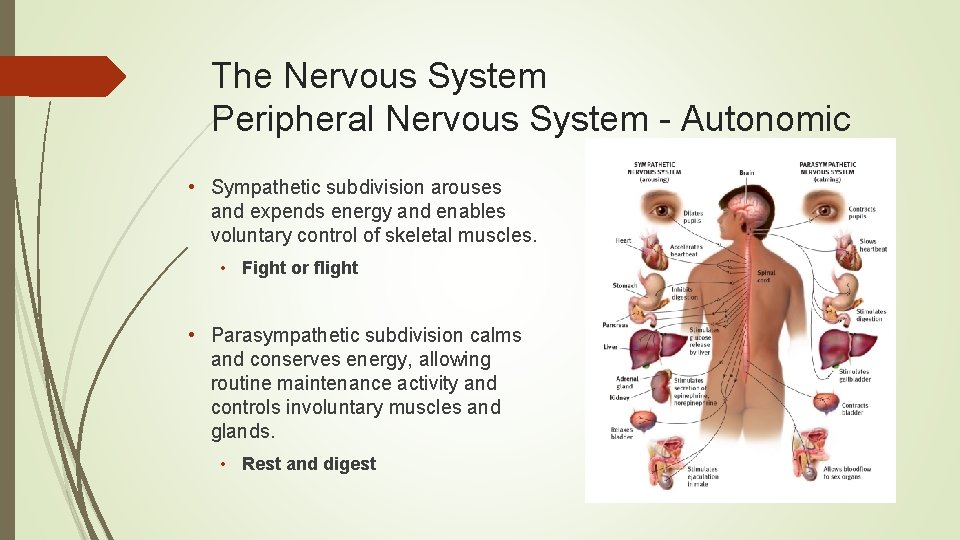
The Nervous System Peripheral Nervous System - Autonomic • Sympathetic subdivision arouses and expends energy and enables voluntary control of skeletal muscles. • Fight or flight • Parasympathetic subdivision calms and conserves energy, allowing routine maintenance activity and controls involuntary muscles and glands. • Rest and digest
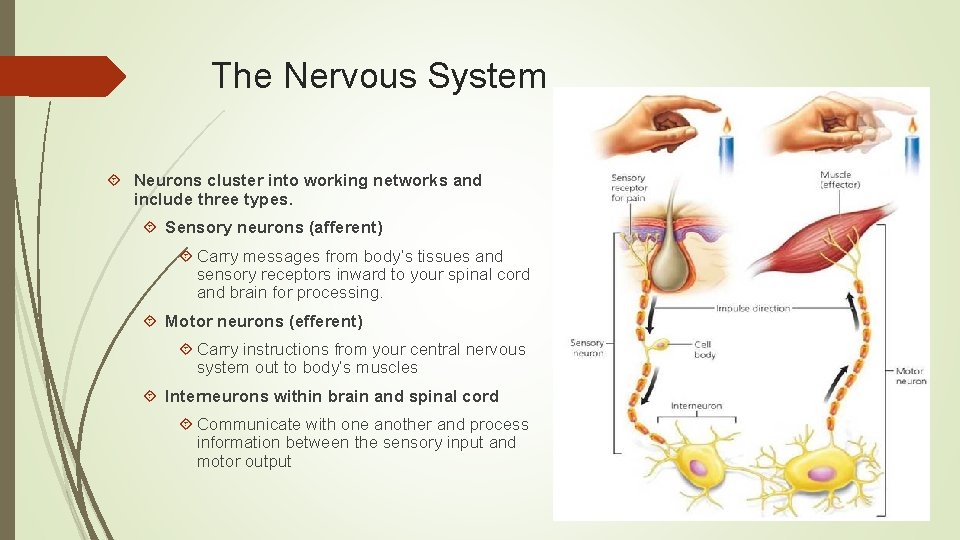
The Nervous System Neurons cluster into working networks and include three types. Sensory neurons (afferent) Carry messages from body’s tissues and sensory receptors inward to your spinal cord and brain for processing. Motor neurons (efferent) Carry instructions from your central nervous system out to body’s muscles Interneurons within brain and spinal cord Communicate with one another and process information between the sensory input and motor output
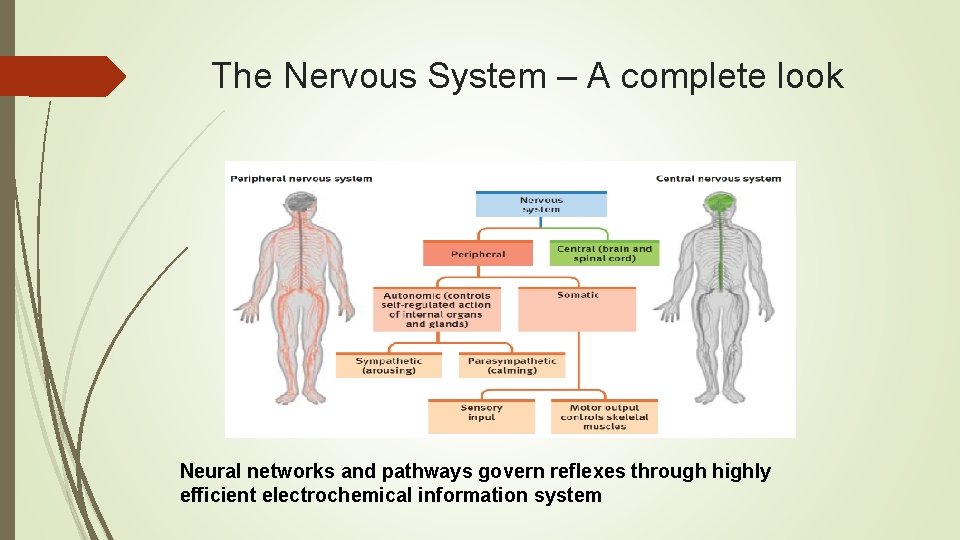
The Nervous System – A complete look Neural networks and pathways govern reflexes through highly efficient electrochemical information system
The Endocrine System Endocrine system is set of glands that secrete hormones into the bloodstream. Hormones travel through the body and affect other tissues, including the brain. The pituitary is the master gland that influences hormone release by other glands, including the adrenal glands. In an intricate feedback system, the brain’s hypothalamus influences the pituitary gland, which influences other glands, which release hormones and influence the brain.
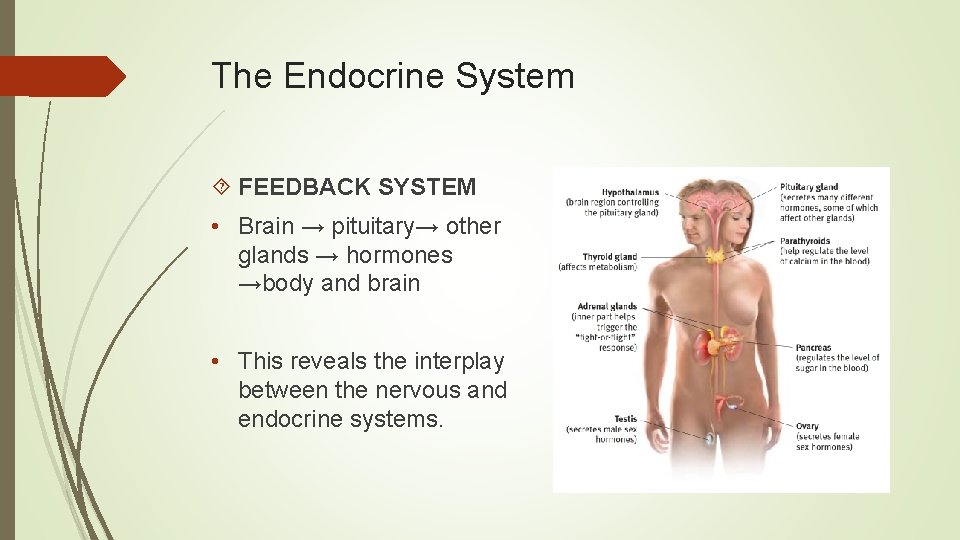
The Endocrine System FEEDBACK SYSTEM • Brain → pituitary→ other glands → hormones →body and brain • This reveals the interplay between the nervous and endocrine systems.
Studying the Brain Scientists can selectively destroy or electrically, chemically, or magnetically stimulate the brain. Lesion EEG (Electroencephalogram) PET (Positron emission tomography) MRI (Magnetic resonance imaging) f. MRI (Functional MRI)
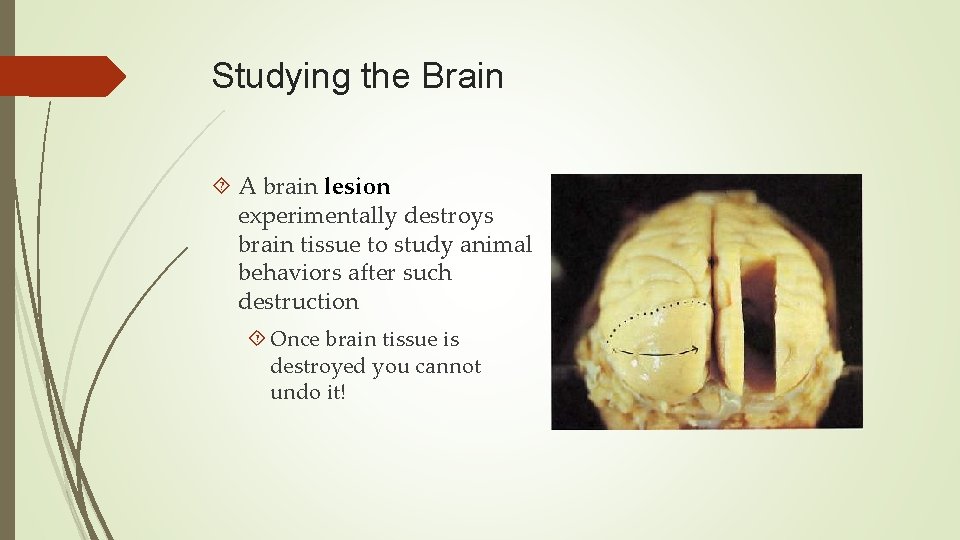
Studying the Brain A brain lesion experimentally destroys brain tissue to study animal behaviors after such destruction Once brain tissue is destroyed you cannot undo it!
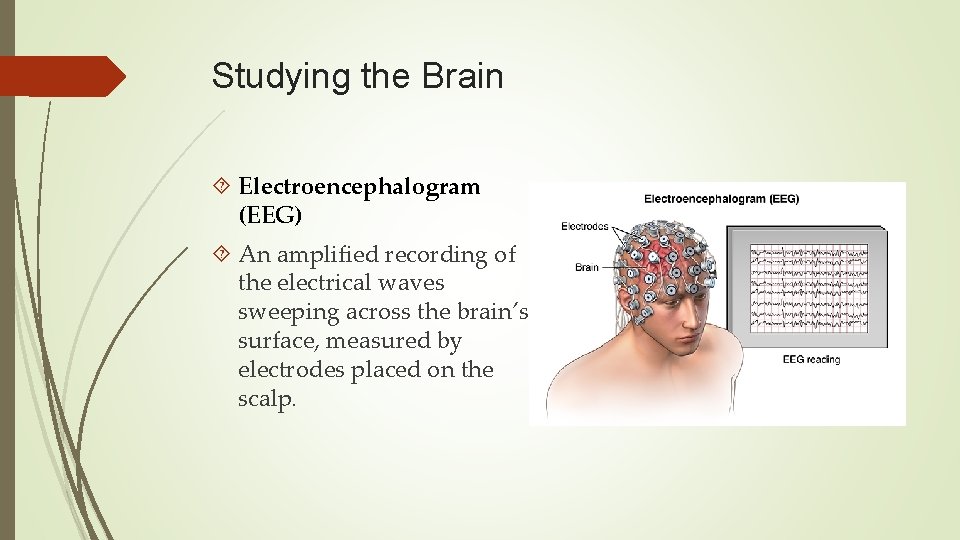
Studying the Brain Electroencephalogram (EEG) An amplified recording of the electrical waves sweeping across the brain’s surface, measured by electrodes placed on the scalp.
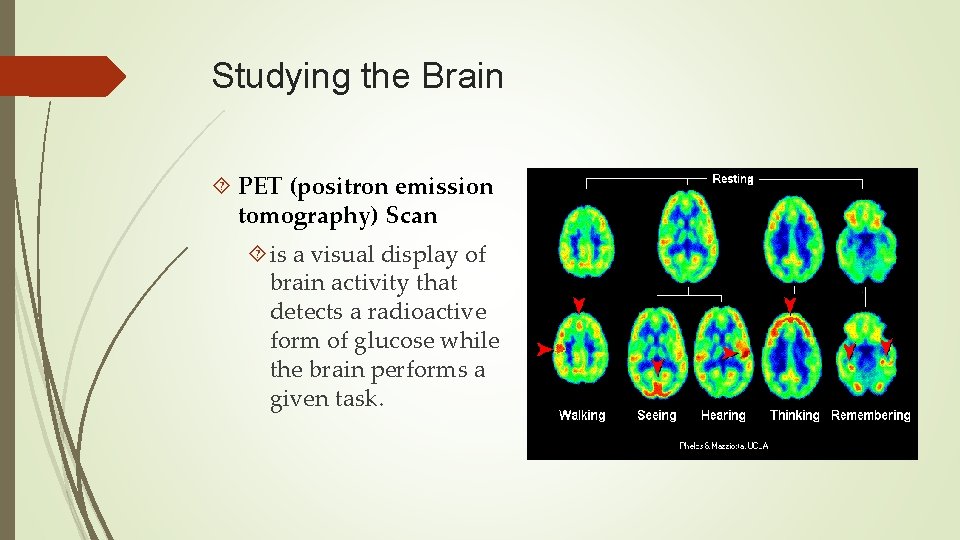
Studying the Brain PET (positron emission tomography) Scan is a visual display of brain activity that detects a radioactive form of glucose while the brain performs a given task.
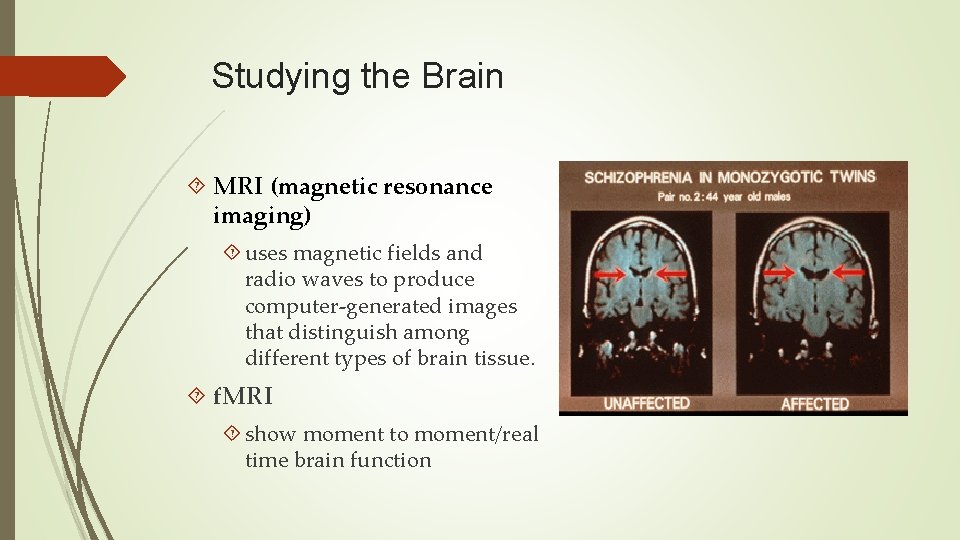
Studying the Brain MRI (magnetic resonance imaging) uses magnetic fields and radio waves to produce computer-generated images that distinguish among different types of brain tissue. f. MRI show moment to moment/real time brain function
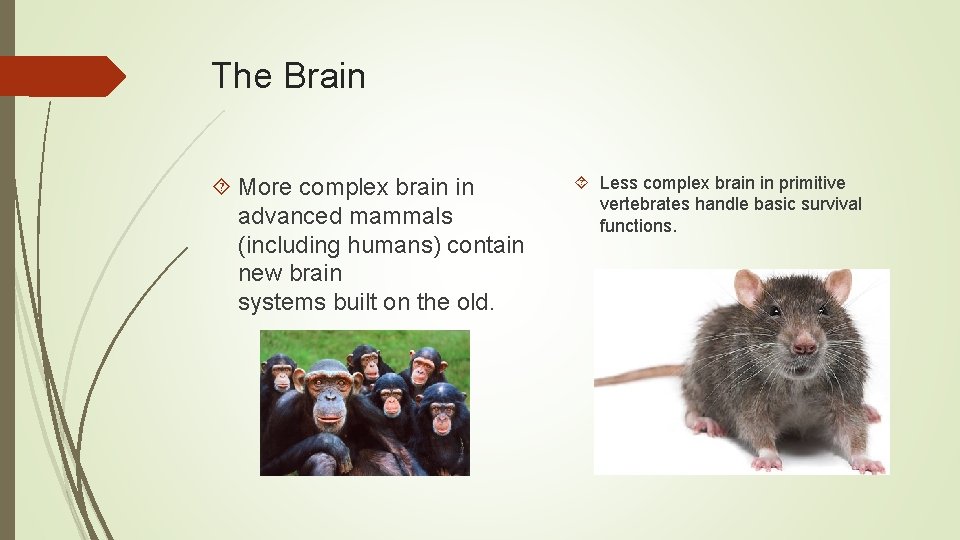
The Brain More complex brain in advanced mammals (including humans) contain new brain systems built on the old. Less complex brain in primitive vertebrates handle basic survival functions.
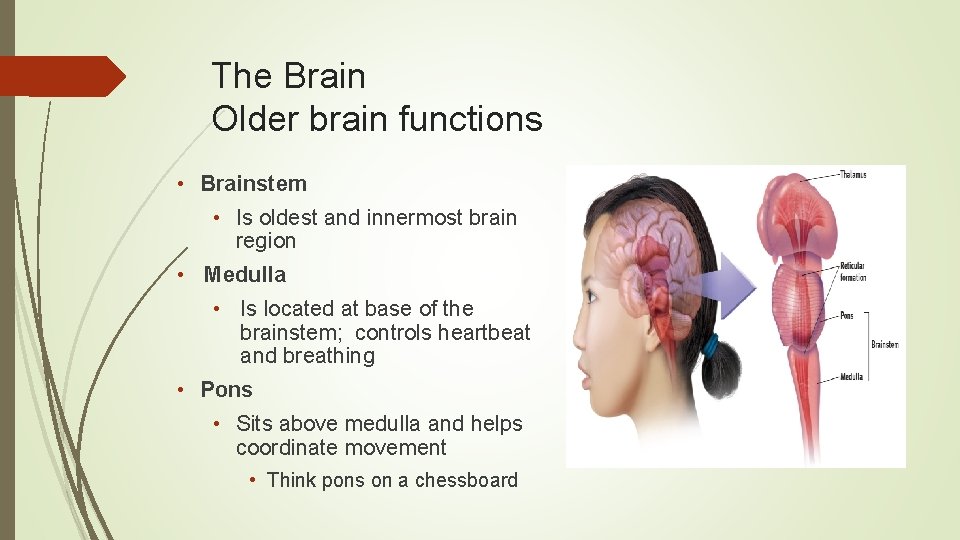
The Brain Older brain functions • Brainstem • Is oldest and innermost brain region • Medulla • Is located at base of the brainstem; controls heartbeat and breathing • Pons • Sits above medulla and helps coordinate movement • Think pons on a chessboard
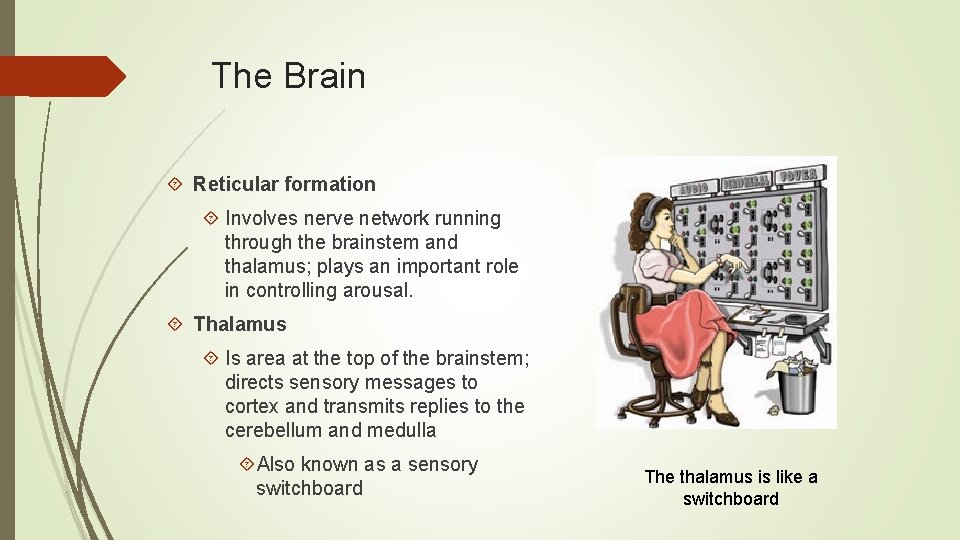
The Brain Reticular formation Involves nerve network running through the brainstem and thalamus; plays an important role in controlling arousal. Thalamus Is area at the top of the brainstem; directs sensory messages to cortex and transmits replies to the cerebellum and medulla Also known as a sensory switchboard The thalamus is like a switchboard
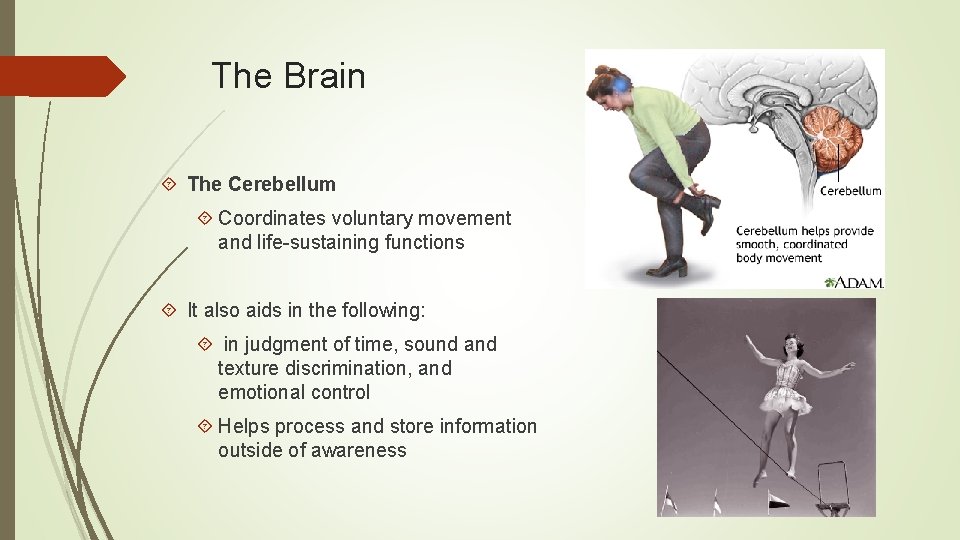
The Brain The Cerebellum Coordinates voluntary movement and life-sustaining functions It also aids in the following: in judgment of time, sound and texture discrimination, and emotional control Helps process and store information outside of awareness
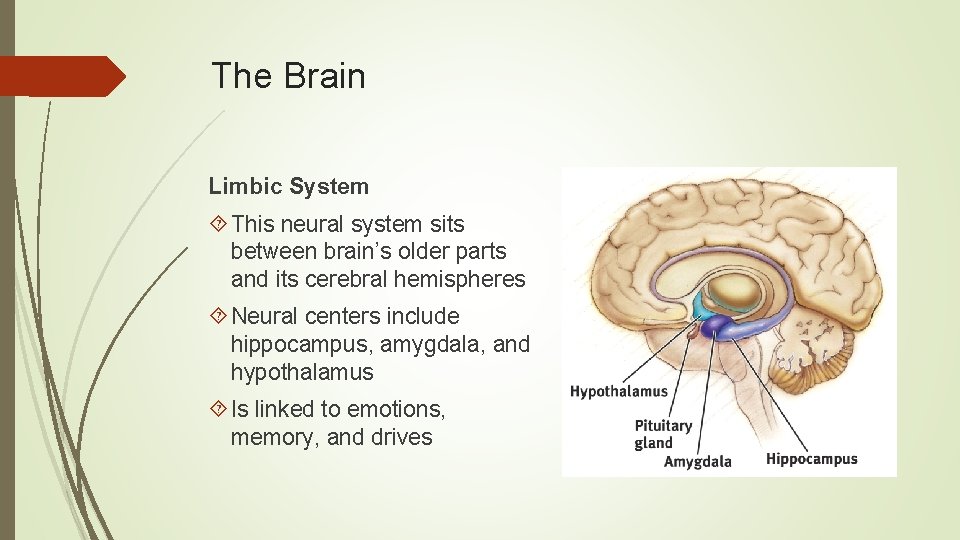
The Brain Limbic System This neural system sits between brain’s older parts and its cerebral hemispheres Neural centers include hippocampus, amygdala, and hypothalamus Is linked to emotions, memory, and drives
The Brain Amygdala Consists of two limabean-sized neural clusters in the limbic system; linked to emotion.
The Brain Hypothalamus Is neural structure lying below the thalamus Directs several maintenance activities Helps govern endocrine system via the pituitary gland, and is linked to emotion and reward.
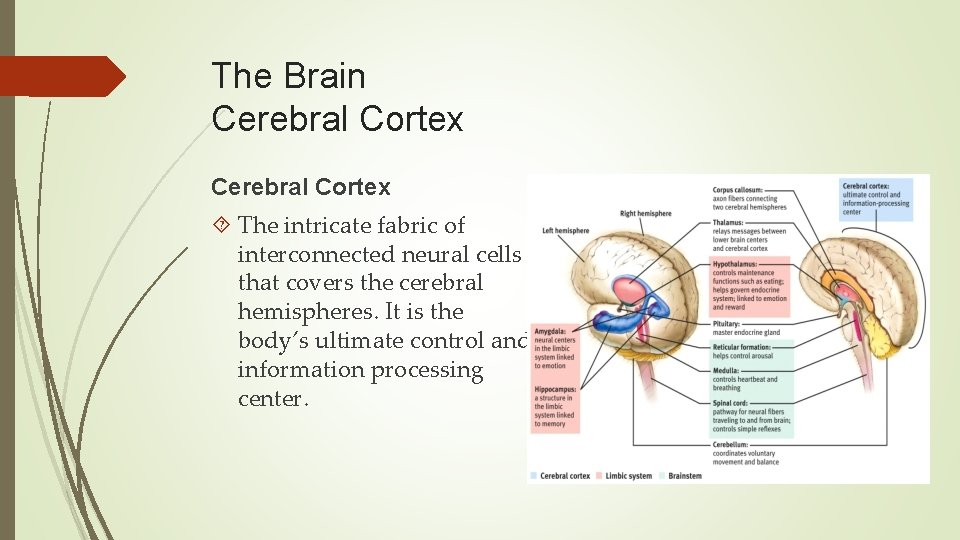
The Brain Cerebral Cortex The intricate fabric of interconnected neural cells that covers the cerebral hemispheres. It is the body’s ultimate control and information processing center.
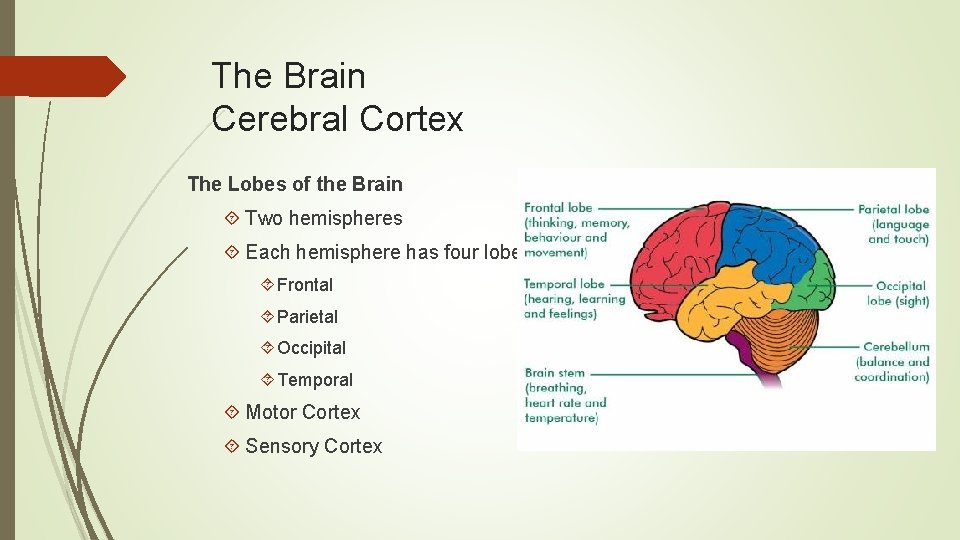
The Brain Cerebral Cortex The Lobes of the Brain Two hemispheres Each hemisphere has four lobes: Frontal Parietal Occipital Temporal Motor Cortex Sensory Cortex
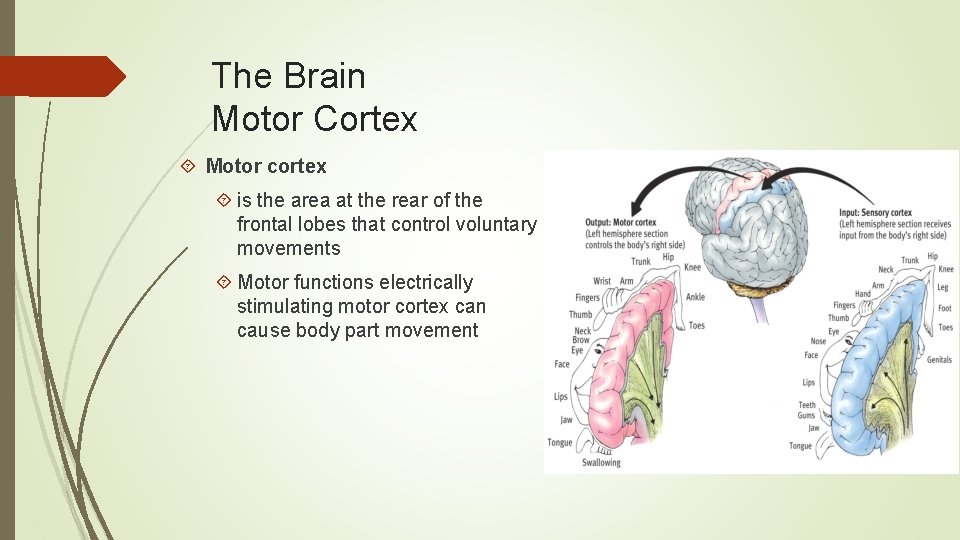
The Brain Motor Cortex Motor cortex is the area at the rear of the frontal lobes that control voluntary movements Motor functions electrically stimulating motor cortex can cause body part movement
The Brain Sensory Cortex Sensory cortex (parietal cortex) receives information from skin surface and sense organs Somatosensory cortex processes information from skin senses and body parts movement
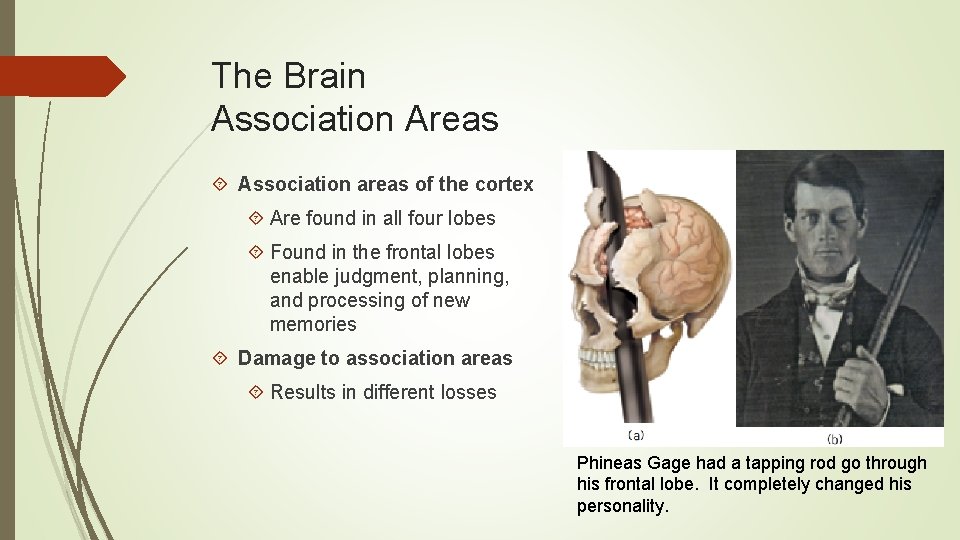
The Brain Association Areas Association areas of the cortex Are found in all four lobes Found in the frontal lobes enable judgment, planning, and processing of new memories Damage to association areas Results in different losses Phineas Gage had a tapping rod go through his frontal lobe. It completely changed his personality.
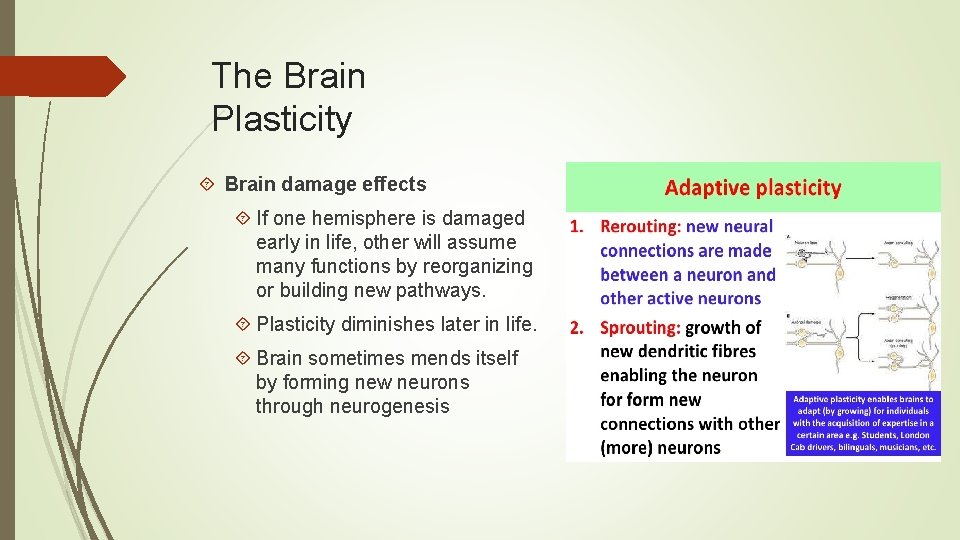
The Brain Plasticity Brain damage effects If one hemisphere is damaged early in life, other will assume many functions by reorganizing or building new pathways. Plasticity diminishes later in life. Brain sometimes mends itself by forming new neurons through neurogenesis
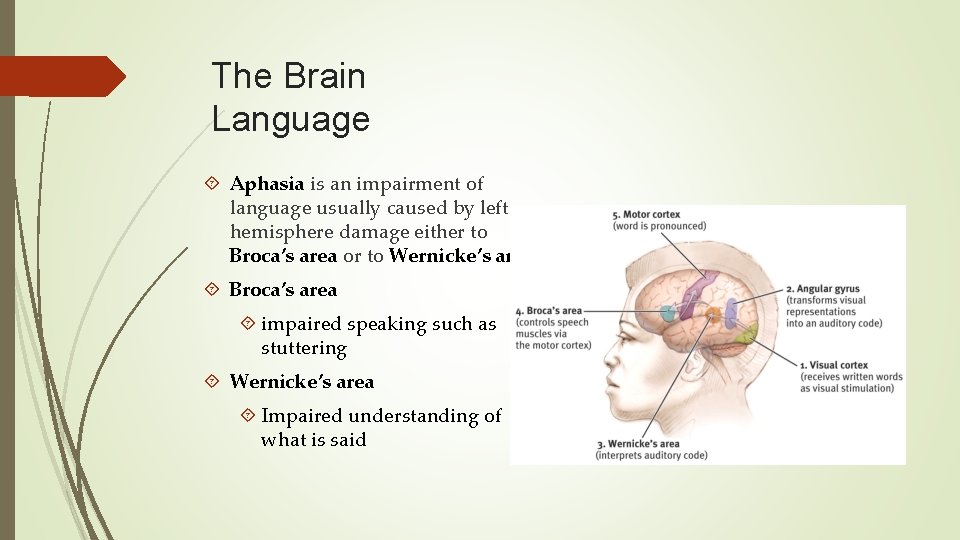
The Brain Language Aphasia is an impairment of language usually caused by left hemisphere damage either to Broca’s area or to Wernicke’s area. Broca’s area impaired speaking such as stuttering Wernicke’s area Impaired understanding of what is said
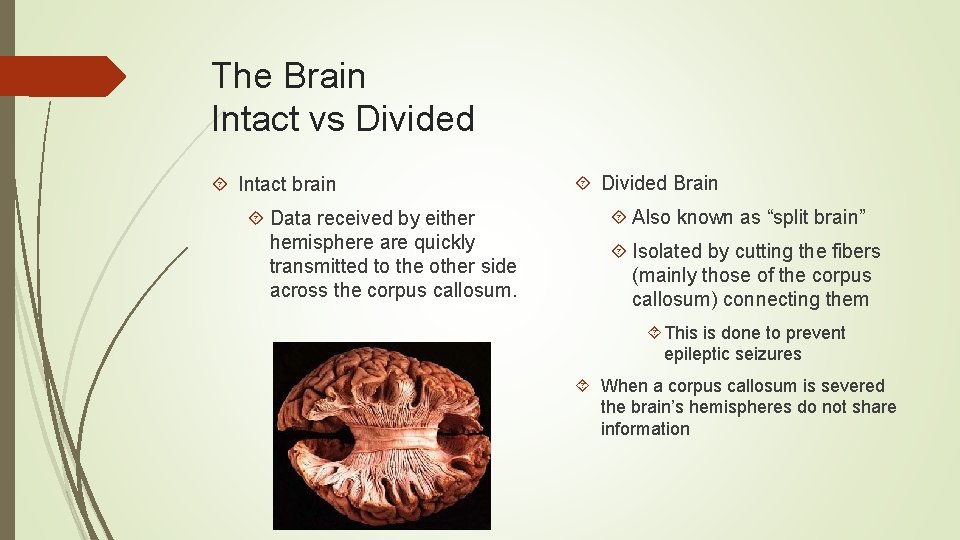
The Brain Intact vs Divided Intact brain Data received by either hemisphere are quickly transmitted to the other side across the corpus callosum. Divided Brain Also known as “split brain” Isolated by cutting the fibers (mainly those of the corpus callosum) connecting them This is done to prevent epileptic seizures When a corpus callosum is severed the brain’s hemispheres do not share information
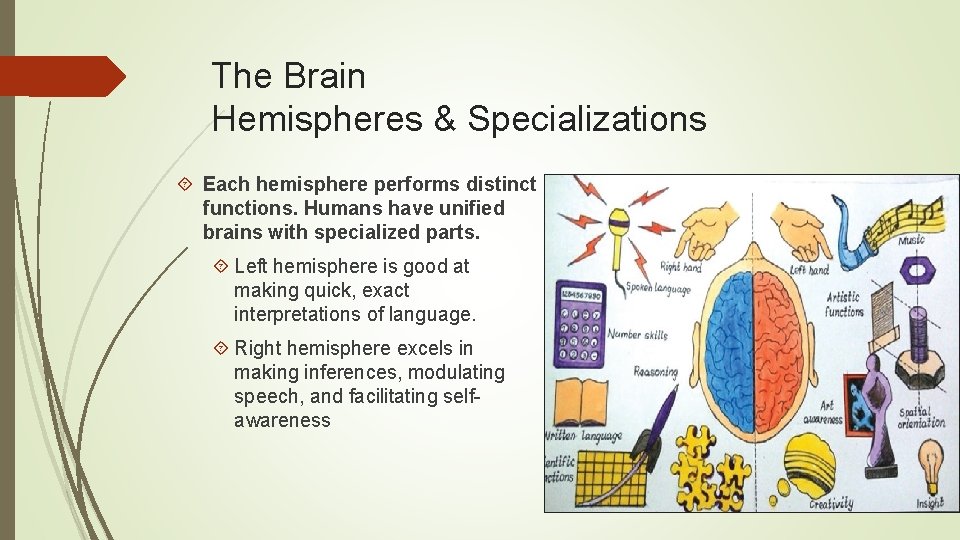
The Brain Hemispheres & Specializations Each hemisphere performs distinct functions. Humans have unified brains with specialized parts. Left hemisphere is good at making quick, exact interpretations of language. Right hemisphere excels in making inferences, modulating speech, and facilitating selfawareness
The Brain Hemispheres and Specializations Nearly 90 percent of people are right-handed and process speech primarily in left hemisphere. Universal prevalence of right-handers suggests a genetic or prenatal influence. Left-handedness more likely to have reading disabilities, allergies, and migraines BUT more common among musicians, mathematicians, and many athletes and artists. Pros and cons of left-handedness seem about equal.
- Slides: 43