
The Binomial Expansion After completing this chapter you

The Binomial Expansion
After completing this chapter you should be able to: • Expand (1 + x)n for any constant n • Expand (a + bx)n for any constants a, b and n • Determine the range of values of x for which the expansion is valid • Use partial fractions to expand more complex fractional expressions
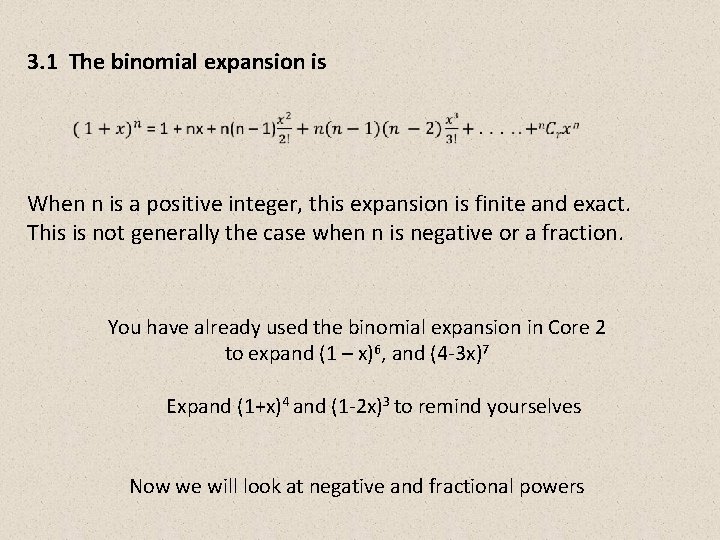
3. 1 The binomial expansion is When n is a positive integer, this expansion is finite and exact. This is not generally the case when n is negative or a fraction. You have already used the binomial expansion in Core 2 to expand (1 – x)6, and (4 -3 x)7 Expand (1+x)4 and (1 -2 x)3 to remind yourselves Now we will look at negative and fractional powers
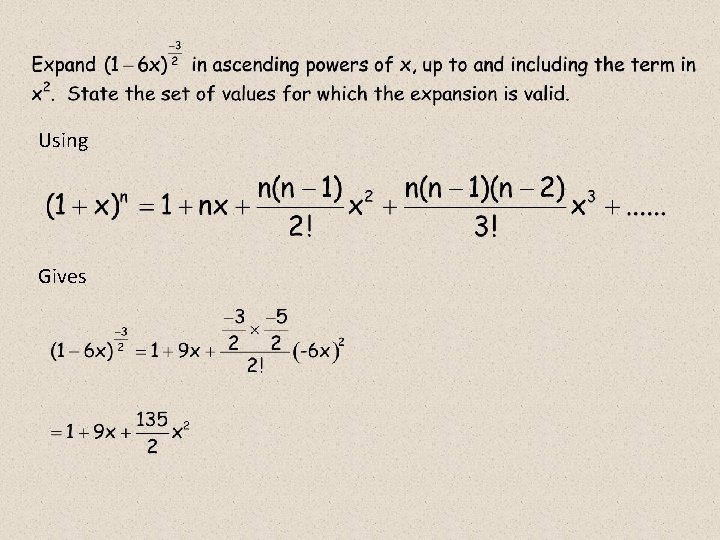
Using Gives
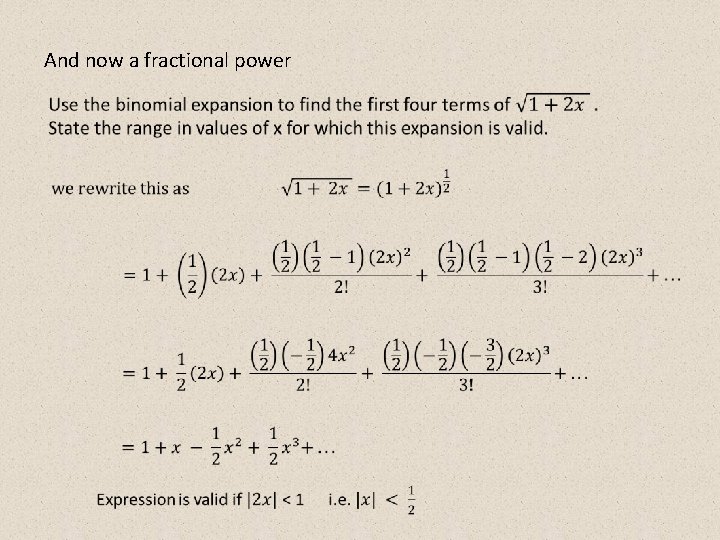
And now a fractional power
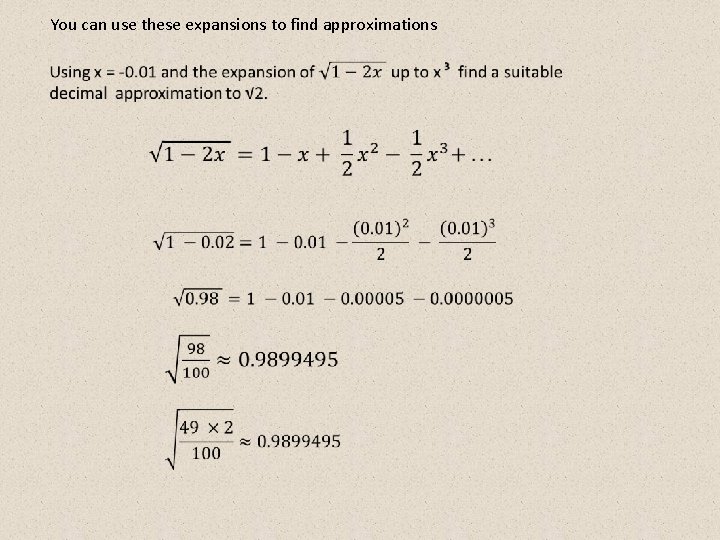
You can use these expansions to find approximations

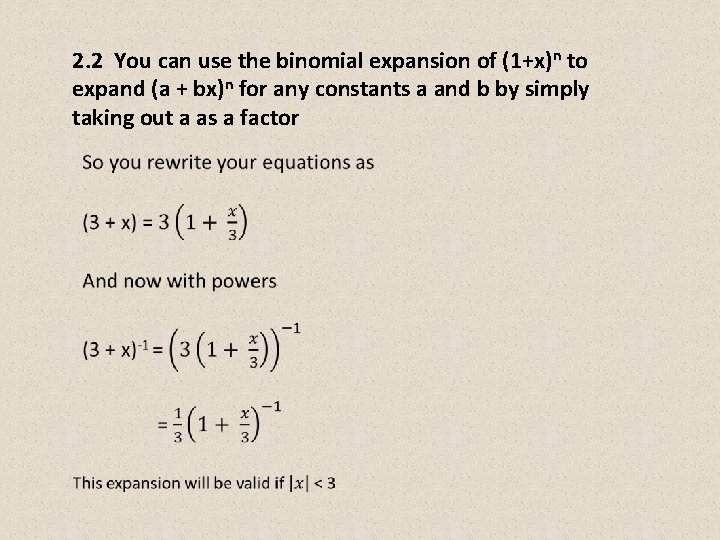
2. 2 You can use the binomial expansion of (1+x)n to expand (a + bx)n for any constants a and b by simply taking out a as a factor
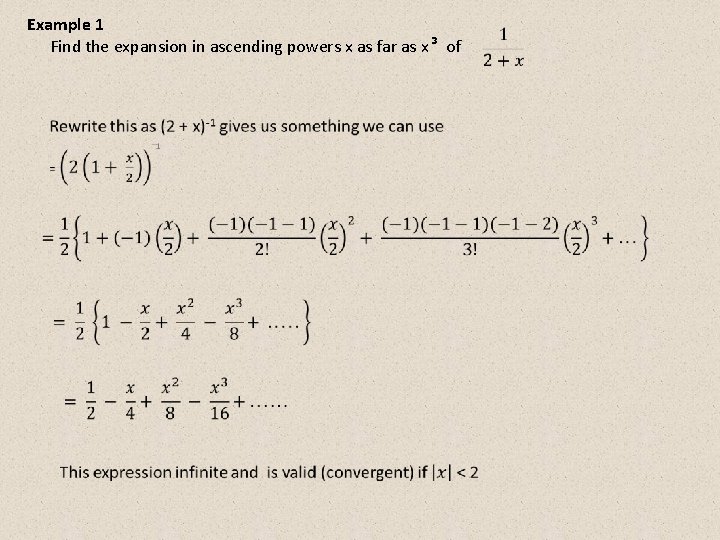
Example 1 Find the expansion in ascending powers x as far as x³ of

Example 2 And now a fractional one This is something we can expand!
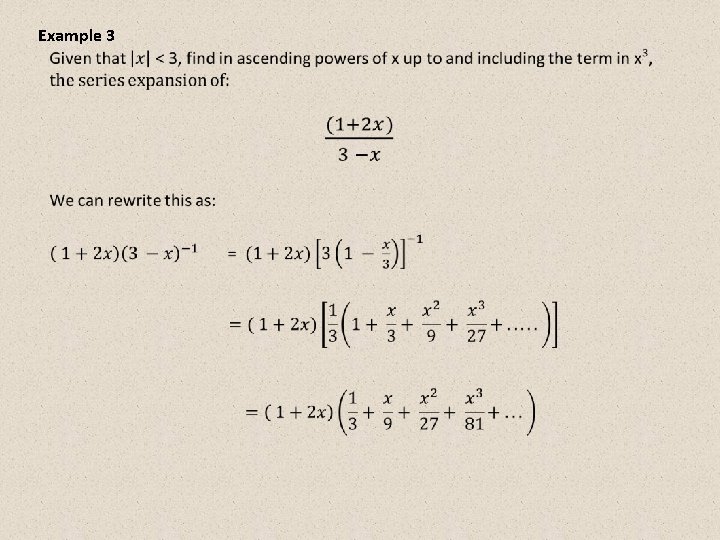
Example 3

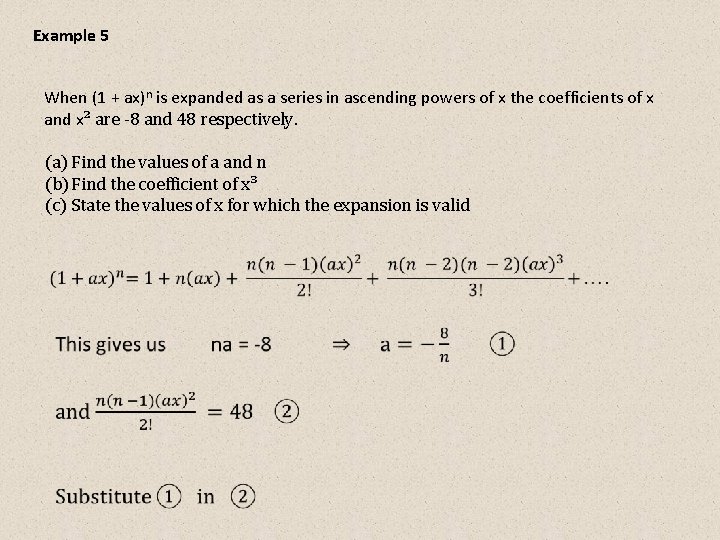
Example 5 When (1 + ax)n is expanded as a series in ascending powers of x the coefficients of x and x² are -8 and 48 respectively. (a) Find the values of a and n (b) Find the coefficient of x³ (c) State the values of x for which the expansion is valid

substitute n = -2 back into ① -2 x a = -8 a=4
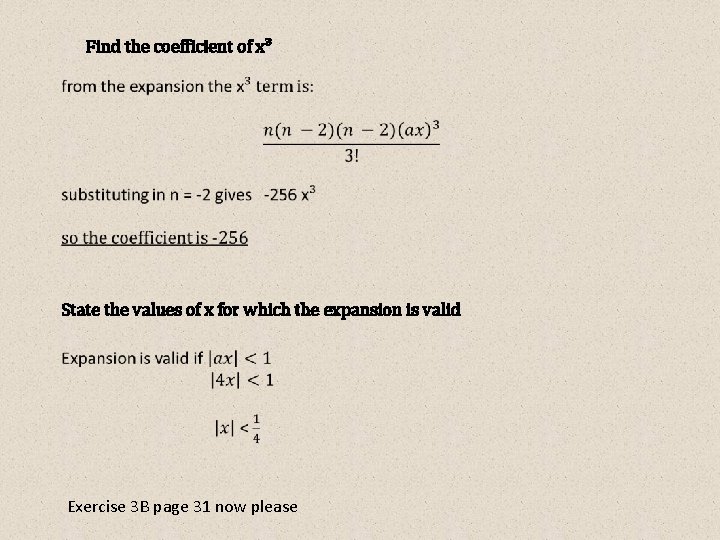
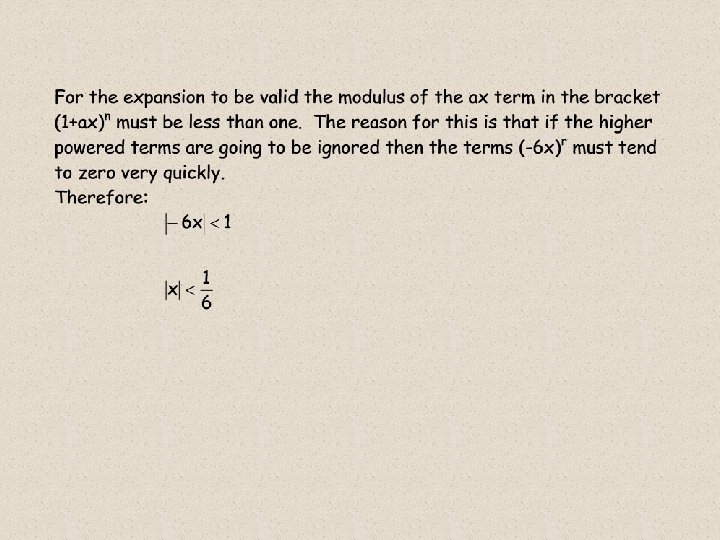
Find the coefficient of x³ State the values of x for which the expansion is valid Exercise 3 B page 31 now please
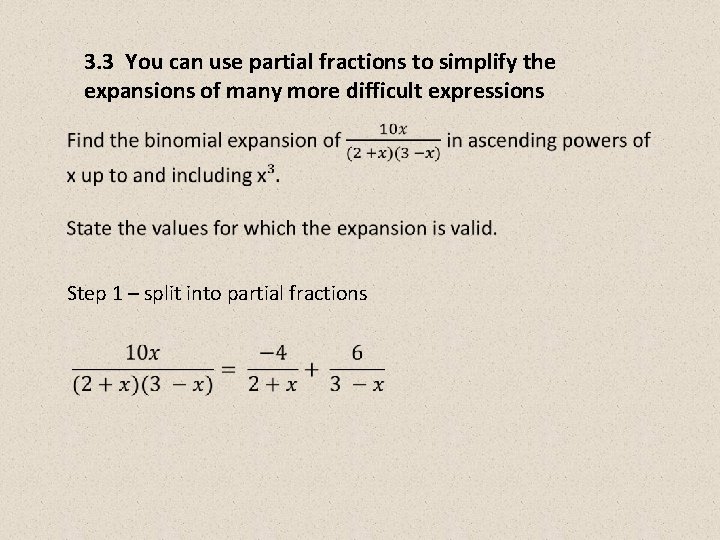
3. 3 You can use partial fractions to simplify the expansions of many more difficult expressions Step 1 – split into partial fractions
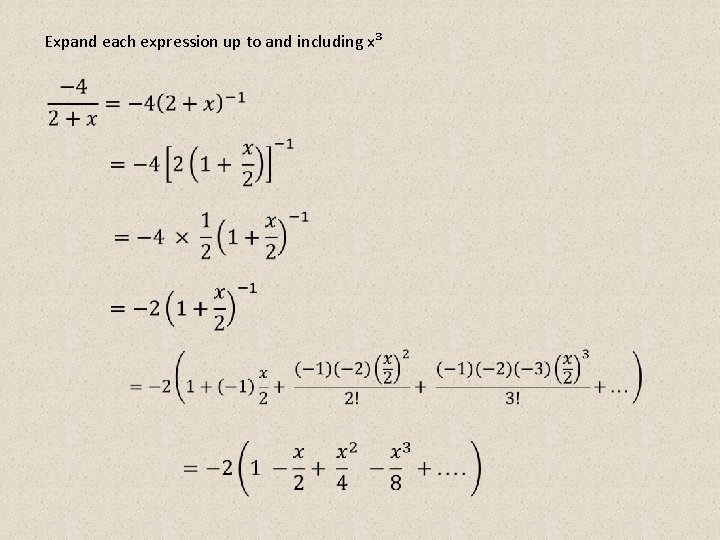
Expand each expression up to and including x³
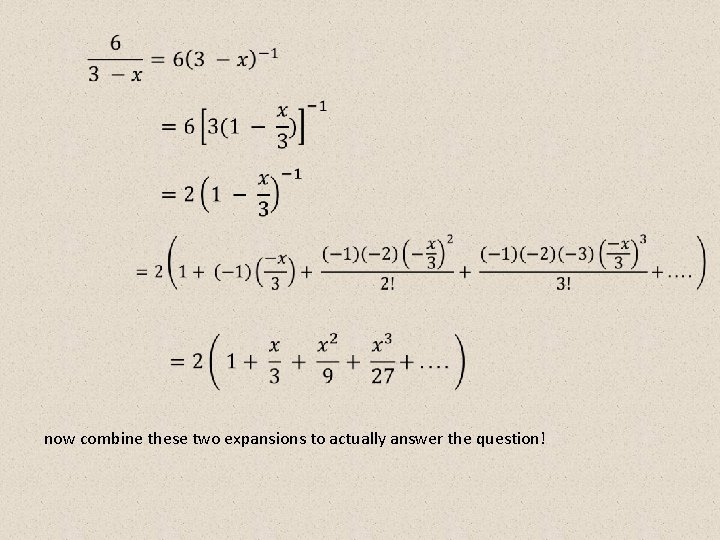
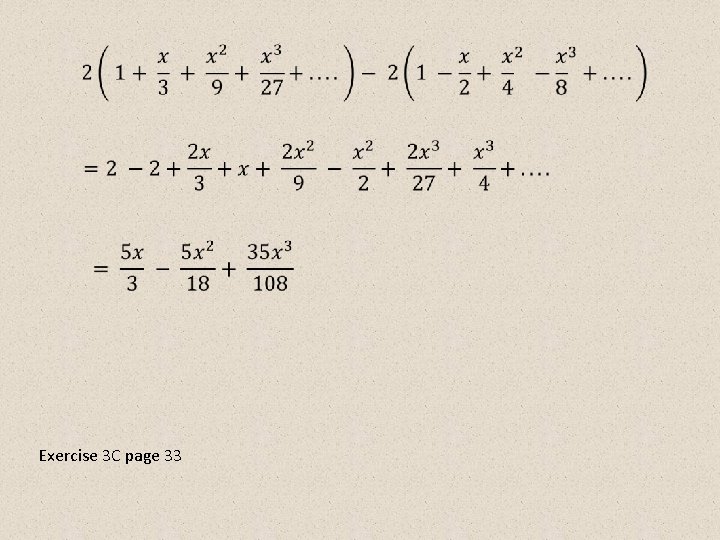
now combine these two expansions to actually answer the question!
Exercise 3 C page 33
- Slides: 20