
The Binomial and Geometric Distributions Chapter 8 8

The Binomial and Geometric Distributions Chapter 8
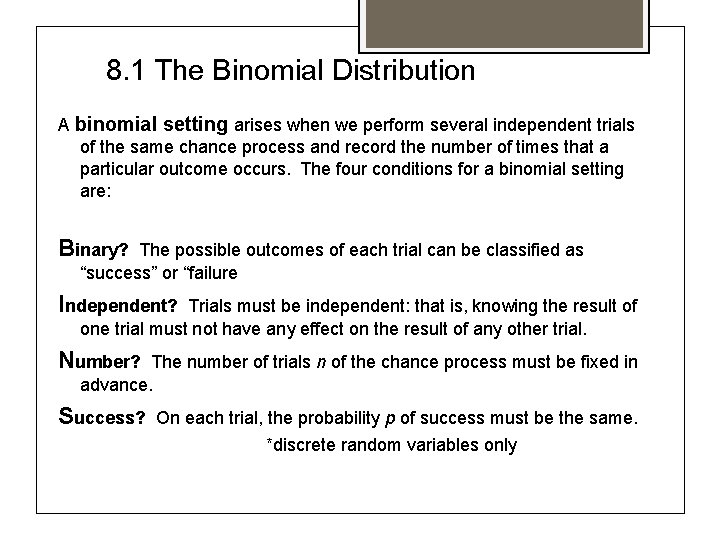
8. 1 The Binomial Distribution A binomial setting arises when we perform several independent trials of the same chance process and record the number of times that a particular outcome occurs. The four conditions for a binomial setting are: Binary? The possible outcomes of each trial can be classified as “success” or “failure Independent? Trials must be independent: that is, knowing the result of one trial must not have any effect on the result of any other trial. Number? The number of trials n of the chance process must be fixed in advance. Success? On each trial, the probability p of success must be the same. *discrete random variables only
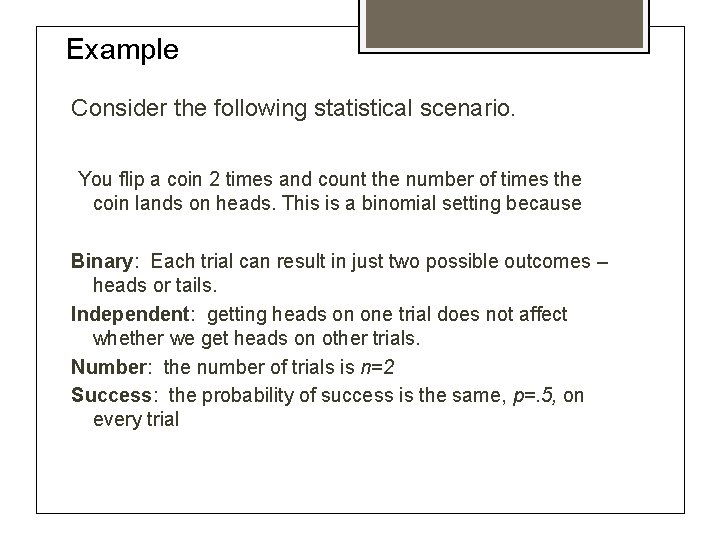
Example Consider the following statistical scenario. You flip a coin 2 times and count the number of times the coin lands on heads. This is a binomial setting because Binary: Each trial can result in just two possible outcomes – heads or tails. Independent: getting heads on one trial does not affect whether we get heads on other trials. Number: the number of trials is n=2 Success: the probability of success is the same, p=. 5, on every trial

Binomial Distribution If data are produced in a binomial setting, the random variable “X = number of successes” is called a binomial random variable. The probability distribution of a binomial random variable is called a binomial distribution
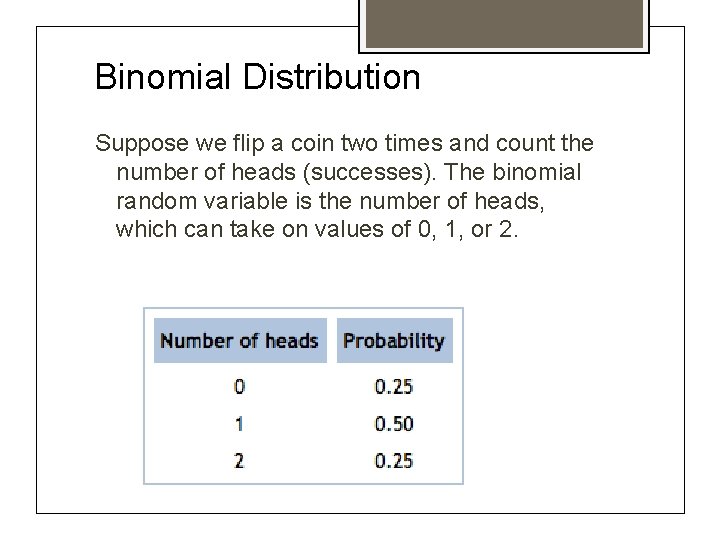
Binomial Distribution Suppose we flip a coin two times and count the number of heads (successes). The binomial random variable is the number of heads, which can take on values of 0, 1, or 2.

Binomial or not? Tossing 20 coins and counting the number of heads. Picking 5 cards from a standard deck and counting the number of hearts. We replace the card each time and reshuffle.
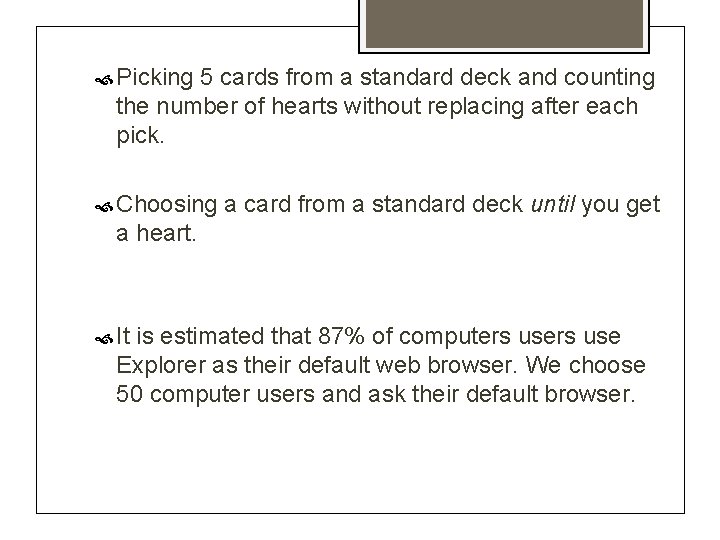
Picking 5 cards from a standard deck and counting the number of hearts without replacing after each pick. Choosing a card from a standard deck until you get a heart. It is estimated that 87% of computers use Explorer as their default web browser. We choose 50 computer users and ask their default browser.
Example 2: An engineer chooses a SRS of 10 switches from a shipment of 10, 000 switches. Suppose that (unknown to the engineer) 10% of the switches in the shipment are bad. The engineer counts the number X of bad switches in the sample.
- Slides: 8