
The Bill of Rights The First 10 Amendments
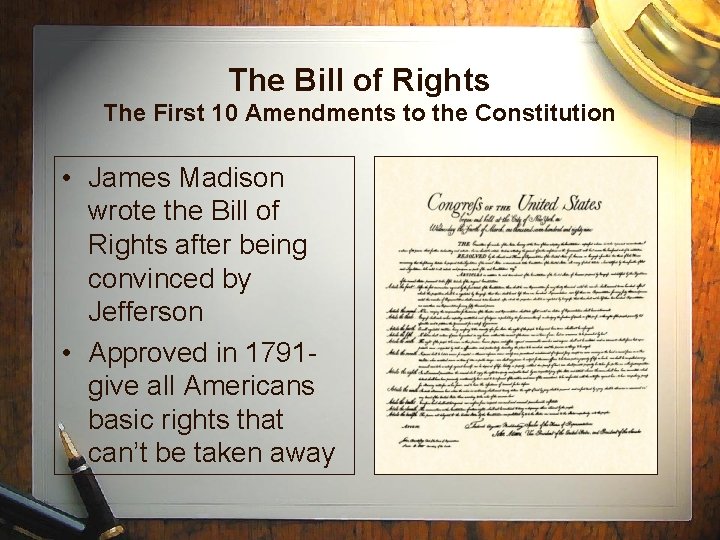
The Bill of Rights The First 10 Amendments to the Constitution • James Madison wrote the Bill of Rights after being convinced by Jefferson • Approved in 1791 give all Americans basic rights that can’t be taken away
Civil Liberties • Protections from the government abusing its power • The protections listed in the Bill of Rights are civil liberties because they protect individuals from the government
1 st Amendment • The 1 st Amendment guarantees freedom of religion, speech, the press, assembly, and petition. • This means that we all have the right to: • believe in any religion we want to • speak freely (does not have to be words ex. “symbolic speech”) • assemble (meet) / protest peacefully • address the government / complain (petition) • Journalists (press) / individuals can publish / voice opinions in newspapers, TV, radio, Internet
Limits on Free Speech • Cannot endanger the safety of others / pose a “clear and present” danger to society • Examples: • Yelling “fire” in a movie theatre • Saying “bomb” on an airplane • Reporters can’t intentionally spread lies to try to damage someone’s reputation
Limits on Protests / Meetings • The First Amendment DOES NOT give people the right to protest violently • Parades, protest marches, and political rallies, as long as they are peaceful meetings / demonstrations, can occur on public property under the First Amendment

Separation of Church & State • Establishment clause of First Amendment = government & religion must remain separate • However, a person’s “free exercise” of religion is protected ex. individual prayer in public school / atheism (can choose not to believe in God)
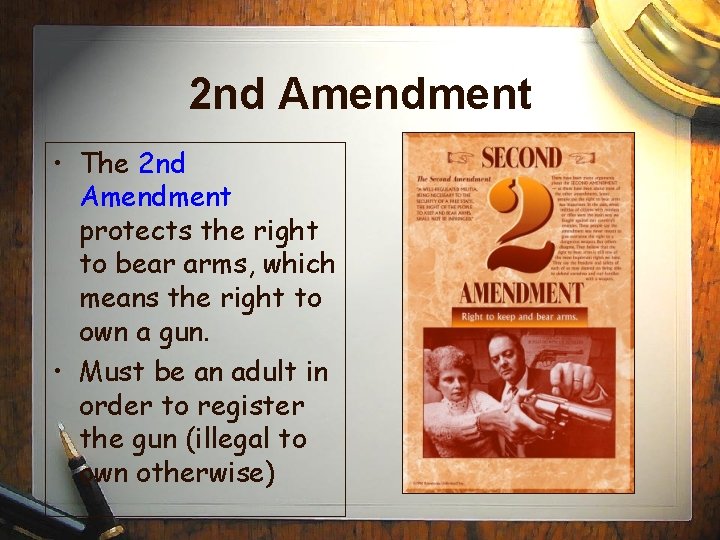
2 nd Amendment • The 2 nd Amendment protects the right to bear arms, which means the right to own a gun. • Must be an adult in order to register the gun (illegal to own otherwise)
3 rd Amendment • The 3 rd Amendment says “No soldier shall, in time of peace be quartered in any house, without the consent of the owner, nor in time of war, but in a manner to be prescribed by law. ” • This means that we cannot be forced to house or “quarter” soldiers.
4 th Amendment • The 4 th Amendment protects the people from unreasonable searches and seizures. • This means that the police / government cannot enter our homes or take our property, papers, or us, without a valid warrant or probable cause (a legitimate legal reason).
4 th Amendment Cont. • Cannot have property searched unreasonably / without probable cause • In most cases, a police officer does not have time to receive a warrant from a judge & return to a car, etc. & doing so would endanger his or her safety so the officer needs a legitimate reason to search property ex. drug dog alerts
5 th Amendment • The 5 th Amendment protects people from being held for committing a crime unless they are properly indicted (accused) • You may not be tried twice for the same crime (double jeopardy) • You don’t have to testify against yourself in court. (Self-incrimination)
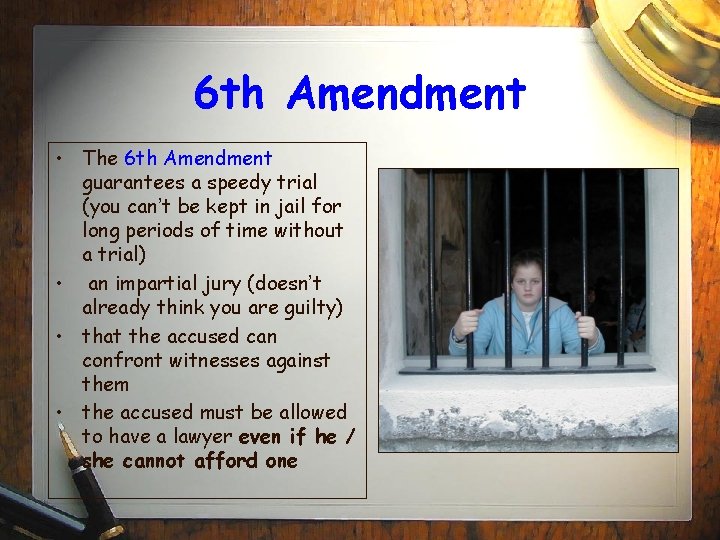
6 th Amendment • The 6 th Amendment guarantees a speedy trial (you can’t be kept in jail for long periods of time without a trial) • an impartial jury (doesn’t already think you are guilty) • that the accused can confront witnesses against them • the accused must be allowed to have a lawyer even if he / she cannot afford one
7 th Amendment • The 7 th Amendment guarantees the right to a jury trial in cases involving > $20 (all but the most minor civil cases) • A civil trial differs from a criminal trial. Civil trial = disputes between people or businesses over $, property, or family matters such as divorce. • Criminal trial is when the state tries to convict someone of a crime.
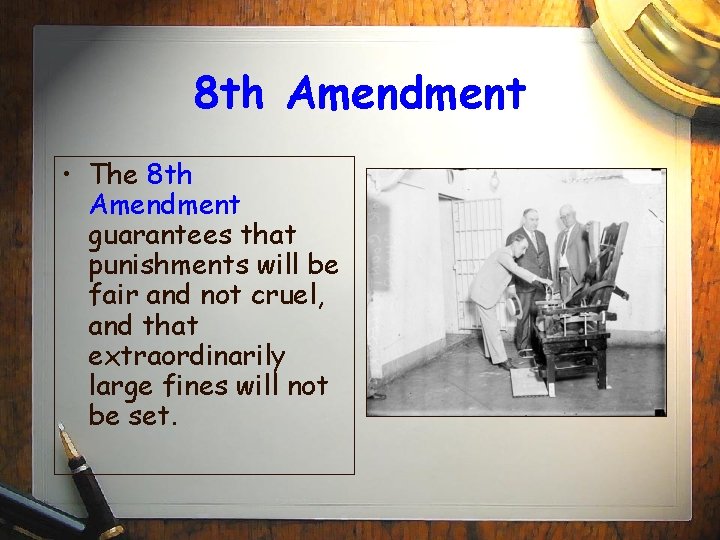
8 th Amendment • The 8 th Amendment guarantees that punishments will be fair and not cruel, and that extraordinarily large fines will not be set.
Death Penalty • In the 1976 S. C. • Still debated case Gregg v. today: some Georgia, the people argue that Court ruled that executing anyone the punishment of is a cruel and death for murder unusual does not violate punishment the 8 th Amendm.
9 th Amendment • All rights not stated in the Constitution and not forbidden by the Constitution belong to the people. • Example: Right to Privacy
10 th Amendment • The 10 th Amendment states that any power not granted to the federal government belongs to the states or to the people. • Ex. establishing schools / making marriage / divorce laws
- Slides: 17