
The Bill of Rights Chapter 4 Sections 1
The Bill of Rights Chapter 4 Sections 1 and 2
Rights What rights do you have?
Purpose n Protect individual rights n n Restrict the government n n Ex. Quartering troops, property rights, rights to the states Protect the accused n n Ex. Freedom of speech, right to bear arms Ex. Trial by jury, no cruel or unusual punishment Antifederalists wanted to add this to the Constitution before it was ratified
1 st Amendment n n n Freedom of Religion Freedom of Speech Freedom of the Press n n Freedom of Assembly n n So long as its peaceful and law abiding Freedom of Petition n n Government can not censor because it contains offensive ideas Formal request Limits: slander and libel Slander- spreading lies (spoken) Libel- spreading lies (printed)
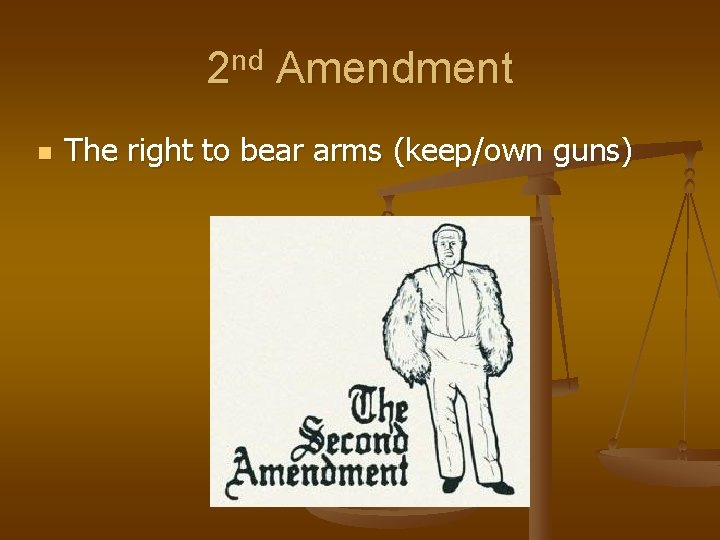
2 nd Amendment n The right to bear arms (keep/own guns)
3 rd Amendment n Not forced to quarter troops in home Do not have to house troops/soldiers n Memory from Great Britain and the Intolerable Acts n
4 th Amendment n n Protection against “unreasonable searches and seizures” (Seizure=take) Can not search without probable cause In order to search, must have a search warrant n Police use probable cause to get a search warrant from a judge n Can search without warrant in some cases: in plain sight, you consent n
5 th Amendment n n n Due Process of Law (can not be deprived life, liberty, or property without all rights guaranteed in the constitution) Indictment by a Grand Jury- enough evidence to go to trial No double jeopardy- can not be charged twice for the same crime No self-incrimination- plead the 5 th, do not have to incriminate yourself in trial Eminent domain- the government may take your property but must pay you fairly for it
6 th Amendment n n n Criminal Cases (arrested, guilt vs. innocence) Speedy, public trial- not defined, what is it? , who decides? , how? Decision from an impartial jury- lawyers decide who is impartial and pick a jury Right to know the charges- must tell you the charges Right to cross-examine witnesses Right to an attorney
7 th Amendment n n Civil Cases (2 parties disagree, lawsuit) Right to a jury in a civil case with a dispute of more than $20 Usually don’t have a jury because most cases want to be private (divorce, child custody, sue) If one side wants a jury, they must have one
8 th Amendment n n Punishment Prohibits “cruel and unusual punishment”- Not defined, what is it? , who decides? , how? , what about capital punishment Prohibits excessive bail Bail n n Money you pay promising to return to the trial (5% down) You can pay or if you can’t afford, you use a bail bondsman You get the money back when you return to the trial If you do not return you owe all of bail, there is a warrant for your arrest, bounty hunter comes to find you, court can take your personal property
9 th Amendment n n n Powers of the People Powers not listed in the Constitution are still given to the people This is an example of flexibility left by the founding fathers because they knew times would change and they couldn’t predict future circumstances
10 th Amendment n n Powers of the State Powers not listed in the Constitution are given to the state Ex. Education and public schools Another show of our founding fathers flexibility
Rights/Powers n Federal- Enumerated Powers (aka Delegated) n Shared- Concurrent Powers n State- Reserved Powers
- Slides: 14