
The Bill of Rights Chapter 4 First Amendment
The Bill of Rights Chapter 4
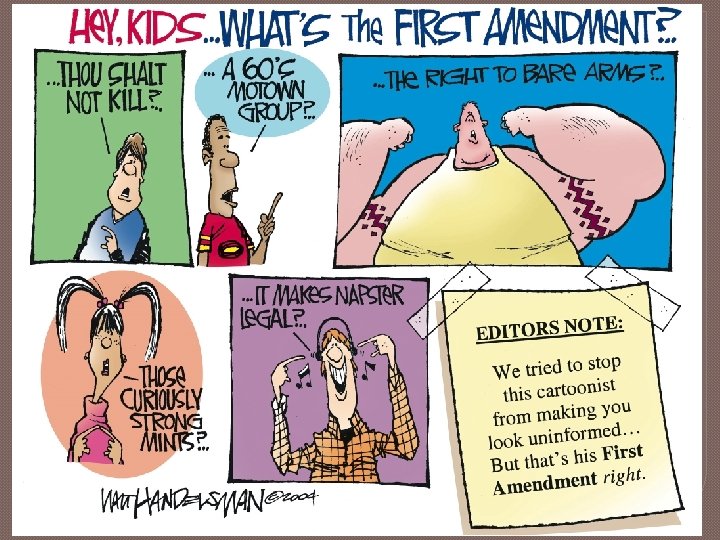
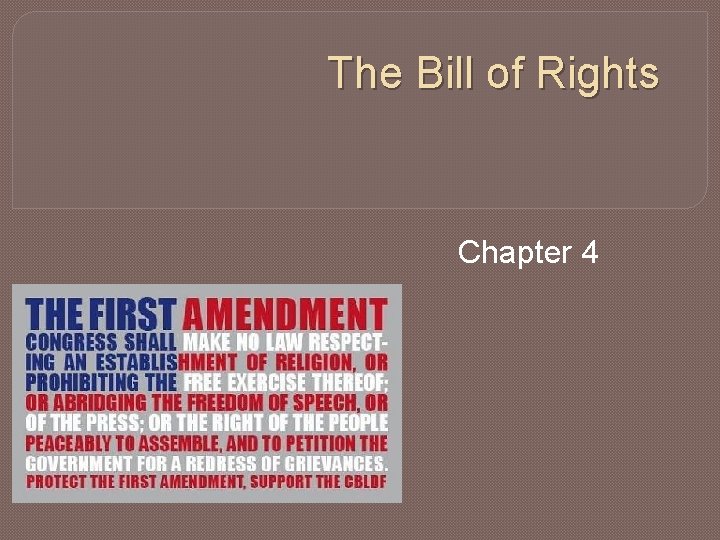
First Amendment Freedoms Founders of US believed in protecting individual rights, providing for safety and well being of citizens Bill of Rights places limits on powers of gov’t. Protects civil liberties Five basic freedoms protected in 1 st Amendment: speech, religion, assembly, press and to petition the government
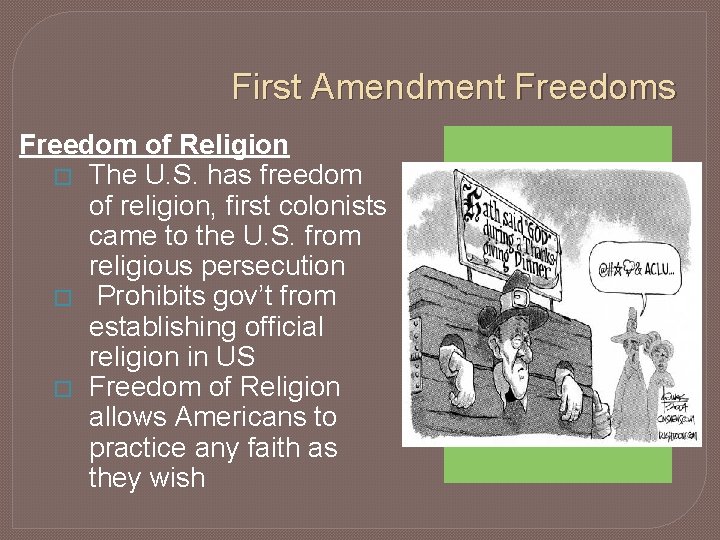
First Amendment Freedoms Freedom of Religion � The U. S. has freedom of religion, first colonists came to the U. S. from religious persecution � Prohibits gov’t from establishing official religion in US � Freedom of Religion allows Americans to practice any faith as they wish
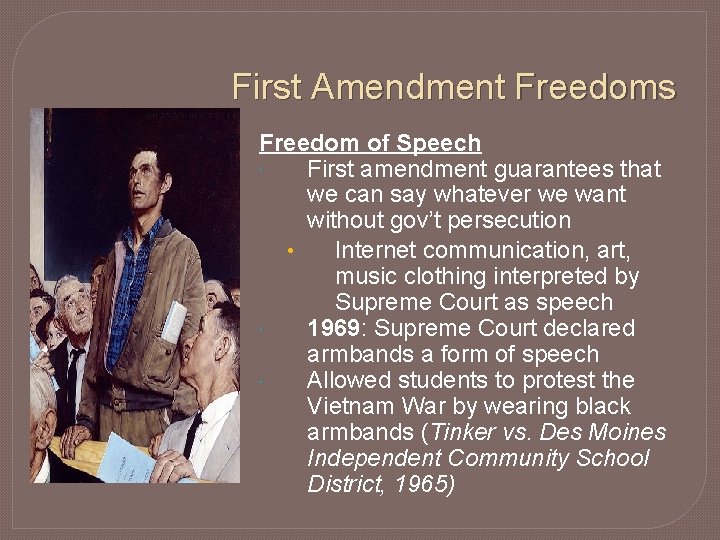
First Amendment Freedoms Freedom of Speech First amendment guarantees that we can say whatever we want without gov’t persecution • Internet communication, art, music clothing interpreted by Supreme Court as speech 1969: Supreme Court declared armbands a form of speech Allowed students to protest the Vietnam War by wearing black armbands (Tinker vs. Des Moines Independent Community School District, 1965)

First Amendment Freedoms Freedom of the Press Freedom of the press allows books, newspapers, magazines, radio, TV, and computer networks to print and broadcast anything without fear of censorship by the gov’t This allows the U. S. to have a wide variety of beliefs and ideas
First Amendment Freedoms Freedom of Assembly Right to gather in groups for any reason as long as the assemblies are peaceful Right to form and join social clubs, political parties, labor unions, and other organizations Freedom to Petition Right to express your ideas to the government, do they always respond?
Limits on the First Amendment Security Comes First Supreme Court has decided safety and security of Americans justify limitations The 1 st Amendment never intended to allow Americans to do whatever they please, the nation and its communities come before the rights of the individual You do not have freedom to • provoke a riot or violent behavior • speak or write in a way that leads to criminal activities • overthrow government • cannot interfere with the rights of others You may criticize gov’t officials but you may not spread lies that harm that person’s reputation • Slander is spoken and libel is printed
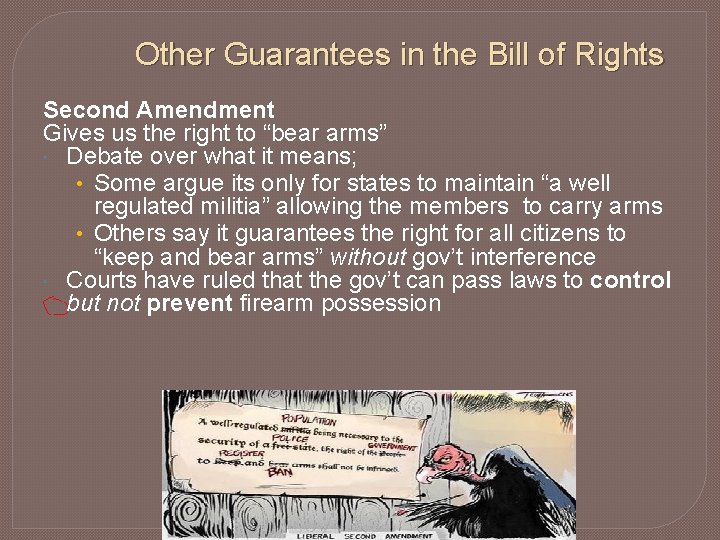
Other Guarantees in the Bill of Rights Second Amendment Gives us the right to “bear arms” Debate over what it means; • Some argue its only for states to maintain “a well regulated militia” allowing the members to carry arms • Others say it guarantees the right for all citizens to “keep and bear arms” without gov’t interference Courts have ruled that the gov’t can pass laws to control but not prevent firearm possession
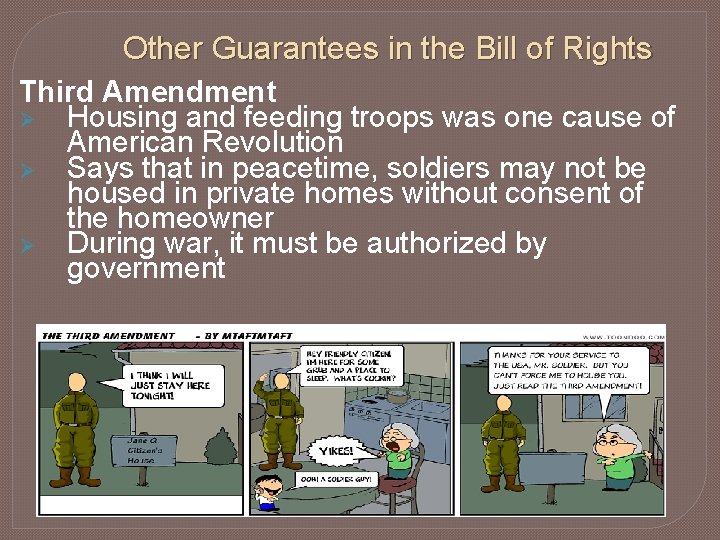
Other Guarantees in the Bill of Rights Third Amendment Ø Housing and feeding troops was one cause of American Revolution Ø Says that in peacetime, soldiers may not be housed in private homes without consent of the homeowner Ø During war, it must be authorized by government
Other Guarantees in the Bill of Rights Protecting the Rights of the Accused The right to fair legal treatment protected by the Bill of Rights 4 th, 5 th and 6 th Amendments The Fourth Amendment Protects against unreasonable searches and seizure, gov’t and police cannot search your home or take your property without good cause Police can ask a judge to issue a search warrant if they believe that you have committed a crime which gives them the right to search your property
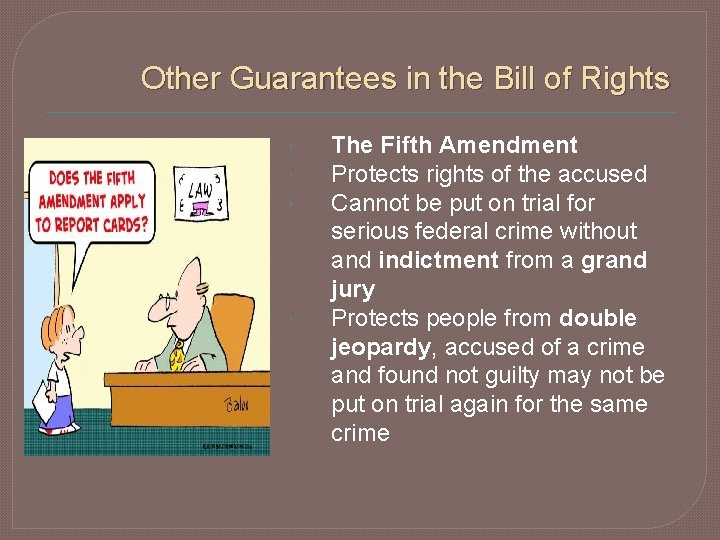
Other Guarantees in the Bill of Rights The Fifth Amendment Protects rights of the accused Cannot be put on trial for serious federal crime without and indictment from a grand jury Protects people from double jeopardy, accused of a crime and found not guilty may not be put on trial again for the same crime
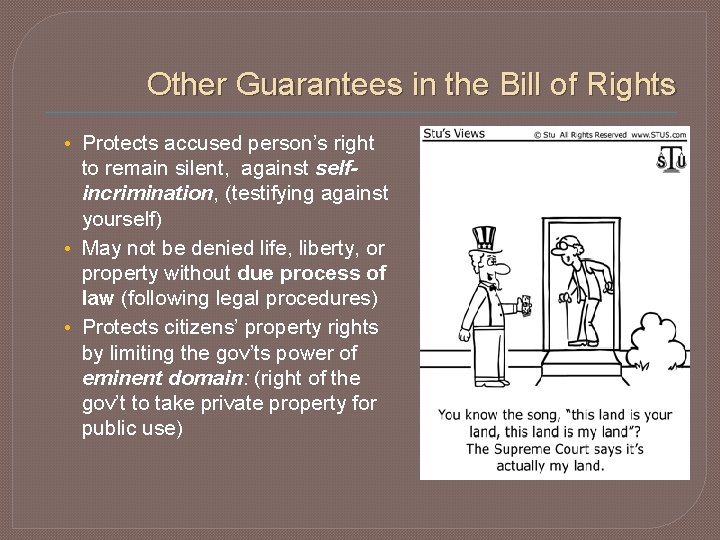
Other Guarantees in the Bill of Rights • Protects accused person’s right to remain silent, against selfincrimination, (testifying against yourself) • May not be denied life, liberty, or property without due process of law (following legal procedures) • Protects citizens’ property rights by limiting the gov’ts power of eminent domain: (right of the gov’t to take private property for public use)

Other Guarantees in the Bill of Rights The Sixth Amendment Gives due process to people accused of crimes, it requires that: Person must be told of the charges It guarantees them trial by jury A speedy and public trial, Right to hear and question witnesses, call witnesses in their defense Have an attorney even if they cannot afford one Supreme Court ruled after amendment written that the gov’t must pay for attorney Gideon v Wainwright
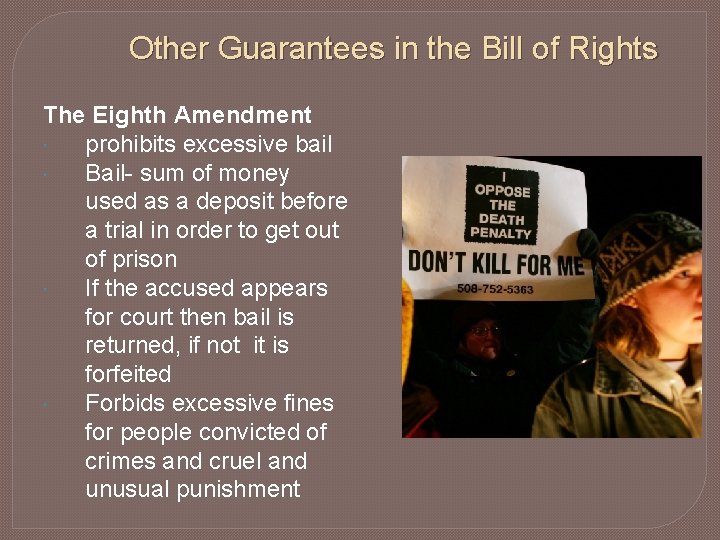
Other Guarantees in the Bill of Rights The Eighth Amendment prohibits excessive bail Bail- sum of money used as a deposit before a trial in order to get out of prison If the accused appears for court then bail is returned, if not it is forfeited Forbids excessive fines for people convicted of crimes and cruel and unusual punishment
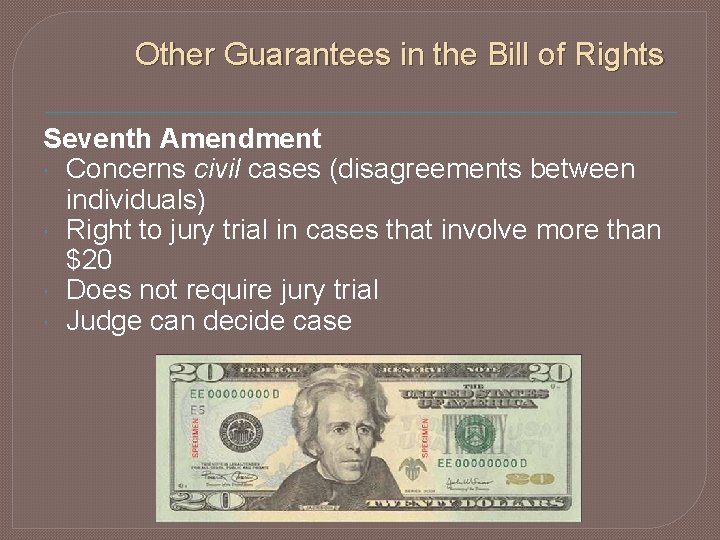
Other Guarantees in the Bill of Rights Seventh Amendment Concerns civil cases (disagreements between individuals) Right to jury trial in cases that involve more than $20 Does not require jury trial Judge can decide case
Other Guarantees in the Bill of Rights Ninth Amendment ü Says that citizens have other rights beyond those listed in the Constitution, protects our right to privacy ü Protects medical records, freedom from gov’t interference in our personal affairs üThese unwritten rights may not be taken away
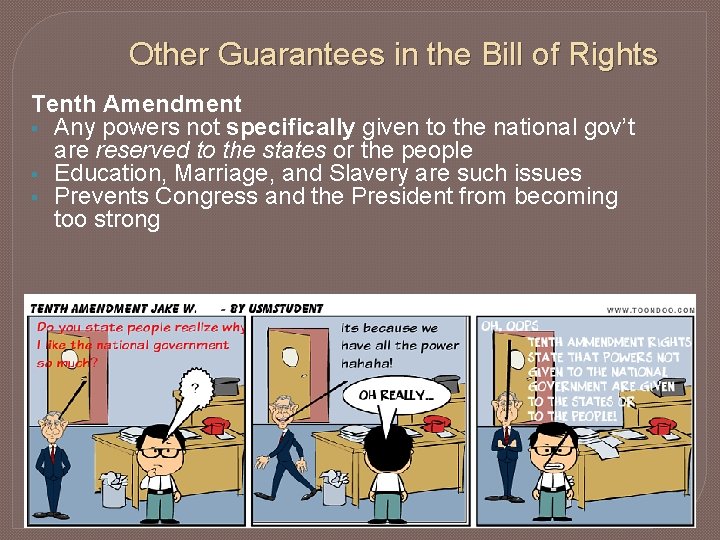
Other Guarantees in the Bill of Rights Tenth Amendment § Any powers not specifically given to the national gov’t are reserved to the states or the people § Education, Marriage, and Slavery are such issues § Prevents Congress and the President from becoming too strong
Extending the Bill of Rights For many years after the passage of the Bill of Rights, state and local gov’ts were not bound by its terms and some states passed laws that violated civil liberties The 13 th, 14 th, 15 th, Amendments known as the Civil War Amendments made states responsible for protecting civil liberties Other amendments were also responsible for extending the Bill of Rights to other citizens through voting
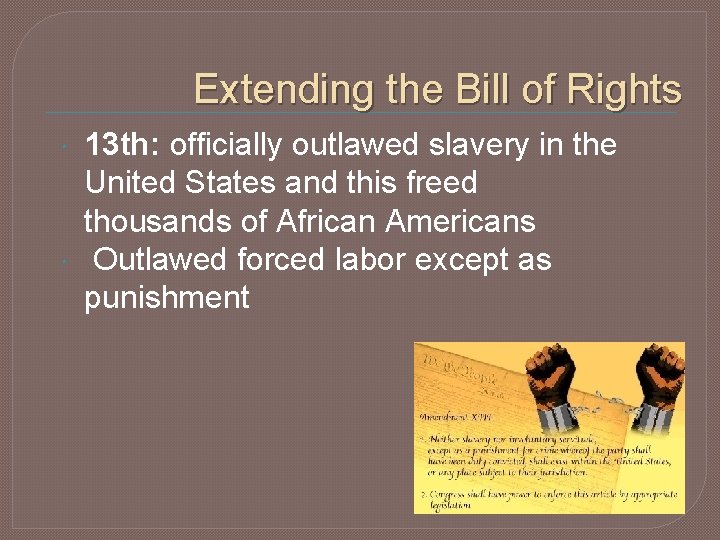
Extending the Bill of Rights 13 th: officially outlawed slavery in the United States and this freed thousands of African Americans Outlawed forced labor except as punishment
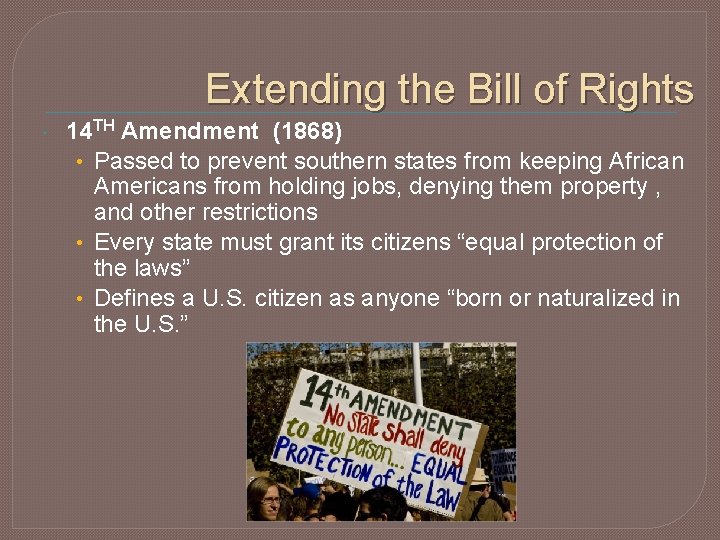
Extending the Bill of Rights 14 TH Amendment (1868) • Passed to prevent southern states from keeping African Americans from holding jobs, denying them property , and other restrictions • Every state must grant its citizens “equal protection of the laws” • Defines a U. S. citizen as anyone “born or naturalized in the U. S. ”
Extending the Bill of Rights The intent of the 14 th Amendment was to make the Bill of Rights binding for state AND national gov’t (nationalization of Bill of Rights) Ignored until 1925 when the Supreme Court ruled in Gitlow v. New York that the 14 th Amendment applies to free speech After this case Supreme Court interpreted that all of the Bill of Rights applied to the states and federal government
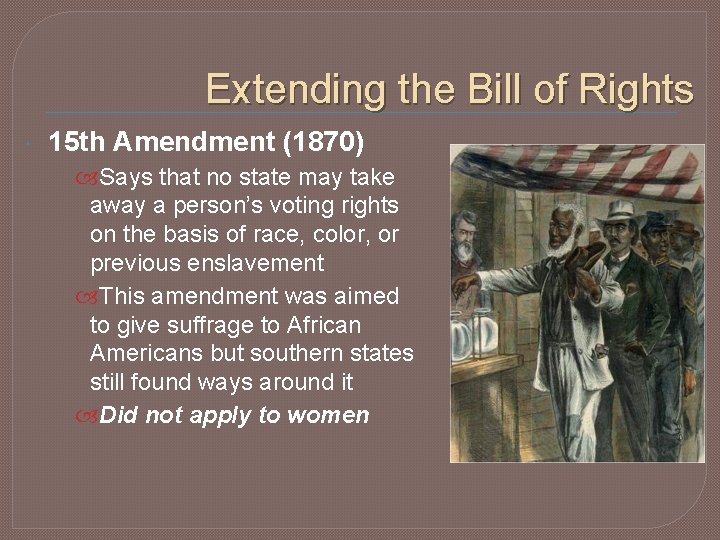
Extending the Bill of Rights 15 th Amendment (1870) Says that no state may take away a person’s voting rights on the basis of race, color, or previous enslavement This amendment was aimed to give suffrage to African Americans but southern states still found ways around it Did not apply to women
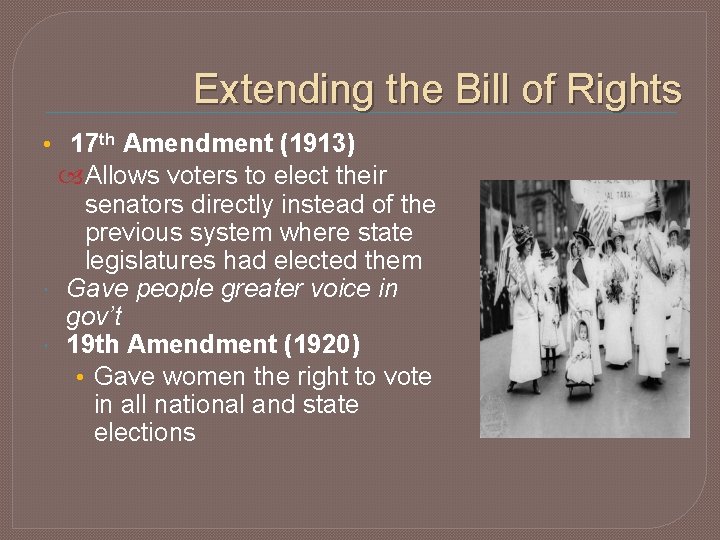
Extending the Bill of Rights • 17 th Amendment (1913) Allows voters to elect their senators directly instead of the previous system where state legislatures had elected them Gave people greater voice in gov’t 19 th Amendment (1920) • Gave women the right to vote in all national and state elections
Extending the Bill of Rights The 23 rd Amendment (1961) Allows the residents of Washington D. C. to vote for president and vice president The 24 th Amendment (1964) Made poll taxes illegal in national and state elections; this prevented some southern states from keeping poor citizens from voting The 26 th Amendment (1971) Sets the voting age at 18, this allowed teens who were fighting for the army to be able to vote This was done while America was involved in the Vietnam Conflict
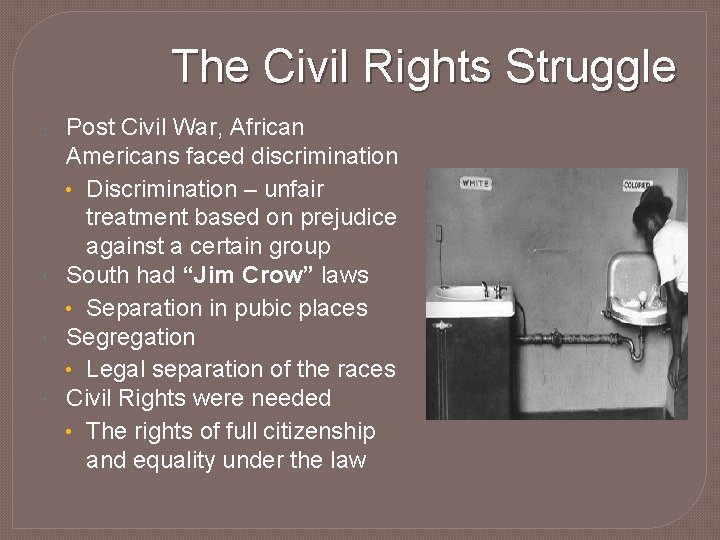
The Civil Rights Struggle Post Civil War, African Americans faced discrimination • Discrimination – unfair treatment based on prejudice against a certain group South had “Jim Crow” laws • Separation in pubic places Segregation • Legal separation of the races Civil Rights were needed • The rights of full citizenship and equality under the law
The Civil Rights Struggle African Americans seen as “second-class citizens” National Association for the Advancement of Colored People (NAACP) established in 1909 by African Americans and whites • Worked through courts to challenge laws and customs 1910 the National Urban League founded • To aid in finding jobs and getting ahead in life 1950’S and 1960’s Civil Rights Movement gradually developed from these and other groups and other involved people • Millions supported the movement
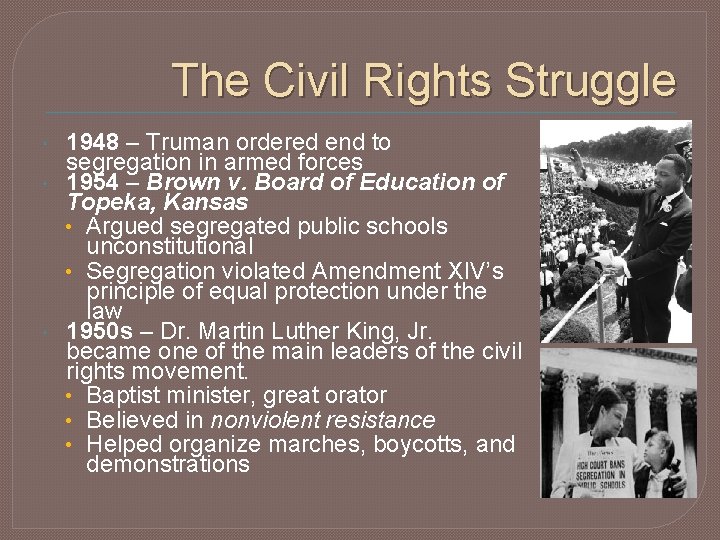
The Civil Rights Struggle 1948 – Truman ordered end to segregation in armed forces 1954 – Brown v. Board of Education of Topeka, Kansas • Argued segregated public schools unconstitutional • Segregation violated Amendment XIV’s principle of equal protection under the law 1950 s – Dr. Martin Luther King, Jr. became one of the main leaders of the civil rights movement. • Baptist minister, great orator • Believed in nonviolent resistance • Helped organize marches, boycotts, and demonstrations
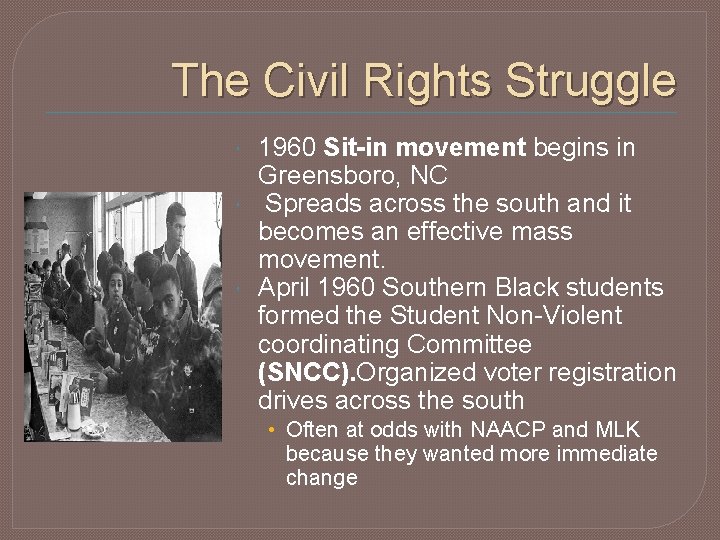
The Civil Rights Struggle 1960 Sit-in movement begins in Greensboro, NC Spreads across the south and it becomes an effective mass movement. April 1960 Southern Black students formed the Student Non-Violent coordinating Committee (SNCC). Organized voter registration drives across the south • Often at odds with NAACP and MLK because they wanted more immediate change
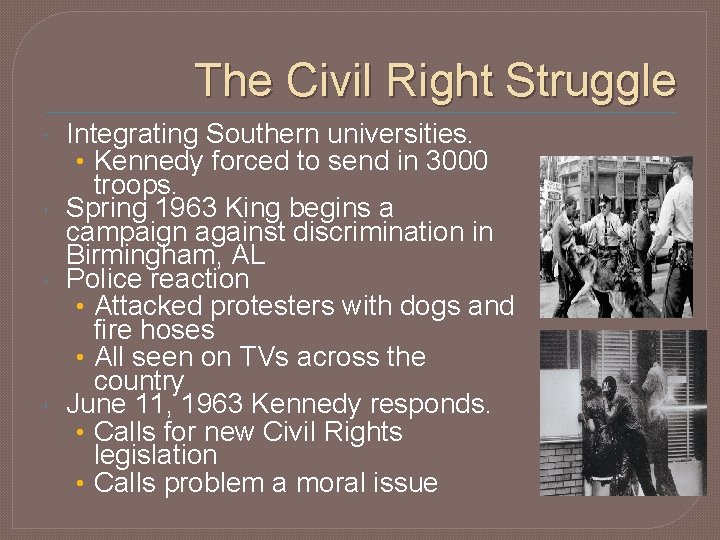
The Civil Right Struggle Integrating Southern universities. • Kennedy forced to send in 3000 troops. Spring 1963 King begins a campaign against discrimination in Birmingham, AL Police reaction • Attacked protesters with dogs and fire hoses • All seen on TVs across the country June 11, 1963 Kennedy responds. • Calls for new Civil Rights legislation • Calls problem a moral issue
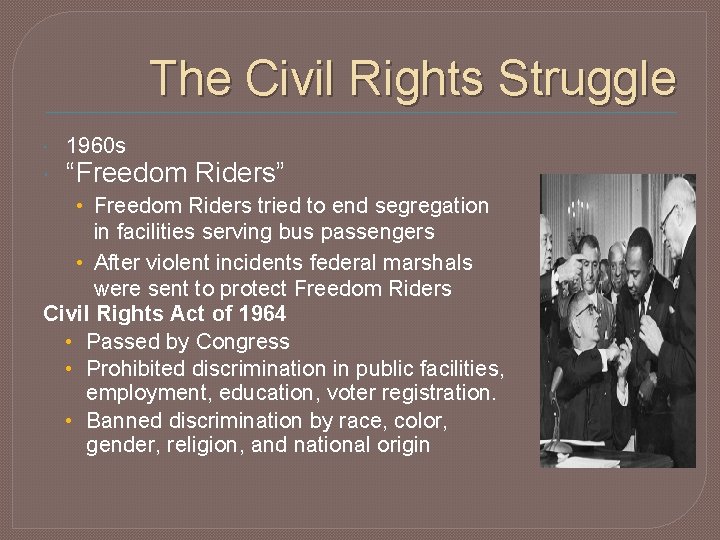
The Civil Rights Struggle 1960 s “Freedom Riders” • Freedom Riders tried to end segregation in facilities serving bus passengers • After violent incidents federal marshals were sent to protect Freedom Riders Civil Rights Act of 1964 • Passed by Congress • Prohibited discrimination in public facilities, employment, education, voter registration. • Banned discrimination by race, color, gender, religion, and national origin
1964 voting rights becomes the main goal of civil rights movement. Passage of 24 th Amendment • outlawed poll taxes Freedom Summer of 1964 was a massive voter registration drive in Mississippi • Three civil rights workers were murdered • MLK resumed voter registration drive in AL, “March to Selma” Voting Rights Act of 1965. • Did away with literacy requirements to vote • Johnson sends in federal officials to oversee voter registration. Over the next 25 years totally transforms the south because blacks are voting.
The Civil Rights Struggle Many gains since the 1960 s civil rights movement for all minorities 1970 s – affirmative action programs • Encouraged the hiring and promoting of minorities and women in fields that were traditionally closed to them. • Colleges also practiced this. Affirmative Action controversial from the beginning • Some saw it as reverse discrimination Gratz v. Bollinger (2003) – Supreme Court struck down a point-based system at the U of MI to give more points to minority applicants People still face workplace discrimination, racial profiling, hate crimes
- Slides: 33