
The Bill of Rights Chapter 4 Bell Ringer
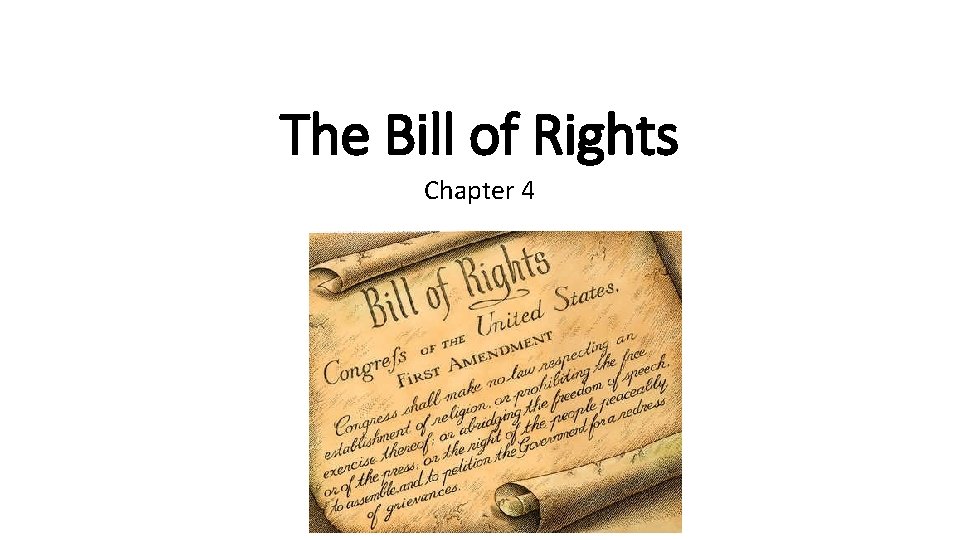
The Bill of Rights Chapter 4
Bell Ringer September 18, 2017 • Page 130 – Cartoon – Critical Thinking 1. Why does the sign say to read the Bill of Rights “in case of fire”? • Burning the flag to express an opinion is protected under the right to freedom of speech in the First Amendment
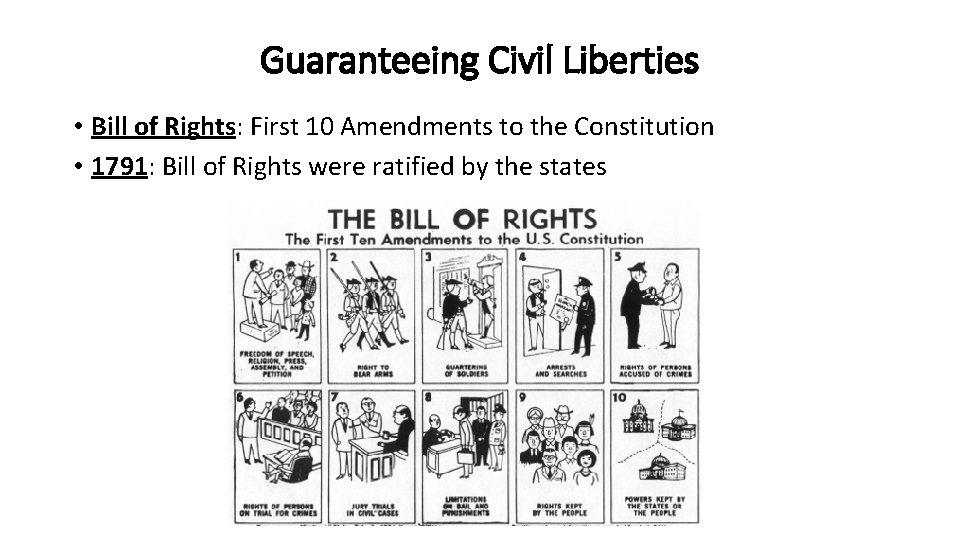
Guaranteeing Civil Liberties • Bill of Rights: First 10 Amendments to the Constitution • 1791: Bill of Rights were ratified by the states
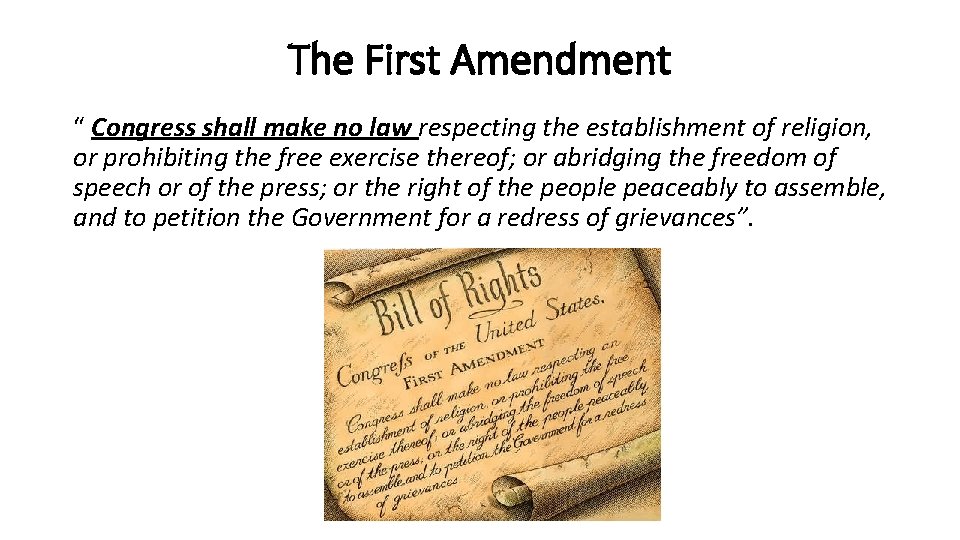
The First Amendment “ Congress shall make no law respecting the establishment of religion, or prohibiting the free exercise thereof; or abridging the freedom of speech or of the press; or the right of the people peaceably to assemble, and to petition the Government for a redress of grievances”.
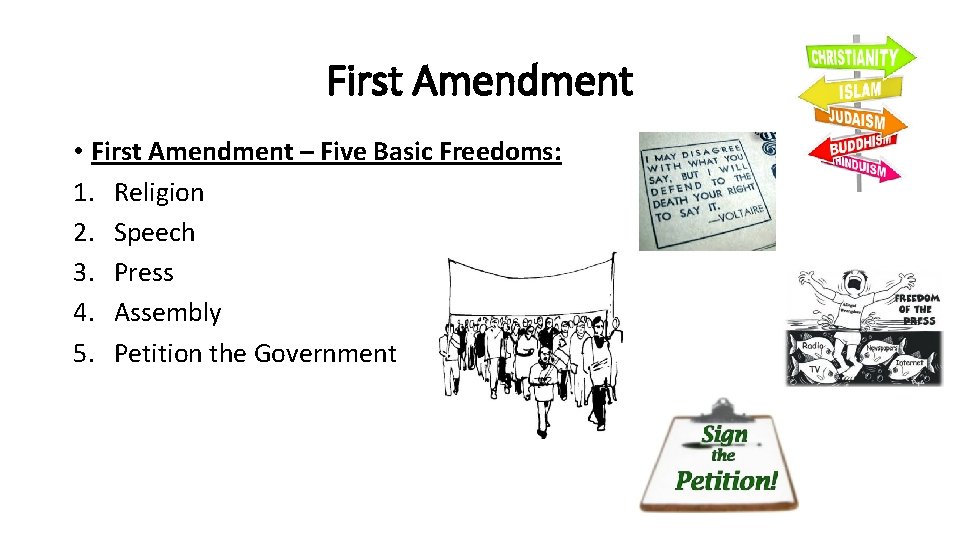
First Amendment • First Amendment – Five Basic Freedoms: 1. Religion 2. Speech 3. Press 4. Assembly 5. Petition the Government
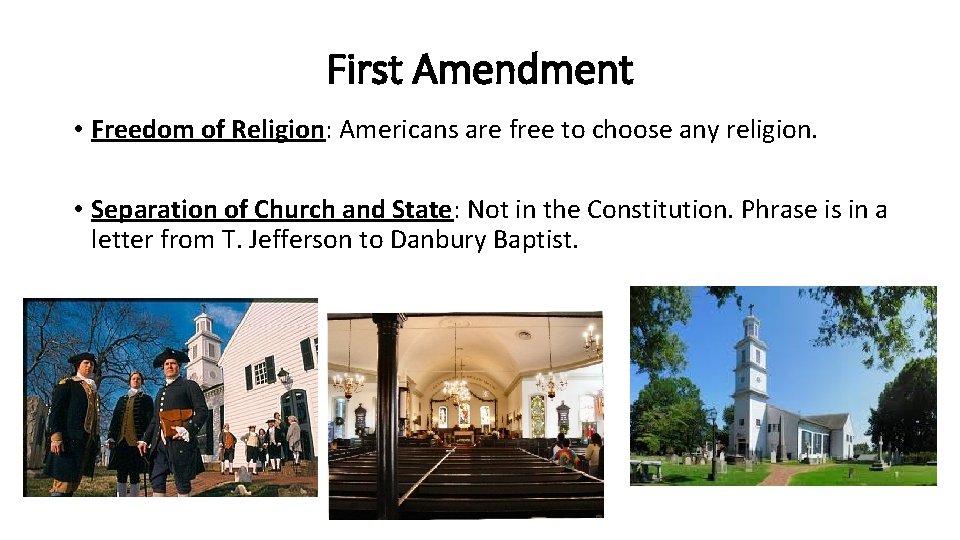
First Amendment • Freedom of Religion: Americans are free to choose any religion. • Separation of Church and State: Not in the Constitution. Phrase is in a letter from T. Jefferson to Danbury Baptist.
First Amendment • Freedom of Speech: right to speak and write freely. • You are not free to slander, or tell lies that damage another person’s reputation
First Amendment • Freedom of the Press: criticism of government may be printed without the fear of arrest. • A newspaper is not free to libel, or print lies.
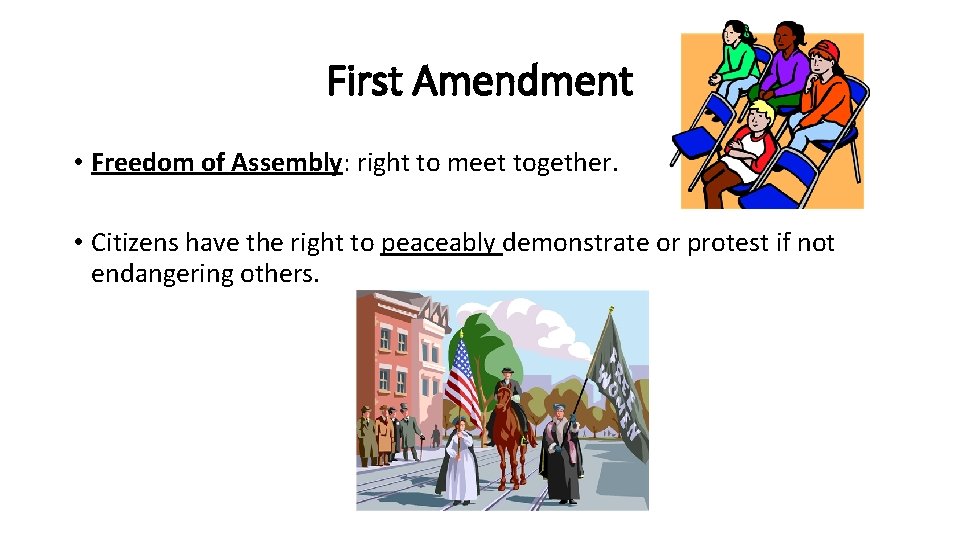
First Amendment • Freedom of Assembly: right to meet together. • Citizens have the right to peaceably demonstrate or protest if not endangering others.
First Amendment • Freedom of Petition: ask a representative to change a law or make a new law. • Citizens may do this by letter, email, telephone, or petition – a request signed by many people.
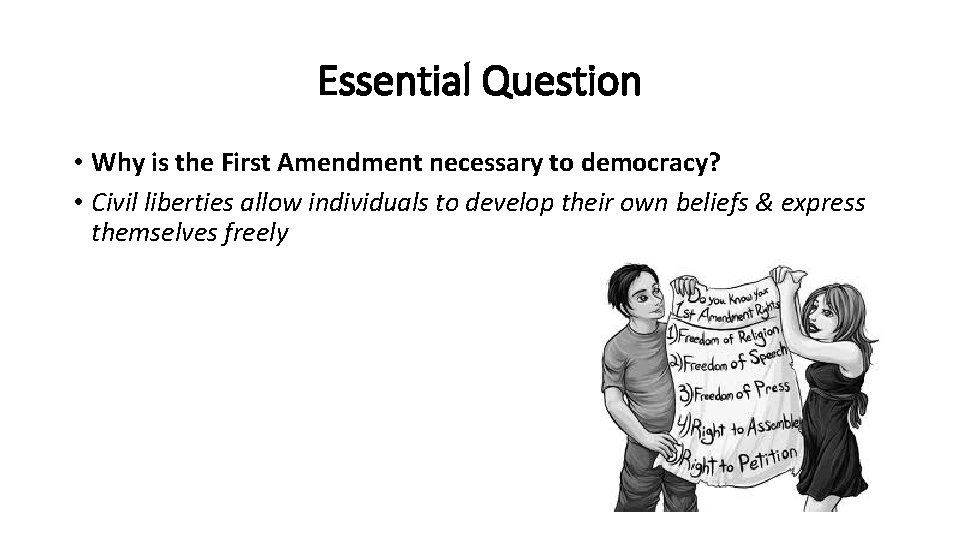
Essential Question • Why is the First Amendment necessary to democracy? • Civil liberties allow individuals to develop their own beliefs & express themselves freely
Activity – 1 st Amendment • List examples where individual rights might be limited • Sporadic protest that causes traffic problems or riots • Yelling “Fire” in a crowded building • Libel & Slander ( Press) & other examples • Rights are limited on private property (right to film, carry a gun, etc)
Tinker v. Des Moines School District Page 133 Write the Questions: Read the Selection. Page 133 1. Why did the students’ lawyers argue that wearing the armbands was protected by the First Amendment? (Explaining) 2. How did Justice Fortas’s concept of “pure speech” extend First Amendment free speech rights? (Inferring) • The students’ lawyers argued that the armbands represented a form of free speech • It determined that freedom of speech reaches beyond just words. Expression or displaying a symbol could be considered speech.
Bell Ringer • Page 136 – 138 – Critical Thinking – Interpreting 1. How does a jury trial protect the rights of the accused? 2. To whom do you think the protesters are directing their signs? 3. Why do you think gun ownership is regulated by the government • A jury trial is not the decision of one person, but many • Possibly the government, supporters of the death penalty, the Supreme Court. • So they can be identified with a crime – If their gun was used. Background checks are necessary in case of mental illness of the owner.
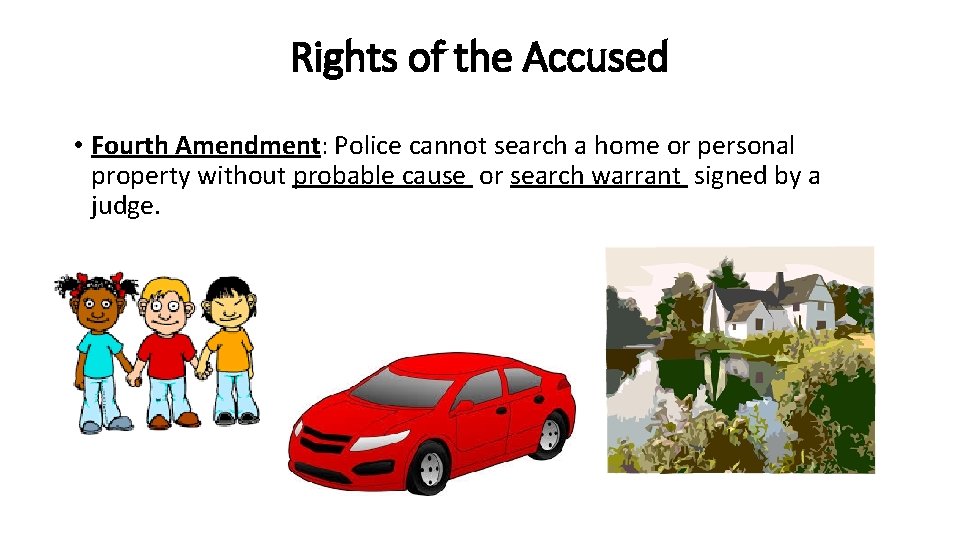
Rights of the Accused • Fourth Amendment: Police cannot search a home or personal property without probable cause or search warrant signed by a judge.
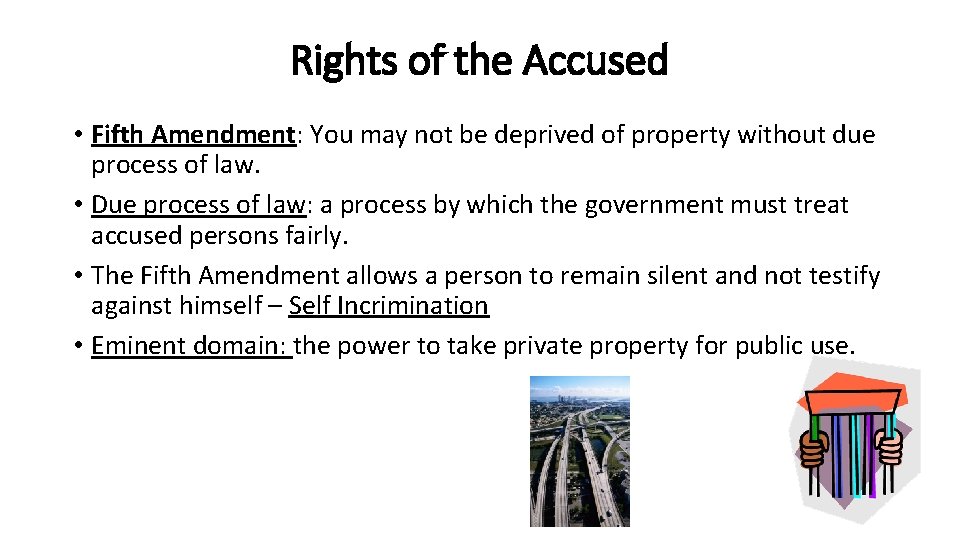
Rights of the Accused • Fifth Amendment: You may not be deprived of property without due process of law. • Due process of law: a process by which the government must treat accused persons fairly. • The Fifth Amendment allows a person to remain silent and not testify against himself – Self Incrimination • Eminent domain: the power to take private property for public use.
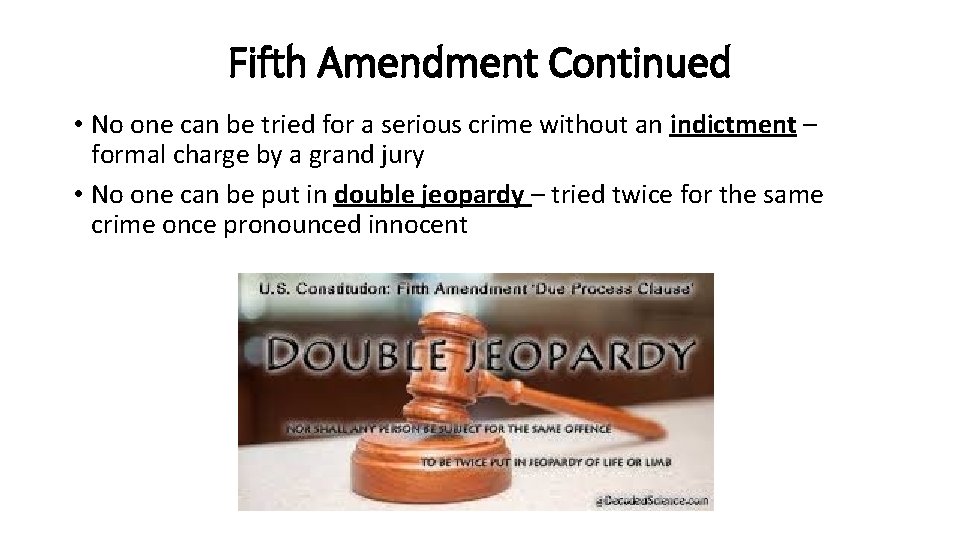
Fifth Amendment Continued • No one can be tried for a serious crime without an indictment – formal charge by a grand jury • No one can be put in double jeopardy – tried twice for the same crime once pronounced innocent
Rights of the Accused • 6 th Amendment: Speedy Trial by Jury & Right to a lawyer • 8 th Amendment: Right to post bail; forbids excessive bail or cruel punishment (death penalty debated)
More Amendments • 2 nd : Right to bear arms • 3 rd : Do not have to quarter soldiers during peacetime • 7 th: Right to jury case for civil cases • 9 th: we still have rights not mentioned in the Bill of Rights • 10 th: Whatever is not given to the Federal Gov’t in the Constitution is reserved for the states.
Debate the Issue Page 140 • Is the Patriot Act an infringement of Privacy?
Bell Ringer September 20, 2017 • Page 143 Chart Skills – Identifying - Speculating 1. What amendments affected the office of the president? In what ways? 2. Why do you think women were given the right to vote before 18 year olds? • The 12 th revised the procedure for electing the president & VP, • the 20 th changed the dates of the term, • the 22 nd limited the president to 2 terms , • the 25 th established the procedures for succession • Women form ½ the population. Women had organized & lobbied for 80 years to win the right.
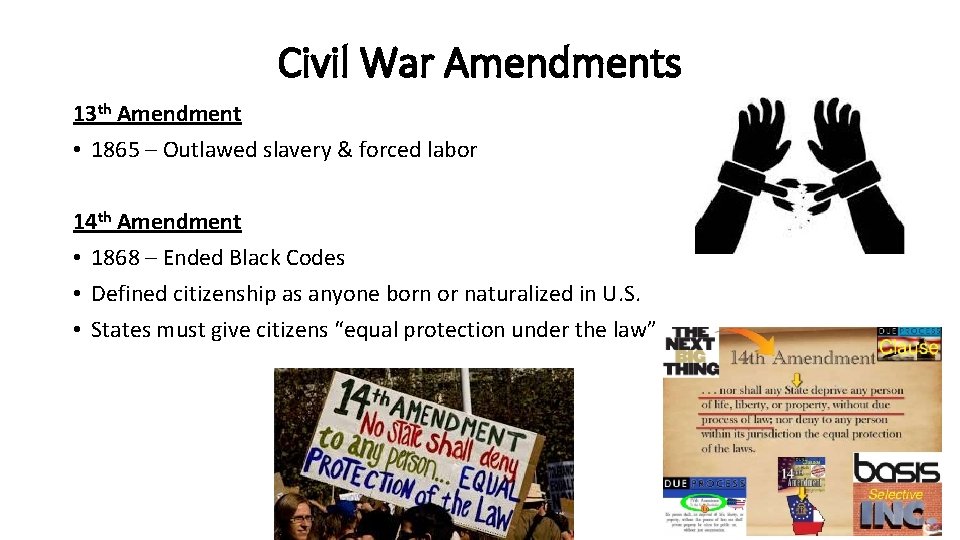
Civil War Amendments 13 th Amendment • 1865 – Outlawed slavery & forced labor 14 th Amendment • 1868 – Ended Black Codes • Defined citizenship as anyone born or naturalized in U. S. • States must give citizens “equal protection under the law”
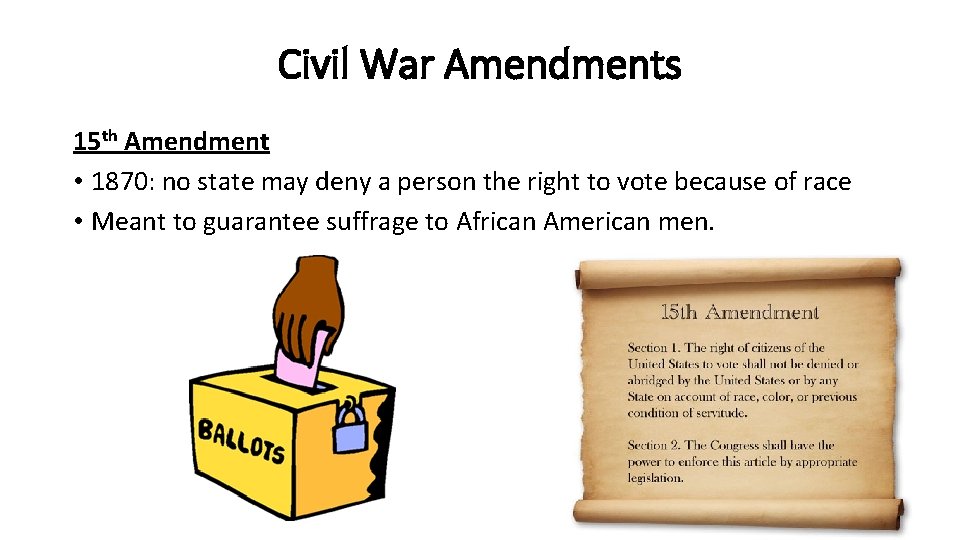
Civil War Amendments 15 th Amendment • 1870: no state may deny a person the right to vote because of race • Meant to guarantee suffrage to African American men.
Electoral Process & Voting Rights • 17 th Amendment: 1913 – Direct election of Senators • 19 th Amendment: 1920 – Right of Women to vote • 23 rd Amendment: 1961 – Right of Citizens in Washington, DC to vote for President • 24 th Amendment: 1964 – Made poll tax illegal in national elections 1966 – Supreme Court ruled tax illegal in states as well • 26 th Amendment: 1971 – Lowered voting age to 18
Essential Question • In what ways have 20 th century amendments affected voting rights & changed elections? • Senators are elected directly by the people • Women gained the right to vote • Citizens of Washington, DC can vote • 18 year-olds can vote • Poll tax is illegal
Bell Ringer September 21, 2017 • Page 147, 148, Critical Thinking Pictures 1. In what part of the country do you think the Freedom Riders traveled? (Inferring) 2. How did Rosa Park’s action lead to the Montgomery Bus Boycott? 3. How did peaceful protests such as sit-ins help the Civil Rights cause? (Inferring) • Where Bus Companies were still formally segregated • People protested her arrest by boycotting the buses • Sit-ins brought attention to the cause of peaceful protests
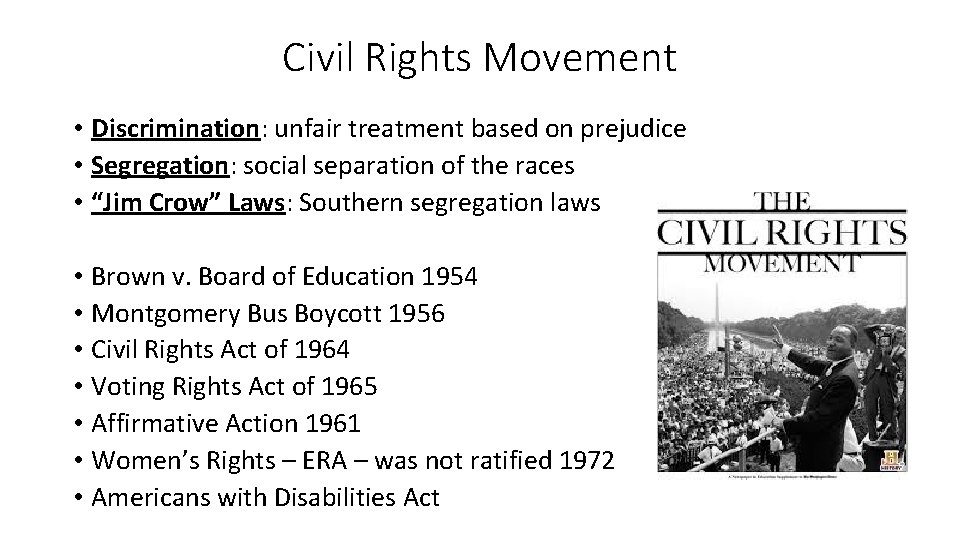
Civil Rights Movement • Discrimination: unfair treatment based on prejudice • Segregation: social separation of the races • “Jim Crow” Laws: Southern segregation laws • Brown v. Board of Education 1954 • Montgomery Bus Boycott 1956 • Civil Rights Act of 1964 • Voting Rights Act of 1965 • Affirmative Action 1961 • Women’s Rights – ERA – was not ratified 1972 • Americans with Disabilities Act
Essential Question • What conditions led to the Civil Rights Movement? • African Americans were subjected to discrimination in the form of segregation laws.
- Slides: 28