
The Big Dig Managing Risk and Complexity on
The Big Dig: Managing Risk and Complexity on Mega Projects Presentation to PM Connect Thursday, December 15, 2011 Virginia A. Greiman, Assistant Professor, Boston University V. A. Greiman Copyright © 2011 Permission as Required
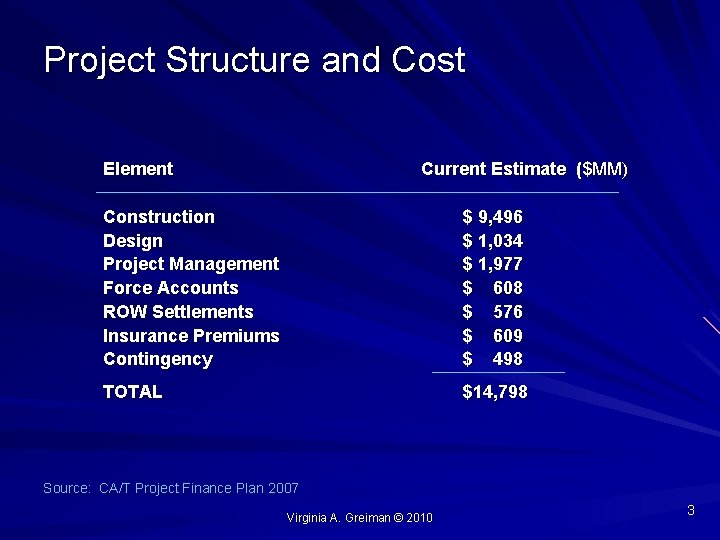
Project Structure and Cost Element Current Estimate ($MM) Construction Design Project Management Force Accounts ROW Settlements Insurance Premiums Contingency $ 9, 496 $ 1, 034 $ 1, 977 $ 608 $ 576 $ 609 $ 498 TOTAL $14, 798 Source: CA/T Project Finance Plan 2007 Virginia A. Greiman © 2010 3
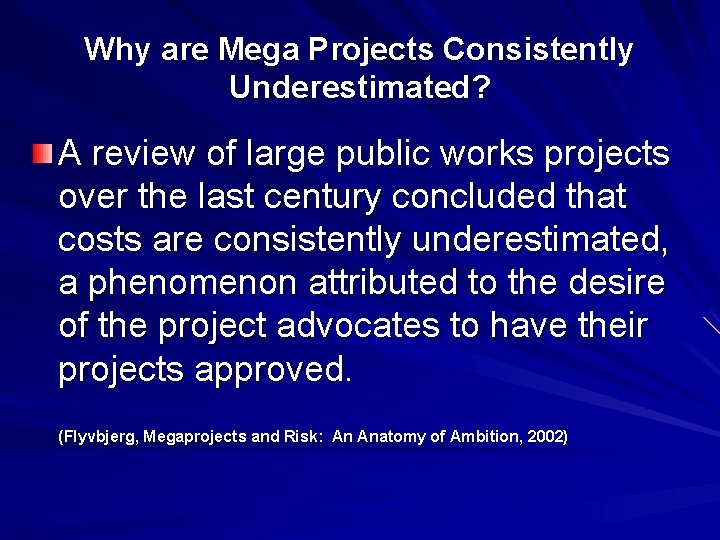
Why are Mega Projects Consistently Underestimated? A review of large public works projects over the last century concluded that costs are consistently underestimated, a phenomenon attributed to the desire of the project advocates to have their projects approved. (Flyvbjerg, Megaprojects and Risk: An Anatomy of Ambition, 2002)
National Transportation Research Board 2006 Cost Estimation Report Identified 8 Strategies linked to 18 different causes of cost escalation on highway projects in the United States. Notably, the research concluded that most efforts in cost estimation have focused on creating tools to improve cost estimates with less emphasis on tools for cost estimation management. (Anderson et. al. 2006).
Risk and Cost Escalation Factors Engineering and Construction Complexities Scope Changes Ambiguous and Conflicting Contract Provisions Unforeseen Events Unforeseen Conditions Virginia A. Greiman © 2010 6
What Makes a Project Complex? Size and Duration: The Big Dig and The English Chunnel (FHWA: More than $1 Billion) Numerous Stakeholders with diverse interests Technology: Hoover Dam and Panama Canal Extension Untried: BP Gulf of Mexico Oil Disaster Integration of Processes: Many Diverse and Autonomous, but interrelated and interdependent components or parts linked through many dense interconnections. Virginia A. Greiman © 2010 7
Major Complexity Challenges on the Big Dig: Project Integration – (150 Major Employers – One Team) 5, 000 workers, thousands of complex processes Risk Management – World’s Largest Wrap-up Program Technology Integration – Monitoring the Critical Path Claims and Changes - Partnering
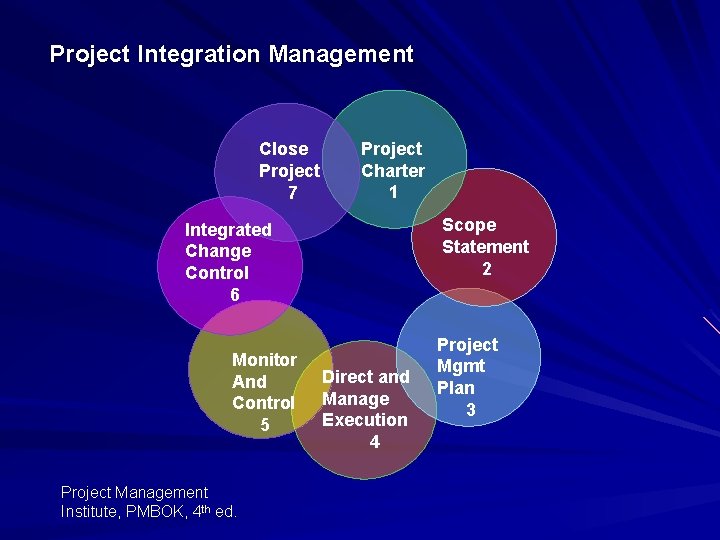
Project Integration Management Close Project 7 Project Charter 1 Scope Statement 2 Integrated Change Control 6 Monitor And Control 5 Project Management Institute, PMBOK, 4 th ed. Direct and Manage Execution 4 Project Mgmt Plan 3
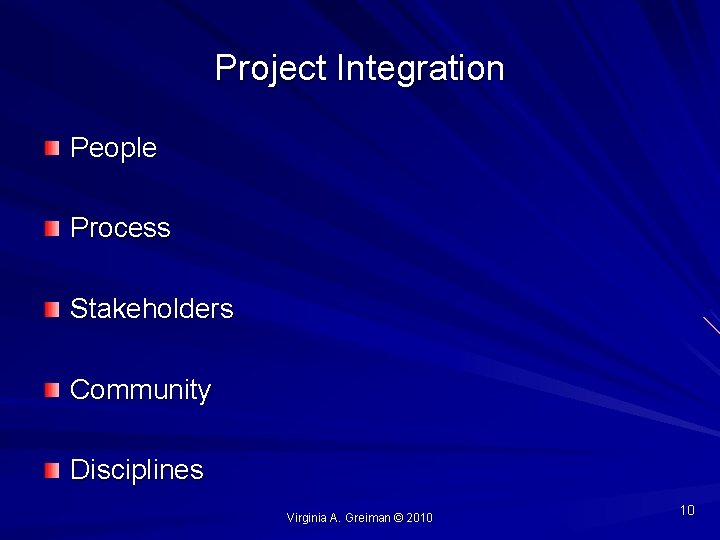
Project Integration People Process Stakeholders Community Disciplines Virginia A. Greiman © 2010 10

PMI Project Management Trade-offs Design, Risk, Safety, and Quality Decisions!!
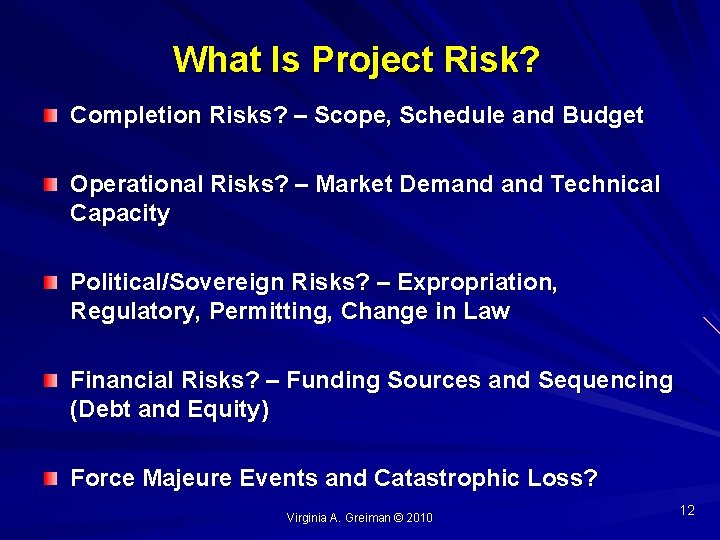
What Is Project Risk? Completion Risks? – Scope, Schedule and Budget Operational Risks? – Market Demand Technical Capacity Political/Sovereign Risks? – Expropriation, Regulatory, Permitting, Change in Law Financial Risks? – Funding Sources and Sequencing (Debt and Equity) Force Majeure Events and Catastrophic Loss? Virginia A. Greiman © 2010 12
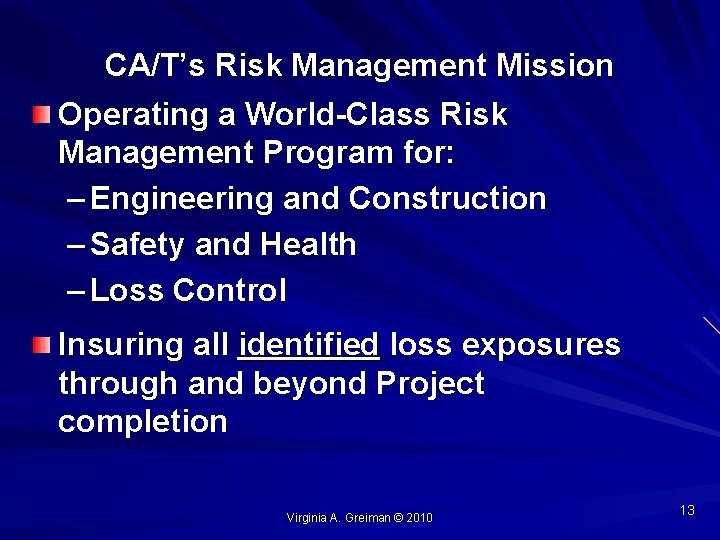
CA/T’s Risk Management Mission Operating a World-Class Risk Management Program for: – Engineering and Construction – Safety and Health – Loss Control Insuring all identified loss exposures through and beyond Project completion Virginia A. Greiman © 2010 13
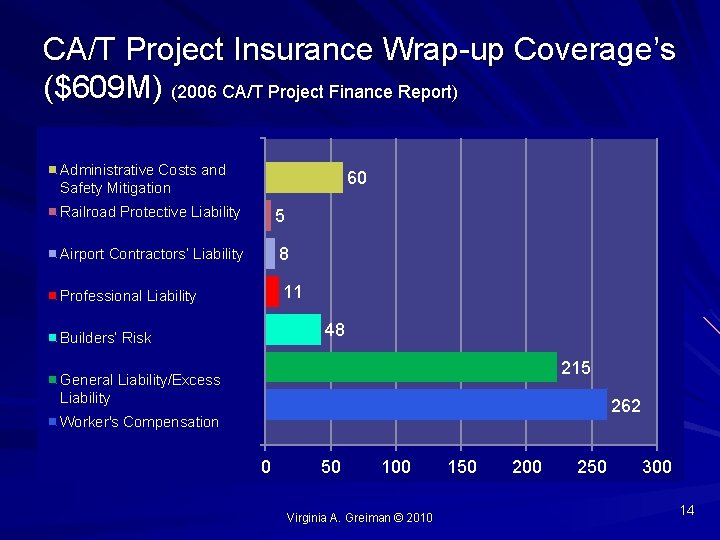
CA/T Project Insurance Wrap-up Coverage’s ($609 M) (2006 CA/T Project Finance Report) Administrative Costs and Safety Mitigation 60 Railroad Protective Liability 5 Airport Contractors’ Liability 8 Professional Liability 11 48 Builders’ Risk 215 General Liability/Excess Liability 262 Worker's Compensation 0 50 100 Virginia A. Greiman © 2010 150 200 250 300 14
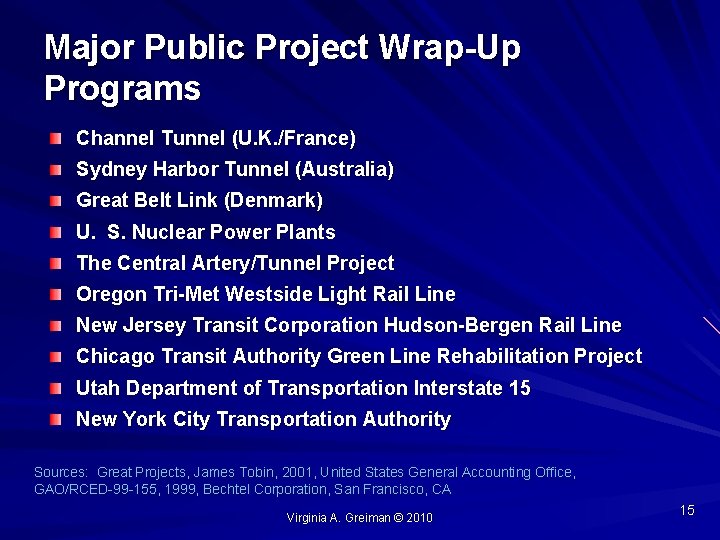
Major Public Project Wrap-Up Programs Channel Tunnel (U. K. /France) Sydney Harbor Tunnel (Australia) Great Belt Link (Denmark) U. S. Nuclear Power Plants The Central Artery/Tunnel Project Oregon Tri-Met Westside Light Rail Line New Jersey Transit Corporation Hudson-Bergen Rail Line Chicago Transit Authority Green Line Rehabilitation Project Utah Department of Transportation Interstate 15 New York City Transportation Authority Sources: Great Projects, James Tobin, 2001, United States General Accounting Office, GAO/RCED-99 -155, 1999, Bechtel Corporation, San Francisco, CA Virginia A. Greiman © 2010 15
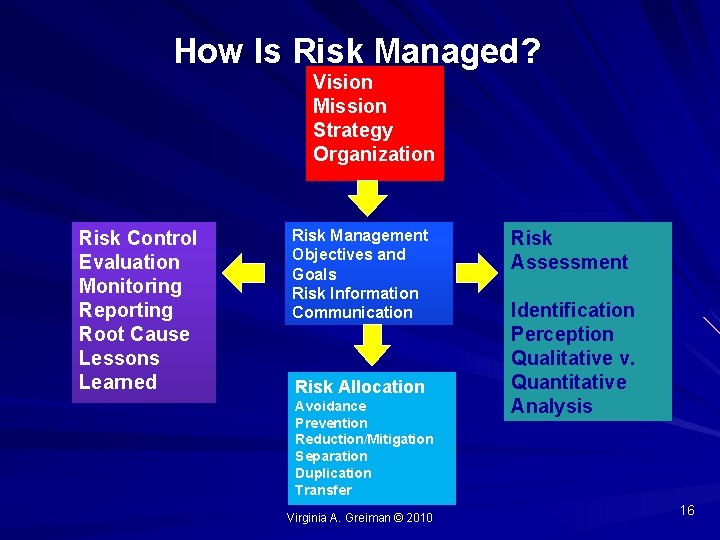
How Is Risk Managed? Vision Mission Strategy Organization Risk Control Evaluation Monitoring Reporting Root Cause Lessons Learned Risk Management Objectives and Goals Risk Information Communication Risk Allocation Avoidance Prevention Reduction/Mitigation Separation Duplication Transfer Virginia A. Greiman © 2010 Risk Assessment Identification Perception Qualitative v. Quantitative Analysis 16
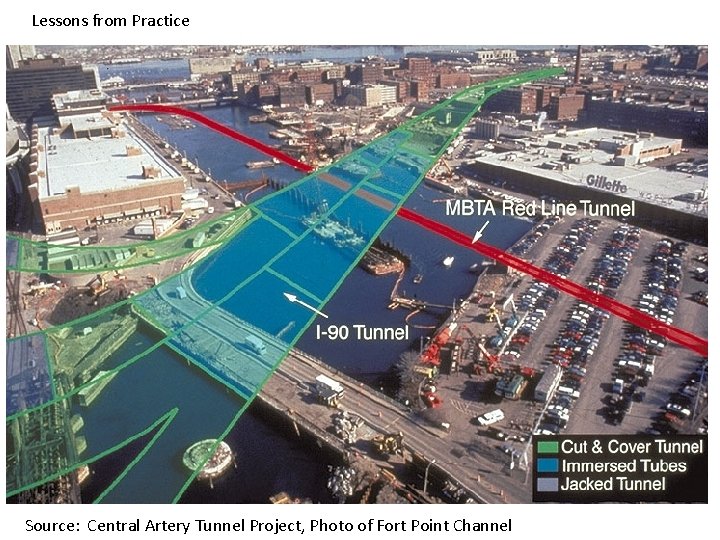
Lessons from Practice Source: Central Artery Tunnel Project, Photo of Fort Point Channel
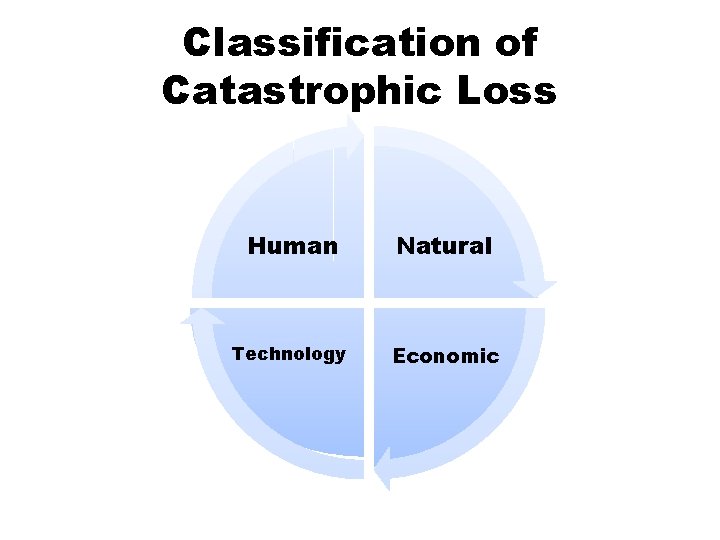
Classification of Catastrophic Loss Human Natural Technology Economic
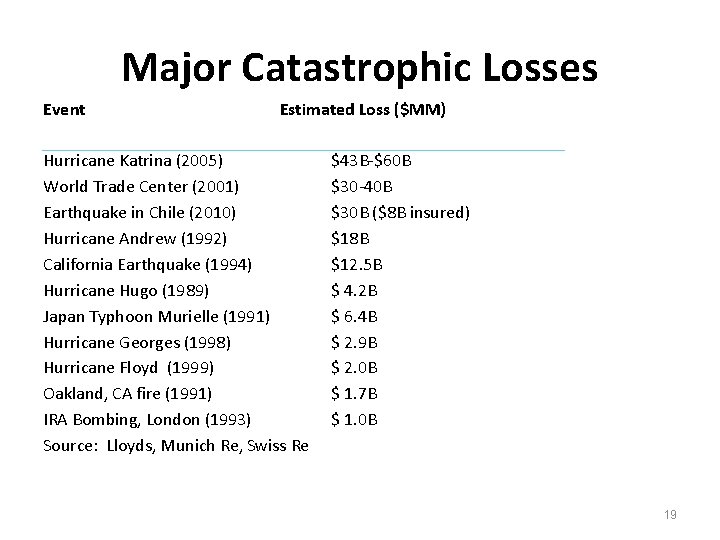
Major Catastrophic Losses Event Estimated Loss ($MM) Hurricane Katrina (2005) World Trade Center (2001) Earthquake in Chile (2010) Hurricane Andrew (1992) California Earthquake (1994) Hurricane Hugo (1989) Japan Typhoon Murielle (1991) Hurricane Georges (1998) Hurricane Floyd (1999) Oakland, CA fire (1991) IRA Bombing, London (1993) Source: Lloyds, Munich Re, Swiss Re $43 B-$60 B $30 -40 B $30 B ($8 B insured) $18 B $12. 5 B $ 4. 2 B $ 6. 4 B $ 2. 9 B $ 2. 0 B $ 1. 7 B $ 1. 0 B 19
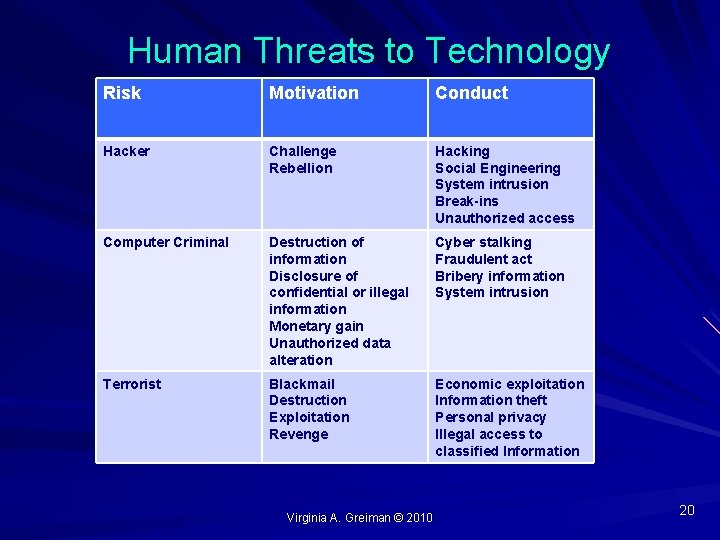
Human Threats to Technology Risk Motivation Conduct Hacker Challenge Rebellion Hacking Social Engineering System intrusion Break-ins Unauthorized access Computer Criminal Destruction of information Disclosure of confidential or illegal information Monetary gain Unauthorized data alteration Cyber stalking Fraudulent act Bribery information System intrusion Terrorist Blackmail Destruction Exploitation Revenge Economic exploitation Information theft Personal privacy Illegal access to classified Information Virginia A. Greiman © 2010 20
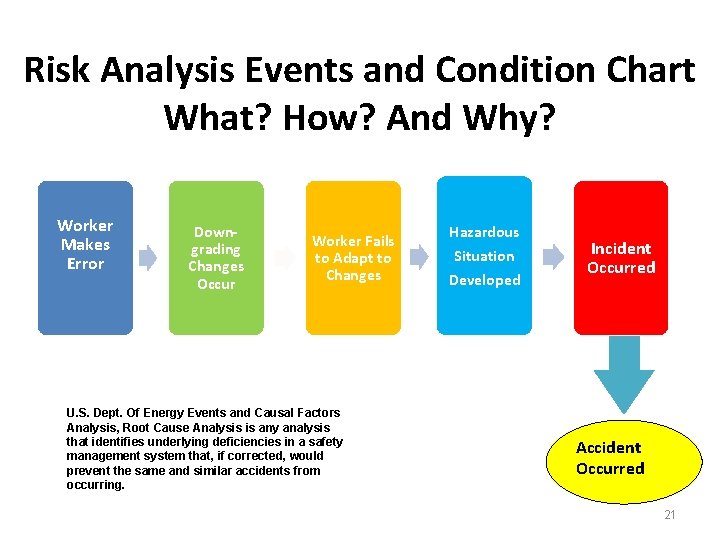
Risk Analysis Events and Condition Chart What? How? And Why? Worker Makes Error Downgrading Changes Occur Worker Fails to Adapt to Changes U. S. Dept. Of Energy Events and Causal Factors Analysis, Root Cause Analysis is any analysis that identifies underlying deficiencies in a safety management system that, if corrected, would prevent the same and similar accidents from occurring. Hazardous Situation Developed Incident Occurred Accident Occurred 21
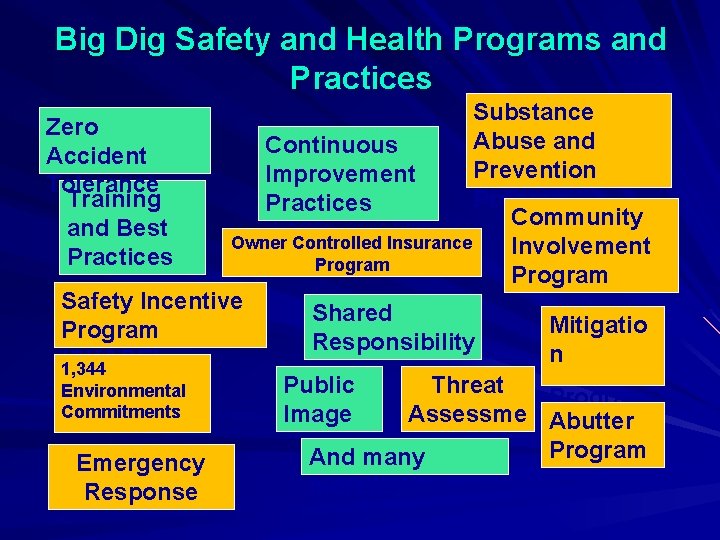
Big Dig Safety and Health Programs and Practices Substance Abuse and Continuous Prevention Improvement Program Practices Community Owner Controlled Insurance Involvement Program Safety Incentive Shared Mitigatio Program Responsibility n (SHARE) 1, 344 Public Threat Environmental Program Commitments Image Assessme Abutter nt Program And many Emergency more… Response Zero Accident Tolerance Training and Best Practices
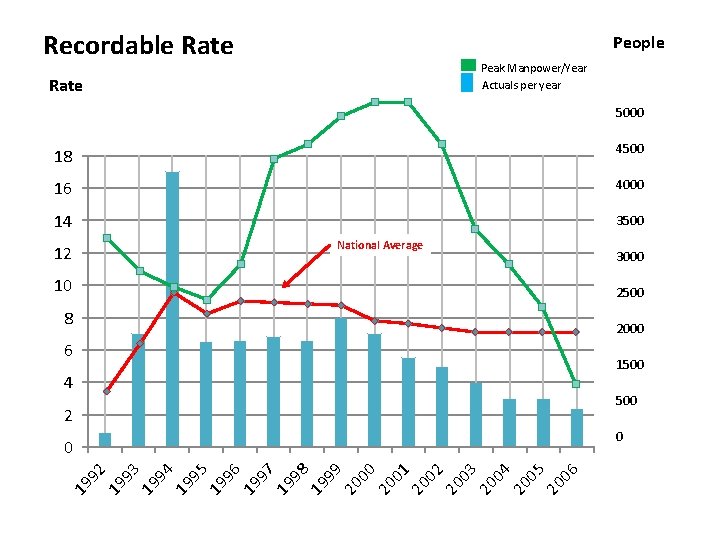
Recordable Rate People Peak Manpower/Year Actuals per year Rate 5000 18 4500 16 4000 14 3500 National Average 12 3000 10 2500 8 2000 6 1500 4 500 2 0 06 20 05 20 04 20 03 20 02 20 01 20 00 20 99 19 98 19 97 19 96 19 95 19 94 19 93 19 19 92 0
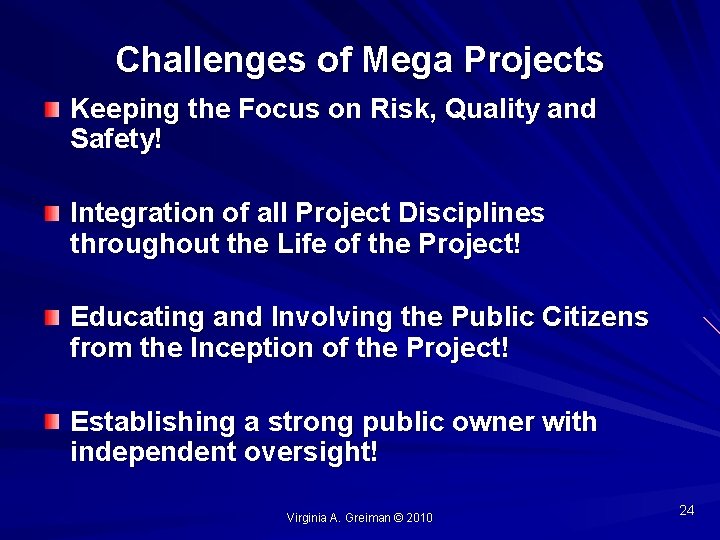
Challenges of Mega Projects Keeping the Focus on Risk, Quality and Safety! Integration of all Project Disciplines throughout the Life of the Project! Educating and Involving the Public Citizens from the Inception of the Project! Establishing a strong public owner with independent oversight! Virginia A. Greiman © 2010 24
Thank Your For Your Participation! Questions? ? ? Virginia A. Greiman Assistant Professor Boston University 617 -353 -6860 ggreiman@bu. edu Virginia A. Greiman © 2010 25
- Slides: 25