
The Big Challenge Trading Models Richard Olsen Overview
The Big Challenge: Trading Models Richard Olsen
Overview • What is the right approach to building trading models? • Understanding the nature of time • The power of scaling laws • Lego building blocks for development of financial engines • The vision: platform similar to Foldit • What needs to be done. Olsen
Personal Background • Studied law at University of Zurich, Economics at Oxford, Ph. D in law, Title: Interaction Between Law And Society. • Worked in a bank in research department and as a trader • Founded Olsen & Associates in 1985, collect tick-by-tick foreign exchange data as of 1986, develop a real-time. information system with forecasts of price and volatility, trading recommendations and other analytics. • Discovery of scaling law of absolute price changes in 1989, first conference on high frequency finance in 1995, discovery of scaling law of number of directional changes in 1997. Olsen
Personal Background • Co-founded OANDA in 1996, introduced currency converter, launched a trading platform in 2001 with second -by-second interest rate payments, leading FX market maker • Essex University Visiting Professor from 2008 • Discovery of 12 new scaling laws in 2008, published in journal of quantitative finance, see also http: //arxiv. org/abs/0809. 1040 • Hands on experience of running a hedge fund Olsen
Personal Motivation • Inspired by progress in medicine and computer technology to innovate in finance. • Not afraid to start afresh. • Bottom-up approach to economics, begin with collecting tick-by-tick data and proceed iteratively. • Financial markets are not a zero-sum game; they are an integral part of real economy. • I view financial markets as a source of energy: risk/return ratio is 1 to 25 (one year coastline is 1600% after transaction costs compared to price risk of 30%). Olsen
How Have Managers Performed? Olsen
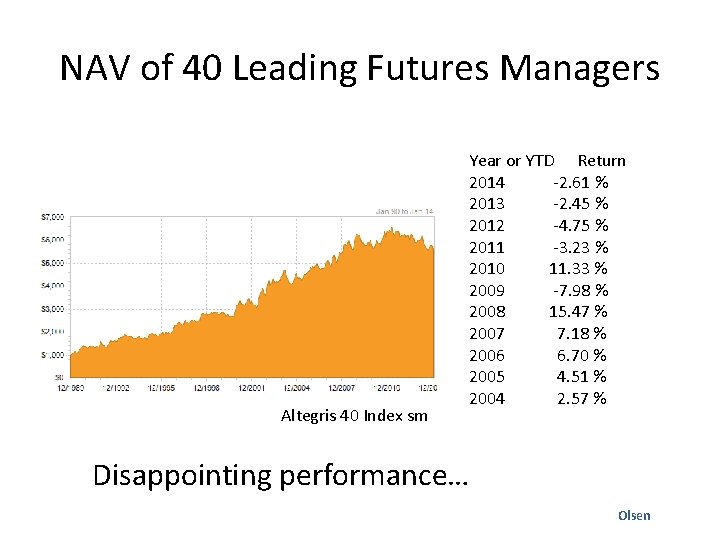
NAV of 40 Leading Futures Managers Altegris 40 Index sm Year or YTD Return 2014 -2. 61 % 2013 -2. 45 % 2012 -4. 75 % 2011 -3. 23 % 2010 11. 33 % 2009 -7. 98 % 2008 15. 47 % 2007 7. 18 % 2006 6. 70 % 2005 4. 51 % 2004 2. 57 % Disappointing performance… Olsen
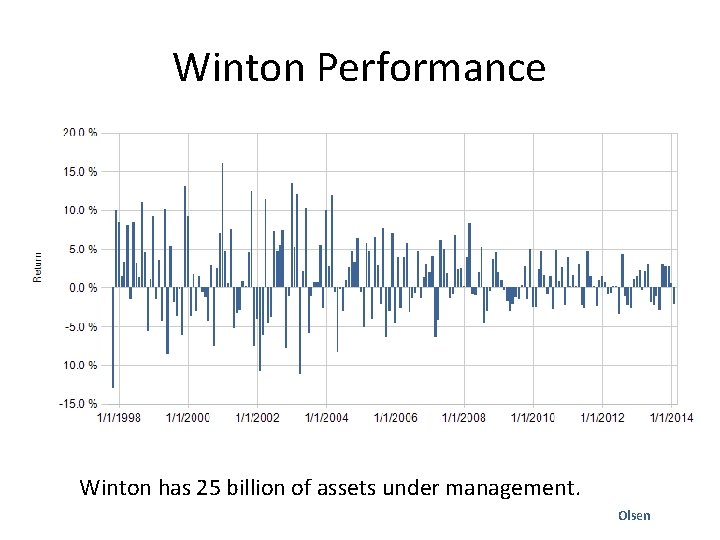
Winton Performance Winton has 25 billion of assets under management. Olsen
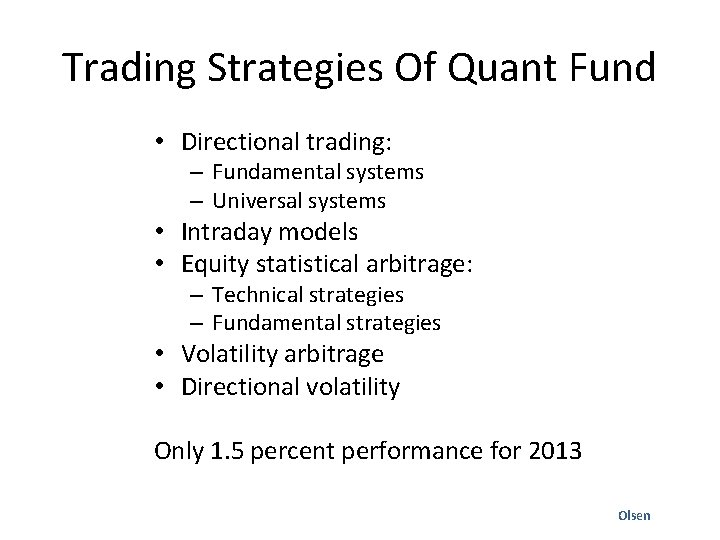
Trading Strategies Of Quant Fund • Directional trading: – Fundamental systems – Universal systems • Intraday models • Equity statistical arbitrage: – Technical strategies – Fundamental strategies • Volatility arbitrage • Directional volatility Only 1. 5 percent performance for 2013 Olsen
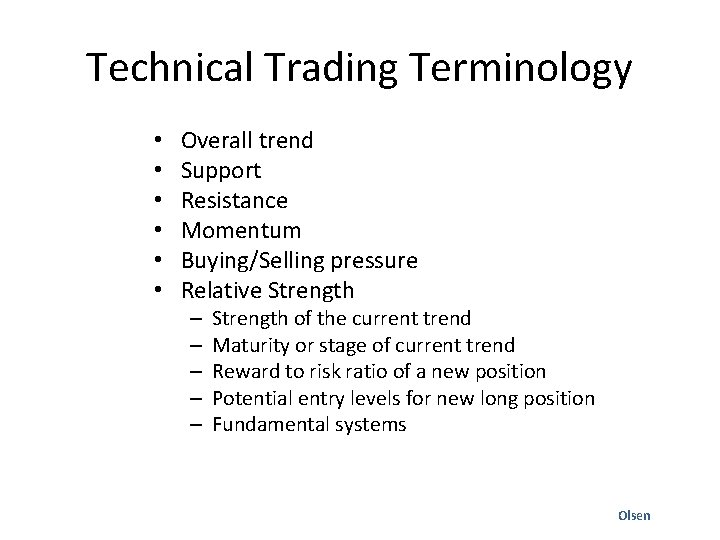
Technical Trading Terminology • • • Overall trend Support Resistance Momentum Buying/Selling pressure Relative Strength – – – Strength of the current trend Maturity or stage of current trend Reward to risk ratio of a new position Potential entry levels for new long position Fundamental systems Olsen
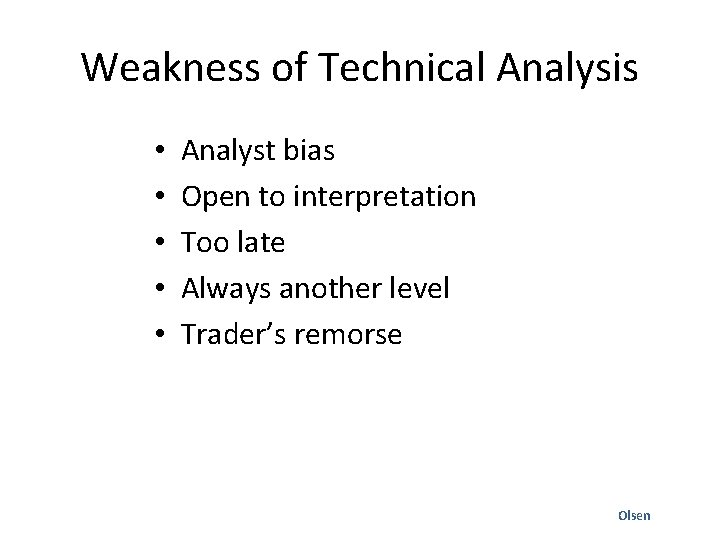
Weakness of Technical Analysis • • • Analyst bias Open to interpretation Too late Always another level Trader’s remorse Olsen
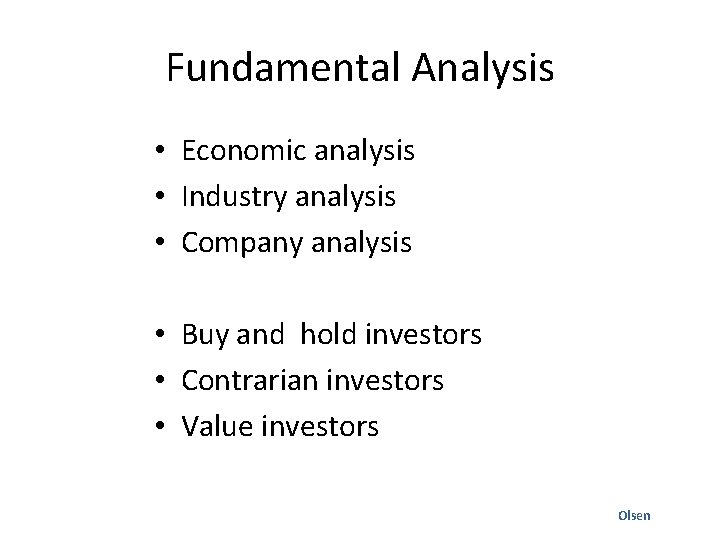
Fundamental Analysis • Economic analysis • Industry analysis • Company analysis • Buy and hold investors • Contrarian investors • Value investors Olsen
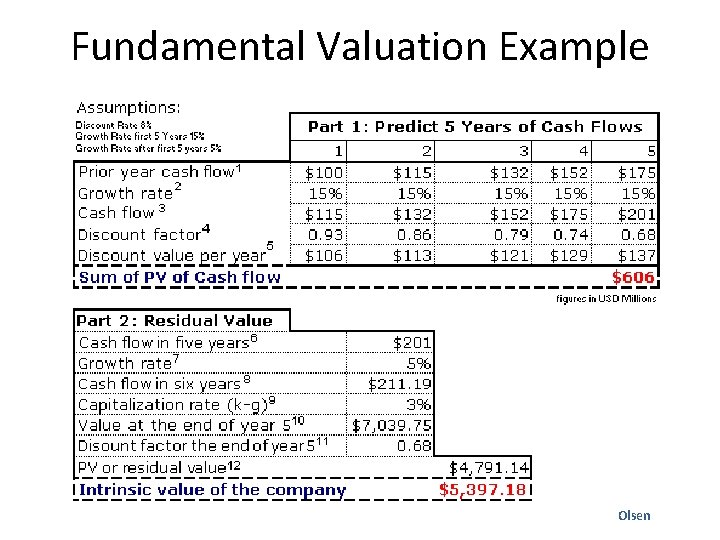
Fundamental Valuation Example Olsen
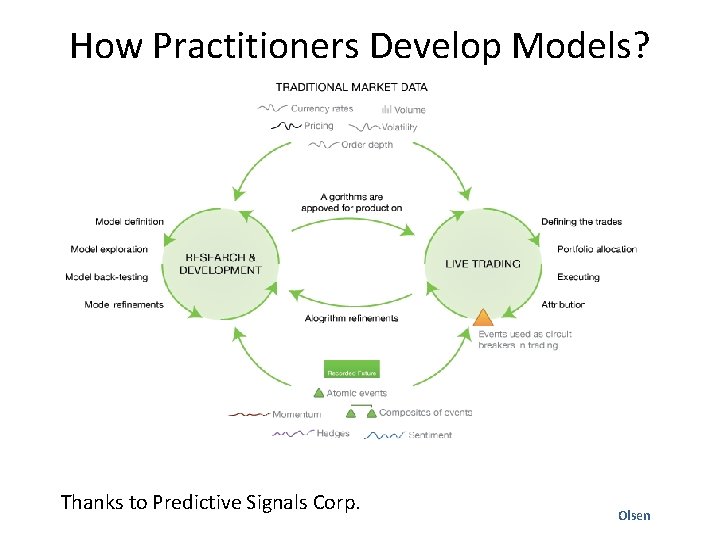
How Practitioners Develop Models? Thanks to Predictive Signals Corp. Olsen
We Need To Ask Questions • 1600% annual coastline after transaction cost per instrument – huge profit potential… • Traders can offset and net risk… • Markets are a part of real economy. • Modern technology works, because methods are subtle? • Nature is subtle. . • Are financial models sufficiently subtle? Olsen
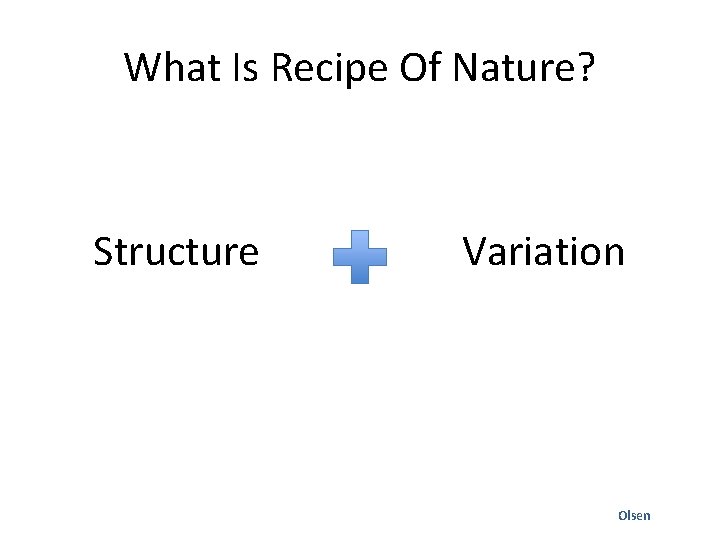
What Is Recipe Of Nature? Structure Variation Olsen
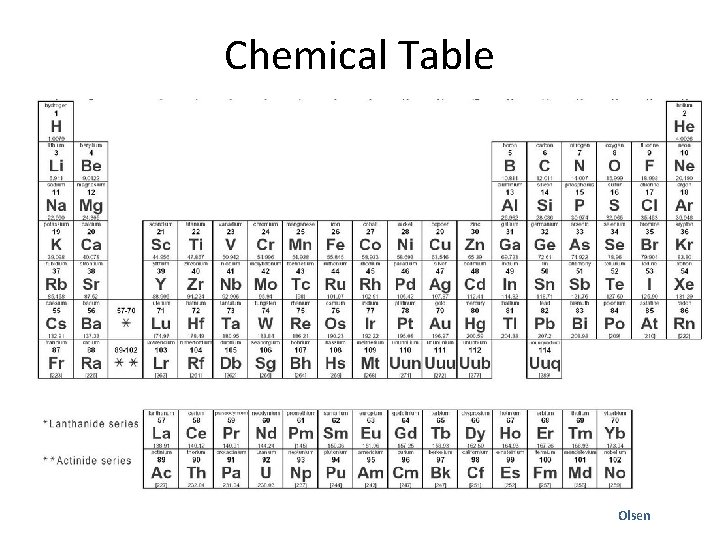
Chemical Table Olsen
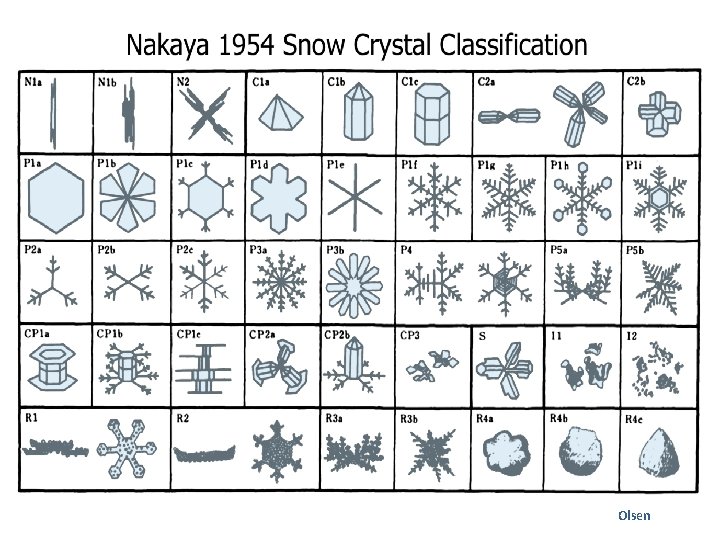
Olsen
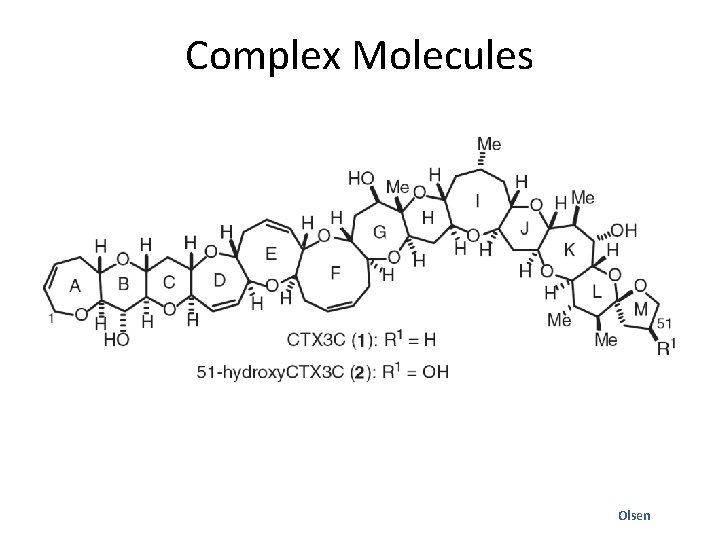
Complex Molecules Olsen
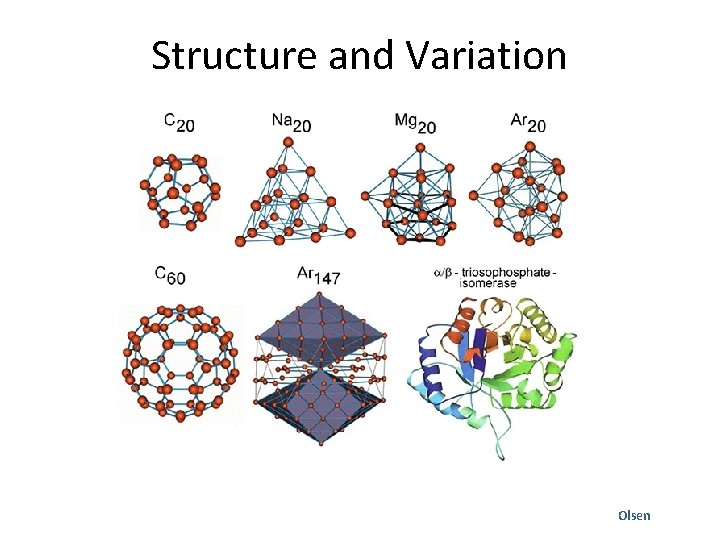
Structure and Variation Olsen

Lets start… Olsen
Our Recipe • Introduce event based definition of time • Grid of scaling laws as a frame of reference • Create a development and simulation platform similar to ‘Foldit’ to discover large diversity of trading atoms that can be turned into a strong investment strategy. Olsen

Time Olsen
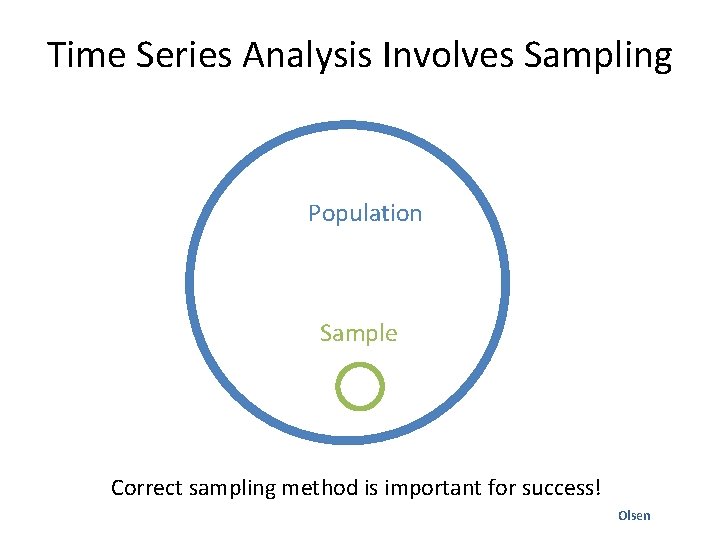
Time Series Analysis Involves Sampling Population Sample Correct sampling method is important for success! Olsen
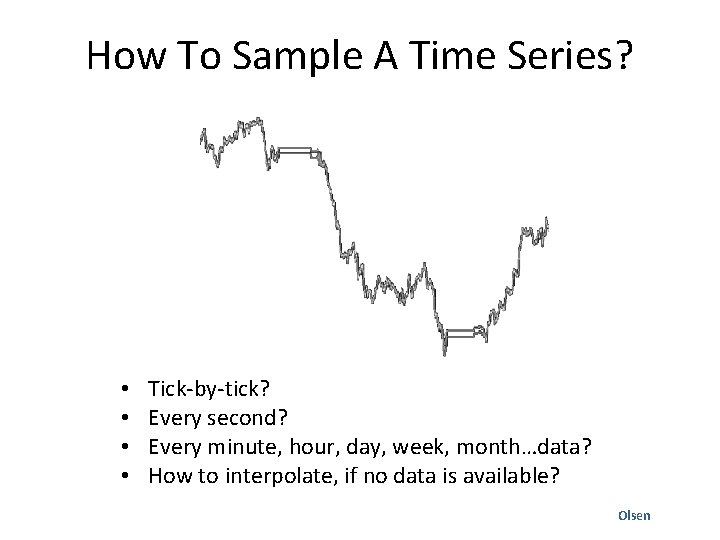
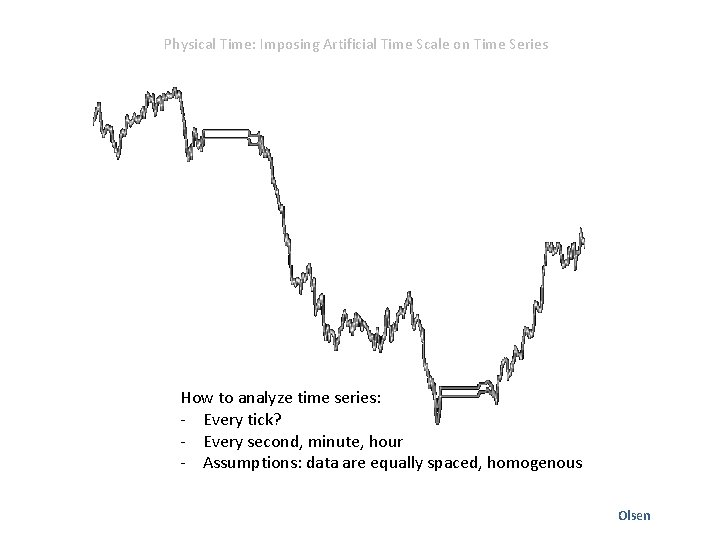
How To Sample A Time Series? • • Tick-by-tick? Every second? Every minute, hour, day, week, month…data? How to interpolate, if no data is available? Olsen
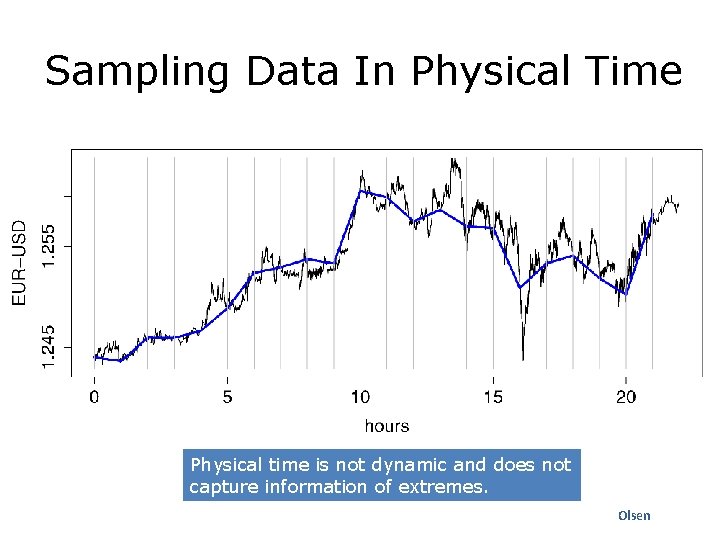
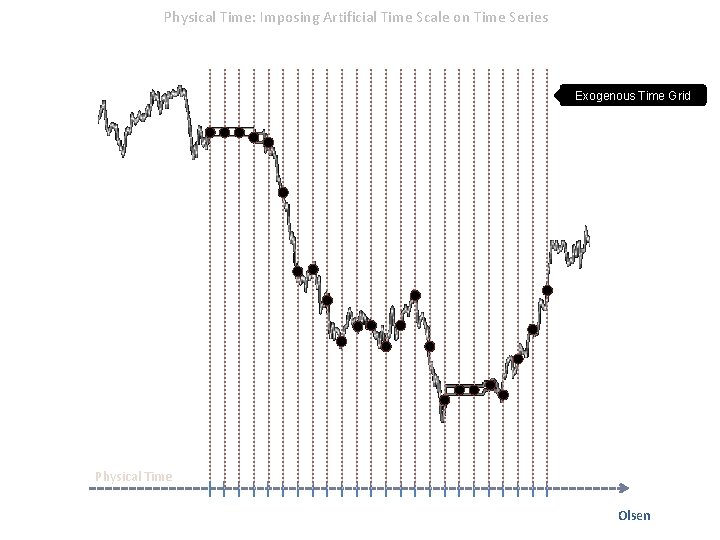
Sampling Data In Physical Time Physical time is not dynamic and does not capture information of extremes. Olsen

If We Increase Sampling Frequency? Increasing frequency of sampling adds noise. Olsen
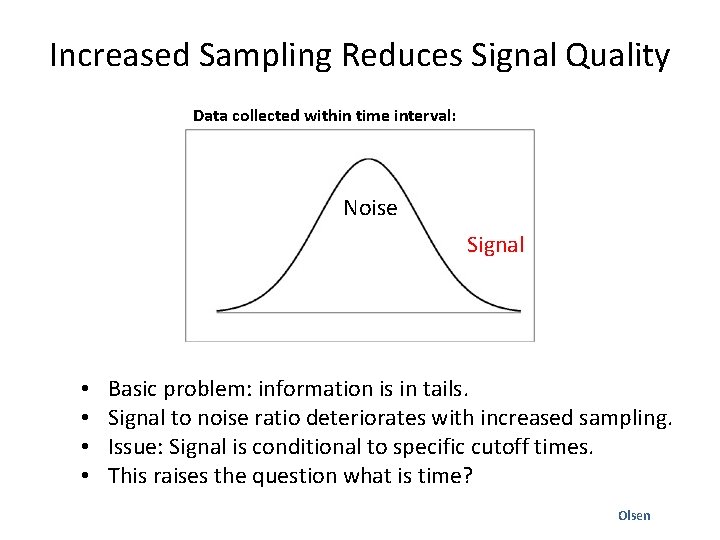
Increased Sampling Reduces Signal Quality Data collected within time interval: Noise Signal • • Basic problem: information is in tails. Signal to noise ratio deteriorates with increased sampling. Issue: Signal is conditional to specific cutoff times. This raises the question what is time? Olsen
Conjecture There is no abstract time. Time tracks the identity of a particular system and records the events of interaction with other systems. Olsen
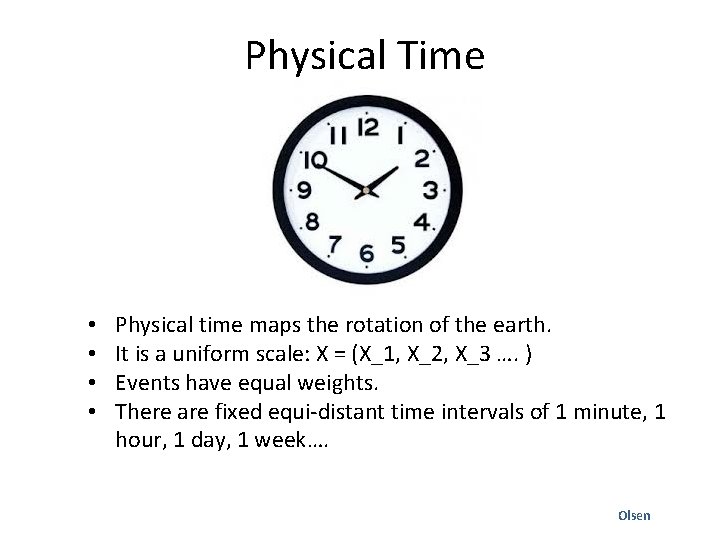
Physical Time • • Physical time maps the rotation of the earth. It is a uniform scale: X = (X_1, X_2, X_3 …. ) Events have equal weights. There are fixed equi-distant time intervals of 1 minute, 1 hour, 1 day, 1 week…. Olsen
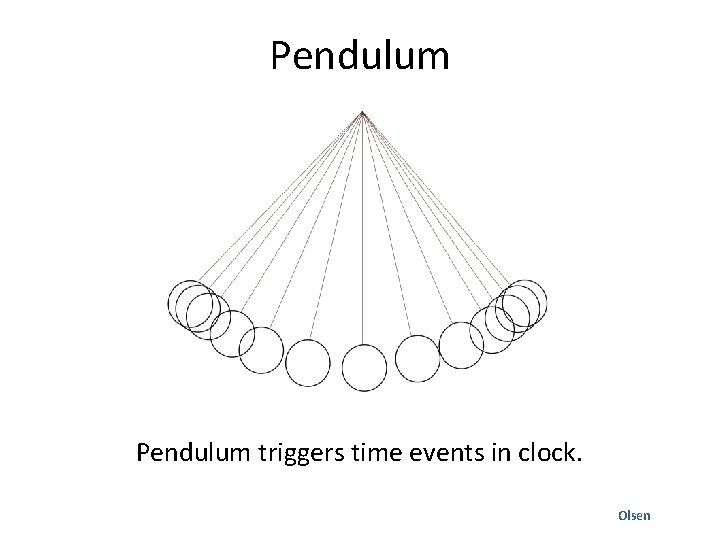
Pendulum triggers time events in clock. Olsen
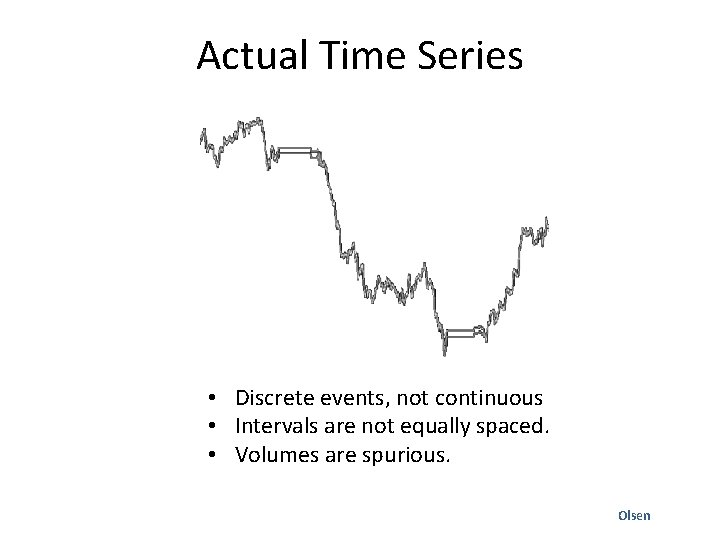
Actual Time Series • Discrete events, not continuous • Intervals are not equally spaced. • Volumes are spurious. Olsen
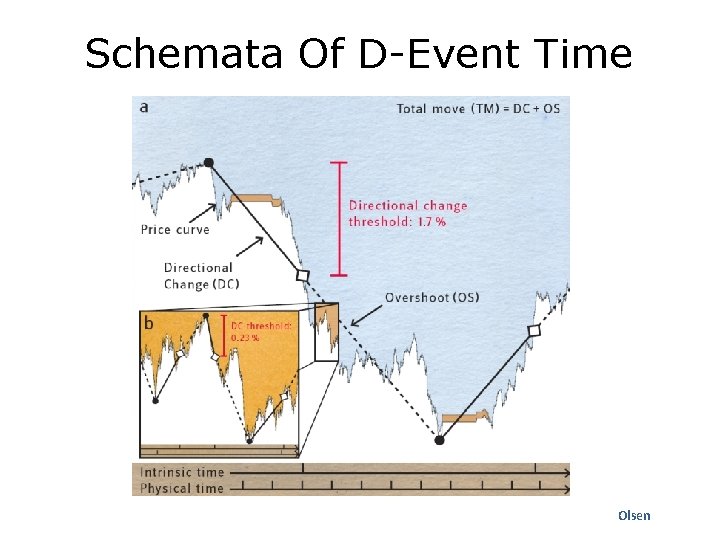
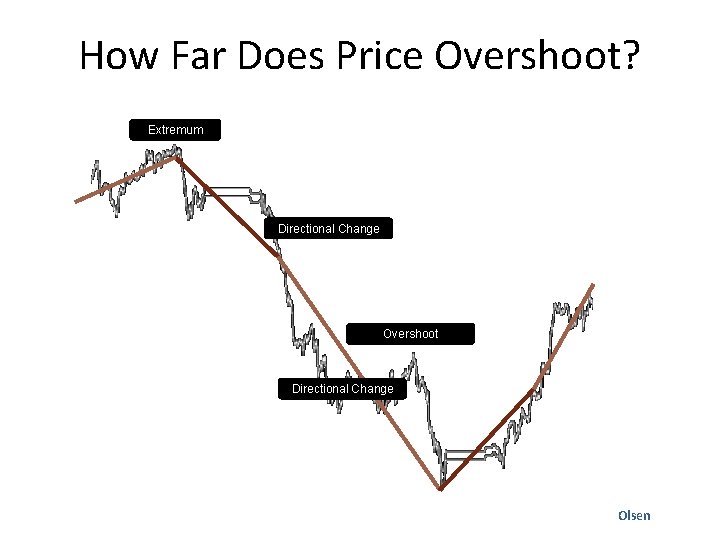
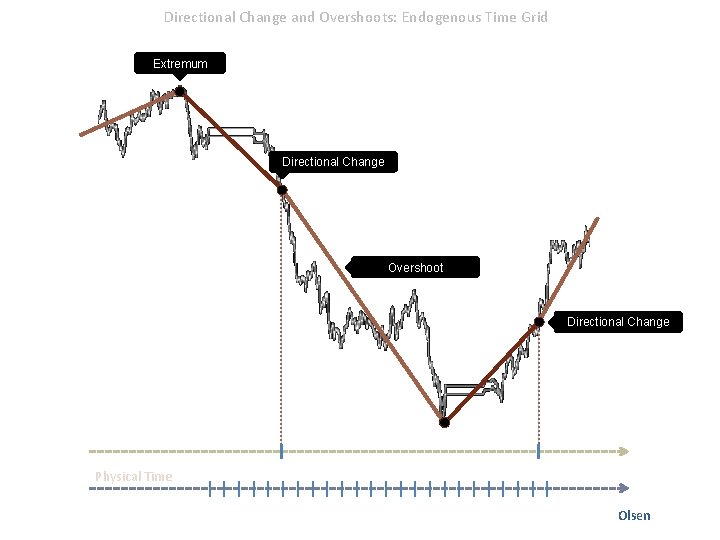
Definition Of Event Time An event is a price reversal or excursion of x percent from a local price extreme as defined by the observer. Olsen
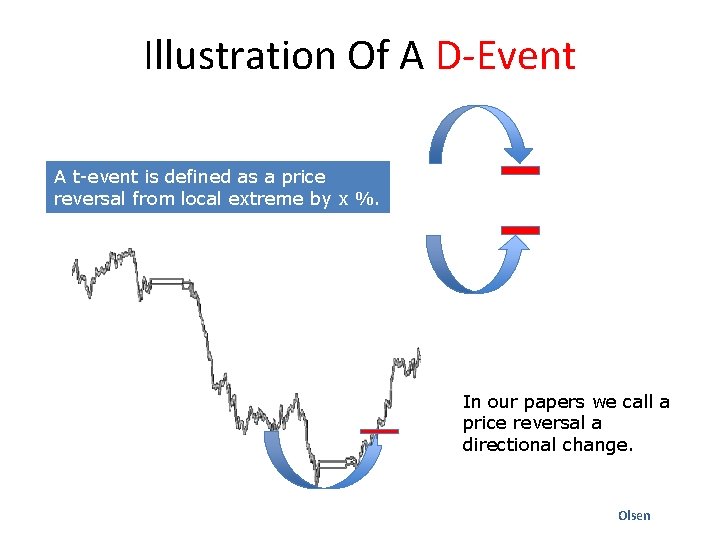
Illustration Of A D-Event A t-event is defined as a price reversal from local extreme by x %. In our papers we call a price reversal a directional change. Olsen
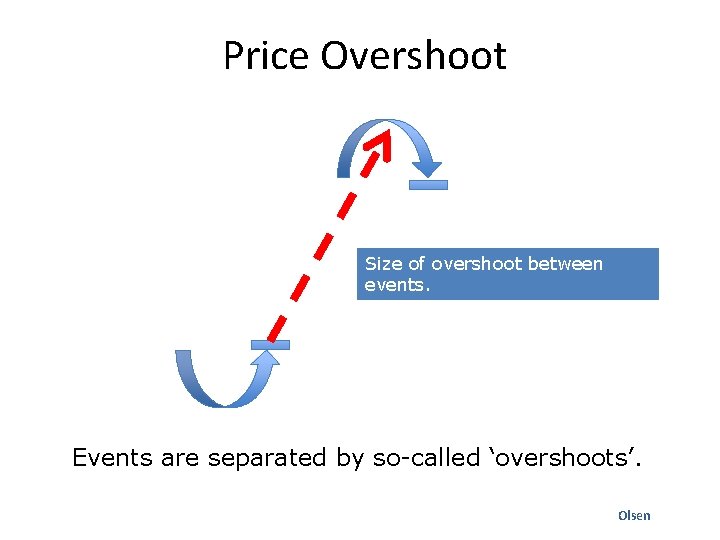
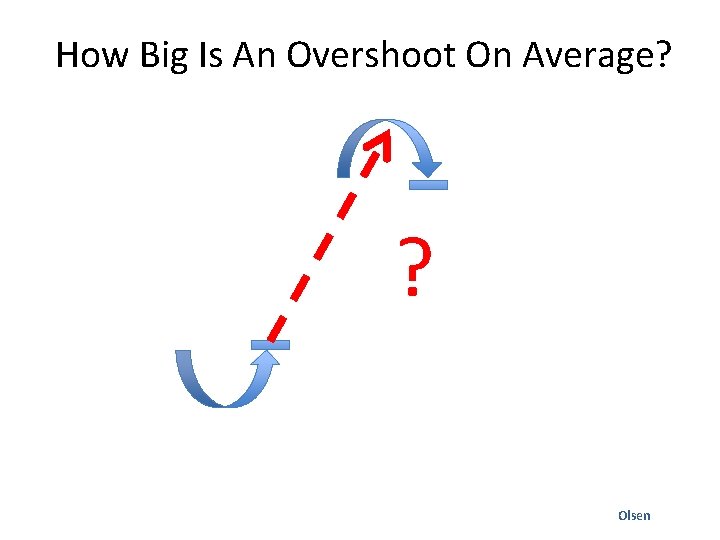
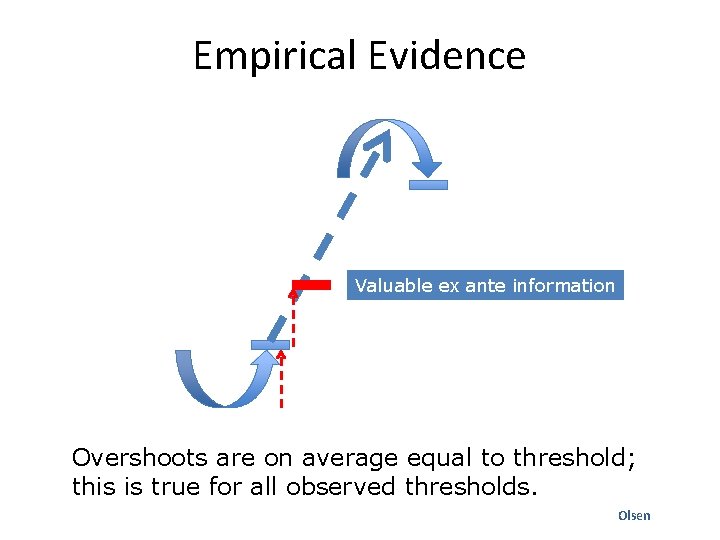
Price Overshoot Size of overshoot between events. Events are separated by so-called ‘overshoots’. Olsen
Schemata Of D-Event Time Olsen
How Big Is An Overshoot On Average? ? Olsen
Empirical Evidence Valuable ex ante information Overshoots are on average equal to threshold; this is true for all observed thresholds. Olsen
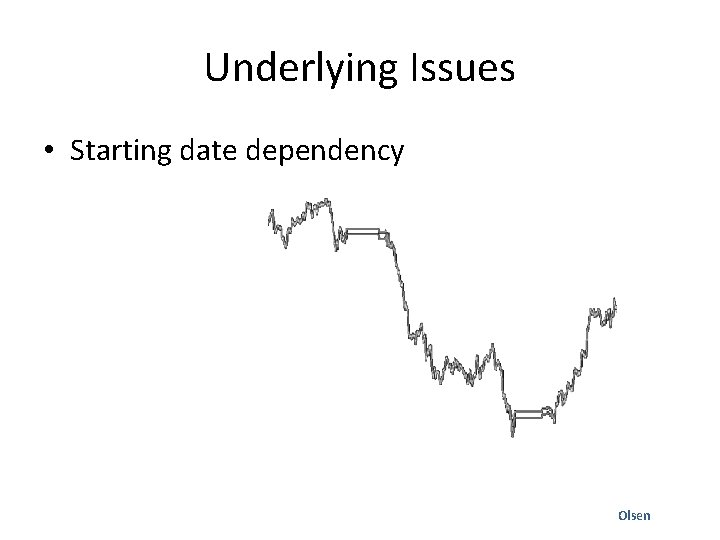
Benefit Of Event Time In calendar time the outcome of an analysis depends on the exact starting time; in event time extremes are the pointers and bring event time into sync whatever the exact starting point. Olsen
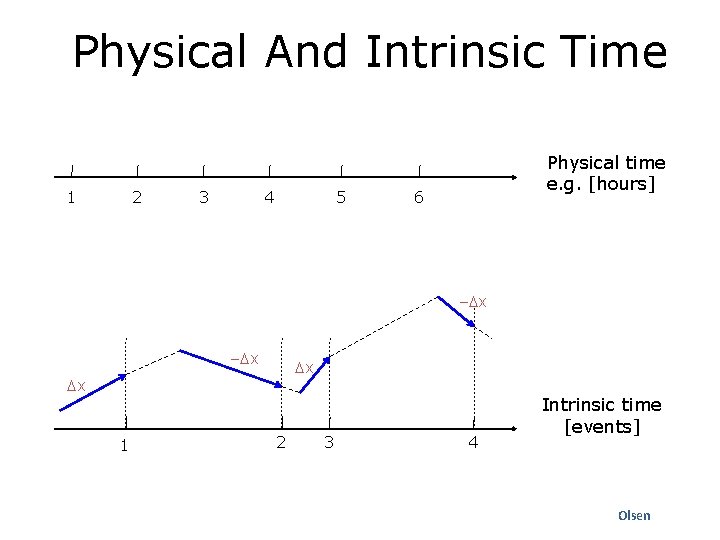
Physical And Intrinsic Time 1 2 3 4 5 Physical time e. g. [hours] 6 -Dx Dx Dx 1 2 3 4 Intrinsic time [events] Olsen
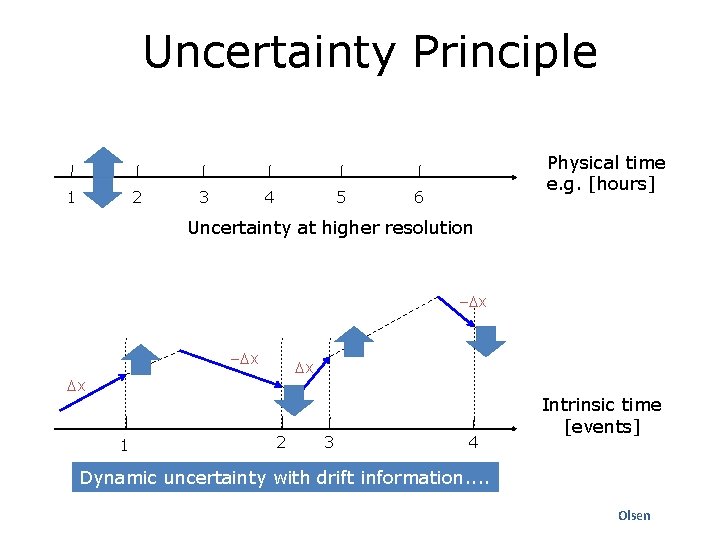
Uncertainty Principle 1 2 3 4 5 Physical time e. g. [hours] 6 Uncertainty at higher resolution -Dx Dx Dx 1 2 3 4 Intrinsic time [events] Dynamic uncertainty with drift information. . Olsen
A Grid Of Scaling Laws Olsen
Trading Models Are Engines Trading models consist of trading cells Each trading cell is a small engine. An engine has levers, gear shifts, breaks, etc. Engines are ‘virtual’ and only exist in the abstract world of bits and bytes, except for the actual transaction of buying and selling. • How do we design levers? • • Olsen
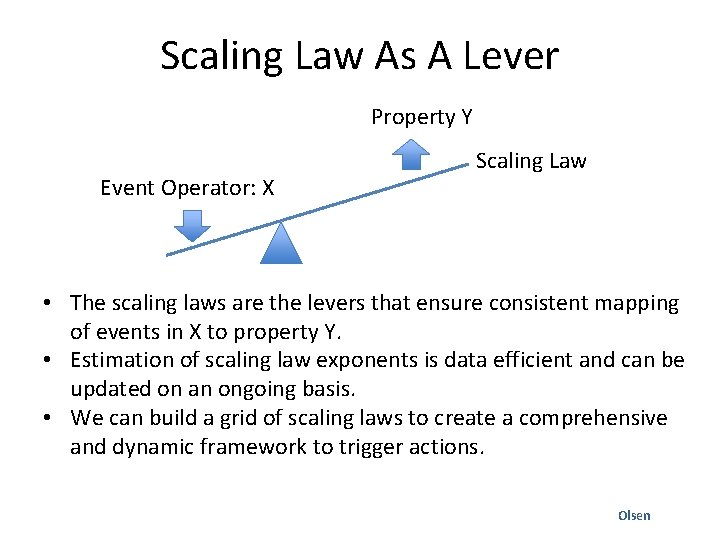
Scaling Law As A Lever Property Y Event Operator: X Scaling Law • The scaling laws are the levers that ensure consistent mapping of events in X to property Y. • Estimation of scaling law exponents is data efficient and can be updated on an ongoing basis. • We can build a grid of scaling laws to create a comprehensive and dynamic framework to trigger actions. Olsen
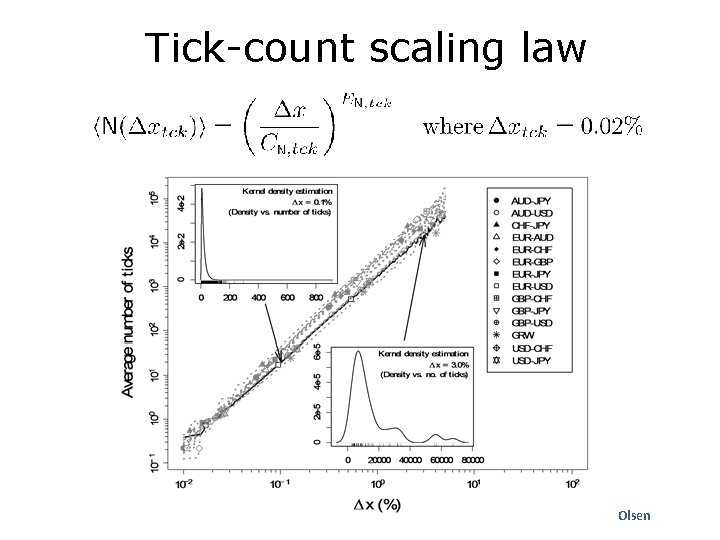
Tick-count scaling law Olsen
Other Questions • Average number of small directional changes within a big directional change • Average yearly number of price moves • Average maximal price move during time interval • Average duration of a price move • Average duration of a directional change • Average length of the coastline and its components Discovery of new 12 scaling laws. Olsen
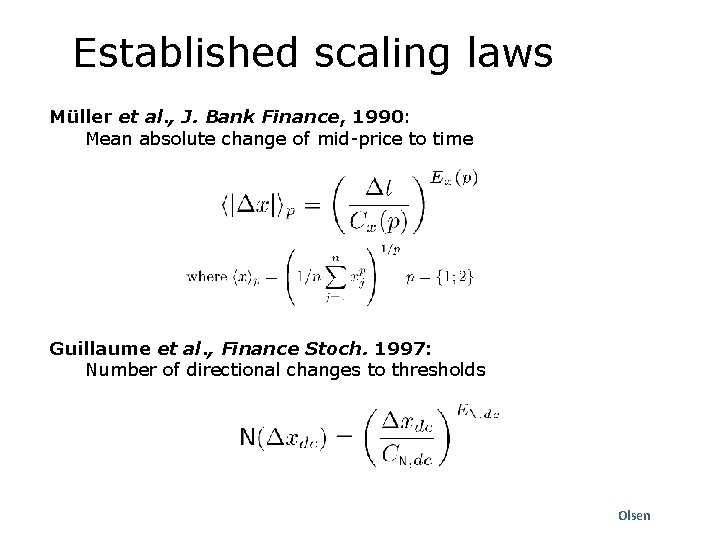
Established scaling laws Müller et al. , J. Bank Finance, 1990: Mean absolute change of mid-price to time Guillaume et al. , Finance Stoch. 1997: Number of directional changes to thresholds Olsen
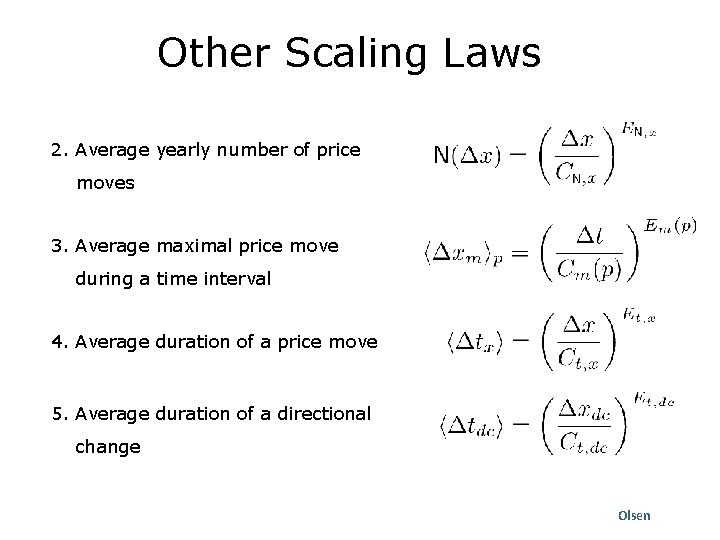
Other Scaling Laws 2. Average yearly number of price moves 3. Average maximal price move during a time interval 4. Average duration of a price move 5. Average duration of a directional change Olsen
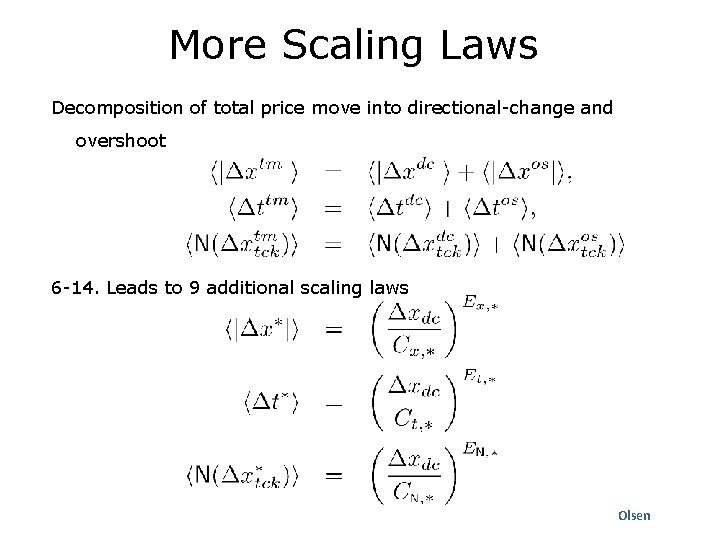
More Scaling Laws Decomposition of total price move into directional-change and overshoot 6 -14. Leads to 9 additional scaling laws Olsen
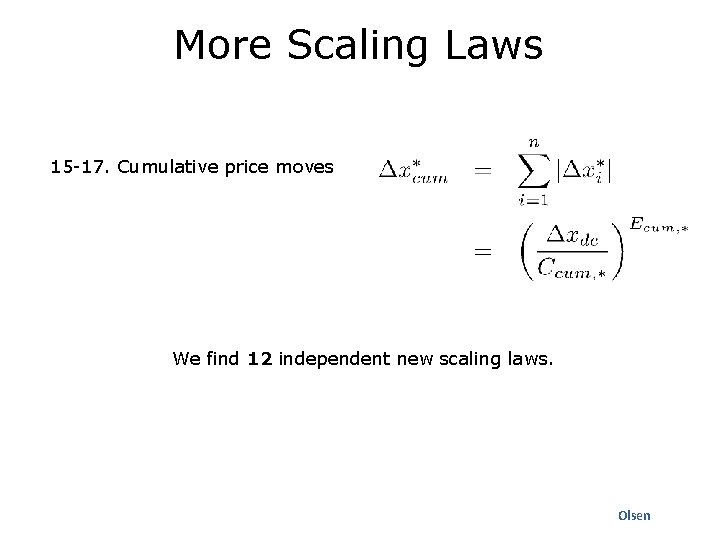
More Scaling Laws 15 -17. Cumulative price moves We find 12 independent new scaling laws. Olsen
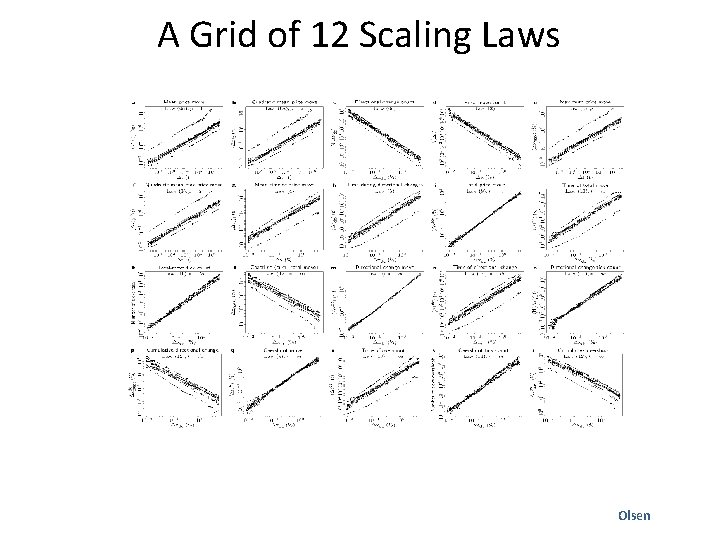
A Grid of 12 Scaling Laws Olsen
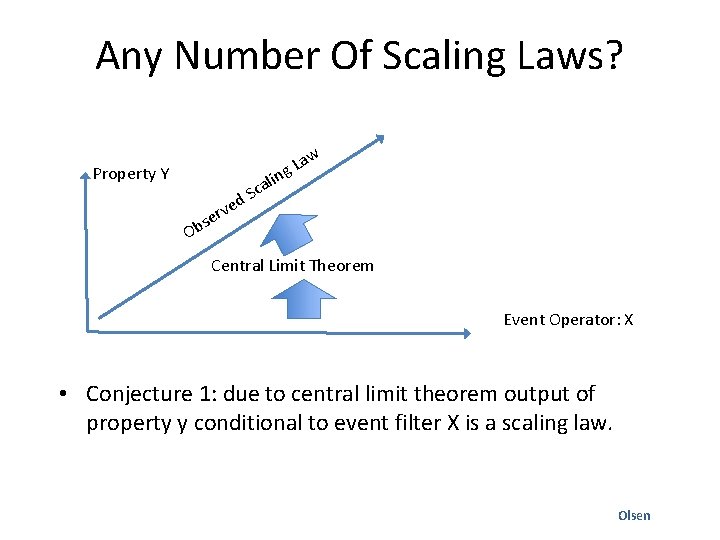
Any Number Of Scaling Laws? Property Y d e v r bse l Sca aw L g in O Central Limit Theorem Event Operator: X • Conjecture 1: due to central limit theorem output of property y conditional to event filter X is a scaling law. Olsen
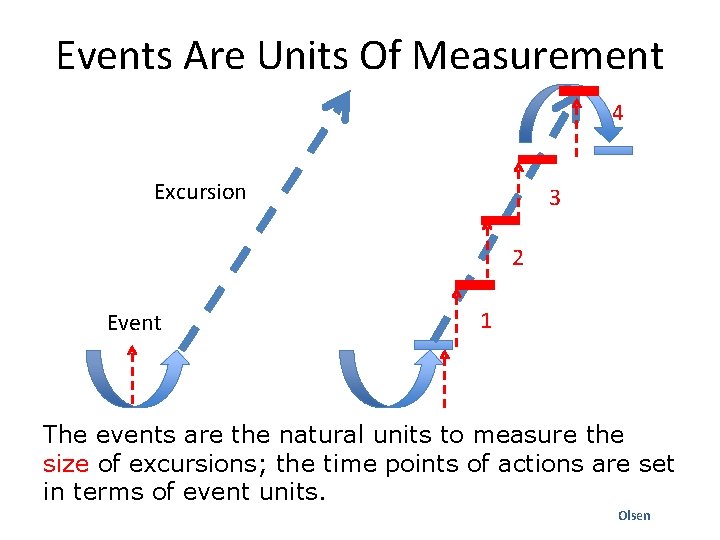
Events Are Units Of Measurement 4 Excursion 3 2 Event 1 The events are the natural units to measure the size of excursions; the time points of actions are set in terms of event units. Olsen
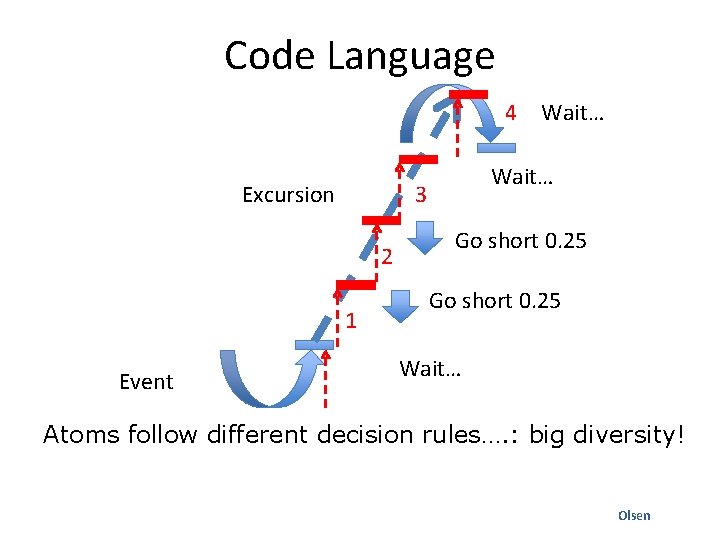
Code Language 4 Excursion 1 Event Wait… 3 2 Wait… Go short 0. 25 Wait… Atoms follow different decision rules…. : big diversity! Olsen
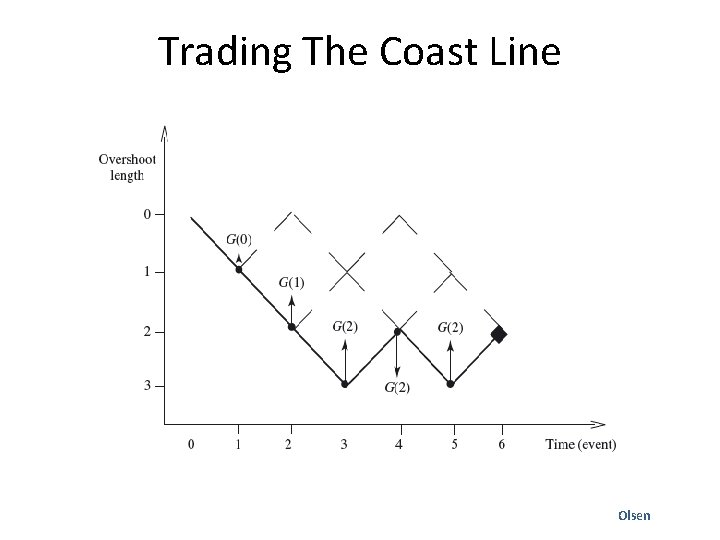
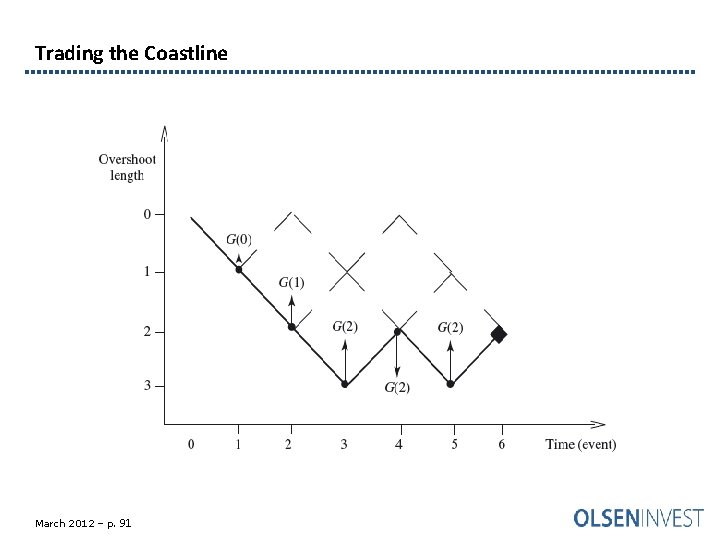
Trading The Coast Line Olsen
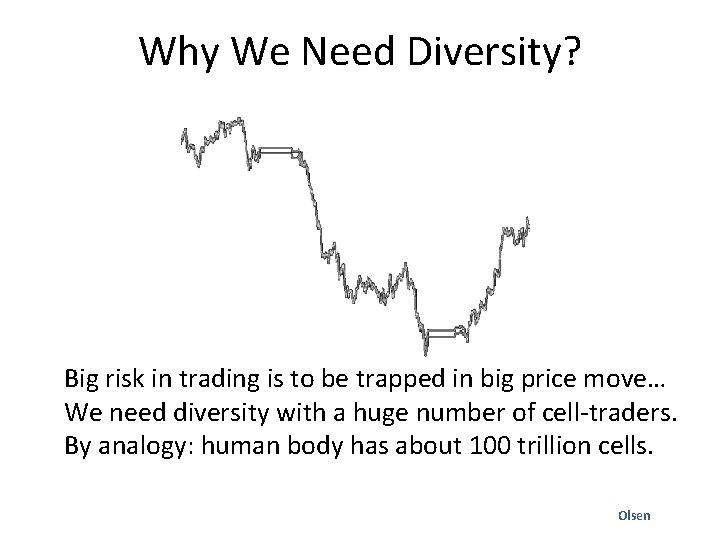
Why We Need Diversity? Big risk in trading is to be trapped in big price move… We need diversity with a huge number of cell-traders. By analogy: human body has about 100 trillion cells. Olsen
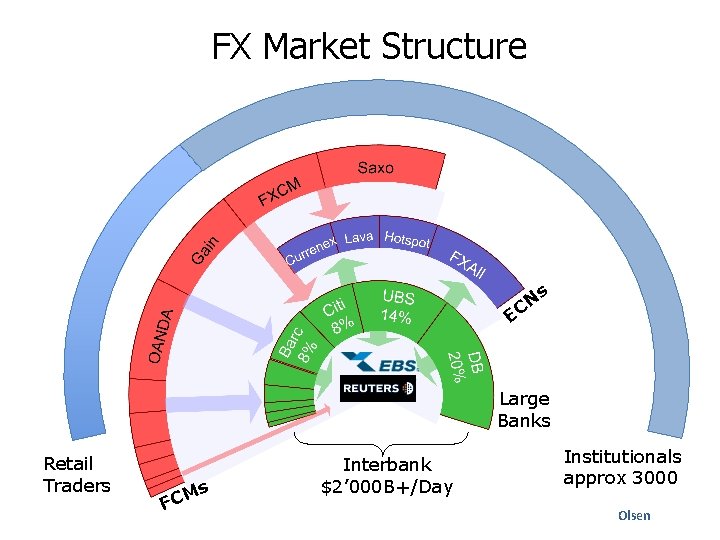
FX Market Structure s N C E Large Banks Retail Traders s M FC Interbank $2’ 000 B+/Day Institutionals approx 3000 Olsen
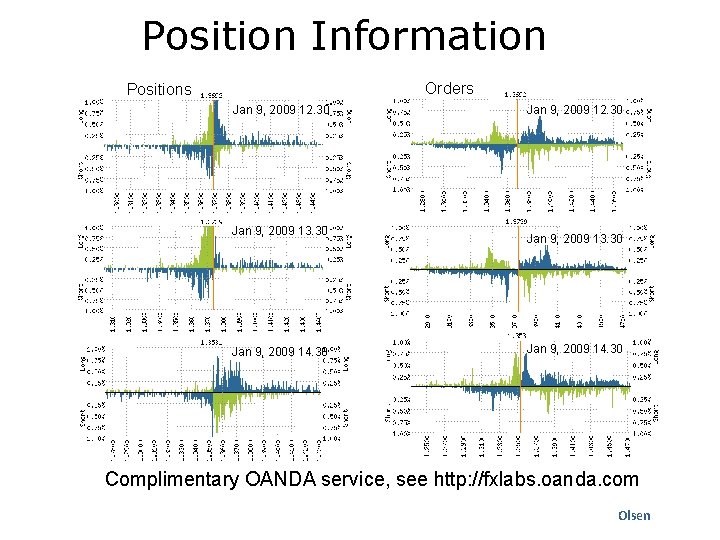
Position Information Orders Positions Jan 9, 2009 12. 30 Jan 9, 2009 13. 30 Jan 9, 2009 14. 30 Complimentary OANDA service, see http: //fxlabs. oanda. com Olsen
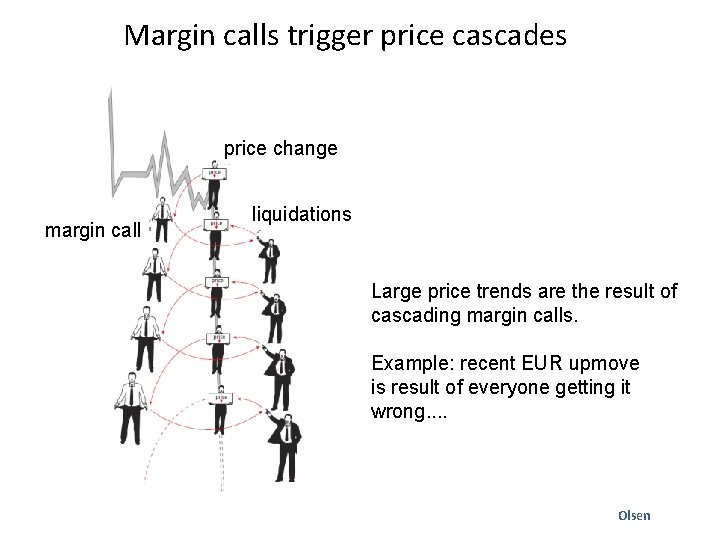
Margin calls trigger price cascades price change margin call liquidations Large price trends are the result of cascading margin calls. Example: recent EUR upmove is result of everyone getting it wrong. . Olsen
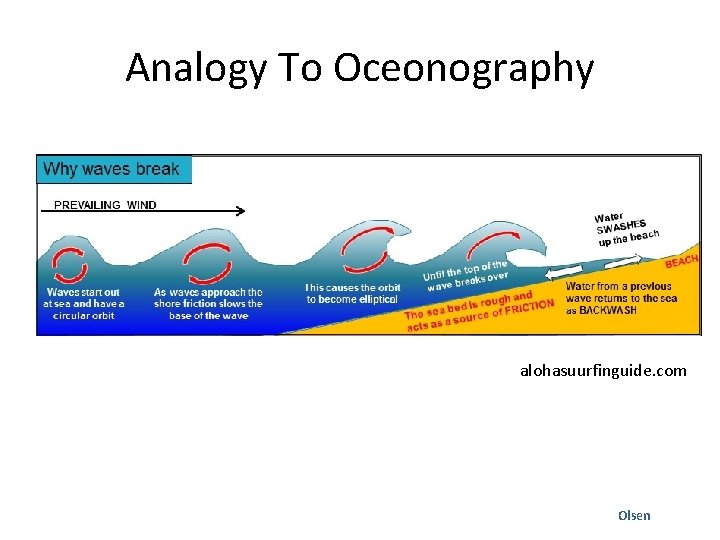
Analogy To Oceonography alohasuurfinguide. com Olsen
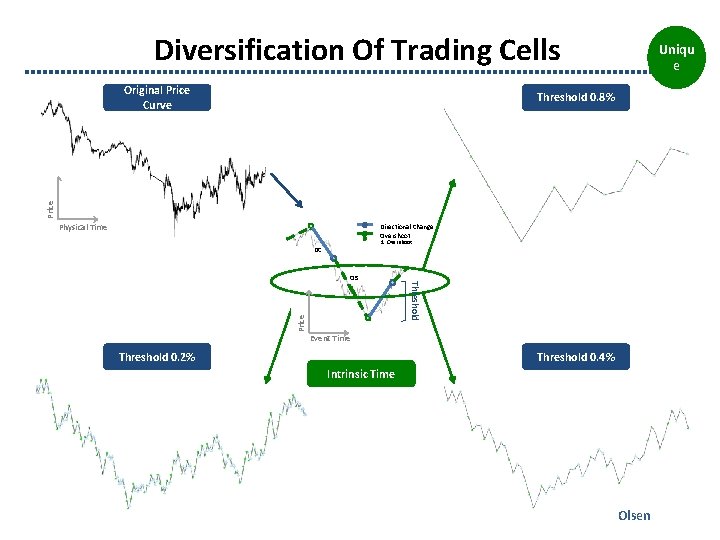
Diversification Of Trading Cells Original Price Curve Uniqu e Price Threshold 0. 8% Physical Time Directional Change Overshoot 1. Overshoot DC Price Threshold OS Event Time Threshold 0. 2% Threshold 0. 4% Intrinsic Time Olsen

Coastline Trading Managing Open Extrema Directional Change Overshoot Average Exposure Take Profit Information o The threshold of 1% is only an Take Profit example threshold. 1% o Same 1% Coastline Trading methodology applies to short position. o Price curves are discrete and not continuous as in the illustrations. o Several positions are trading at a given time. Olsen
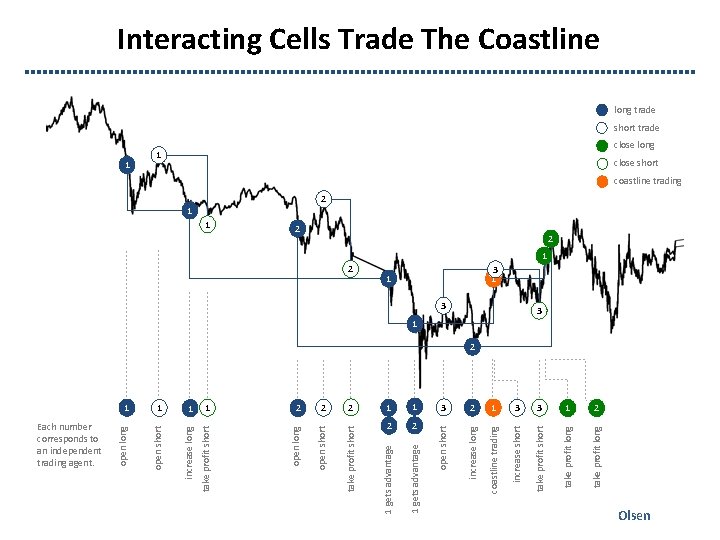
Each number corresponds to an independent trading agent. 1 1 2 2 2 1 3 3 1 2 increase short take profit long 2 2 coastline trading 2 3 increase long 1 open short 1 1 gets advantage 2 1 gets advantage take profit short 1 open long 1 take profit short 1 increase long 1 open short open long Interacting Cells Trade The Coastline long trade short trade 1 close long close short coastline trading 2 2 2 1 1 3 1 3 2 Olsen
Complex decision trees Olsen

Platform To Develop Trading Cells Olsen
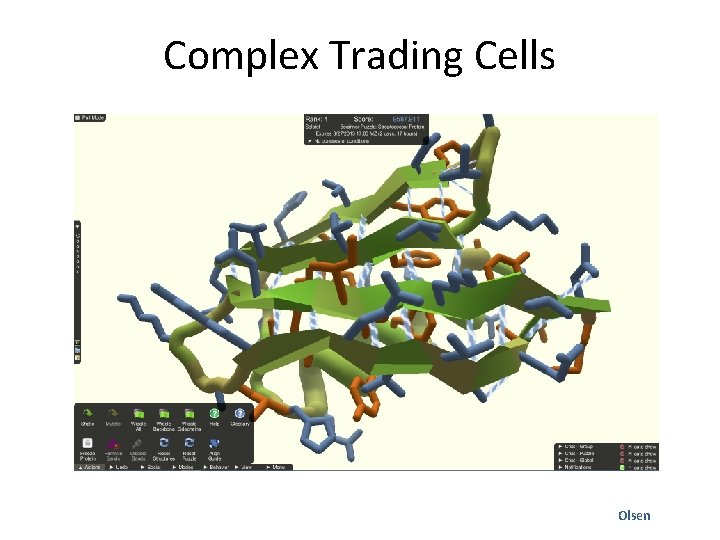
Complex Trading Cells Olsen
Features Of Platform • • • Data repository for simulation and validation Real time trading environment Graphic event-based scripting language Historical and real-time statistics Crowd based development environment Competitions Olsen
Promotion • …new research…promising results. • We need to store wealth and require performing investment strategies. • We need to stabilize markets to reduce entropy. • …we can earn money and make the economic system more sustainable. Olsen

It would be great to work together! Olsen
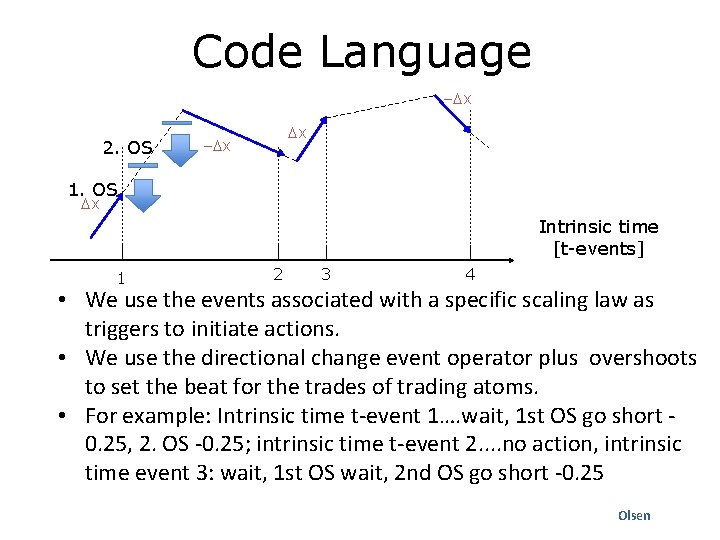
Code Language -Dx 2. OS Dx -Dx 1. OS Dx Intrinsic time [t-events] 1 2 3 4 • We use the events associated with a specific scaling law as triggers to initiate actions. • We use the directional change event operator plus overshoots to set the beat for the trades of trading atoms. • For example: Intrinsic time t-event 1…. wait, 1 st OS go short 0. 25, 2. OS -0. 25; intrinsic time t-event 2. . no action, intrinsic time event 3: wait, 1 st OS wait, 2 nd OS go short -0. 25 Olsen
Why We Need To Ask Basic Questions? • Starting in 1985, we tested more or less every methodology… • Standard models work a little, but break down as soon as they become more complex or are combined: mantra of practitioners is to keep models simple and stupid. • Astronomy, computer technology, etc. . have sophisticated models; so why not in finance and economics? • We need to rethink foundations and ask basic questions: – In the spirit of relativity theory: is a financial market one deterministic system or is a financial market an output of a process of a large number of interacting systems? – What is time? Olsen
What Type of Models Exist? • Technical models – Oscillators – Trend following • Fundamental models – Regression models • What do they have in common? • What are the new ideas? Olsen
Quantitative Trading • Directional trading: – Fundamental systems – Universal systems • Intraday models • Equity statistical arbitrage: – Technical strategies – Fundamental strategies • Volatility arbitrage • Directional volatility Olsen
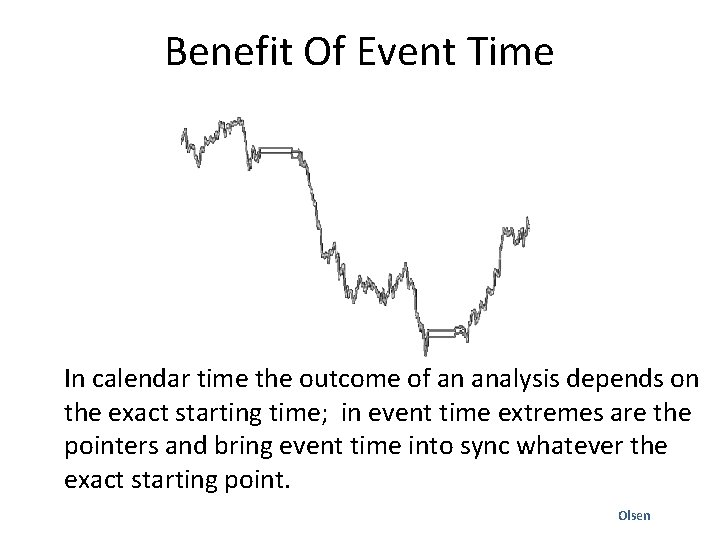
Underlying Issues • Starting date dependency Olsen
Featrues Not To Forget • 80% of volume has duration of only 20 minutes • 98% has intra-day duration • Agent diversification is essential! Olsen
Featrues Not To Forget Olsen
What Is Time? • • Linear and cyclical time in mythology Philosophy of time Newtonian time Relativistic time World time Biological and psychological time Transaction time Event time……. Olsen
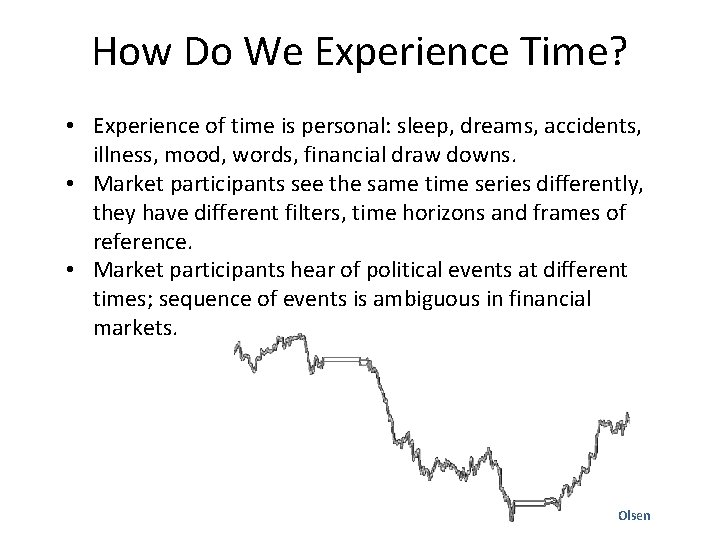
How Do We Experience Time? • Experience of time is personal: sleep, dreams, accidents, illness, mood, words, financial draw downs. • Market participants see the same time series differently, they have different filters, time horizons and frames of reference. • Market participants hear of political events at different times; sequence of events is ambiguous in financial markets. Olsen
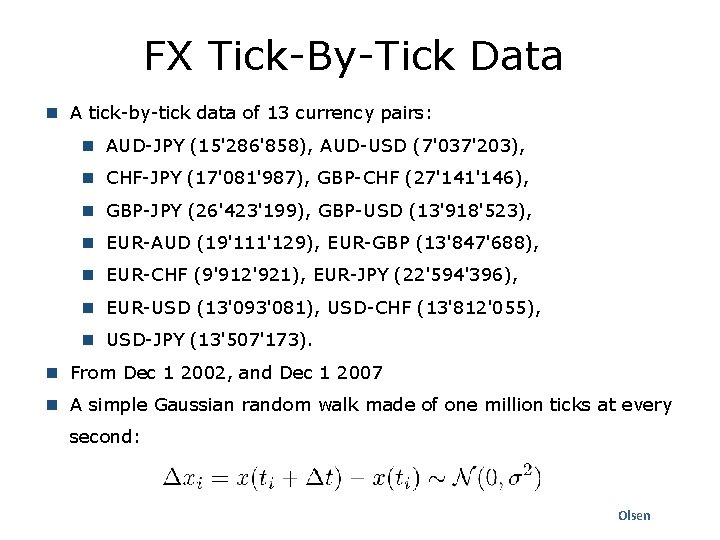
FX Tick-By-Tick Data A tick-by-tick data of 13 currency pairs: AUD-JPY (15'286'858), AUD-USD (7'037'203), CHF-JPY (17'081'987), GBP-CHF (27'141'146), GBP-JPY (26'423'199), GBP-USD (13'918'523), EUR-AUD (19'111'129), EUR-GBP (13'847'688), EUR-CHF (9'912'921), EUR-JPY (22'594'396), EUR-USD (13'093'081), USD-CHF (13'812'055), USD-JPY (13'507'173). From Dec 1 2002, and Dec 1 2007 A simple Gaussian random walk made of one million ticks at every second: Olsen
Intrinsic Time • Uniform intrinsic time scale for a given reversal of x percent: X = (X_1, X_2, X_3 …. ) • Events have equal weights in intrinsic time. • Events occur with a shift of x percent from extreme. • Intrinsic time scales with different thresholds are analogous to 1 minute, 1 hour, 1 day, etc. time scale. Olsen
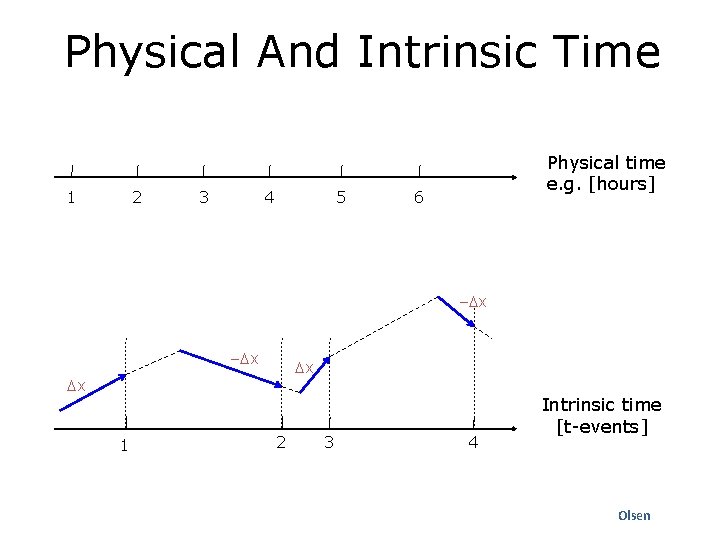
Physical And Intrinsic Time 1 2 3 4 5 Physical time e. g. [hours] 6 -Dx Dx Dx 1 2 3 4 Intrinsic time [t-events] Olsen
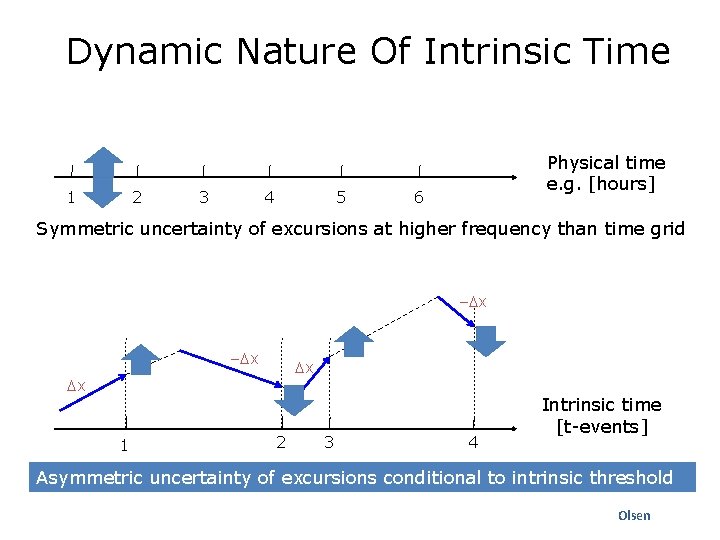
Dynamic Nature Of Intrinsic Time 1 2 3 4 5 Physical time e. g. [hours] 6 Symmetric uncertainty of excursions at higher frequency than time grid -Dx Dx Dx 1 2 3 4 Intrinsic time [t-events] Asymmetric uncertainty of excursions conditional to intrinsic threshold Olsen
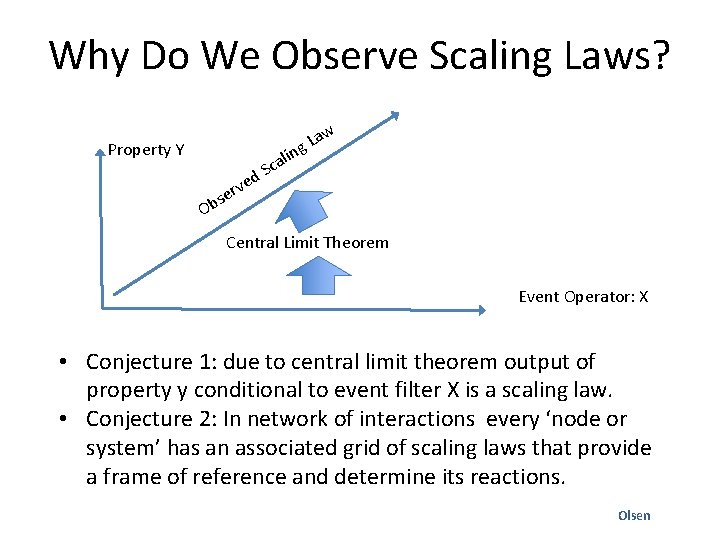
Why Do We Observe Scaling Laws? Property Y c d. S e rv aw L g alin se Ob Central Limit Theorem Event Operator: X • Conjecture 1: due to central limit theorem output of property y conditional to event filter X is a scaling law. • Conjecture 2: In network of interactions every ‘node or system’ has an associated grid of scaling laws that provide a frame of reference and determine its reactions. Olsen
Agent Based Modeling • Financial market consists of large network of interacting agents. • In our trading models we create networks of agents. • Agents are generic and are configured on the basis of the scaling law methodology. • Individual agents differ with respect to parameter settings and details of code configurations. • We develop models that are triggered by overshoots of tevents and are counter-trend models designed to stabilize markets. Olsen
Discussion Point of departure: • Physical time scale is static and discards valuable information. • Proposal: introduce an event based time scale. • We define an event as a directional change or excursion of ≥ x percent from extreme. • Intrinsic time maps events of local extremes. Results: • Discovery of large number of scaling laws (results can be verified with small data samples). • Intrinsic time scale: • Intrinsic events are not equi-distant in physical time • Events have fixed shift from local extreme; they are equidistant from extreme and provide predictive information. Olsen
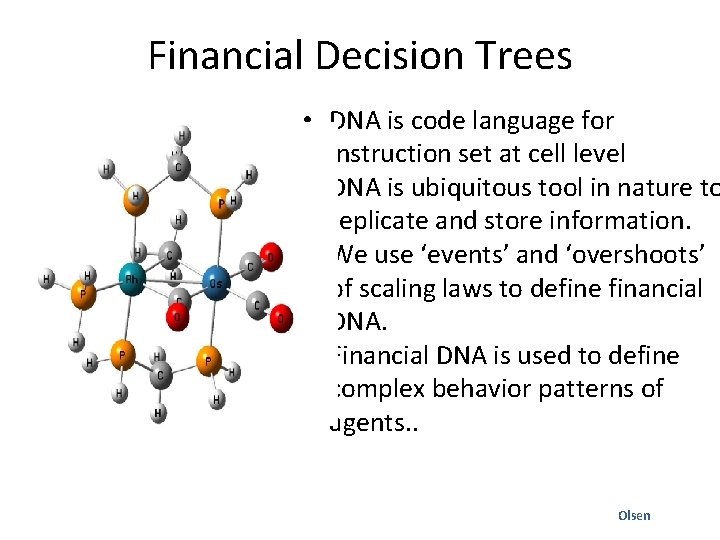
Financial Decision Trees • DNA is code language for instruction set at cell level • DNA is ubiquitous tool in nature to replicate and store information. • We use ‘events’ and ‘overshoots’ of scaling laws to define financial DNA. • Financial DNA is used to define complex behavior patterns of agents. . Olsen
Example Of Financial DNA • We develop trading models as networks of coastline traders to diversify risk. • Decisions of individual coastline trader is defined by financial DNA. • Simple DNA setup: • Intrinsic clock to increase positions • Intrinsic clock to reduce positions • NAV i-clock of agent to increase allocation • NAV i-clock of agent to reduce allocation and take profit. Olsen
DNA Configuration • I-clock to increase positions (0. 5%): overshoot 1…to 20; 1 st overshoot establish position with gearing 0. 1 • 2 nd overshoot increase position by 0. 05 gearing • 3 rd overshoot increase position by 0. 05 gearing • Decisions of individual coastline trader is defined by financial DNA. • Simple DNA setup: • Intrinsic clock to increase positions • Intrinsic clock to reduce positions • NAV i-clock of agent to increase allocation • NAV i-clock of agent to reduce allocation Olsen

Complex Organic Matter Olsen
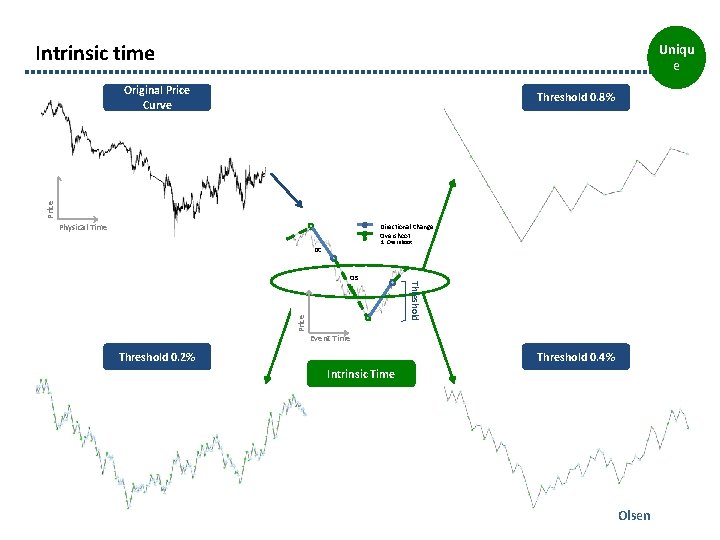
Intrinsic time Uniqu e Original Price Curve Price Threshold 0. 8% Physical Time Directional Change Overshoot 1. Overshoot DC Price Threshold OS Event Time Threshold 0. 2% Threshold 0. 4% Intrinsic Time Olsen
Trading the Coastline March 2012 – p. 91

Olsen
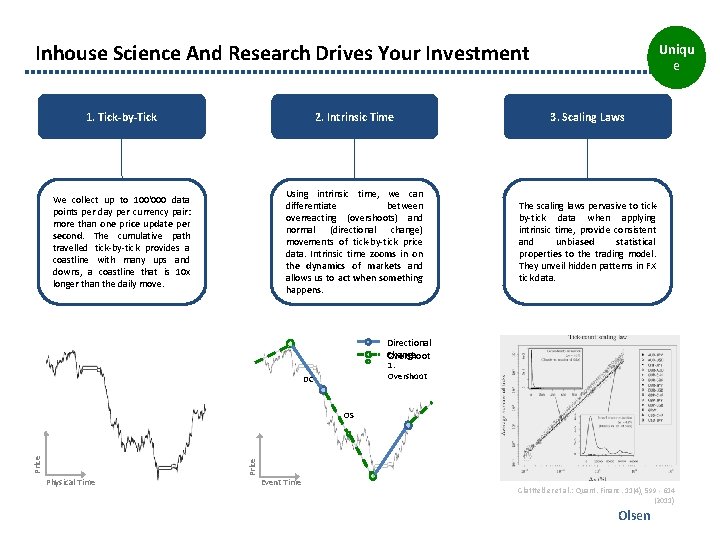
Inhouse Science And Research Drives Your Investment Uniqu e 1. Tick-by-Tick 2. Intrinsic Time 3. Scaling Laws We collect up to 100‘ 000 data points per day per currency pair: more than one price update per second. The cumulative path travelled tick-by-tick provides a coastline with many ups and downs, a coastline that is 10 x longer than the daily move. Using intrinsic time, we can differentiate between overreacting (overshoots) and normal (directional change) movements of tick-by-tick price data. Intrinsic time zooms in on the dynamics of markets and allows us to act when something happens. The scaling laws pervasive to tickby-tick data when applying intrinsic time, provide consistent and unbiased statistical properties to the trading model. They unveil hidden patterns in FX tick data. Directional Change Overshoot 1. Overshoot DC Price OS Physical Time Event Time Glattfelder et al. : Quant. Financ. 11(4), 599 - 614 (2011) Olsen

Exciting Work… Olsen
Key Features Of FX Markets • • FX spot transaction volume is 2 trillion per day, 15 percent of US GDP Price ticks occur at irregular intervals. Price changes are leptokurtic, increasingly so for short-term horizons. Average volume per second is 12 million of buys and sells; volume spikes are two to three orders larger in size. Small imbalances of buy and sell volume have big price impact. 80% of volume has holding periods of less than 20 minutes; 98% of volume has holding periods of less than 24 hours. Bid/ask spread can be as low as 0. 0003% Average price move per day is 0. 5% with a daily 6. 4% coast line of sum of price changes larger than 0. 05% after deducting transaction costs. Above features are typical for other liquid markets Olsen
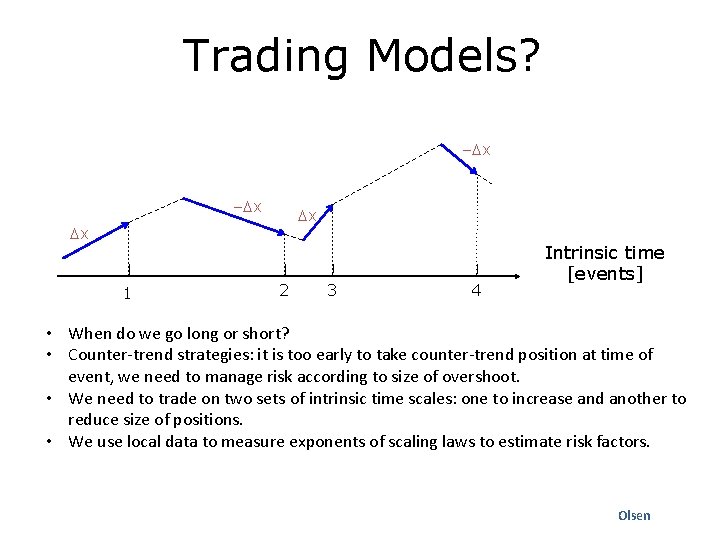
Trading Models? -Dx Dx Dx 1 2 3 4 Intrinsic time [events] • When do we go long or short? • Counter-trend strategies: it is too early to take counter-trend position at time of event, we need to manage risk according to size of overshoot. • We need to trade on two sets of intrinsic time scales: one to increase and another to reduce size of positions. • We use local data to measure exponents of scaling laws to estimate risk factors. Olsen
Summary Implicit hypothesis: everything is based on interacting systems. Intrinsic time is endogenous to a specific system. Events are displacements from local extremes. Event based methodology reveals many scaling laws. Scaling laws establish proportional relationships between different variables or properties. • The scaling laws are a frame of reference for a new class of economic and financial models. • The concept of intrinsic time is by design relativistic and opens the door to a relativity theory of economics. • The real work has only just started, lots and lots of open questions. • • • Olsen
Global Challenges • • Unemployment Environment Political discontent Zero interest rate policy System changers for global economy: • Global ledger based on Bitcoin peer-to-peer crypto technology • Predictive technology based on a relativity theory of economics. Olsen
How Far Does Price Overshoot? Extremum Directional Change Overshoot Directional Change Olsen
Directional Change and Overshoots: Endogenous Time Grid Extremum Directional Change Overshoot Directional Change Event Time Physical Time Olsen
Physical Time: Imposing Artificial Time Scale on Time Series How to analyze time series: - Every tick? - Every second, minute, hour - Assumptions: data are equally spaced, homogenous Olsen
Physical Time: Imposing Artificial Time Scale on Time Series Exogenous Time Grid Physical Time Olsen
- Slides: 102