
The Big Bang Theory Ways of Labeling Past
The Big Bang Theory Ways of Labeling Past Events Time in the Universe • We can see the universe is expanding • Extrapolating backwards, we conjecture that there is a time when everything was together • We will call this event The Big Bang • We will call this time t = 0 • Though in fact, we can’t actually extrapolate all the way to t = 0 • The big bang theory really describes all the things that happen after t = 0 • As we work our way backwards, we will discover that conditions/temperatures/etc. become increasingly difficult to do experiments • Therefore, we pass from knowledge to speculation the earlier we get • Any comments about t = 0 or even t < 0 are pretty much pure speculation
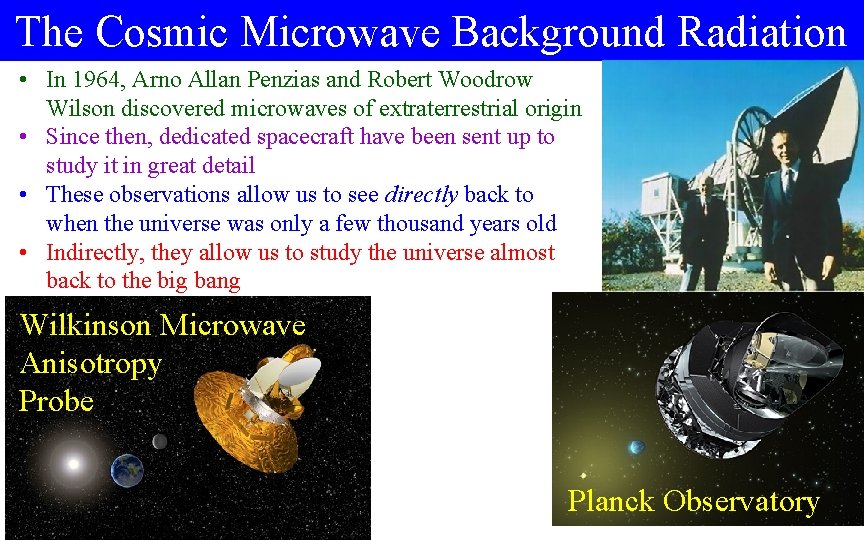
The Cosmic Microwave Background Radiation • In 1964, Arno Allan Penzias and Robert Woodrow Wilson discovered microwaves of extraterrestrial origin • Since then, dedicated spacecraft have been sent up to study it in great detail • These observations allow us to see directly back to when the universe was only a few thousand years old • Indirectly, they allow us to study the universe almost back to the big bang Wilkinson Microwave Anisotropy Probe Planck Observatory
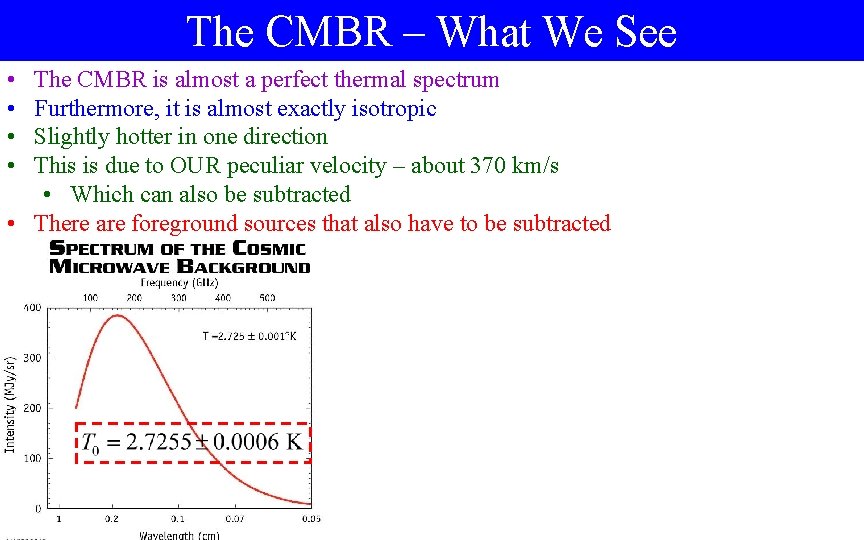
The CMBR – What We See • • The CMBR is almost a perfect thermal spectrum Furthermore, it is almost exactly isotropic Slightly hotter in one direction This is due to OUR peculiar velocity – about 370 km/s • Which can also be subtracted • There are foreground sources that also have to be subtracted
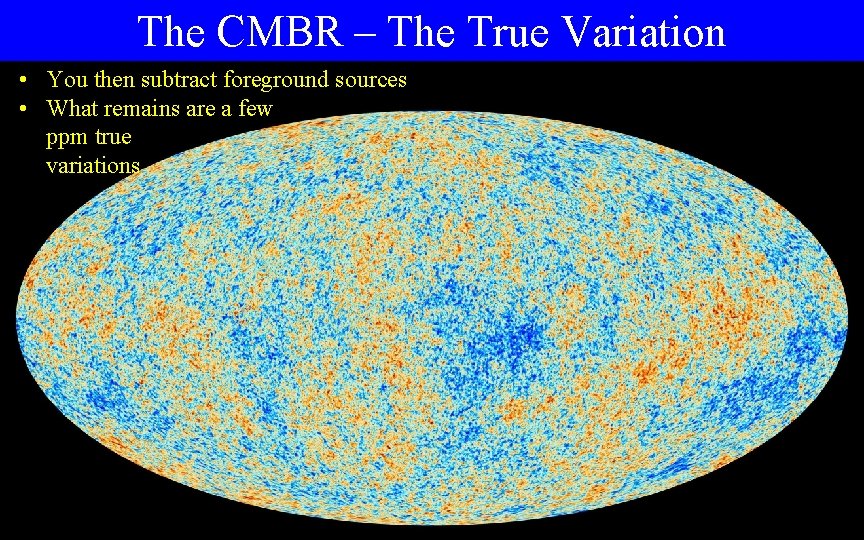
The CMBR – The True Variation • You then subtract foreground sources • What remains are a few ppm true variations
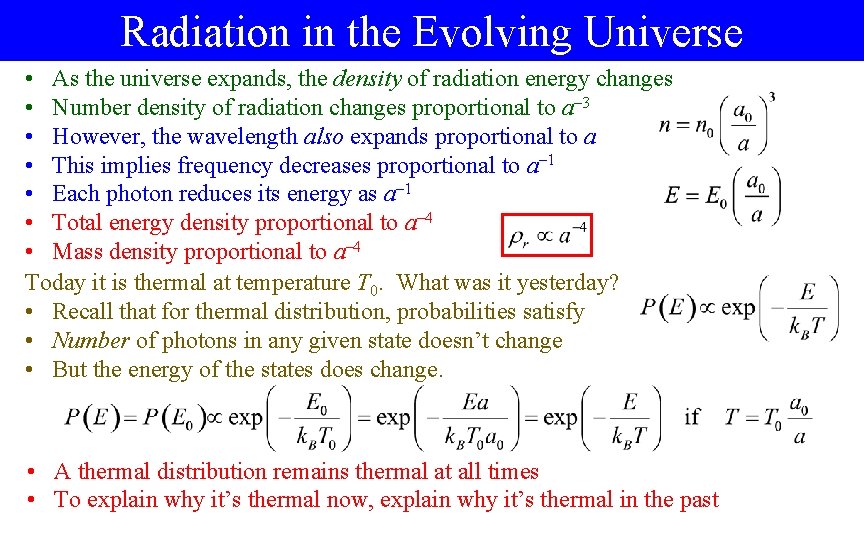
Radiation in the Evolving Universe • As the universe expands, the density of radiation energy changes • Number density of radiation changes proportional to a– 3 • However, the wavelength also expands proportional to a • This implies frequency decreases proportional to a– 1 • Each photon reduces its energy as a– 1 • Total energy density proportional to a– 4 • Mass density proportional to a– 4 Today it is thermal at temperature T 0. What was it yesterday? • Recall that for thermal distribution, probabilities satisfy • Number of photons in any given state doesn’t change • But the energy of the states does change. • A thermal distribution remains thermal at all times • To explain why it’s thermal now, explain why it’s thermal in the past
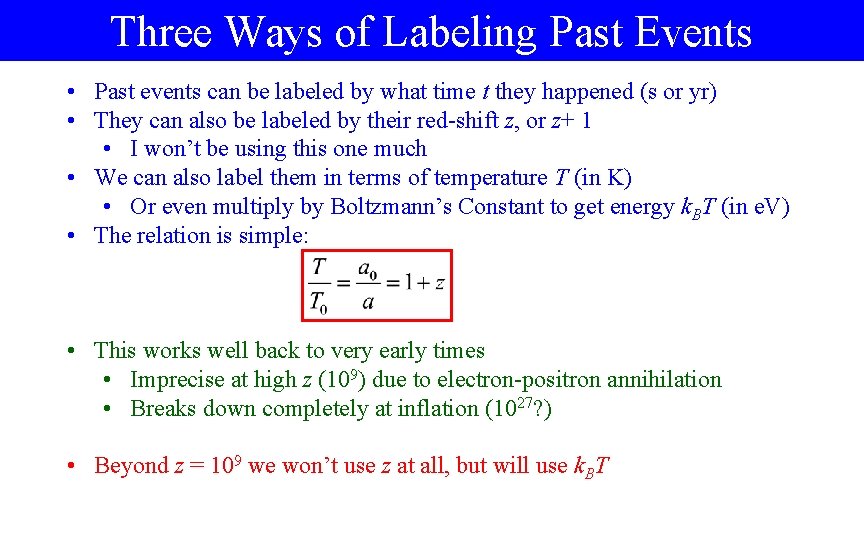
Three Ways of Labeling Past Events • Past events can be labeled by what time t they happened (s or yr) • They can also be labeled by their red-shift z, or z+ 1 • I won’t be using this one much • We can also label them in terms of temperature T (in K) • Or even multiply by Boltzmann’s Constant to get energy k. BT (in e. V) • The relation is simple: • This works well back to very early times • Imprecise at high z (109) due to electron-positron annihilation • Breaks down completely at inflation (1027? ) • Beyond z = 109 we won’t use z at all, but will use k. BT
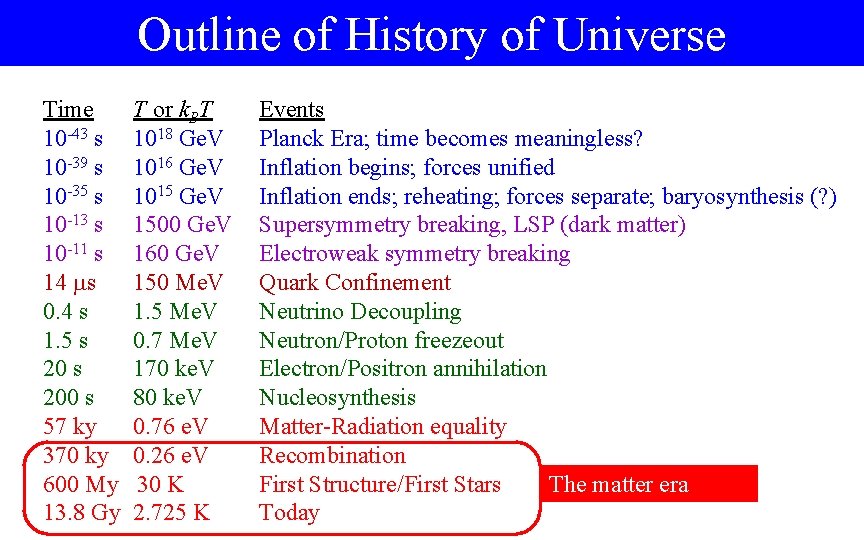
Outline of History of Universe Time 10 -43 s 10 -39 s 10 -35 s 10 -13 s 10 -11 s 14 s 0. 4 s 1. 5 s 200 s 57 ky 370 ky 600 My 13. 8 Gy T or k. BT 1018 Ge. V 1016 Ge. V 1015 Ge. V 1500 Ge. V 160 Ge. V 150 Me. V 1. 5 Me. V 0. 7 Me. V 170 ke. V 80 ke. V 0. 76 e. V 0. 26 e. V 30 K 2. 725 K Events Planck Era; time becomes meaningless? Inflation begins; forces unified Inflation ends; reheating; forces separate; baryosynthesis (? ) Supersymmetry breaking, LSP (dark matter) Electroweak symmetry breaking Quark Confinement Neutrino Decoupling Neutron/Proton freezeout Electron/Positron annihilation Nucleosynthesis Matter-Radiation equality Recombination First Structure/First Stars The matter era Today
Outline of History of Universe Time 10 -43 s 10 -39 s 10 -35 s 10 -13 s 10 -11 s 14 s 0. 4 s 1. 5 s 200 s 57 ky 370 ky 600 My 13. 8 Gy T or k. BT 1018 Ge. V 1016 Ge. V 1015 Ge. V 1500 Ge. V 160 Ge. V 150 Me. V 1. 5 Me. V 0. 7 Me. V 170 ke. V 80 ke. V 0. 76 e. V 0. 26 e. V 30 K 2. 725 K Events Planck Era; time becomes meaningless? Inflation begins; forces unified Inflation ends; reheating; forces separate; baryosynthesis (? ) Supersymmetry breaking, LSP (dark matter) Electroweak symmetry breaking Quark Confinement Neutrino Decoupling Neutron/Proton freezeout Electron/Positron annihilation Nucleosynthesis Matter-Radiation equality Recombination First Structure/First Stars The matter era Today
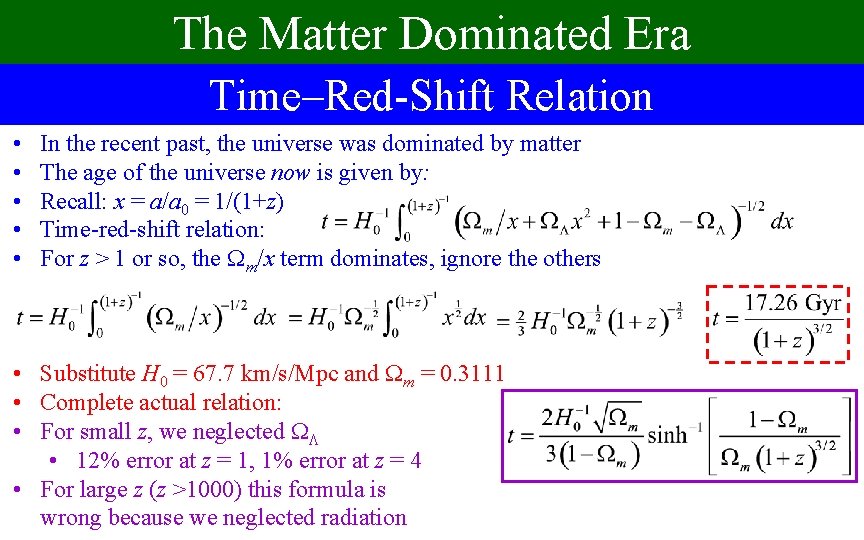
The Matter Dominated Era Time–Red-Shift Relation • • • In the recent past, the universe was dominated by matter The age of the universe now is given by: Recall: x = a/a 0 = 1/(1+z) Time-red-shift relation: For z > 1 or so, the m/x term dominates, ignore the others • Substitute H 0 = 67. 7 km/s/Mpc and m = 0. 3111 • Complete actual relation: • For small z, we neglected • 12% error at z = 1, 1% error at z = 4 • For large z (z >1000) this formula is wrong because we neglected radiation
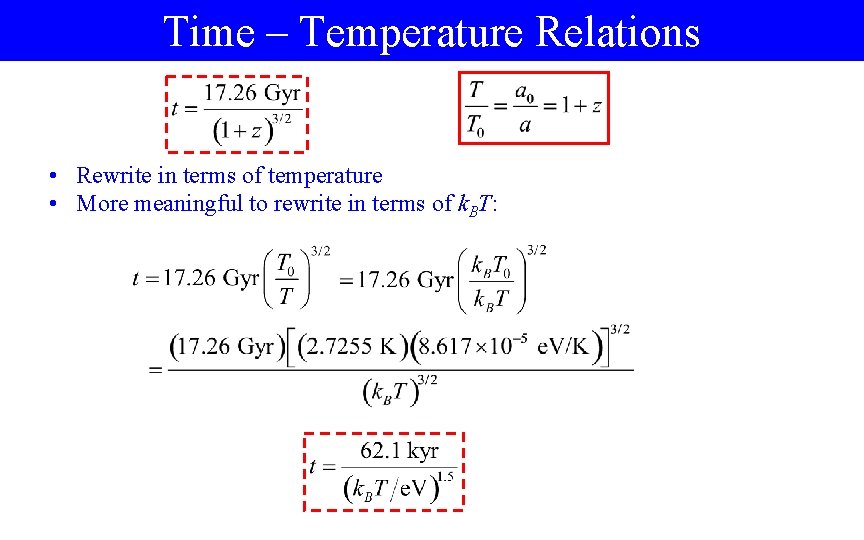
Time – Temperature Relations • Rewrite in terms of temperature • More meaningful to rewrite in terms of k. BT:
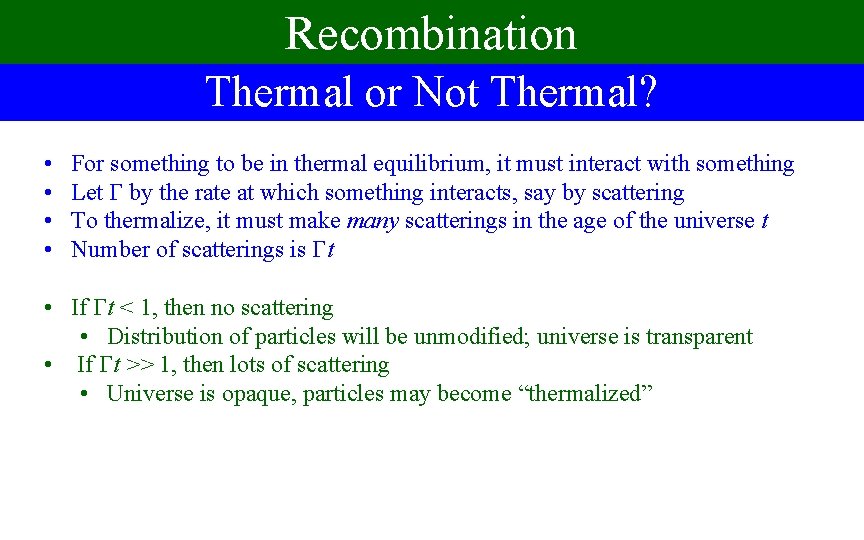
Recombination Thermal or Not Thermal? • • For something to be in thermal equilibrium, it must interact with something Let by the rate at which something interacts, say by scattering To thermalize, it must make many scatterings in the age of the universe t Number of scatterings is t • If t < 1, then no scattering • Distribution of particles will be unmodified; universe is transparent • If t >> 1, then lots of scattering • Universe is opaque, particles may become “thermalized”
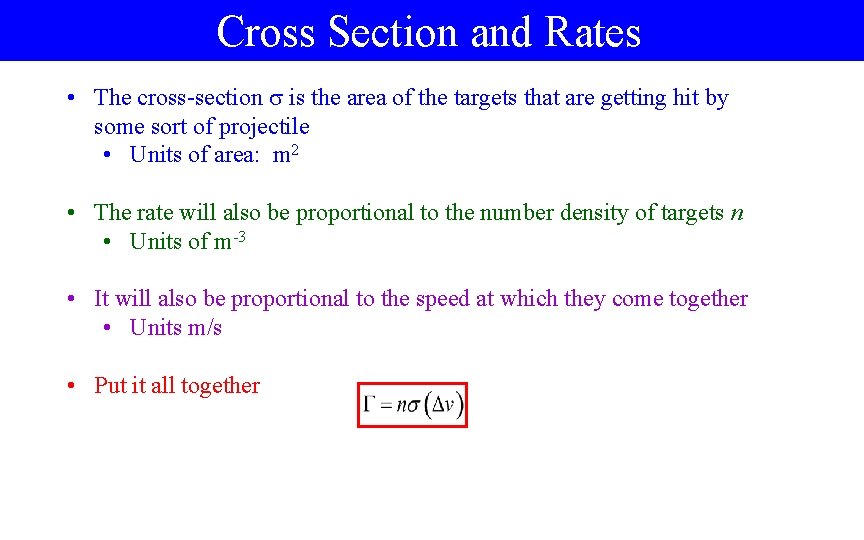
Cross Section and Rates • The cross-section is the area of the targets that are getting hit by some sort of projectile • Units of area: m 2 • The rate will also be proportional to the number density of targets n • Units of m-3 • It will also be proportional to the speed at which they come together • Units m/s • Put it all together
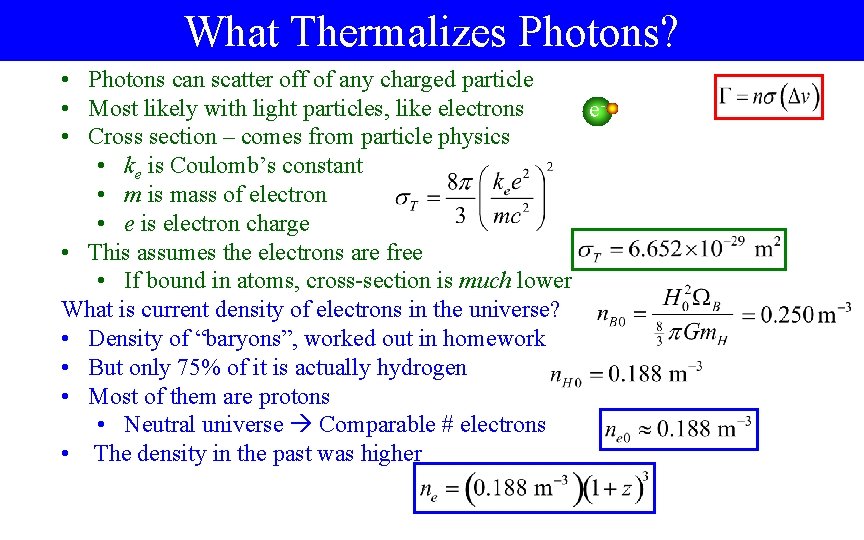
What Thermalizes Photons? • Photons can scatter off of any charged particle • Most likely with light particles, like electrons e • Cross section – comes from particle physics • ke is Coulomb’s constant • m is mass of electron • e is electron charge • This assumes the electrons are free • If bound in atoms, cross-section is much lower What is current density of electrons in the universe? • Density of “baryons”, worked out in homework • But only 75% of it is actually hydrogen • Most of them are protons • Neutral universe Comparable # electrons • The density in the past was higher
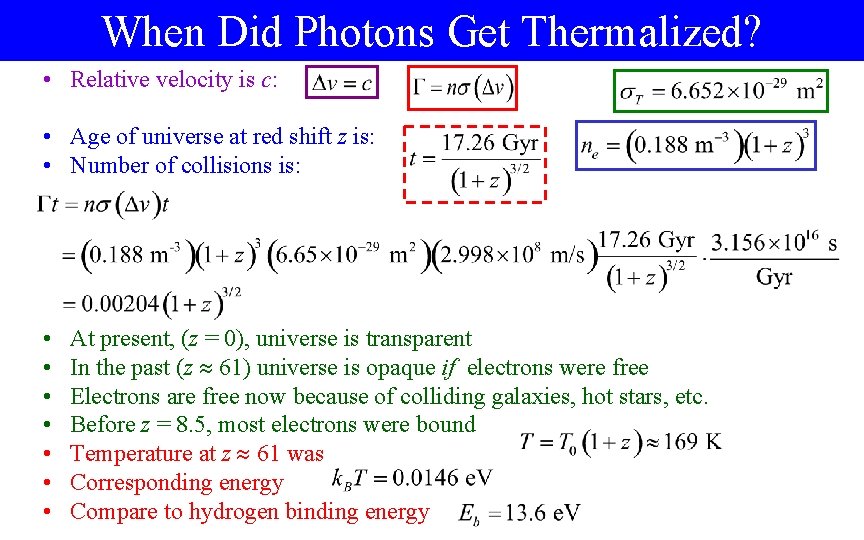
When Did Photons Get Thermalized? • Relative velocity is c: • Age of universe at red shift z is: • Number of collisions is: • • At present, (z = 0), universe is transparent In the past (z 61) universe is opaque if electrons were free Electrons are free now because of colliding galaxies, hot stars, etc. Before z = 8. 5, most electrons were bound Temperature at z 61 was Corresponding energy Compare to hydrogen binding energy
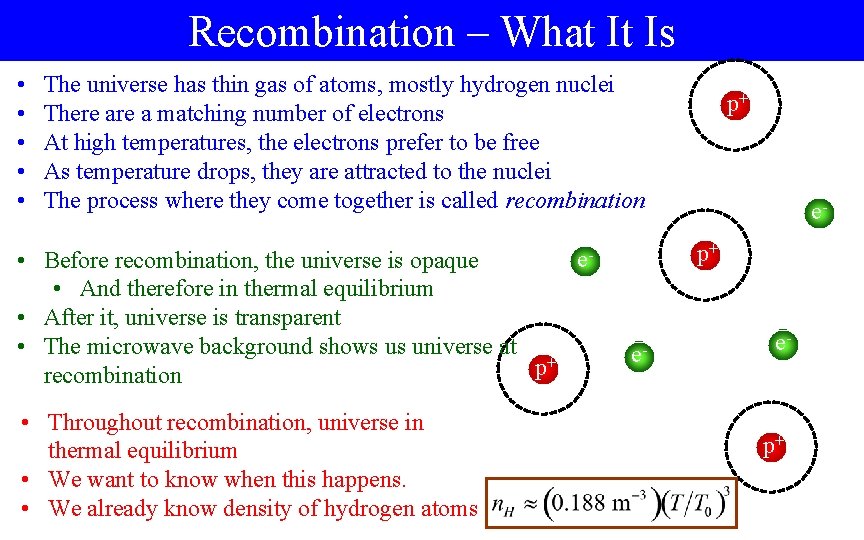
Recombination – What It Is • • • The universe has thin gas of atoms, mostly hydrogen nuclei There a matching number of electrons At high temperatures, the electrons prefer to be free As temperature drops, they are attracted to the nuclei The process where they come together is called recombination e • Before recombination, the universe is opaque • And therefore in thermal equilibrium • After it, universe is transparent • The microwave background shows us universe at + p recombination • Throughout recombination, universe in thermal equilibrium • We want to know when this happens. • We already know density of hydrogen atoms p+ e- e- p+
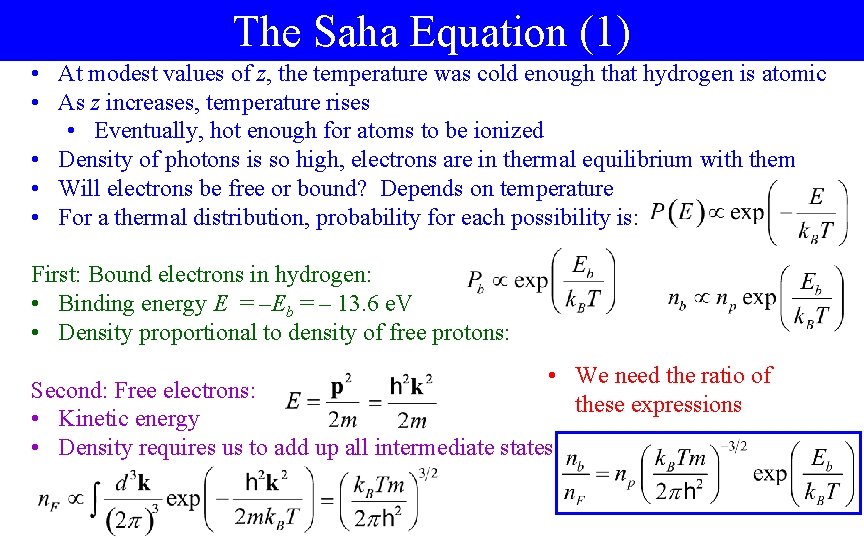
The Saha Equation (1) • At modest values of z, the temperature was cold enough that hydrogen is atomic • As z increases, temperature rises • Eventually, hot enough for atoms to be ionized • Density of photons is so high, electrons are in thermal equilibrium with them • Will electrons be free or bound? Depends on temperature • For a thermal distribution, probability for each possibility is: First: Bound electrons in hydrogen: • Binding energy E = –Eb = – 13. 6 e. V • Density proportional to density of free protons: • We need the ratio of these expressions Second: Free electrons: • Kinetic energy • Density requires us to add up all intermediate states
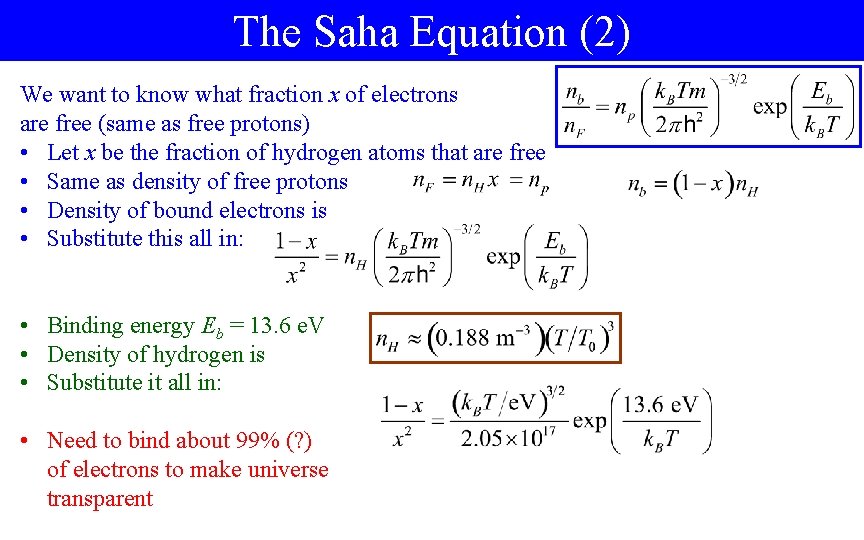
The Saha Equation (2) We want to know what fraction x of electrons are free (same as free protons) • Let x be the fraction of hydrogen atoms that are free • Same as density of free protons • Density of bound electrons is • Substitute this all in: • Binding energy Eb = 13. 6 e. V • Density of hydrogen is • Substitute it all in: • Need to bind about 99% (? ) of electrons to make universe transparent
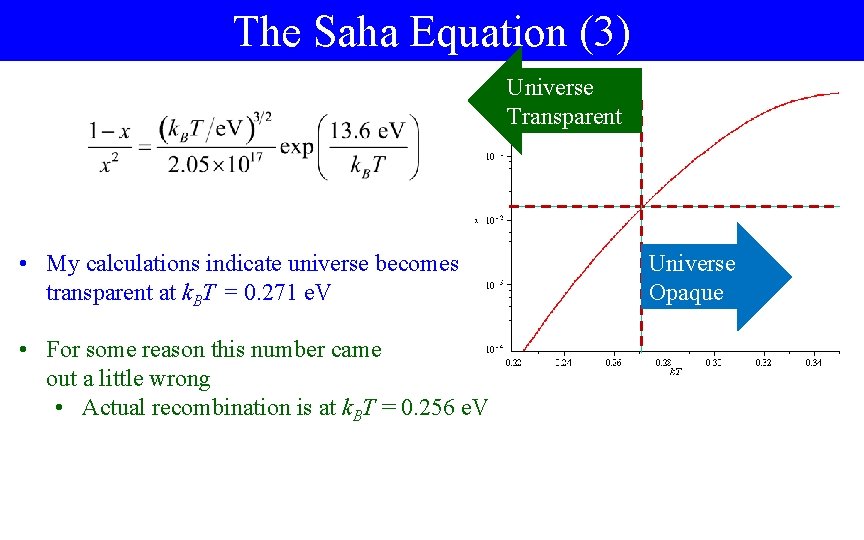
The Saha Equation (3) Universe Transparent • My calculations indicate universe becomes transparent at k. BT = 0. 271 e. V • For some reason this number came out a little wrong • Actual recombination is at k. BT = 0. 256 e. V Universe Opaque
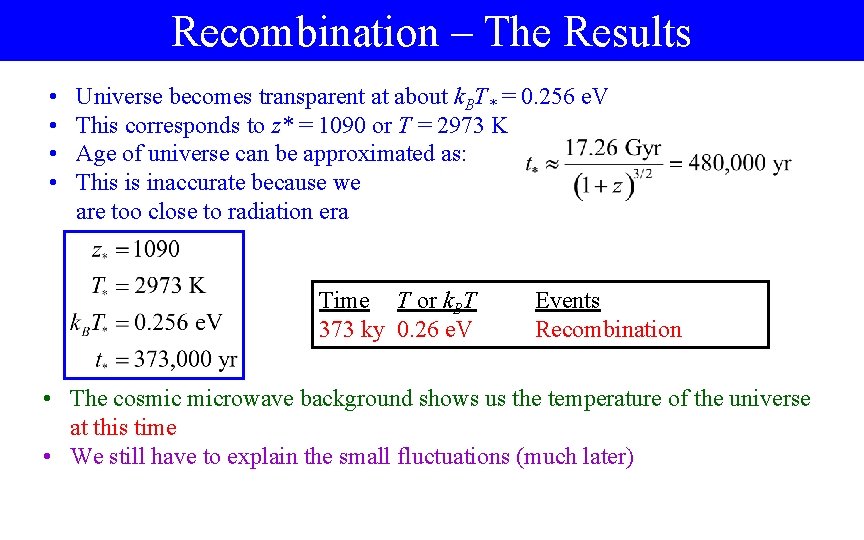
Recombination – The Results • • Universe becomes transparent at about k. BT* = 0. 256 e. V This corresponds to z* = 1090 or T = 2973 K Age of universe can be approximated as: This is inaccurate because we are too close to radiation era Time T or k. BT 373 ky 0. 26 e. V Events Recombination • The cosmic microwave background shows us the temperature of the universe at this time • We still have to explain the small fluctuations (much later)
- Slides: 19