
The Big Bang debate A new perspective The
The Big Bang debate A new perspective? The Big Bang: Fact or Fiction? Dr Cormac O’Raifeartaigh
Cosmology The study of the cosmos Is it finite? how big is it? Is it eternal? how old is it? How did it begin? Not science?
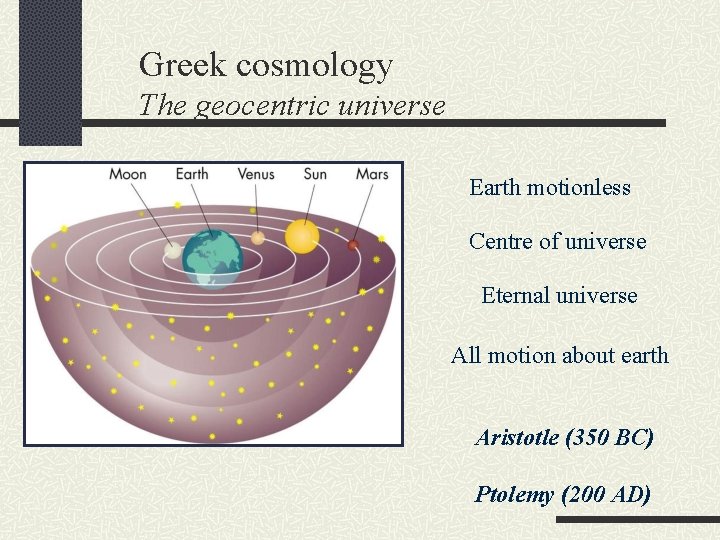
Greek cosmology The geocentric universe Earth motionless Centre of universe Eternal universe All motion about earth Aristotle (350 BC) Ptolemy (200 AD)
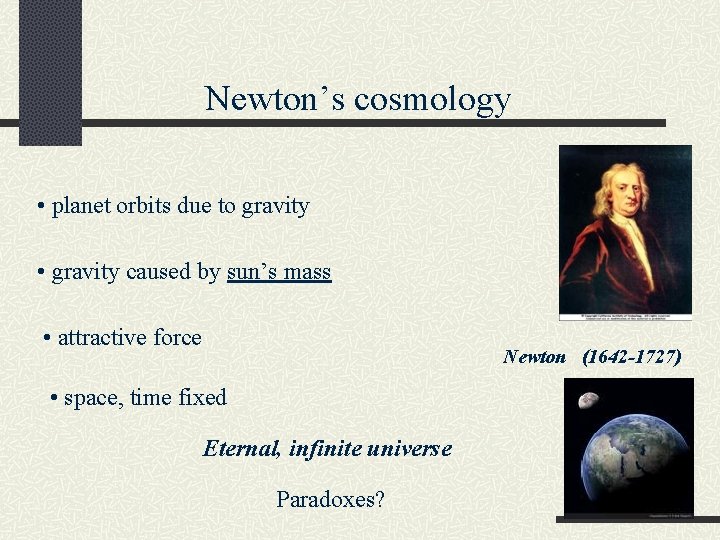
Newton’s cosmology • planet orbits due to gravity • gravity caused by sun’s mass • attractive force Newton (1642 -1727) • space, time fixed Eternal, infinite universe Paradoxes?
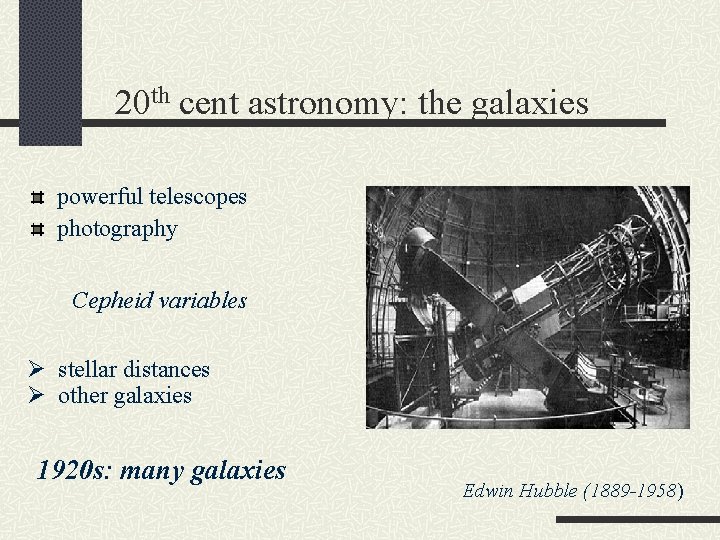
20 th cent astronomy: the galaxies powerful telescopes photography Cepheid variables Ø stellar distances Ø other galaxies 1920 s: many galaxies Edwin Hubble (1889 -1958)
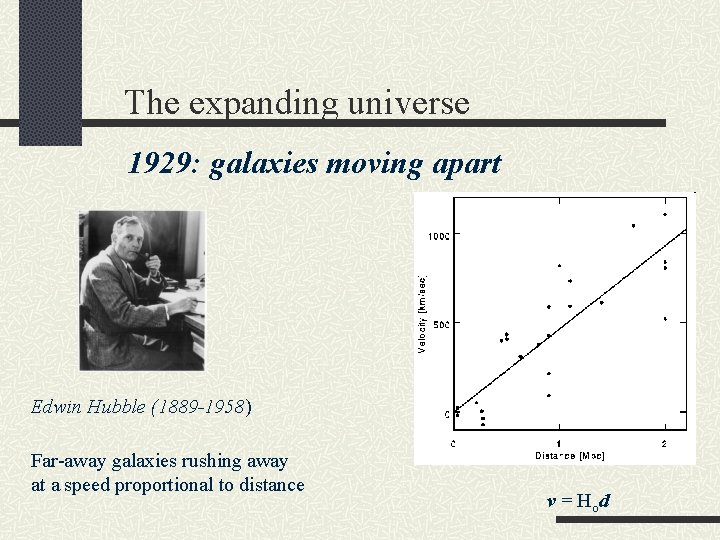
The expanding universe 1929: galaxies moving apart Edwin Hubble (1889 -1958) Far-away galaxies rushing away at a speed proportional to distance v = Ho d
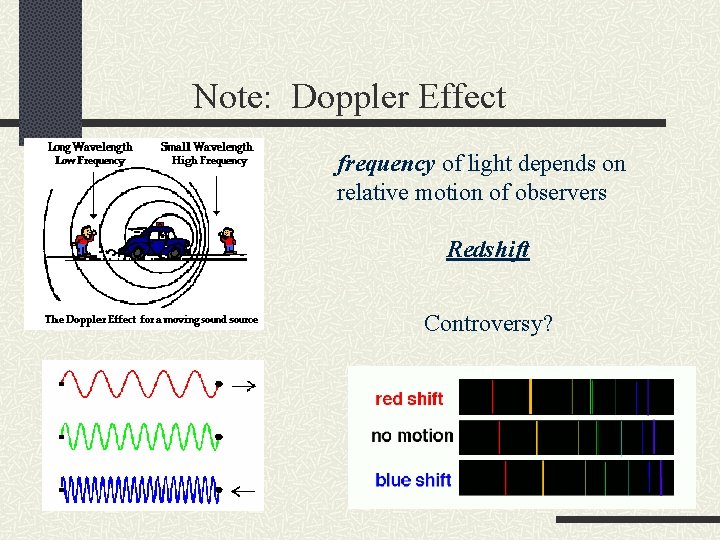
Note: Doppler Effect frequency of light depends on relative motion of observers Redshift Controversy?
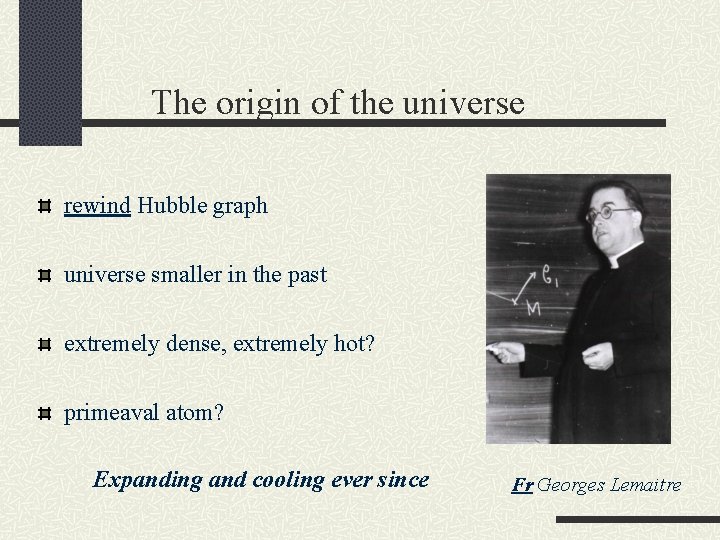
The origin of the universe rewind Hubble graph universe smaller in the past extremely dense, extremely hot? primeaval atom? Expanding and cooling ever since Fr Georges Lemaitre
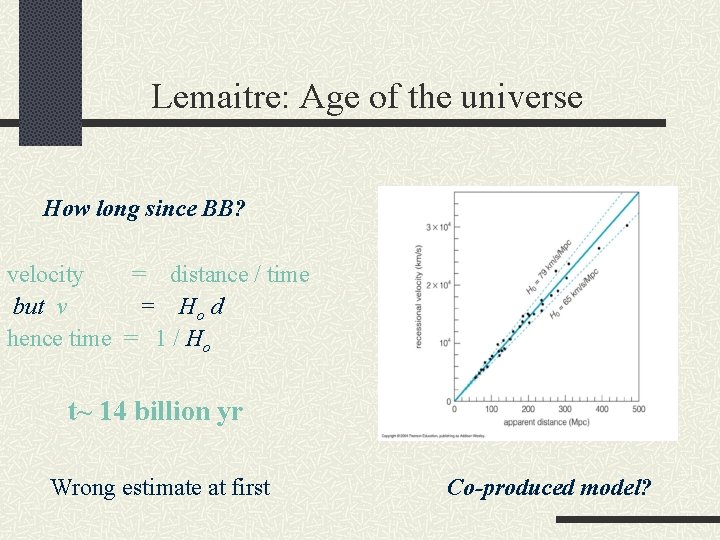
Lemaitre: Age of the universe How long since BB? velocity = distance / time but v = Ho d hence time = 1 / Ho t~ 14 billion yr Wrong estimate at first Co-produced model?
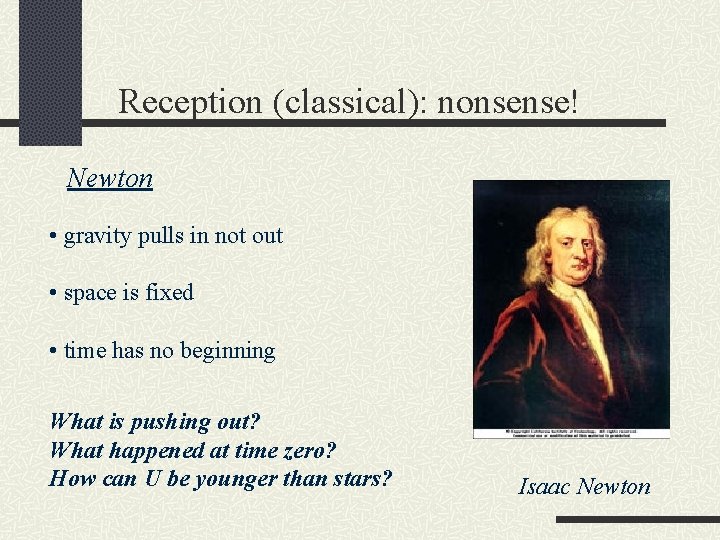
Reception (classical): nonsense! Newton • gravity pulls in not out • space is fixed • time has no beginning What is pushing out? What happened at time zero? How can U be younger than stars? Isaac Newton
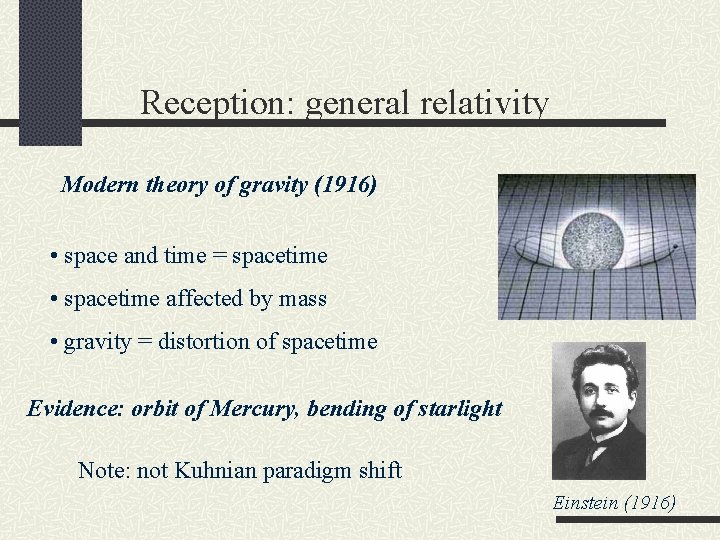
Reception: general relativity Modern theory of gravity (1916) • space and time = spacetime • spacetime affected by mass • gravity = distortion of spacetime Evidence: orbit of Mercury, bending of starlight Note: not Kuhnian paradigm shift Einstein (1916)
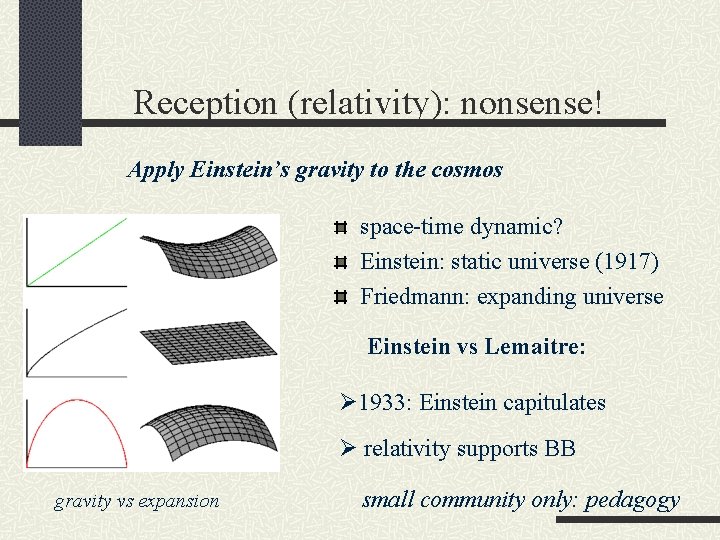
Reception (relativity): nonsense! Apply Einstein’s gravity to the cosmos space-time dynamic? Einstein: static universe (1917) Friedmann: expanding universe Einstein vs Lemaitre: Ø 1933: Einstein capitulates Ø relativity supports BB gravity vs expansion small community only: pedagogy
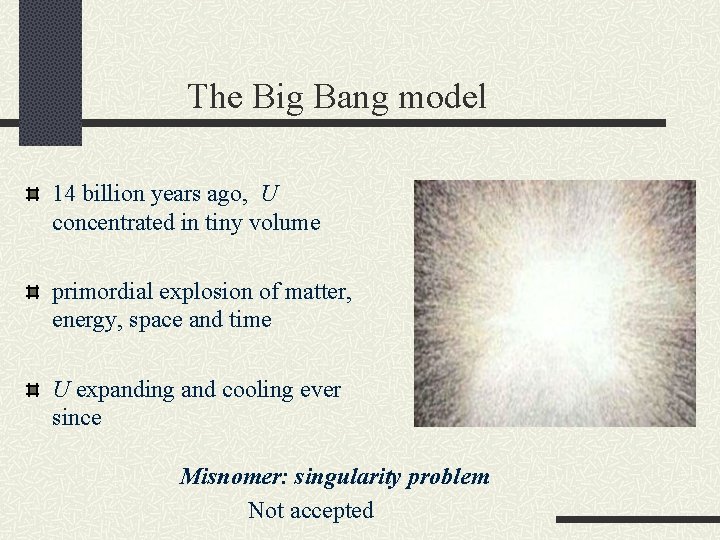
The Big Bang model 14 billion years ago, U concentrated in tiny volume primordial explosion of matter, energy, space and time U expanding and cooling ever since Misnomer: singularity problem Not accepted
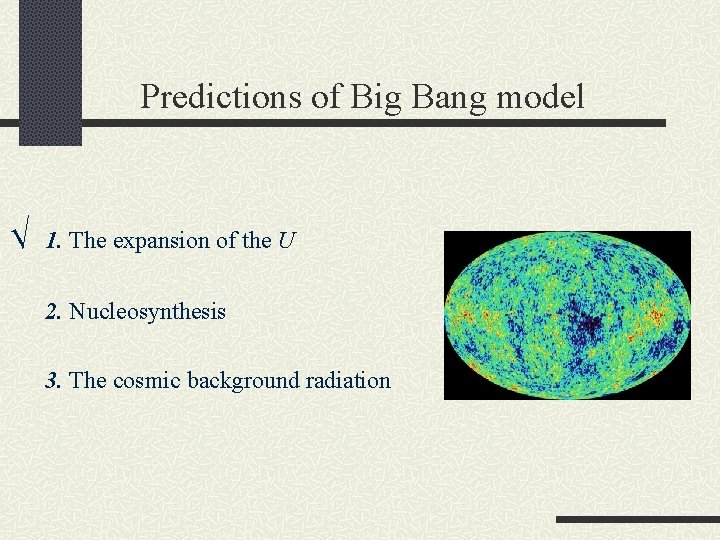
Predictions of Big Bang model √ 1. The expansion of the U 2. Nucleosynthesis 3. The cosmic background radiation
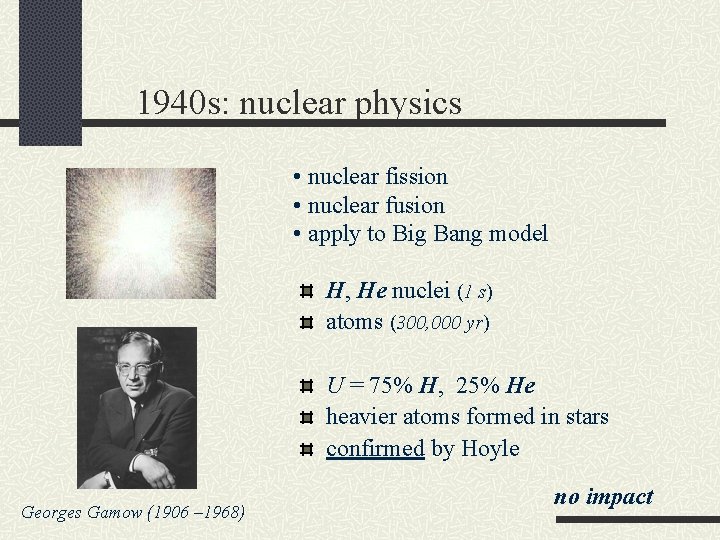
1940 s: nuclear physics • nuclear fission • nuclear fusion • apply to Big Bang model H, He nuclei (1 s) atoms (300, 000 yr) U = 75% H, 25% He heavier atoms formed in stars confirmed by Hoyle Georges Gamow (1906 – 1968) no impact
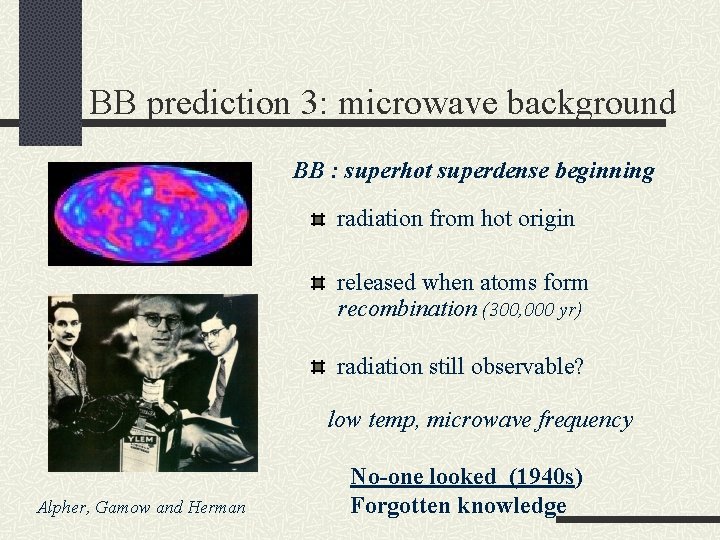
BB prediction 3: microwave background BB : superhot superdense beginning radiation from hot origin released when atoms form recombination (300, 000 yr) radiation still observable? low temp, microwave frequency Alpher, Gamow and Herman No-one looked (1940 s) Forgotten knowledge
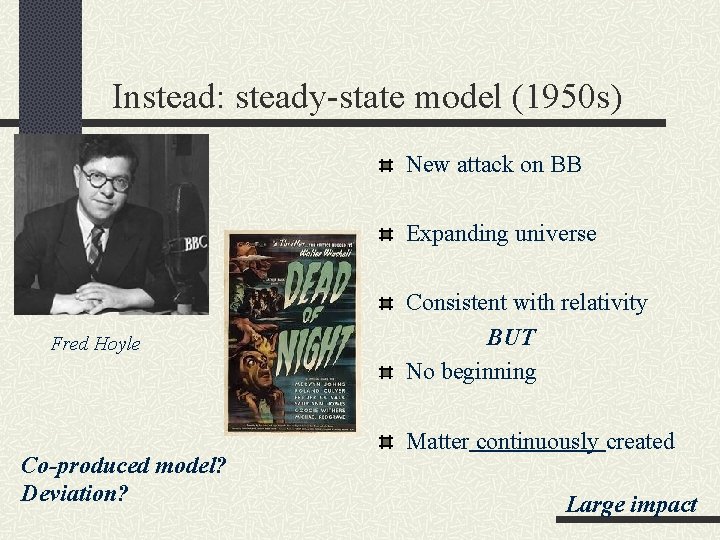
Instead: steady-state model (1950 s) New attack on BB Expanding universe Fred Hoyle Co-produced model? Deviation? Consistent with relativity BUT No beginning Matter continuously created Large impact
Steady-State prediction: eternal U § Continuous creation § Density of matter constant § U unchanging, eternal § Distant galaxies similar to present? § Youngest galaxies similar to present? Falsification possible
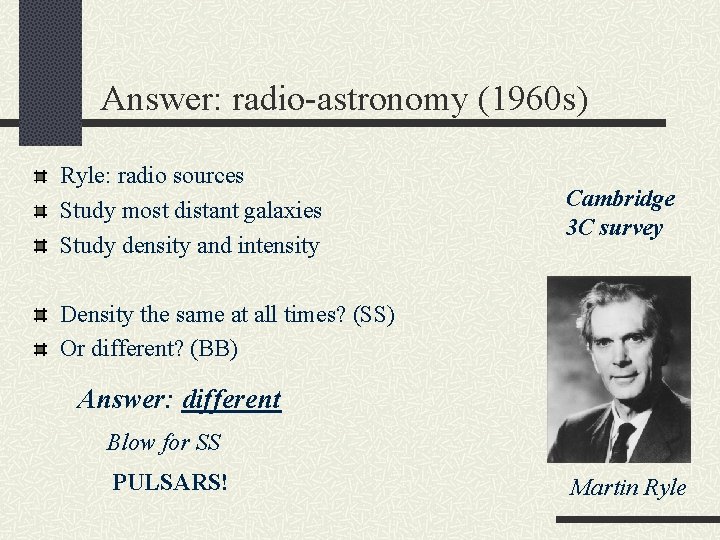
Answer: radio-astronomy (1960 s) Ryle: radio sources Study most distant galaxies Study density and intensity Cambridge 3 C survey Density the same at all times? (SS) Or different? (BB) Answer: different Blow for SS PULSARS! Martin Ryle
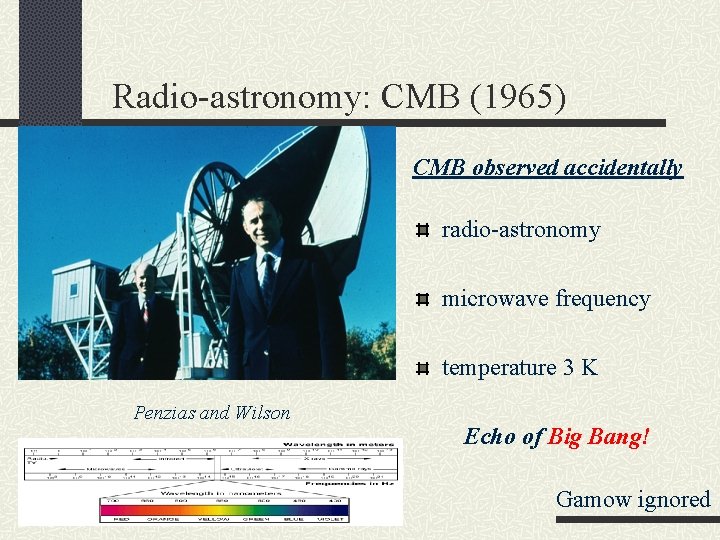
Radio-astronomy: CMB (1965) CMB observed accidentally radio-astronomy microwave frequency temperature 3 K Penzias and Wilson Echo of Big Bang! Gamow ignored
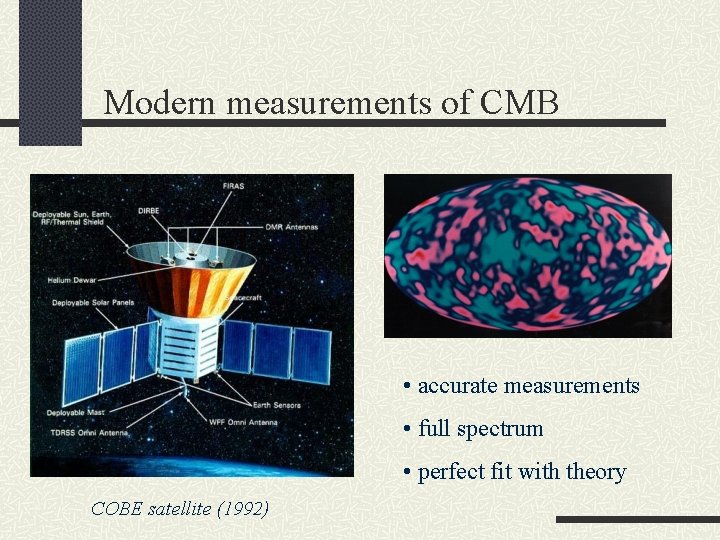
Modern measurements of CMB • accurate measurements • full spectrum • perfect fit with theory COBE satellite (1992)
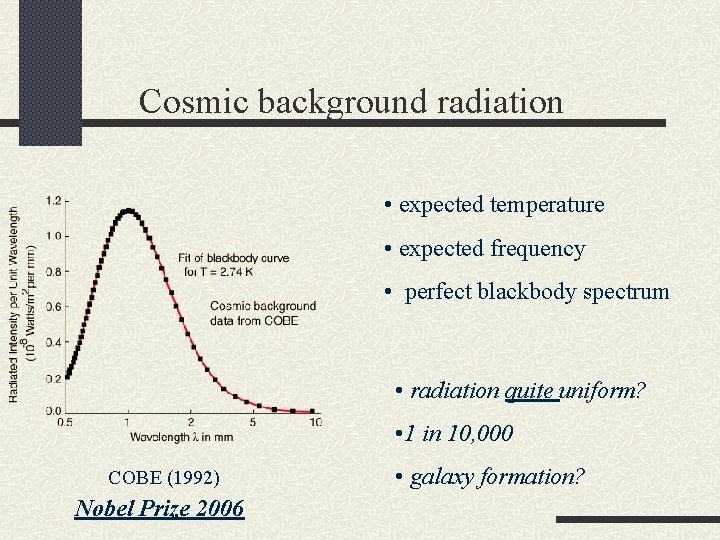
Cosmic background radiation • expected temperature • expected frequency • perfect blackbody spectrum • radiation quite uniform? • 1 in 10, 000 COBE (1992) Nobel Prize 2006 • galaxy formation?
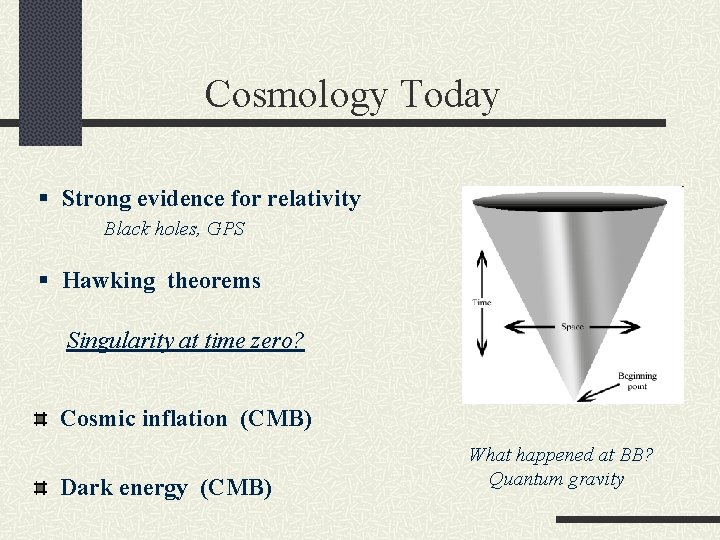
Cosmology Today § Strong evidence for relativity Black holes, GPS § Hawking theorems Singularity at time zero? Cosmic inflation (CMB) Dark energy (CMB) What happened at BB? Quantum gravity
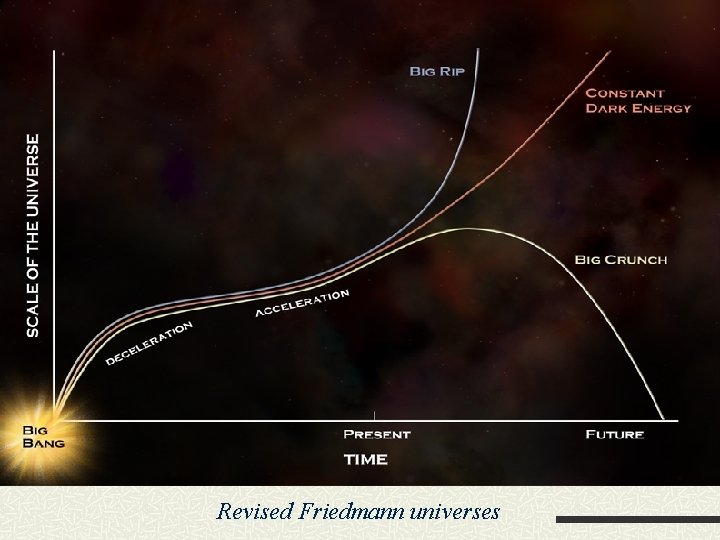
Revised Friedmann universes
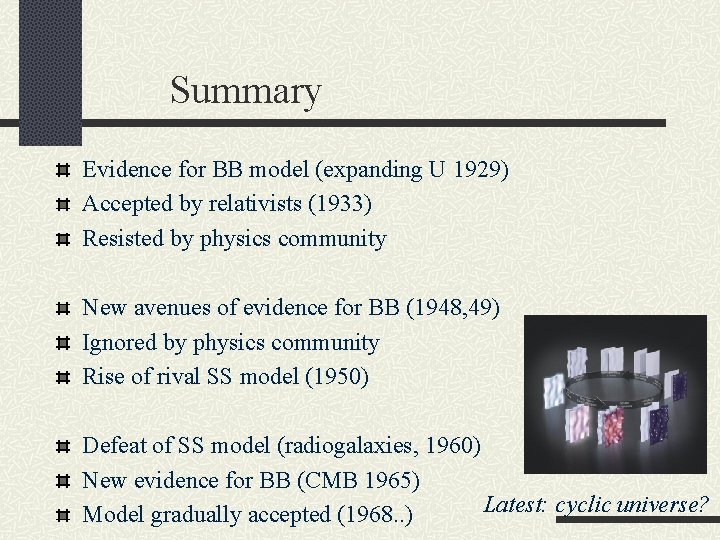
Summary Evidence for BB model (expanding U 1929) Accepted by relativists (1933) Resisted by physics community New avenues of evidence for BB (1948, 49) Ignored by physics community Rise of rival SS model (1950) Defeat of SS model (radiogalaxies, 1960) New evidence for BB (CMB 1965) Latest: cyclic universe? Model gradually accepted (1968. . )
- Slides: 25