
The BIG 6 RESEARCH MODEL What Is It
The BIG 6 RESEARCH MODEL What Is It Why Use It How to Implement It
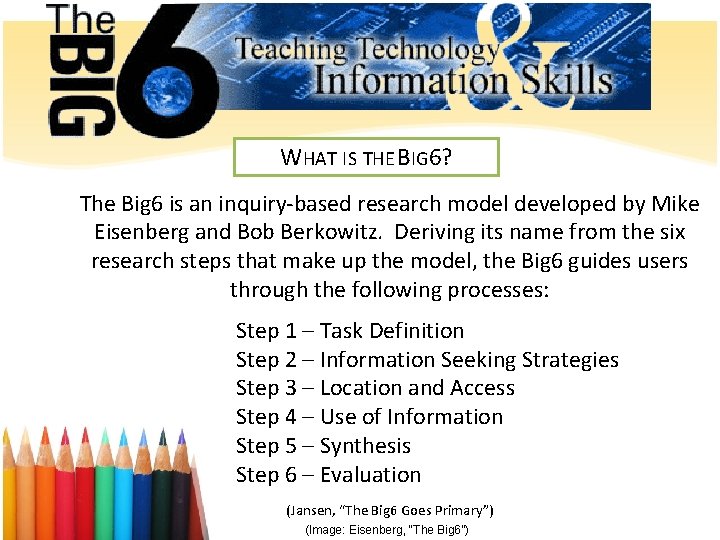
WHAT IS THE BIG 6? The Big 6 is an inquiry-based research model developed by Mike Eisenberg and Bob Berkowitz. Deriving its name from the six research steps that make up the model, the Big 6 guides users through the following processes: Step 1 – Task Definition Step 2 – Information Seeking Strategies Step 3 – Location and Access Step 4 – Use of Information Step 5 – Synthesis Step 6 – Evaluation (Jansen, “The Big 6 Goes Primary”) (Image: Eisenberg, “The Big 6”)
THE BIG 6 Created with Wordle. net The Big 6 follows the traditional inquiry model format through its six corresponding steps. In comparison to other research models, Big 6 offers students the opportunity to activate and extend knowledge in a manner that is conducive to any level of cognitive ability. The Big 6 is a student-led method for researching that meets all elements of true inquiry-based learning. Its use in any classroom offers a plethora of benefits, many of which will be described in this presentation.
What is the Big 6? Step 1 – Task Definition Students Ask: What do we need to do? During this step, students: Define the information problem and Identify information needed (Jansen, “The Big 6 Goes Primary”) (Eisenberg, “The Big 6”)

What is the Big 6? Step 2 – Information Seeking Strategies Students Ask: What can we use to find what we need? During this step, students: Determine all possible sources and Select the best sources (Jansen, “The Big 6 Goes Primary”) (Eisenberg, “The Big 6”)

What is the Big 6? Step 3 – Location and Access Students Ask: Where can we find what we need? During this step, students: Locate sources and Find information within sources (Jansen, “The Big 6 Goes Primary”) (Eisenberg, “The Big 6”)
What is the Big 6? Step 4 – Use of Information Students Ask: What information can we use? During this step, students: Engage (read, hear, view, touch) information and Extract relevant information (Jansen, “The Big 6 Goes Primary”) (Eisenberg, “The Big 6”)
What is the Big 6? Step 5 – Synthesis Students Ask: How can we show what we learned? During this step, students: Organize from multiple sources and Present the information (Jansen, “The Big 6 Goes Primary”) (Eisenberg, “The Big 6”)

What is the Big 6? Step 6 – Evaluation Students Ask: How will we know if we did well? During this step, students: Judge the product and Judge the process (Jansen, “The Big 6 Goes Primary”) (Eisenberg, “The Big 6”)
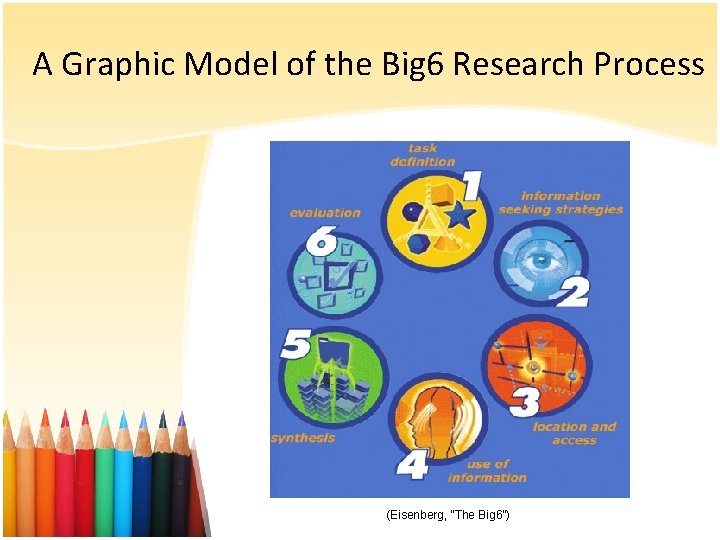
A Graphic Model of the Big 6 Research Process (Eisenberg, “The Big 6”)
Why Use the Big 6? ADVANTAGES The Big 6 is able to be used at virtually any grade, subject and ability level. • Students are able to work through steps at their own pace allowing differentiation based on interest, reading level, and learning style (Jansen, “Differentiating Instruction” 32). • Multiple literacies and content can be integrated in a logical manner using the Big 6 approach (Needham, 42). • The process is not linear; revisiting steps and resources at any point can help the student connect and integrate information as they progress through lessons.

Why Use the Big 6? ADVANTAGES The Big 6 also produces a framework for teaching and learning that is closely correlated to the American Association of School Librarians’ Standards for the 21 st-Century Learner (2009). It does this by providing teachers and school librarians a concrete process in which to embed instruction of each of the individual skills identified in the standards and for learners it enables connections between problem solving and individual skills leading to mastery (Needham, 42).
Why Use the Big 6? SKILLS FOR LIFE The bottom line is to raise the next generation of thinkers to be independent learners capable of turning curiosity into knowledge. Incorporating the six steps of the Big 6 into the teaching curriculum at any level and in any subject will help achieve greater information literacy skills and deeper learning for your students. (Image: Erniac, “Media Centered”)
How to Implement the Big 6 POSSIBLE PROJECTS The Big 6 can be implemented across the curriculum. Collaborate with your school librarian or media specialist to discover more possibilities for inquiry-based learning. Follow the Big 6 model to explore the world around us. Here are some possible projects to do with your students: • Explore the value of fresh water and present conservation techniques and benefits. • Build a water still and transform salt water into fresh water. • Explore the long term effects of the Gulf oil spill on the coastal swamps and develop preservation ideas. • What caused the 2004 tsunami in the Indian Ocean and how were the coastal countries affected?

Kat Gullahorn & Deanne May A 2. 4 Persuasive Presentation Fall 2010 LS 5443. 22 Librarians as Instructional Partners Dr. Judy Moreillon Texas Woman’s University
Works Cited Eisenberg, Mike. The Big 6: Information & Technology Skills for Student Achievement. 2007. Web. 10 Oct. 2010. Eisenberg, Michael and Robert E. Berkowitz. The Big 6. 2010. Web. 18 Oct. 2010. Erniec. Media Centered: Theory and Practice of School Librarianship. Word. Press, 2008. Web. 18 Oct. 2010. Jansen, Barbara A. “Differentiating Instruction in the Primary Grades with the Big 6. ” Library Media Connection 27. 4 (2009): 32 – 33. Web. 8 Oct. 2010. Jansen, Barbara A. The Big 6 Goes Primary: Teaching Information and Communications Technology Skills in Grades K – 3. Santa Barbara, CA: Linworth Publishing, Inc. , 2009. Print. Needham, J. "Meeting the New AASL Standards for the 21 st. Century Learner via Big 6 Problem Solving. " Library Media Connection 28. 6 (2010): 42 – 43. Web. 8 Oct. 2010.
- Slides: 16