
The Bible Prepared by Pat Lavercombe Religious Education
The Bible Prepared by Pat Lavercombe Religious Education Services BCEO 2014
This Presentation Learning Intentions: • The Bible is a collection of Sacred Texts compiled over a period of 1500 years. • The Hebrew Scriptures and the Christian Old Testament are similar but different. • Christians differ in what they consider to be the Canon of the Old Testament. • Knowing the Worlds Behind the Old Testament texts impacts strongly on their interpretation. • The Worlds of the OT Texts need to be explored in order to help make meaning of them for today’s reader. • Catholic Christianity teaches that the World in Front of the Text is always one of contextualisation for today’s audiences.
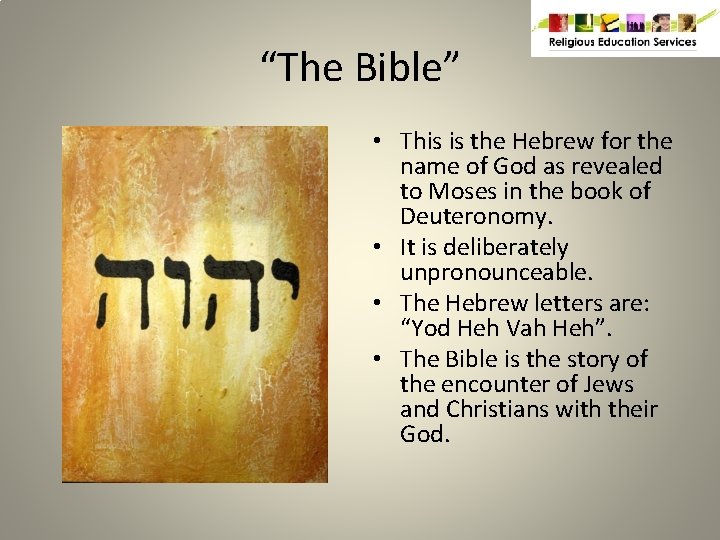
“The Bible” • This is the Hebrew for the name of God as revealed to Moses in the book of Deuteronomy. • It is deliberately unpronounceable. • The Hebrew letters are: “Yod Heh Vah Heh”. • The Bible is the story of the encounter of Jews and Christians with their God.
The World of the Text
What’s in a name? • “The” Bible. Gr: ta biblia- the books • Testament: covenant/agreement • Scriptures: – Word of God (i. e. a Sacred Book) set down in writing (So there are words of God not in writing) – Originally an oral tradition for hundreds of years (OT) and at least a generation (NT) – Originally in Hebrew, translated into Greek in the centuries before Christ. – Word of God for particular peoples: (Set down in the context of time and place and culture and the worldview of those peoples. )
Whose Scriptures? • Hebrew Scriptures – The Tanakh (TNK) is an acronym of the initial Hebrew letters of the Tanakh's three traditional subdivisions: Torah (Law) Nevi'im (Prophets) and Ketuvim (Writings). According to Jewish tradition, the Tanakh consists of twenty-four books. • “Protestant” Old Testament: 39 books • “Catholic” Old Testament: 46 books add 1, 2 Maccabees; Wisdom, Ecclesiasticus; Baruch (Deuterocanonicals)
Old Testament, New Testament • Jewish scholar Amy Jill Levine states that Jewish Scholars have no issue with this nomenclature: they only accept one testament which is ever old and ever new. • The Christian Old Testament (39, 46 books) is not the same as the Hebrew Scriptures (24 books) • The structure of the Jewish Sacred Writings is not the same as that of the Christian Old Testament. • The Jewish Texts are structured so as to point to reconstruction and renewal of Israel.
The Christian Old Testament • While all Christians agree there are 27 books in the New Testament, Catholics (46)and Protestants (39) disagree on the number of books of the Old Testament. • Protestant scholars follow Martin Luther who accepted only those texts originally written in Hebrew, rejecting the texts first recorded in Greek. Hence seven Deutero- (extra)canonical books of the Catholic (Vulgate) Bible.
An “Arranged” Text • Jewish and Christian compilers arranged the texts of the Old Testament for their own purposes. • The Jewish Texts are structured so as to point to reconstruction and renewal of Israel. • The structure of the Christian Old Testament is such that it ends with prophets, pointing to the arrival of Jesus, the Messiah.
One “Book”: Many Text Types • The Bible is an omnibus: it contains a collection of books, written in a variety of Text Types: e. g. – – – – – Myth and Story Codes and Laws Accounts of historical events and characters Songs and Prayers Letters Prophetic Utterances Chronologies Gospels Collections of sayings and wisdom
What Happens in the OT? • Creation • Sin (Original and lots of others!) • Murder and betrayal (Cain and Abel, Joseph and his brothers; David and Uriah) • Migrations and exiles (Mesopotamia, Egypt, Babylon) • Great escapes (Sea of Reeds, Joseph, Moses, Daniel) • Battles (David & Goliath; Judas Maccabeus; Ester) • Division ( Northern and Southern Kingdoms; Jews and Samaritans) • God is revealed (Burning bush; Mt Sinai; floods, rainbow, wind, columns of fire) • A Covenant renewed five times • Foreign Occupations (Babylonians, Persians, Greeks, Romans)
Who’s Who in the OT? • • • First man and first woman Abraham and Sarah Isaac and Rebekah, Jacob, Leah and Rachel Joseph and his brothers Moses, Pharaoh, Joshua Samuel, Sampson Kings Saul, David and Solomon Ester, Deborah, Ruth The Prophets

Scriptural Texts are not Originals Each Biblical text type is the product of significant and multiple processes of: • Recording • Editing • Transmission • Reproduction • Enculturation • Authorship • Translation
Many Text Types, Many Authors • Authorship of the Bible texts is a complex thing. • Oral traditions/written texts • Drawn from encounters with many different cultures: Mesopotamian; Egyptian; Babylonian; Greek; Persian; Ammonites; Philistines • Worked and re-worked: (JEDP); Septuagint (LXX 250 -150 BCE); Pentateuch (400 CE); in retrospect of historical eventsespecially the Exile. • Across time: J: 950 BCE; E: 750 BCE; D: 8 C; P: 587 -538 BCE; put together th after the Exile. • Translated across time and cultures. • Meaning is affected by all of these.
The World Behind the Text
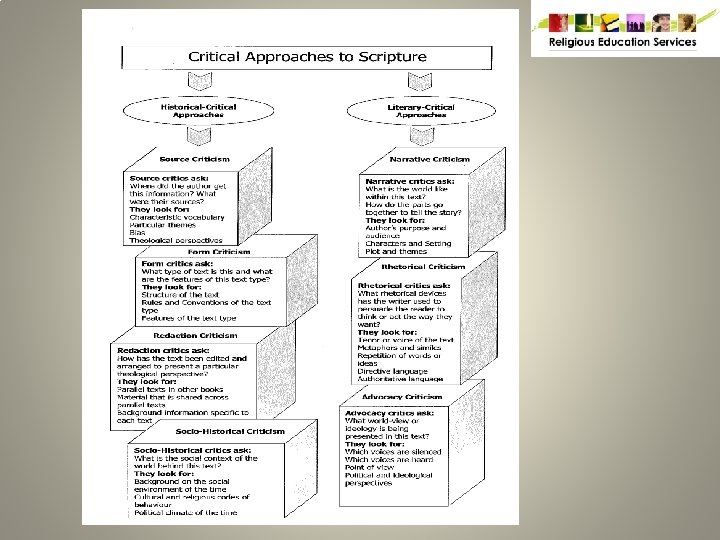
Biblical Criticism • In the past three hundred years, different ways of interpreting the bible have emerged. • This is known as Biblical criticism, or exploring the three worlds of the text from various standpoints such as History and Sociology; linguistics; intended audiences and author’s purpose/s.
Religious Stories, Religious History; Religious Truth • Each Biblical text type serves it own purpose/s. • Each Biblical text type uses text features to serve its own purpose/s. • Each Biblical text type has its own intended audience/s who are unique in nature and time. • Each Biblical text type held a specific meaning for its intended audience which subsequent audiences will probably never fully grasp. • Each Biblical text type uses its source material/s differently, for its own purpose/s. • Each Biblical text type is rendered more powerful by being more than a literal account.
How the Bible was formed • • Events/ exposure to other cultures Oral Traditions Written Tradition (J, E, D, P); Septuagint Canons
Three ways to translate the Bible Across time, a variety of linguistic, philological and ideological approaches to translation have been used, including: • Dynamic equivalence translation • Formal equivalence translation (similar to literal translation) • Idiomatic, or Paraphrastic translation.
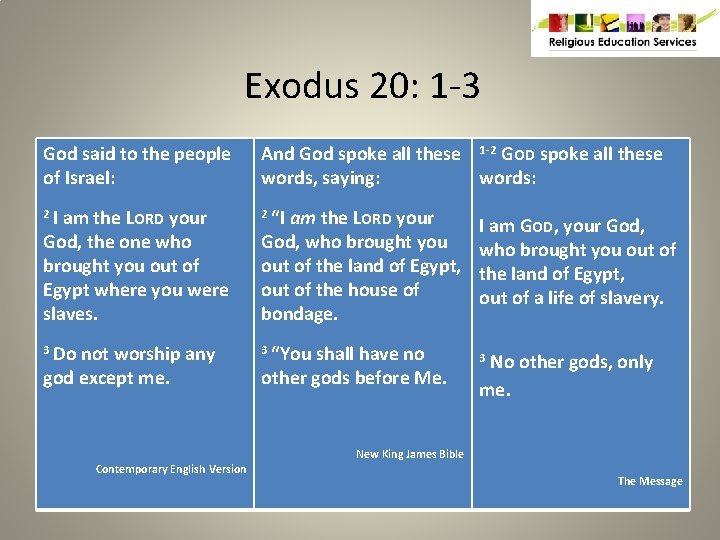
Exodus 20: 1 -3 God said to the people of Israel: And God spoke all these 1 -2 GOD spoke all these words, saying: words: 2 I am the LORD your God, the one who brought you out of Egypt where you were slaves. 2 “I am the LORD your God, who brought you out of the land of Egypt, out of the house of bondage. I am GOD, your God, who brought you out of the land of Egypt, out of a life of slavery. 3 Do 3 “You 3 not worship any god except me. Contemporary English Version shall have no other gods before Me. No other gods, only me. New King James Bible The Message
World in Front of the Text
Learning 1 for the Classroom The concept of “ The Holy Bible” needs constant unpacking for students. • Students need to be reminded every time they open a Bible that it is not one, uniform, sequential and cohesive book they are opening: they are opening a particular text type, among a collection of text types transmitted over a period of about 1100 years and written and arranged for specific religious, social and political purposes. (See Yr 4, 6, 7) • However, the text is still part of a sacred story; it is to be treated with reverence and awe because it reveals religious truths about God and God’s desire that humans would enter into a relationship that would challenge and transform the way they lived.
Learning 2 for the Classroom: • Scripture needs interpretation in order to determine historical truths; factual truths and religious truths (Yrs 4, 7) • The Bible, like all classical texts, must be interpreted through study of author, text and message. (Yr 10, Yr 7) • No longer is it accepted that Bible provides an unchanging and unmediated revelation from God. (Recontextualisation) • Selecting a text merely for “what it says” is no longer acceptable for mainstream Christians
Classroom Learning Three • The rules for writing were not the same then as they are today. – Plagiarism/copying/re-writing – “Storyteller’s licence” – Writing back into the story – Adding to the story, particularly with hindsight
Classroom Learning Four • • Be circumspect about what you attribute as “fact” to the Bible or characters in the bible! Change the language you use when speaking about the Bible or characters in the Bible.
Two Key Words • “Finally, for those of us hoping to say something about the times and places in which Biblical characters lived and acted, two words in particular come in very handy. . Imagine. . . Perhaps. . . and Scott Korb 2010
- Slides: 27