
The Beveridge Report 1942 from the cradle to
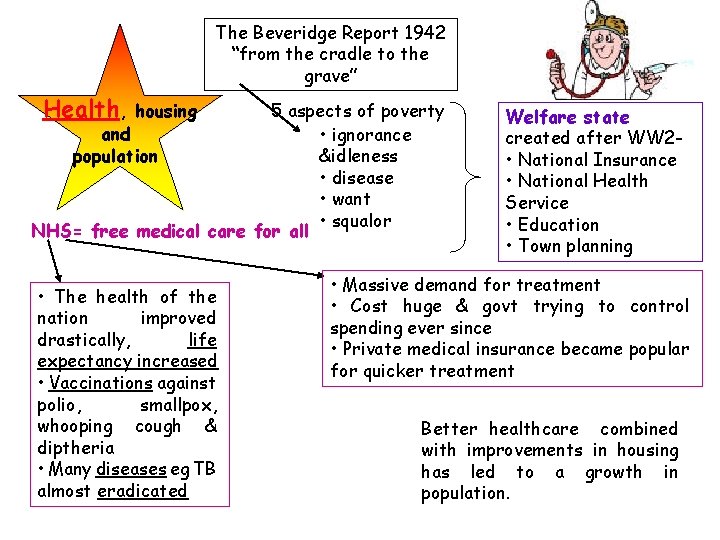
The Beveridge Report 1942 “from the cradle to the grave” Health, 5 aspects of poverty and • ignorance population &idleness • disease • want • squalor NHS= free medical care for all housing • The health of the nation improved drastically, life expectancy increased • Vaccinations against polio, smallpox, whooping cough & diptheria • Many diseases eg TB almost eradicated Welfare state created after WW 2 • National Insurance • National Health Service • Education • Town planning • Massive demand for treatment • Cost huge & govt trying to control spending ever since • Private medical insurance became popular for quicker treatment Better healthcare combined with improvements in housing has led to a growth in population.

1 A. Why was health such a problem at the beginning of the 20 th century? 1. • • 2. • • • HOUSING Damp Lack of sanitation Overcrowding Slums Rats Broken windows/ lack of ventilation Dirty water Disease spread easily & quickly POVERTY No/ little food & poor diet No heating Poor clothing 3. WORK PLACES • Damp/ stuffy/ dirty/ crowded 4. WATER SUPPLY INADEQUATE 5. LACK OF HYGIENE/ AWARENESS 6. LACK OF MEDICINE & MEDICAL IGNORANCE 7. NO GOVERNMENT INTERVENTION • health & housing very both very poor for the working class in Britain • by 1900 there was still no free health service but the medical service was improving with trained doctors and discoveries like anaesthetics and antiseptics B. Improvements in health up to 1939 1. 2. 3. 4. 5. Some slum clearance New housing/ building of parks Public water supply schemes National Insurance and ‘Welfare State’ Medical improvements Health: • 188 os- smallpox under control • Diptheria, measles, whooping cough, scarlet fever and TB flourished Improved living standards and better diet caused: • death rate to fall • life expectancy to increase Medicine: • until the 20 th century, advances in medicine had little effect • 1899 - X ray • 1921 - anti toxin for TB • 1924 - child diptheria could be treated successfully • cures for preventable diseases- measles & whooping cough Medical advances reduced infectious diseases- TB; • Surgery had improved due to: • anaesthetics • chloroform & antiseptics

Hospitals & nursing: Before 1900 • 50% of patients died • Dirty & overcrowded • Nurses- low paid & illiterate After 1900 • Florence Nightingale’s work a success • specialists • fever hospitals • cottage hospitals • district nurses • healthier, brighter hospitals 1906 - 1914 Liberal Government • improves health and welfare of public • 1906 School Meals Act • 1907 School Medical Inspection • 1911 National Insurance Act C. Why did health improve between 1919 - 1939? 1. Better diet, better housing, less overcrowded & cleaner 2. Average wages increased 3. Average number of children decreased (contraception) 4. Improvements in water supply and sewerage 5. Access to fresh fruit & vegetables 6. 1920 s. Alexander Fleming researches penicillin as an antibiotic • However, there was still a huge gap between rich and poor. • A survey by Rowntree in 1935 found that 1/3 of households were living below the poverty line 2 D. WW 2 and beyond During the war Middle class families were shocked to learn from evacuated children that they rarely bathed, suffered from scabies, had head lice. Badly clothed & fed. Abused. 1942 Beveridge Report • free school meals • free immunisation & vitamin supplements Helps improve the situation E. How did the nation’s health improve from 1945? 1. 2. 3. 4. 5. 6. 7. The Welfare State- ‘from the cradle to the grave’ system of benefits 1948 NHS began Education- huge emphasis on healthy eating & hygiene Housing- council & private homes and govt planning Greater access to a wide variety of foodbetter diet - fridges & air transport Electricity -houses no longer cold & damp Advances in medicine- antibiotics & vaccinations
- Slides: 3