
The Bernoulli Distribution A random variable X has
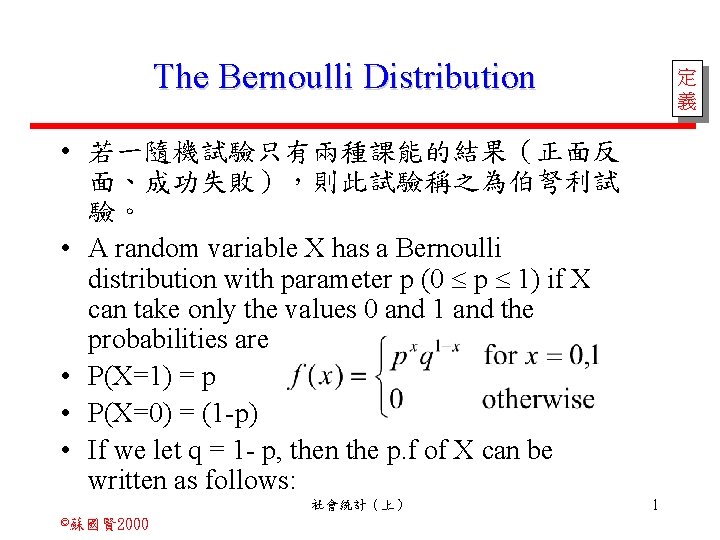
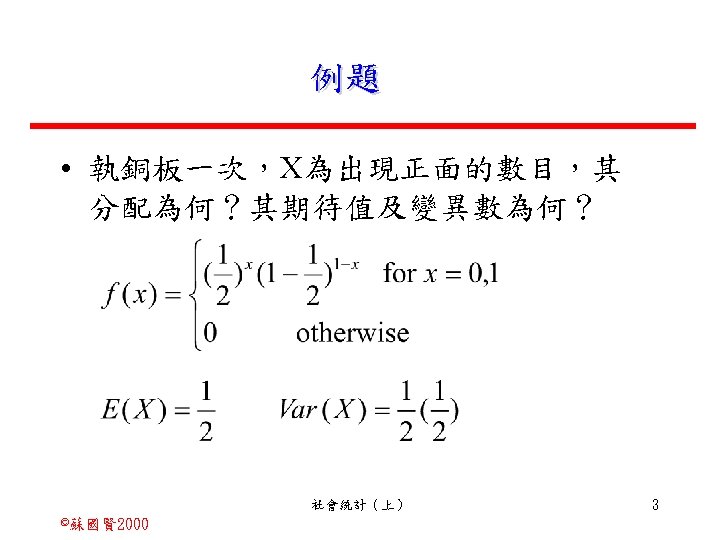
The Bernoulli Distribution 定 義 • 若一隨機試驗只有兩種課能的結果(正面反 面、成功失敗),則此試驗稱之為伯弩利試 驗。 • A random variable X has a Bernoulli distribution with parameter p (0 p 1) if X can take only the values 0 and 1 and the probabilities are • P(X=1) = p • P(X=0) = (1 -p) • If we let q = 1 - p, then the p. f of X can be written as follows: 社會統計(上) ©蘇國賢 2000 1
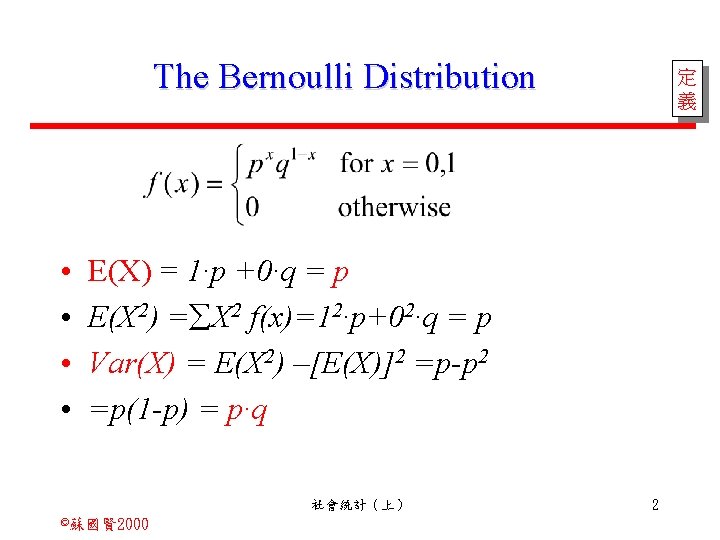
The Bernoulli Distribution • • 定 義 E(X) = 1·p +0·q = p E(X 2) = X 2 f(x)=12·p+02·q = p Var(X) = E(X 2) –[E(X)]2 =p-p 2 =p(1 -p) = p·q 社會統計(上) ©蘇國賢 2000 2
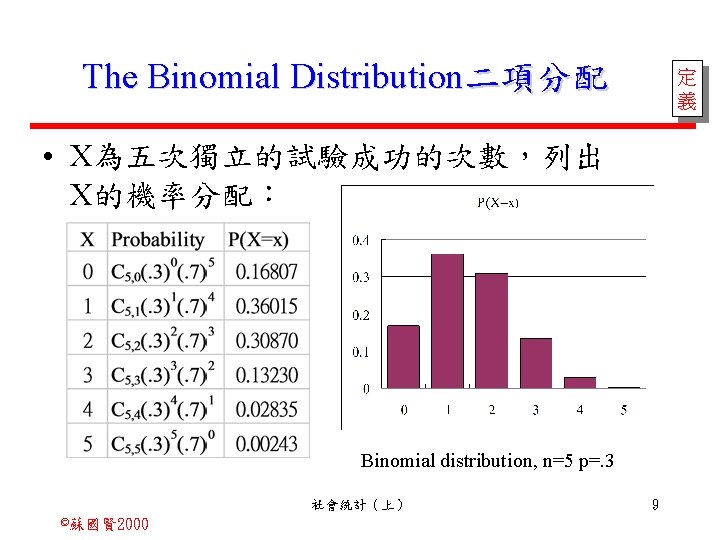
Page 236, Figure 5. 4 社會統計(上) ©蘇國賢 2000 6
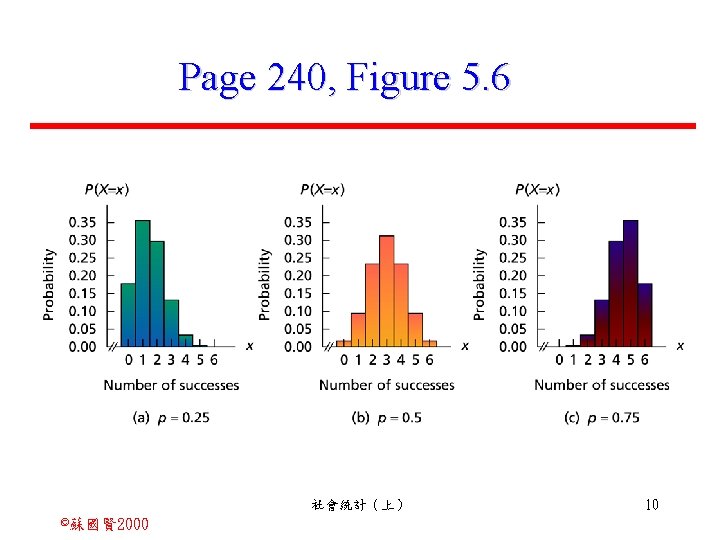
Page 240, Figure 5. 6 社會統計(上) ©蘇國賢 2000 10
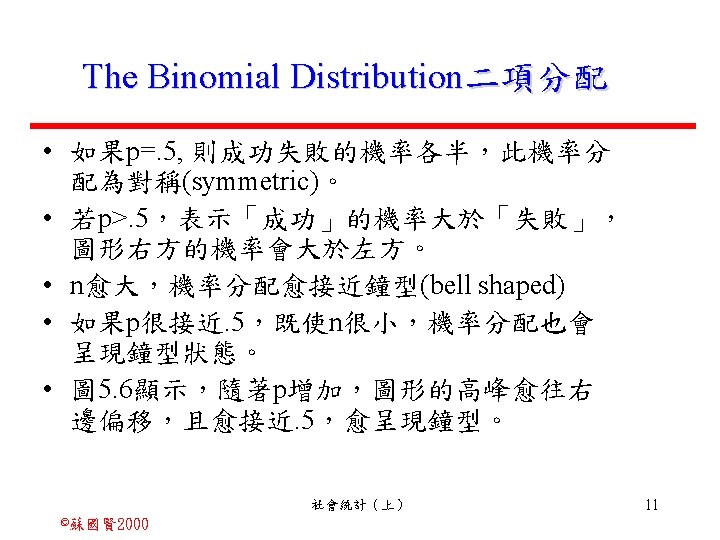
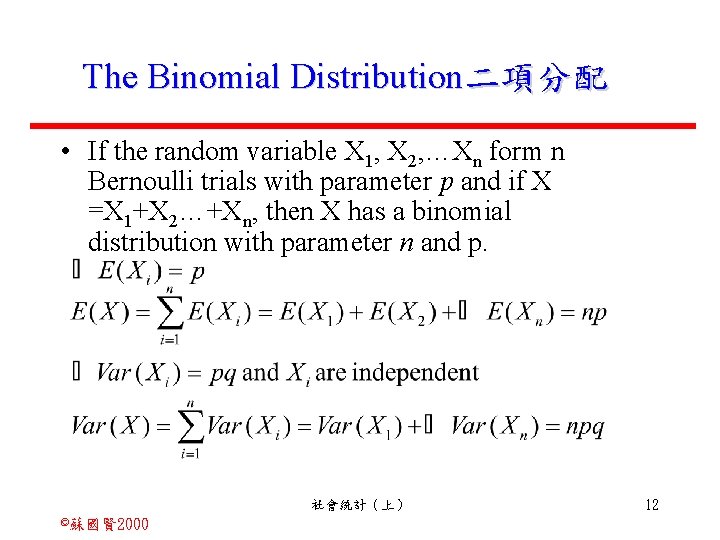
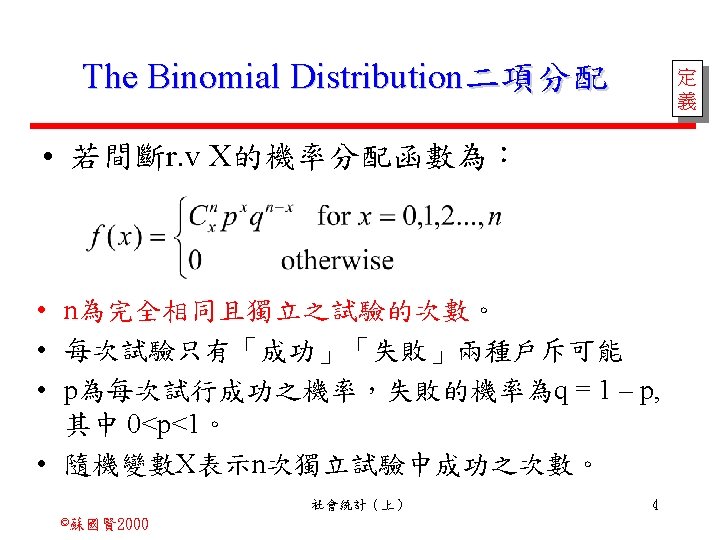
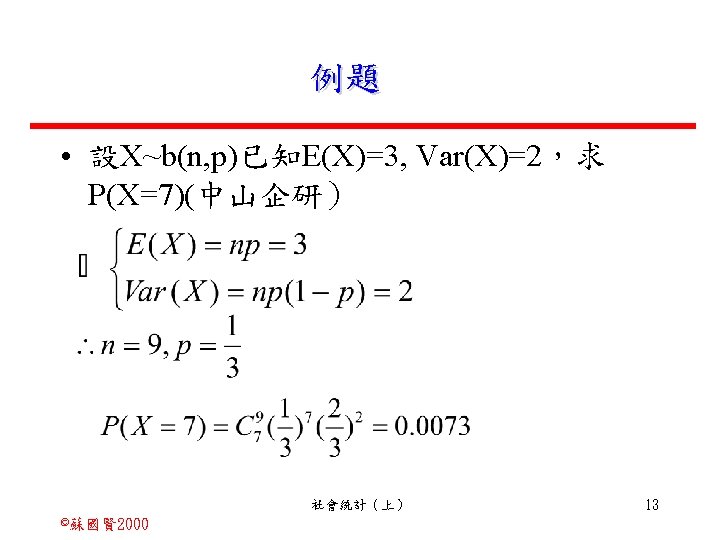
The Binomial Distribution二項分配 • If the random variable X 1, X 2, …Xn form n Bernoulli trials with parameter p and if X =X 1+X 2…+Xn, then X has a binomial distribution with parameter n and p. 社會統計(上) ©蘇國賢 2000 12
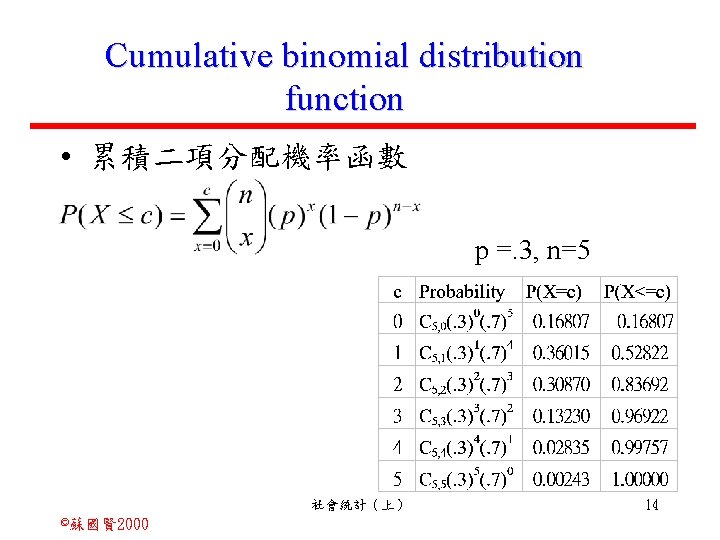
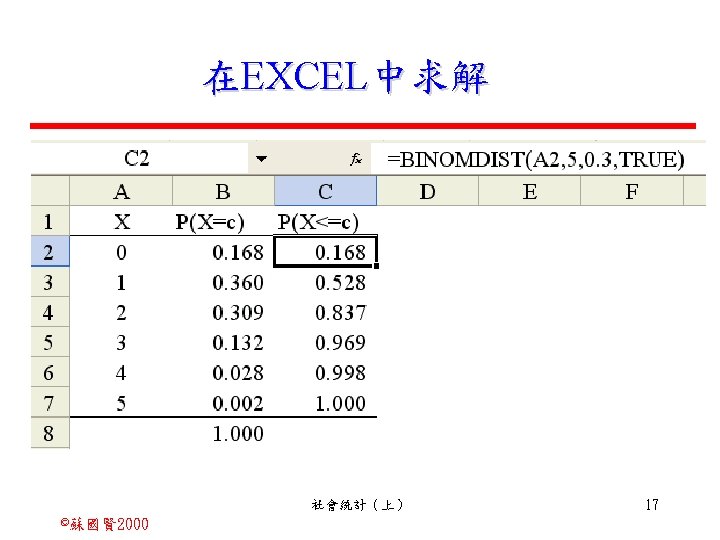
Cumulative binomial distribution function • 累積二項分配機率函數 p =. 3, n=5 社會統計(上) ©蘇國賢 2000 14
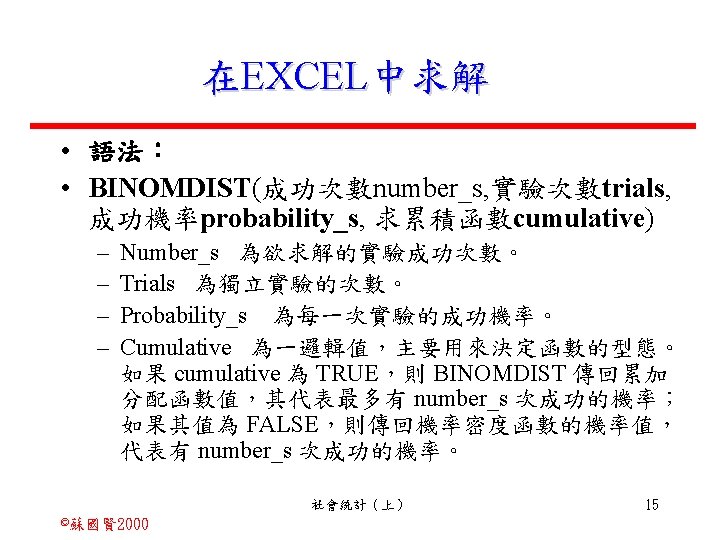
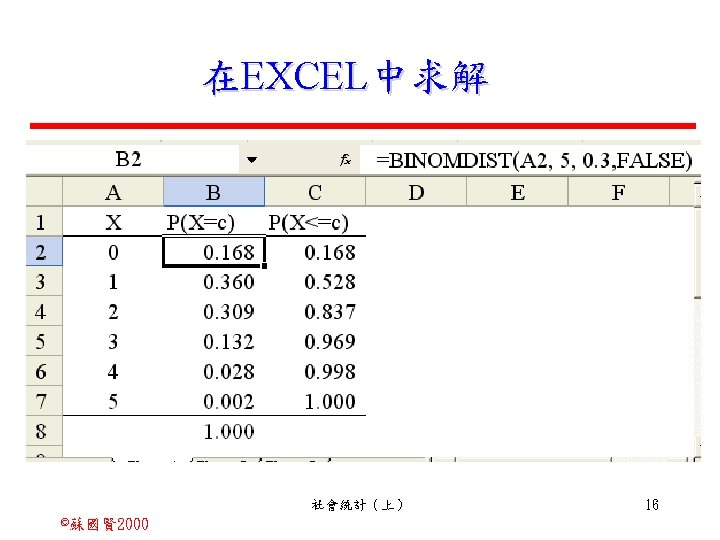
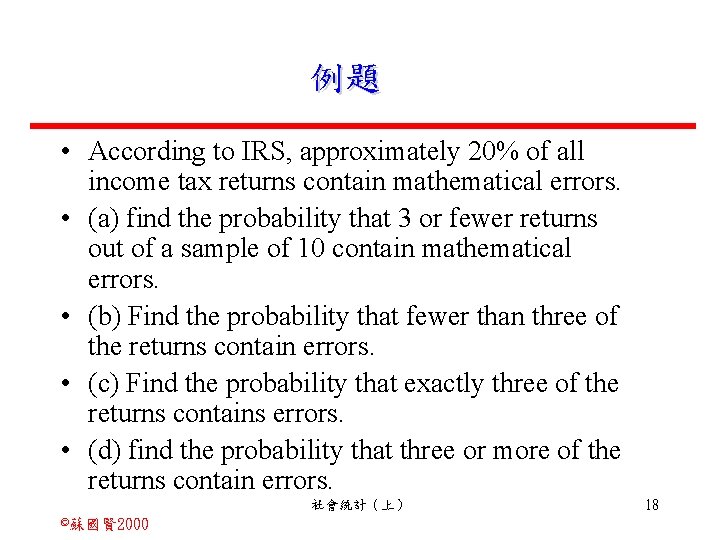
例題 • According to IRS, approximately 20% of all income tax returns contain mathematical errors. • (a) find the probability that 3 or fewer returns out of a sample of 10 contain mathematical errors. • (b) Find the probability that fewer than three of the returns contain errors. • (c) Find the probability that exactly three of the returns contains errors. • (d) find the probability that three or more of the returns contain errors. 社會統計(上) ©蘇國賢 2000 18
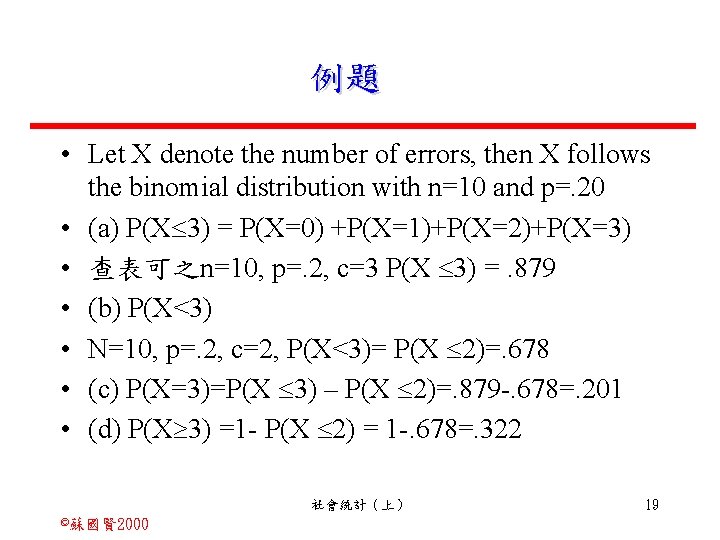
例題 • Let X denote the number of errors, then X follows the binomial distribution with n=10 and p=. 20 • (a) P(X 3) = P(X=0) +P(X=1)+P(X=2)+P(X=3) • 查表可之n=10, p=. 2, c=3 P(X 3) =. 879 • (b) P(X<3) • N=10, p=. 2, c=2, P(X<3)= P(X 2)=. 678 • (c) P(X=3)=P(X 3) – P(X 2)=. 879 -. 678=. 201 • (d) P(X 3) =1 - P(X 2) = 1 -. 678=. 322 社會統計(上) ©蘇國賢 2000 19
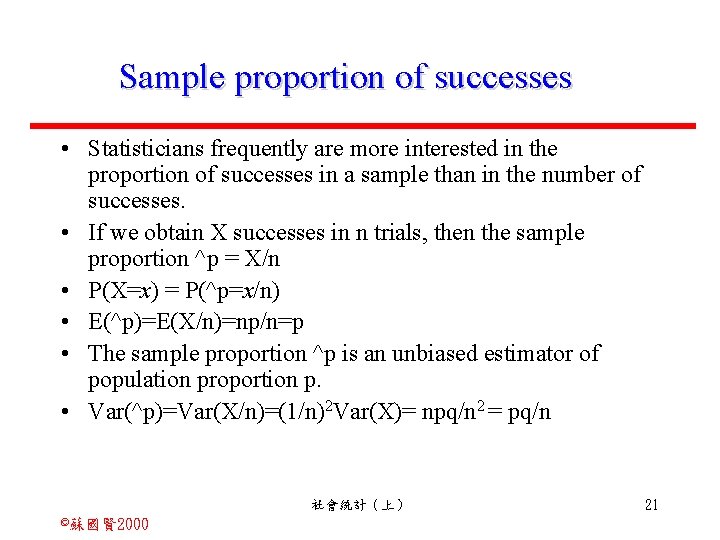
Sample proportion of successes • Statisticians frequently are more interested in the proportion of successes in a sample than in the number of successes. • If we obtain X successes in n trials, then the sample proportion ^p = X/n • P(X=x) = P(^p=x/n) • E(^p)=E(X/n)=np/n=p • The sample proportion ^p is an unbiased estimator of population proportion p. • Var(^p)=Var(X/n)=(1/n)2 Var(X)= npq/n 2 = pq/n 社會統計(上) ©蘇國賢 2000 21
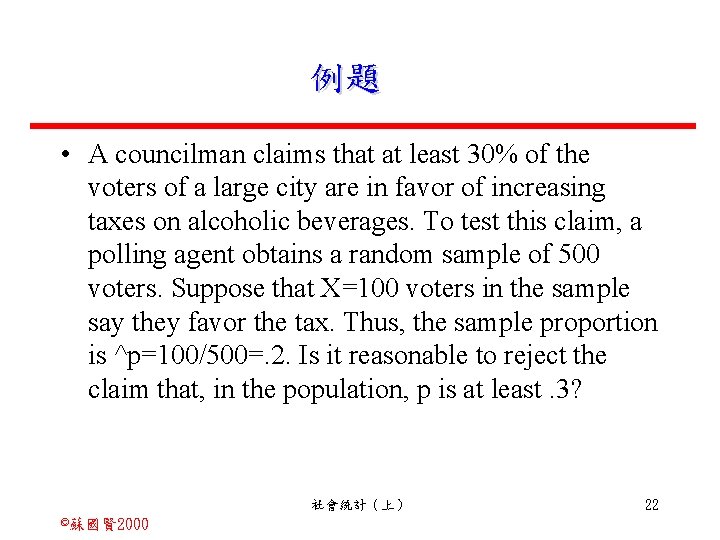
例題 • A councilman claims that at least 30% of the voters of a large city are in favor of increasing taxes on alcoholic beverages. To test this claim, a polling agent obtains a random sample of 500 voters. Suppose that X=100 voters in the sample say they favor the tax. Thus, the sample proportion is ^p=100/500=. 2. Is it reasonable to reject the claim that, in the population, p is at least. 3? 社會統計(上) ©蘇國賢 2000 22
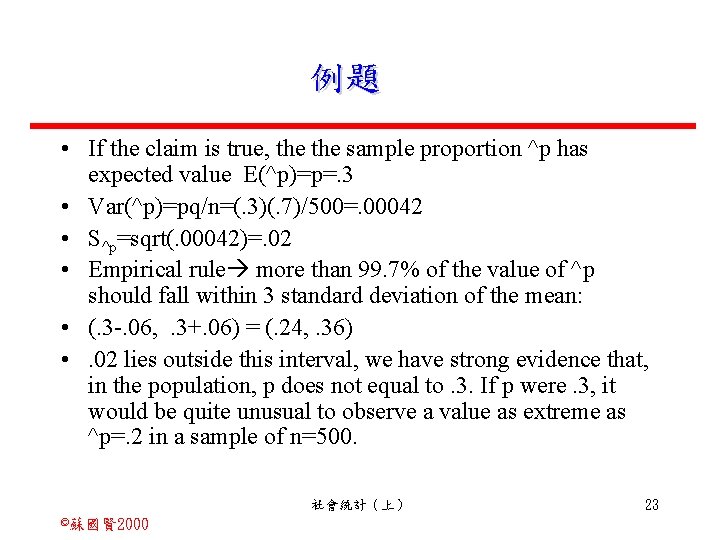
例題 • If the claim is true, the sample proportion ^p has expected value E(^p)=p=. 3 • Var(^p)=pq/n=(. 3)(. 7)/500=. 00042 • S^p=sqrt(. 00042)=. 02 • Empirical rule more than 99. 7% of the value of ^p should fall within 3 standard deviation of the mean: • (. 3 -. 06, . 3+. 06) = (. 24, . 36) • . 02 lies outside this interval, we have strong evidence that, in the population, p does not equal to. 3. If p were. 3, it would be quite unusual to observe a value as extreme as ^p=. 2 in a sample of n=500. 社會統計(上) ©蘇國賢 2000 23
- Slides: 23