
The Berlin Crisis 1958 1961 Khrushchevs Aims GDR
The Berlin Crisis 1958 -1961
Khrushchev’s Aims GDR had acted as Soviet ally in 1956 and had recognition BUT remained dependent on Moscow 20 divisions of Soviet troops within frontiers West Germany was an economic miracle Autumn 1958 Khrushchev was confident of US concessions for West Berlin He exaggerated Soviet nuclear power and put pressure on West Berlin He wanted concessions without war
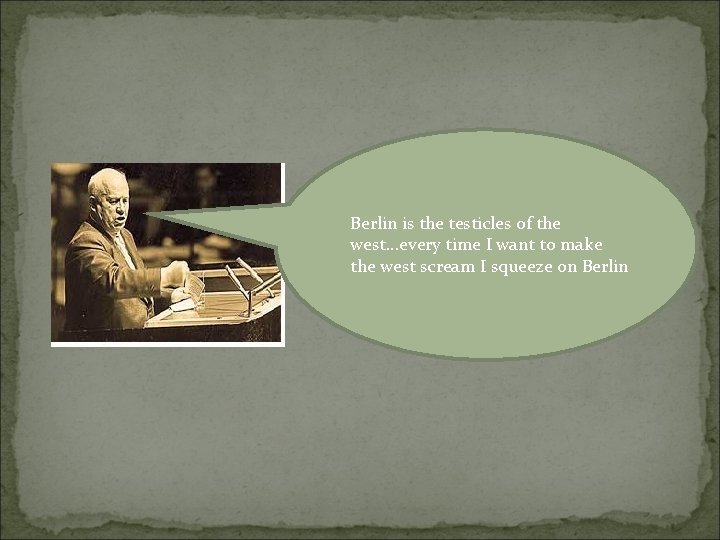
Berlin is the testicles of the west. . . every time I want to make the west scream I squeeze on Berlin
Khrushchev’s Aims Stop or delay FRG being equipped with NATO’s nuclear weapons Show USSR and China that he was not soft on ‘imperialists’ Divide western powers Get the west to accept the USSR as equal and call a conference to recognise the division of Germany and GDR’s post-war frontiers with Poland
The Berlin Ultimatum Began on 10 Nov 1958 when Khrushchev called for a peace treaty for the two German states: ‘The time has obviously arrived for the signatories of the Potsdam Agreement to renounce the remnants of the occupation regime in Berlin, and thereby make it possible to create a normal situation in the capital of the GDR. The USSR, for its part, would hand over to the sovereign GDR the functions in Berlin that are still exercised by Soviet agencies. This, I think, would be the correct thing to do’.
27 November 1958 He issued a 6 month ultimatum calling for the demilitarisation of West Berlin, withdrawal of Western troops and its status as a free city He threatened to sign a peace agreement with the GDR to recognise sovereignty over East Berlin This would mean control of access to West Berlin would be controlled by FRG Western allies would be dealing with East Germans – Hallstein Doctrine? ? ?
Summit meetings: 1959 -60 In September 1959 Khrushchev visited Camp David – the atmosphere was friendly but there was no progress 2 years of thaw alternated with crisis! Threats led to discussions in London and Washington: Scheme for nuclear free zone in Central Europe? Recognition of Poland’s western frontiers? Recognition of GDR? Western divisions
Paris Summit, May 1960 This was cancelled by Khrushchev when a US U 2 spy plane was shot down over the USSR At first, the Americans tried to claim that it was a weather-plane that had gone off-course. However, the Russians put the pilot Gary Powers on trial for spying, and it was clear that he was not a weatherman. The Americans admitted it was a spy-plane. Confirmed their lack of ICBMs
Khrushchev’s Reaction Khrushchev had hoped to avoid closing off East Berlin frontier He had hoped to take West Berlin from the FRG instead of cutting of East Germany However, unrest caused by agricultural collectivisation and an increasing number of refugees meant he had to prevent the collapse of the GDR At the end of July/beginning of August 1961 he decided to close the East German border in Berlin This was confirmed by Warsaw Pact members in Moscow 3 -5 August
13 August 1961 The border was closed, sealed off first with barbed wire and later a concrete wall
The importance of the wall for the USSR Khrushchev had failed to get western troops out of the USSR or negotiate a peace treaty The wall meant limited but important success for Soviet Policies Western toleration meant recognising East Germany Consolidated GDR and ensured that the USSR was responsible for maintaining international access to West Berlin
1961 -3 Tension remained high in Europe until 1963 30 October 1961 the Soviets exploded a nuclear bomb that could destroy an area the size of Maryland There was tension along the wall Khrushchev kept pressure on West Berlin JFK talked of the possibility of an agreement which protected ‘western rights’ and ‘the legitimate interests of others’ Adenauer remained suspicious The Cuban Missile Crisis!
- Slides: 12