
The Benefits of Veterinary Activity and the Value
The Benefits of Veterinary Activity and the Value of Animals Keith Howe Florence Beaugrand Helmut Saatkamp This presentation was developed within the frame of the NEAT project, funded with support from the European Commission under the Lifelong Learning Programme (Grant no. 527 855). Please attribute the NEAT network with a link to www. neat-network. eu. Except where otherwise noted, this presentation is licensed under a Creative Commons Attribution-Non. Commercial-Share. Alike 4. 0 International License.
Objectives are to § Explain ‘benefits’ and ‘value’, and how they relate to price § Explain why veterinary activity creates benefits and value from animals § Introduce some key concepts and relationships Ø Ø Willingness to pay Utility Indifference curve Demand curve 2

Part 1 Introduction to basic concepts 3
Definitions § Benefit – something that promotes well-being and so has § Value – monetary worth in an everyday sense Example: The price of a litre of milk, a kg of meat, a horse-riding lesson BUT not everything of value has a money price Example: People’s pleasure that animals are well cared-for, a beautiful landscape, friendship 4
Definitions § Willingness to pay, which may be (a) Revealed , reflected in prices people actually pay e. g. when buying eggs, meat and milk, or paying veterinary bills for pet care or (b) Declared/stated , when people say how much they are prepared to pay, e. g. for products sourced from a more welfarefriendly animal production system 5
IMPORTANT! What people value is essentially based on physical need and emotional want, and varies according to Ø Ø Ø Each individual person Individual tastes and preferences Personal ethics Culture Religious beliefs Value is intangible BUT people reveal what they value, and how much, by behaviour which can be observed, including their economic behaviour i. e. how people choose to allocate their limited resources 6
VALUE AND ANIMALS Animals provide people with Ø Ø Ø Food products (e. g. milk, meat, eggs) Non-food raw materials (e. g. hides and skins) Companionship (e. g. pet dogs and cats, parrots) Sport and recreation ( e. g. horses for riding and racing) Traction and transport A store of wealth Variously Ø Physical final products Ø Physical intermediate products Ø Services Ø Fixed capital Ø Savings 7
VALUE AND ANIMALS Healthier animals provide people with Ø More or better quality food products (e. g. milk, meat, eggs) Ø More or better quality non-food raw materials (e. g. hides and skins) Ø Longer lived and happier companions (e. g. pet dogs and cats, parrots) and so owners! Ø Longer lived and happier sport and recreation animals (e. g. horses for riding and racing) and people Ø More secure store of wealth In other words, more real value Ø More durable traction and transport animals so lower capital depreciation And more efficient resource use 8
VALUE AND ANIMALS People want (= demand) animals because of the goods (e. g. food products) and services (e. g. companionship) they provide for us Thus demand for animals is a derived demand. Also, our behaviour as individuals sometimes affects other people without having any intention to do so, called an externality effect Externalities can be costs or benefits, depending on the effect, for example - 9
VALUE AND ANIMALS For infectious diseases, Ø Farmer implements biosecurity measures for bovine TB, and unintentionally protects other farms from infection: External benefit Private benefit + External benefit = Social benefit Ø Farmer fails to implement biosecurity measures, own cattle become infected, vectors spread disease to other farms: External cost Private cost + External cost = Social cost VALUE EFFECTS FOR INDIVIDUALS CAN BE AMPLIFIED FOR SOCIETY AS A WHOLE 10
AND NOW ……. . THINK ABOUT YOUR OWN BEHAVIOUR! Assertion: At any given time, for any food commodity you like to consume (e. g. beer, chocolate, fish and chips, etc. ), typically you obtain Ø More satisfaction from the first unit (litre, gramme) you consume than from the second, Ø More satisfaction from the second unit than from the third, Ø and so on, until you want no more! Economists call this general observation evidence of the LAW OF DIMINISHING MARGINAL UTILITY 11
HEALTH WARNING! Economic jargon can be confusing because of synonyms, e. g. output and product Here, Satisfaction = Happiness = UTILITY a generic term not meaning ‘usefulness’ (except sometimes!) 12
Part 2 An economic model helps us understand the relationship between how much we consume and the price 13
HOW ECONOMISTS PICTURE THE WORLD Ø They construct a model, a simplified description of key concepts and relationships to help us make sense of often very complex real world relationships Ø An economic model may be expressed in words, diagrams, or mathematics, or some combination of the three Ø Here, we begin with a diagram to describe an imagined utility relationship for an imagined consumer whose imagined characteristics are very useful to us 14
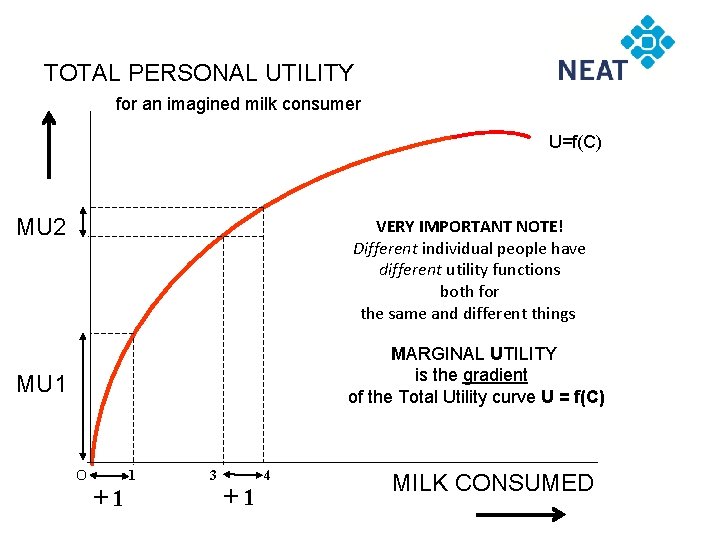
TOTAL PERSONAL UTILITY for an imagined milk consumer U=f(C) MU 2 VERY IMPORTANT NOTE! Different individual people have different utility functions both for the same and different things MARGINAL UTILITY is the gradient of the Total Utility curve U = f(C) MU 1 1 O +1 4 3 +1 MILK CONSUMED
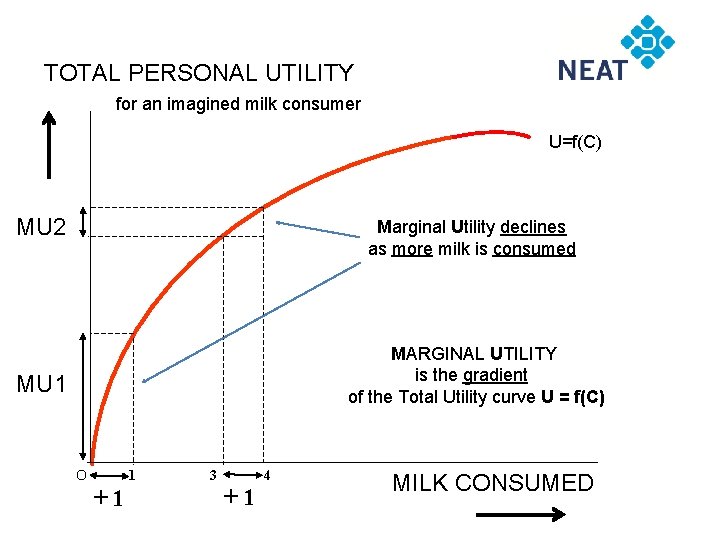
TOTAL PERSONAL UTILITY for an imagined milk consumer U=f(C) MU 2 Marginal Utility declines as more milk is consumed MARGINAL UTILITY is the gradient of the Total Utility curve U = f(C) MU 1 1 O +1 4 3 +1 MILK CONSUMED
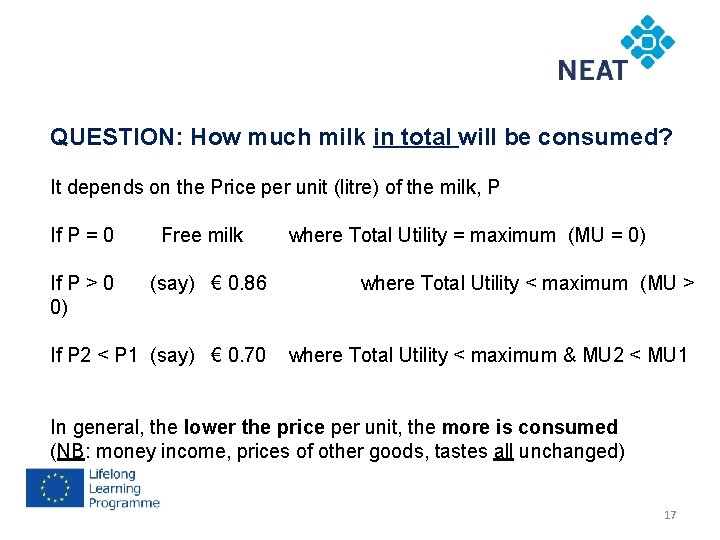
QUESTION: How much milk in total will be consumed? It depends on the Price per unit (litre) of the milk, P If P = 0 If P > 0 0) Free milk (say) € 0. 86 If P 2 < P 1 (say) € 0. 70 where Total Utility = maximum (MU = 0) where Total Utility < maximum (MU > where Total Utility < maximum & MU 2 < MU 1 In general, the lower the price per unit, the more is consumed (NB: money income, prices of other goods, tastes all unchanged) 17
HOW ECONOMISTS PICTURE THE WORLD Ø The example shows the importance of ‘marginal analysis’ in economics Ø Marginal analysis applies both in demand-side analysis (as here) and supply-side analysis (a different topic) Ø This explains why sometimes you might hear economists say “It all happens at the margin” Ø Remember that the sum of marginal amounts = total amount 18
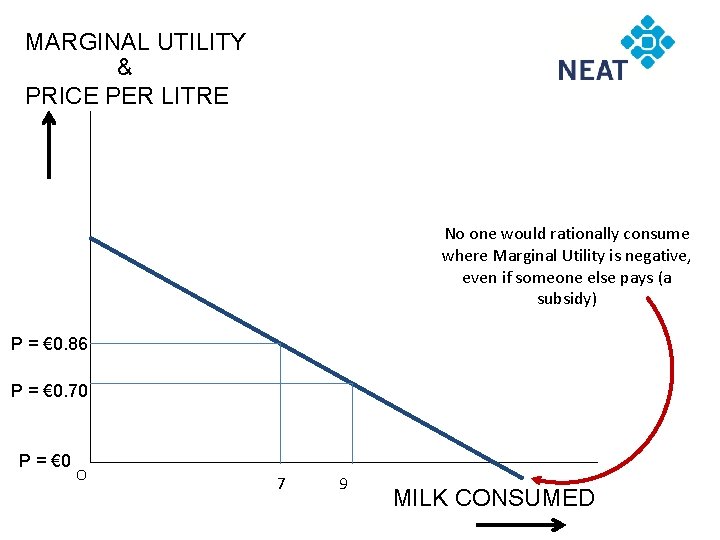
MARGINAL UTILITY & PRICE PER LITRE No one would rationally consume where Marginal Utility is negative, even if someone else pays (a subsidy) P = € 0. 86 P = € 0. 70 P = € 0 O 7 9 MILK CONSUMED
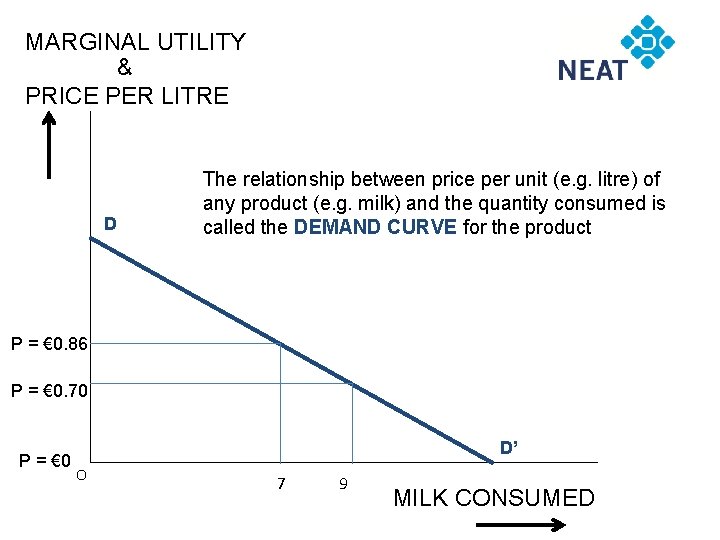
MARGINAL UTILITY & PRICE PER LITRE D The relationship between price per unit (e. g. litre) of any product (e. g. milk) and the quantity consumed is called the DEMAND CURVE for the product P = € 0. 86 P = € 0. 70 P = € 0 D’ O 7 9 MILK CONSUMED
CONCLUSIONS Ø Price and utility are related; in the example, our consumer would purchase units of a commodity until the money value of utility obtained from the last unit equals the price paid for it i. e. Price = Marginal Utility P = MU at the last unit consumed So price per unit (observable) is a measure of value (unobservable) at the margin 21
CONCLUSIONS Ø Price and quantity consumed normally are inversely related for people as individuals (and in aggregate) Ø People reveal what they value (intangible) by their actual observable behaviour Ø A person obtains more economic value on all units up to the last marginal unit consumed than the financial expenditure shows Economic value and accounting value are different! 22
Part 3 Why price tells us something about value but not everything 23
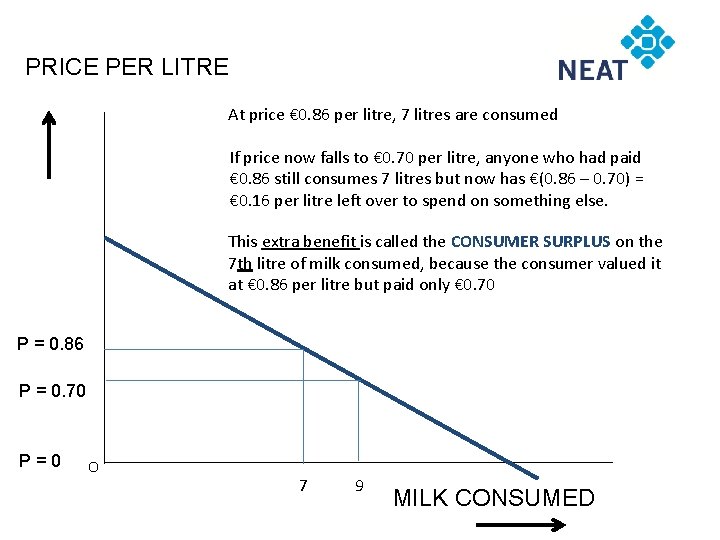
PRICE PER LITRE At price € 0. 86 per litre, 7 litres are consumed If price now falls to € 0. 70 per litre, anyone who had paid € 0. 86 still consumes 7 litres but now has €(0. 86 – 0. 70) = € 0. 16 per litre left over to spend on something else. This extra benefit is called the CONSUMER SURPLUS on the 7 th litre of milk consumed, because the consumer valued it at € 0. 86 per litre but paid only € 0. 70 P = 0. 86 P = 0. 70 P=0 O 7 9 MILK CONSUMED
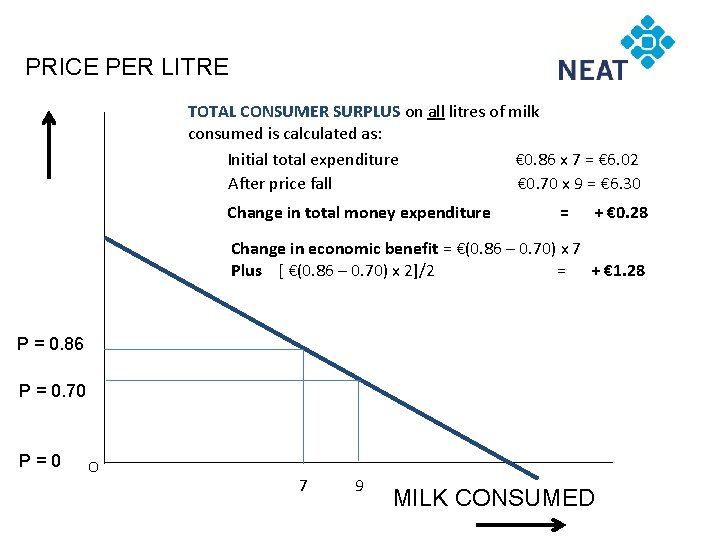
PRICE PER LITRE TOTAL CONSUMER SURPLUS on all litres of milk consumed is calculated as: Initial total expenditure € 0. 86 x 7 = € 6. 02 After price fall € 0. 70 x 9 = € 6. 30 Change in total money expenditure = + € 0. 28 Change in economic benefit = €(0. 86 – 0. 70) x 7 Plus [ €(0. 86 – 0. 70) x 2]/2 = + € 1. 28 P = 0. 86 P = 0. 70 P=0 O 7 9 MILK CONSUMED
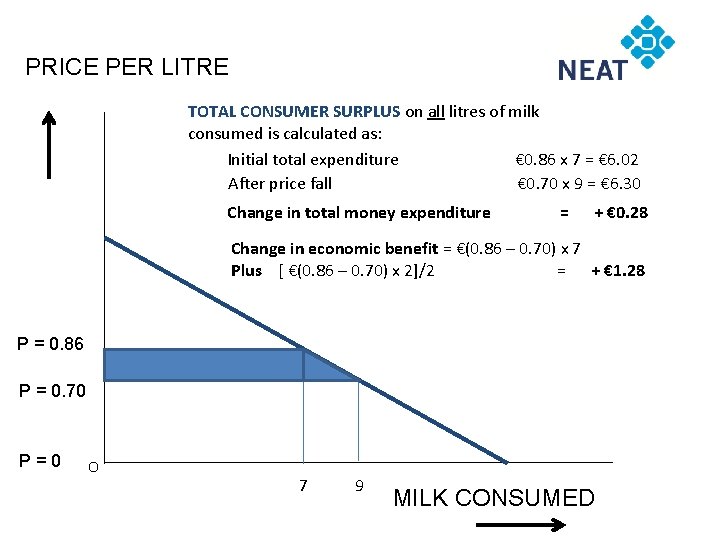
PRICE PER LITRE TOTAL CONSUMER SURPLUS on all litres of milk consumed is calculated as: Initial total expenditure € 0. 86 x 7 = € 6. 02 After price fall € 0. 70 x 9 = € 6. 30 Change in total money expenditure = + € 0. 28 Change in economic benefit = €(0. 86 – 0. 70) x 7 Plus [ €(0. 86 – 0. 70) x 2]/2 = + € 1. 28 P = 0. 86 P = 0. 70 P=0 O 7 9 MILK CONSUMED
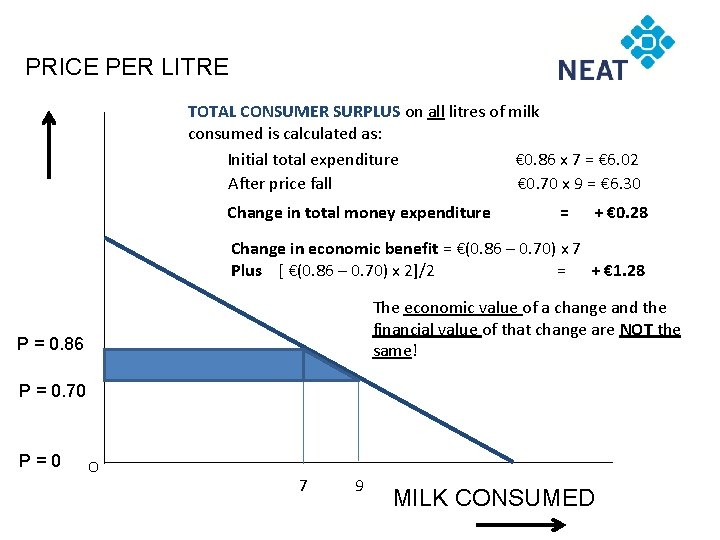
PRICE PER LITRE TOTAL CONSUMER SURPLUS on all litres of milk consumed is calculated as: Initial total expenditure € 0. 86 x 7 = € 6. 02 After price fall € 0. 70 x 9 = € 6. 30 Change in total money expenditure = + € 0. 28 Change in economic benefit = €(0. 86 – 0. 70) x 7 Plus [ €(0. 86 – 0. 70) x 2]/2 = + € 1. 28 The economic value of a change and the financial value of that change are NOT the same! P = 0. 86 P = 0. 70 P=0 O 7 9 MILK CONSUMED
NOTE! Ø Estimates of such measures of (aggregate) changes in economic benefits are the basis for thorough analysis of the consequences of national policies for animal disease control Ø Such analysis revolutionised ideas about how to achieve policy objectives by economic instruments, and informs arguments about international agricultural policy reform – a major and unique contribution of economics as a discipline 28
Part 4 Value, choosing between consumption alternatives, and why animals are one part of the whole economy 29
It can be shown that: For two sources of value (consumption goods), both showing diminishing marginal utility, a curve showing a given level of total utility obtained from different combinations of the two goods is called an INDIFFERENCE CURVE. An indifference curve has the following general appearance - 30
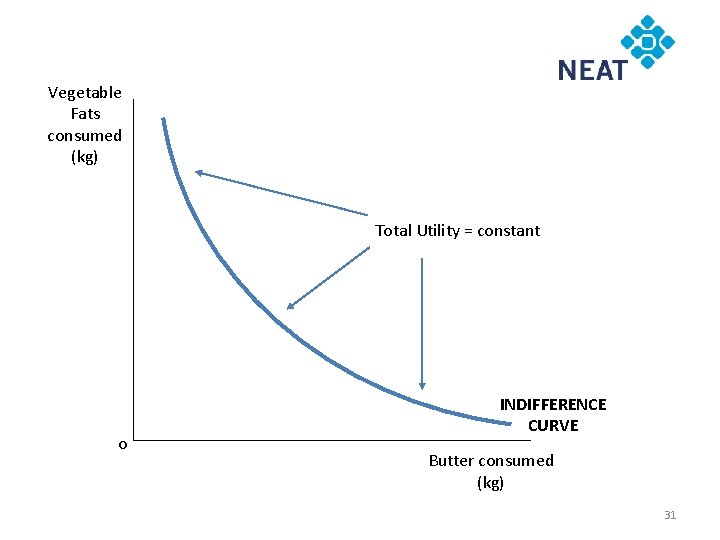
Vegetable Fats consumed (kg) Total Utility = constant o INDIFFERENCE CURVE Butter consumed (kg) 31
CHOOSING BETWEEN VALUED ALTERNATIVES: INDIFFERENCE CURVES Assume: 2 value sources, B = Butter V = Vegetable fats Note: One animal product, one non-animal product Different utility functions, i. e. Uv = f(V) is different from UB = f(B) 32
QUESTION: How should the consumer choose the best combination of butter and vegetable fats to maintain their current level of overall satisfaction? Remember! P = MU is the criterion for deciding how much to spend on one source of value, given its per unit price, So, for each of V and B taken in isolation, PV = MUV or PB = MUB 33
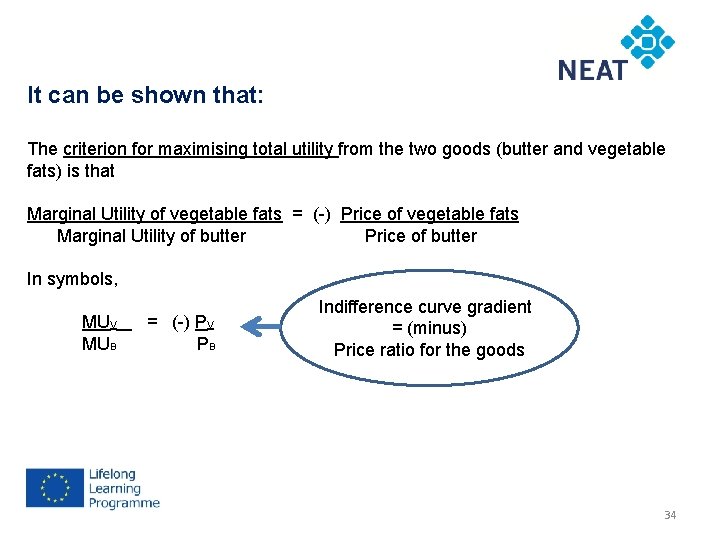
It can be shown that: The criterion for maximising total utility from the two goods (butter and vegetable fats) is that Marginal Utility of vegetable fats = (-) Price of vegetable fats Marginal Utility of butter Price of butter In symbols, MUV MUB = (-) PV PB Indifference curve gradient = (minus) Price ratio for the goods 34
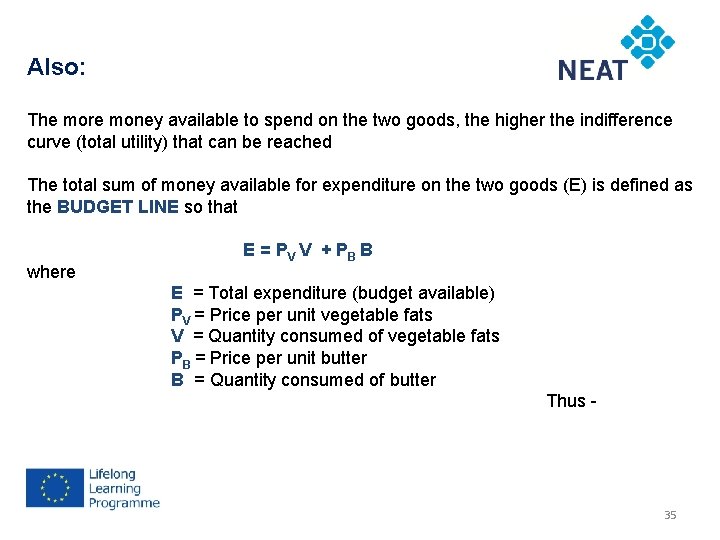
Also: The more money available to spend on the two goods, the higher the indifference curve (total utility) that can be reached The total sum of money available for expenditure on the two goods (E) is defined as the BUDGET LINE so that where E = PV V + P B B E = Total expenditure (budget available) PV = Price per unit vegetable fats V = Quantity consumed of vegetable fats PB = Price per unit butter B = Quantity consumed of butter Thus - 35
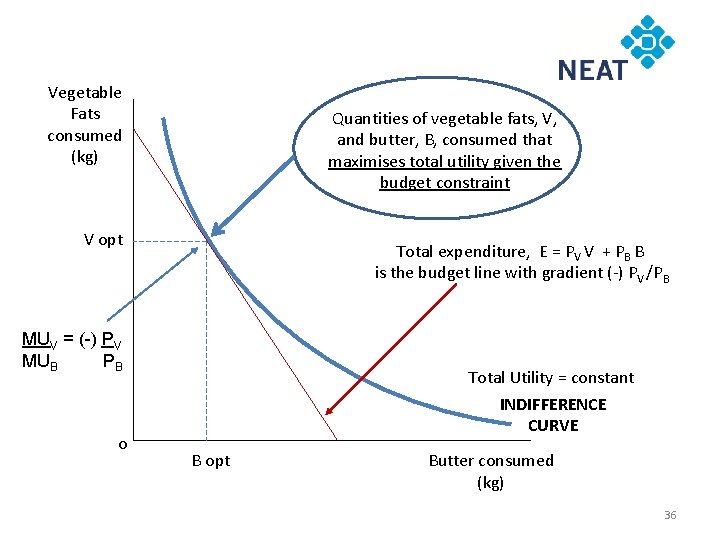
Vegetable Fats consumed (kg) Quantities of vegetable fats, V, and butter, B, consumed that maximises total utility given the budget constraint V opt Total expenditure, E = PV V + PB B is the budget line with gradient (-) PV /PB MUV = (-) PV MUB PB o Total Utility = constant INDIFFERENCE CURVE B opt Butter consumed (kg) 36
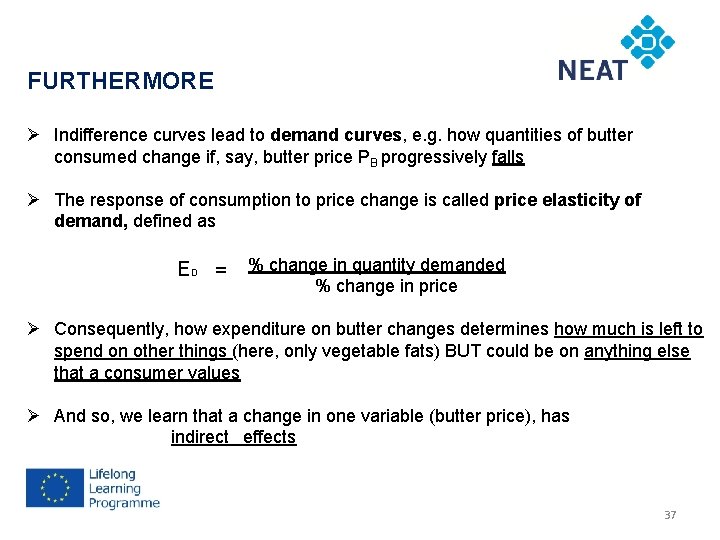
FURTHERMORE Ø Indifference curves lead to demand curves, e. g. how quantities of butter consumed change if, say, butter price PB progressively falls Ø The response of consumption to price change is called price elasticity of demand, defined as ED = % change in quantity demanded % change in price Ø Consequently, how expenditure on butter changes determines how much is left to spend on other things (here, only vegetable fats) BUT could be on anything else that a consumer values Ø And so, we learn that a change in one variable (butter price), has indirect effects 37
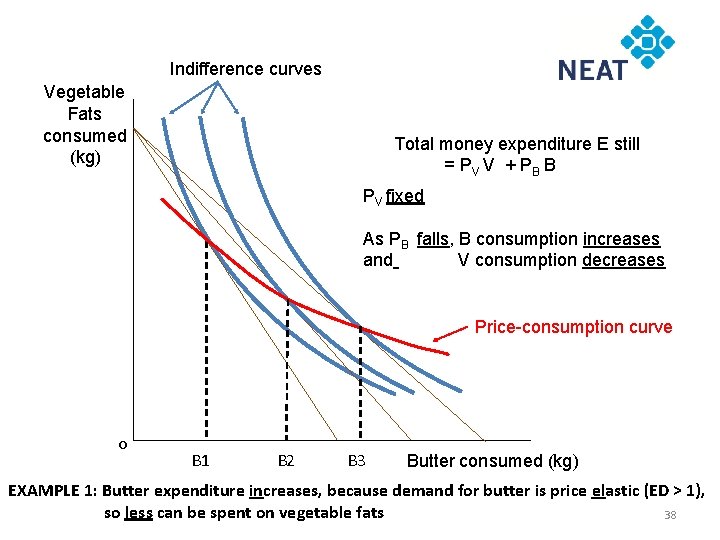
Indifference curves Vegetable Fats consumed (kg) Total money expenditure E still = P V V + PB B PV fixed As PB falls, B consumption increases and V consumption decreases Price-consumption curve o B 1 B 2 B 3 Butter consumed (kg) EXAMPLE 1: Butter expenditure increases, because demand for butter is price elastic (ED > 1), so less can be spent on vegetable fats 38
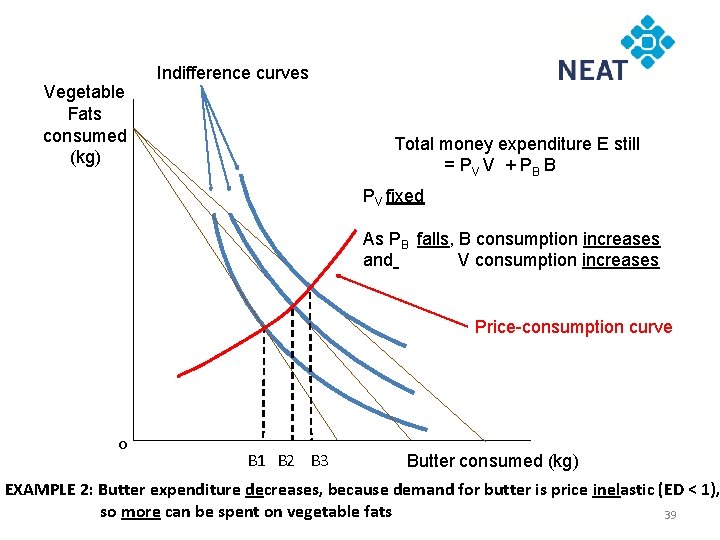
Vegetable Fats consumed (kg) Indifference curves Total money expenditure E still = P V V + PB B PV fixed As PB falls, B consumption increases and V consumption increases Price-consumption curve o B 1 B 2 B 3 Butter consumed (kg) EXAMPLE 2: Butter expenditure decreases, because demand for butter is price inelastic (ED < 1), so more can be spent on vegetable fats 39
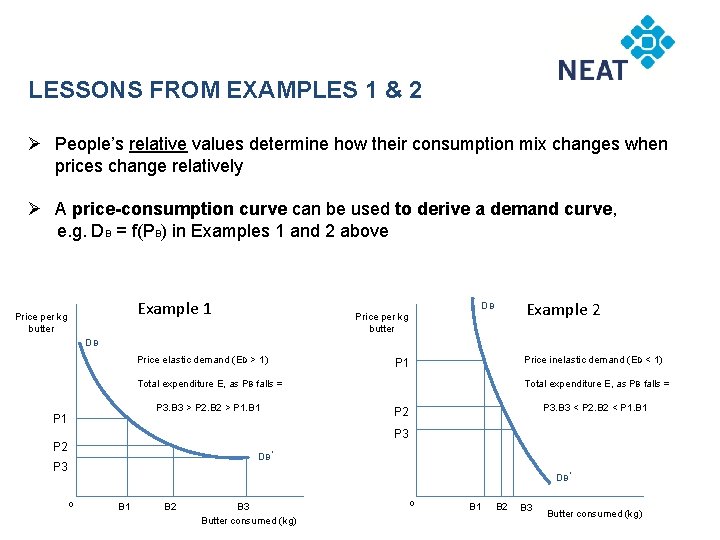
LESSONS FROM EXAMPLES 1 & 2 Ø People’s relative values determine how their consumption mix changes when prices change relatively Ø A price-consumption curve can be used to derive a demand curve, e. g. DB = f(PB) in Examples 1 and 2 above Example 1 Price per kg butter Example 2 DB Price per kg butter DB Price elastic demand (ED > 1) Price inelastic demand (ED < 1) P 1 Total expenditure E, as PB falls = P 3. B 3 > P 2. B 2 > P 1. B 1 P 3. B 3 < P 2. B 2 < P 1. B 1 P 2 P 3 P 2 DB’ P 3 DB’ o B 1 B 2 B 3 Butter consumed (kg)
LESSONS FROM EXAMPLES 1 & 2 Ø People’s relative values determine how their consumption mix changes when prices change relatively Ø A price-consumption curve can be used to derive a demand curve, e. g. DB = f(PB) in Examples 1 and 2 above Ø Now reinterpret ‘vegetable fats consumed’ on the vertical axes of the indifference curve diagrams as ‘money for spending on all other goods’ Ø It reminds us that economic decisions in one part of the economic system have impacts throughout the entire system, where all goods and services people value and consume potentially are affected Ø It follows that vets and animals must be seen as belonging to only one part of the general economic system that exists to provide people with many sources of value from scarce resources
VETS AND VALUE Ø If vets make cows healthier, cows produce more milk, and more butter is made, the demand curve tells us that more litres (potentially) can be consumed at a lower price – thank you vets! Ø Lower prices enable more butter to be purchased from a given money budget, enabling consumers to obtain higher levels of utility (enhanced well-being); real income increases because now more money is left to spend on other valued things Ø Exact consequences for expenditure on other products (with given prices) depend on people’s tastes and preferences Ø If tastes and preferences change (e. g. “Dairy products are good for you!”), the demand curve shifts right 42
VETS AND VALUE Ø But if tastes and preferences change unfavourably (e. g. “Dairy products give you a heart attack!”), the demand curve shifts left Ø If disposable money income (budget constraint) increases, higher levels of utility can be achieved overall Ø If disposable money income (budget constraint) decreases, lower levels of utility can be achieved overall Ø In conclusion, vets are one element in a complex and extensive economic system – helping animals to be healthier is just the start of a value-adding process which benefits society 43
Contact Dr Keith Howe University of Exeter Florence Beaugrand ONIRIS K. S. Howe@exeter. ac. uk http: //www. neat-network. eu florence. beaugrand@oniris-nantes. fr http: //www. neat-network. eu 44
- Slides: 44