
The Benefits of UK Shale Gas Development Author

The Benefits of UK Shale Gas Development. Author Vincent Booth, January 2017 1
THE UK SHOULD SUPPORT THE DEVELOPMENT OF NATURAL GAS IN THE UK FOR THE FOLLOWING REASONS: Security of supply. The variability of renewable energy. The cost of renewables and the energy produced; paid for by the low paid and poorest people. Benefit to the balance of payments. Employment opportunities. 2
1. Security of supply (Russia and Qatar as long term suppliers are future concerns). The UK’s gas supplies from the North Sea are fast running out. In the future we will have to spend £billions importing gas from abroad. In 2000, we didn’t import any gas at all, now half of our supplies come from overseas. By 2030, up to 90% of our gas is likely to be imported. The poor performance of renewables, (wind and solar). These have to be backed up by standby generation bought each year. The low storage capacity. The UK has the capacity to store about fourteen days of gas supply, the lowest in Europe. 3
The UK is very dependant on gas. Eight out of every 10 UK homes are heated by gas. The cost of electricity produced by all sources; is typically more expensive than the cost of natural gas. OFGEM figures for 2015 give the average electricity price at 15. 71 pence per k. Wh, and at 4. 81 per k. Wh pence for gas to domestic customers. If the UK moves to electricity to heat homes. We will all pay more than an extra £ 1000 each year to heat our homes. 4
Several pipelines feed the UK with gas, gas will be available – but at what price? Also, Gas generates about a quarter of the UK’s electricity. To change to a total renewable electricity energy system would cost vast sums of money; to replace all the existing domestic gas systems and upgrade the elecricity infrastructure. Security of supply, because of environmental regulations and government’s drive to a low CO 2 economy, coal-fired power stations in the UK will be closed by 2025. Several ageing nuclear stations will also close, leaving a large shortfall in the country’s generating capacity. Gas is best able to fill this shortfall 5
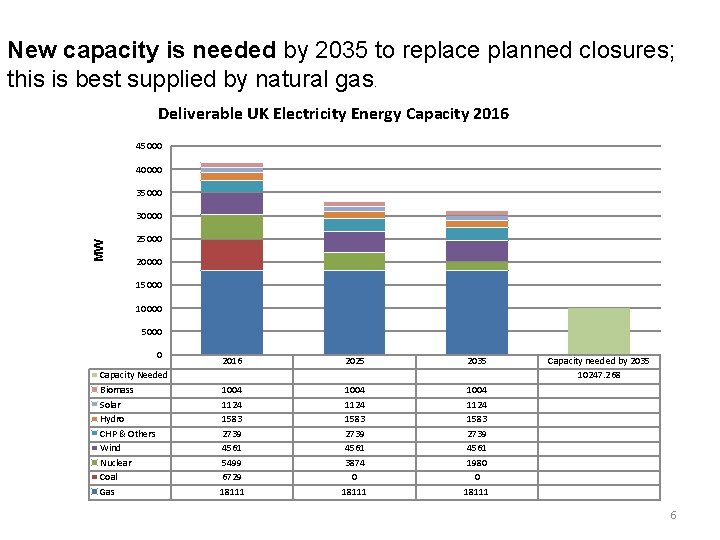
New capacity is needed by 2035 to replace planned closures; this is best supplied by natural gas. Deliverable UK Electricity Energy Capacity 2016 45000 40000 35000 MW 30000 25000 20000 15000 10000 5000 0 Capacity Needed Biomass Solar Hydro CHP & Others Wind Nuclear Coal Gas 2016 2025 2035 1004 1124 1583 2739 4561 5499 6729 18111 1004 1124 1583 2739 4561 3874 0 18111 1004 1124 1583 2739 4561 1980 0 18111 Capacity needed by 2035 10247. 268 6

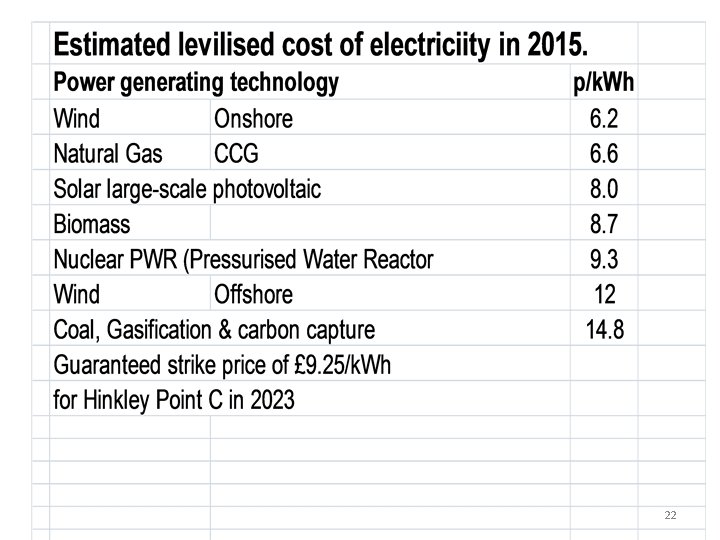
To buy electricity to meet the above shortfall, from renewables it would cost the domestic customers £ 3. 1 billion more each year; than if the electricity was generated from natural gas. Est. on 2016 prices, renewables at 12. 1 p per k. Wh gas at 8. 61 p per k. Wh. 7
2. The variability output of renewables (wind & solar) are a problem to the electricity network. Power stations must make the power they are generating exactly match the power required. Demand is only predictable to a certain level. Standby capacity and spinning reserve power units must be available to meet the changing demand at short notice. This is best supplied by modern gas-fired power stations having fast start up times. Responding to short-term variations in demand the “intermittent” output from renewables. Also if gas-fired stations replace coal-fired plant scheduled to close, They will emit approximately half the amount of CO 2 released by coal in electricity generation. 8
Re the serious issue of variability; Wind and tides are very variable and intermittent; solar does not provide energy at night. We could solve the problem of variability, by providing pumped storage to balance demand supply. To store one month’s amount of the UK’s electrical energy produced by wind and solar. We would need to increase our pumped storage capacity by approx 150 times the current UK capacity, thus making renewables even more expensive. In 30 years time when we all drive electric vehicles, their batteries may provide storage capacity for renewable energy. 9
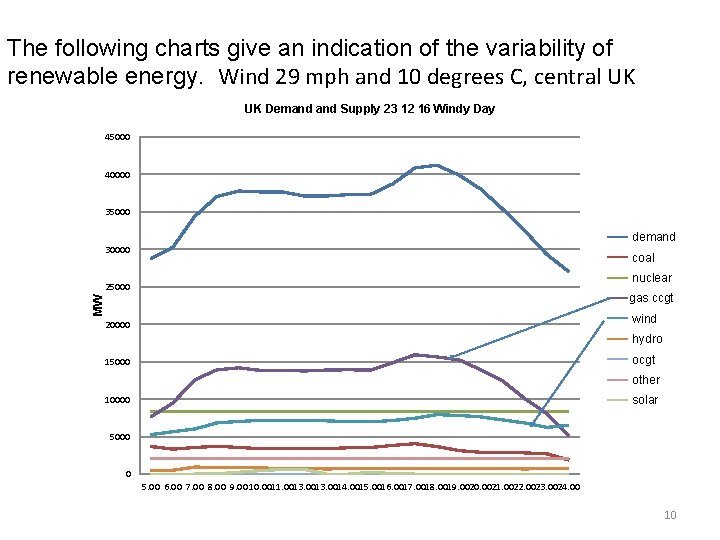
The following charts give an indication of the variability of renewable energy. Wind 29 mph and 10 degrees C, central UK UK Demand Supply 23 12 16 Windy Day 45000 40000 35000 demand 30000 coal nuclear 25000 MW gas ccgt wind 20000 hydro ocgt 15000 other 10000 solar 5000 0 5. 00 6. 00 7. 00 8. 00 9. 00 10. 0011. 0013. 0014. 0015. 0016. 0017. 0018. 0019. 0020. 0021. 0022. 0023. 0024. 00 10
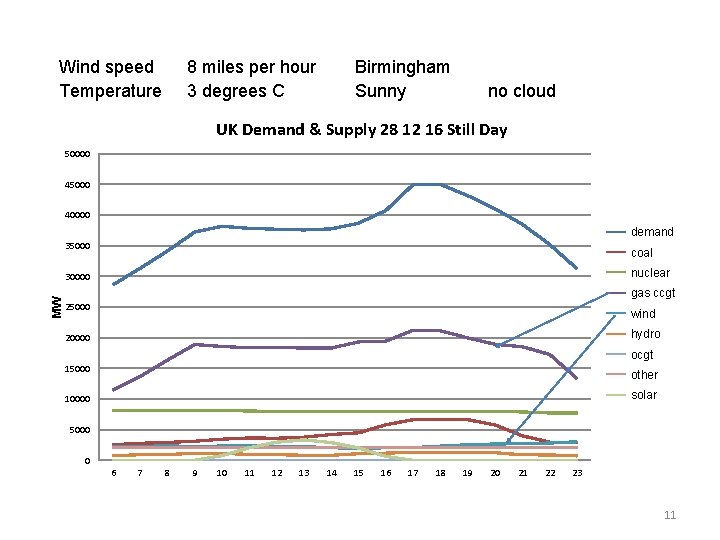
Wind speed Temperature 8 miles per hour 3 degrees C Birmingham Sunny no cloud UK Demand & Supply 28 12 16 Still Day 50000 45000 40000 demand 35000 coal nuclear MW 30000 gas ccgt 25000 wind hydro 20000 ocgt 15000 other solar 10000 5000 0 6 7 8 9 10 11 12 13 14 15 16 17 18 19 20 21 22 23 11
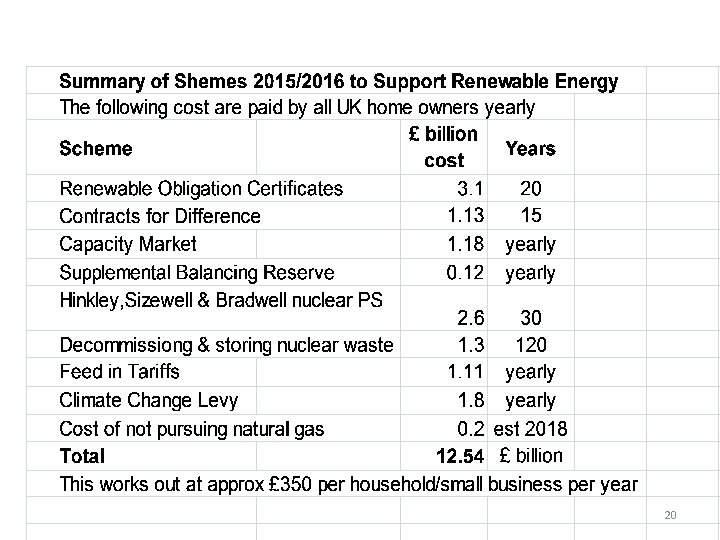
3. The costs in 2016 (charges added to electricity bills) of supporting renewable energy, are as follows: 12
Renewables Obligation Certificates (ROCs). The Renewables Obligation scheme is designed to encourage investment in renewable electricity generation. The RO requires licensed UK electricity suppliers (i. e. British Gas or Powergen) to source a specified proportion of the electricity they provide from renewable sources. In 2014/15, 17. 4 million MWh of electricity was bought at a cost of £ 3. 1 billion, i. e. 17. 86 p/k. Wh The generators must first be accredited by Ofgem & their rates will then be fixed for 20 years. The scheme will not be available to new generating capacity from 1 April 2017 but capacity accredited before then will receive ROCs for 20 years. 13
Contracts for Difference Scheme. Introduced from end of 2014. £ 1. 13 billion paid to renewable energy generators in 2016. The government guarantees the renewable energy suppliers a price equal to an agreed strike price per k. Wh. i. e. offshore wind 15 p, onshore wind 9 p and solar 11. 5 p in 2016. The wholesale price of electricity in 2016 was 4. 07 p per k. Wh The price per unit is paid for 15 years with the strike price reducing slightly over time; also: Wind farms pay up to £ 100, 000 per turbine to landowners, most of these charges come from ordinary people’s electricity bills. 14
Capacity Market £ 1. 18 billion to provide backup in 2020/21 Capacity auctions started in 2014. to cater for future closer of power plants. Plants are paid to provide stand-by power at short notice. Contracts for 52. 43 (GW) of capacity were awarded in the auction in December 2016. Due to their fast start-up time (30 to 60 min) gas fired power (CCGS) stations are best able to respond to intermittent renewable supply from wind. Also proposed is Demand Side Response (DSR) To balance the intermittent supply provided by renewables the Government intends large industrial users of electricity switch off at times of low production by renewable sources. 15
Supplemental Balancing Reserve (SBR) £ 122. 4 m for 2016/17 Supplemental Balancing Reserve (SBR) is a new service designed to support National Grid in balancing the system in the unlikely event that there is insufficient capacity to meet demand. SBR is targeted at generators who would otherwise be closed, mothballed or generally unavailable and would only be used as a last resort. This equates to around £ 1. 50 on the average domestic bill. Additional costs will be incurred if this service is used; these range from 20 p to 55 p per k. Wh. 16
£ 3. 9 billion, the cost of new nuclear power stations. The deal between the UK, China and the French state owned EDF to build three (Hinkley, Sizewell and Bradwell) nuclear power stations will cost the average bill-payer more than £ 30 a year, according to an (Energydesk analysis) a total subsidy of £ 2. 6 bn per year. The deal stretches over 30 years. 17
£ 1. 3 billion a year for 120 years is the estimated cost. Of decommissioning and storing nuclear waste from existing nuclear power plant, the current figures based on the best data now available, different assumptions produce figures between £ 95 billion and £ 219 billion. Take an average of 157 billion over 120 years is £ 1. 3 billion per year. 18
The cost of Feed-in Tariffs, £ 1. 11 billion 2015/16, Ogem, (Feed -in Tariff (FIT) Levelisation Reports 2015). (FITs, introduced, April 2010) is a programme introduced by the government to promote the use of small-scale renewable and low CO 2 electricity generation. If a householder, community or business has an eligible installation, FITs pays them a tariff for the electricity. This means they can save money by not having to import it from the national grid. Any electricity not used is sold back to the grid at a rate called the Export Tariff. Like Feed in Tariffs, Export Tariffs are RPI linked and guaranteed for the next 20 years. An typical total price for both the above tariffs was 8. 8 p/k. Wh. 19
20
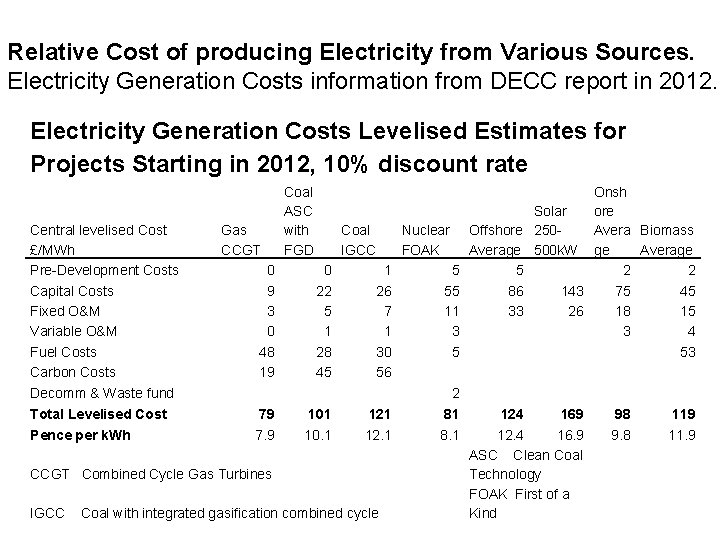
Relative Cost of producing Electricity from Various Sources. Electricity Generation Costs information from DECC report in 2012. Electricity Generation Costs Levelised Estimates for Projects Starting in 2012, 10% discount rate Central levelised Cost Gas £/MWh CCGT Pre-Development Costs 0 Capital Costs 9 Fixed O&M 3 Variable O&M 0 Fuel Costs 48 Carbon Costs 19 Decomm & Waste fund Total Levelised Cost Pence per k. Wh 79 7. 9 Coal ASC with FGD 0 22 5 1 28 45 Coal IGCC 1 26 7 1 30 56 Nuclear Offshore FOAK Average 5 5 55 86 11 33 3 5 Onsh Solar ore 250 Avera Biomass 500 k. W ge Average 2 2 143 75 45 26 18 15 3 4 53 2 101 10. 1 12. 1 CCGT Combined Cycle Gas Turbines IGCC Coal with integrated gasification combined cycle 81 8. 1 124 169 12. 4 16. 9 ASC Clean Coal Technology FOAK First of a Kind 98 9. 8 119 11. 9
22
A report by the (The Global Warming Policy Foundation) December 2016 has estimated the cost to UK energy users, to comply with the Climate Change Act will reach £ 300 billion by 2030. 24
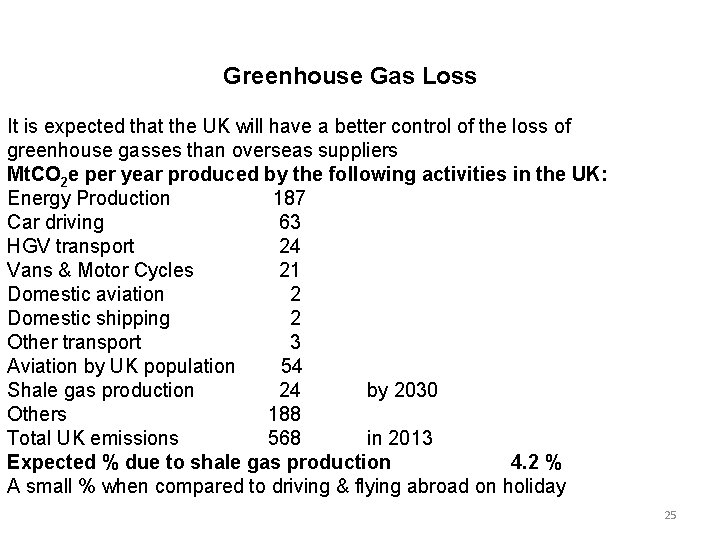
Greenhouse Gas Loss It is expected that the UK will have a better control of the loss of greenhouse gasses than overseas suppliers Mt. CO 2 e per year produced by the following activities in the UK: Energy Production 187 Car driving 63 HGV transport 24 Vans & Motor Cycles 21 Domestic aviation 2 Domestic shipping 2 Other transport 3 Aviation by UK population 54 Shale gas production 24 by 2030 Others 188 Total UK emissions 568 in 2013 Expected % due to shale gas production 4. 2 % A small % when compared to driving & flying abroad on holiday 25
5. To provide employment in the UK. The employment opportunities that natural gas will bring (or be lost). Jobs will include, metal industry, piping, valves, pumps, water treatment, civil engineering, surveying, new gas plants, gas treatment plants, fertilizer plants, transport. Also note that natural gas can be used as a motor fuel. Compressed (or pressurized) methane costs half as much as petrol. If used to replace petrol and diesel it would be of great benefit to the UK. An independent study says there could be 65, 000 new jobs from a successful UK shale industry. 26
Conclusion, As a means of producing useful electrical power renewable energy is very expensive, not only because of its poor (~18%) capacity factor but also because it is much less useful to the electrical grid because it must be used when produced, and the inevitable intermittency. The spending on renewables by past governments has been paid for in the most part by extra charges on UK utility bills. It is a hidden tax that puts the burden on poorer people, whilst leaving wealthier people who are more able to pay less affected. 27
The past policies of both Labour and Conservative governments has put the UK in a position that in the near future we will have to import both gas from Russia and electricity from France at unknown costs. More renewable wind generation will not solve the problem and will cause the cost of electricity to remain high. Because of its variability the only way wind can considered as a reliable base load is that major pumped storage schemes are developed (at a significant cost) adding to the price of electrical energy from wind. As for solar, even with the reducing cost of solar panels in 2016 to approx 1. 5 pence per W, when one adds the effect of a 20% capacity factor, the cost of an inverter, installation and mains connection, a final price of approx 10 pence per k. Wh will be the cost. Solar is not able to provide a base load at night and in winter day time, the very high cost of storage via batteries or pumped 28 storage will be required.
Recommendation That the Government arranges a study by economic and energy consultants, to explore the benefits and cost of the safe and regulated development of UK onshore natural gas. The British people voted, to gain more control and independence from Europe. Therefore the UK should develop a self sufficient energy policy; in the first instance based on UK natural gas. As the financial market has not invested new nuclear or gasfired power stations due to the subsidies given to renewables (paid for by electricity users). Government should invest (via taxation) in the development of, gas-fired stations, small thorium reactors, pumped storage, electric vehicles, and energy saving; to provide long term energy stability for the UK. Not funded by poorer electricity users. 29
references from: “Sustainable Energy without the hot air” David JC Mac. Kay DECC websites Ofgem National Grid http: //www. gridwatch. templar. co. uk/ The Global Warming Policy Foundation. 30
- Slides: 29