
The benefits of non formal learning in critical
The benefits of non formal learning in critical pedagogical contexts ATEE Spring Conference, Riga 12 -13 th May 2017 Emanuele Micheli, Fiorella Operto School of Robotics, Italy This project has been funded with support from the European Commission under the Erasmus+ programme (2015 -1 -IT 02 -KA 201 -015141). This website reflects the views only of the authors, and the Commission cannot be held responsible for any use which may be made of the information contained therein.
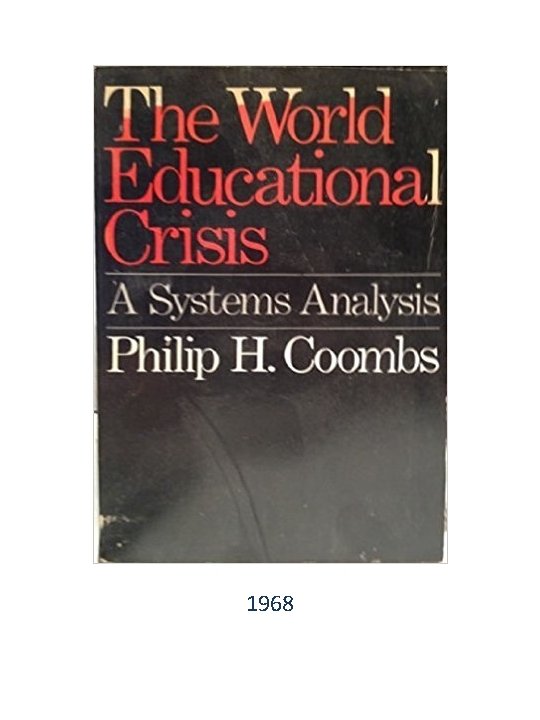
1968
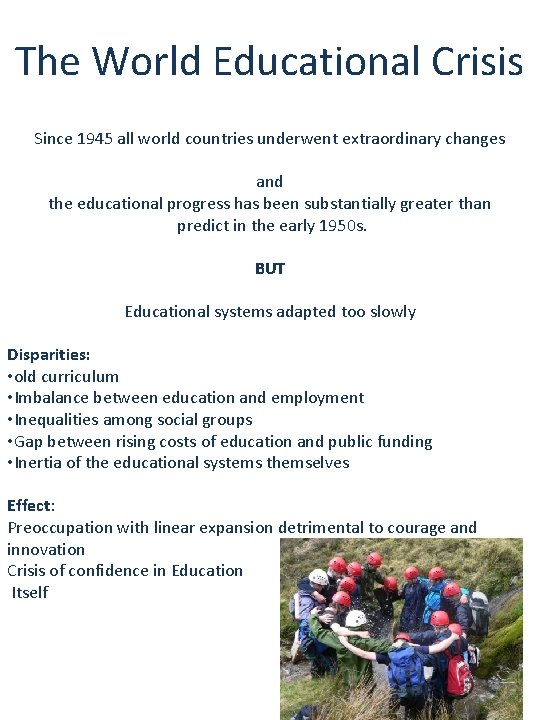
The World Educational Crisis Since 1945 all world countries underwent extraordinary changes and the educational progress has been substantially greater than predict in the early 1950 s. BUT Educational systems adapted too slowly Disparities: • old curriculum • Imbalance between education and employment • Inequalities among social groups • Gap between rising costs of education and public funding • Inertia of the educational systems themselves Effect: Preoccupation with linear expansion detrimental to courage and innovation Crisis of confidence in Education Itself
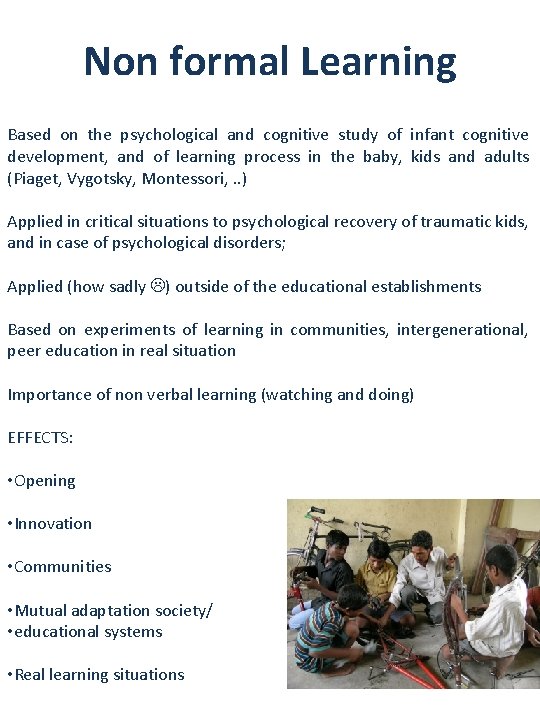
Non formal Learning Based on the psychological and cognitive study of infant cognitive development, and of learning process in the baby, kids and adults (Piaget, Vygotsky, Montessori, . . ) Applied in critical situations to psychological recovery of traumatic kids, and in case of psychological disorders; Applied (how sadly ) outside of the educational establishments Based on experiments of learning in communities, intergenerational, peer education in real situation Importance of non verbal learning (watching and doing) EFFECTS: • Opening • Innovation • Communities • Mutual adaptation society/ • educational systems • Real learning situations
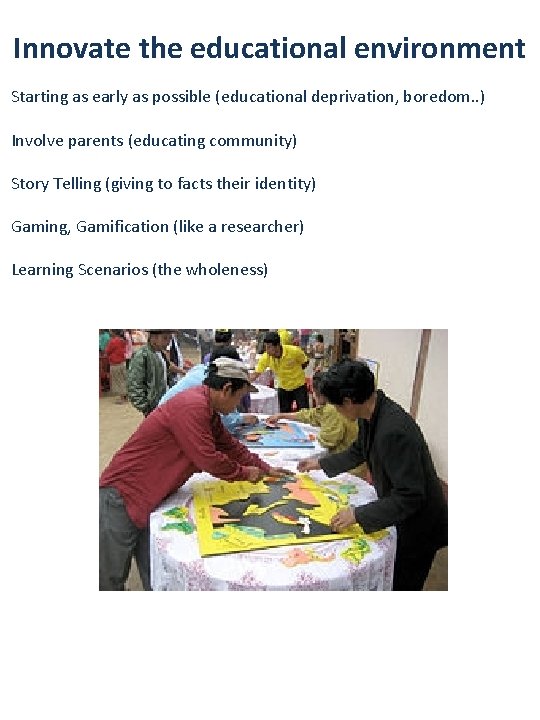
Innovate the educational environment Starting as early as possible (educational deprivation, boredom. . ) Involve parents (educating community) Story Telling (giving to facts their identity) Gaming, Gamification (like a researcher) Learning Scenarios (the wholeness)
THANK YOU! operto@scuoladirobotica. it European Centre for the Development of Vocational Training Cedefop has created European guidelines to provide validation to a broad range of learning experiences, thereby aiding transparency and comparability across its national borders. The broad framework for achieving this certification across both nonformal and informal learning is outlined in the Cedefop European guidelines for validating non-formal and informal learning; Routes from learning to certification.
- Slides: 6