
The benefits of ICT in the Primary Curriculum
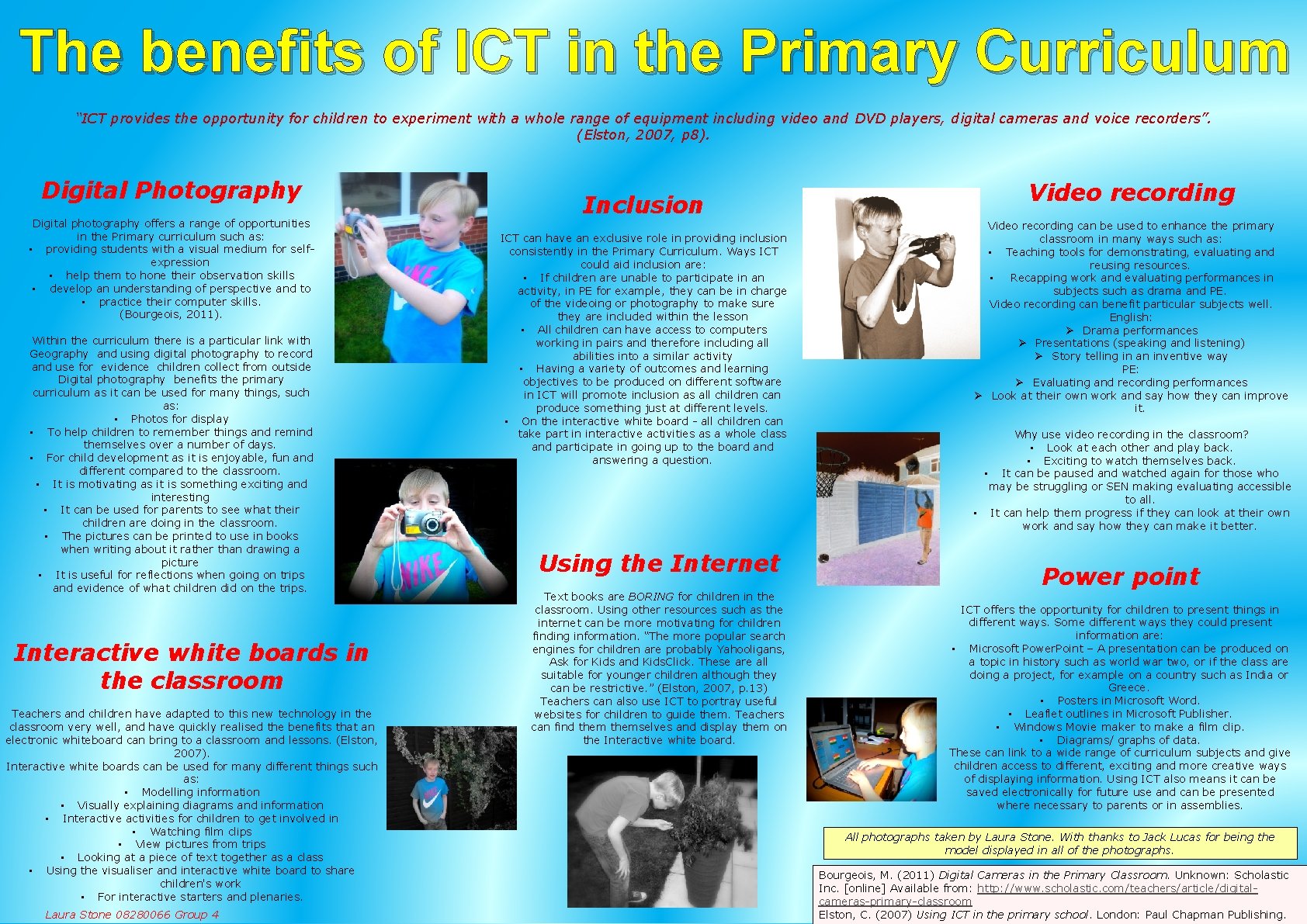
The benefits of ICT in the Primary Curriculum “ICT provides the opportunity for children to experiment with a whole range of equipment including video and DVD players, digital cameras and voice recorders”. (Elston, 2007, p 8). Digital Photography Digital photography offers a range of opportunities in the Primary curriculum such as: • providing students with a visual medium for selfexpression • help them to hone their observation skills • develop an understanding of perspective and to • practice their computer skills. (Bourgeois, 2011). Within the curriculum there is a particular link with Geography and using digital photography to record and use for evidence children collect from outside Digital photography benefits the primary curriculum as it can be used for many things, such as: • Photos for display • To help children to remember things and remind themselves over a number of days. • For child development as it is enjoyable, fun and different compared to the classroom. • It is motivating as it is something exciting and interesting • It can be used for parents to see what their children are doing in the classroom. • The pictures can be printed to use in books when writing about it rather than drawing a picture • It is useful for reflections when going on trips and evidence of what children did on the trips. Interactive white boards in the classroom Teachers and children have adapted to this new technology in the classroom very well, and have quickly realised the benefits that an electronic whiteboard can bring to a classroom and lessons. (Elston, 2007). Interactive white boards can be used for many different things such as: • Modelling information • Visually explaining diagrams and information • Interactive activities for children to get involved in • Watching film clips • View pictures from trips • Looking at a piece of text together as a class • Using the visualiser and interactive white board to share children's work • For interactive starters and plenaries. Laura Stone 08280066 Group 4 Inclusion ICT can have an exclusive role in providing inclusion consistently in the Primary Curriculum. Ways ICT could aid inclusion are: • If children are unable to participate in an activity, in PE for example, they can be in charge of the videoing or photography to make sure they are included within the lesson • All children can have access to computers working in pairs and therefore including all abilities into a similar activity • Having a variety of outcomes and learning objectives to be produced on different software in ICT will promote inclusion as all children can produce something just at different levels. • On the interactive white board - all children can take part in interactive activities as a whole class and participate in going up to the board answering a question. Using the Internet Text books are BORING for children in the classroom. Using other resources such as the internet can be more motivating for children finding information. “The more popular search engines for children are probably Yahooligans, Ask for Kids and Kids. Click. These are all suitable for younger children although they can be restrictive. ” (Elston, 2007, p. 13) Teachers can also use ICT to portray useful websites for children to guide them. Teachers can find themselves and display them on the Interactive white board. Video recording can be used to enhance the primary classroom in many ways such as: • Teaching tools for demonstrating, evaluating and reusing resources. • Recapping work and evaluating performances in subjects such as drama and PE. Video recording can benefit particular subjects well. English: Ø Drama performances Ø Presentations (speaking and listening) Ø Story telling in an inventive way PE: Ø Evaluating and recording performances Ø Look at their own work and say how they can improve it. Why use video recording in the classroom? • Look at each other and play back. • Exciting to watch themselves back. • It can be paused and watched again for those who may be struggling or SEN making evaluating accessible to all. • It can help them progress if they can look at their own work and say how they can make it better. Power point ICT offers the opportunity for children to present things in different ways. Some different ways they could present information are: • Microsoft Power. Point – A presentation can be produced on a topic in history such as world war two, or if the class are doing a project, for example on a country such as India or Greece. • Posters in Microsoft Word. • Leaflet outlines in Microsoft Publisher. • Windows Movie maker to make a film clip. • Diagrams/ graphs of data. These can link to a wide range of curriculum subjects and give children access to different, exciting and more creative ways of displaying information. Using ICT also means it can be saved electronically for future use and can be presented where necessary to parents or in assemblies. All photographs taken by Laura Stone. With thanks to Jack Lucas for being the model displayed in all of the photographs. Bourgeois, M. (2011) Digital Cameras in the Primary Classroom. Unknown: Scholastic Inc. [online] Available from: http: //www. scholastic. com/teachers/article/digitalcameras-primary-classroom Elston, C. (2007) Using ICT in the primary school. London: Paul Chapman Publishing.
- Slides: 1