
The Benefits and Challenges of Implementing Performance Based
The Benefits and Challenges of Implementing Performance Based Navigation (PBN) Instrument Flight Procedures Presented to: IFIS 2008 By: Bradley W. Rush Manager, Quality Oversight and Technical Advisory Staff National Flight Procedures Office, FAA Date: June 24, 2008 Federal Aviation Administration
Introduction Presentation of benefits and challenges of PBN (RNP AR) and lessons learned of implementing over 100 instrument approach procedures in the United States The Benefits and Challenges of Implementing Performance Based Navigation (PBN) Instrument Flight Procedures June 24, 2008 Federal Aviation Administration 2
Overview • Benefits – – Reduced Obstacle Evaluation Area (OEA) No secondary areas Missed approach segment OEA Radius-to-Fix leg types • Challenges – – – Operator authorization and training Air traffic control procedures and training RNP criteria application Procedure benefit Flight inspection technique The Benefits and Challenges of Implementing Performance Based Navigation (PBN) Instrument Flight Procedures June 24, 2008 Federal Aviation Administration 3
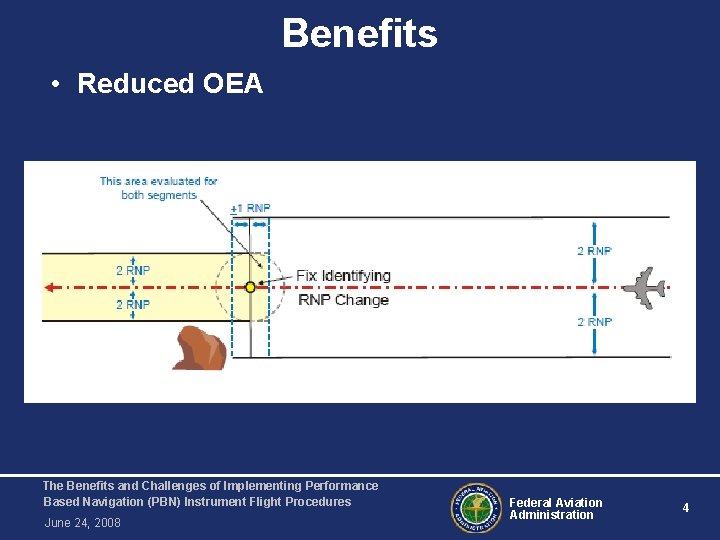
Benefits • Reduced OEA The Benefits and Challenges of Implementing Performance Based Navigation (PBN) Instrument Flight Procedures June 24, 2008 Federal Aviation Administration 4
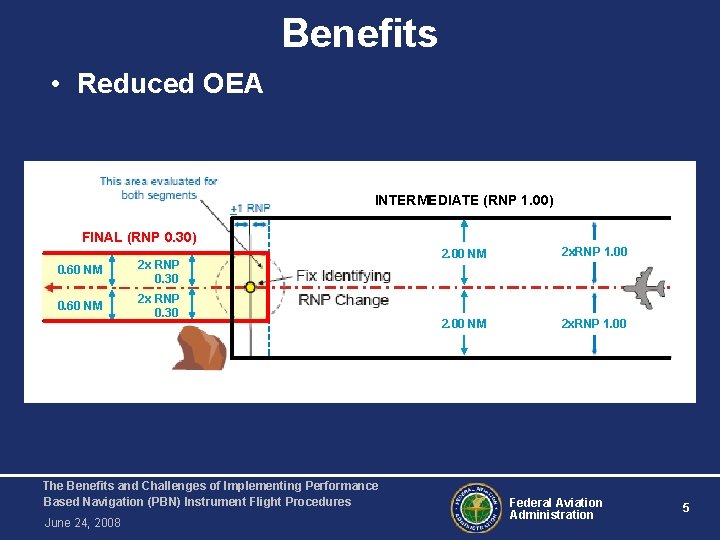
Benefits • Reduced OEA INTERMEDIATE (RNP 1. 00) FINAL (RNP 0. 30) 0. 60 NM 2 x RNP 0. 30 The Benefits and Challenges of Implementing Performance Based Navigation (PBN) Instrument Flight Procedures June 24, 2008 2. 00 NM 2 x. RNP 1. 00 Federal Aviation Administration 5
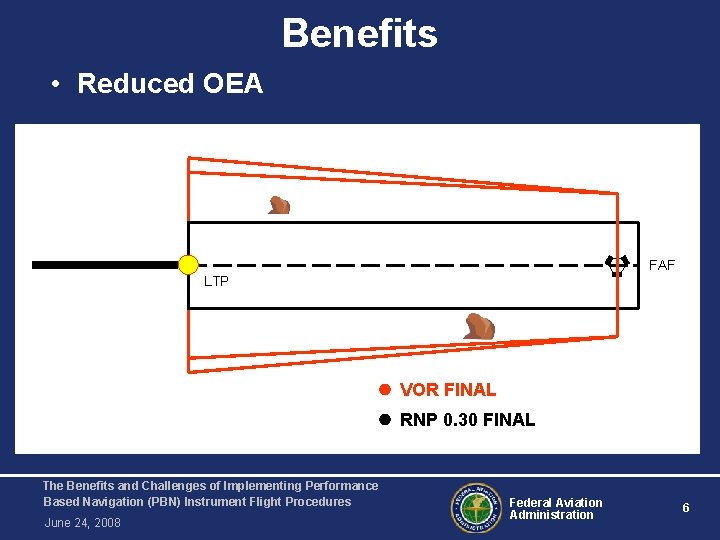
Benefits • Reduced OEA FAF LTP VOR FINAL RNP 0. 30 FINAL The Benefits and Challenges of Implementing Performance Based Navigation (PBN) Instrument Flight Procedures June 24, 2008 Federal Aviation Administration 6
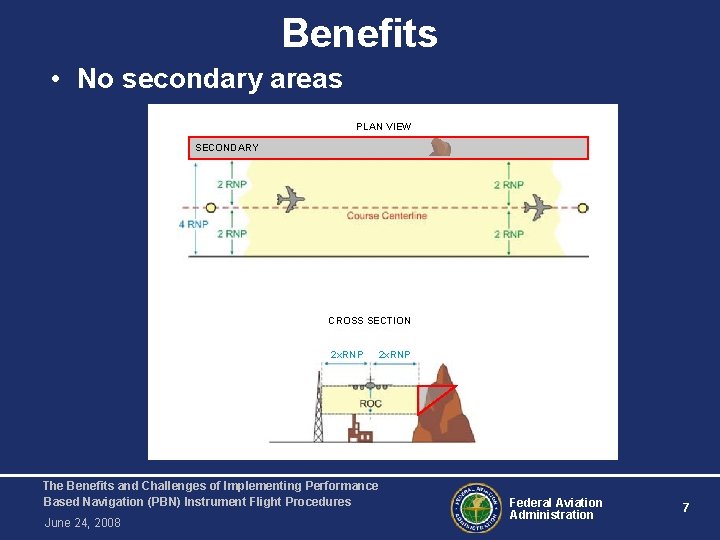
Benefits • No secondary areas PLAN VIEW SECONDARY CROSS SECTION 2 x. RNP The Benefits and Challenges of Implementing Performance Based Navigation (PBN) Instrument Flight Procedures June 24, 2008 Federal Aviation Administration 7
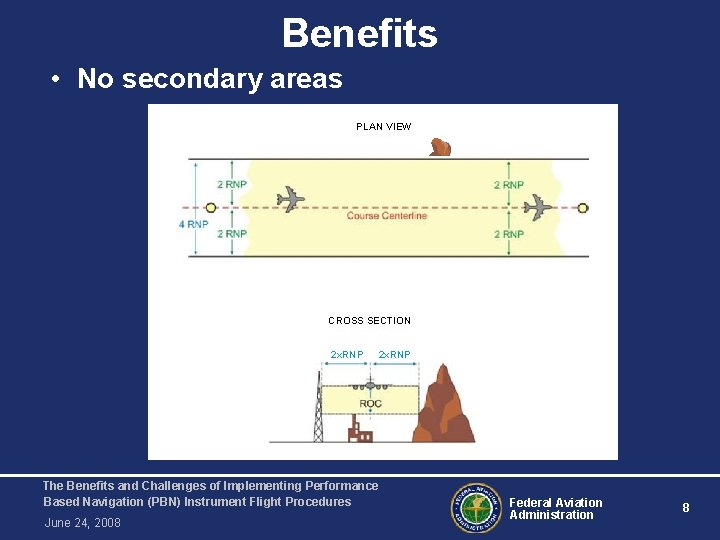
Benefits • No secondary areas PLAN VIEW CROSS SECTION 2 x. RNP The Benefits and Challenges of Implementing Performance Based Navigation (PBN) Instrument Flight Procedures June 24, 2008 Federal Aviation Administration 8
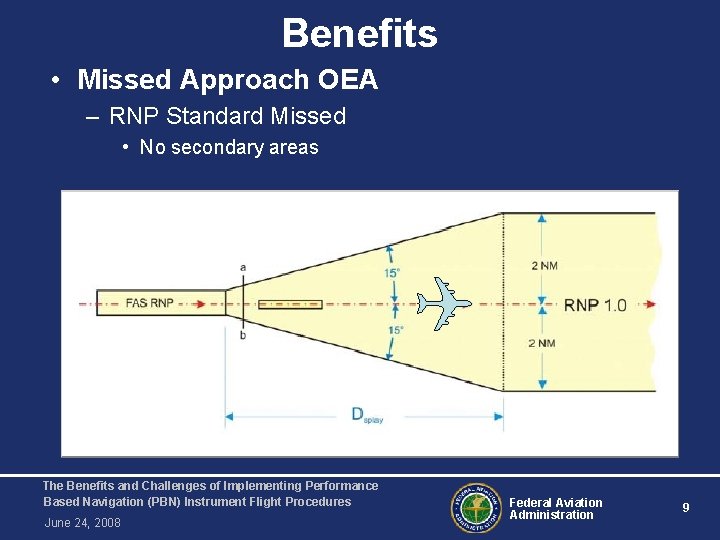
Benefits • Missed Approach OEA – RNP Standard Missed • No secondary areas The Benefits and Challenges of Implementing Performance Based Navigation (PBN) Instrument Flight Procedures June 24, 2008 Federal Aviation Administration 9

Benefits • Missed Approach OEA – RNP Standard Missed • Benefit over ground-based missed approach VOR MISSED RNP MISSED The Benefits and Challenges of Implementing Performance Based Navigation (PBN) Instrument Flight Procedures June 24, 2008 Federal Aviation Administration 10
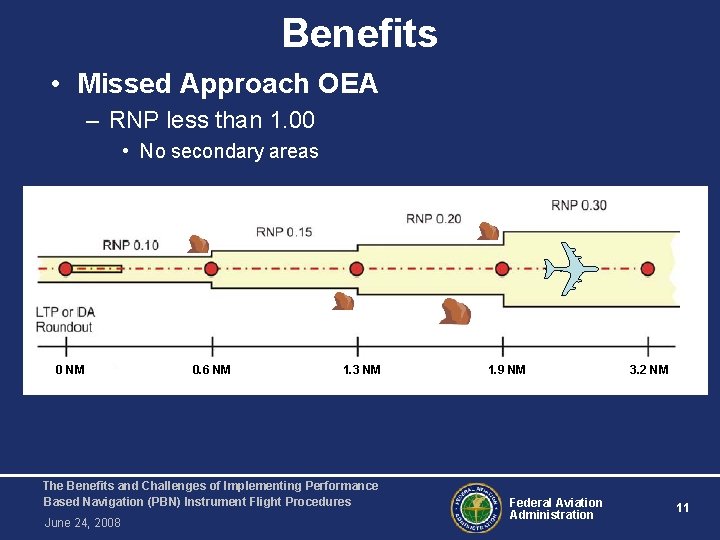
Benefits • Missed Approach OEA – RNP less than 1. 00 • No secondary areas 0 NM 0. 6 NM 1. 3 NM The Benefits and Challenges of Implementing Performance Based Navigation (PBN) Instrument Flight Procedures June 24, 2008 1. 9 NM Federal Aviation Administration 3. 2 NM 11
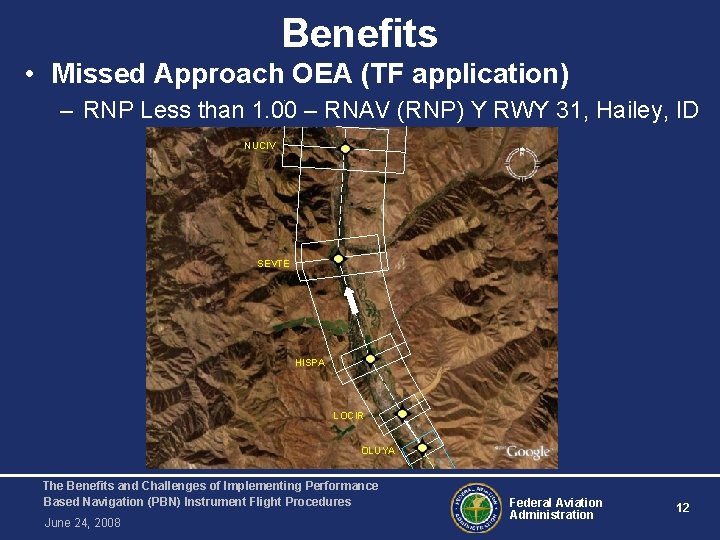
Benefits • Missed Approach OEA (TF application) – RNP Less than 1. 00 – RNAV (RNP) Y RWY 31, Hailey, ID NUCIV SEVTE HISPA LOCIR OLUYA The Benefits and Challenges of Implementing Performance Based Navigation (PBN) Instrument Flight Procedures June 24, 2008 Federal Aviation Administration 12

Benefits • Radius-to-Fix (RF) path terminators – Provides a consistently repeatable ground track and smooth transition to next segment The Benefits and Challenges of Implementing Performance Based Navigation (PBN) Instrument Flight Procedures June 24, 2008 Federal Aviation Administration 13
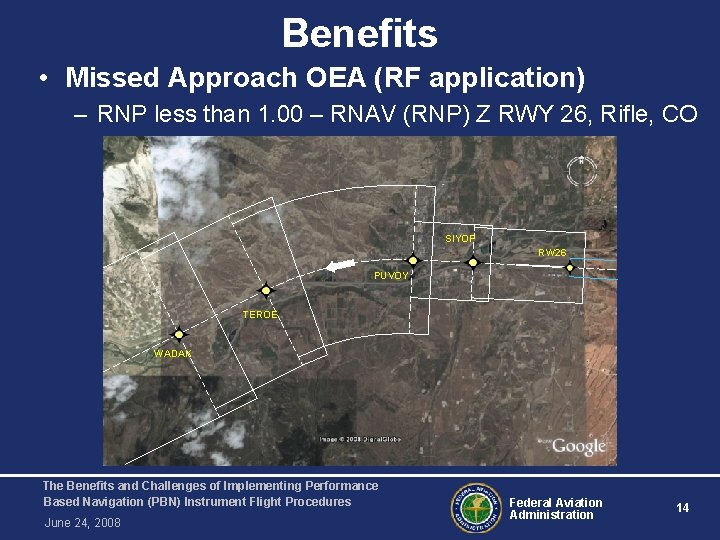
Benefits • Missed Approach OEA (RF application) – RNP less than 1. 00 – RNAV (RNP) Z RWY 26, Rifle, CO SIYOP RW 26 PUVOY TEROE WADAK The Benefits and Challenges of Implementing Performance Based Navigation (PBN) Instrument Flight Procedures June 24, 2008 Federal Aviation Administration 14
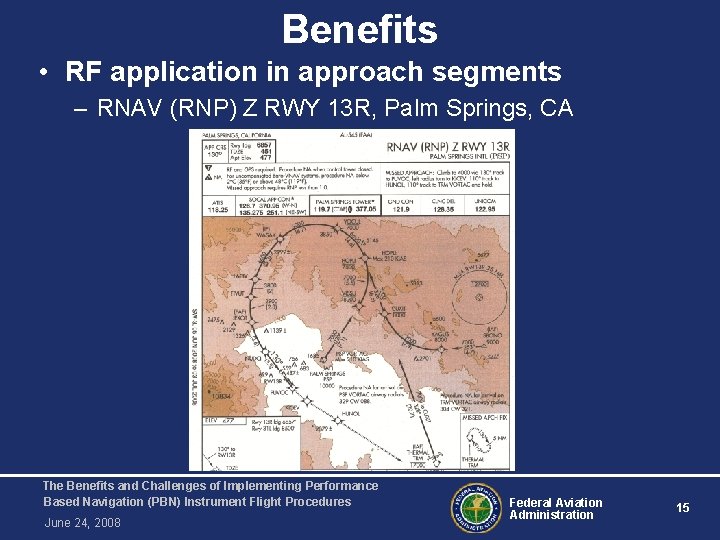
Benefits • RF application in approach segments – RNAV (RNP) Z RWY 13 R, Palm Springs, CA The Benefits and Challenges of Implementing Performance Based Navigation (PBN) Instrument Flight Procedures June 24, 2008 Federal Aviation Administration 15
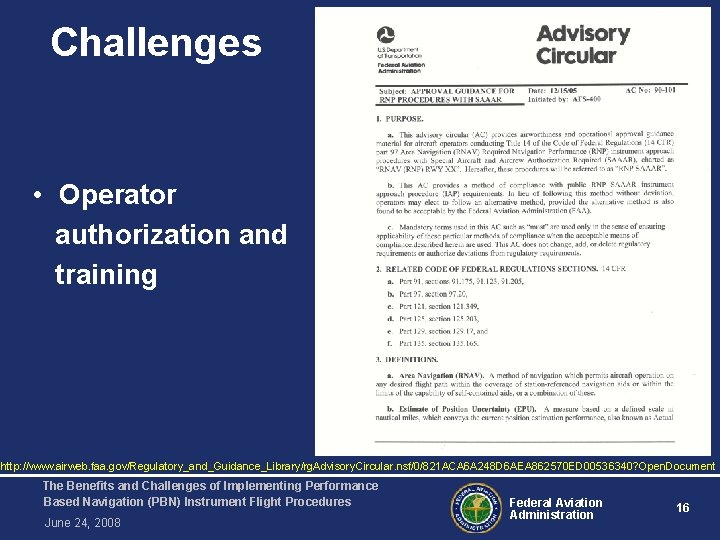
Challenges • Operator authorization and training http: //www. airweb. faa. gov/Regulatory_and_Guidance_Library/rg. Advisory. Circular. nsf/0/821 ACA 6 A 248 D 6 AEA 862570 ED 00536340? Open. Document The Benefits and Challenges of Implementing Performance Based Navigation (PBN) Instrument Flight Procedures June 24, 2008 Federal Aviation Administration 16
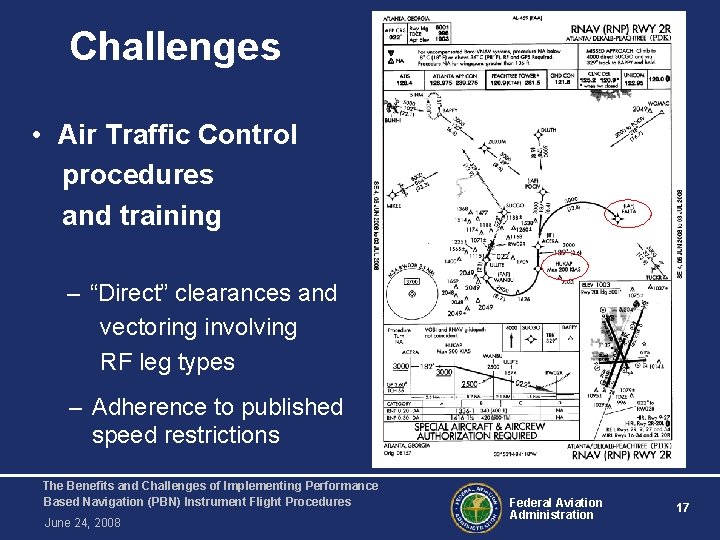
Challenges • Air Traffic Control procedures and training – “Direct” clearances and vectoring involving RF leg types – Adherence to published speed restrictions The Benefits and Challenges of Implementing Performance Based Navigation (PBN) Instrument Flight Procedures June 24, 2008 Federal Aviation Administration 17
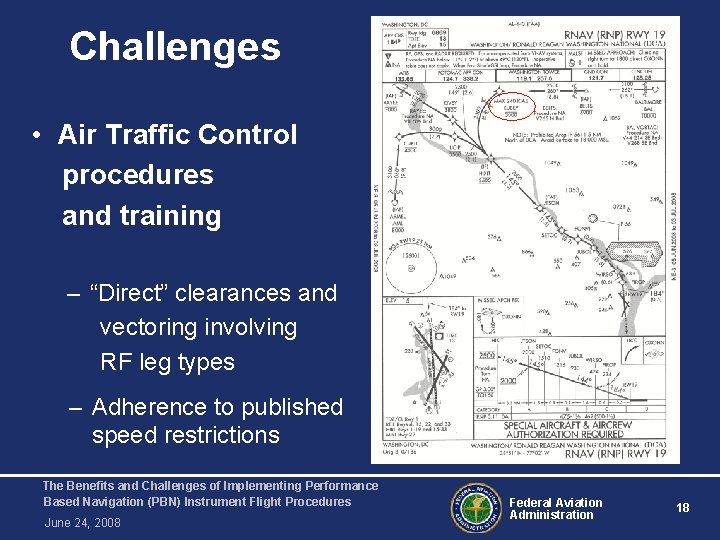
Challenges • Air Traffic Control procedures and training – “Direct” clearances and vectoring involving RF leg types – Adherence to published speed restrictions The Benefits and Challenges of Implementing Performance Based Navigation (PBN) Instrument Flight Procedures June 24, 2008 Federal Aviation Administration 18
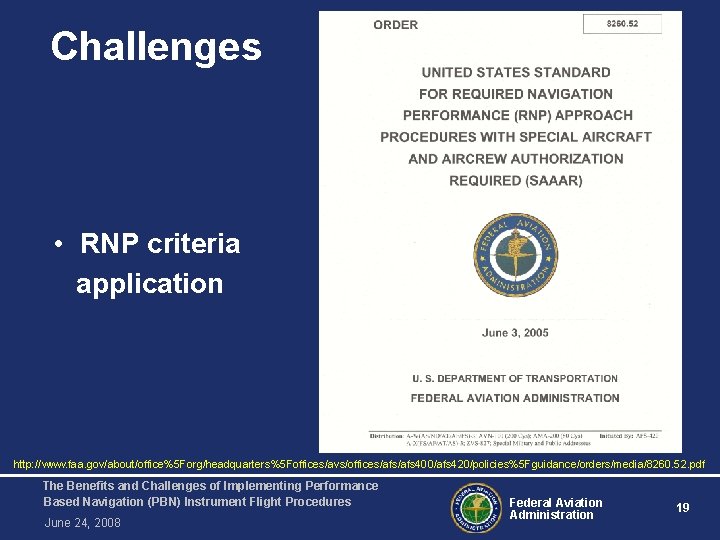
Challenges • RNP criteria application http: //www. faa. gov/about/office%5 Forg/headquarters%5 Foffices/avs/offices/afs 400/afs 420/policies%5 Fguidance/orders/media/8260. 52. pdf The Benefits and Challenges of Implementing Performance Based Navigation (PBN) Instrument Flight Procedures June 24, 2008 Federal Aviation Administration 19
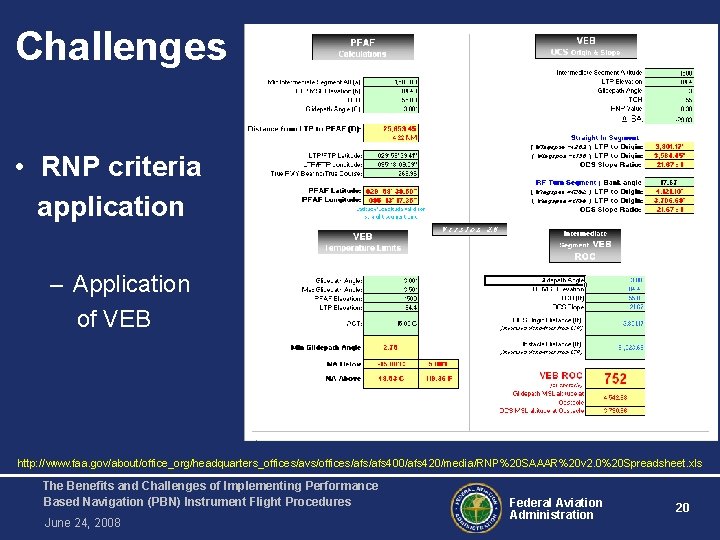
Challenges • RNP criteria application – Application of VEB http: //www. faa. gov/about/office_org/headquarters_offices/avs/offices/afs 400/afs 420/media/RNP%20 SAAAR%20 v 2. 0%20 Spreadsheet. xls The Benefits and Challenges of Implementing Performance Based Navigation (PBN) Instrument Flight Procedures June 24, 2008 Federal Aviation Administration 20
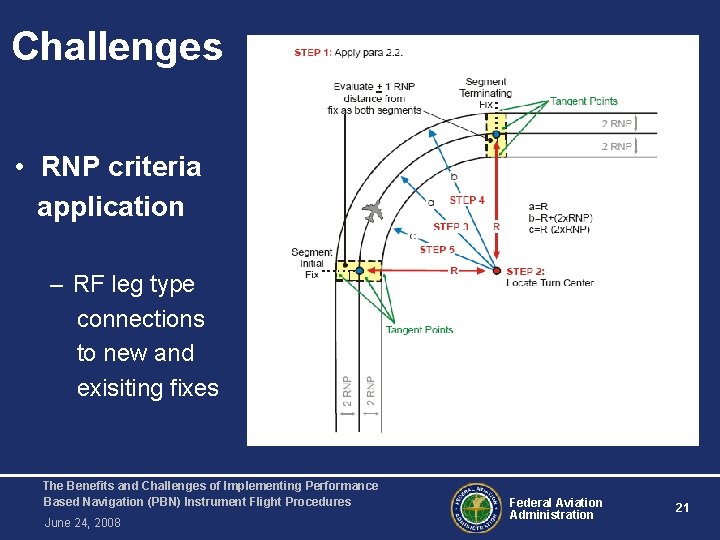
Challenges • RNP criteria application – RF leg type connections to new and exisiting fixes The Benefits and Challenges of Implementing Performance Based Navigation (PBN) Instrument Flight Procedures June 24, 2008 Federal Aviation Administration 21
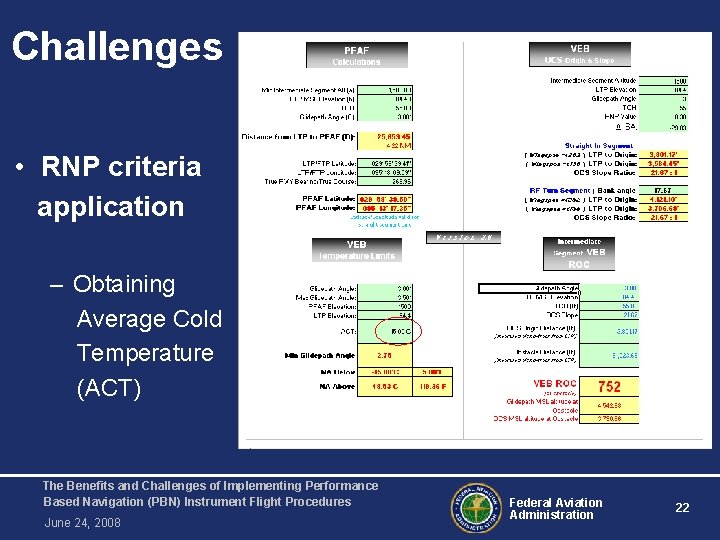
Challenges • RNP criteria application – Obtaining Average Cold Temperature (ACT) The Benefits and Challenges of Implementing Performance Based Navigation (PBN) Instrument Flight Procedures June 24, 2008 Federal Aviation Administration 22
Challenges • RNP criteria application – Achieving benefit • • • Operator certification ATC integration RNP levels ARINC leg types Missed approach climb gradients The Benefits and Challenges of Implementing Performance Based Navigation (PBN) Instrument Flight Procedures June 24, 2008 Federal Aviation Administration 23
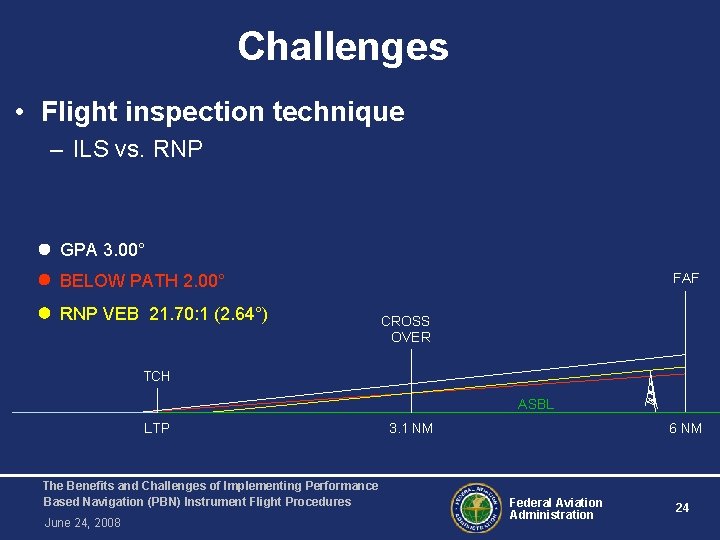
Challenges • Flight inspection technique – ILS vs. RNP GPA 3. 00° FAF BELOW PATH 2. 00° RNP VEB 21. 70: 1 (2. 64°) CROSS OVER TCH ASBL LTP The Benefits and Challenges of Implementing Performance Based Navigation (PBN) Instrument Flight Procedures June 24, 2008 3. 1 NM 6 NM Federal Aviation Administration 24
Summary • Benefits – – Reduced Obstacle Evaluation Area (OEA) No secondary areas Missed approach segment OEA Radius-to-Fix Leg • Challenges – – – Operator authorization and training Air traffic control procedures and training RNP criteria application Procedure benefit Flight inspection technique The Benefits and Challenges of Implementing Performance Based Navigation (PBN) Instrument Flight Procedures June 24, 2008 Federal Aviation Administration 25
Questions ? The Benefits and Challenges of Implementing Performance Based Navigation (PBN) Instrument Flight Procedures June 24, 2008 Federal Aviation Administration 26
- Slides: 26