
The Bell Curve Intelligence and Class Structure in

The Bell Curve: Intelligence and Class Structure in American Life Richard J. Herrnstein Charles Murray
Emergence of the Cognitive Elite “The twentieth century dawned on a world segregated into social classes defined in terms of money, power, and status. . Our thesis is that the twentieth century has continued the transformation [of the origin of social class], so that the twenty-first will open on a world in which cognitive ability is the decisive driving force. . Social class remains the vehicle of social life, but intelligence now pulls the train. ” Herrnstein and Murray, p. 25
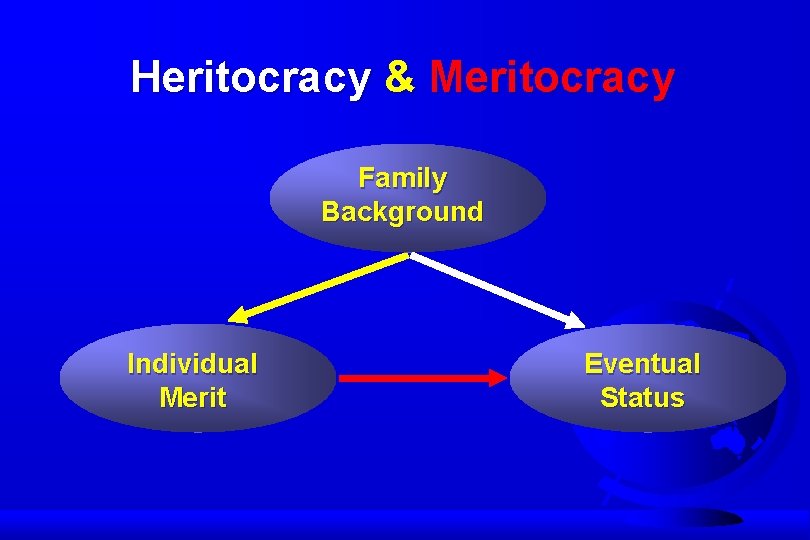
Arguments: 1) Greater access to higher education. 2) Greater efficiency in selecting college students for cognitive ability. The beta weights shifted for college = merit + parental status 3) Occupational status has became more dependent upon cognitive ability.
Assumptions & Evidence 1. Intelligence, as measured by IQ tests, is meaningful and stable. 2. Intelligence runs in families; assortative mating for intelligence. 3. Intelligence has a direct causal role in eventual social status. 4. Society has become increasingly efficient in selecting for intelligence in education and occupations.
Predictions: An increasingly isolated cognitive elite. A merging of the cognitive elite with the affluent. A deteriorating quality of life for people at the bottom end of the cognitive ability distribution. Herrnstein and Murray, , p. 509
“Unchecked, these trends will lead the U. S. towards something resembling a caste system, with the underclass mired ever more deeply at the bottom and the cognitive elite ever more firmly anchored at the top, restructuring the rules of society so that it becomes harder and harder for them to lose. ” Herrnstein and Murray, p. 509
Topics: 1. What is intelligence? 2. How stabile is intelligence? 3. Does it run in families? 4. Does it influence eventual social status? 5. Is a meritocracy evolving?
1. What is Intelligence?
Analogies: past is to present as present is to ______ dog is to god as rat is to ______
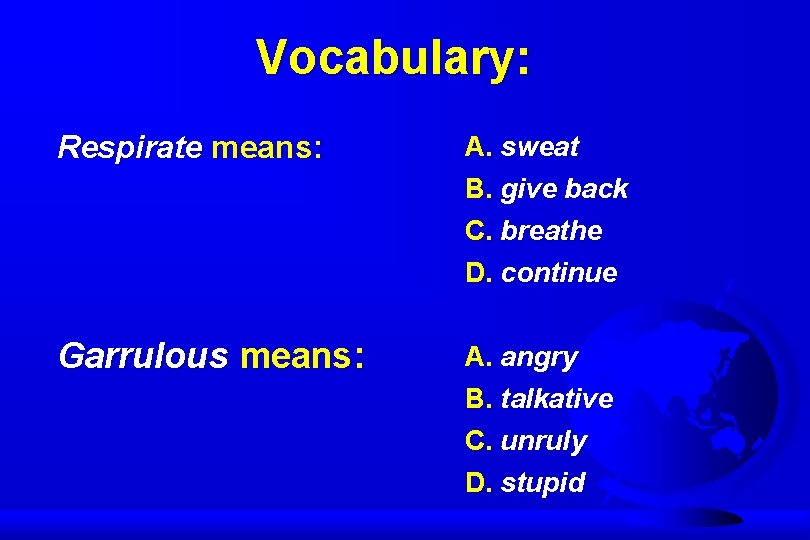
Vocabulary: Respirate means: A. sweat B. give back C. breathe D. continue Garrulous means: A. angry B. talkative C. unruly D. stupid
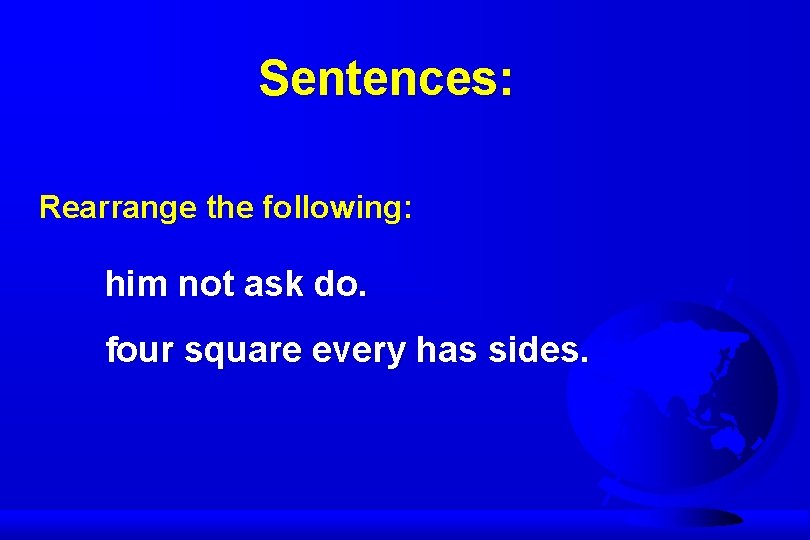
Sentences: Rearrange the following: him not ask do. four square every has sides.
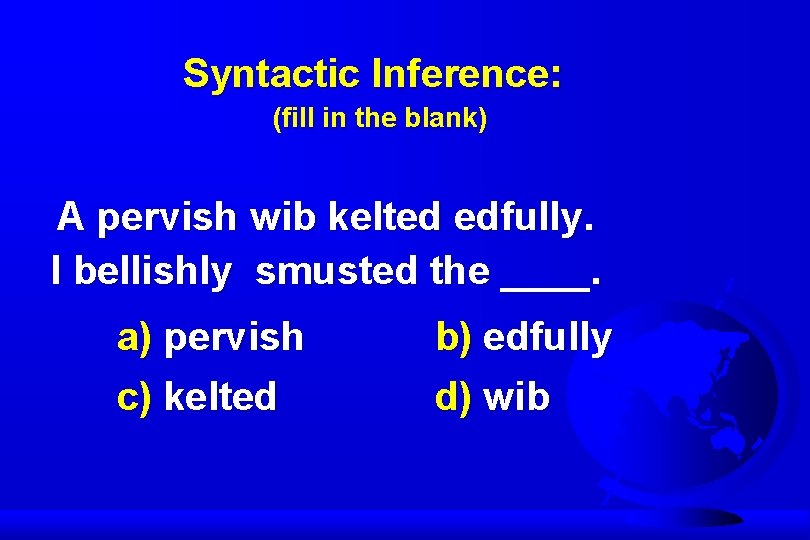
Syntactic Inference: (fill in the blank) A pervish wib kelted edfully. I bellishly smusted the ____. a) pervish c) kelted b) edfully d) wib
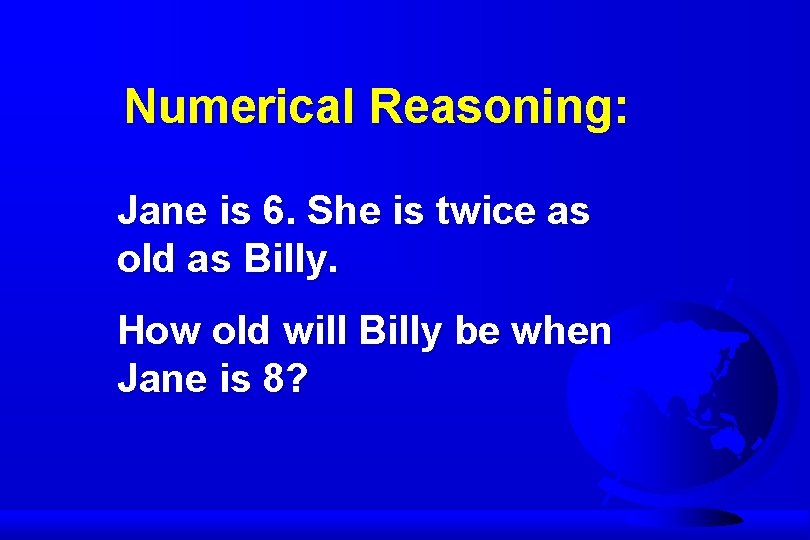
Numerical Reasoning: Jane is 6. She is twice as old as Billy. How old will Billy be when Jane is 8?
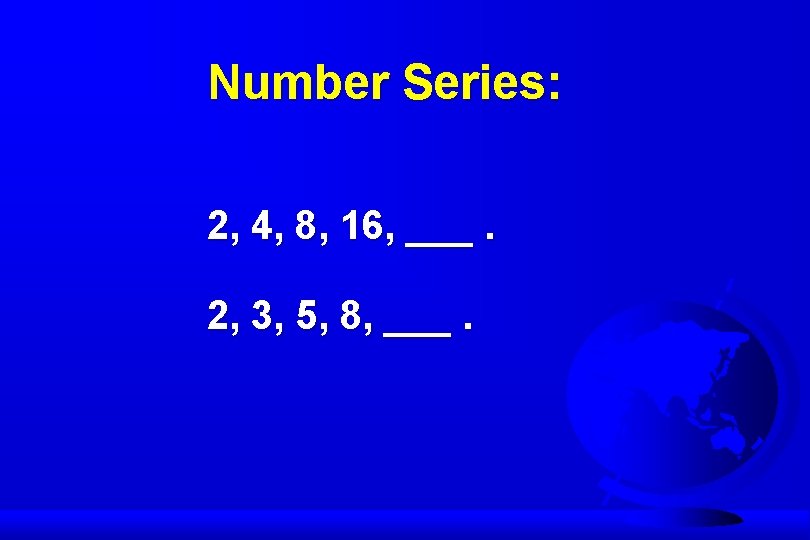
Number Series: 2, 4, 8, 16, ___. 2, 3, 5, 8, ___.
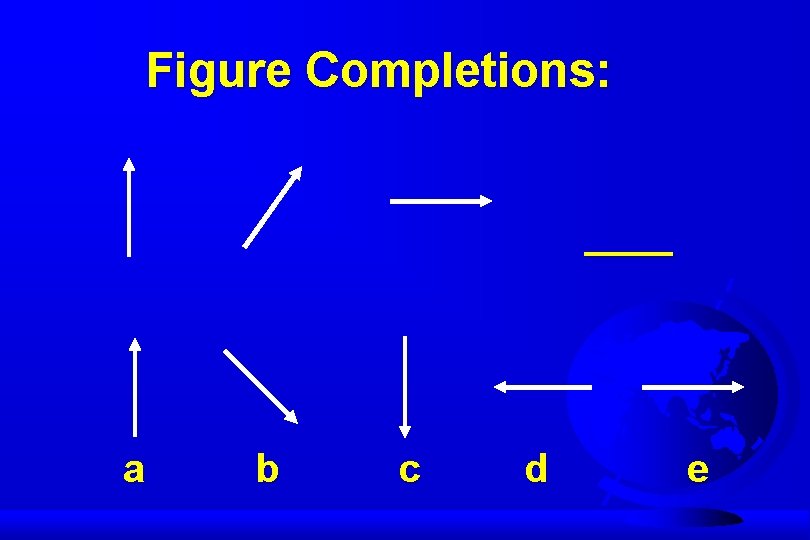
Figure Completions: ____ a b c d e
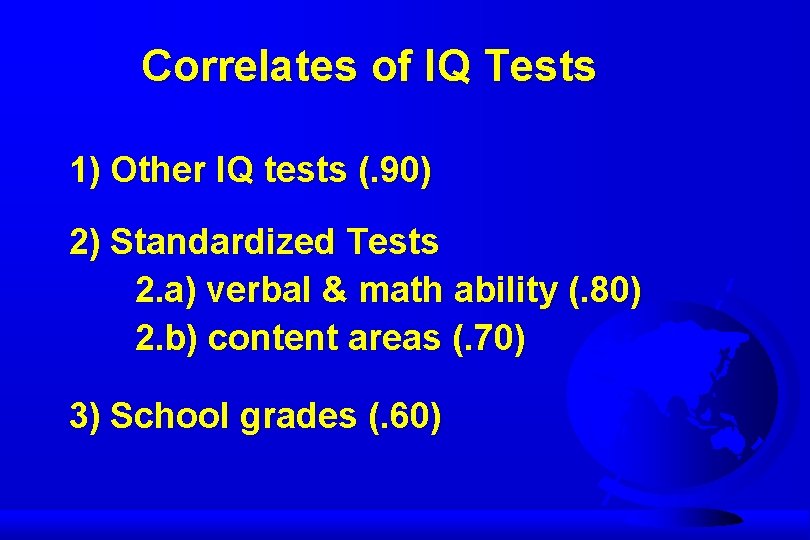
Correlates of IQ Tests 1) Other IQ tests (. 90) 2) Standardized Tests 2. a) verbal & math ability (. 80) 2. b) content areas (. 70) 3) School grades (. 60)

2. How stabile is intelligence?
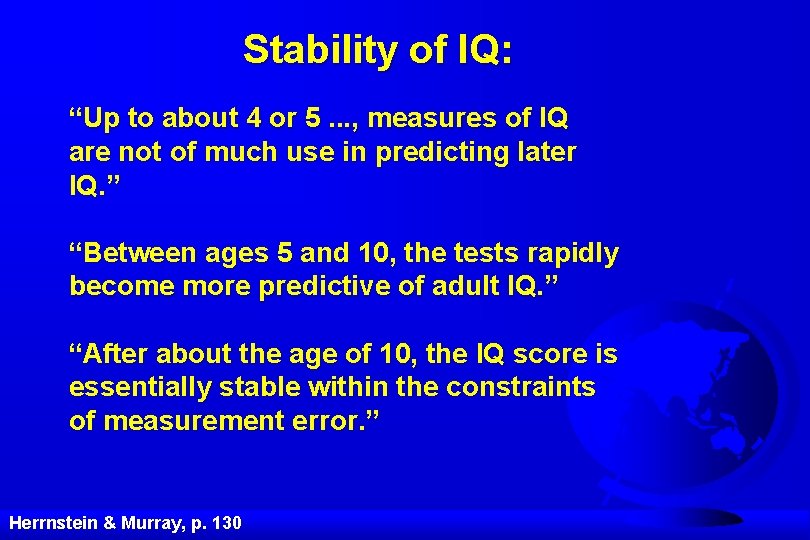
Stability of IQ: “Up to about 4 or 5. . . , measures of IQ are not of much use in predicting later IQ. ” “Between ages 5 and 10, the tests rapidly become more predictive of adult IQ. ” “After about the age of 10, the IQ score is essentially stable within the constraints of measurement error. ” Herrnstein & Murray, p. 130
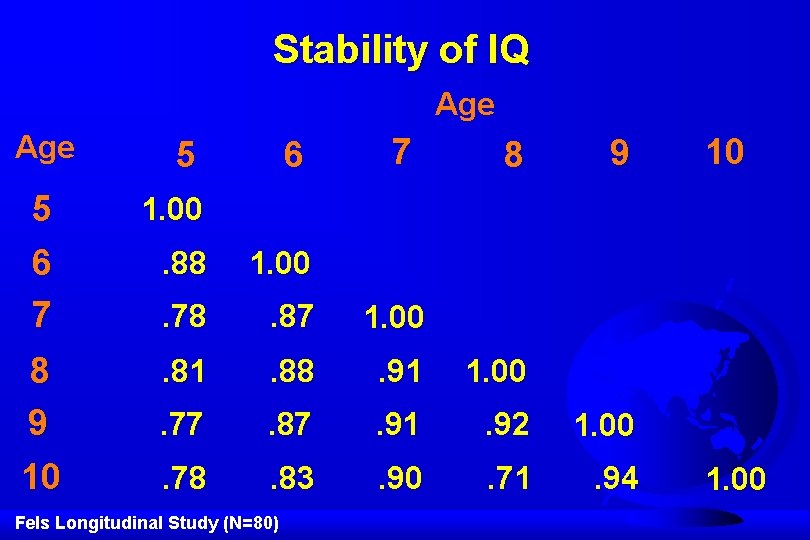
Stability of IQ Age 5 5 6 7 1. 00 8 9 10 6 7 8 9 . 88 1. 00 . 78 . 87 1. 00 . 81 . 88 . 91 1. 00 . 77 . 87 . 91 . 92 1. 00 . 78 . 83 . 90 . 71 . 94 Fels Longitudinal Study (N=80) 10 1. 00
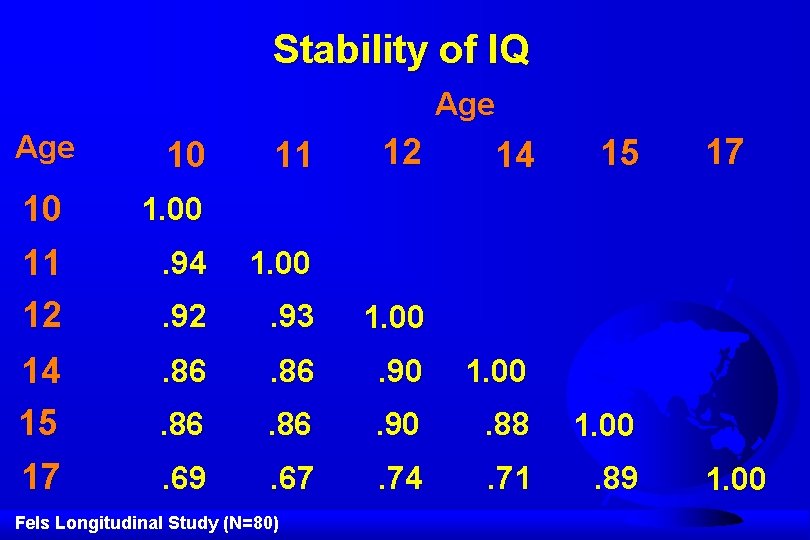
Stability of IQ Age 10 10 11 12 1. 00 14 15 17 11 12 14 15 . 94 1. 00 . 92 . 93 1. 00 . 86 . 90 . 88 1. 00 . 69 . 67 . 74 . 71 . 89 Fels Longitudinal Study (N=80) 17 1. 00
3. Does intelligence run in families?
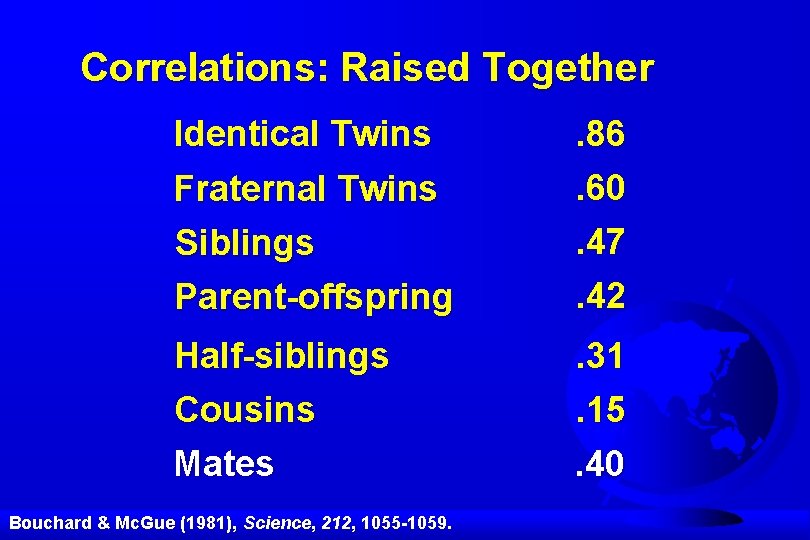
Correlations: Raised Together Identical Twins Fraternal Twins Siblings Parent-offspring . 86. 60. 47. 42 Half-siblings Cousins Mates . 31. 15. 40 Bouchard & Mc. Gue (1981), Science, 212, 1055 -1059.
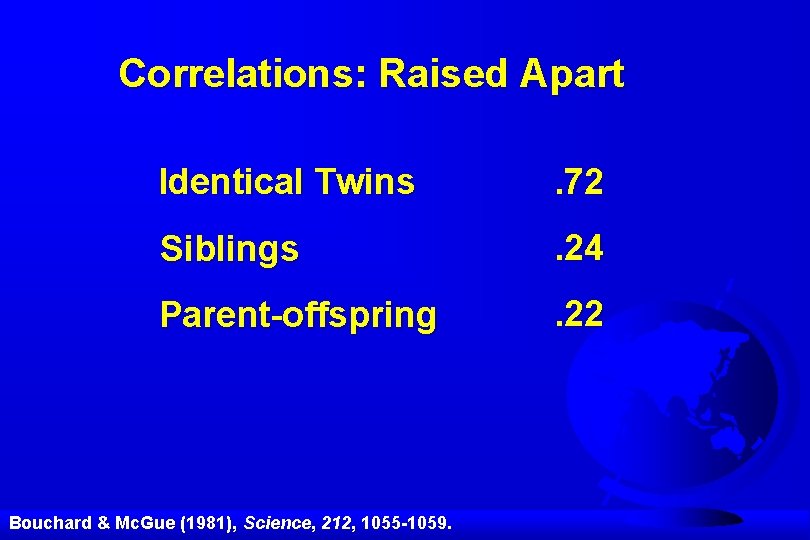
Correlations: Raised Apart Identical Twins . 72 Siblings . 24 Parent-offspring . 22 Bouchard & Mc. Gue (1981), Science, 212, 1055 -1059.
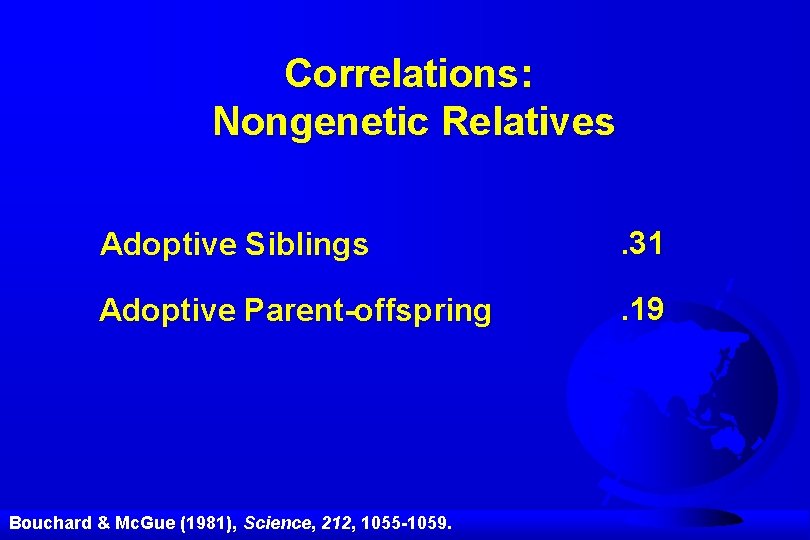
Correlations: Nongenetic Relatives Adoptive Siblings . 31 Adoptive Parent-offspring . 19 Bouchard & Mc. Gue (1981), Science, 212, 1055 -1059.
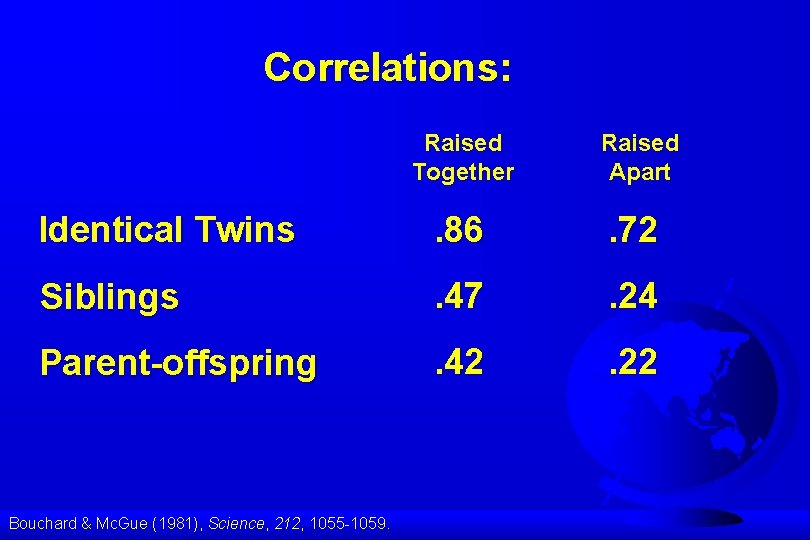
Correlations: Raised Together Raised Apart Identical Twins . 86 . 72 Siblings . 47 . 24 Parent-offspring . 42 . 22 Bouchard & Mc. Gue (1981), Science, 212, 1055 -1059.
4. Does intelligence influence eventual social status?

Herrnstein and Murray, p. 149

Herrnstein and Murray, p. 134
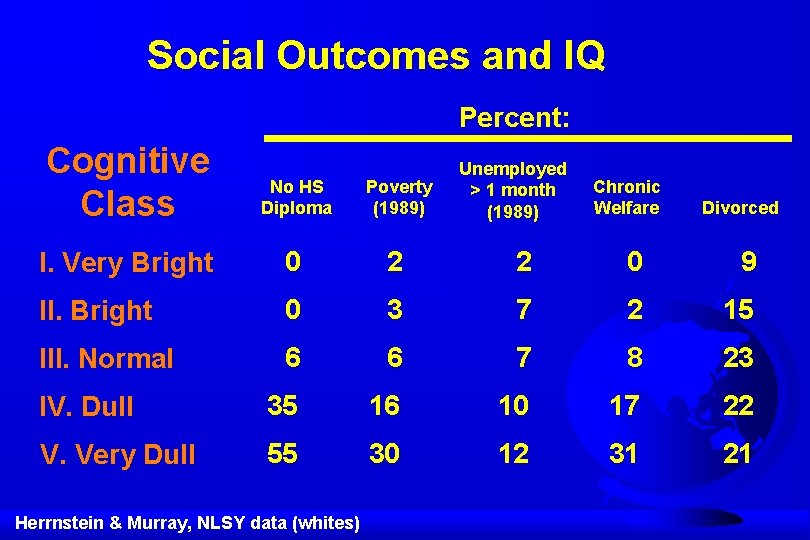
Social Outcomes and IQ Percent: Cognitive Class No HS Diploma Poverty (1989) I. Very Bright 0 2 2 0 9 II. Bright 0 3 7 2 15 III. Normal 6 6 7 8 23 IV. Dull 35 16 10 17 22 V. Very Dull 55 30 12 31 21 Herrnstein & Murray, NLSY data (whites) Unemployed > 1 month (1989) Chronic Welfare Divorced
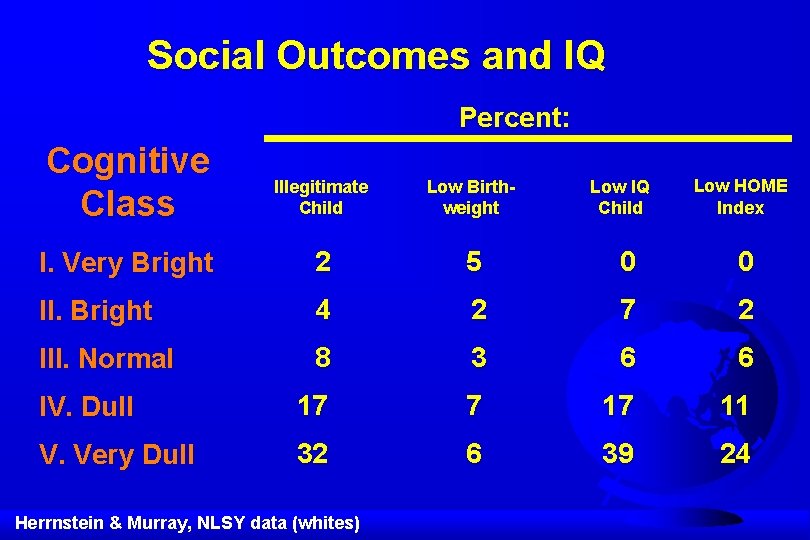
Social Outcomes and IQ Percent: Cognitive Class Illegitimate Child Low Birthweight I. Very Bright 2 5 0 0 II. Bright 4 2 7 2 III. Normal 8 3 6 6 IV. Dull 17 7 17 11 V. Very Dull 32 6 39 24 Herrnstein & Murray, NLSY data (whites) Low IQ Child Low HOME Index
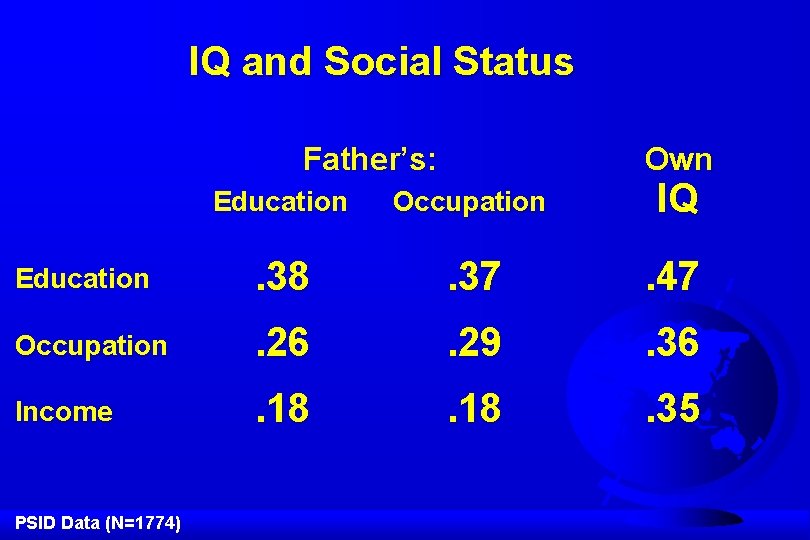
IQ and Social Status Father’s: Own Education Occupation IQ Education . 38 . 37 . 47 Occupation . 26 . 29 . 36 Income . 18 . 35 PSID Data (N=1774)
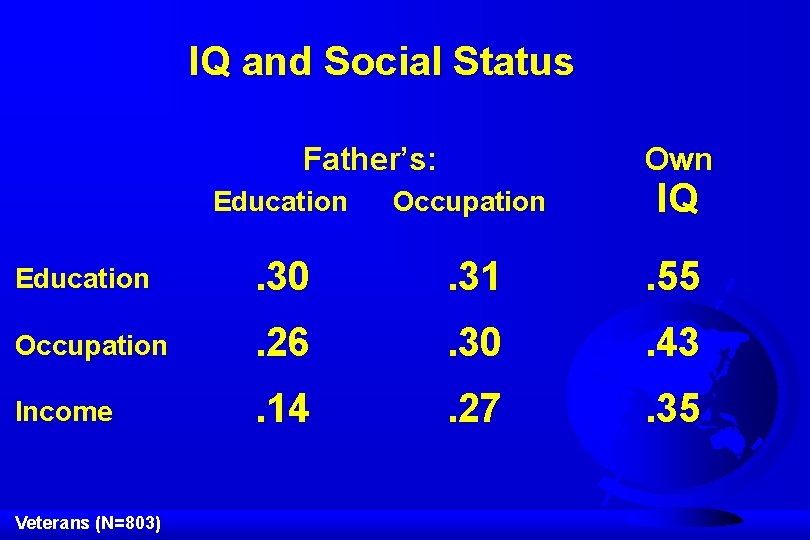
IQ and Social Status Father’s: Own Education Occupation IQ Education . 30 . 31 . 55 Occupation . 26 . 30 . 43 Income . 14 . 27 . 35 Veterans (N=803)
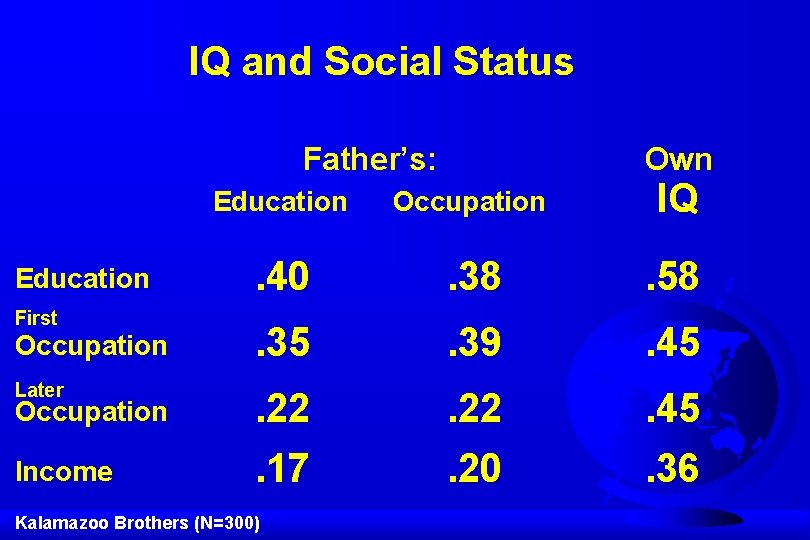
IQ and Social Status Father’s: Own Education Occupation IQ . 40 . 38 . 58 Occupation . 35 . 39 . 45 Later . 22. 17 . 22. 20 . 45. 36 Education First Occupation Income Kalamazoo Brothers (N=300)
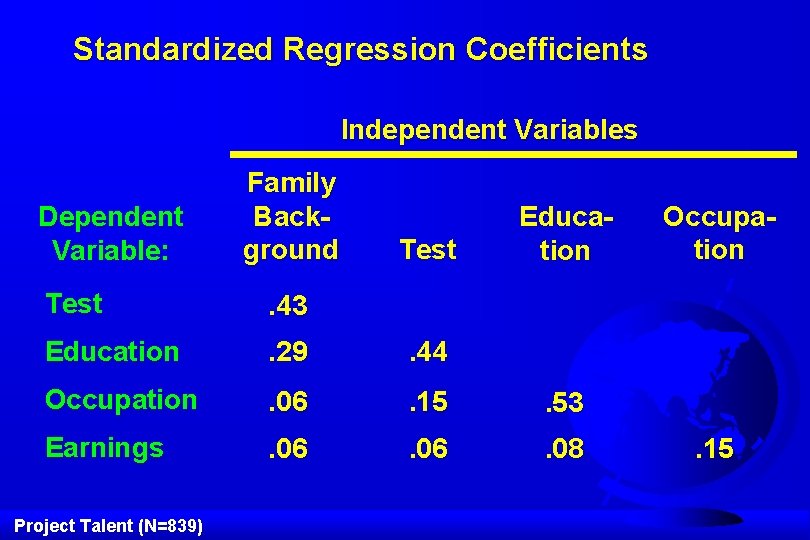
Standardized Regression Coefficients Independent Variables Dependent Variable: Family Background Test Education Test . 43 Education . 29 . 44 Occupation . 06 . 15 . 53 Earnings . 06 . 08 Project Talent (N=839) Occupation . 15
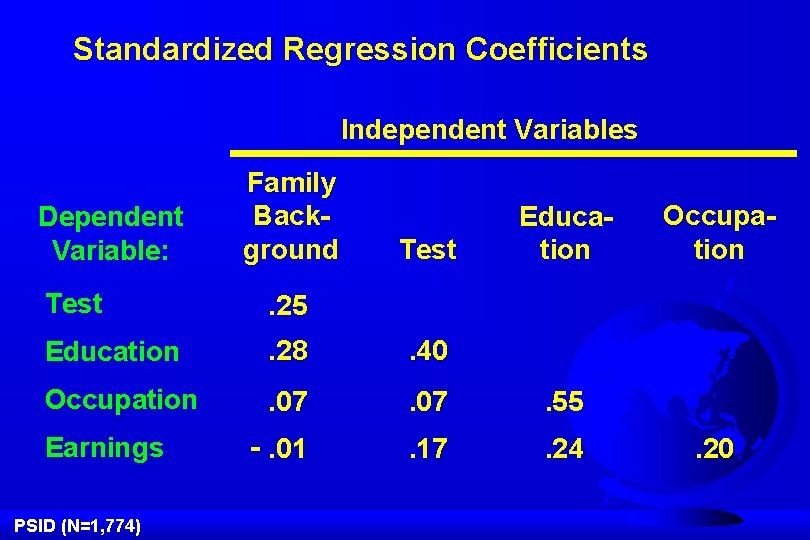
Standardized Regression Coefficients Independent Variables Dependent Variable: Family Background Test Education Test . 25 Education . 28 . 40 Occupation . 07 . 55 -. 01 . 17 . 24 Earnings PSID (N=1, 774) Occupation . 20
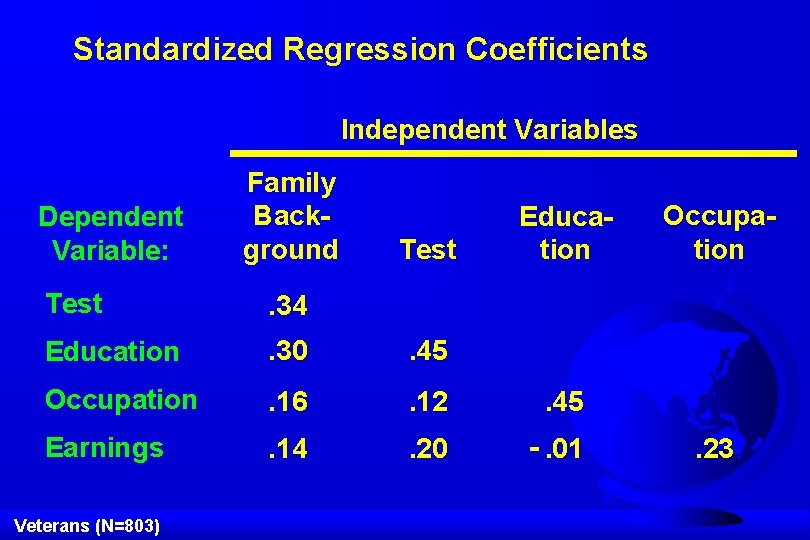
Standardized Regression Coefficients Independent Variables Dependent Variable: Family Background Test Education Test . 34 Education . 30 . 45 Occupation . 16 . 12 . 45 Earnings . 14 . 20 -. 01 Veterans (N=803) Occupation . 23
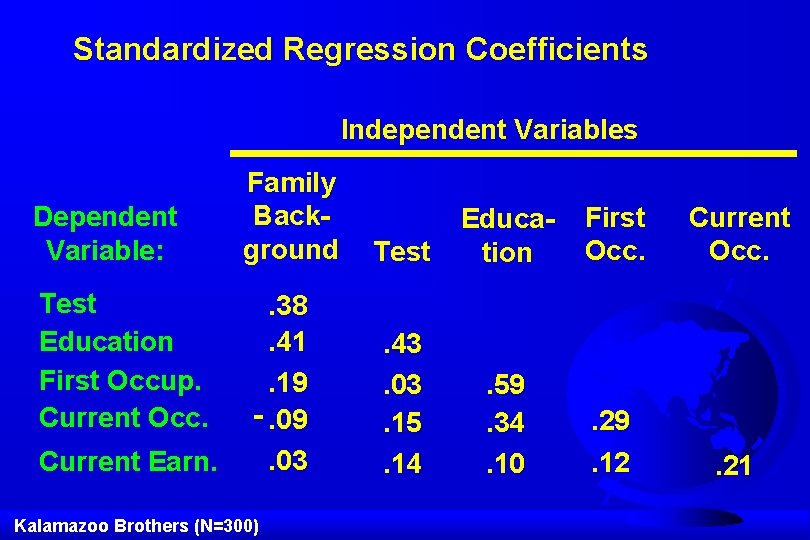
Standardized Regression Coefficients Independent Variables Dependent Variable: Test Education First Occup. Current Occ. Current Earn. Family Background. 38. 41. 19 -. 09. 03 Kalamazoo Brothers (N=300) Test Education First Occ. Current Occ. . 43. 03. 15. 14 . 59. 34. 10 . 29. 12 . 21
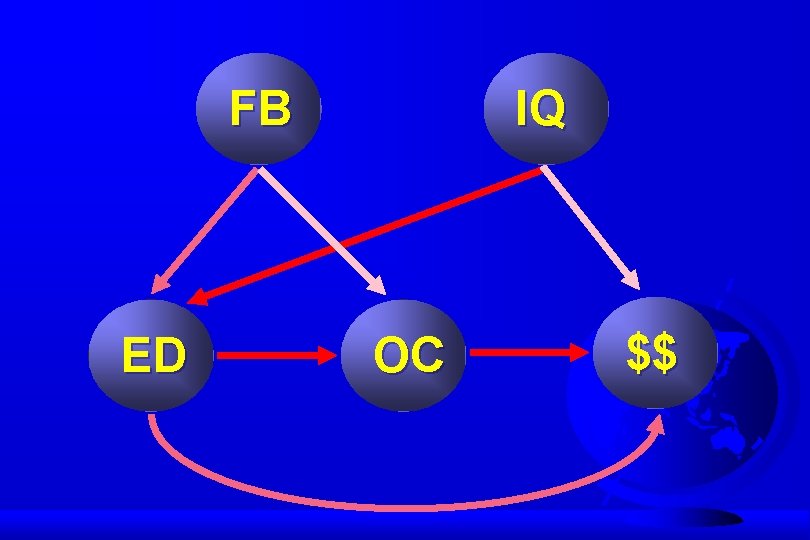
FB ED IQ OC $$
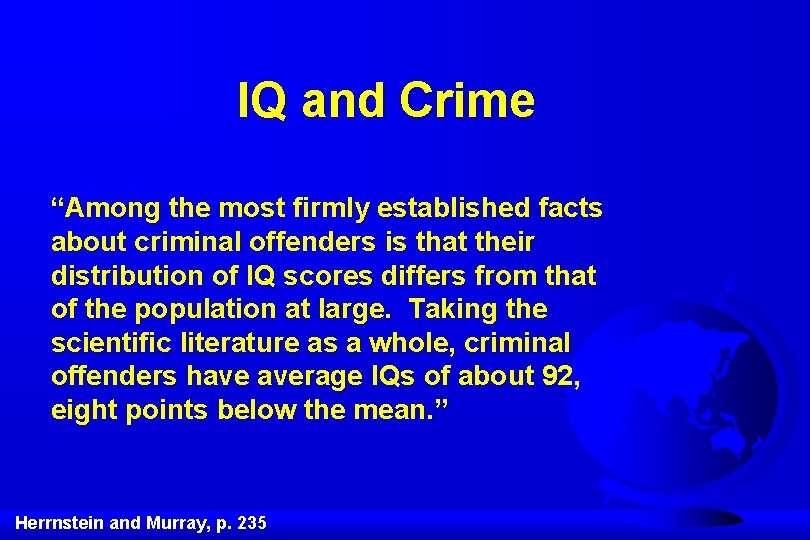
IQ and Crime “Among the most firmly established facts about criminal offenders is that their distribution of IQ scores differs from that of the population at large. Taking the scientific literature as a whole, criminal offenders have average IQs of about 92, eight points below the mean. ” Herrnstein and Murray, p. 235
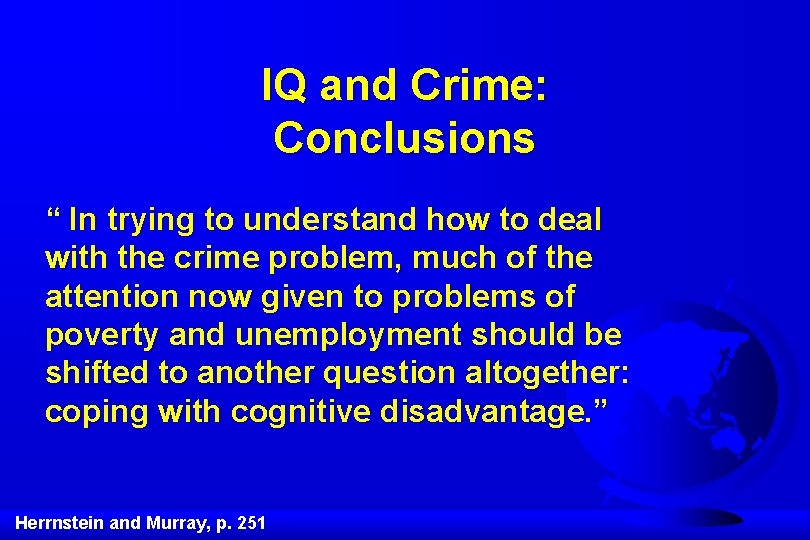
IQ and Crime: Conclusions “ In trying to understand how to deal with the crime problem, much of the attention now given to problems of poverty and unemployment should be shifted to another question altogether: coping with cognitive disadvantage. ” Herrnstein and Murray, p. 251
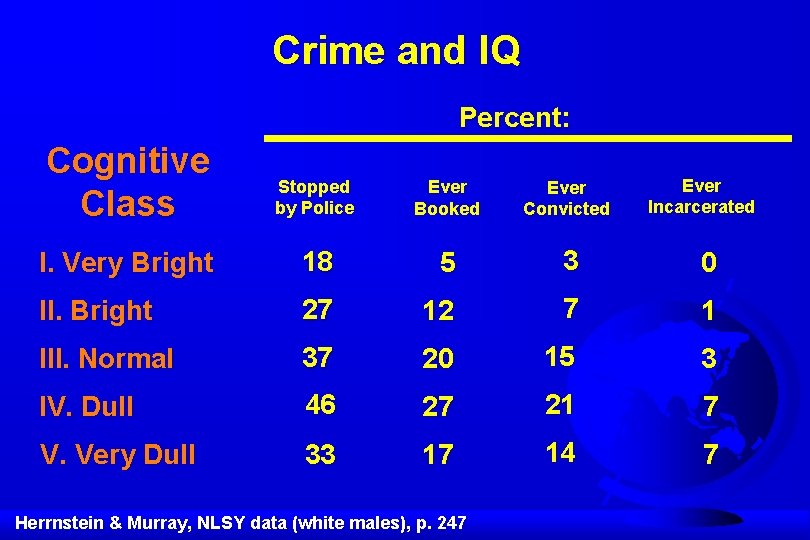
Crime and IQ Percent: Cognitive Class Stopped by Police Ever Booked Ever Convicted I. Very Bright 18 5 3 0 II. Bright 27 12 7 1 III. Normal 37 20 15 3 IV. Dull 46 27 21 7 V. Very Dull 33 17 14 7 Herrnstein & Murray, NLSY data (white males), p. 247 Ever Incarcerated
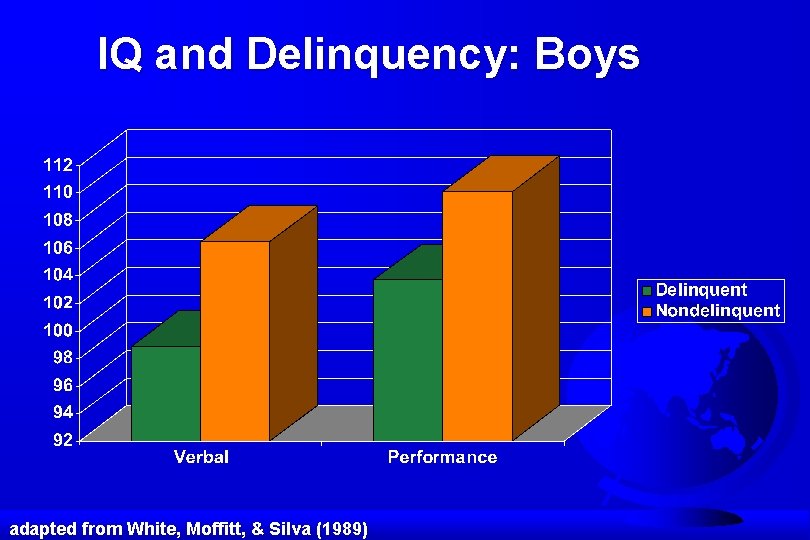
IQ and Delinquency: Boys adapted from White, Moffitt, & Silva (1989)
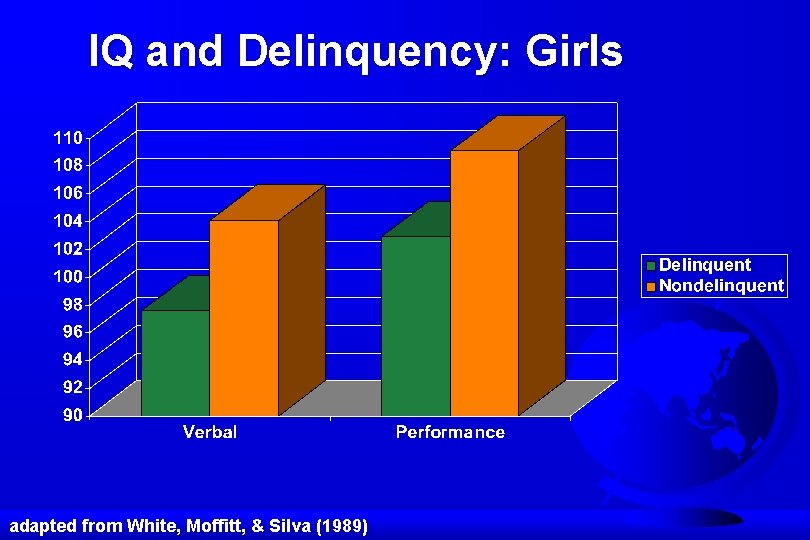
IQ and Delinquency: Girls adapted from White, Moffitt, & Silva (1989)
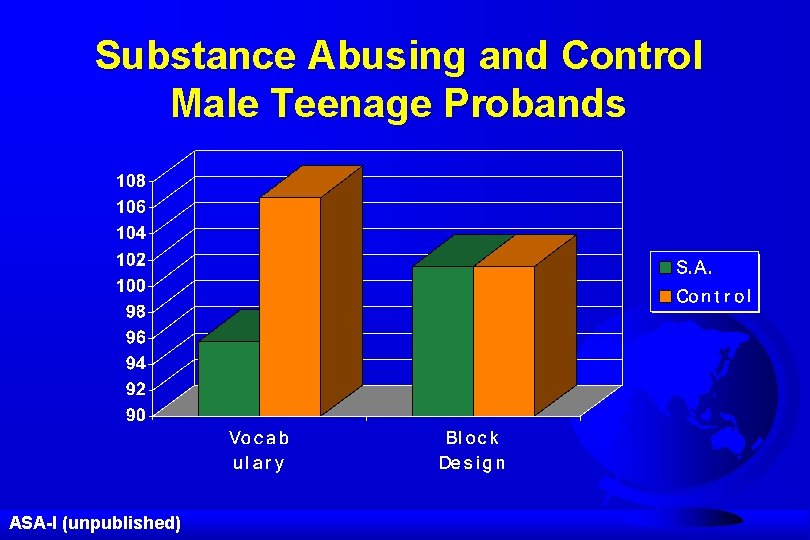
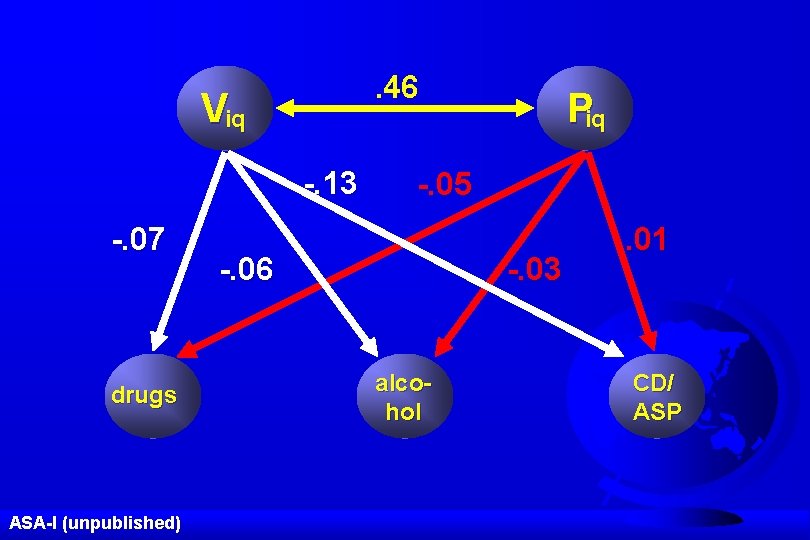
Substance Abusing and Control Male Teenage Probands ASA-I (unpublished)
Relatives of Substance Abusing and Control Male Teenage Probands ASA-I (unpublished)
. 46 Viq -. 13 -. 07 drugs ASA-I (unpublished) Piq -. 05 -. 06 -. 03 alcohol . 01 CD/ ASP
5. Is a cognitive meritocracy evolving?
Heritocracy & Meritocracy Family Background Individual Merit Eventual Status
Rethinking Ethnic Differences “If the reader is now convinced that either the genetic or environmental explanation has won out to the exclusion of the other, we have not done a sufficiently good job of presenting one side or the other. It seems highly likely to us that both genes and the environment have something to do with racial differences. What might the mix be? We are resolutely agnostic on that issue. ” Herrnstein and Murray, p. 311
And, on the next page. . . “. . . we have found that the genetic aspect of ethnic differences has assumed an overwhelming importance. One symptom of this is that while this book was in preparation and regardless of how we described it to anyone who asked, it was assumed that the book’s real subject had to be not only ethnic differences in cognitive ability but the genetic source of those differences. ” Herrnstein and Murray, p. 312
- Slides: 50