
The behavior of light in the Universe Most
The behavior of light in the Universe
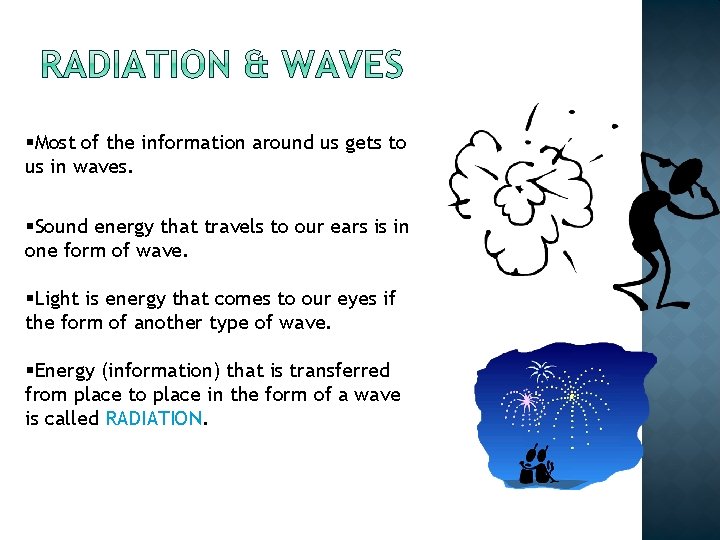
§Most of the information around us gets to us in waves. §Sound energy that travels to our ears is in one form of wave. §Light is energy that comes to our eyes if the form of another type of wave. §Energy (information) that is transferred from place to place in the form of a wave is called RADIATION.
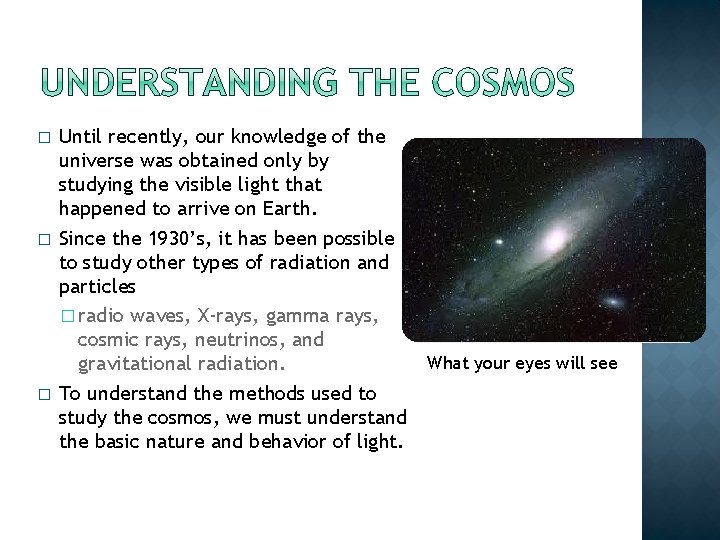
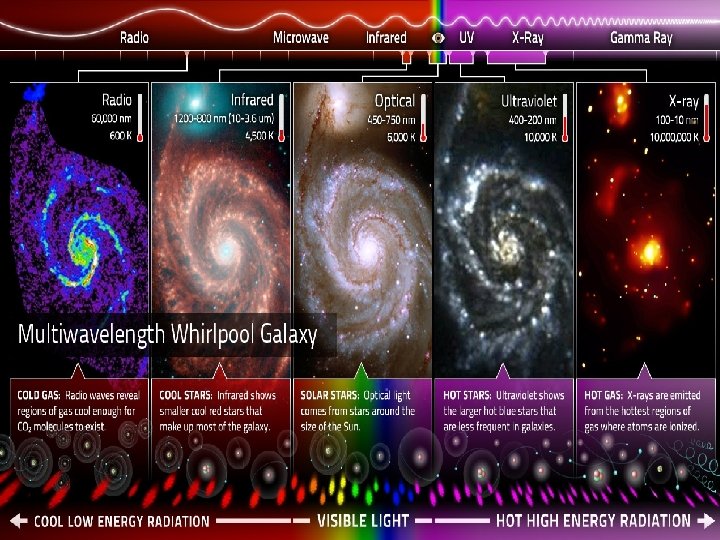
� � � Until recently, our knowledge of the universe was obtained only by studying the visible light that happened to arrive on Earth. Since the 1930’s, it has been possible to study other types of radiation and particles � radio waves, X-rays, gamma rays, cosmic rays, neutrinos, and What your eyes will see gravitational radiation. To understand the methods used to study the cosmos, we must understand the basic nature and behavior of light.
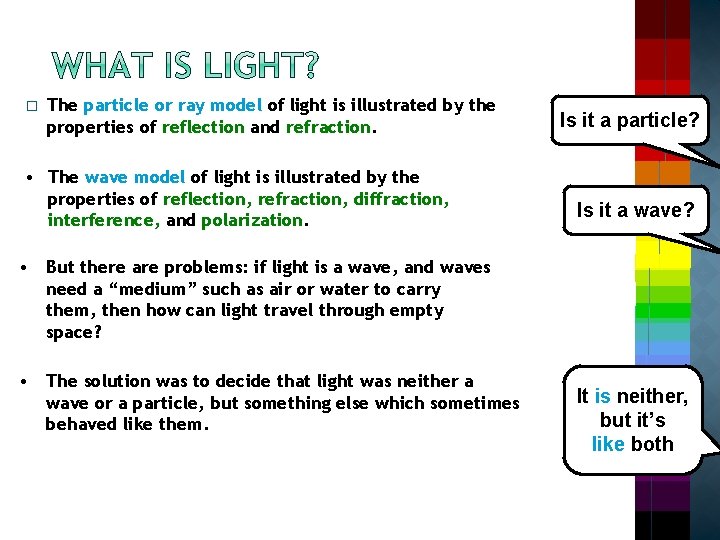
� The particle or ray model of light is illustrated by the properties of reflection and refraction. • The wave model of light is illustrated by the properties of reflection, refraction, diffraction, interference, and polarization. Is it a particle? Is it a wave? • But there are problems: if light is a wave, and waves need a “medium” such as air or water to carry them, then how can light travel through empty space? • The solution was to decide that light was neither a wave or a particle, but something else which sometimes behaved like them. It is neither, but it’s like both
� Wave motion is NOT a mechanical phenomenon because a wave is not actually an object, it is just a form of energy � It can be a � deformation of a material object (music string or waves on the surface of a body of water) OR � pattern in a field (light or radio waves)
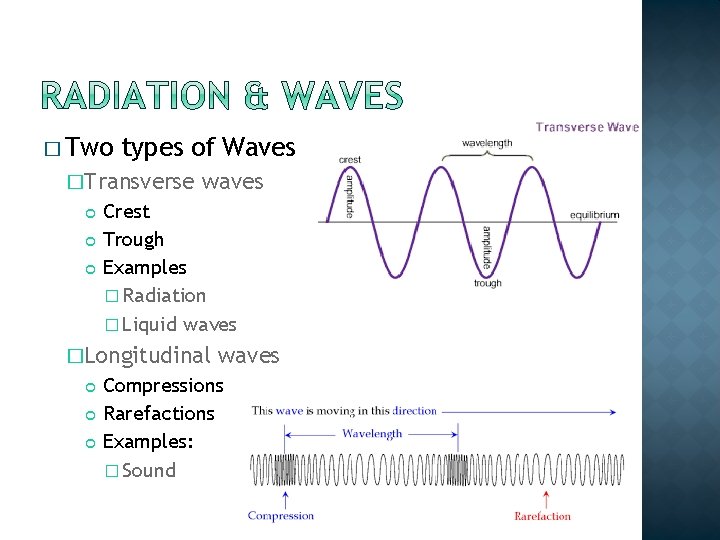
� Two types of Waves �Transverse waves Crest Trough Examples � Radiation � Liquid waves �Longitudinal waves Compressions Rarefactions Examples: � Sound
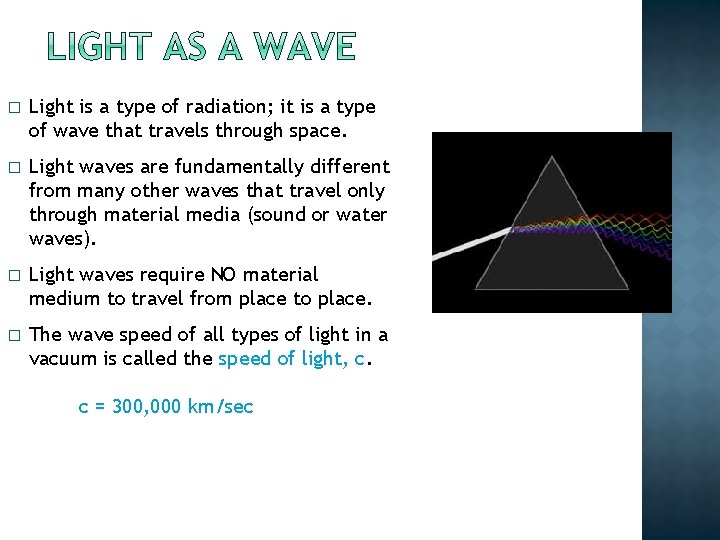
� Light is a type of radiation; it is a type of wave that travels through space. � Light waves are fundamentally different from many other waves that travel only through material media (sound or water waves). � Light waves require NO material medium to travel from place to place. � The wave speed of all types of light in a vacuum is called the speed of light, c. c = 300, 000 km/sec
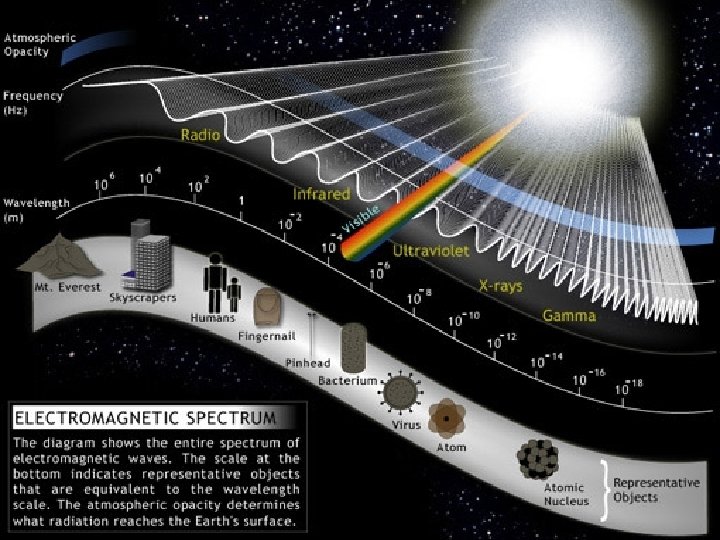
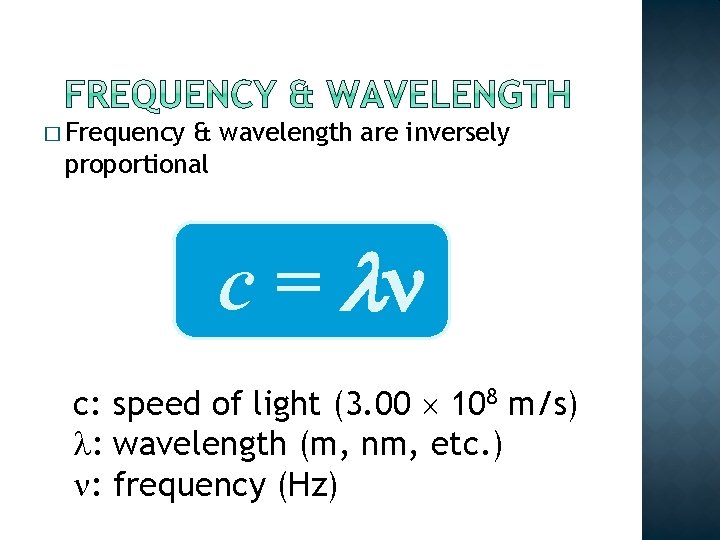
� Frequency & wavelength are inversely proportional c = c: speed of light (3. 00 108 m/s) : wavelength (m, nm, etc. ) : frequency (Hz)
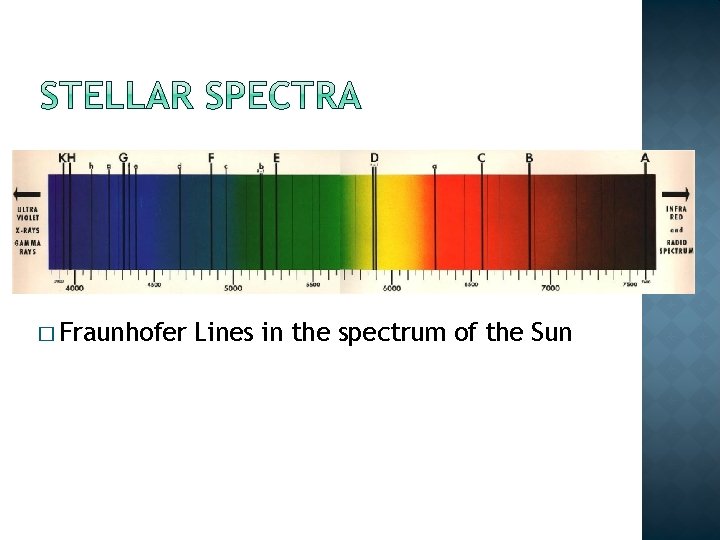
� Fraunhofer Lines in the spectrum of the Sun
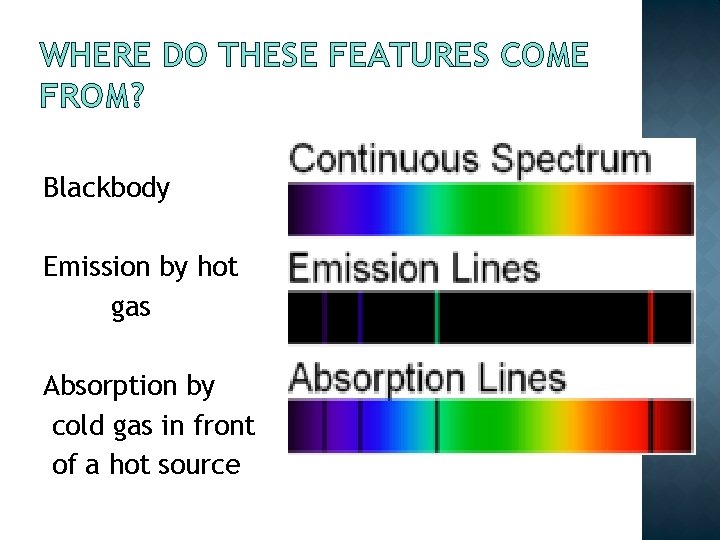
WHERE DO THESE FEATURES COME FROM? Blackbody Emission by hot gas Absorption by cold gas in front of a hot source
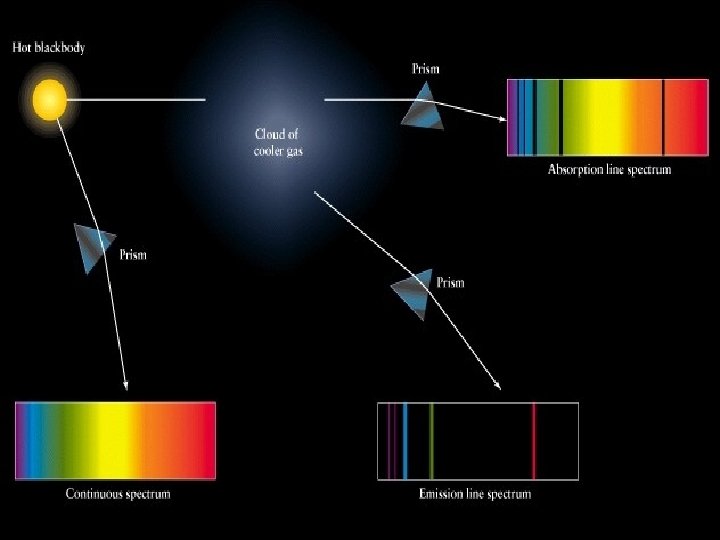
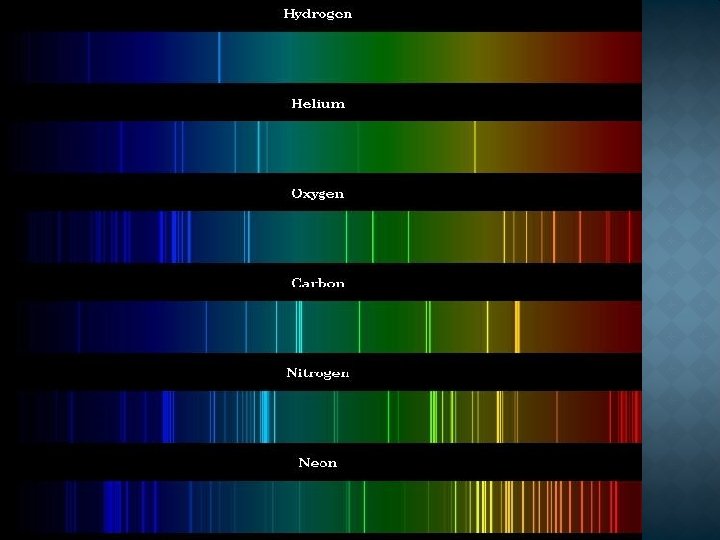
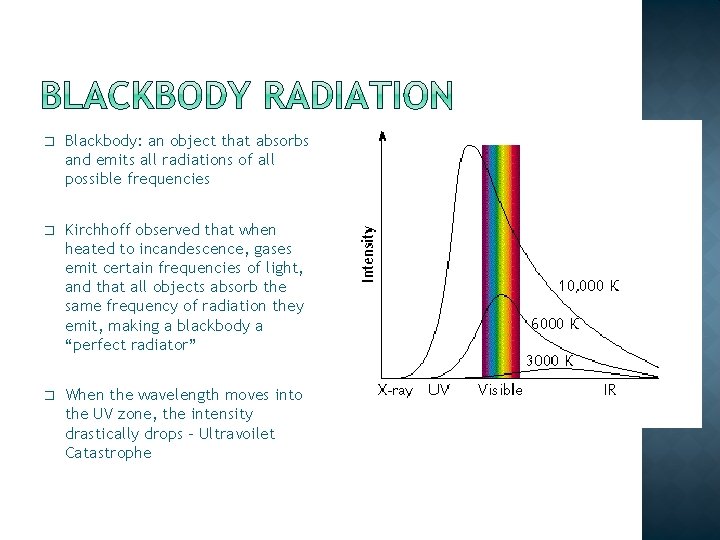
� Blackbody: an object that absorbs and emits all radiations of all possible frequencies � Kirchhoff observed that when heated to incandescence, gases emit certain frequencies of light, and that all objects absorb the same frequency of radiation they emit, making a blackbody a “perfect radiator” � When the wavelength moves into the UV zone, the intensity drastically drops – Ultravoilet Catastrophe
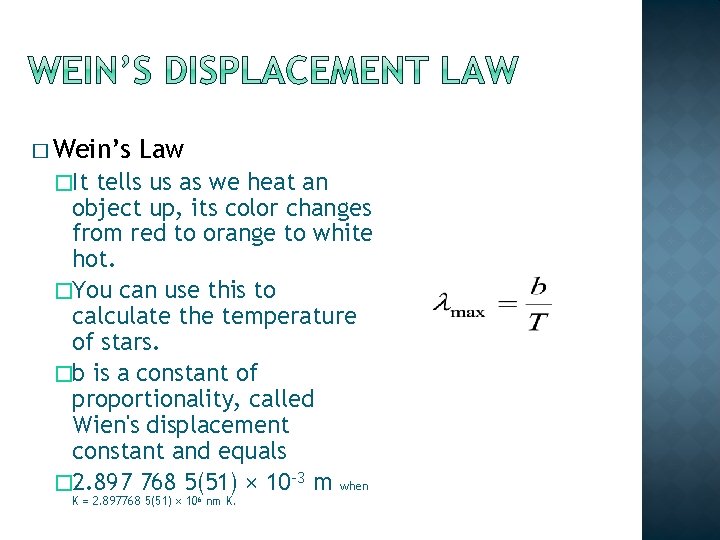
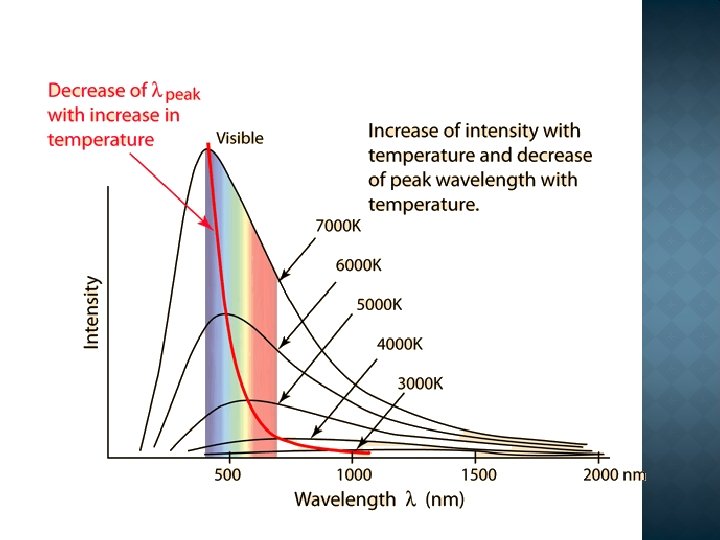
� Wein’s Law �It tells us as we heat an object up, its color changes from red to orange to white hot. �You can use this to calculate the temperature of stars. �b is a constant of proportionality, called Wien's displacement constant and equals � 2. 897 768 5(51) × 10– 3 m when K = 2. 897768 5(51) × 106 nm K.
- Slides: 18